Skip to comments.
Iranian Regime tv Channel One hacked while it was airing Khamenie speech
various
| 10-8-22
Posted on 10/08/2022 1:05:38 PM PDT by nuconvert
Iranian Regime national tv Channel One hacked about an hour ago. During a broadcast of Khamenie speech, a red crosshair appeared over his face and chanting of Women. Life. Freedom. There was writing to the side saying "Rise up. Join us". Also 4 photos at the bottom of the screen of young people killed and additional writing: "The blood of our youth is dropping from your paws".
Also, there was a huge banner in the middle of Tehran highway today that read: We are no longer afraid of you. We will fight.
Also, attempted attack on IRI ambassador in Denmark. Her bodyguard was stabbed. Diplomatic Security intervened before the attacker could stab the ambassador.
TOPICS:
KEYWORDS: basij; deathtothemullahs; denmark; ebrahimrigi; erdogan; iran; iranprotests; iraq; irgc; iri; israel; khameini; khamenei; kurdistan; lebanon; mahsaamini; mullahloversonfr; mullahsmustbekilled; najisharifizindashti; protests; qudsforce; raisi; receptayyiperdogan; shahrammaroufmola; syria; turkey; yemen; zahedi
Navigation: use the links below to view more comments.
first previous 1-20 ... 2,281-2,300, 2,301-2,320, 2,321-2,340 ... 2,401-2,404 next last
Ukrainian forces struck an Iranian vessel transporting military cargo between Iran and Russia in the Caspian Sea, Ukraine's security service (SBU) said on July 25. President Volodymyr Zelensky wrote on social media that Kyiv’s forces “achieved very good results from long-range strikes in the waters of the Caspian Sea,” reporting early morning strikes on an unspecified number of vessels, including a ship “transporting military cargo in cooperation with Iran.” The SBU confirmed that the vessel, which was operating while evading international sanctions, shipped military cargo between the two countries. Iran's Foreign Ministry later claimed the strike targeted a commercial vessel, killing one sailor and injured another.
https://kyivindependent.com/ukraine-strikes-iranian-vessel-used-for-military-cargo-transport-in-caspian-sea/
2,301
posted on
07/25/2026 11:26:47 PM PDT
by
AdmSmith
(GCTGATATGTCTATGATTACTCAT)
Sal Mercogliano- What's Going on With Shipping? 25JUL2026: The Double Chokehold: Houthis Choke the Bab el-Mandeb to Saudi Oil
The maritime crisis in the Middle East intensifies as the Houthis announce a formal blockade against Saudi Arabia, targeting two major tankers in the Bab el-Mandeb. This episode analyzes the strikes on two Saudi tankers, the immediate spike in war risk insurance, and how this new front in the Red Sea—combined with the ongoing closure of the Strait of Hormuz—is creating a global energy chokehold. We also look at the impact on Saudi oil exports from Yanbu, the role of Russian and Chinese shipping in the region, and the growing dangers of “dark fleet” tankers like the Carolyn Benzeni off the coast of Oman. As freedom of the seas faces its greatest challenge in decades, what does this mean for global trade and the price of oil?
00:00 - Introduction
00:50 - Houthi Maritime Embargo Against Saudi Arabia
02:19 - Attack on Tankers: Amfilia and Laela
02:52 - Impact on Shipping and War Risk Insurance
04:16 - Selective Transit: Chinese and Russian Vessels
04:55 - U.S. Response and Geopolitical Context
05:55 - Two Chokepoints Locked: Hormuz and Bab el-Mandeb
06:19 - Challenges of Rerouting Oil Through the Suez Canal
08:02 - Dark Fleet Dangers: Carolyn Benzeni and Cabo Malalius
09:30 - Global Shipping at Peril: A Multi-Dimensional Conflict
11:36 - The Cost of Freedom of the Seas
13:11 - Conclusion and Final Thoughts
https://www.youtube.com/watch?v=mT7Dzt60Rj4
2,302
posted on
07/26/2026 2:45:39 AM PDT
by
AdmSmith
(GCTGATATGTCTATGATTACTCAT)
Iran Update Special Report, July 26, 2026
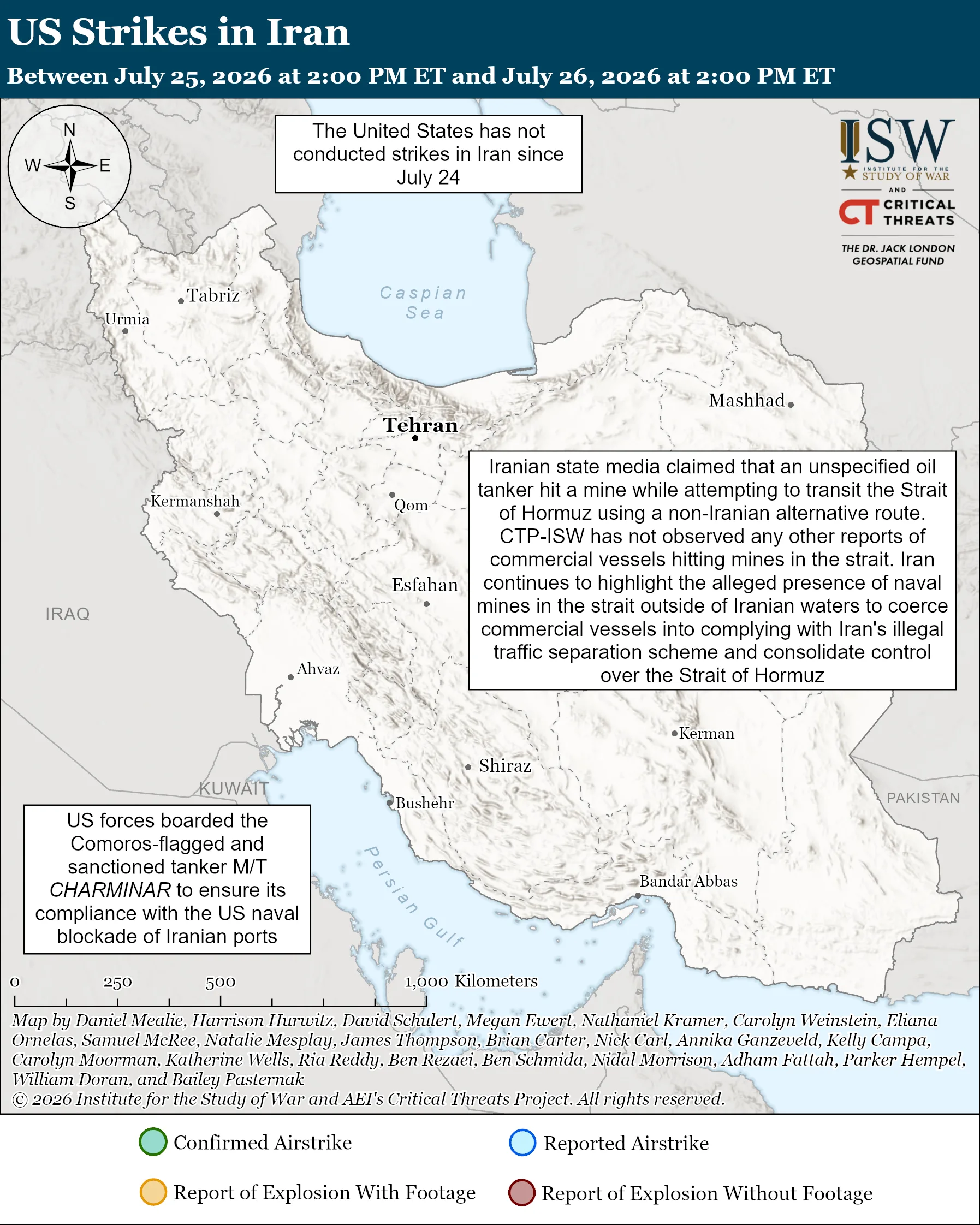
The current level and type of US strikes have likely failed to meaningfully affect the Iranian regime's willingness to pursue and secure its strategic objectives with force, including long-term control over the Strait of Hormuz. The United States struck roughly 1,000 targets between July 12 and July 24, compared to 13,000 in the 38 days in the war's first phase in March and April.[1] The United States has not conducted strikes in Iran since July 24 but has maintained its naval blockade on Iranian ports and vessels.[2] The United States targeted primarily military assets like coastal radars and drone launch facilities during the current phase of the war. ISW-CTP has previously assessed that Iran is conducting proactive military operations to achieve discrete war objectives despite an ongoing Iranian information operation to frame its attacks on US bases and regional states as “retaliatory” and purely defensive.[3] Unspecified Iranian officials told the New York Times on July 23 that Iran would reject any proposal for a ceasefire that left the status of the strait ambiguous, for example, which suggests that Iranian decision-makers remain committed to pursuing these Iranian objectives, including securing recognition for long-term control of the strait, despite US strikes.[4] Iranian forces have not conducted attacks targeting US bases or regional partners since July 24.[5] Iranian officials told international media on July 26 that Iran will maintain a posture of “retaliation” and refrain from conducting attacks if the United States maintains its pause on air operations.[6] Iran has no reason to strike US forces or partners right now because the United States has not successfully prevented Iran from controlling the Strait of Hormuz.
US forces have continued to take action to maintain the blockade of Iranian ports. US Central Command (CENTCOM) announced on July 25 that US forces boarded the Comoros-flagged tanker M/T Charminar, which the United States sanctioned in July 2025 for its involvement in Iranian oil smuggling operations, in the Arabian Sea to ensure its compliance with the blockade.[7] Commercially available maritime data indicated on July 26 that the Charminar resumed its course for Shinas, Oman, after US forces inspected the vessel.[8]
The ongoing pause in US air operations against Iran coincides with regional diplomatic efforts to end the conflict and resume negotiations. Iranian and Omani officials met in Tehran on July 24 and 25 to discuss a potential agreement regarding the Strait of Hormuz.[9] Iranian Foreign Ministry spokesperson Esmail Baghaei and unspecified regional officials claimed on July 26 that the delegations have made “progress” in the discussions.[10] Pakistani government officials told Turkish state media on July 26 that both the United States and Iran have responded to a recent joint Pakistani-Qatari proposal to halt all attacks and return to negotiations.[11] An unspecified regional official told international media on July 26 that the current pause in US and Iranian strikes signals mutual “efforts to de-escalate.”[12] White House Communications Director Steven Cheung also said on July 26 that US President Donald Trump continues to prefer a “diplomatic solution” to the current conflict but warned that the United States can resume military options if Iran continues to attack regional US allies or civilian vessels in the strait.[13]
Iran is continuing to illegally claim control over the Strait of Hormuz and use the threat of naval mines to deter commercial vessels from using non-Iranian-approved routes through the strait, which illustrates that Iran still seeks to control the strait. Iranian officials have continued to claim Iranian control over the strait in recent days.[14] Iranian Foreign Ministry Spokesperson Esmail Baghaei stated on July 25 that “there has been no change in the traffic situation in the Strait” following the recent Iran-Oman talks on the management of the Strait of Hormuz.[15] Iranian parliamentarians, including Iranian Deputy Parliament Speaker Ali Nikzad and Iranian Parliament's National Security and Foreign Policy Committee member Alaeddin Boroujerdi, said on July 26 that Iran must maintain control over the strait and cannot allow it to return to pre-war conditions.[16] Regime media is continuing to highlight the alleged presence of naval mines in the strait outside of Iran's illegal traffic separation scheme to deter commercial vessels from using non-Iranian routes and coerce them to use the Iranian-designated route as part of a broader effort to try to consolidate Iran's control over the Strait of Hormuz.[17] An “informed source” told Iranian Armed Forces General Staff (AFGS)-run media on July 26 that an unspecified oil tanker hit a mine while trying to use a route alternative route to transit through the Strait of Hormuz.[18] ISW-CTP could not verify this claim at the time of this writing. Iranian media has repeatedly warned commercial vessels that using non-Iranian-approved routes could have “consequences.”[19] The Islamic Revolutionary Guard Corps (IRGC) similarly claimed on July 22 that an oil tanker attempting to use the southern Omani route through the strait struck a naval mine that disabled the vessel.[20] ISW-CTP has not observed reports of any commercial vessels hitting mines in the southern route at the time of this writing. Alternative routes through the strait, including the southern Omani route, undermine Iranian efforts to assert full control over the strait. ISW-CTP has not observed any Iranian attacks on vessels in the strait since July 20, likely in part due to an absence of targets because traffic in the strait has fallen.[21]
Ukraine struck several sanctioned cargo vessels in the Caspian Sea on July 25 that Russia reportedly uses to transport military cargo between Iran and Russia.[22] Ukrainian President Volodymyr Zelenskyy announced that Ukrainian forces targeted multiple sanctioned cargo vessels, including the Russian-flagged Port Olya 2 and Begey.[23] Iranian officials and media claimed on July 26 that Ukrainian forces also struck an Iranian commercial vessel transporting military cargo between Iran and Russia and killed one crewmember.[24] ISW-CTP cannot verify this claim at the time of this writing. Commercially available maritime data suggests that Iranian vessels in the Caspian Sea at the time were either too far from the reported strike location, were using location spoofing, or had their AIS transponders turned off.[25] Senior Iranian officials condemned the strikes and threatened an Iranian response.[26] Russia and Iran have historically used the Caspian Sea to move both civilian and military goods.[27] The Israel Defense Forces (IDF) struck Bandar Anzali Port on the Caspian Sea in March 2026 to disrupt shipments of military equipment, including Shahed drones, artillery shells, and other ammunition, that Russia was reportedly transferring to Iran.[28] Ukraine's strikes follow reports that Russia is providing support to Iran during the current conflict.[29]
Zelenskyy stated on July 25 that Russia is providing Iran with satellite imagery of US bases in the Gulf to support Iranian attacks and battle damage assessments.[30] Zelenskyy’s statement is consistent with ISW-CTP’s previous assessment that Russia is helping Iran increase the accuracy of its targeting of US military sites in the region.[31] Zelenskyy said that Ukraine has recorded Russian satellite surveillance of Gulf states and US military facilities since July 2026.[32] He added that the timing of Russian satellite collections consistently aligns with Iranian strikes, with imagery captured both before attacks to support targeting and afterward to assess damage. Four air bases fell within the area of interest of Russian satellites on July 19 and 20, including two in Bahrain, one in Jordan, and one in Kuwait. Zelenskyy’s statement is consistent with a July 22 Reuters report citing four sources familiar with US intelligence who said that Russia may be providing Iran with targeting intelligence on US military sites and equipment in the region.[33] Zelenskyy previously stated in March 2026 that Iran has used Russian-produced Shahed drones “with Russian details” and Russian satellite imagery to attack US bases in the region.[34] Reuters separately reported that two Western officials familiar with intelligence assessments said analysts concluded that Iran used “Russian-enhanced versions” of Shahed drones in a March attack on a US CIA outpost.[35] ISW-CTP previously assessed that Russia's provision of targeting intelligence to Iran would likely improve the accuracy and effectiveness of Iran's drone and missile attacks.[36]
Iranian Supreme Leader Mojtaba Khamenei’s father-in-law and Expediency Discernment Council member Gholam Ali Haddad Adel stated on July 25 that Mojtaba is not in contact with any person or institution “due to certain issues.”[37] Adel’s statement comes amid numerous reports in recent months that Mojtaba was seriously wounded or incapacitated during combined force strikes in February 2026.[38] Multiple reports also indicate that many Iranian officials continue to have difficulty contacting Mojtaba, which has raised questions about the level of Mojtaba’s involvement in regime decision-making.[39]
The Houthis shot down a Saudi drone over Yemen on July 26 and continued to target Saudi-linked vessels in the Red Sea.[40] The Houthis claimed that their forces shot down a Saudi-operated, Turkish-made Bayraktar Akinci drone in al Jawf Governorate in Houthi-controlled northern Yemen on July 26.[41] The Houthis published images and a video of the downed drone on July 26.[42] The Houthis previously downed at least seven US MQ-9 Reapers during US operations against the Houthis in 2025.[43] The Houthis also likely attacked a Saudi-linked vessel in the southern Red Sea on July 24.[44] The Houthis previously attacked a Saudi-linked vessel in the southern Red Sea on July 22.[45]
https://understandingwar.org/research/middle-east/iran-update-special-report-july-26-2026/
2,303
posted on
07/27/2026 8:54:13 AM PDT
by
AdmSmith
(GCTGATATGTCTATGATTACTCAT)
To: AdmSmith; bert; BeauBo; dennisw
I hope that whatever our government is doing in Iran, it involves hitting the IRGC very hard. That is the best thing for giving the anti Regime Iranians the edge they need to have any hope of ever getting rid of this parasite government.
It is good to hear that Ukraine has expanded their expertise to making life difficult for Russia and Russian allies, by keeping an eye on the Caspian Sea traffic.
2,304
posted on
07/27/2026 3:39:46 PM PDT
by
gleeaikin
(Question Authority: report facts and post their 'links" in your messages.I)
To: gleeaikin
Iran Update Special Report, July 27, 2026
Recent attacks on regional states by Iran's proxies and partners enable Iran to maintain plausible deniability while continuing to advance its objective of coercing the United States to end the war in terms favorable to Iran, which include accepting Iranian control over the Strait of Hormuz. Saudi Arabia and Jordan reported hostile drone attacks on July 27.[1] Saudi Arabia confirmed that Iranian-backed Iraqi militias conducted attacks on Saudi territory, but the Houthis also claimed attacks on Saudi infrastructure.[2] Jordan reported that its air defenses shot down two unspecified drones.[3] The Islamic Revolutionary Guards Corps (IRGC) and Artesh did not claim these attacks, and a senior Iranian official told Reuters on July 26 that Iran would halt its attacks so long as the United States halted its attacks on Iran.[4] The official added that Iran had conveyed this message to the United States.[5] The United States has not conducted any attacks on Iran since July 24.[6] These facts indicate that Iranian-backed Iraqi militias probably conducted the attack on Jordan and at least some attacks on Saudi Arabia, which support Iran's effort to pressure the United States to end the war on Iran's terms.[7] These attacks also support Iran's effort to compel regional countries to pressure the United States to end the war by imposing economic and political costs on these countries.
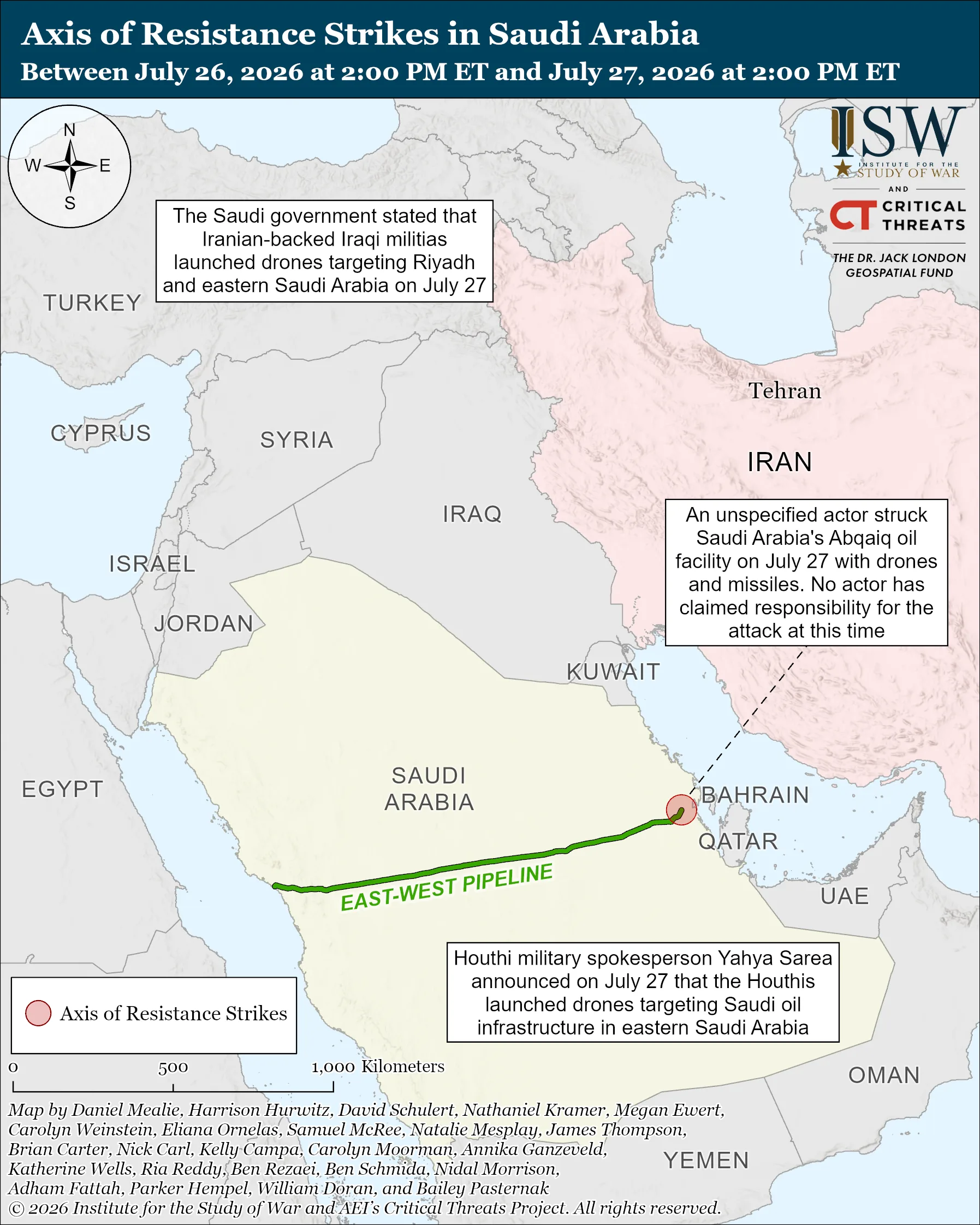
The recent strikes on Saudi Arabia also support Iran's objective of coercing the Gulf states to accept Iranian control over the strait by disrupting efforts to bypass the strait. Saudi Arabia stated on July 27 that it shot down drones launched from Iraq aimed at petroleum facilities in its Eastern Province and in Riyadh.[8] IRGC-affiliated media reported a fire on July 27 at the Abqaiq oil facility in Saudi Arabia's Eastern Province due to drone and missile attacks.[9] Israeli media also posted satellite imagery of a fire at the facility.[10] No actor has claimed the attack on Abqaiq at the time of this writing. Houthi military spokesperson Yahya Sarea announced on July 27 that the Houthis launched drones targeting Saudi infrastructure vital to transporting oil from Saudi oilfields in eastern Saudi Arabia to export hubs on the Red Sea.[11] The Houthis did not specifically claim the attack on Abqaiq, however. The Abqaiq oil facility is the start of the East-West oil pipeline, which ends at Yanbu Port. The Houthis claimed attacks on Saudi Aramco facilities in Yanbu and Jizan on July 24.[12] Saudi Arabia has increasingly relied on the East-West pipeline and Yanbu to export oil to circumvent Iran's control over the Strait of Hormuz.[13] Strikes against Gulf energy infrastructure support Iran's goal of degrading the Gulf states’ willingness and ability to resist Iranian control of the strait. Iranian Parliament Speaker Mohammad Bagher Ghalibaf stated on July 22 that “no one will sell oil” if Iran cannot sell oil in response to the US naval blockade on Iranian ports.[14]
Houthi attacks on Saudi Arabia also support the Houthis’ objective of coercing Saudi Arabia to lift its blockade on Houthi ports and airports. The Houthis are an Iranian partner, not a proxy, that possess strategic objectives that are separate from Iranian objectives.[15] Houthi officials have asserted that the group's military actions against Saudi Arabia are a direct response to Saudi military activity in Yemen.[16] Houthi officials have emphasized that the Houthis will continue to act against Saudi Arabia until Saudi Arabia terminates its blockade on Houthi-controlled ports and airports and ceases strikes on Houthi infrastructure.[17] The Houthis’ recent attacks on Saudi energy infrastructure are intended to raise Saudi political and economic costs to an untenable level that would force Saudi leaders to concede to Houthi demands. Houthi attacks targeting vital Saudi oil infrastructure beyond the Red Sea, such as facilities and pipelines linking Saudi oil reserves in eastern Saudi Arabia to Red Sea export hubs, threaten broader damage to the Saudi oil industry and supply chain.[18]
Iran is likely using the recent pause in US strikes to try to reconstitute its military capabilities. An Iranian analyst close to the regime stated on July 27 that pauses in the war have benefited Iran by allowing it to “rebuild combat capabilities, address weaknesses, and enhance its military capacities.”[19] Iran has made efforts to reconstitute its drone and missile programs during every pause in fighting, such as after the US-Iran ceasefire went into effect on April 8.[20] Iran may calculate that, by maintaining plausibility in the Axis of Resistance's recent attacks on regional states, Iran can maintain the current pause in strikes and continue to reconstitute its military capabilities.
Iranian Supreme Leader Mojtaba Khamenei reaffirmed on July 26 that Hezbollah's preservation and Israel's capitulation in Lebanon are part of Iran's “strategic policy” and a prerequisite for a resolution to Iran's war with the United States.[21] Mojtaba issued a statement on July 26 calling for the Israel Defense Forces’ (IDF) complete withdrawal from Lebanese territory and the cessation of all military activity against Hezbollah, which would constitute Israeli capitulation in Lebanon.[22] Mojtaba stated that the IDF’s unconditional withdrawal from Lebanon is the “first condition” for ending the regional conflict per the June 17 US-Iran memorandum of understanding.[23] Mojtaba also declared that the “defense” of Hezbollah is Iran's “strategic policy.”[24] Iranian and Hezbollah leaders have consistently demanded throughout the war that the IDF withdraw entirely from Lebanon and end its military campaign against Hezbollah.[25]
Mojtaba’s statement was a response to a letter from Hezbollah to the Supreme Leader, in which Hezbollah pledged loyalty to Mojtaba.[26] Hezbollah did not previously publish the letter, and it is unclear when Hezbollah sent it. Hezbollah referred to the group's current activity in southern Lebanon as a modern “Karbala campaign.”[27] Iran and the Axis of Resistance frequently reference the Battle of Karbala, during which the third Shia Imam Husayn ibn Ali died in combat against a massive enemy army, to express their desire for sacrifice in fierce combat against “oppressors.”[28] Hezbollah's letter may increase concerns within Lebanon that Hezbollah could conduct kinetic activity in support of the Iranian regime, as the group previously did in March and April after US-Israeli combined force airstrikes killed former Iranian Supreme Leader Ali Khamenei.[29]
The Lebanese government is reportedly bolstering security at key transportation hubs in Lebanon and implementing new counter-smuggling measures to curb Hezbollah smuggling efforts, according to unspecified sources speaking to Lebanese and Saudi media on July 27.[30] An unspecified Lebanese government source told Saudi media on July 27 that the Lebanese government recently installed new scanners and implemented new security protocols at the Beirut Port, Beirut's Rafic Hariri International Airport, and the Lebanon-Syria Masnaa border crossing in Bekaa Governorate to curb Hezbollah's ability to smuggle weapons and money into Lebanon.[31] Unspecified sources separately told Lebanese media on July 27 that the Lebanese Armed Forces (LAF) is implementing a “broad security plan” to close land-based smuggling routes and tunnels in northeastern Lebanon along the Lebanon-Syria border, including several routes in Hermel District, Baalbek-Hermel Governorate, which is a Hezbollah stronghold.[32] The LAF will reportedly focus on curbing fuel smuggling in this area, which could disrupt Hezbollah's weapons smuggling efforts.[33] Hezbollah recently attempted to smuggle weapons into Lebanon by concealing them in an oil tanker truck, for example.[34] The Lebanese government's reported focus on securing key transportation hubs and closing smuggling routes in Lebanon follows an emphasis in Hezbollah rhetoric on the importance of Beirut's airport. Hezbollah Political Council Deputy Chairman Mahmoud Qamati threatened on July 21 that Hezbollah may shut down the airport in response to Lebanese government restrictions on Iranian influence in Lebanon.[35]
The LAF accused the IDF of “hindering” Israeli and Lebanese efforts to implement the “pilot zones” in southern Lebanon on July 27.[36] The LAF accused the IDF of firing near LAF positions in and around the “pilot zones,” including Zawtar el Gharbiyeh, Nabatieh District, on July 27.[37] The LAF previously accused the IDF of firing on an LAF patrol that the LAF claimed was operating in Zawtar el Gharbiyeh on July 21 after Israeli forces withdrew from the town.[38] The June 26 Trilateral Framework Agreement stipulates that the LAF will establish security in “pilot zones” in southern Lebanon following IDF withdrawals from those areas.[39] The IDF reported on July 21 that its forces fired into the air to repel Lebanese forces who “breached” the IDF’s security zone in Zawtar el Charqiyeh, a town immediately east of Zawtar el Gharbiyeh.[40] The IDF stated that Zawtar el Charqiyeh is not part of the “pilot zones” plan and that the IDF did not permit Lebanese forces to enter the town.[41]
An unidentified Iranian-backed Popular Mobilization Forces (PMF) brigade commander told anti-regime media on July 27 that PMF fighters have deployed to Iran in preparation for a potential US ground assault against Iran, potentially in an effort to deter the United States from deciding to conduct such an assault.[42] The brigade commander did not specify where or in what capacity the PMF fighters have deployed.[43] ISW-CTP has not observed any indicators or additional reports of PMF activity in Iran at the time of this writing. The PMF is an Iraqi state security service that includes many Iranian-backed Iraqi militias that answer to Iran instead of the Iraqi prime minister.[44] The brigade commander claimed to anti-regime media that the PMF fighters in Iran are there for “ideological and doctrinal reasons,” instead of official orders.[45] PMF fighters have previously deployed to Iran to support the Iranian regime's suppression of protest movements, such as the winter 2025-2026 protests.[46] Anti-regime media also reported in March 2026 that PMF members had deployed to Iran.[47]
A high-level Iraqi security source told Iraqi media on July 26 that the Iraqi federal government has merged several security offices into the Office of the Commander-in-Chief of the Armed Forces.[48] The source said that the federal government merged the Joint Operations Command, the Office of the Personal Secretary to the Commander-in-Chief, and the National Operations Center into the Office of the Commander-in-Chief of the Armed Forces.[49] The Office of the Commander-in-Chief of the Armed Forces will reportedly oversee the interior and defense ministries, the Counter Terrorism Service, the Iraqi National Intelligence Service, the PMF, border crossings, and military manufacturing.[50] The Iraqi federal government established the Joint Operations Command in 2007 to coordinate between the Interior Ministry, the Defense Ministry, and other security agencies.[51] The United States heavily collaborated with the Joint Operations Command prior to the US withdrawal from Iraq in 2011 and during later US-led operations against the Islamic State in Iraq and al Sham (ISIS).[52]
The Iraqi federal government continues to develop alternative routes to export oil amid Iranian efforts to control traffic in the Strait of Hormuz. Iraqi Prime Minister Ali al Zaydi met with Lebanese Prime Minister Nawaf Salam on July 27 to discuss Iraqi fuel exports to Lebanon and restarting the Kirkuk-Tripoli oil pipeline, which extends from Kirkuk to Tripoli, Lebanon, on the Mediterranean Sea.[53] An Iraqi government source also told Iraqi media on July 26 that Zaydi will discuss the resumption of Iraqi oil exports through the Kirkuk-Ceyhan pipeline during his July 28 visit to Ankara, Turkey.[54] The source also implied that Zaydi will discuss reviving the Iraqi Pipeline in Saudi Arabia (IPSA) during his July 30 visit to Saudi Arabia.[55] The IPSA is a decommissioned pipeline that transported Iraqi oil from Basra Province to the al Muajjiz terminal on the Red Sea.[56] Zaydi’s meetings come amid US support for Iraqi and Syrian efforts to revive the Kirkuk-Baniyas pipeline that extends from Kirkuk to the eastern Mediterranean Sea.[57] The United States’ support for such efforts is intended, in part, to reduce regional reliance on the Strait of Hormuz by linking Iraq, Syria, and other regional countries to the Mediterranean Sea and the Red Sea.[58]
Unidentified actors within the Iranian government reportedly “prohibited” Zaydi from discussing Iranian-backed Iraqi militia disarmament, and particularly the surrender of heavy weapons, during his July 23 visit to Tehran, according to unspecified sources speaking to Iraqi media on July 27.[59] Informed sources previously told Iraqi media on July 20 that Zaydi had planned to ask the Iranian government to pressure Iranian-backed Iraqi militias to surrender Iranian-provided missiles to the Iraqi federal government during his visit.[60] ISW-CTP assessed on July 20 that the Iranian government was unlikely to agree to Zaydi’s request.[61] The recent Iranian-backed Iraqi militia attacks on regional states to support Iranian strategic objectives underscore why Iran values the militias and opposes their disarmament.[62]
https://understandingwar.org/research/middle-east/iran-update-special-report-july-27-2026/
2,305
posted on
07/28/2026 1:46:23 AM PDT
by
AdmSmith
(GCTGATATGTCTATGATTACTCAT)
Iran Update Special Report, July 28, 2026
Three competing groups within the regime are attempting to influence negotiations policy.
1
The group currently arguing for negotiations and total control over the strait is likely guiding policy at this time. This group is likely led by elements of the Islamic Revolutionary Guards Corps (IRGC), including IRGC commander Major General Ahmad Vahidi.[1] The IRGC-Vahidi group appears willing to negotiate with the United States but is totally unwilling to end the war on terms that preclude complete control of the strait. This group acquiesced to the Memorandum of Understanding (MoU) in June, but the IRGC again began firing on shipping after it became clear that Iran could not achieve complete control.[2] An IRGC-affiliated outlet, Tasnim, summarized this viewpoint in an op-ed on July 28, stating that the strait is “not something that can be easily replaced,” and noted that some people have said that abandoning the strait will equate to failure for Iran in this conflict.[3]
2
The IRGC-Vahidi group is under pressure from a pro-negotiations and pro-compromise group that likely includes but is not limited to President Masoud Pezeshkian, Foreign Affairs Minister Abbas Araghchi, and Parliament Speaker Mohammad Bagher Ghalibaf. This group primarily disagrees with the IRGC-Vahidi group over means, not ends. This group also seeks “control” of the strait, though its definition of control may be less expansive. It sees negotiations to secure some degree of control over the strait without suffering further economic pain. The New York Post, citing regional sources, reported on July 26 that the pro-negotiations camp was frustrated with IRGC “escalation” after it derailed “dialogue” with the United States during an unspecified period.[4] Pezeshkian also successfully convinced the supreme leader — who is close to the IRGC — to agree to the MoU, according to the New York Times.[5] Tasnim’s July 28 op-ed noted that others in Iran have warned against not compromising over the strait because of the “consequences” it will inflict on Iran.[6] The op-ed is almost certainly referring to Iran's economic hardship from the continued US naval blockade, sanctions, and frozen assets, which the United States has offered to lift in exchange for the freedom of navigation through the strait.[7] The op-ed implies that some element of the regime is arguing for compromise in policy circles.[8] An Iranian outlet previously linked to chief negotiator and Parliament Speaker Mohammad Bagher Ghalibaf argued on July 15 that Iran should avoid overcommitting resources to controlling the strait if doing so comes at the expense of regime stability or preserving its nuclear capabilities.[9] An Iranian Parliament National Security and Foreign Policy committee member similarly urged hardliners to relax their policies regarding the strait during a parliamentary debate on July 23.[10] Pezeshkian has consistently warned the regime and public about the consequences this war is having on the Iranian economy.[11]
3
The third group is an ultra-hardline faction, the Paydari Front, which opposes all negotiations with the United States. This group is a small minority, but its proximity to power through regime insiders like Saeed Jalili, who is currently a Supreme Leader representative on Iran's top national security decision-making body — the Supreme National Security Council — and previously chaired the council, would likely require Vahidi and other policymakers to take note of its views.[12] The faction advocates for a strict no-negotiation policy with the United States rooted in its interpretation of revolutionary principles.[13] The call back to revolutionary principles can create challenges for regime leaders as they attempt to advance talks due to concerns about revolutionary credibility.[14]
Concerns from pro-negotiation corners in Iran over continued US sanctions, the US blockade, and economic damage from the war underscore the risk Iran faces in continuing the war indefinitely. Economic challenges caused by the US blockade were one of the reasons Pezeshkian argued the MoU’s case to the supreme leader in June, according to the New York Times, which indicates that at least some regime actors believe the present situation is untenable for Iran.[15] On-again-off-again airstrikes have precluded any serious economic reconstruction in Iran. Many Iranians have been laid off since the war began, including, presumably, regime supporters whom the regime would like to satisfy.[16] These layoffs also come amid recent US intelligence assessments that the Iranian regime is struggling to pay its armed forces due to US sanctions.[17] The rial has collapsed, unemployment rates remain high, and the Iranian people endure shortages of basic goods.[18] The economic challenges across the country also pose a real risk to internal security, given recent mass protests, especially during a major war. Iran's top national security decision-making body — the Supreme National Security Council — is aware of the risk of renewed anti-regime protest.[19] On July 28, ISW-CTP recorded the first mass gathering of protesters since the regime suppressed protests in January. At least 100 residents in Malekshahr, Esfahan Province, protested the judiciary's execution of three protesters involved in the December 2025-January 2026 protests on July 28.[20] These protests are notable because they are a public display of support for individuals killed for protesting economic conditions, not necessarily because the protests will spread. Iran is concurrently attempting to manage the ongoing threat of Kurdish insurgent activity in northwestern Iran.[21] It is impossible to assess when or if any, all, or some of these issues will threaten regime stability, however.
Iran continues to reject compromises to Iranian control of the Strait of Hormuz because hardline decisionmakers perceive control of the waterway as the regime's most reliable means of preserving future leverage. Iran is refusing to give up control of the strait in talks with Omani mediators as the mediators have proposed a formal 10-day truce, according to a US official and mediators speaking to Western media on July 27.[22] The proposal reportedly requires Iran to reopen the strait and, in exchange, the United States would lift the naval blockade on Iranian ports and consider unfreezing Iranian assets.[23] Oman also proposed a regional consortium to manage the strait and reproposed donations for shipping companies for strait maintenance as part of this plan.[24] Oman's proposal to establish a regional consortium aligns with the defunct US-Iran memorandum of understanding, which required Iran to consult Oman and other Gulf states on Strait of Hormuz management.[25] Oman previously proposed voluntary fees from shipping firms before the US and Iran's most recent wave of strikes in July, according to the Wall Street Journal on July 2.[26] Iran rejected the proposal and maintained its demand to levy fees.[27] Iran's rejection of this reported deal shows that Iran may calculate that it can pressure the United States into lifting the blockade or extract further economic concessions without giving up the strait. Iran's top wartime operations coordination body, the Khatam ol Anbia Central Headquarters, called the US naval blockade an escalation in the war on July 27 and stated the Iranian armed forces will respond accordingly.[28]
Iranian regime officials and media continue to highlight how important the strait is in retaining Iran's long-term security. Iranian Deputy Foreign Affairs Minister for Legal and International Affairs Kazem Gharibabadi called the strait a very important indicator for assessing Iran's success in war, as any arrangements on the strait will “ensure” Iran's long-term security, and stated that Iran “is not afraid of any action to establish its sovereignty” in the strait or of the resumption of war in an interview with regime media on July 28.[29]
The Houthis claimed to have struck a Saudi vessel on July 28, marking their third claimed attack on Saudi shipping since July 22.[30] Houthi military spokesperson Yahya Sarea announced on July 28 that the Houthis fired several ballistic missiles targeting the Saudi-flagged oil and chemical tanker NCC Ghazal for “violating” the Houthi blockade.[31] United Kingdom Maritime Operations Center has not confirmed the attack at the time of this writing. The Ghazal departed Yanbu Port on July 23 and has turned off its automatic identification system, according to commercially available ship tracking data.[32] The Houthi blockade and attacks on Saudi oil infrastructure support Iran's effort to coerce the United States and Gulf states into accepting Iranian control over the Strait of Hormuz by disrupting alternative export routes.[33] These attacks also support the Houthis’ objective of coercing Saudi Arabia to lift its blockade on Houthi-controlled ports and airports and deter future Saudi strikes on Houthi targets in Yemen.[34]
The People's Republic of China (PRC) reportedly asked the Houthis to facilitate safe passage for Chinese-owned oil tankers through the Red Sea, according to six informed sources speaking to Reuters on July 28.[35] One source said that unspecified Chinese officials “have cleared each ship individually“ with the Houthis.[36] Reuters, citing commercial ship tracking data, reported on July 28 that at least four tankers transporting Saudi oil to China transited the Bab al Mandeb since the Houthis announced their blockade on July 20.[37] The Houthis similarly said that they refrained from attacking Chinese vessels during their attacks on Red Sea shipping from 2023 to 2025.[38] Western media reported in March 2024 that Chinese and Russian diplomats reached an agreement with the Houthis in Oman to ensure that the Houthis would not target their ships.[39]
The Iranian regime's English-language media outlet, Press TV, reported on July 28 that Iranian forces used “358” missiles, “Majid” air defense systems, and “Ghaem-118” interceptor missiles to down US MQ-9 Reaper drones during the conflict.[40] The IRGC Aerospace Force designed the 358 surface-to-air cruise missile in 2019 to intercept low-altitude and low-speed aerial threats such as drones and helicopters, according to Iranian media.[41] The 358 missile has a 100-kilometer range, an 8,500-meter ceiling, and a cruise speed of about 700 kilometers per hour.[42] The AD-08 Majid is a short-range, low-altitude air defense system that can reportedly engage up to four targets at ranges of 700 meters to 8 kilometers and altitudes of 20 meters to 6 kilometers.[43] The Ghaem 118 has a 25-kilometer range and uses radar, electro-optical, and thermal guidance.[44]
The Lebanese Armed Forces (LAF) seized a Hezbollah weapons cache in one of the “pilot zones” in southern Lebanon for the first time on July 27, according to an Israeli public news outlet.[45] This marks the first LAF clearing operation under the June 26 Trilateral Framework Agreement, which requires the LAF to disarm Hezbollah in the pilot zones in coordination with the Military Coordination Group for Lebanon, which includes the Israel Defense Forces (IDF).[46] The LAF reportedly notified the Coordination Group of the seizure on July 27.[47] ISW-CTP has not observed any documented evidence of the reported Hezbollah weapons cache seizure, however. It is also unclear whether the LAF searched private property to find the cache. Saudi media reported on July 22 that the Lebanese judiciary was considering implementing legal mechanisms that would allow the LAF to search private property in the “pilot zones,” but it remains unclear whether this mechanism has been implemented.[48] The LAF conducted limited private property searches during previous efforts to disarm Hezbollah after the November 2024 ceasefire.[49] US, Israeli, and Lebanese delegations are expected to meet in Rome from August 4 to August 6 to discuss expanding the “pilot zones,” according to an unspecified State Department official speaking to Axios on July 27.[50] The delegations previously convened in Rome to discuss the “pilot zones” and the Agreement from July 14 to July 15.[51]
The Islamic Resistance in Iraq denied Saudi “accusations” that attacks on oil facilities in Riyadh and eastern Saudi Arabia originated from Iraq on July 27.[52] The Islamic Resistance in Iraq is a coalition of Iranian-backed Iraqi militias.[53] Saudi Arabia stated on July 27 that it shot down drones launched from Iraq that targeted oil facilities in Saudi Arabia's Eastern Province and in Riyadh.[54] An attack by an unidentified projectile also caused a fire at the Abqaiq oil facility in the Eastern Province on July 27, but no one has claimed responsibility for the attack at the time of this writing.[55] The Islamic Resistance in Iraq added in its statement on July 27 that the group would respond “harshly” to any “foolish” Saudi action.[56] Iranian-backed Iraqi militias conducted multiple attacks on Saudi Arabia during the war in March and April and, in response, Saudi Arabia reportedly struck militia targets in Iraq in April.[57] Iraqi National Security Advisor Qasim al Aboudi said on July 28 that there is “no evidence” that the drones used in recent attacks against Gulf states originated from Iraq.[58] Iranian-backed Iraqi militias also likely conducted a drone attack on July 23 that targeted Kuwait's Abdali border crossing with Iraq.[59] Iraqi Prime Minister Ali al Zaydi directed the Iraqi security agencies to investigate Saudi Arabia's July 27 claims of attacks launched from Iraq, and the committee involved in the investigation held high-level talks with Saudi officials on July 28.[60]
Jordan intercepted a drone in its eastern desert near Iraq on July 28 that was likely launched by the Iraqi militias.[61] Jordanian air defenses also intercepted two drones on July 27, which Israeli media reported were launched from areas of Iraq controlled by Iraqi militias.[62] Recent attacks by Iranian partners and proxies, including against Saudi Arabia, allow Iran to maintain plausible deniability while pressuring the United States to accept terms favorable to Iran, including Iranian control over the Strait of Hormuz.
A Kurdistan Democratic Party (KDP) member claimed on July 28 that an unspecified brigade of the Iranian-backed Popular Mobilization Forces (PMF) located in the Ninewa Plains is conducting rocket and drone attacks targeting Iraqi Kurdistan.[63] The KDP member is likely referring to the Kataib Hezbollah and Harakat Hezbollah al Nujaba-affiliated 50th PMF Brigade and the Badr-affiliated 30th PMF Brigade, which both supported militia attacks on Iraqi Kurdistan in March and April.[64] The PMF is an Iraqi state security service that includes many Iranian-backed Iraqi militias, such as Asaib Ahl al Haq and the Badr Organization, that answer to Iran instead of the Iraqi Prime Minister.[65] The United States sanctioned the senior officials within the 30th and 50th PMF Brigades for human rights abuses in July 2019.[66] US-led international coalition forces separately intercepted multiple drones launched by unidentified actors in Iraqi Kurdistan on July 27, according to Iraqi media.[67] A local source said that initial information indicates that the drones were targeting the US Consulate in Erbil.[68] US-led international coalition forces have recently intercepted numerous drones targeting the US Consulate in Erbil and the Erbil International Airport, which hosts a US base.[69] Iranian-backed Iraqi militias also frequently attacked these targets in March and April.[70]
Iraqi National Security Advisor Qasim Aboudi said on July 28 that the Iraqi federal government has requested the continued presence of NATO Training Mission-Iraq military advisors to assist the Iraqi Security Forces (ISF) with military planning, training, and development.[71] US-led international coalition forces are expected to withdraw from Iraq by the end of September, as their mission to counter the Islamic State in Iraq and al Sham (ISIS) ends.[72] NATO began its mission in Iraq in 2018 to focus on training and advising the ISF.[73] NATO Training Mission-Iraq troops withdrew from Iraq in March due to the war and still appear to be based in Naples, Italy.[74]
The Bahrain Defense Force began conducting a combined Gulf Cooperation Council (GCC) military exercise on July 30 that will continue until July 30.[75] It is unclear what specific exercises the GCC militaries will conduct.[76] The GCC previously conducted the Gulf Shield Exercise 2026 to improve air and air defense cooperation, operational integration, and command-and-control systems among member states.[77] Iran has concentrated attacks on the Gulf states and threatened their oil exports through its illegal control of the Strait of Hormuz.[78]
https://understandingwar.org/research/middle-east/iran-update-special-report-july-28-2026/
2,306
posted on
07/29/2026 12:53:50 AM PDT
by
AdmSmith
(GCTGATATGTCTATGATTACTCAT)
Iran Update Special Report, July 29, 2026
The Iranian regime likely launched a “surprise attack” on US forces in Jordan on July 28 to erode the United States’ willingness to undermine the regime's efforts to achieve its war aims, including securing Iranian control over the Strait of Hormuz. US Central Command (CENTCOM) stated on July 28 that Islamic Revolutionary Guards Corps (IRGC) forces launched multiple ballistic missiles at Muwaffaq Salti Airbase in Azraq, Jordan, in an “attempted surprise attack.” The Jordanian Army said its forces intercepted five missiles.[1] Iran's attack on July 28 ended a four-day pause in fighting between the United States and Iran. The United States and Iran exchanged near-daily fire between July 8 and 24.[2] The United States paused strikes on July 24 to restart talks with Iran.[3] Iran has repeatedly attacked US forces in the region during the war to achieve discrete objectives.[4] The Iranian regime likely calculated that it could degrade the United States’ willingness to continue the conflict by inflicting damage or US casualties during the current “pause” in strikes. IRGC-affiliated media argued on July 29 that Iran's attack on Jordan demonstrated that Iran maintains the “initiative” in the war and will not allow the United States to “determine the rules of engagement.”[5] A newspaper published on the Supreme Leader's website, Voice of Iran, separately argued on July 29 that the United States “should accept defeat” because it has, according to the newspaper, failed to achieve its strategic objectives in the war.[6]
Iran targeted US forces in Jordan shortly after rejecting any compromise over Iranian control of the Strait of Hormuz in recent talks with Oman.[7] A senior Iranian official told Reuters on July 29 that Iran rejected a recent Omani proposal to place the strait under regional management with voluntary fees to pay for managing navigation, environmental protection, and other services.[8] Iran deemed the proposal “unrealistic.”[9]
The Iranian regime also likely sought for its attack on Jordan to signal the regime's willingness to incur the risk of full-scale conflict with the United States in order to secure control over the strait. Iranian Deputy Foreign Affairs Minister Kazem Gharibabadi stated on July 28 that Iran would take any action, including war, to ensure its sovereignty over the strait.[10] Gharibabadi’s statement highlights the regime's willingness to use force to secure control over the strait regardless of the risk of a US military response. Iran has continued to use force to assert its control over the strait. The IRGC Navy claimed on July 28 that it struck three tankers in the strait that were transiting along the southern route despite IRGC warnings.[11] An “informed military source” told IRGC-affiliated outlet Fars News that the strait is under “full Iranian control” and that no ship can pass through without Iran's permission.[12]
The IRGC Aerospace Force conducted the attack in Jordan, but it is unclear if there was consensus among various regime factions to conduct the attack. The IRGC Aerospace Force stated that its forces conducted the attack in response to alleged US “aggressive actions.”[13] ISW-CTP continues to observe diverging viewpoints between various regime factions over the means through which Iran should attempt to achieve its war aims. IRGC Commander Major General Ahmad Vahidi, whom ISW-CTP continues to assess is playing an outsized role in decision-making, almost certainly supported the decision to launch the recent attack on Jordan. Vahidi has frequently overruled Iranian Foreign Affairs Minister Abbas Araghchi and President Masoud Pezeshkian, who are relatively more amenable to compromise and sought a deal with the United States to secure economic relief.[14] Vahidi previously drove the decision to fire ballistic missiles at Israel in early June and link the fighting in Lebanon to the war in Iran, which made a US-Iran deal dependent on Israel ending its conflict with Hezbollah.[15] Two senior US officials told the Wall Street Journal on July 28 that they believe the IRGC is actively trying to undermine negotiations to renew the ceasefire and reopen the Strait of Hormuz.[16]
That Vahidi and his allies likely supported the decision to strike Jordan does not mean that those within the regime's pro-negotiations camp did not also back the strikes. The pro-negotiations faction—which includes but is not limited to Araghchi, Pezeshkian, and Parliament Speaker Mohammad Bagher Ghalibaf—primarily disagrees with the IRGC over means, not ends. This group still seeks to secure Iranian control over the strait, an end to the US military presence in the region, and other regime objectives but views negotiations as the most effective way to secure these objectives.[17]
The United States and Saudi Arabia conducted strikes targeting Iranian-backed Iraqi militia weapons and logistics supply sites across Iraq on July 28 in retaliation for Iraqi militia attacks on Saudi oil infrastructure and US interests in Iraq and the region.[18] The Popular Mobilization Forces (PMF) stated on July 29 that US and Saudi strikes across seven Iraqi provinces killed at least 20 PMF members and injured 32 members.[19] The PMF is an Iraqi state security service that includes many Iranian-backed Iraqi militias that answer to Iran instead of the Iraqi prime minister.[20] The United States and Saudi Arabia struck several PMF brigade bases in Ninewa, Diyala, Salah al Din, and Kirkuk provinces, including the Iranian-backed Badr Organization-affiliated 30th and 52nd brigades and the Kataib Imam al Ali-affiliated 40th PMF Brigade.[21] These Iranian-backed brigades likely supported militia attacks targeting US interests in Iraqi Kurdistan in recent days.[22] Iraq analysts have noted that these brigades previously provided logistical support to enable Iraqi militia attacks on US and regional interests in March and April.[23]
The United States and Saudi Arabia also conducted several strikes on July 28 along the Iran-Iraq border targeting sites used for the Arbaeen pilgrimage.[24] Iran intended to use the Arbaeen pilgrimage to move weapons and advisers into Iraq, according to Israeli media.[25] The Arbaeen pilgrimage is an annual religious pilgrimage in which millions of Shia Muslims walk to Karbala to mark the martyrdom of Imam Hussein bin Ali.[26] Iraqi media claimed on July 29 that US and Saudi forces struck a guesthouse hosting Arbaeen pilgrims in Karbala Province and the PMF Basra Operations Command headquarters in Basra Province.[27] The PMF Basra Operations Command provides security for Arbaeen pilgrims traveling through the Shalamcheh border crossing between Iraq and Iran.[28] US forces previously struck the Shalamcheh border crossing on July 22.[29]
The US and Saudi strikes on July 28 reportedly killed at least four IRGC Quds Force officers in Diyala Province, which underscores the IRGC’s role in overseeing Iraqi militia attacks on the Gulf states and US interests in Iraq.[30] Iranian state media reported on July 28 that the strikes killed four IRGC Quds Force officers in Diyala Province.[31] Saudi media reported on July 29 that IRGC Quds Force officers directly oversaw the recent Iraqi militia attacks against Jordan and the Gulf. This report is consistent with previous Western media reporting that the IRGC formed multiple Iraqi militia cells that directly report to the IRGC, instead of pre-existing Iranian-backed Iraqi militias, in order to conduct attacks on Gulf countries.[32] Iraqi sources told Reuters in June 2026 that the IRGC created the cells to maintain plausible deniability.[33]

The Houthis are threatening to expand their attacks on Saudi targets, likely in order to coerce Saudi Arabia to terminate its blockade against Houthi ports and airports.[34] Houthi media reported on July 28 that the Houthis plan to “expand” the group's blockade on Saudi Arabia by attacking Saudi oil pipelines and ports.[35] Houthi threats to expand attacks on Saudi Arabia are consistent with the Houthis’ efforts to raise economic and political costs on Saudi Arabia for blockading Houthi ports and airports.[36] The Houthis have attacked several Saudi vessels and state-owned oil industry assets as part of this effort since imposing their blockade against Saudi Arabia on July 20.[37] Houthi Spokesperson Yahya Sarea claimed on July 27 that the Houthis launched drones targeting Saudi infrastructure vital to transporting oil from Saudi oilfields in eastern Saudi Arabia to export hubs on the Red Sea.[38] The Houthis’ threats to target Saudi vessels, ports, and pipelines indicate that the group is attempting to incapacitate the Saudi oil industry by disrupting vital infrastructure at several points in the supply chain. The Houthis also intend for these threats to wear down Saudi Arabia's willingness to circumvent Iranian demands for control over the Strait of Hormuz, which supports Iran's strategic objectives.[39]
Unspecified regional sources told Reuters on July 29 that the Houthis may start to impose fees on international commercial vessels transiting the Red Sea and Bab al Mandeb Strait.[40] An Arab state official claimed that the Houthis discussed prospects of establishing a regulatory authority to charge fees for vessels transiting the Bab al Mandeb, similar to Iran's Persian Gulf Strait Authority.[41] Unspecified sources told Reuters that the People's Republic of China (PRC) has held direct negotiations with the Houthis to secure safe and toll-free passage for PRC vessels navigating the southern Red Sea.[42] The Houthis have not confirmed or denied any plans to impose fees for passage through the Bab al Mandeb, however. The Houthis may plan to levy international passage fees in order to further coerce Saudi Arabia to terminate its blockade against Houthi ports and airports by raising global economic costs and international pressure on the Saudi government. It is unclear whether the Houthis intend to establish a fee system in order to achieve other potential strategic objectives, such as securing codified permanent control over the Bab al Mandeb.
Iran is attempting to bolster its air defense capabilities with assistance from the People's Republic of China (PRC) and improve its drone capabilities. Three sources told Reuters on July 28 that Iran reportedly signed a deal through a Hong Kong-based company to buy between 300 and 400 PRC-made man-portable air-defense systems (MANPADS).[43] A European source separately told Reuters that the deal could include a shipment of Chinese QW-12, QW-18, and QW-19 MANPADS. A second unspecified source added that it is unclear whether Iran and the PRC have completed the deal.[44] Iranian forces may have previously used a Chinese-made MANPAD to shoot down a US F-15E fighter jet in April 2026.[45] Sources also told Reuters that China would deliver the MANPADS via aircraft to Pakistan, which would then be transferred to Iran by land.[46] The Pakistani military denied the source's claim. Iranian and Pakistani diplomats have recently discussed increasing overland trade, according to multiple Iranian media reports.[47] This Reuters report follows an April 2026 New York Times report that China may have sent a shipment of Chinese MANPADS to Iran.[48] Iran also previously purchased 500 Russian MANPADS in December 2025.[49]
Iranian media separately reported on July 29 that Iran has developed a “new version” of its Hadid 110 drone.[50] Iranian media stated that the new version of the Hadid 110 has a jet engine with a solid fuel booster that enables the drone to fly at lower flight altitudes with higher speed, and greater stealth capabilities.[51] Israeli media reported on July 29 that the upgrades to the Hadid 110 are designed to reduce air defense detection and interception time.[52] The drone reportedly lacks long-range capabilities, however.[53] Iranian defense officials and state media have recently emphasized the importance of evolving Iranian drone technologies to counter US air defense systems in the region.[54]
An unspecified actor conducted a drone attack targeting a US-owned tanker at a Mediterranean port in Damietta, Egypt, on July 29.[55] Reuters reported that an unspecified actor launched a drone that struck the gas storage tanker Energos Winter and caused a fire that spread to a second vessel.[56] The Egyptian Petroleum Ministry confirmed that a fire broke out at Damietta Port but did not indicate whether a drone attack caused the fire.[57] Israeli media claimed on July 29 that pro-Iranian Telegram channels mentioned Damietta Port as a potential Iranian target in retaliation for a Ukrainian attack on an Iranian vessel in the Caspian Sea.[58] No actor has claimed responsibility for the attack as of this writing.
Hezbollah fighters conducted a drone strike on an Israel Defense Forces (IDF) engineering vehicle operating near Ali al Taher in Nabatieh Governorate on July 28.[59] This attack marks the first observed Hezbollah drone strike on Israeli forces in southern Lebanon since June 18.[60] Hezbollah has not claimed responsibility for the attack as of this writing. Hezbollah fighters may have conducted the drone strike to achieve a specific tactical objective. Ali al Taher contains one of Hezbollah's largest underground command-and-control facilities.[61] The IDF reported on June 26 that its forces took “complete control” of the territory surrounding Ali al Taher.[62] The tunnel complex reportedly still contains approximately 30 Hezbollah fighters.[63]
The IDF pledged to respond to Hezbollah's violation of the ceasefire. IDF Chief of Staff Lieutenant General Eyal Zamir stated on July 29 that the IDF is prepared to expand operations against Hezbollah in southern Lebanon.[64] The IDF affirmed that it will continue to operate in the Ali al Taher area.[65] Israeli media reported that the IDF will likely conduct strikes against Hezbollah fighters in southern Lebanon in response.[66]
The Hezbollah drone strike coincides with a report that local and international leaders have reportedly urged Hezbollah not to restart kinetic activity against Israel if the US-Iran conflict continues.[67] Hezbollah previously entered the war in March to support Iran against the US-Israeli combined force.[68] Lebanese media separately claimed on July 29 that Lebanese Parliament Speaker and Hezbollah ally Nabih Berri is communicating with Iran and Hezbollah to prevent a renewed war in southern Lebanon, but Iran has not directed Hezbollah or Berri on how to proceed yet.[69]
Several Iranian-backed Iraqi militias threatened on July 29 to attack US and Saudi targets in retaliation for joint US-Saudi airstrikes on Iranian-backed Iraqi militia positions across Iraq on July 28.[70] Kataib Sayyid al Shuhada, Harakat Hezbollah al Nujaba, and likely militia front groups Ashab al Kahf and Kataib Sarkhat al Quds issued separate statements on July 29 that condemned the strikes as “violations” of Iraqi sovereignty and threatened to retaliate.[71] These groups have been among the most active in conducting attacks against US and partner forces in the region since February 2026.[72]
The Houthis claimed to shoot down a Saudi drone over Houthi-controlled territory on July 28.[73] Houthi Spokesperson Brigadier General Yahya Saree said that the Houthis downed a Turkish-made, Saudi-operated Vestel Karayel reconnaissance drone in Saada Governorate in Houthi-controlled northern Yemen on July 28.[74] The Houthis have not provided evidence for this claim or detailed what system they used to intercept the drone at the time of this writing. The Houthis previously downed a Saudi-operated, Turkish-made Bayraktar Akinci drone in al Jawf Governorate in Houthi-controlled northern Yemen on July 26.[75]
The Houthis reportedly established a new operational headquarters south of Baghdad, Iraq, to coordinate operations with Iranian-backed Iraqi militias in Iraq.[76] UK-based, Saudi-owned media reported on July 29 that the Houthis recently established a headquarters in Jurf al Sakhr, Babil Province.[77] The Houthis maintain an active presence in Iraq, including at a headquarters in Baghdad's Jadriyah neighborhood.[78] Jurf al Sakhr is a Kataib Hezbollah stronghold, and the US-Israeli combined force struck numerous Kataib Hezbollah targets in Jurf al Sakhrin March 2026.[79] Kataib Hezbollah is a member of the Islamic Resistance of Iraq, which is a coalition of Iranian-backed Iraqi militias.[80] Iraqi media reported that US and Saudi forces struck targets in Jurf al Sakhr on July 29.[81] It is possible that US and Saudi forces targeted Houthi fighters in Iraq in the recent strikes on Iraq on July 29.
The Houthis may have conducted or supported attacks on Saudi Arabia from Iraqi territory in recent days. Saudi Arabia intercepted drones launched from Iraq at oil facilities in Saudi Arabia's Eastern Province and in Riyadh on July 27.[82] The Houthis claimed responsibility for the attack. Iraqi militias denied the Saudi accusation.[83] A Yemen OSINT analyst reported on July 27 that the Houthis are “active and operational inside Iraq” and “may have” launched drones at Saudi Arabia.[84] The reported Houthi headquarters in Jurf al Sakhr could, in theory, support such attacks. Houthi representative to Iraq, Ahmed al Sharafi, reportedly runs the new Houthi position in Jurf al Sakhr and is responsible for coordinating combined military operations with Iranian-backed Iraqi militias.[85] The Houthis conducted several coordinated attacks with Iranian-backed Iraqi militias, including a drone strike on targets in Israel, in June 2024.[86]
https://understandingwar.org/research/middle-east/iran-update-special-report-july-29-2026/
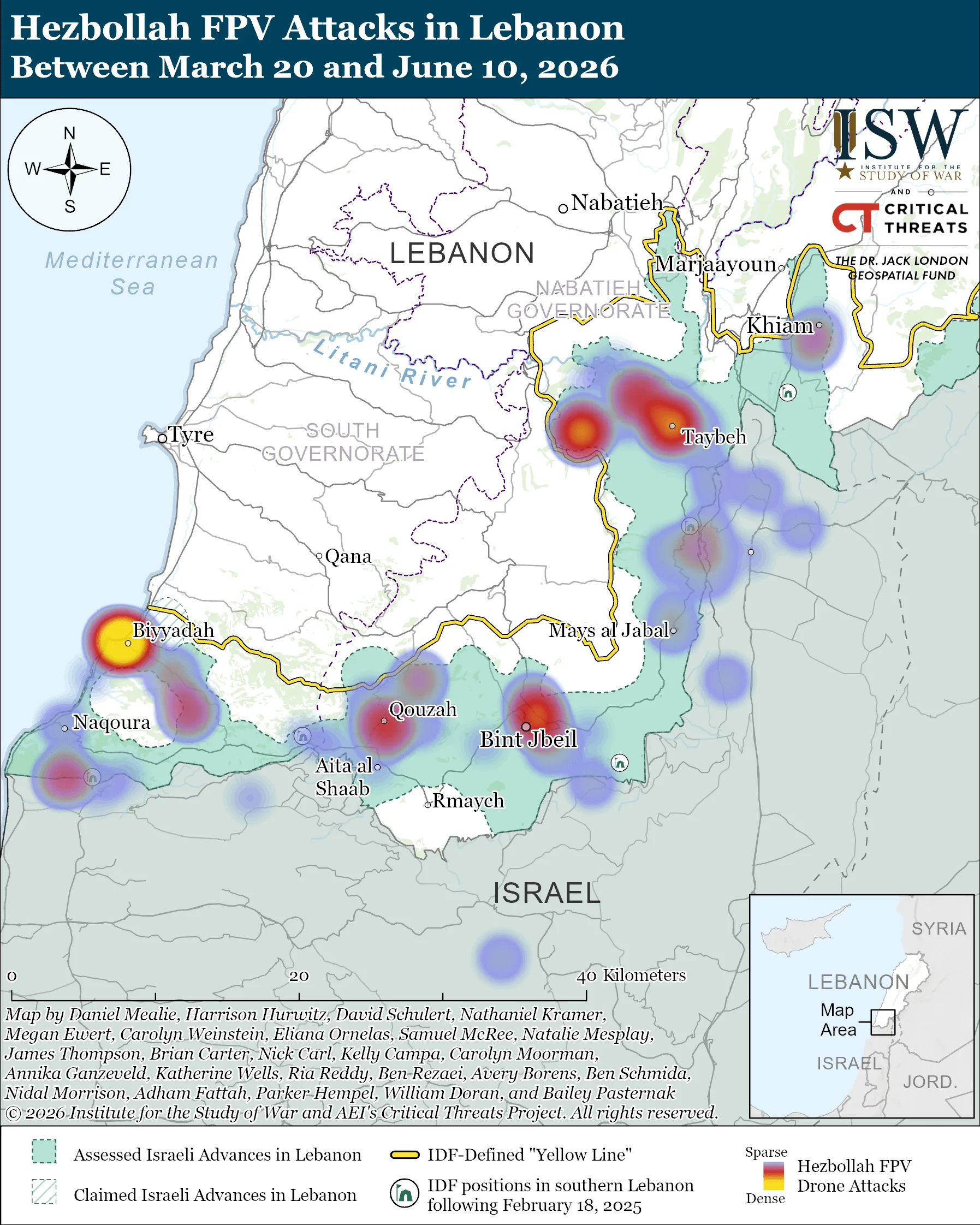
Hezbollah's Pivot to FPV Drones Requires Israeli Overmatch
Hezbollah's ability to develop and refine its use of tactical first-person view (FPV) systems represents a significant development that could alter the character of future conflicts between Israel and Hezbollah. Hezbollah increasingly deployed FPV systems in its asymmetric campaign against Israel between March and June 2026, likely as part of an early effort to integrate more precise FPV strike capabilities into its operations. Hezbollah's current challenges with scale and integration have likely thus far limited Hezbollah's ability to impose serious operational or strategic effects upon Israel, but Hezbollah will almost certainly work to expand and refine its FPV capabilities in the coming months if given time and space to do so. Hezbollah's ability to develop a more robust FPV drone program represents a serious medium-term threat to Israel, which will need to not only rapidly adapt appropriate countermeasures to counter the current threat but also anticipate Hezbollah's future adaptations and prepare accordingly.
Hezbollah's flawed military campaign between October 7, 2023, and the end of the Israeli campaign in Lebanon in 2024 likely helped trigger tactical innovation within Hezbollah that led to the adoption of tactical FPV drones on a greater scale. Hezbollah had long relied on rockets, missiles, and anti-tank guided missiles as the backbone of its military forces.[1] These systems were designed to deter an Israeli attack into southern Lebanon by holding the security of northern Israeli towns at risk.[2] This strategic concept presupposed that Israel was unwilling to accept the risk required to launch a major campaign into southern Lebanon to silence the rocket fire, especially after the challenges Israel had in ending Hezbollah's rocket fire in the 2006 war.[3] Any Israeli attack on Lebanon would be answered with rocket fire into northern Israel, and Israeli leaders would therefore be unwilling to attack. This theory failed when former Hezbollah Secretary General Hassan Nasrallah initiated fires at Israel on October 8, 2023, and could not stop the fire lest he be seen as abandoning Hamas.[4] Israel made the decision to stop the rocket fire through military force, and Hezbollah's strategic concept collapsed.[5]
more: https://understandingwar.org/research/middle-east/hezbollahs-pivot-to-fpv-drones-requires-israeli-overmatch/
2,307
posted on
07/30/2026 2:27:45 AM PDT
by
AdmSmith
(GCTGATATGTCTATGATTACTCAT)
I need to draw your attention to a very underreported crisis. The islamic regime's ties to Sudanese islamists which has gone on for 4 long decades is growing more and more ominous. A former Sudanese minister named Khalid Yousif not only revealed that the regime in Iran's deeply rooted ties with Sudan's Islamists remain active, he also added some worrying new information:
• Khomeini's islamic revolution was a direct inspiration for Sudan's islamist movement, and they shaped themselves after his vision.
• After the 1989 coup, Sudan based its regime security model on the IRGC and its basijis - in other words a foreign facing islamist army, with an inwards facing oppressive paramilitary group.
• The IRGC has been training the Sudanese Muslim Brotherhood-linked terrorists who now fight in the SAF for many years.
• The islamic regime financially and technologically supports the islamist Sudanese regime.
• The recent Green Card holder who was arrested in Los Angeles for procuring weapons for the IRGC, intended to transfer these to Sudan.
• Sudan restored diplomatic ties with the islamic regime in Iran in 2023, at a time when the entire world began opening its eyes to how evil the regime truly is.
He clarified that the IRGC terrorist mafia, while bombing every country in the Persian Gulf, also directly backs the MB whose mission is to spread islamist terrorism worldwide.
My point is this:
I have seen this before. The islamic regime currently exploits Iraq, (formerly) Syria, Yemen and Lebanon as a terrorist trade network to peddle everything from weapons to proxy militias. They are now also doing the same thing in the heart of Africa, and believe me when I tell you there will be an attempted attack on Israel through Sudan one day
https://x.com/NiohBerg/status/2082276677913055523
2,308
posted on
07/30/2026 10:27:50 AM PDT
by
AdmSmith
(GCTGATATGTCTATGATTACTCAT)
The SAF camp is supported by Egypt, Saudi Arabia, Turkey, Iran, and other actors. Previously, when Sudan was a British colony, Egypt acted as Britain's proxy in governing the country; however, even after Sudan's independence, SAF executive candidates were generally educated at Egyptian military academies, creating such a strong bond between the Egyptian Armed Forces and the SAF that could be described as a mentor-protege relationship. Saudi Arabia also supports the SAF, defending Sudan's continuity and legitimacy as a nation, given its location across the Red Sea. While the SAF’s support base includes Islamist groups such as the Muslim Brotherhood, Turkey and Iran—which take a tolerant stance toward the Muslim Brotherhood—also support the SAF.
In contrast, the RSF camp includes the United Arab Emirates (UAE) as the leading supporter, along with Ethiopia, Chad, and other actors. The UAE, which does not border the Red Sea, has long shown strong interest in Sudan, driven by its desire to secure a foothold along the Red Sea coast and establish a base for expansion into Africa. It is also closely tied to the RSF for securing its gold business. Chad has joined this network to provide transport routes linking the UAE and the RSF, and Ethiopia—which has been in conflict with Egypt and Sudan over the waters of the Nile—is also supporting the RSF.
In the context of the civil war in Sudan, Saudi Arabia and the UAE have long been supporting opposition groups, but tensions between the two countries have recently escalated—as demonstrated by the UAE’s withdrawal from the Organization of the Petroleum Exporting Countries (OPEC) and OPEC+ in May 2026. The civil war in Sudan has effectively become a “proxy war between Saudi Arabia and the UAE.”
https://www.spf.org/iina/en/articles/sakane_16.html
26MAR2026: Saudi Arabia suspends a $1.5 billion Pakistan arms deal for Sudan after Islamist fighters within the Sudanese army declared support for Iran amid the Gulf war.
The specific incident that rattled Riyadh involved Naji Abdullah, a commander within the al-Baraa Bin Malik Brigade, an Islamist militia aligned with Sudan's Islamic Movement, the country's branch of the Muslim Brotherhood. The brigade has fought alongside the Sudanese Armed Forces since the civil war erupted in April 2023, operating as a semi-autonomous formation wearing army uniforms but answering to Islamist rather than conventional military command structures.
In a speech to brigade members in early March, Abdullah declared: “We support Iran…if a ground war begins between the Americans and the Iranians, open the way for us to participate in it,” according to Asharq Al-Awsat, which reported the remarks on March 6. The statement amounted to a public alignment with Tehran at the precise moment Saudi Arabia was absorbing daily Iranian attacks on its territory.
The Foundation for Defense of Democracies (FDD), a Washington think tank, described the arrest as revealing “the depth of Islamist penetration within Sudan's military apparatus” in a March 6 analysis. The FDD noted that Abdullah’s brigade operates within a broader network of Muslim Brotherhood-aligned formations that have received training and support from Iran's Islamic Revolutionary Guard Corps.
The Iran-Sudan connection is not new. Sudan maintained diplomatic relations with Iran for decades, and Khartoum served as a transit point for Iranian weapons shipments to Hamas and other groups before the 2019 normalization with Israel. The Omar al-Bashir regime, which ruled Sudan from 1989 to 2019 and was itself rooted in the Islamist movement, maintained close ties with Tehran despite also cultivating Gulf Arab relationships.
https://houseofsaud.com/saudi-sudan-arms-deal-stalls-islamist-iran-ties/
2,309
posted on
07/31/2026 12:30:48 AM PDT
by
AdmSmith
(GCTGATATGTCTATGATTACTCAT)
Iran Update Special Report, July 30, 2026
The United States conducted a wave of strikes in Iran on July 29 in response to Iranian attacks on US forces on July 28. The majority of recorded US airstrikes targeted Iranian military sites in southern Iran, including targets along the Persian Gulf coastline. US Central Command (CENTCOM) announced that US forces struck dozens of Islamic Revolutionary Guards Corps (IRGC) targets, including military command centers, missile and drone facilities, coastal surveillance and defense sites, and maritime capabilities to diminish threats that Iran and its proxies pose to US forces, commercial shipping, and neighboring Gulf countries.[1] Iranian media and open-source intelligence accounts on X reported airstrikes across Khuzestan, Hormozgan, Fars, and Bushehr provinces.[2] Local authorities also reported that a US strike targeted a sports hall in Farashband, western Fars Province.[3] Iran previously repurposed sports halls and other civilian sites as military and internal security sites during US and Israeli strikes on Iran in March 2026.[4]
The United States likely struck the IRGC Ground Forces Ansar ol Mahdi Provincial Unit in Zanjan Province in northwestern Iran. The IRGC announced that US strikes killed three IRGC Ground Forces Ansar ol Mahdi Provincial Unit members.[5] IRGC Ground Forces Provincial Units are responsible for countering external and internal threats across population centers and are established to conduct operations independently in times of crisis.[6]
Iranian media also reported that the United States struck an unspecified site in Bandar Anzali on Iran's northern coastline with the Caspian Sea on July 29.[7] Israel previously struck sites in Bandar Anzali, including facilities to disrupt Russian shipments of military equipment, such as Shahed drones and artillery shells and other munitions, to Iran.[8] Ukraine more recently struck several sanctioned cargo vessels in the Caspian Sea on July 25 that Russia reportedly used to transport military cargo between Russia and Iran.[9] US and Ukrainian intelligence have assessed that Russia may be supporting Iran's drone capabilities by providing targeting intelligence and Russian-modified drones.[10] ISW-CTP previously assessed that Russia's provision of targeting intelligence to Iran would likely improve the accuracy and effectiveness of Iran's drone and missile attacks.[11]

Iran is attempting to weaken the United States’ resolve to continue the war against Iran by increasing the economic and political costs of ongoing US military operations. Iran possibly conducted or directed the drone attack on a US gas tanker at Damietta Port in northeastern Egypt on July 29.[12] Two Iranian officials did not directly claim the attack but told the New York Times on July 29 that the attack “was designed” to show that global shipping and energy supplies could be disrupted further if Iran chose to escalate.[13] Egyptian authorities initially blamed Iran for the attack, according to the Wall Street Journal.[14] The Houthis denied their involvement in the attack.[15] Iran almost certainly recognizes that the northern Red Sea and Suez Canal corridor provides a viable alternative route for international shipping and energy markets to circumvent Iran's disruptions to shipping in the Strait of Hormuz.[16] The IRGC has continued to claim attacks on shipping in the Strait of Hormuz and threaten to attack any actor that collaborates with the United States to restore shipping through the strait.[17] The Iranian regime is certainly aware of the impact that these reported attacks and threats have on the risk calculations of ship captains and shipping companies, which are generally risk-averse. Iran's actions to disrupt global shipping and energy markets are part of a concerted effort to increase the economic cost of US military operations in Iran.

Iran also seeks to increase domestic pressure on the US government by inflicting casualties on US forces and material damage to regional bases. Iran has continued to launch ballistic missiles at US forces at Jordan's Muwaffaq Salti Air Base, including with Emad and Kheybar Shekan missile systems in recent attacks.[18] The IRGC falsely claimed that its missile attacks on July 30 killed several US officers and technical staff and destroyed three F-35s.[19] CENTCOM denied the IRGC’s claim.[20] The IRGC also claimed to have destroyed two drone hangars and a fuel depot at Ali al Salem Base in Kuwait and US facilities at the Sheikh Isa base in Bahrain.[21] Iran's claims of inflicting civilian and material damage aim to generate an informational effect on the US domestic population and thus increase political pressure on the United States. Iranian attacks on US critical infrastructure aim to achieve a similar effect. US officials told Western media on July 30 that Iran or hackers associated with Iran may have conducted the cyber-attacks on more than 30 water plants in Minnesota, causing mass disruption earlier this week.[22]
Iran is also likely attempting to coerce US partner states into revoking US basing access within the region or in nearby locations from which Iran could be threatened. Expelling US forces from the region is one of Iran's long-standing strategic objectives. Iran is attempting to rally civilian populations in regional states to pressure their governments to decrease or entirely remove any US force presence from their countries. These attempts also have an informational effect by suggesting to regional leaders that US presence may generate instability for the governments. Iran has repeatedly called on the Jordanian people to “dismantle” US bases in Jordan, for example.[23] The IRGC claimed that it attacked Muwaffaq Salti Air Base on July 30 in part to help the Jordanian people “liberate” Jordan from its “American occupiers.”[24] Regime media also amplified a July 29 New York Times article featuring an open letter from “hundreds” of Jordanian politicians, lawyers, academics, retired officers, and other public figures that called for the removal of US troop presence from Jordan.[25] The Iranian outlet assessed that the letter demonstrated how US troop presence has “exposed” Jordan to “security, political, and economic threats” and increased the risk that Jordan would be drawn into a war that it did not start.[26] The IRGC is simultaneously asserting that US forces and air defense systems cannot protect US troops or bases, almost certainly as part of a broader information operation that portrays US military presence as a source of insecurity for regional states.[27]
Iran also seeks to discourage countries from hosting US forces in the region by inflicting economic damage upon US allies in the region, particularly those in the Gulf. The Kuwait Armed Forces reported on July 30 that an Iranian ballistic missile struck a Chinese company-owned building in northern Kuwait, killing one worker and causing severe material damage.[28] Iran's attacks on critical and civilian infrastructure likely aim to raise the costs for regional allies of hosting US forces. Iran has repeatedly attacked Kuwaiti power and water desalination facilities in recent weeks, for example.[29]
Saudi Arabia is assembling a multinational “maritime defense coalition” to protect Red Sea shipping from Houthi and Iranian threats to the Bab al Mandeb Strait.[30] The Saudi Defense Ministry held a meeting in Riyadh on July 30 to establish a multinational maritime defense coalition to protect shared maritime interests in the Bab al Mandeb Strait, the Red Sea, and the Gulf of Aden.[31] Representatives from 43 countries attended the meeting, including the United States, the Republic of Yemen Government (ROYG), the United Kingdom, Canada, Turkey, as well as several Gulf and regional countries.[32] It is unclear whether the United States will join the coalition. Fourteen countries issued a joint statement following the meeting expressing support for the alliance, including the ROYG, Kuwait, Bahrain, Qatar, Pakistan, Turkey, Egypt, Djibouti, Jordan, and Sudan, as well as other African and South Asian countries.[33]
Saudi Arabia likely formed the coalition in response to the July 20 Houthi blockade on Saudi Arabia, recent Houthi threats to expand attacks on Saudi infrastructure, and reports that the Houthis may impose transit fees in the Red Sea and Bab al Mandab Strait.[34] The New York Times reported on July 30 that the Houthi blockade on Saudi Arabia has reduced vessel traffic through the Bab al Mandeb by one-fifth, citing Windward maritime data.[35] The report added that Saudi Arabia has diverted oil shipments from the Bab al Mandeb to the Suez Canal, which increases transit times to Asia by about a month.[36]
The Houthis and Iran will likely view this coalition's formation as a direct threat to their current regional objectives. Houthi Supreme Leader Abdulmalik al Houthi condemned countries that “pledge allegiance” to Israel and the United States in a speech on July 30, possibly in reference to reports about the Saudi-led maritime coalition.[37] It is unclear when Abdulmalik filmed his message, but rumors about the formation of the coalition began circulating in Western media on July 29. His statement suggests that the Houthis view the coalition as a threat to their blockade of Saudi ports and vessels and the broader Houthi campaign to coerce Saudi Arabia into lifting its blockade of Houthi-controlled ports and airports.[38] Iran will also likely oppose the coalition's formation because the ongoing Houthi blockade advances Iranian efforts to impose economic costs on the United States and its regional partners to erode US willingness to continue the war with Iran and achieve Iranian strategic objectives, including securing recognized control over the Strait of Hormuz.[39]
Iranian-backed Iraqi militias are discussing how to respond to recent US-Saudi airstrikes on militia positions in Iraq. The United States and Saudi Arabia struck militia weapons and logistics supply sites across Iraq on July 28 in retaliation for Iraqi militia attacks on Saudi oil infrastructure and US interests in Iraq and the region.[40] An unspecified Iraqi militia leader told Lebanese Hezbollah-affiliated media on July 30 that the militias aim to respond within 72 hours.[41] A Kataib Sayyid al Shuhada official added that the militias’ response will be “seismic” and threatened to target US and Saudi interests if military operations, likely against Iraq or Iran, continue.[42] Informed sources told Iraqi media on July 30 that the Islamic Resistance in Iraq held a meeting to discuss how the militias should respond, including possibly through retaliatory strikes.[43] The Islamic Resistance in Iraq is a coalition of Iranian-backed Iraqi militias. The coalition includes Kataib Hezbollah, Kataib Sayyid al Shuhada, and Harakat Hezbollah al Nujaba, which were the three most kinetically active Iraqi militias in March and April 2026 and share the strongest ideological alignment with Iran.[44] The Islamic Resistance in Iraq released a statement on July 29 warning that it will “inevitably” respond after the Arbaeen pilgrimage concludes on August 6, potentially by striking US targets in Saudi Arabia. The statement also demanded an Iraqi government response before the pilgrimage concludes.[45] The Arbaeen pilgrimage is an annual religious pilgrimage in which millions of Shia Muslims walk to Karbala to commemorate the martyrdom of Imam Hussein bin Ali.[46] The militias could also target US targets in Iraqi Kurdistan or in Baghdad. Informed sources told Iraqi media on July 30 that the Iraqi federal government is pressuring the militias to avoid military escalation to avoid security and political repercussions for Iraq.[47]
The Houthis may participate in the Iraqi militias’ response to the US-Saudi strikes.[48] The unspecified Iraqi militia leader speaking to Lebanese Hezbollah-affiliated media said that the Iraqi militias are consulting with other Axis of Resistance members, including the Houthis, to coordinate a broader regional response to the US-Saudi strikes.[49] Two regional sources told Reuters on July 30 that Saudi Arabia and unspecified regional partners assess that the Houthis attacked Saudi Arabia on July 27 from Iraqi territory in coordination with the Iraqi militias and under IRGC supervision.[50] Regional and Western media have repeatedly reported that the IRGC has directed Iraqi militia attacks against the Gulf states in recent months.[51] US-Saudi airstrikes reportedly killed a senior Houthi member on July 29, according to a Yemeni journalist.[52] The Houthis also reportedly established a new operational headquarters in a Kataib Hezbollah stronghold south of Baghdad in order to coordinate with the militias.[53] The Houthis’ ability to launch attacks in the region from Iraqi territory expands the group's options to obfuscate responsibility for the attacks that it is conducting. Reuters added that Iraq's large, sparsely populated terrain provides favorable conditions for actors to conduct covert attacks as well as conceal personnel and equipment.[54]
Iraqi authorities have deliberately avoided publicly attributing recent militia attacks against Gulf states to the Iraqi militias due to Iranian pressure and a desire to avoid military escalation, according to Iraqi and Saudi reporting.[55] Informed sources told Iraqi media on July 30 that Iran pressured the Iraqi federal government not to identify the militias responsible for recent attacks in Iraqi Kurdistan and regional countries.[56] Iraqi militias attacked US and foreign targets in Iraqi Kurdistan and regional countries in March and April 2026.[57] The militias have also attacked Gulf countries and possibly tried to attack US targets in Iraqi Kurdistan in recent weeks.[58] The sources added that Iraqi authorities prepared to release the information but instead sought to shift responsibility to other actors.[59] Western diplomatic sources similarly told Saudi media that Iraqi authorities have refrained from acknowledging that recent attacks against Gulf states originated from Iraqi territory to avoid a “premature conflict.” The spokesperson for Commander-In-Chief Major General Sabah al Numan said on July 30 that there is “no evidence” that attacks have been launched from Iraq, for example.[60] Gulf Cooperation Council (GCC) Secretary General Jasem al Budaiwi reportedly told the Iraqi federal government that the GCC had evidence proving that attacks on Gulf countries originated from Iraqi territory, according to the Western diplomatic sources speaking to Saudi media.[61] The sources assessed that the militia attacks on Gulf countries in recent months aimed to undermine Iraq's relations with GCC states, embarrass Iraqi Prime Minister Ali al Zaydi ahead of his planned visit to Saudi Arabia, and respond to his recent engagement with the United States.[62] Iraqi media reported on July 29 that Zaydi’s visit has been postponed. However, neither the Iraqi federal government nor Saudi Arabia has publicly confirmed the cancellation at the time of this writing.[63] The Iraqi federal government has for years refused to acknowledge that Iranian-backed Iraqi militias take part in these attacks.[64] The federal government accused “outlaws” of conducting the November 2025 drone attack on the Khor Mor Gas Field in Iraqi Kurdistan, a term often used to accuse the militias without explicitly implicating the militias, for example.[65]
Iranian-backed Iraqi militias are using the US-Saudi strikes to reject Baghdad's disarmament efforts and will likely continue to use a variety of excuses to justify retaining their weapons. The unspecified militia leader speaking to Lebanese Hezbollah-affiliated media on July 30 said that weapons will remain “in the hands of the resistance” and that the recent US-Saudi strikes have ended any discussion of militia disarmament.[66] Unspecified Popular Mobilization Forces (PMF) sources speaking to Iraqi media on July 30 said that unidentified militias have called on Zaydi to halt government efforts to restrict weapons to the state because the Iraqi state is “incapable of protecting Iraqi lives.”[67] US-Saudi airstrikes killed at least 20 PMF members and injured 32 members, according to the PMF.[68] The PMF is an Iraqi state security service that includes multiple Iraqi militias that answer to Iran instead of the Iraqi prime minister.[69] An Iraq analyst posted a video on July 30 of PMF Chief of Staff Abu Fadak al Muhammadawi sarcastically demanding to know who will disarm the militias of their weapons.[70] The militias have used varying reasons to justify their armament over the years, including the US presence in Iraq — which is set to end in September — and sectarian violence in Syria.[71] The Iraqi federal government launched a disarmament campaign in early June to restrict weapons to the state, largely in response to US pressure.[72] The militias have attempted to circumvent Baghdad's disarmament efforts by surrendering “older and lower-quality” weapons as well as “scrap” missiles and inoperable drones.[73] Iran has reportedly urged its Iraqi partners to resist disarmament.[74]
The Iranian regime remains concerned about internal security threats in southeastern Iran. The regime's state broadcasting network, Islamic Republic of Iran Broadcasting (IRIB), announced on July 30 that it has launched Balochi-language news bulletins for the first time in order to “pay attention to the linguistic and cultural diversity” of Sistan and Baluchistan Province.[75] IRIB’s decision may reflect a regime effort to strengthen its influence over Balochi audiences by shaping the information environment. Sistan and Baluchistan Province has historically served as a hotspot for anti-regime protests and anti-regime militant activity.[76] Fighters likely tied to the Mobarizoun Popular Front (MPF) — a coalition of armed Baloch organizations, including Salafi-jihadi groups — killed a Law Enforcement Command (LEC) officer in Iranshahr, Sistan and Baluchistan Province, on July 29, for example.[77] Likely MPF fighters killed another LEC officer in a separate attack at a checkpoint in Iranshahr on July 30.[78]
The US Department of the Treasury imposed sanctions on Iranian entities involved in maintaining Iran's illicit financial and military networks on July 29 and 30.[79] The US Treasury imposed sanctions on July 29 that target Iran's Persian Gulf Marine Insurance Company and HormuzSafe Marine Services Authority — two entities that enable Iran to “extract revenue under the guise of maritime services.”[80] Iran established the Persian Gulf Strait Authority (PGSA) in early May 2026 in part to formalize a mechanism that extracts money from the international economy.[81] The United States sanctioned the PGSA on May 27.[82] The US Treasury imposed sanctions on July 30 that target six entities and individuals in China, India, Russia, and Iran that enable the transportation of IRGC Quds Force members and procurement and transport of drones and other weapons.[83]
Saudi Defense Minister Khalid bin Salman reportedly told US Vice President JD Vance during a meeting in Washington, DC, on July 29 that Saudi Arabia continues to seek regional de-escalation with Iran.[84] A source familiar with the meeting told Axios on July 29 that Khalid told Vance that Saudi Arabia participated in the US-Saudi attacks on Iraqi militia targets to warn Iran and its proxies against conducting attacks on Saudi critical infrastructure.[85] Khalid also met with US President Donald Trump on July 29.[86]
https://understandingwar.org/research/middle-east/iran-update-special-report-july-30-2026/
2,310
posted on
07/31/2026 1:28:28 AM PDT
by
AdmSmith
(GCTGATATGTCTATGATTACTCAT)
To: gleeaikin
2,311
posted on
07/31/2026 2:34:18 AM PDT
by
AdmSmith
(GCTGATATGTCTATGATTACTCAT)
Iran is expected to receive within weeks a first shipment out of up to 400 Chinese-made shoulder-fired air-defense missile launchers, as it rebuilds its defences amid war with the United States.
https://x.com/Reuters/status/2082310915110703393
2,312
posted on
07/31/2026 2:39:52 AM PDT
by
AdmSmith
(GCTGATATGTCTATGATTACTCAT)
Treasury Cracks Down on Global Networks Enabling Iran's Mahan Air and IRGC
The U.S. Department of the Treasury's Office of Foreign Assets Control (OFAC) is designating six entities and individuals in China, India, Russia, and Iran, including multiple companies serving as general sales agents for the U.S.- and European Union‑sanctioned Iranian airline Mahan Air. Although Mahan Air presents itself as a civilian carrier, it has long played a central role in enabling the Islamic Revolutionary Guard Corps (IRGC), providing travel services for IRGC‑Qods Force personnel, facilitating military training, and supporting Iran's procurement and transport of unmanned aerial vehicle (UAV) systems and weapons.
https://home.treasury.gov/news/press-releases/sb0582
2,313
posted on
07/31/2026 4:06:39 AM PDT
by
AdmSmith
(GCTGATATGTCTATGATTACTCAT)
Sal Mercogliano- What's Going on With Shipping? 29JUL2026: Freedom of the Sea is Not Free: How War in Strait of Hormuz, Bab el-Mandeb, and Black Sea Overlap
In this episode of What's Going on With Shipping?, Sal Mercogliano explores the dangerous convergence of maritime conflicts across three critical global chokepoints: the Strait of Hormuz, the Bab el-Mandeb, and the Black Sea. By analyzing recent strikes—including Ukrainian attacks on Russian vessels in the Caspian Sea and Houthi threats in the Red Sea—Sal illustrates how these disparate wars are morphing into a singular, massive threat to the principle of “Freedom of the Seas.” From skyrocketing insurance rates to the redirection of global energy flows, this update breaks down how the current “furball” in the Middle East and Eastern Europe is redefining maritime trade and impacting the global economy.
Key Takeaways
⚓️The Nexus of Conflict: Recent Ukrainian strikes on Russian vessels in the Caspian Sea highlight how the wars in Eastern Europe and the Middle East are becoming increasingly intertwined, creating a unified threat to global shipping.
⚓️Strait of Hormuz in “Freefall”: Traffic through the Strait of Hormuz has plummeted by 80%, with “dark transits” now accounting for 82% of all voyages as ship owners avoid the region due to a lack of security guarantees.
⚓️Skyrocketing Costs: War risk insurance for the Persian Gulf has surged from 1% to as high as 9% of vessel value, potentially adding up to $10 million in costs for a single transit—costs that are ultimately passed to consumers.
⚓️Suez Canal Logistics: Because very large crude carriers (VLCCs) cannot transit the Suez Canal fully loaded, the industry is shifting to complex ship-to-ship transfers and pipeline systems to bypass Red Sea threats.
⚓️China’s Withdrawal: Major Chinese shipping firms, including COSCO and China Merchants, have begun pulling their tankers from high-risk regions, removing a key stabilizing variable from the global oil market.
⚓️Black Sea Escalation: The sinking of the Golden Leo marks the first commercial vessel lost to Russian strikes since 2022, signaling a dangerous new phase in the maritime war as Ukraine's harvest season approaches.
⚓️Shipping’s Resilience: Despite these “flashing red” indicators, 80% of world cargo continues to move, demonstrating that while shipping is resilient like “water in a sidewalk,” the increased friction makes global trade slower and more expensive.
https://www.youtube.com/watch?v=McjjnRKssHY
2,314
posted on
07/31/2026 4:13:59 AM PDT
by
AdmSmith
(GCTGATATGTCTATGATTACTCAT)
To: AdmSmith; BeauBo; PIF; adorno; dennisw; nuconvert
Of course vaccines are not mentioned in the Quran. They are also not mentioned in the Old or New Testament Bibles. No mention because not yet invented/discovered. Fortunately most Christians and Jews accept the reality of new inventions.
Fortunately for Islam, Mohammed believed that frequent hand washing was a good safety measure, and insured compliance by combining it with multiple daily prayers. Probably an important reason why Islam survived and spread. The command to use the right hand for eating from the common bowl, and use the left hand for personal cleaning activities was another effective life saver. This is a major reason cutting off the right hand for theft can be a death sentence. A really nasty criminal is going to have a hard time finding people to set aside a meal for personal use if they only have a left hand.
2,315
posted on
07/31/2026 4:53:12 PM PDT
by
gleeaikin
(Question Authority: report facts and post their 'links" in your messages.I)
To: gleeaikin
Mohammed believed that frequent hand washing was a good safety measure, and insured compliance by combining it with multiple daily prayers. This applies not only to Islam but to most religions, which, of course, originated long before Islam.
Religious and cultural aspects of hand hygiene
https://www.ncbi.nlm.nih.gov/books/NBK143998/
2,316
posted on
08/01/2026 1:09:56 AM PDT
by
AdmSmith
(GCTGATATGTCTATGATTACTCAT)
Iran Update Special Report, July 31, 2026
The United States has not conducted any strikes on Iran since ISW-CTP’s last data cutoff on July 30. The United States has targeted Iranian military command centers, drone storage facilities, communications networks, coastal surveillance sites, maritime capabilities, and military logistics infrastructure in recent days.[1] US President Donald Trump met with his cabinet at Camp David on July 31 to discuss US operations against Iran.[2]
Iran has conducted only one attack against US assets in the region since ISW-CTP’s July 30 data cutoff. This attack was likely part of Iran's ongoing effort to try to erode US willingness to continue the war and force the United States to accept Iranian control over the Strait of Hormuz.[3] The Artesh announced on July 30 that it launched drones against Ahmed al Jaber Air Base in Kuwait and targeted fighter aircraft storage facilities, satellite communications systems, and equipment warehouses.[4] A US Department of Defense official told the New York Times that Iran launched multiple projectiles overnight but that US bases in the region did not sustain major damage.[5] Iran has repeatedly attacked US bases and personnel across the region to erode US willingness to challenge Iranian control over the Strait of Hormuz. Iranian leaders likely assess that sustained attacks and US casualties will increase domestic pressure on the United States to end the conflict and accept Iranian control over the strait.[6] Iran nevertheless appears to have limited its regional strikes overnight following the pause in US strikes, possibly to avoid triggering a full-scale US campaign that could threaten key Iranian strategic objectives, including developing its missile and drone programs as well as maintaining its nuclear program.
Conflicting Iranian statements about Iran's role in the recent attack on Egypt are consistent with ISW-CTP’s assessment that there are divisions among regime factions over the means through which Iran should attempt to achieve its war aims. Two Iranian officials implied in a statement to the New York Times that Iran may have conducted or, at the very least, supported the July 29 drone attack on a US gas tanker at Damietta Port in northeastern Egypt.[7] The officials said that the attack “was designed” to show that global shipping and energy supplies could be further disrupted if Iran chose to escalate.[8] Iranian Foreign Affairs Minister Abbas Araghchi criticized the strike on July 31, however. Araghchi accused Israel of conducting the attack and emphasized that Egypt is an important partner for Iran.[9] IRGC-affiliated outlet Tasnim News Agency recirculated Araghchi’s comment. Tasnim’s recirculation of Araghchi’s comment is noteworthy given that Tasnim has repeatedly supported a hardline position during the conflict. The New York Times report and Araghchi’s comments nevertheless reflect divisions in the regime over how the regime should try to achieve its strategic objectives, including securing control over the Strait of Hormuz. Araghchi and other “pragmatist” actors view diplomacy as the most effective way to achieve the regime's objectives, while IRGC Commander Major General Ahmad Vahidi, whom ISW-CTP continues to assess is playing an outsized role in decision-making, and his allies have supported a more forceful approach to achieve Iran's objectives. CNN reported on July 31 that unspecified officials have concluded that the IRGC is “firmly in control” of regime decision-making.[10]
The Persian Gulf Strait Authority (PGSA) suggested on July 31 that it will not issue transit permits for vessels to pass through the strait until the United States ends military operations in the region, likely as part of Iran's effort to impose economic costs on the global economy to erode the United States’ willingness to continue the war. Iran also likely calculates that this economic pressure will coerce the Gulf states to urge the United States to halt its campaign against Iran.[11] The PGSA falsely claimed on July 31 that US military operations have made passage through the Strait of Hormuz “not possible.”[12] The PGSA added that it will review requests to transit the strait and issue permits only after “stability and calm are restored,” which presumably refers to a cessation of the US campaign against Iran.[13] Iran has repeatedly falsely portrayed the United States as responsible for the disruption to international shipping, likely to push Gulf states to pressure Washington to end military operations against Iran.[14] Iran continues to be the only threat against commercial shipping in the strait, however. The IRGC has continued to claim attacks on commercial vessels in the Strait of Hormuz and has threatened to attack any actor that cooperates with the United States to restore freedom of navigation.[15]
The Israel Defense Forces (IDF) demolished multiple Hezbollah tunnel networks near Beaufort Castle in Nabatieh Governorate on July 30.[16] The IDF stated that it had secured the area around the tunnels and prepared them for demolition over the past “several weeks.”[17] Israeli Prime Minister Benjamin Netanyahu stated that the IDF demolished the tunnels in response to a Hezbollah drone attack on an IDF engineering vehicle operating near Ali al Taher in Nabatieh Governorate on July 29.[18] Lebanese President Joseph Aoun stated on July 31 that the IDF’s tunnel demolitions pose a ”direct threat” to the implementation of the June 26 Trilateral Framework Agreement.[19] US, Israeli, and Lebanese delegations are expected to meet in Rome, Italy, between August 4 and 6 to discuss the implementation of the Agreement.[20]
Israeli and Lebanese delegations reportedly disagree over the mechanism to monitor Lebanese Armed Forces (LAF) activity in the “pilot zones,” according to an unspecified Lebanese source familiar with the Israel-Lebanon negotiations speaking to a UK-based, Saudi-owned media outlet on July 31.[21] The source claimed that “there is no agreement on a verification mechanism” to monitor LAF activity in the “pilot zones.”[22] The Israeli delegation is reportedly insisting that the IDF be responsible for monitoring LAF activity in the “pilot zones,” which the Lebanese delegation reportedly rejects.[23] Lebanese media reported on July 6 that the United States, Israel, and Lebanon had established the US-led Military Coordination Group for Lebanon under the June 26 Trilateral Framework Agreement to monitor and coordinate LAF activity in the “pilot zones.”[24] The LAF reportedly notified the Coordination Group after it seized a Hezbollah weapons cache in one of the “pilot zones” in southern Lebanon for the first time on July 27.[25]
Turkish President Recep Tayyip Erdogan pledged to increase military aid to the LAF during a meeting with Lebanese President Joseph Aoun in Turkey on July 30.[26] Syrian media reported that Turkey will provide the LAF with surveillance and reconnaissance equipment, logistics equipment, military vehicles, and “specialized training programs” for LAF border units.[27] Aoun’s visit marks the first time a Lebanese president has visited Turkey in 17 years.[28]
Saudi officials may be attempting to weaken Iraqi militias’ justification for future attacks against Saudi Arabia by emphasizing to Saudi, Iraqi, and Western media on July 31 that Saudi Arabia did not target Iraqi civilians.[29] The United States and Saudi Arabia struck militia weapons and logistics supply sites across Iraq on July 28 in retaliation for Iraqi militia attacks on Saudi oil infrastructure and US interests in Iraq and the region.[30] A senior Saudi official told Saudi media on July 31 that Saudi Arabia struck “terrorist militias” in Iraq.[31] Another Saudi official told the New York Times on July 31 that Saudi Arabia targeted Iraqi militia weapons depots.[32] These clarifications come after several Iranian-backed Iraqi militias issued statements on July 29 accusing Saudi Arabia of targeting Iraqi civilians and vowing to retaliate for recent US and Saudi strikes across Iraq.[33] Saudi Arabia may seek to undermine Iraqi militias’ justification for retaliation by emphasizing that its strikes only targeted the militias and militia infrastructure and did not harm Iraqi civilians. ISW-CTP has not recorded any new Iranian-backed Iraqi militia attacks against Saudi Arabia at the time of this writing.
Unspecified Yemeni sources told the Guardian on July 30 that Saudi Arabia is preparing for a naval and possibly land-based military offensive against the Houthis.[34] Saudi Arabia's objective for any such operation would be to end the Houthis’ “chokehold” on Saudi oil exports through the Bab al Mandeb Strait, according to the Guardian.[35] The Houthis imposed a naval blockade on Saudi ports and vessels on July 20.[36] The blockade has reduced vessel traffic through the Bab al Mandeb by one-fifth as of July 30.[37] Saudi Arabia formed a multinational “maritime defense coalition” on July 30 with 14 other countries to protect Red Sea shipping from Houthi and Iranian threats to the Bab al Mandeb Strait.[38] This mission is intended to be “purely defensive” in nature and does not involve “targeting any country.”[39] Saudi Arabia could simultaneously undertake offensive operations against the Houthis to degrade the Houthis’ capability to threaten shipping and compel the Houthis to end their blockade. The Royal Saudi Air Force struck several Houthi targets across Yemen on July 24 and 25 in response to Houthi attacks on commercial vessels in the Red Sea. [40]
The Yemeni sources said that Saudi forces appear to be concentrating in an unspecified area or areas, possibly in preparation for an offensive on Bayda Governorate.[41] The Houthis control the majority of territory within Bayda Governorate.[42] The sources did not elaborate on any details of the deployments. Lebanese Hezbollah-affiliated media reported on July 29 that Saudi Arabia has sent reinforcements to Aden in recent days.[43] The Saudi-supported Yemeni government arrested several individuals in Marib Province on July 31 for filming troop movements and warned the public not to film military forces.[44]
https://understandingwar.org/research/middle-east/iran-update-special-report-july-31-2026/
2,317
posted on
08/01/2026 1:19:12 AM PDT
by
AdmSmith
(GCTGATATGTCTATGATTACTCAT)
Danny (Dennis) Citrinowicz: The frustration with this war is understandable. The United States has inflicted enormous damage on Iran, yet the weaker side in the conflict continues to refuse to surrender or make fundamental concessions. That, however, should not be surprising.
The problem is that expanding the campaign to include civilian and economic infrastructure is unlikely to produce a different strategic outcome. Iran will undoubtedly absorb severe economic damage, but it is equally likely to respond by increasing the costs for its adversaries. Rather than capitulating, Tehran will seek to impose comparable pain on the Gulf states through attacks on critical infrastructure and by maintaining pressure on the world’s two most important maritime chokepoints. The Strait of Hormuz will not simply reopen, nor will the Bab el-Mandeb.
There is no military silver bullet to the Iran challenge. Damaging infrastructure may deepen Iran’s economic crisis, but it is difficult to see how that alone will compel the regime to abandon what it considers its core strategic interests. The leadership has consistently demonstrated that it is prepared to absorb extraordinary costs rather than negotiate from a position of perceived weakness. If anything, Tehran is more likely to escalate in an effort to establish a new deterrence equation. That could include a broader campaign against energy infrastructure across the region, and potentially even attacks on highly sensitive strategic facilities, including nuclear sites.
The bottom line is this: the United States can inflict unprecedented damage on Iran, but it should not assume that unprecedented damage will translate into Iranian capitulation. Managing expectations about what military force alone can achieve is just as important as managing the conflict itself.
https://x.com/citrinowicz/status/2083313446393880779
2,318
posted on
08/01/2026 1:34:26 AM PDT
by
AdmSmith
(GCTGATATGTCTATGATTACTCAT)
2,319
posted on
08/01/2026 4:15:37 AM PDT
by
AdmSmith
(GCTGATATGTCTATGATTACTCAT)
Iran Update Special Report, August 1, 2026
Iran is threatening to target energy infrastructure in the Middle East, likely to try to deter the United States and Israel from following through on reported plans to strike Iranian energy infrastructure. An unspecified senior security official told Islamic Revolutionary Guards Corps (IRGC)-affiliated Tasnim News Agency on July 30 that Iran has prepared an attack plan that includes attacks on regional energy infrastructure in response to reports that US President Donald Trump has ordered new strikes on Iran.[1] IRGC-affiliated Fars News Agency reiterated this threat and published a list of regional energy facilities that it said Iranian missiles can reach.[2] The list included oil fields and other energy infrastructure in Israel, Saudi Arabia, Qatar, Kuwait, Bahrain, and the United Arab Emirates.[3] Iran issued these threats after Western media reported that the United States and Israel are considering conducting large-scale strikes against Iranian energy infrastructure.[4] An Iranian analyst close to the regime stated on August 1 that an attack on Iranian infrastructure would be a “terrifying scenario for everyone” and urged regional and international actors to prevent the “crisis.”[5] Iran likely seeks to prevent US or US-Israeli combined force operations by signaling that any attack on Iran's energy sector would trigger Iranian retaliatory strikes against regional critical infrastructure.
The IRGC reportedly used the US-Iran ceasefire in April 2026 to coordinate with the Houthis, Hezbollah, and Iraqi militias to expand the conflict and increase the costs of US military operations.[6] Two senior IRGC officers told the New York Times on August 1 that senior IRGC Quds Force officers held virtual conference calls with Hezbollah, Houthi, and Iraqi militia commanders during the ceasefire to coordinate efforts to expand the conflict with the United States.[7] The officers added that Quds Force commanders and advisers also worked directly with these groups on the ground.[8] ISW-CTP has observed reports that are consistent with some of these officers’ claims. The IRGC reportedly set up covert cells in Iraq to carry out attacks on Gulf countries that host US forces during the ceasefire, according to eight Iraqi sources speaking to Reuters, for example.[9] The officers told the New York Times that the objective of this coordination was to make the war as costly as possible for US President Donald Trump.[10] These statements are consistent with ISW-CTP’s ongoing assessment that Iran seeks to weaken US resolve by increasing the military and political costs of sustained US operations against Iran.[11] The IRGC officers’ decision to speak with the New York Times now is likely also part of the Iranian information effort to try to deter US and Israeli strikes against Iranian critical infrastructure.
Kuwaiti air defenses intercepted an unspecified number of Iranian drones targeting Kuwait on August 1.[12] Iran has not claimed nor commented on this attack at the time of this writing. The drones targeted “vital facilities,” including a government building in northern Kuwait and a vehicle belonging to a civilian company on Bubiyan Island.[13] Iran claimed attacks on Bubiyan Island, which hosts US anti-aircraft equipment, in late March and on July 21.[14] Six IRGC officers previously attempted to infiltrate Bubiyan Island using a chartered fishing boat to carry out unspecified “hostile acts” against Kuwait in early May.[15] Iranian-backed Iraqi militias could have conducted the August 1 attack on Kuwait, but no militia has claimed or commented on the attack at the time of this writing. Iraqi militias conducted multiple attacks on Gulf countries, including Kuwait, in March and April and likely struck Kuwait's Abdali border crossing with Iraq on July 23.[16]
Iran continues to illegally assert control over the Strait of Hormuz with force by attacking civilian vessels that attempt to use non-Iranian-approved routes through the strait. Iran's attacks on commercial shipping are also likely intended to impose economic costs on the global economy to erode the United States’ willingness to continue the war and force the United States to accept Iranian demands. United Kingdom Maritime Trade Operations (UKMTO) reported that a projectile struck the Bermuda-flagged GASLOG SHANGHAI oil tanker 11 nautical miles northeast of Limah, Oman, on July 31.[17] The likely Iranian projectile damaged the vessel's engine room but caused no casualties.[18] UKMTO separately reported on July 31 that another projectile landed near a second unspecified vessel 21 nautical miles northeast of Khasab, Oman, causing no damage or casualties.[19] Iran has repeatedly targeted civilian vessels that transit through the strait using alternative routes to Iran's illegal traffic separation scheme, such as the southern Omani route.[20] Alternative routes through the strait, including the southern Omani route, undermine Iranian efforts to assert full control over the strait. Iran's Supreme National Security Council (SNSC) issued a statement on July 31 that Iran will continue to strengthen Iranian control over the Strait of Hormuz and close other waterways–presumably referring to the Bab al Mandeb Strait–in response to the US blockade of Iranian ports. The SNSC added that “the price [of increased Iranian control over the Strait of Hormuz] will be paid by” US citizens and the global economy, particularly the energy sector.[21] The SNSC’s emphasis on the economic costs for US citizens is part of Iran's effort to increase domestic pressure on the US government to end the war. The SNSC’s statement follows an announcement from Iran's Persian Gulf Strait Authority on July 31 that it will not issue transit permits for vessels to pass through the strait until the United States ends military operations in the region.[22]
US CENTCOM reiterated on July 31 that the Strait of Hormuz remains open to all vessel traffic.[23] Commercially available maritime shipping data indicates that at least four vessels transited through the strait using the southern Omani route since ISW-CTP’s last data cutoff at 2:00 PM ET on July 31.[24]

The Houthis denied on August 1 that they are currently imposing fees on international commercial vessels transiting the Bab al Mandeb Strait.[30] The Houthi-controlled Humanitarian Operations Coordination Center (HOCC) issued a press release on August 1 that emphasized that transit through the Bab al Mandeb Strait remains free of charge.[31] The HOCC is a Houthi body that liaises between the Houthis and international shipping companies.[32] The HOCC also stated that services for authorized vessels, which almost certainly excludes Saudi and Israeli ships subject to the Houthis’ blockade, are voluntary and cost-free.[33] This denial comes after regional sources told Reuters on July 29 that the Houthis may start imposing fees on international commercial vessels transiting the Red Sea and Bab al Mandeb Strait.[34] The Houthis could decide to impose fees at any time of their choosing, however. ISW-CTP assessed on July 29 that the Houthis may intend to impose fees on international shipping to further coerce Saudi Arabia to end its blockade on Houthi-controlled ports and airports and deter future Saudi strikes on Houthi targets by raising economic costs and international pressure on the Saudi government.[35]
https://understandingwar.org/research/middle-east/iran-update-special-report-august-1-2026/
2,320
posted on
08/01/2026 11:47:08 PM PDT
by
AdmSmith
(GCTGATATGTCTATGATTACTCAT)
Navigation: use the links below to view more comments.
first previous 1-20 ... 2,281-2,300, 2,301-2,320, 2,321-2,340 ... 2,401-2,404 next last
Disclaimer:
Opinions posted on Free Republic are those of the individual
posters and do not necessarily represent the opinion of Free Republic or its
management. All materials posted herein are protected by copyright law and the
exemption for fair use of copyrighted works.
FreeRepublic.com is powered by software copyright 2000-2008 John Robinson