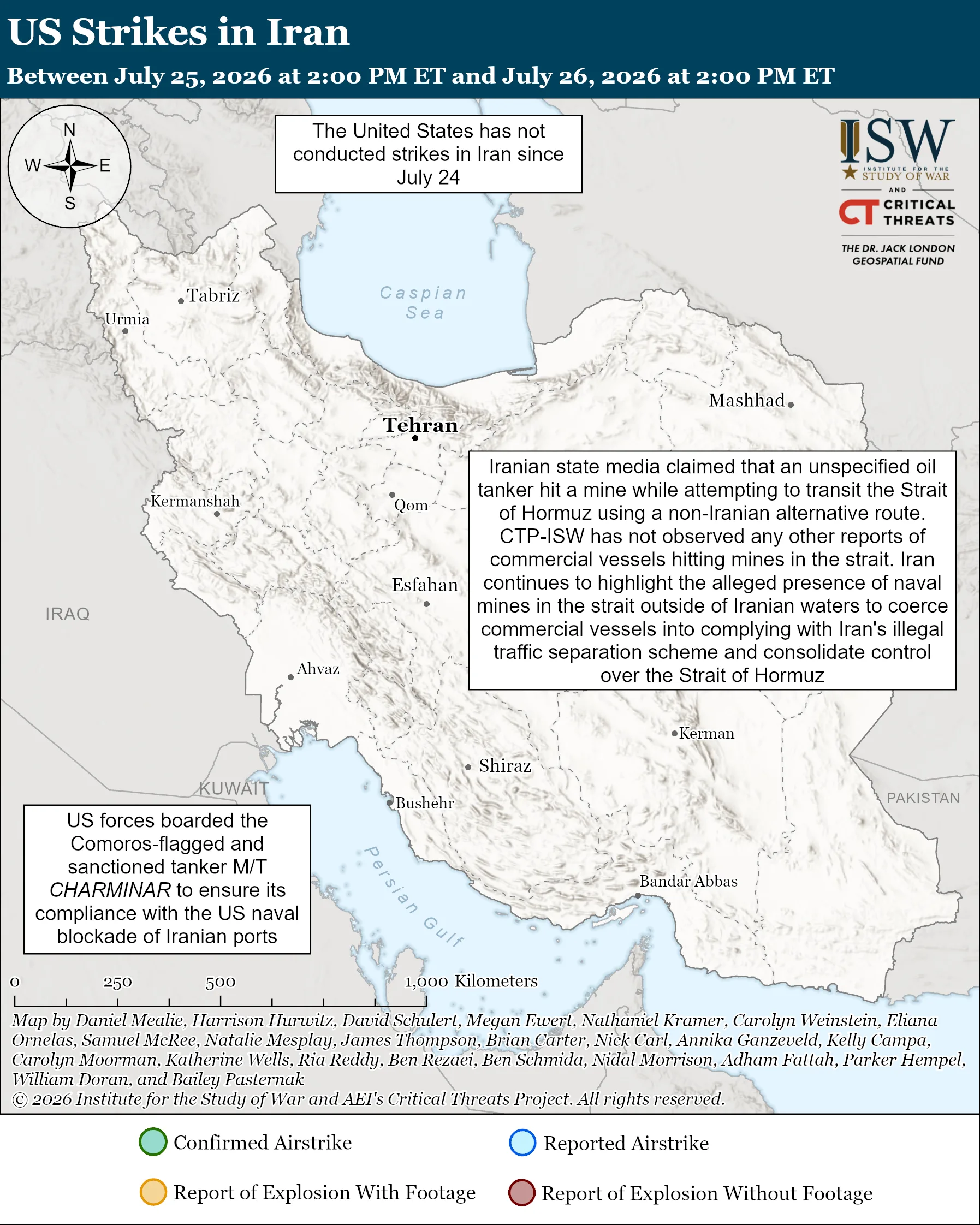
The current level and type of US strikes have likely failed to meaningfully affect the Iranian regime's willingness to pursue and secure its strategic objectives with force, including long-term control over the Strait of Hormuz. The United States struck roughly 1,000 targets between July 12 and July 24, compared to 13,000 in the 38 days in the war's first phase in March and April.[1] The United States has not conducted strikes in Iran since July 24 but has maintained its naval blockade on Iranian ports and vessels.[2] The United States targeted primarily military assets like coastal radars and drone launch facilities during the current phase of the war. ISW-CTP has previously assessed that Iran is conducting proactive military operations to achieve discrete war objectives despite an ongoing Iranian information operation to frame its attacks on US bases and regional states as “retaliatory” and purely defensive.[3] Unspecified Iranian officials told the New York Times on July 23 that Iran would reject any proposal for a ceasefire that left the status of the strait ambiguous, for example, which suggests that Iranian decision-makers remain committed to pursuing these Iranian objectives, including securing recognition for long-term control of the strait, despite US strikes.[4] Iranian forces have not conducted attacks targeting US bases or regional partners since July 24.[5] Iranian officials told international media on July 26 that Iran will maintain a posture of “retaliation” and refrain from conducting attacks if the United States maintains its pause on air operations.[6] Iran has no reason to strike US forces or partners right now because the United States has not successfully prevented Iran from controlling the Strait of Hormuz.
US forces have continued to take action to maintain the blockade of Iranian ports. US Central Command (CENTCOM) announced on July 25 that US forces boarded the Comoros-flagged tanker M/T Charminar, which the United States sanctioned in July 2025 for its involvement in Iranian oil smuggling operations, in the Arabian Sea to ensure its compliance with the blockade.[7] Commercially available maritime data indicated on July 26 that the Charminar resumed its course for Shinas, Oman, after US forces inspected the vessel.[8]
The ongoing pause in US air operations against Iran coincides with regional diplomatic efforts to end the conflict and resume negotiations. Iranian and Omani officials met in Tehran on July 24 and 25 to discuss a potential agreement regarding the Strait of Hormuz.[9] Iranian Foreign Ministry spokesperson Esmail Baghaei and unspecified regional officials claimed on July 26 that the delegations have made “progress” in the discussions.[10] Pakistani government officials told Turkish state media on July 26 that both the United States and Iran have responded to a recent joint Pakistani-Qatari proposal to halt all attacks and return to negotiations.[11] An unspecified regional official told international media on July 26 that the current pause in US and Iranian strikes signals mutual “efforts to de-escalate.”[12] White House Communications Director Steven Cheung also said on July 26 that US President Donald Trump continues to prefer a “diplomatic solution” to the current conflict but warned that the United States can resume military options if Iran continues to attack regional US allies or civilian vessels in the strait.[13]
Iran is continuing to illegally claim control over the Strait of Hormuz and use the threat of naval mines to deter commercial vessels from using non-Iranian-approved routes through the strait, which illustrates that Iran still seeks to control the strait. Iranian officials have continued to claim Iranian control over the strait in recent days.[14] Iranian Foreign Ministry Spokesperson Esmail Baghaei stated on July 25 that “there has been no change in the traffic situation in the Strait” following the recent Iran-Oman talks on the management of the Strait of Hormuz.[15] Iranian parliamentarians, including Iranian Deputy Parliament Speaker Ali Nikzad and Iranian Parliament's National Security and Foreign Policy Committee member Alaeddin Boroujerdi, said on July 26 that Iran must maintain control over the strait and cannot allow it to return to pre-war conditions.[16] Regime media is continuing to highlight the alleged presence of naval mines in the strait outside of Iran's illegal traffic separation scheme to deter commercial vessels from using non-Iranian routes and coerce them to use the Iranian-designated route as part of a broader effort to try to consolidate Iran's control over the Strait of Hormuz.[17] An “informed source” told Iranian Armed Forces General Staff (AFGS)-run media on July 26 that an unspecified oil tanker hit a mine while trying to use a route alternative route to transit through the Strait of Hormuz.[18] ISW-CTP could not verify this claim at the time of this writing. Iranian media has repeatedly warned commercial vessels that using non-Iranian-approved routes could have “consequences.”[19] The Islamic Revolutionary Guard Corps (IRGC) similarly claimed on July 22 that an oil tanker attempting to use the southern Omani route through the strait struck a naval mine that disabled the vessel.[20] ISW-CTP has not observed reports of any commercial vessels hitting mines in the southern route at the time of this writing. Alternative routes through the strait, including the southern Omani route, undermine Iranian efforts to assert full control over the strait. ISW-CTP has not observed any Iranian attacks on vessels in the strait since July 20, likely in part due to an absence of targets because traffic in the strait has fallen.[21]
Ukraine struck several sanctioned cargo vessels in the Caspian Sea on July 25 that Russia reportedly uses to transport military cargo between Iran and Russia.[22] Ukrainian President Volodymyr Zelenskyy announced that Ukrainian forces targeted multiple sanctioned cargo vessels, including the Russian-flagged Port Olya 2 and Begey.[23] Iranian officials and media claimed on July 26 that Ukrainian forces also struck an Iranian commercial vessel transporting military cargo between Iran and Russia and killed one crewmember.[24] ISW-CTP cannot verify this claim at the time of this writing. Commercially available maritime data suggests that Iranian vessels in the Caspian Sea at the time were either too far from the reported strike location, were using location spoofing, or had their AIS transponders turned off.[25] Senior Iranian officials condemned the strikes and threatened an Iranian response.[26] Russia and Iran have historically used the Caspian Sea to move both civilian and military goods.[27] The Israel Defense Forces (IDF) struck Bandar Anzali Port on the Caspian Sea in March 2026 to disrupt shipments of military equipment, including Shahed drones, artillery shells, and other ammunition, that Russia was reportedly transferring to Iran.[28] Ukraine's strikes follow reports that Russia is providing support to Iran during the current conflict.[29]
Zelenskyy stated on July 25 that Russia is providing Iran with satellite imagery of US bases in the Gulf to support Iranian attacks and battle damage assessments.[30] Zelenskyy’s statement is consistent with ISW-CTP’s previous assessment that Russia is helping Iran increase the accuracy of its targeting of US military sites in the region.[31] Zelenskyy said that Ukraine has recorded Russian satellite surveillance of Gulf states and US military facilities since July 2026.[32] He added that the timing of Russian satellite collections consistently aligns with Iranian strikes, with imagery captured both before attacks to support targeting and afterward to assess damage. Four air bases fell within the area of interest of Russian satellites on July 19 and 20, including two in Bahrain, one in Jordan, and one in Kuwait. Zelenskyy’s statement is consistent with a July 22 Reuters report citing four sources familiar with US intelligence who said that Russia may be providing Iran with targeting intelligence on US military sites and equipment in the region.[33] Zelenskyy previously stated in March 2026 that Iran has used Russian-produced Shahed drones “with Russian details” and Russian satellite imagery to attack US bases in the region.[34] Reuters separately reported that two Western officials familiar with intelligence assessments said analysts concluded that Iran used “Russian-enhanced versions” of Shahed drones in a March attack on a US CIA outpost.[35] ISW-CTP previously assessed that Russia's provision of targeting intelligence to Iran would likely improve the accuracy and effectiveness of Iran's drone and missile attacks.[36]
Iranian Supreme Leader Mojtaba Khamenei’s father-in-law and Expediency Discernment Council member Gholam Ali Haddad Adel stated on July 25 that Mojtaba is not in contact with any person or institution “due to certain issues.”[37] Adel’s statement comes amid numerous reports in recent months that Mojtaba was seriously wounded or incapacitated during combined force strikes in February 2026.[38] Multiple reports also indicate that many Iranian officials continue to have difficulty contacting Mojtaba, which has raised questions about the level of Mojtaba’s involvement in regime decision-making.[39]
The Houthis shot down a Saudi drone over Yemen on July 26 and continued to target Saudi-linked vessels in the Red Sea.[40] The Houthis claimed that their forces shot down a Saudi-operated, Turkish-made Bayraktar Akinci drone in al Jawf Governorate in Houthi-controlled northern Yemen on July 26.[41] The Houthis published images and a video of the downed drone on July 26.[42] The Houthis previously downed at least seven US MQ-9 Reapers during US operations against the Houthis in 2025.[43] The Houthis also likely attacked a Saudi-linked vessel in the southern Red Sea on July 24.[44] The Houthis previously attacked a Saudi-linked vessel in the southern Red Sea on July 22.[45]
https://understandingwar.org/research/middle-east/iran-update-special-report-july-26-2026/