
Posted on 10/08/2022 1:05:38 PM PDT by nuconvert
Iranian Regime national tv Channel One hacked about an hour ago. During a broadcast of Khamenie speech, a red crosshair appeared over his face and chanting of Women. Life. Freedom. There was writing to the side saying "Rise up. Join us". Also 4 photos at the bottom of the screen of young people killed and additional writing: "The blood of our youth is dropping from your paws".
Also, there was a huge banner in the middle of Tehran highway today that read: We are no longer afraid of you. We will fight.
Also, attempted attack on IRI ambassador in Denmark. Her bodyguard was stabbed. Diplomatic Security intervened before the attacker could stab the ambassador.
Since the February 28 U.S. strikes on the Leadership Residence, Mojtaba has not made a single confirmed public appearance. He also did not attend his own wife's funeral, despite repeated assurances from Islamic Republic officials that he is alive, healthy, and leading the country.
For months, senior regime officials have insisted his absence is solely due to security. Foreign Ministry spokesman Esmail Baghaei said wartime conditions have prevented public appearances. Iran's ambassador to the UN in Geneva, Ali Bahreini, said Mojtaba remains active but is staying out of sight because of heightened security. Now, Ayatollah Hakim Elahi, the Supreme Leader's representative in India, says Mojtaba will miss his father's funeral because “the security doesn't allow him to come,” adding that Israel has “very, very advanced technology” and can “recognize him and follow him.”
His absence also comes days after Israeli Defense Minister Israel Katz declared Mojtaba Khamenei was “marked for death” and ordered the IDF to prepare an independent operation inside Iran. Despite repeated official assurances, Mojtaba has appeared only through written statements read on state television. There has been no confirmed public appearance, video, or audio recording since the February 28 strikes. Missing both his wife's funeral and now his father's funeral will only deepen speculation over his health and the true extent of his injuries.
Hardline MP Kamran Ghazanfari [affiliated with the Paydari Front] claims President Masoud Pezeshkian and his allies are systematically stripping power from the Supreme Leader by strengthening the Supreme National Security Council and sidelining both the leadership and parliament. According to Ghazanfari, the plan is to make the Supreme National Security Council the country's sole decision-making body, calling it a “political coup” being carried out step by step.
He also alleges that Basij units have been instructed not to support nightly pro-regime gatherings and that parliament has effectively been shut down for four months to prevent lawmakers from opposing the alleged power grab. Whether these allegations are accurate or not, the fact that senior figures within the Islamic Republic are now publicly accusing each other of orchestrating a coup underscores the growing internal fractures and power struggle at the top of the regime.
...
Alongside antisemitic, anti-imperialist, and geopolitical motives, Iranian discourse regarding Israel also relies on a theological-legal foundation. According to the perception promoted by Iran, the territory of Israel is considered waqf land, a religious endowment that cannot be permanently transferred or relinquished. At the core of this perception also lies Iranian opposition to Jewish sovereignty over the al-Aqsa Mosque, regarded as the first qibla of the Muslims. The leadership of the Islamic Republic adopted this interpretation to justify an uncompromising stance toward the very existence of Israel. If the territory is defined as an Islamic waqf, then any recognition of Jewish sovereignty over it is perceived as a violation of divine law.
The conflict is therefore presented not merely as a political or territorial dispute but as a religious struggle over sacred land belonging to the Islamic nation. Within this framework, Khomeini issued a fatwa calling for the elimination of Israel, elevating the struggle to a religious obligation. Several senior regime figures have further linked Israel's destruction to the reappearance of the Hidden Imam, who, according to Shiite belief, is destined to emerge at the end of days. These figures include IRGC Quds Force Chief Esmail Qaani (statement made on December 2021), Deputy IRGC Commander Ali Fadavi (July 2017), [15] and Ayatollah Hossein Noori Hamedani (October 2023), [16] a senior pro-regime cleric based in Qom. Also prominent in this discourse is Mehdi Taeb (February 2019),[17] head of the Ammar Strategic Think Tank and a close associate of Mojtaba Khamenei, who reportedly advocated for the latter's leadership. Within this worldview, the annihilation of Israel and the weakening of the West are viewed as essential catalysts for the Imam's reappearance and the ultimate redemption of the Shiite world.
...
https://www.meforum.org/meq/behind-irans-ambition-to-destroy-israel
Iran continues to insist on imposing an illegal toll scheme in the Strait of Hormuz despite Omani opposition to mandatory fees. Iran reportedly rejected an Omani proposal to create a fund for “maritime services” that would be financed by voluntary donations from shipping and energy companies, according to people familiar with the discussions speaking to the Wall Street Journal on July 2.[1] The New York Times, citing an Iranian official, similarly reported on June 30 that Iran seeks to impose mandatory fees on vessels that transit through the strait.[2] A regional diplomat told the New York Times that Oman suggested making the fees voluntary, in contrast.[3] The US-Iran memorandum of understanding (MoU) requires Iran to engage with Oman to determine the “future administration” of the strait, but these reports indicate that Iran and Oman have different visions for the future management of the waterway.[4] Other Gulf states, with which Iran is also required to engage under the MoU, have similarly expressed opposition to Iranian control of the strait.[5] Iranian Parliament Speaker Mohammad Bagher Ghalibaf separately claimed that Iran and Oman's management of the strait is “in accordance with international law,” but any Iranian management of the strait in which Iran charged tolls would violate the United Nations Convention on the Law of the Sea (UNCLOS), which forbids states bordering international waterways from restricting transit passage or imposing transit charges.[6]
Iranian officials also appear to be trying to rally support for Iranian management of the strait by touting the alleged economic and security benefits of such management for regional countries. Iranian management of the strait would be detrimental to global commercial interests by enabling Iran to disrupt global trade and energy flows at will, however. Ghalibaf told his Uzbek counterpart on July 3 that Iranian control over the strait will bring “better opportunities” for the “development of transit cooperation” between Iran and Uzbekistan and reduce US interference in the region.[7] Ghalibaf’s comment comes as Iranian officials have recently called on regional countries to support a new “regional security mechanism” that Iran likely envisions would include Iranian control over the Strait of Hormuz and the removal of US forces from the Middle East.[8]
Iranian Supreme Leader Mojtaba Khamenei did not make a public appearance at the opening ceremony for the funeral of former Supreme Leader Ali Khamenei in Tehran on July 3, despite the attendance of most of Iran's senior leadership and many foreign dignitaries.[9] Mojtaba has not been seen publicly since the war began and is reportedly recovering from injuries sustained in the strike that killed his father.[10] Key decision-maker and Islamic Revolutionary Guards Corps (IRGC) Commander Major General Ahmad Vahidi also made his first public appearance since the US-Israel-Iran War at the ceremony.[11]
Iran continues to exploit the ceasefire and memorandum of understanding (MoU) to try to replenish its economic resources and rebuild its defense capabilities in preparation for potential future conflict with the United States and Israel. Iran has begun talks with Japanese companies to buy Iranian oil, according to Iranian and Western sources speaking to Reuters on July 3.[12] The US-Iran MoU includes a 60-day oil sanctions waiver and states that the United States will lift all sanctions on Iran upon the signing of a final agreement. Japan was previously a large importer of Iranian oil prior to the imposition of US maximum pressure sanctions on Iran in 2018.[13] Iran's talks with Japan suggest that Iran is attempting to use the sanctions waiver to rebuild its oil sales network with former economic partners. Iran separately appears to be using this period to fortify tunnel entrances at nuclear sites against potential future airstrikes or ground operations targeting these sites.[14] Iranian construction vehicles have been operating at the western tunnel entrances of the Kolang Gaz La Mountain site, according to the Institute for Science and International Security's July 2 analysis of commercially available satellite imagery between June 21 and 30.[15] Iranian officials, including Qom Friday Prayer Leader Mohammad Saeedi, have also explicitly stated that Iran is using this period to reconstitute its defense capabilities.[16] Saeedi also expressed doubts about the US-Iran negotiations and stated that Iran will not compromise on its demands.[17] This recent Iranian activity is consistent with ISW-CTP’s ongoing assessment that the status quo–in which Iran is benefiting from economic relief from the MoU but has not had to make concessions on its nuclear program–is favorable for Iran. Iran's acquisition of economic relief also strips the United States of leverage in later negotiations about Iran's nuclear program.[18]
The Israel Defense Forces (IDF) and Hezbollah continued to engage each other in southern Lebanon on July 1 and 2.[19] The IDF reported that a Hezbollah fighter injured three IDF reservists in a small arms engagement in Bint Jbeil, Nabatieh Governorate, on July 1.[20] The IDF reported that it struck 10 Hezbollah sites near the towns of Bint Jbeil, Beit Yahoun, Kounin, and Baraachit in Nabatieh Governorate in response on July 2.[21] The IDF also reported on July 2 that it struck a Hezbollah vehicle that Hezbollah fighters were using to transport weapons and explosives near the IDF’s security zone in southern Lebanon.[22] The IDF stated that the strike detonated the explosives inside the vehicle, causing a secondary blast.[23] Lebanese media reported on July 2 that the IDF also struck an unspecified target near Seddiqine, South Governorate.[24]
IRGC Quds Force-affiliated Mahan Air has resumed direct flights between Tehran and Houthi-controlled Sanaa, Yemen, for the first time in over 10 years, according to commercially available flight data.[25] Commercially available flight data shows that a Mahan Air plane flew from Tehran to Sanaa on July 3 and returned to Tehran a few hours later.[26] An Israeli military correspondent reported on July 3 that the flight was transporting senior Houthi officials to former Iranian Supreme Leader Ali Khamenei’s funeral ceremony in Tehran.[27] Iranian media and a US-based Yemen analyst reported on July 3 that the Mahan Air flight was the first direct flight between Iran and Yemen in over 10 years.[28] Mahan Air is a US-sanctioned Iranian airline that has frequently transported Quds Force funds, weapons, and operatives to support Iranian regional activities.[29] Houthi military spokesperson Yahya Sarea claimed that Saudi aircraft attempted to prevent the Mahan Air flight from landing in Sanaa, but that Houthi air defenses forced the Saudi aircraft to withdraw.[30] ISW-CTP has not observed any evidence that this incident took place at the time of this writing. Sarea warned Saudi Arabia that the Houthis would retaliate against any future Saudi “airspace violations” with strikes on Saudi airports and other “vital interests on land and sea.”[31]
https://understandingwar.org/research/middle-east/iran-update-special-report-july-3-2026/
Updated link https://www.iranintl.com/en/liveblog/202607049017
This fight is not over ideology or the future direction of the Islamic Republic: all the oligarchic clans are Islamist; some wear turbans, others wear military uniforms, and some wear suits.
In other words, they all subscribe to the core tenets of Shia Islamism in Iran: the forceful imposition of Sharia law domestically, support for the so-called Axis of Resistance militia network, anti-Americanism, and the goal of eradicating the Israel (driven by innate anti-Semitism).
The latest manifestation of this infighting has erupted in the most unlikely of places: the Assembly of Experts – a body of 88 clerics who, in theory, appoint and oversee the authority of the supreme leader. Last week, 73 members of the normally silent assembly made an unusual public intervention in the form of a statement on the ongoing negotiations with the United States and the recently-signed Memorandum of Understanding
The statement de facto criticised Iran's Supreme National Security Council (SNSC) over its conduct of the negotiations with Washington, suggesting the officials had moved beyond the “red lines” of the supreme leader, Mojtaba Khamenei. It said in Farsi: “All officials should respect that, in the system of Velayat-e Faqih (Guardianship of the Islamic Jurist), the opinion and directives of the Supreme Leader are decisive. Once informed of the Leader's definitive view, no official may act contrary to it.”
After its publication, Ayatollah Hashem Hosseini Busheri, chairman of the Assembly of Experts’ secretariat and spokesperson, immediately stated that he was completely unaware of the statement and that, while he did not oppose its content, its signatories had broken convention and published it without coordination with him.
If Mojtaba fails to appear at his father's funeral, it will dramatically intensify speculation about his physical condition and could accelerate factional efforts to prepare for a second succession crisis.Such a moment would not merely raise questions about one man's fate. It could expose the deeper structural crisis facing the Islamic Republic: that a regime built around the absolute authority of one man may no longer have a leader capable of imposing order on the very factions that depend on his authority for their own survival.
The Assembly of Experts’ intervention is therefore more than an isolated episode; it is a sign that the Islamic Republic's internal balance of power is shifting.
The clerical class, the IRGC-linked networks, the security bureaucracy, and political-economic factions are all manoeuvring to protect their interests in a system whose central source of authority has been weakened. While these rivalries may remain contained in the short term, the post-Ali Khamenei order is increasingly vulnerable to open elite conflict. What appears today as a dispute over negotiations may soon become a broader struggle over who truly rules the Islamic Republic.
As the Saudi delegation approached the coffin, the recitation chosen for them was Surah Al-Imran 3:13, a verse describing the Battle of Badr and contrasting believers with an opposing army described as disbelievers. The symbolism came just months after the Islamic Republic and its regional proxies launched hundreds of missile and drone attacks against Saudi Arabia during the 2026 war, with more than 105 attacks per week at the peak of the conflict. The campaign killed at least three civilians, injured more than 20 others, and prompted Saudi air defenses to intercept dozens of incoming missiles and drones.
According to accounts of the ceremony, each foreign delegation was assigned a different Quranic verse, suggesting the selections were deliberate rather than arbitrary.
In that context, many observers interpreted the verse chosen for Saudi Arabia as an ideological and confrontational message, casting Iran as the righteous side of a divinely sanctioned struggle while implicitly placing Saudi Arabia on the opposing side. For many across the Persian Gulf, the recitation was seen not as a gesture of respect toward a visiting delegation, but as a symbolic political and religious rebuke delivered at a state funeral. Even in mourning, the Islamic Republic appeared to prioritize revolutionary messaging over reconciliation.
Iran continues to use threats and force to compel commercial vessels to transit through its illegal traffic separation scheme in the Strait of Hormuz. Bloomberg reported that at least eight vessels attempted to exit the strait along the Omani coast between July 2 and 3 before reversing course.[1] Some of the vessels later resumed transit through Iran's traffic separation scheme, almost certainly after Iranian authorities threatened to attack the vessels. Iran has previously threatened and attacked vessels that attempted to transit through the strait via alternative routes.[2] Iran attacked a vessel on June 25 that was using the International Maritime Organization-Oman route, for example.[3] Iranian Deputy Foreign Affairs Minister for Legal and International Affairs Kazem Gharibabadi also warned the United Kingdom and France against engaging in any military activity in the strait in a statement on July 4 after both countries announced that they had agreed to work with Oman to ensure safe navigation for vessels through Omani territorial waters.[4] Alternative transit routes such as the route along Oman's coast undermine Iran's efforts to establish complete control over the Strait of Hormuz. Iran likely calculates that threats and continued attacks on vessels will deter countries and international organizations from facilitating such alternative transit routes.
Senior Iranian officials continue to portray the strait as Iran's primary source of leverage against the United States. Supreme Leader Military Affairs Adviser Major General Yahya Rahim Safavi warned on July 4 that Iran could use both the strait and the Bab al Mandeb as leverage if the United States violates the US-Iran memorandum of understanding (MoU).[5] Iranian Parliamentarian Malek Shariati similarly emphasized on July 3 the importance of Iranian control over the strait because of its important role for global energy markets.[6] Iran has repeatedly used force and the threat of force since April 2026 to control transit through the waterway to raise global oil prices and thus increase pressure on the United States and the broader international community to meet Iranian demands.[7] Iran announced the closure of the strait on June 20 to try to compel the United States to pressure Israel to halt operations against Hezbollah, for example.[8] Long-term Iranian control over the strait would enable Iran to close the waterway at any time and for any reason in order to make its adversaries meet Iranian demands and deter its adversaries from taking action against Iran.
Senior Iranian regime officials appear to be trying to contain growing factional disputes over Supreme Leader Mojtaba Khamenei’s position on the US-Iran MoU. Supreme Leader Representative to the Islamic Revolutionary Guards Corps (IRGC) Abdollah Haji Sadeghi told IRGC and Basij commanders and members in a letter on July 4 that Mojtaba’s recent message on the MoU is the regime's final basis for action.[9] Mojtaba stated on June 18 that he had authorized the MoU but emphasized that he had “a different opinion in principle.”[10] Haji Sadeghi stated that debates over whether officials imposed the MoU on Mojtaba, acted negligently, or betrayed Mojtaba damage regime unity and do not align with Mojtaba’s message.[11] Haji Sadeghi’s statement follows recent public divisions among members of the Assembly of Experts — an 88-member clerical body that is responsible for appointing and supervising the Supreme Leader — and parliamentarians over the MoU and negotiations with the United States.[12] Sixty Assembly of Experts members issued a statement on June 28 warning negotiators not to violate Mojtaba’s red lines.[13] The Assembly of Experts Secretariat later clarified that the statement did not represent the Assembly's official position.[14] A group of at least 84 parliamentarians, many of whom are aligned with the ultra-hardline Paydari (Stability) Front, endorsed the June 28 Assembly statement.[15] Haji Sadeghi’s directive to IRGC and Basij commanders suggests that senior regime officials close to the supreme leader and the IRGC are trying to prevent ultra-hardline factions from framing support for the MoU as disloyalty to Mojtaba.
The Iranian regime appears to be reshuffling some senior military positions after the US-Israel-Iran war. Armed Forces General Staff (AFGS)-run media Defa Press reported that Rear Admiral Ali Ozmaei replaced Rear Admiral Alireza Tangsiri as the IRGC Navy commander.[16] The Israel Defense Forces (IDF) killed Tangsiri in an airstrike targeting Bandar Abbas, Hormozgan Province, on March 26.[17] Ozmaei previously commanded the IRGC Navy 5th Imam Mohammad Bagher Region in Hormozgan Province, which oversees IRGC Navy operations in the southern Persian Gulf near the northern entrance of the Strait of Hormuz.[18] The United States sanctioned Ozmaei in June 2019 for acting on behalf of the IRGC and facilitating “destabilizing and provocative” actions around the strait.[19] The US sanctions against Ozmaei came after Iran conducted several attacks against commercial vessels in the Strait of Hormuz, including two tankers in early June 2019.[20] Iran's maritime escalation around the strait in 2019 was a response to US President Donald Trump's imposition of maximum pressure sanctions on Iran.[21] Some Iranian media outlets have also begun to publicly describe Major General Ahmad Vahidi as the IRGC commander instead of the IRGC deputy commander.[22] ISW-CTP assesses that Vahidi has been serving as the IRGC commander since the US-Israeli combined force killed the former commander on February 28.[23]
Defa Press separately referred to Khatam ol Anbia Central Headquarters Inspection Deputy Brigadier General Mohammad Jafar Asadi as the “former” inspection deputy on July 4.[24] Iranian media identified Asadi as the inspection deputy as recently as June 14.[25] It remains unclear whether Asadi was removed, reassigned, or promoted, however. This report comes after Defa Press described Major General Ali Abdollahi Aliabadi as the AFGS deputy chief, suggesting that Aliabadi may simultaneously serve as the AFGS deputy chief and Khatam ol Anbia Central Headquarters commander.[26] The new characterizations of Asadi and Aliabadi in Iranian media follow unconfirmed reports in December 2025 that former Supreme Leader Ali Khamenei was considering merging the AFGS and Khatam ol Anbia Central Headquarters.
Israeli Prime Minister Benjamin Netanyahu is reportedly seeking approval from US President Donald Trump before initiating an Israel Defense Forces (IDF) operation to seize remaining Hezbollah infrastructure in Ali al Taher, Nabatieh District, southeastern Lebanon, according to Israeli media on July 3.[27] The IDF reportedly postponed a planned operation to seize Hezbollah infrastructure in Ali al Taher on June 21 in order not to disrupt US-Iran negotiations.[28] An Israeli military correspondent reported on July 2 that approximately 30 Hezbollah fighters remain at an underground facility in Ali al Taher.[29] The IDF has continued to engage Hezbollah fighters who have emerged from the facility or have attempted to approach IDF positions surrounding Ali al Taher in recent days.[30] Ali al Taher contains one of Hezbollah's largest underground command and control facilities and serves as a key reconnaissance position and launch site for Hezbollah attacks into northern Israel.[31] Ali al Taher also contains the headquarters of Hezbollah's Badr Unit, which is one of Hezbollah's geographic units that is responsible for the area north of the Litani River, particularly around Nabatieh District and the southern Bekaa Valley, and one of the main Hezbollah units that has engaged Israeli forces in southern Lebanon.[32]
The Houthis sent a senior fundraising official to Tehran as part of its delegation to former Supreme Leader Ali Khamenei’s funeral, potentially to try to obtain funds from the Iranian regime. Houthi Endowments Authority Chairman Abdulmaged bin Abdulrahman bin al Hassan bin al Hussein al Houthi gave a speech at an event in Tehran on July 4 on the sidelines of Ali Khamenei’s funeral.[33] The Houthi Endowments Authority is one of the Houthis’ primary institutions for generating revenue, according to a Washington-based Yemen analyst.[34] Abdulmaged's visit follows reports that Iran intends to use part of the economic relief it gains from the US-Iran MoU to provide funding to Hezbollah.[35] Iran may consider using economic relief to support other regional proxies and partners, including the Houthis. Iranian officials have recently emphasized the value of the Houthis in the Axis of Resistance, particularly the Houthis’ ability to disrupt shipping in the Red Sea in support of Iranian objectives. Iranian officials, including IRGC Quds Force Commander Brigadier General Esmail Ghaani and Supreme Leader Military Affairs Adviser Major General Yahya Rahim Safavi, continue to threaten that Iran and the Houthis could disrupt traffic through the Bab el Mandeb Strait alongside Iran's efforts to control shipping in the Strait of Hormuz.[36]
https://understandingwar.org/research/middle-east/iran-update-special-report-july-4-2026/
Ali Khamenei was married to Mansoureh Khojasteh Bagherzadeh, with whom he had six children; four sons (Mostafa, Mojtaba, Masoud, and Meysam) and two daughters (Boshra and Hoda)
https://en.wikipedia.org/wiki/Ali_Khamenei
Mostafa, Masoud and Meysam attended the funeral, but not Mojtaba Khamenei!
https://x.com/HadiZonouzi/status/2073626635388190794
It’s probably not an AI-generated video, because if it were, they would have included Mojtaba as well.
Ebrahim Azizi said the world should know that the Islamic Republic would avenge the killing of Ali Khamenei, military commanders and members of the “resistance front.” He said Iran would seek revenge for all those killed, including Khamenei and military commanders.
https://x.com/IranIntl_En/status/2073782032577052930
They said this 05FEB2026: Iran Officially Shifts Military Doctrine Toward Offensive and Asymmetric Warfare
Iran has formally confirmed a major shift in its military posture, moving away from a purely defensive strategy toward a more offensive doctrine centered on asymmetric warfare, according to statements by the country's top military leadership. Speaking to state-affiliated media, Abdolrahim Mousavi, Chief of Staff of the Iranian Armed Forces, stated that Iran has revised its military doctrine in response to recent regional developments and evolving security threats. He emphasized that Iran will no longer limit itself to passive defense and is prepared to conduct rapid and decisive operations if faced with aggression.
The revised doctrine highlights asymmetric warfare, including the use of missiles, drones, unconventional tactics, and dispersed force structures, designed to counter technologically superior adversaries. Iranian officials stressed that any miscalculation by hostile actors would be met with a swift and proportionate response.
This announcement marks one of the clearest public acknowledgements to date that Iran is recalibrating its military strategy, signaling a more assertive stance in regional and deterrence planning.
Note: Epic Fury started 28FEB2026 !
Iranian control of the Strait of Hormuz is detrimental to global commercial interests because it enables Iran to selectively determine which vessels may pass through the strait and at what cost. Iranian Ambassador to the People's Republic of China (PRC) Abdolreza Rahmani Fazli stated on July 4 that Iran will give the PRC “special considerations” in determining the cost of “service” fees because the PRC is a “friendly country.”[1] This comment suggests that Iran plans to discount the tolls that the PRC and other “friendly” countries must pay for their vessels to transit through the strait. Iranian Foreign Affairs Minister Abbas Araghchi previously identified the PRC, Russia, India, Iraq, and Pakistan as “friendly” states whose vessels can pass through the strait.[2] Iran's imposition of tolls on vessels belonging to countries that it deems “non-friendly” violates the principle of free navigation under the UN Convention on the Law of the Sea.[3] Fazli’s statement is also consistent with ISW-CTP’s ongoing assessment that Iran is prioritizing international recognition of its control of the strait over the collection of tolls.[4]
Israel Defense Forces (IDF) Chief of Staff Lieutenant General Eyal Zamir announced on July 5 that the IDF has established control over Hezbollah's extensive underground tunnel networks in the vicinity of Beaufort Castle, Nabatieh District, in southern Lebanon.[5] The IDF previously established control over above-ground terrain surrounding Beaufort Castle on May 31 and began to seize and dismantle underground Hezbollah infrastructure throughout June.[6] Zamir, IDF Northern Command Commander Major General Rafi Milo, and other senior IDF field commanders visited Israeli forces and toured seized Hezbollah tunnels in the vicinity of Beaufort Castle on July 5.[7] Zamir noted that Hezbollah, with Iranian assistance, had developed extensive tunnel networks underneath the ridge surrounding Beaufort Castle for command and control (C2) and targeting northern Israeli communities.[8] Senior IDF officers have identified the Beaufort Castle ridge and terrain surrounding Ali al Taher, which is about three miles north of Beaufort Castle, as major Hezbollah operational areas.[9] Zamir urged the Lebanese Armed Forces (LAF) to fulfill its commitment to disarming Hezbollah fighters and dismantling militant infrastructure per the terms of the June 26 Trilateral Framework Agreement.[10] Zamir also announced that the IDF will continue to attack Hezbollah in Lebanon and warned that the IDF is prepared to launch a “swift offensive” if Hezbollah violates the ceasefire.[11] The IDF has continued to attack Hezbollah positions in southern Lebanon. The IDF has conducted four airstrikes across southern Lebanon since ISW-CTP’s last data cut-off on July 4.[12]
United Kingdom Maritime Trade Operations (UKMTO) reported that unspecified armed actors attacked a bulk carrier off the coast of the Houthi-controlled port of Hudaydah on July 5.[13] UKMTO said that the unspecified armed actors approached the bulk carrier in a skiff 30 nautical miles southwest of Hudaydah Port and opened fire.[14] No actor has claimed responsibility for the attack at the time of this writing.
https://understandingwar.org/research/middle-east/iran-update-special-report-july-5-2026/
https://x.com/MEMRIReports/status/2073714447177195633
80 s video
How did Pakistan become a mediator?
Iranian media are portraying the landing of an Iranian civilian aircraft in Sanaa as a strategic victory for Ansarullah [=Houthis]: the symbolic breaking of Yemen’s 11-year air blockade, the reopening of the Sanaa-Tehran route, and evidence that Saudi deterrence is no longer what it once was.
- That is, of course, the “Axis of Resistance” narrative.
- But beyond the propaganda, the episode may point to something more significant: the evolving regional political environment. It is difficult to separate this development from the improvement in Iran-Saudi relations and Riyadh’s role within the “Islamabad Quartet” -alongside Pakistan, Turkey and Egypt -which helped produce first the ceasefire and then the Islamabad MoU.
- If so, the significance of this flight goes beyond Yemen. It may be one of the first visible signs that the diplomatic architecture built around the Islamabad process is beginning to generate practical effects across the region.
- In that sense, Ansarullah presents it as a military victory, while Tehran presents it as a victory for the Axis. But the deeper story may be that regional de-escalation and the new diplomatic framework have created conditions that would have been far more difficult to imagine only a few months ago.
https://x.com/BabakVahdad/status/2073509364242235479
Danny Citrinowicz: This is about far more than a single flight landing in Sana’a.
The recent conflict, and the disruption around the Strait of Hormuz, likely reinforced Tehran’s view of how powerful it could be to combine pressure in the Strait of Hormuz with disruption in the Bab al-Mandab. From Iran’s perspective, the ability to threaten both chokepoints simultaneously could dramatically increase pressure on global energy markets and drive up oil prices during a future crisis. In that sense, the conflict may have elevated the Houthis’ strategic importance in Tehran’s military thinking, despite their initial hesitation to become directly involved.
If the air blockade on Yemen eventually weakens or is lifted, an important question will be what follows. It is reasonable to expect that future flights could be used not only for civilian purposes but also to strengthen the Houthis’ long-term capabilities. For now, based on the Houthis’ public statements, it appears they are unlikely to accept Saudi efforts to block or restrict these flights.
That underscores the difficult balancing act facing Riyadh: preserving its détente with Iran while trying to prevent the Houthis from rebuilding capabilities that could pose a long-term strategic threat. How Saudi Arabia manages that tension will be an important indicator of the future direction of regional security. This may prove to be one of the less-discussed strategic consequences of the last war.
https://x.com/citrinowicz/status/2073799036348530861
Attack by Yemen’s Houthis kills 16 government troops
The attack targeted government-aligned forces south of the port city of Hodeidah. Hospitals received 16 dead from pro-government forces and 22 injured, medical sources say. On Friday, the Houthis threatened airports and vital assets belonging to Saudi Arabia, a key backer of Yemen’s Aden-based government.
https://www.arabnews.com/node/2649751/middle-east
The Lebanese government appears to be implementing the June 26 Trilateral Framework Agreement and other diplomatic initiatives in a way that advances the government's primary objective of ensuring stability in Lebanon.[1] The Lebanese government has multiple objectives, including weakening and disarming Hezbollah, securing an Israeli withdrawal from Lebanese territory, and expelling Iranian influence from Lebanon, but its overriding objective appears to be ensuring internal stability. Senior Lebanese government officials, including President Joseph Aoun, have repeatedly expressed support for the framework agreement as the best means to end conflict and instability in Lebanon.[2] The Lebanese government may hesitate to implement parts of the framework agreement that it assesses would risk igniting widespread conflict in Lebanon, however. Hezbollah leaders have threatened that Lebanese Armed Forces (LAF) attempts to disarm the group would result in a civil war, which is consistent with Hezbollah's long-term efforts to deter the LAF from threatening the group's existence.[3] Unnamed sources told Lebanese media on July 6 that the LAF refuses to establish “pilot zones,” in which the LAF would disarm Hezbollah, north of the Litani River until Israeli forces withdraw from Lebanese territory.[4] The sources claimed that the LAF is concerned that Israeli forces would remain in Lebanon in the event of a Hezbollah-LAF conflict, which would undermine the Lebanese government's objective of facilitating an Israeli withdrawal from Lebanon.[5] The sources also claimed that the LAF refuses to initiate an “internal confrontation” with Hezbollah because of the risk of starting a civil war with the group and fracturing the LAF.[6]
The Lebanese government may also be postponing or preventing the Iran-Lebanon-United States “deconfliction cell” from commencing operations because the mechanism contradicts other Lebanese government objectives, especially expelling Iranian influence from Lebanon. The Qatari Foreign Ministry announced on June 21 that Iran would take part in a multilateral deconfliction cell to monitor and report violations of the Israel-Hezbollah ceasefire.[7] Lebanese media reported on July 6 that Iranian regime officials have expressed frustration regarding the Lebanese government's refusal to appoint representatives to the cell.[8] The mechanism requires the appointment of Lebanese representatives to the cell before it can commence operations.[9] Lebanese media also reported that the Lebanese government has largely ignored the deconfliction cell since Israel, Lebanon, and the United States signed the framework agreement on June 26.[10] The deconfliction cell would give Iran a formal role in monitoring the Israel-Hezbollah ceasefire in Lebanon. ISW-CTP previously assessed that Iran could use its on-the-ground presence in southern Lebanon to quickly report incidents to the deconfliction cell and thereby shape the narrative about such incidents in the cell.[11] The Lebanese government views Iranian influence in Lebanon negatively because the Iranian regime empowers Hezbollah, whose activities have repeatedly destabilized Lebanon.[12] Lebanese officials have rejected Iranian efforts to link the conflict in Lebanon to broader US-Iran negotiations and have urged an end to Iranian interference in Lebanon.[13]
Iranian Supreme Leader Mojtaba Khamenei reappointed Gholam Hossein Mohseni Ejei as judiciary chief on July 5.[14] Ejei’s appointment is Mojtaba’s third appointment since becoming supreme leader in March 2026. Mojtaba appointed former IRGC Commander Mohsen Rezaei as his military adviser on March 17 and Mehdi Khamoushi as his chief of staff on May 12.[15] Ejei previously served as the intelligence minister under former hardline President Mahmoud Ahmadinejad.[16] Ejei has served as the judiciary chief since 2021. Ejei has historically taken a harsh stance against regime dissidents, such as when he publicly defended executing protesters during the Mahsa Amini protests in 2022 and described protesters as “terrorists” in 2026.[17] The United States sanctioned Ejei in September 2010 for committing human rights abuses.[18]
Unidentified Israeli security officials told Israeli media on July 6 that Hezbollah is attempting to reconstitute its forces in southern Lebanon.[19] The Israeli security officials said that Hezbollah is transferring fighters to unspecified areas of southern Lebanon in preparation for a potential resumption of combat with Israeli forces.[20] The officials added that the IDF has encircled Hezbollah positions in Bint Jbeil District and Deir Seryan in Nabatieh Governorate and Majdal Zoun in South Governorate.[21]
The IDF continued to strike Hezbollah fighters and infrastructure in southern Lebanon on July 5 and 6. Lebanese media reported that the IDF struck unspecified targets near Nabatieh al Fawqa and Kfar Tebnit in Nabatieh Governorate on July 5.[22] The IDF reported that it killed four Hezbollah fighters driving a vehicle toward IDF positions in Nabatieh al Fawqa on July 6.[23] Lebanese media reported that the IDF conducted five additional strikes on unspecified targets in Nabatieh Governorate on July 6.[24]
The Iraqi federal government reportedly barred Islamic Revolutionary Guards Corps (IRGC) leaders, including Quds Force Commander Brigadier General Esmail Ghaani, from attending funeral ceremonies for former Iranian Supreme Leader Ali Khamenei in Iraq, according to an informed source speaking to Iraqi media on July 5.[25] A second source stated that Iraqi Prime Minister Ali al Zaydi permitted funeral ceremonies in the cities of Karbala and Najaf but not in Baghdad.[26] This decision could reflect Zaydi’s attempts to balance between Iran and the United States and distance the Iraqi federal government from Iran amid ongoing US pressure on the Iraqi government to curb Iranian influence in Iraq.[27]
The Iraqi Counter Terrorism Service (CTS) engaged possible Iranian-backed Iraqi militia Kataib Hezbollah fighters in Dora District, Baghdad Province, on July 3.[28] Iraqi security sources told Saudi media on July 3 that CTS attempted to retake an Iraqi militia-controlled farm in Dora District, which triggered a firefight.[29] The sources added that an unspecified Iraqi militia had previously seized the area from a local farmer.[30] Iranian-backed Iraqi militias, including Kataib Hezbollah, have used areas under their control to store weapons and conduct rocket attacks targeting US interests in Iraq.[31] Iraqi security forces, including CTS, have sporadically targeted Kataib Hezbollah sites in Dora District since 2020.[32] Iraqi Federal Police officers engaged Kataib Hezbollah members in Dora District in July 2025, for example.[33] CTS also raided a Kataib Hezbollah headquarters in Dora District in 2020 following militia attacks on US forces in Iraq.[34] CTS’s July 3 operation comes as the Iraqi federal government has recently taken steps to disarm Iranian-backed Iraqi militias.[35]
https://understandingwar.org/research/middle-east/iran-update-special-report-july-6-2026/
In this Week 18 recap of the crisis in the Strait of Hormuz, Sal Mercogliano breaks down a week of “red cards,” maritime disruptions, and unravelling propaganda. From the July 4th shipping halt to the debunking of Iranian claims about the grounded ship Arista, we look at why the global shipping market is sitting on a dangerous precipice.
Key highlights in this episode:
⚓The “Red Card” Mystery: President Trump talks FIFA and Iran, while underscoring the real-world tensions in the Strait...and on the pitch.
⚓July 4th Disruption: Analysis of the aborted convoy attempt and why traffic suddenly turned around on Independence Day.
⚓Propaganda Debunked: Step-by-step proof that the Iranian story regarding the grounded ship Arista is complete BS.
⚓Global Energy Impact: Why record-low oil storage levels mean even a small “wrench in the works” could cause a massive price spike.
⚓The Human Cost: An update on the 8,000 seafarers still stranded and the resurgence of piracy off the coast of Yemen.
https://www.youtube.com/watch?v=tzo4tW1NMYU
Iran is attempting to stop Western and Gulf efforts that could weaken its ability to use the Strait of Hormuz as a source of leverage in current and future disputes. Gulf states and the United States are attempting to undermine Iran's ability to use the strait as leverage by entering and exiting the strait along the Omani coast and by proposing alternative, non-Iranian-controlled transit mechanisms. Several Iranian media outlets reported on July 7 that the UAE proposed a plan to the International Maritime Organization (IMO) to manage the strait, which Iran rejected and eight other unspecified UAE “allies” supported.[1] Iran claimed that the Emirati proposal lacked “legal basis” and “exceeds the IMO Council's technical mandate and authority.”[2] Iran claimed that it is still providing services to vessels.[3] Iranian regime-affiliated outlets did not disclose any details about this plan, and no other regional or Western outlet has confirmed the existence of such a plan at the time of this writing. Iranian regime-affiliated outlets also published a statement from an “informed” source that all transit through the strait must be in accordance with Iranian arrangements after these outlets reported that Iran had rejected the supposed Emirati plan.[4] Iran recently objected to an Omani proposal under which shipping companies would voluntarily pay fees for using the strait.[5] Iranian Parliament's National Security and Foreign Policy Committee member Alaeddin Boroujerdi separately warned against any foreign action in the strait that is not in coordination with Iran and specifically noted French plans to remove naval mines in the strait as an example.[6]
Iran is also taking military steps to stop Western and Gulf efforts to weaken Iran's ability to control traffic in the strait. Iran launched two missile attacks on tankers in the strait on July 6 because both vessels failed to use Iranian-approved transit mechanisms. The first attack targeted a tanker carrying Qatari gas exports eight nautical miles off the coast of Limah, Oman, and the second attack targeted a Saudi-flagged oil tanker in the strait.[7] Iran launched another drone at an unspecified tanker on July 7 in the vicinity of the Strait of Hormuz.[8] These attacks are designed to deter vessels from transiting the strait using transit routes near the Omani coasts. Iran recognizes that if it fails to attack these vessels, it will lose the Strait of Hormuz as a tool of leverage. Iran will lose the strait as a tool of leverage if it cannot control the rate of traffic through the strait to secure concessions in negotiations.
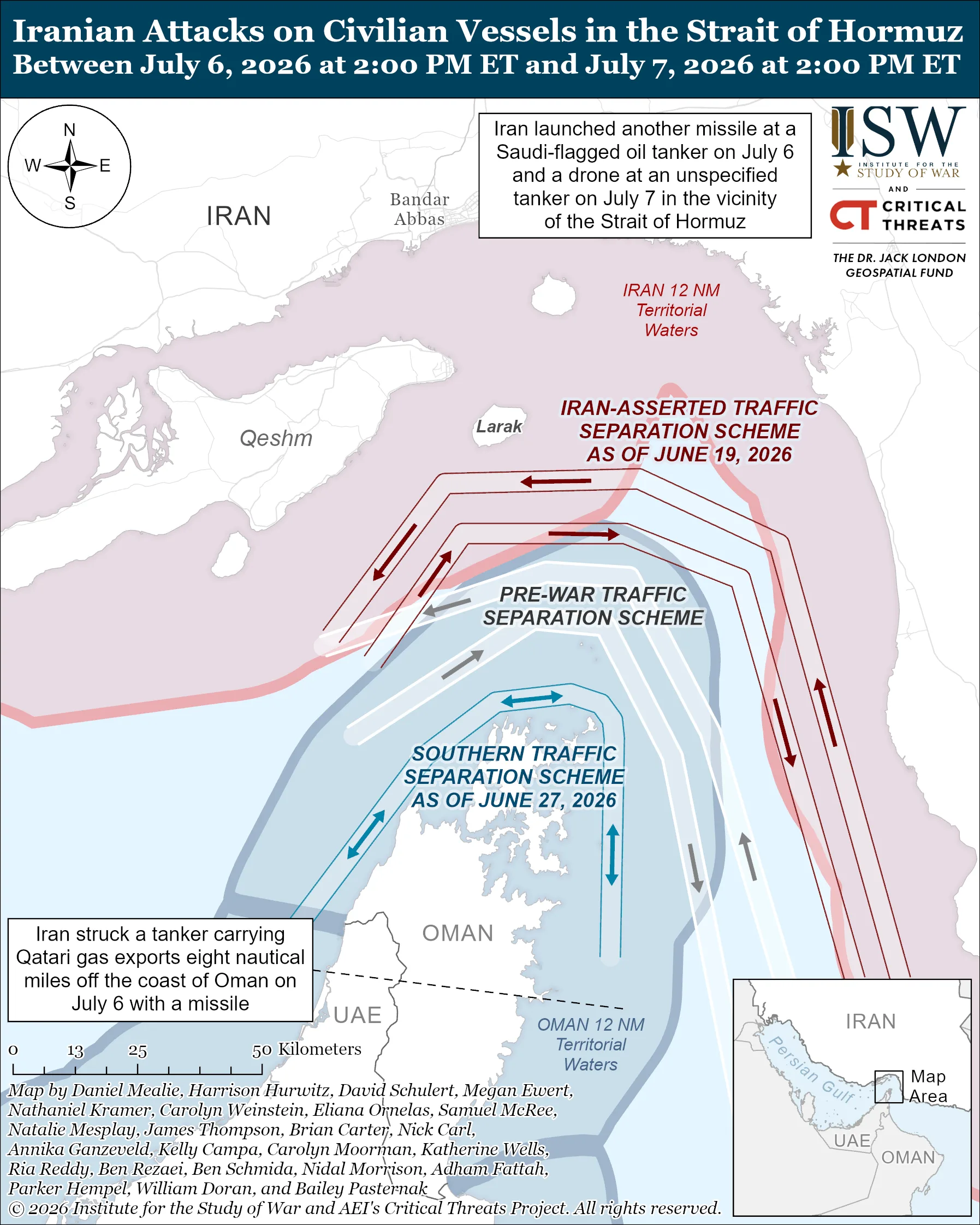
Iran's military and diplomatic efforts come as North Atlantic Treaty Organization (NATO) member Foreign Ministers are set to discuss how to handle the strait issue with Bahraini, Kuwaiti, Qatari, and Emirati foreign ministers on the sidelines of the NATO summit in Ankara, Turkey, on July 7, according to diplomats speaking to Reuters.[9] Saudi Arabia, Kuwait, and the United Arab Emirates (UAE) are reportedly working on plans to extend the energy pipelines that will allow them to circumvent the strait and mitigate Iranian disruption to their economies, according to multiple sources speaking to Reuters on July 7.[10]
Hezbollah is preparing to use Iranian funds to resume financial payments to displaced Lebanese families in Hezbollah's political strongholds as part of an effort to rebuild support among the Lebanese public.[11] Unspecified Lebanese political and financial sources told Emirati media on June 29 that Hezbollah is preparing to disburse temporary housing assistance payments and reconstruction funding to displaced families in southern Lebanon, Beirut's southern suburbs, and the Bekaa Valley, where the population has traditionally supported Hezbollah.[12] The sources claimed that Hezbollah has received Iranian funding to support its reconstruction efforts through unspecified Iraqi financial channels.[13] Iran has historically used the Iraqi economy and Iranian-backed Iraqi militias to transfer funds, among other supplies, to other Axis of Resistance groups, including Hezbollah.[14] Four informed sources told Reuters on June 17 that Iran would use potential economic relief from the US-Iran memorandum of understanding (MoU) to fund and reconstitute Hezbollah, though it is not immediately clear what — if any — resources have reached Hezbollah as a result of the MoU.[15] Reconstruction payments have long been one of many tools Hezbollah uses to financially assist Lebanese people affected by conflicts with Israel.[16] Hezbollah's financial challenges as a result of its investment in the War in Syria, and a decrease in Iranian funding after the collapse of Assad, have been one of several reasons that some communities in Lebanon are increasingly disenchanted with the group.[17] Hezbollah's financial challenges following the October 7 War and during the current Israeli campaign in Lebanon have generated unprecedented discontent among its Shia support base in recent years, however.[18] Hezbollah's efforts to resume financial payments to its support base also challenge the Lebanese government's efforts to assert itself as the sole provider of social services for the Lebanese people.
The Lebanese government is also simultaneously providing financial compensation and reconstruction support to southern Lebanese citizens and municipalities in recent days.[19] The Lebanese Social Affairs Minister Hanin al Sayed announced on July 4 that the ministry plans to provide financial compensation payments to 130,000 displaced Lebanese families in the coming days.[20] The Lebanese Health Ministry issued a $250,000 US dollar grant for repairs to the Tebnine Government Hospital, in Bint Jbeil District, on June 30.[21] Lebanese Agriculture Minister Nizar Hani announced a five-million-dollar project to provide emergency relief payments and reconstruction support for Lebanese farmers in war-affected areas on July 7.[22] The Lebanese government is also reportedly reviewing plans to provide financial support to families to repair “light and moderate damage” to their homes, offer rental allowances for displaced families unable to return to their homes, and provide temporary housing to displaced families, according to Saudi media on July 4.[23]
Lebanese media characterized the June 26 Trilateral Framework Agreement's Military Coordination Group for Lebanon as the primary mechanism for implementing the ceasefire in Lebanon.[24] The framework agreement's security annex stipulates that the coordination group will deconflict between Israel Defense Forces (IDF) and Lebanese Armed Forces (LAF) units in southern Lebanon and verify that both militaries implement the framework agreement's terms.[25] The coordination group will monitor and coordinate LAF movements to backfill the IDF as it withdraws from positions and LAF efforts to disarm Hezbollah in mutually agreed “pilot zones,” for example.[26] Lebanese media claimed on July 6 that the MGC4L is the direct successor body to the now-defunct ceasefire monitoring mechanism established in Lebanon at the end of the previous Israel-Hezbollah conflict in November 2024.[27] Lebanese media further clarified that US Marine Lieutenant General Joseph Clearfield, who previously led the 2024 ceasefire monitoring mechanism, will lead the coordination group.[28] The Lebanese government has not directly confirmed that the coordination group will operate as an exclusive mechanism for implementing the ceasefire, however. Lebanese President Joseph Aoun told Lebanese media in an interview on July 6 that the Lebanese government is not opposed to appointing a representative to the Iran-Lebanon-United States “deconfliction cell” that the Qatari Foreign Ministry announced on June 21.[29] Unnamed Lebanese government sources told other Lebanese media on July 7 that the government will appoint a representative once the involved parties agree upon a date to convene, and that the government may appoint Lebanese negotiating delegation leader and former Lebanese Ambassador to the United States Simon Karam to the position.[30] Lebanese media previously reported on July 6 that the Lebanese government had largely ignored the deconfliction cell, which requires the Lebanese government to appoint representatives to the cell before it can commence operations, after signing the framework agreement on June 26.[31]
Iran will likely continue to assert that the deconfliction cell is the main legitimate mechanism for implementing the ceasefire in Lebanon, however. Iranian regime officials and media have claimed since June that the framework agreement is illegitimate and demanded that the United States and Lebanon abandon ceasefire efforts outside of negotiations pursuant to the Iran-United States Memorandum of Understanding (MoU).[32] Iran seeks to promote its involvement in the ceasefire in Lebanon to dictate ceasefire terms that are favorable to Iranian and Hezbollah interests, such as the IDF’s full withdrawal from southern Lebanon and cessation of IDF attacks on Hezbollah.[33] Iran will likely challenge any assertions that the coordination group is the legitimate ceasefire implementation mechanism because its mission is to oversee a process that will disarm Hezbollah, which threatens Iran's core interest in Lebanon.[34] The degree of Iranian opposition to the coordination group will almost certainly be dependent on the efficacy of LAF disarmament efforts, however.
Iraq and Syria are preparing to sign a US-sponsored strategic economic agreement in mid-July, according to three unspecified Syrian, Iraqi, and Western sources speaking to Saudi media on July 7.[35] An unspecified Syrian source said that Syrian Foreign Minister Assad al Shaibani will meet with Iraqi Prime Minister Ali al Zaydi or other Iraqi officials on the sidelines of Zaydi’s visit to Washington, DC, in July 2026. The primary purpose of the July 2026 visit is for Zaydi to meet with US President Donald Trump.[36] A political adviser in a previous Iraqi administration confirmed that Zaydi is preparing to sign a regional economic agreement that includes Syria.[37] An unspecified Western source added that US Special Envoy to Iraq and Syria Tom Barrack plans to create the “core of a new alliance of interests,” which will include efforts to reduce regional reliance on the Strait of Hormuz by linking Iraq, Syria, and other regional countries to a shorter route to the Mediterranean Sea.[38] The Saudi report comes amid recent US pressure on the Iraqi federal government to reduce Iranian influence in Iraq, including via the disarmament of Iranian-backed Iraqi militias and combatting militia financial networks.[39]
https://understandingwar.org/research/middle-east/iran-update-special-report-july-7-2026/
Iranian President Masoud Pezeshkian also arrived in Najaf to participate in the ceremonies. The official reception at the airport was attended by Iraqi political leaders and Shi'ite religious figures, before the coffin is carried through the city in public mourning events expected to draw large crowds on Wednesday.
https://www.jpost.com/middle-east/iran-news/article-901813
Iraqi authorities declared Wednesday a public holiday, with ceremonies set to begin at 6:00 am (0300 GMT) in Najaf.
Huge crowds were expected in Najaf and Karbala, where banners welcoming Khamenei adorned the streets. Large portraits of the late leader hung beside Iranian flags and photos of other slain commanders from Iran's “axis of resistance”.
In Najaf, mourners will join a six-kilometre (four-mile) procession ending at the majestic shrine of Imam Ali, the Prophet Mohammed’s son-in-law and the first Shia Imam. Najaf is the main centre of Shia religious seminaries, and is also home to Grand Ayatollah Ali Sistani, Iraq's top Shia religious authority. Many senior Shia clerics have studied, taught or lived there, including Khamenei’s predecessor Ayatollah Ruhollah Khomeini.
After Najaf, Khamenei’s body will be flown to Karbala, about 60 kilometres north, for another procession that will culminate at the shrines of Imam Hussein and his brother Abbas.
Khamenei’s final burial will take place on Thursday in his hometown of Mashhad in northeast Iran.
Ayatollah Ruhollah Khomeini was buried Tuesday after frenzied mourners knocked his body to the ground and ripped his white burial shroud to pieces for mementos of the revolutionary who ruled Iran for 10 years.
Thousands of Revolutionary Guards and civilians pushed and shoved around the graveside, kicking up clouds of dust as Khomeini's body was taken from a metal casket and lowered to the grave.”They are burying a sacred body,” screamed a television announcer, his voice hoarse with emotion, as soldiers piled concrete blocks on top of the shrouded body.
Khomeini, the driving force of Iran's Islamic revolution, died Saturday at age 86. Amid scenes of mass hysteria, the huge crowd surrounding the grave beat their heads with their hands in expressions of grief and threw dust on themselves to show they wanted to be buried with their spiritual patriarch.
Several people were knocked unconscious in crushes at the cemetery and earlier at Mosalla Mosque, where mourners halted the nearly 10-hour funeral procession. They blocked the path of a van driving the body to the cemetery, grabbed the corpse out of an open wooden coffin and ripped the shroud to pieces. The body fell to the ground. State television later showed mourners grabbing the body and pulling the shroud, until the feet could be seen. The broadcast then was cut off abruptly for several minutes.
The body was rewrapped, placed in a closed metal casket and airlifted to the Baheshte Zahra cemetery, with mourners clinging to the helicopter's landing sled until it was several feet off the ground.
https://www.deseret.com/1989/6/6/18810045/khomeini-buried-after-mourners-tear-off-shroud/
Disclaimer: Opinions posted on Free Republic are those of the individual posters and do not necessarily represent the opinion of Free Republic or its management. All materials posted herein are protected by copyright law and the exemption for fair use of copyrighted works.