Iran is attempting to stop Western and Gulf efforts that could weaken its ability to use the Strait of Hormuz as a source of leverage in current and future disputes. Gulf states and the United States are attempting to undermine Iran's ability to use the strait as leverage by entering and exiting the strait along the Omani coast and by proposing alternative, non-Iranian-controlled transit mechanisms. Several Iranian media outlets reported on July 7 that the UAE proposed a plan to the International Maritime Organization (IMO) to manage the strait, which Iran rejected and eight other unspecified UAE “allies” supported.[1] Iran claimed that the Emirati proposal lacked “legal basis” and “exceeds the IMO Council's technical mandate and authority.”[2] Iran claimed that it is still providing services to vessels.[3] Iranian regime-affiliated outlets did not disclose any details about this plan, and no other regional or Western outlet has confirmed the existence of such a plan at the time of this writing. Iranian regime-affiliated outlets also published a statement from an “informed” source that all transit through the strait must be in accordance with Iranian arrangements after these outlets reported that Iran had rejected the supposed Emirati plan.[4] Iran recently objected to an Omani proposal under which shipping companies would voluntarily pay fees for using the strait.[5] Iranian Parliament's National Security and Foreign Policy Committee member Alaeddin Boroujerdi separately warned against any foreign action in the strait that is not in coordination with Iran and specifically noted French plans to remove naval mines in the strait as an example.[6]
Iran is also taking military steps to stop Western and Gulf efforts to weaken Iran's ability to control traffic in the strait. Iran launched two missile attacks on tankers in the strait on July 6 because both vessels failed to use Iranian-approved transit mechanisms. The first attack targeted a tanker carrying Qatari gas exports eight nautical miles off the coast of Limah, Oman, and the second attack targeted a Saudi-flagged oil tanker in the strait.[7] Iran launched another drone at an unspecified tanker on July 7 in the vicinity of the Strait of Hormuz.[8] These attacks are designed to deter vessels from transiting the strait using transit routes near the Omani coasts. Iran recognizes that if it fails to attack these vessels, it will lose the Strait of Hormuz as a tool of leverage. Iran will lose the strait as a tool of leverage if it cannot control the rate of traffic through the strait to secure concessions in negotiations.
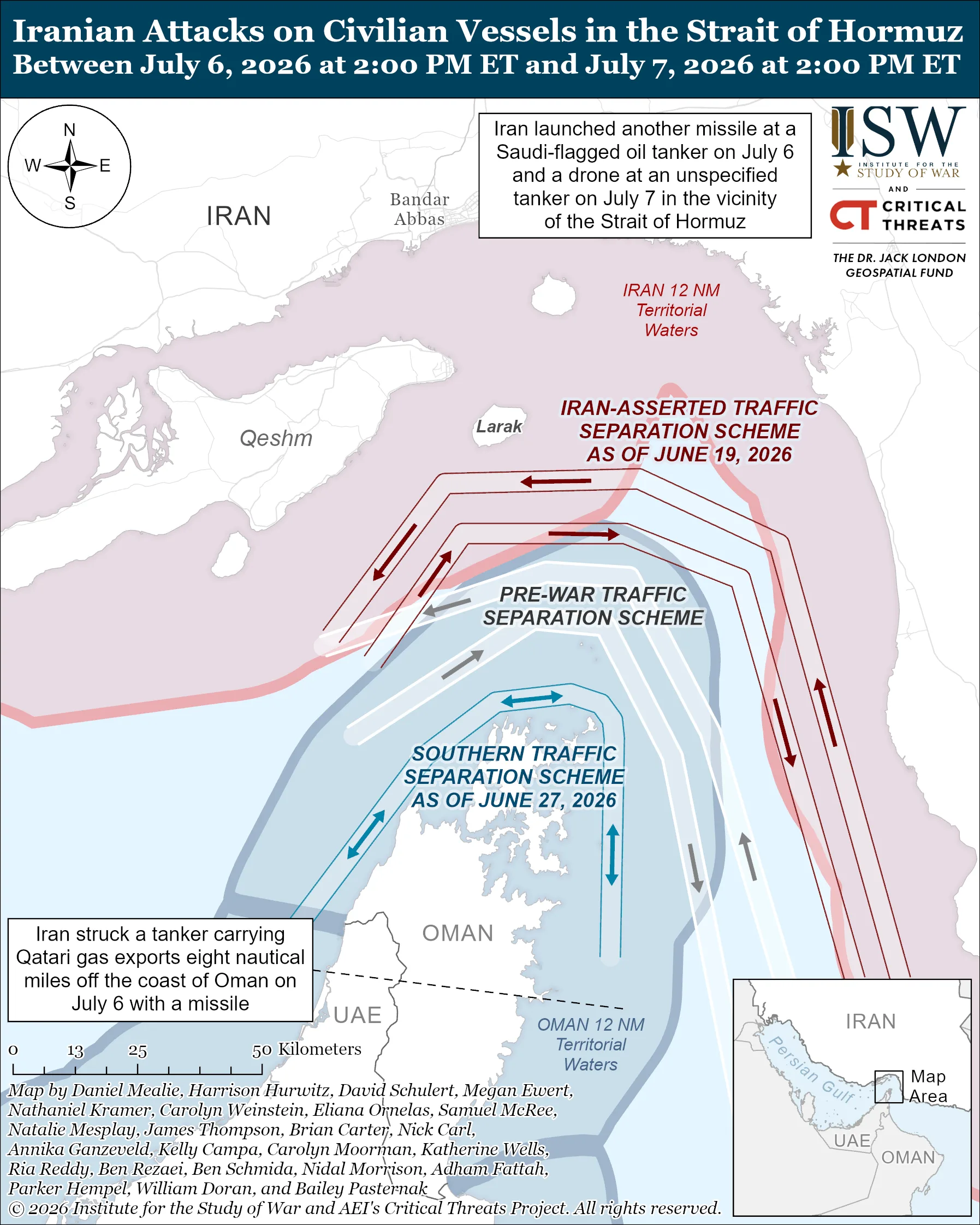
Iran's military and diplomatic efforts come as North Atlantic Treaty Organization (NATO) member Foreign Ministers are set to discuss how to handle the strait issue with Bahraini, Kuwaiti, Qatari, and Emirati foreign ministers on the sidelines of the NATO summit in Ankara, Turkey, on July 7, according to diplomats speaking to Reuters.[9] Saudi Arabia, Kuwait, and the United Arab Emirates (UAE) are reportedly working on plans to extend the energy pipelines that will allow them to circumvent the strait and mitigate Iranian disruption to their economies, according to multiple sources speaking to Reuters on July 7.[10]
Hezbollah is preparing to use Iranian funds to resume financial payments to displaced Lebanese families in Hezbollah's political strongholds as part of an effort to rebuild support among the Lebanese public.[11] Unspecified Lebanese political and financial sources told Emirati media on June 29 that Hezbollah is preparing to disburse temporary housing assistance payments and reconstruction funding to displaced families in southern Lebanon, Beirut's southern suburbs, and the Bekaa Valley, where the population has traditionally supported Hezbollah.[12] The sources claimed that Hezbollah has received Iranian funding to support its reconstruction efforts through unspecified Iraqi financial channels.[13] Iran has historically used the Iraqi economy and Iranian-backed Iraqi militias to transfer funds, among other supplies, to other Axis of Resistance groups, including Hezbollah.[14] Four informed sources told Reuters on June 17 that Iran would use potential economic relief from the US-Iran memorandum of understanding (MoU) to fund and reconstitute Hezbollah, though it is not immediately clear what — if any — resources have reached Hezbollah as a result of the MoU.[15] Reconstruction payments have long been one of many tools Hezbollah uses to financially assist Lebanese people affected by conflicts with Israel.[16] Hezbollah's financial challenges as a result of its investment in the War in Syria, and a decrease in Iranian funding after the collapse of Assad, have been one of several reasons that some communities in Lebanon are increasingly disenchanted with the group.[17] Hezbollah's financial challenges following the October 7 War and during the current Israeli campaign in Lebanon have generated unprecedented discontent among its Shia support base in recent years, however.[18] Hezbollah's efforts to resume financial payments to its support base also challenge the Lebanese government's efforts to assert itself as the sole provider of social services for the Lebanese people.
The Lebanese government is also simultaneously providing financial compensation and reconstruction support to southern Lebanese citizens and municipalities in recent days.[19] The Lebanese Social Affairs Minister Hanin al Sayed announced on July 4 that the ministry plans to provide financial compensation payments to 130,000 displaced Lebanese families in the coming days.[20] The Lebanese Health Ministry issued a $250,000 US dollar grant for repairs to the Tebnine Government Hospital, in Bint Jbeil District, on June 30.[21] Lebanese Agriculture Minister Nizar Hani announced a five-million-dollar project to provide emergency relief payments and reconstruction support for Lebanese farmers in war-affected areas on July 7.[22] The Lebanese government is also reportedly reviewing plans to provide financial support to families to repair “light and moderate damage” to their homes, offer rental allowances for displaced families unable to return to their homes, and provide temporary housing to displaced families, according to Saudi media on July 4.[23]
Lebanese media characterized the June 26 Trilateral Framework Agreement's Military Coordination Group for Lebanon as the primary mechanism for implementing the ceasefire in Lebanon.[24] The framework agreement's security annex stipulates that the coordination group will deconflict between Israel Defense Forces (IDF) and Lebanese Armed Forces (LAF) units in southern Lebanon and verify that both militaries implement the framework agreement's terms.[25] The coordination group will monitor and coordinate LAF movements to backfill the IDF as it withdraws from positions and LAF efforts to disarm Hezbollah in mutually agreed “pilot zones,” for example.[26] Lebanese media claimed on July 6 that the MGC4L is the direct successor body to the now-defunct ceasefire monitoring mechanism established in Lebanon at the end of the previous Israel-Hezbollah conflict in November 2024.[27] Lebanese media further clarified that US Marine Lieutenant General Joseph Clearfield, who previously led the 2024 ceasefire monitoring mechanism, will lead the coordination group.[28] The Lebanese government has not directly confirmed that the coordination group will operate as an exclusive mechanism for implementing the ceasefire, however. Lebanese President Joseph Aoun told Lebanese media in an interview on July 6 that the Lebanese government is not opposed to appointing a representative to the Iran-Lebanon-United States “deconfliction cell” that the Qatari Foreign Ministry announced on June 21.[29] Unnamed Lebanese government sources told other Lebanese media on July 7 that the government will appoint a representative once the involved parties agree upon a date to convene, and that the government may appoint Lebanese negotiating delegation leader and former Lebanese Ambassador to the United States Simon Karam to the position.[30] Lebanese media previously reported on July 6 that the Lebanese government had largely ignored the deconfliction cell, which requires the Lebanese government to appoint representatives to the cell before it can commence operations, after signing the framework agreement on June 26.[31]
Iran will likely continue to assert that the deconfliction cell is the main legitimate mechanism for implementing the ceasefire in Lebanon, however. Iranian regime officials and media have claimed since June that the framework agreement is illegitimate and demanded that the United States and Lebanon abandon ceasefire efforts outside of negotiations pursuant to the Iran-United States Memorandum of Understanding (MoU).[32] Iran seeks to promote its involvement in the ceasefire in Lebanon to dictate ceasefire terms that are favorable to Iranian and Hezbollah interests, such as the IDF’s full withdrawal from southern Lebanon and cessation of IDF attacks on Hezbollah.[33] Iran will likely challenge any assertions that the coordination group is the legitimate ceasefire implementation mechanism because its mission is to oversee a process that will disarm Hezbollah, which threatens Iran's core interest in Lebanon.[34] The degree of Iranian opposition to the coordination group will almost certainly be dependent on the efficacy of LAF disarmament efforts, however.
Iraq and Syria are preparing to sign a US-sponsored strategic economic agreement in mid-July, according to three unspecified Syrian, Iraqi, and Western sources speaking to Saudi media on July 7.[35] An unspecified Syrian source said that Syrian Foreign Minister Assad al Shaibani will meet with Iraqi Prime Minister Ali al Zaydi or other Iraqi officials on the sidelines of Zaydi’s visit to Washington, DC, in July 2026. The primary purpose of the July 2026 visit is for Zaydi to meet with US President Donald Trump.[36] A political adviser in a previous Iraqi administration confirmed that Zaydi is preparing to sign a regional economic agreement that includes Syria.[37] An unspecified Western source added that US Special Envoy to Iraq and Syria Tom Barrack plans to create the “core of a new alliance of interests,” which will include efforts to reduce regional reliance on the Strait of Hormuz by linking Iraq, Syria, and other regional countries to a shorter route to the Mediterranean Sea.[38] The Saudi report comes amid recent US pressure on the Iraqi federal government to reduce Iranian influence in Iraq, including via the disarmament of Iranian-backed Iraqi militias and combatting militia financial networks.[39]
https://understandingwar.org/research/middle-east/iran-update-special-report-july-7-2026/