Skip to comments.
Iranian Regime tv Channel One hacked while it was airing Khamenie speech
various
| 10-8-22
Posted on 10/08/2022 1:05:38 PM PDT by nuconvert
Iranian Regime national tv Channel One hacked about an hour ago. During a broadcast of Khamenie speech, a red crosshair appeared over his face and chanting of Women. Life. Freedom. There was writing to the side saying "Rise up. Join us". Also 4 photos at the bottom of the screen of young people killed and additional writing: "The blood of our youth is dropping from your paws".
Also, there was a huge banner in the middle of Tehran highway today that read: We are no longer afraid of you. We will fight.
Also, attempted attack on IRI ambassador in Denmark. Her bodyguard was stabbed. Diplomatic Security intervened before the attacker could stab the ambassador.
TOPICS:
KEYWORDS: basij; deathtothemullahs; denmark; ebrahimrigi; erdogan; iran; iranprotests; iraq; irgc; iri; israel; khameini; khamenei; kurdistan; lebanon; mahsaamini; mullahloversonfr; mullahsmustbekilled; najisharifizindashti; protests; qudsforce; raisi; receptayyiperdogan; shahrammaroufmola; syria; turkey; yemen; zahedi
Navigation: use the links below to view more comments.
first previous 1-20 ... 2,121-2,140, 2,141-2,160, 2,161-2,180 ... 2,401-2,406 next last
To: AdmSmith; PIF; BeauBo; adorno; MalPearce; USA-FRANCE; BroJoeK; rodguy911; nuconvert; blitz128
Thank you for providing this very detailed Iranian power structure graphic of current likely conditions. Of course it will be interesting to see how the graph will change over time, and see how it will influence our foreign policy and military actions.
2,141
posted on
06/09/2026 12:27:00 PM PDT
by
gleeaikin
(Question Authority: report facts and post their 'links" in your messages.)
Iran Update Special Report, June 9, 2026
The Iranian regime is attempting to use calibrated force in an attempt to extract concessions from the United States without triggering a full-scale US response. Recent statements from senior Iranian officials and regime-affiliated media suggest that Iran believes that it is at war—not in a ceasefire—and views military action as a tactic to improve its negotiating position to serve the regime's strategic objectives. Iranian Parliament Speaker Mohammad Bagher Ghalibaf stated on June 8 that Iran must use military action and diplomacy in a complementary way, in which Iranian military action creates favorable conditions for the regime so that diplomacy can turn these conditions into ”legal, political, and economic achievements.“[1] Regime-affiliated outlet Nour News argued on June 9 that the recent round of strikes between Iran and Israel occurred because each side is attempting to use limited military action in order to strengthen its position in negotiations without triggering a full-scale war.[2] These statements and regime media opinions suggest that the regime views negotiations as a continuation of the war with the United States and perceives military action as a tool to secure the regime's objectives in negotiations.
Iranian officials appear to be calibrating their response to avoid triggering a major US response. Iranian Foreign Affairs Minister Abbas Araghchi stated on June 9 that “foreign forces” are at constant risk due to their own errors and should leave the region because Iran will never be “hospitable” to their presence.[3] Araghchi‘s statement is likely a reference to the Iranian attack on the US Apache helicopter (see below) and notably stops short of explicitly naming or threatening US forces. The attack is consistent with Iran's broader effort to secure recognition of its control over the strait by deterring US intervention to protect maritime traffic, but the operation's limited scope suggests that Iran seeks to increase pressure on the United States through limited military action to secure greater concessions in negotiations while avoiding a return to full-blown war.
Iran has likely designed this new approach based on an assessment that the United States does not want to return to war.[4] Nour News, for example, highlighted that neither side wants to trigger a full-scale conflict, which implies that Nour News—a regime-affiliated outlet—believes that the United States does not want to return to war. US President Donald Trump has attempted to avoid a return to war. He has also said explicitly that he seeks to avoid war, which would increase Iran's confidence in its assessment.[5] Avoiding a return to large-scale operations is beneficial for Iran because it allows Iran to drag out the economic and political pressure on the United States and Israel. Iran faces its own economic pressure due to war damages and the US Navy blockade, but the Iranian regime only cares about economic damage insofar as it damages the regime's parochial interests and threatens regime security.
The recent escalation in Lebanon is also emblematic of this Iranian approach. ISW-CTP assessed on June 8 that the recent Iranian strikes and threats of future attacks are likely an attempt to deter US or Israeli military action against Iran's partners and proxies in the region (particularly Hezbollah), which are a central pillar of Iranian deterrence.[6] Iran has almost certainly observed discussions and leaks in Western media about the increasing tension between Trump and Netanyahu over Israeli strikes in Lebanon and Trump's fears that Israeli actions in Lebanon will cause US-Iran negotiations to collapse, for example.[7] Pressure from Trump on Netanyahu resulted in limited Israeli strikes that were carefully calibrated to avoid war, rather than restore deterrence vis-à-vis Iran. Such reports would increase Iranian confidence that Trump wants to avoid war. Trump's pressure on Israel increases the political risk of any strike in Beirut, thus limiting Israel's ability to degrade Hezbollah and threaten a key pillar of Iranian deterrence.
These strikes and Iranian efforts to link a complete ceasefire in Lebanon to a US-Iran ceasefire are part of an Iranian effort to secure a key objective, the survival of Hezbollah, and simultaneously distract the United States from discussions of Iran's nuclear program and Iranian efforts to control the strait and aim to reduce US leverage before negotiations on such issues.
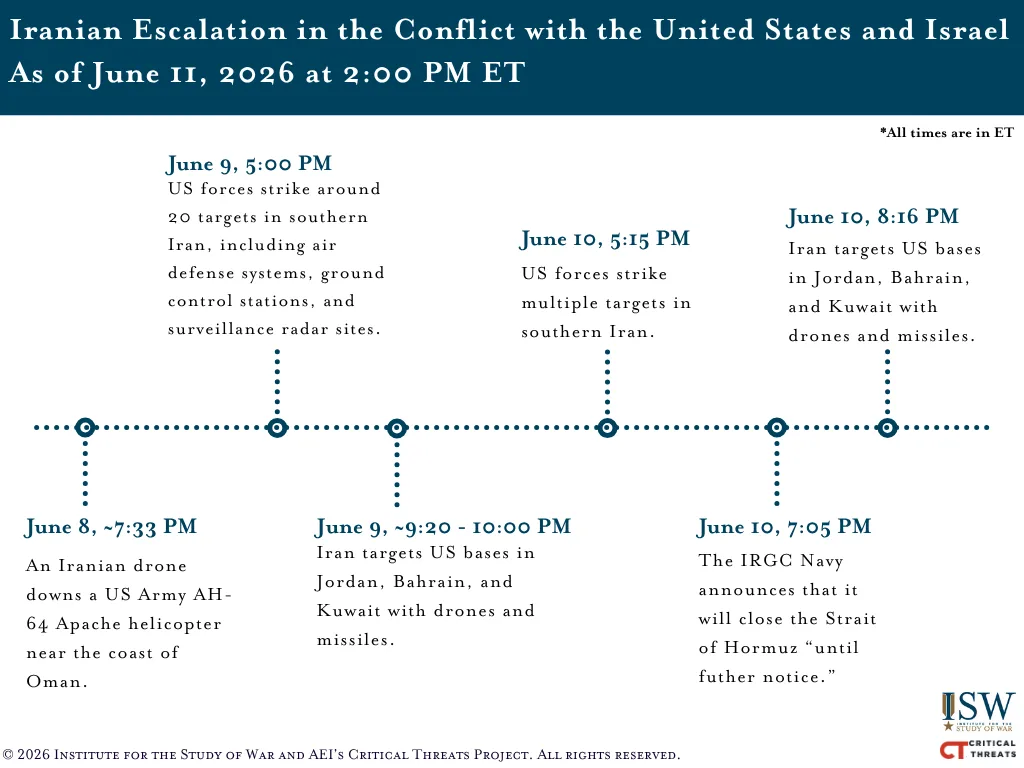
Iran is using force against US forces near the Strait of Hormuz, likely in an effort to deter US forces from operating in the Strait of Hormuz for any reason. This use of force is designed to achieve the Iranian war aim of asserting its control over the strait. An Iranian drone downed a US Army AH-64 Apache gunship near the coast of Oman on June 8.[8] US President Donald Trump stated on June 9 that Iranian air defenses shot down a US Apache helicopter while the helicopter was patrolling in the Strait of Hormuz on June 8.[9] A US source told CNN on June 9 that an Iranian Shahed drone struck the US Apache helicopter.[10] Iran possesses a jet-powered interceptor variant of the Shahed, which may have downed the US Apache helicopter, according to a drone analyst.[11] Iran has not claimed responsibility for the Apache incident at the time of this writing, and Iranian Deputy Foreign Minister Majid Takht Ravanchi denied Iranian involvement to Al Jazeera on June 9.[12] CENTCOM spokesperson Captain Timothy Hawkins announced on June 9 that a US Navy Corsair unmanned surface vessel (USV) rescued the two crew members within two hours of the incident on June 8, marking the Navy's first USV search-and-rescue mission.[13] Both crew members are in stable condition.[14] Trump emphasized that the United States must respond to the Iranian attack.[15] ISW-CTP is monitoring reports of a ”proportional” US response as of 5:50 PM ET on June 9.[16] ISW-CTP will provide more details on the US response in its June 10 morning thread and evening update.
Iran likely targeted the Apache due to the role Apache gunships can play in air defense against Iranian drones over the strait or in intercepting Iranian fast attack craft. Lloyd's List, a maritime intelligence firm, told CNBC on June 4 that the US Navy has coordinated the transit of nearly 40 vessels via the Strait of Hormuz over the past three weeks.[17] Lloyd's List's chief editor told CNBC on June 4 that “the assumption is that the US Navy is providing limited assurances that it will intercept incoming threats against commercial ships.”[18] A US CENTCOM spokesperson denied to the Wall Street Journal that US forces escorted commercial vessels but confirmed that US forces continually communicate and coordinate with vessels transiting the Strait of Hormuz on May 24.[19] US Apache gunships engaged Iranian fast attack craft during Project Freedom on May 4, and Emirati Apache gunships have intercepted incoming Iranian drones.[20]
The Iranian attack on the US Apache helicopter comes amid repeated Iranian efforts to use coercive measures, including force, in and around the Strait of Hormuz to force vessels to transit through Iran's illegal traffic separation scheme and comply with Iran's protection racket.[21] Iran almost certainly perceives US efforts to facilitate the safe passage of vessels through the strait as a threat to this broader effort to assert control over the strait. Iran has previously used force to threaten US naval forces in the strait in order to try to increase the risk to US forces protecting vessels and deter such US efforts.[22]
The Iranian regime has continued to signal that it will not accept the United States’ latest nuclear demands. The New York Times, citing US officials and diplomats who have been briefed on the confidential talks, reported on June 8 that there are four major points of discussion between the United States and Iran, including a suspension of uranium enrichment for ten to 20 years, the dilution of Iran's highly enriched uranium (HEU), the dismantling of Iran's major nuclear sites at Natanz, Fordow, and Esfahan, and the ability of International Atomic Energy Agency inspectors to be able to conduct “snap” inspections.[23] Ebrahim Azizi reiterated on June 9 that the regime is not negotiating on any nuclear issues at this time and that the two sides are not close to reaching an agreement.[24]
The Houthis continue to threaten to restrict commercial shipping in the Bab el Mandeb Strait and the Red Sea, but they have not yet conducted attacks to realize these threats. Houthi Political Bureau member Mohammed al Bukhaiti told Russia Today India on June 9 that the Houthis have imposed a “blockade” against Israel and may target “any vessel heading to Israel.[25] Bukhaiti noted that the Houthis are using the Bab el Mandeb Strait as “leverage” to pressure Israel to stop operations against Hamas and Hezbollah.[26] Bukhaiti’s statement comes after the Houthis announced on June 8 that they will target Israeli vessels in the Red Sea.[27]
The Houthis launched a drone targeting Eilat Port in southern Israel on June 8, which Israel successfully intercepted.[28] The Houthis have yet to take responsibility for the drone attack at the time of this writing. The drone attack on Eilat comes after the Houthis launched two missiles reportedly targeting Tel Aviv in central Israel on June 8, one of which Israel intercepted. The other fell in Saudi territory.[29]
Hezbollah and Iran appear not to have effectively deterred Israel from striking Hezbollah targets in southern Lebanon. The Khatam ol Anbia Central Headquarters, which is Iran's top operational headquarters, warned on June 8 that Iranian forces would inflict “much more severe and crushing measures” if the IDF continued to conduct operations against Hezbollah across Lebanon, including in southern Lebanon.[30] The Iranian warning occurred after Iran launched missiles at Israel on June 7 following Israeli strikes on a Hezbollah first-person view (FPV) drone headquarters in Beirut's southern suburbs, which Israel conducted in response to a Hezbollah attack on northern Israel.[31] The Iranian warning implied that any Israeli kinetic activity in Lebanon, including responses to Hezbollah attacks, may elicit an Iranian attack on Israeli territory.[32] ISW-CTP assessed on June 8 that Hezbollah likely seeks to benefit from Iran's threat to respond to any Israeli attack against Hezbollah because such threats seek to inject uncertainty into Israel's decision-making process for military operations against Hezbollah.[33]
The IDF has continued strikes on Hezbollah infrastructure in southern Lebanon on June 8, however.[34] Senior Israeli officials stated on June 8 and 9 that Israel will not allow Hezbollah and Iran to deter Israel from striking Hezbollah targets in Lebanon and will respond to any Hezbollah or Iranian attacks on Israeli territory.[35] Senior Israeli cabinet officials said that any Hezbollah fire intended to cross the border into Israel will trigger strikes on Beirut, according to Israeli media on June 9.[36] Netanyahu said on June 8 that Hezbollah and Iran are attempting to limit IDF freedom of action, which is “intolerable and unacceptable.”[37] Netanyahu stated that if Iran attacks Israel again, Israel will “respond forcefully.”[38] Hezbollah and Iran have not conducted any attacks on Israeli territory since ISW-CTP’s last data cut off on June 8 at the time of this writing, and the IDF has limited its strikes to southern Lebanon.
US and Lebanese officials provided additional details on a US-Israeli-Lebanese framework to deploy the Lebanese Armed Forces (LAF) to “pilot zones” in southern Lebanon.[39] The United States, Israel, and Lebanon issued a joint statement on June 3 announcing that they would coordinate to establish zones south of the Litani River where the LAF would establish territorial control “to the exclusion of all non-state actors.”[40] The LAF will reportedly operate in these zones to confiscate weapons and protect civilians returning to evacuated areas.[41] Lebanese President Joseph Aoun told Western media on June 5 that these ”pilot zones” will be established once a complete ceasefire takes effect.[42] Aoun proposed that Israel and Lebanon first establish a “pilot zone” near Beaufort Castle and that the LAF replace the Israeli forces that seized the area on May 31.[43] US Ambassador to Lebanon Michel Issa told Lebanese media on June 9 that Israeli forces will refrain from conducting kinetic activity in these zones.[44] Issa said that the LAF will move to new areas and conduct further disarmament operations after disarming the initial zones in an effort to eventually clear all of southern Lebanese territory of non-state weapons.[45]
Israeli forces exchanged fire with an unspecified militia fighter near the Israel-Lebanon border on June 9.[46] The IDF determined in an investigation that the gunman wore a “military uniform” and entered Israeli territory in the early afternoon of June 9, but failed to cross the Israeli border fence, which is several meters past the border within Israel.[47] Israeli soldiers in a community nearly one mile away responded to reports of gunfire near the border and killed the gunman, who acted alone and carried only a knife and a handgun.[48] The lone gunman's light armament, conspicuous military dress, and daytime movement suggest a very amateur and uncoordinated infiltration attempt rather than a well-coordinated military operation.
Iraqi political sources told Iraqi media on June 9 that they “anticipate” that only parties unaffiliated with Iraqi militias’ parties will fill the nine remaining Iraqi ministerial positions.[49] The Iraqi parliament approved 14 out of 23 ministers of incumbent Prime Minister Ali al Zaydi’s government on May 14 but multiple key ministries, including the defense and interior ministries, remain unfilled.[50] The United States opposes the allocation of any ministerial portfolio to political parties tied to Iranian-backed Iraqi militias, even if the militias announced their disarmament.[51] ISW-CTP continues to assess that Iranian-backed Iraqi militias Asaib Ahl al Haq and Kataib Imam al Ali may have signaled on June 2 their willingness to disarm to reduce US opposition to their political wings participating in the next Iraqi government in non-cabinet level roles.[52]
https://understandingwar.org/research/middle-east/iran-update-special-report-june-9-2026/
2,142
posted on
06/10/2026 7:14:01 AM PDT
by
AdmSmith
(GCTGATATGTCTATGATTACTCAT)
To: AdmSmith; nuconvert; BeauBo; adorno; rodguy911; USA-FRANCE
If Israel succeeds in totally destroying this large Hezbollah base, especially collapsing the entire structural area, will this force Hezbollah to hide above ground and thus be much more vulnerable to Israel and perhaps even Lebanese government attack and destruction? If this hidden underground base that Iran has apparently financed for a decade is totally gone, does IRGC have the resources to help them rebuild another operational hiding headquarters? Or would this be a death blow to Hezbollah and IRGC/Iranian influence in that region?
2,143
posted on
06/10/2026 9:02:20 AM PDT
by
gleeaikin
(Question Authority: report facts and post their 'links" in your messages.)
To: gleeaikin
A year after Operation Rising Lion and the subsequent Operation Roaring Lion, it is becoming clear that the impressive operational achievements in Iran created a strategic situation more challenging and complex than ever.
The arrogance and mistaken assumptions of Israel’s security establishment did not lead to regime change in Tehran, but helped entrench an extremist, self-confident regime that is not deterred and continues to strengthen its nuclear project and missile stockpiles. Now, as the US administration pushes for a deal and limits Jerusalem’s freedom of action, Israel appears to be left with only problematic options.
https://x.com/citrinowicz/status/2064713789652549838
2,144
posted on
06/10/2026 9:15:37 AM PDT
by
AdmSmith
(GCTGATATGTCTATGATTACTCAT)
To: AdmSmith; PIF; BroJoeK; nuconvert; adorno; Political Junkie Too; Alas Babylon!; SunkenCiv
A lot of interesting thoughts laid out from comment 2138 thru 2140. As a quick response I would say a key difference is that with the top leadership killed at one blow by Israel, a lot of institutional politically strategic thinking was also destroyed. In the short run, at least, a number of aggressive thinkers who may have been suppressed by former leaders now have the opportunity to raise their ugly heads and seek power. There will likely be serious internal struggles, but eventually the more politically intelligent will likely rise to the top. How much more damage is done within Iran and by us and Israel before that happens remains to be seen.
A lot will depend from our perspective on what happens with potential Democrat wins short (2026) and long (2028) term. To what extent will the sympathies for the murdered Iran protesters and Republican desires to support Trump’s in this war determine our continued efforts in Iran? Would Democrat victory or a very different Republican leadership win in 2028 bring back the long term military expertise and limit Trump’s personal diplomats, to provide the kind of serious diplomacy and military efforts needed to prevent a nuclear Iran?
Right now the IRGC seems to be top dog, but they are already fighting water and power battles within Iran. They will have a serious problem dealing with their water crisis, unless there is a significant shift in our world wide drought, or some seriously scientific approaches are taken. Iran must correct the half century of Mullah neglect of a 2,500 year successful Persian water management system. This neglect currently prevails, and I suspect IRGC lacks the mentality to approach it effectively. The question is whether political leaders in our own country are able to think and plan with these facts in play? More thoughts in a day or two.
2,145
posted on
06/10/2026 9:47:33 AM PDT
by
gleeaikin
(Question Authority: report facts and post their 'links" in your messages.fr)
Iran Update Special Report, June 10, 2026
Iran is using force, combined with the threat to suspend US-Iran negotiations, to try to deter the United States from conducting further attacks on Iran that would likely make it more difficult for Iran to achieve its strategic objectives, which include solidifying control over the Strait of Hormuz and preserving the Axis of Resistance. US forces struck around 20 targets in southern Iran, including air defenses, ground control stations, and surveillance radar sites, on June 9 in response to Iran's drone attack that downed a US Apache helicopter off the coast of Oman on June 8.[1] Iranian forces responded by conducting several drone and missile attacks targeting US bases in Jordan, Kuwait, and Bahrain.[2] US forces intercepted all of the projectiles except for one that landed in the vicinity of the US Navy 5th Fleet Headquarters in Manama, Bahrain, with no reported casualties at the time of this writing.[3] The Iranian regime likely intended for these strikes to have an informational effect by signaling to the United States that Iranian forces would be prepared to resume the war with the United States if necessary. The Iranian regime likely calculated that the United States would not resume the war in response to these strikes given recent reports that US President Donald Trump would prefer a negotiated settlement over a resumption of conflict. Iranian Foreign Affairs Ministry Spokesperson Esmail Baghaei separately stated on June 10 that Iran will “review” negotiations with the United States in light of the US self-defense strikes on Iran on June 9.[4] This comment is also part of the Iranian informational campaign aimed at deterring further US military action against Iran because Baghaei is implicitly threatening to suspend negotiations if the United States takes military action against Iran.[5] Iran is exploiting the current situation in which it has neither made concessions in negotiations nor faces continuous large-scale strikes from the United States and Israel to advance its objectives, such as normalizing Iranian control over the Strait of Hormuz. ISW-CTP previously assessed that the Iranian regime likely calculates that the status quo is favorable to achieving its objectives.
Iran has repeatedly used calibrated force in recent weeks as part of a series of campaigns to try to achieve its strategic objectives. Iran launched missiles at Israel on June 7 to pressure US President Donald Trump to convince Israel to halt its operations against Hezbollah in Lebanon.[6] These attacks were part of a broader Iranian effort to preserve Hezbollah, which it views as a key pillar of its deterrence strategy vis-a-vis Israel and the United States.[7] Iran has also used force, including attacks on US forces in the Gulf and the drone attack on the Apache helicopter, to try to deter the United States from enforcing its naval blockade and interfering with Iranian efforts to control the strait.[8] Iranian officials and media have repeatedly emphasized that Iran will not concede on control of the strait, its proxy and partner network, and its nuclear program because it views these things as central pillars to its national security strategy to deter future attacks by the United States and Israel.[9]
ISW-CTP is monitoring reports of additional US strikes in Iran as of 5:36 PM ET on June 10. CTP-ISW will provide more details on the US strikes in its June 11 morning thread and evening update. President Trump threatened earlier on June 10 to strike Iranian power plants and bridges if Iran did not make progress in negotiations.[10]
The Israel Defense Forces (IDF) is continuing to strike Hezbollah targets and conduct ground operations in southern Lebanon, despite Hezbollah and Iranian efforts to deter Israel from continuing its campaign in Lebanon. ISW-CTP assessed on June 8 that Hezbollah likely seeks to benefit from Iran's threat to respond to any Israeli attack against Hezbollah because such threats seek to inject uncertainty into Israel's decision-making process for military operations against Hezbollah.[11] Senior Israeli officials stated on June 8 and 9 that Israel will not allow Hezbollah and Iran to deter Israel from striking Hezbollah targets in Lebanon and will respond to any Hezbollah or Iranian attacks on Israeli territory.[12] The IDF continued to strike Hezbollah targets, including rocket and drone launch sites, in southern Lebanon on June 9 and 10.[13] IDF units, including the 869th Brigade Reconnaissance Unit (91st Division) and the 84th (Givati) Infantry Brigade (91st Division), have continued to seize and destroy Hezbollah weapons caches and infrastructure and kill the group's fighters in southern Lebanon in recent days.[14] Lebanese security sources told Saudi media on June 10 that the IDF is attempting to advance along the Beaufort Castle axis toward Kfar Tebnit and Ali Taher Hill in southeastern Lebanon and along the Biyyadah axis toward Majdal Zoun and Mazraat Buyut al Sayad in southwestern Lebanon.[15] Kfar Tebnit and Ali al Taher are both located on high ground, which is favorable for observing Hezbollah ground force movements.[16] The IDF and Hezbollah launched strikes against each other along both axes on June 10.[17]
Iranian-backed Iraqi militia Kataib al Imam Ali submitted files and data related to its members, weapons, and vehicles to the Iraqi federal government's disarmament committee.[18] The Iraqi federal government began trying to restrict arms to the state on June 4 through the disarmament and integration of Iranian-backed Iraqi militia fighters into the Iraqi security establishment, including the Iranian-backed Popular Mobilization Forces (PMF).[19] The PMF is an Iraqi state security service that includes many Iraqi militias, such as Kataib al Imam Ali, that answer to Iran instead of the Iraqi prime minister.[20] Kataib al Imam Ali controls the 40th PMF Brigade.[21] Kataib al Imam Ali announced on June 2 that it would begin to “disengage” from the PMF and restrict weapons to the Iraqi state, possibly to overcome US opposition to the group's involvement in the next Iraqi government.[22] Kataib al Imam Ali could also seek to fill a portion of the 35,000 jobs in Iraqi security institutions that Iraqi Prime Minister Ali al Zaydi has reportedly proposed to be allocated to militia members who disarm.[23]
It will be difficult for the Iraqi federal government to confirm the degree of Kataib al Imam Ali's transparency and honesty given the extent to which Iranian-backed Iraqi militias have routinely obscured their operations from the Iraqi state. Iranian-backed Iraqi militias operate covertly due to their very nature as “resistance” organizations.[24] The PMF, which the militias are supposed to integrate into, also operates with limited Iraqi government oversight.[25] The Iraqi federal government, under former Prime Minister Haider al Abadi, tried and failed multiple times to audit the PMF.[26] PMF officials have deliberately hidden information such as the size of the PMF from the Iraqi federal government, for example.[27] Militias that control PMF brigades also manage illicit financial networks that Iran uses to evade US sanctions.[28] ISW-CTP continues to assess that any Iraqi federal government attempt to disarm the militias and integrate them into the Iraqi security establishment that does not address the militias’ networks and allegiance to Iran will likely further embed Iranian influence within the Iraqi state.
https://understandingwar.org/research/middle-east/iran-update-special-report-june-10-2026/
2,146
posted on
06/10/2026 10:56:30 PM PDT
by
AdmSmith
(GCTGATATGTCTATGATTACTCAT)
To: nuconvert
IRGC better watch their ass if they attack the Peshmerga,those guys are the real deal.Boots on the ground with the Peshmerga/Iranian Kurds has alwasy been the answer to stop the IRGC.If they got logistics help from the US and Israel IRGC would not last long.
2,147
posted on
06/11/2026 2:44:40 AM PDT
by
rodguy911
(HOME OF THE FREE BECAUSE OF THE BRAVE!! ITS ALL A CONSPIRACY: UNTIL ITS NOT))
To: AdmSmith
According to Trey Yingst, Trump said that Iran has today to sign the deal or the bombing will continue tonight.
2,148
posted on
06/11/2026 4:24:58 AM PDT
by
nuconvert
( Warning: Accused of being a radical militarist. Approach with caution.)
To: nuconvert
Currently, the military wing likely dominates the decision-making process in Iran. The government’s role is primarily limited to managing internal affairs, particularly in logistical and economic matters, while its involvement in sovereign decision-making is restricted to procedural functions carried out mainly by the Minister of Foreign Affairs and, to a lesser extent, by the President of the Republic.
The Iranian Parliament exercises limited influence, with its role is largely confined to Speaker Mohammad Bagher Ghalibaf – who leads the negotiating team but whose powers are restricted – and a small group of his deputies. Parliamentary blocs, including hardline factions, remain largely ineffective due to the suspension of parliamentary sessions during wartime.[ix]
The headquarters of Khatam al-Anbiya, dominated by the Revolutionary Guard and led by General Abdollahi[x] (a two-star general, the highest military rank available in the Iranian military establishment), includes influential figures such as General Mostafa Izadi[xi] (a two-star general) and General Mohammad Jafar Asadi[xii] (commander of Iranian forces in Syria prior to the collapse of the Assad regime).
The Islamic Revolutionary Guard Corps (IRGC) is the dominant military institution both domestically and in the conflict with the United States and Israel. It is currently led by General Ahmad Vahidi (a two-star general) – with news of his potential assassination in strikes just breaking[xiii] – with General Hojjatollah Qureshi[xiv] as deputy. General Ali Ozmaei (a one-star general) commands its naval forces, while General Majid Mousavi oversees its air and missile forces.
Conclusion: A prolonged transitional period
While the wave of assassinations has weakened the Revolutionary Guard’s leadership structure, several generals and commanders within the organization can still be considered influential in the current decision-making process. These include senior Revolutionary Guard commanders Mohsen Rezaei, Yahya Safavi, and Mohammad Ali Jafari, along with Hossein Taeb, the former head of the Revolutionary Guard’s intelligence organisation.
Ultimately, Iran appears to be entering a difficult transitional period depending on regional and international developments, which is unlikely to be brief. As a result, ongoing negotiations with Iran are taking place amid political and institutional fragmentation, making it difficult to reach final decisions and complicating effective communication with influential actors within the Iranian political landscape.
https://manaramagazine.org/2026/06/irans-hierarchical-to-flat-leadership/
https://en.wikipedia.org/wiki/Khatam_al-Anbiya_Central_Headquarters
2,149
posted on
06/11/2026 1:44:53 PM PDT
by
AdmSmith
(GCTGATATGTCTATGATTACTCAT)
Iran Update Special Report, June 11, 2026
The Iranian regime is using information operations to magnify the informational effect of its strikes as part of an effort to compel the United States to accept an agreement that is relatively advantageous to Iran. Iran does not view the current phase in the conflict as negotiations in pursuit of a deal; it believes it is at war and that war will end with a deal. The Supreme Leader's website argued on June 10 that Iran is “not afraid” of a ceasefire collapse, which aims to suggest to the United States that Iran does not fear a return to conflict.[1] These messages magnify the informational effect of Iranian strikes across the region. These regional strikes are not militarily effective, but they create an informational effect by demonstrating that Iran is not concerned about going to war. This improves Iran's position in negotiations by demonstrating to the United States that Iran is willing to resume the conflict if it does not get what it seeks in a deal—namely, control of the Strait of Hormuz, and the release of frozen funds, among other issues.
The Iranian regime likely assesses that the United States does not seek a return to the conflict. The campaign described above seeks to leverage US fears about a return to conflict. The regime has almost certainly observed and reacted to US statements in the Western press.[2] Iranian regime-affiliated Nour News, for example, highlighted that neither side wants to trigger a full-scale conflict, which implies that Nour News believes that the United States does not want to return to war.[3] US President Donald Trump has said explicitly that he seeks to avoid war, which would presumably increase Iran's confidence in its assessment.[4] US Vice President JD Vance similarly said that he believes the United States and Iran can reach a deal, which implies he continues to support a diplomatic track, which also would increase Iran's confidence that the United States does not want to return to war at this time.[5]
Iran's strikes on US bases and assets are also designed to have primarily informational and economic effects, rather than military effects. Iran responded to US airstrikes targeting Iranian military capabilities on June 11 (see below for report on US airstrikes and timeline of events) with drone and missile attacks on US bases in Bahrain, Kuwait, and Jordan, as Iran had previously done on June 10.[6] These strikes had little military effect. But the strikes appeared designed to upset markets—thereby increasing economic pressure on the United States—and trigger fears that Iran may be willing to resume the war.
Iran continues to demonstrate that it is unwilling to yield to US military pressure and come to an agreement. Axios also reported on June 11, citing unspecified sources, that Qatari and Iranian officials believed they had reached an ”agreed-upon text” that the United States would also accept.[7] The IRGC outlet's source also claimed that the United States will eventually have to accept the main frameworks of Iran's text.[8] Iran's denial and the narrative spread by the IRGC outlet suggest that Iran is trying to preserve its negotiating position and avoid creating the impression that US military pressure forced Iran to accept US terms as well.
Iran also knows that not conceding and amplifying its denial imposes political and economic cost on the United States as well. Supreme Leader Military Adviser Mohsen Rezaei warned on June 11 that the United States must choose between accepting Iran's terms and losing “the last shred of its credibility.”[9] Parliamentary National Security and Foreign Policy Committee member Esmail Kowsari similarly claimed on June 11 that the war has imposed pressure on the US economy and that Trump is pressuring Iran to achieve his goals.[10] Iran's announcement that it has “closed” the Strait of Hormuz is an extension of Iran's information operation to heighten political and economic pressure on the United States by amplifying its military operations in the region. The Persian Gulf Strait Authority separately announced on June 11 that the strait is closed and told vessels that previously received transit permits to remain “patient” and await further guidance.[11] It remains unclear whether Iran's statement will translate into changes to its existing coercive maritime behavior.
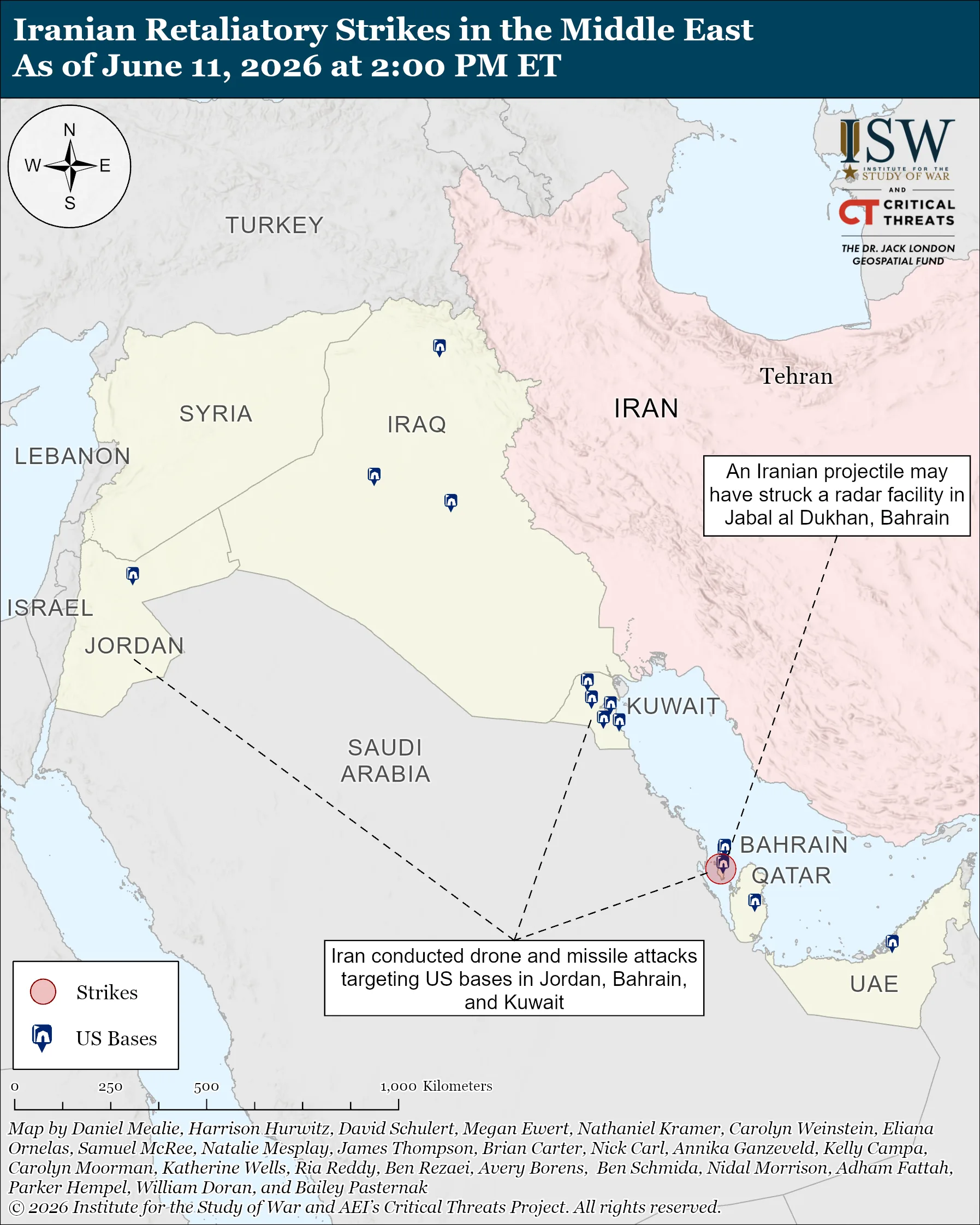
US President Donald Trump's announced on June 11 that he canceled scheduled strikes against Iran on the night of June 11 after discussions with Iran reached the “highest level” of Iranian leadership.[12] IRGC-linked Fars News Agency later denied that Iranian leaders had approved the deal, but later clarified that it would “likely” be approved because the United States approved Iran's text.[13] It is unclear what precisely is in the text. ISW-CTP will provide further analysis on June 12.
The United States is attempting to degrade Iran's ability to sense, target, and strike vessels moving through the Strait of Hormuz and US air assets protecting their transit. US Central Command (CENTCOM) announced on June 10 that US forces struck Iranian air defenses, surveillance assets, radar systems, and drone command units in southern Iran to degrade Iran's ability to track, coerce, and attack US forces and commercial vessels in the Strait of Hormuz.[14] Satellite imagery confirmed that US forces struck Bandar Abbas International Airport on June 10, and open-source social media users and Iranian media reported explosions across southern Iran, including Qeshm Island, Kish Island, and Minab City in Hormozgan Province near the Strait of Hormuz on June 10.[15] The June 10 strikes followed an exchange of fire between the United States and Iran on June 9. Iran initiated the most recent escalation when an Iranian drone downed a US Apache helicopter off Oman on June 8 while it was operating over the strait.[16] US forces also struck multiple targets on the outskirts of Tehran City, but ISW-CTP is unable to verify what these strikes targeted at this time.[17]
The United States has also continued to enforce its blockade on Iranian ports as part of its economic pressure campaign on Iran. CENTCOM announced that US forces disabled the Guinea-Bissau-flagged oil tanker M/V Jalveer on June 10 after the vessel attempted to violate the US blockade and transport Iranian oil outside of Iran.[18] The strike that disabled the vessel injured some crew members.[19] This is the third Iranian-linked vessel that US forces have disabled this week for failing to comply with the US blockade.[20] CENTCOM forces also disabled the Palau-flagged oil tanker M/T Settebello as it transited the Gulf of Oman on June 9 and disabled the Palau-flagged oil tanker M/T Marivex as it transited international waters in the Gulf of Oman toward Iran on June 8.[21] CENTCOM also announced on June 11 that US forces have disabled ”nine non-compliant vessels,” redirected 135 ships that attempted to run the US blockade, and allowed 42 vessels with humanitarian aid to transit since the United States initiated the blockade on April 13.[22]
Senior Emirati and Iranian national security officials held an in-person meeting for the first time since the start of the US-Israeli war against Iran, according to Bloomberg on June 11, citing people familiar with the matter.[23] The United Arab Emirates (UAE)’s motivation to meet with Iran was to reportedly ease tensions with Iran, according to the sources.[24] Emirati officials have reportedly become more disillusioned with the prospect of Iranian regime change and the United States and Iran achieving a political settlement.[25] Emirati officials also reportedly remain concerned about the fragility of the US-Iran ceasefire and threats to shipping through the Strait of Hormuz — both of which have damaged the UAE’s economy and security.[26] Iranian officials pushed for a high-level meeting with the UAE, but the Emiratis waited until their Iranian point of contacts could prove they had a direct line to Supreme Leader Mojtaba Khamenei and the IRGC, according to Bloomberg’s sources.[27] Bloomberg assessed that the talks had positive results for the Emiratis and noted that Iran has not fired at the UAE since Iran targeted the Barakah Nuclear Power Plant on May 17.[28] Iran has targeted Kuwait, Bahrain, and Jordan on June 9 and 10, however.[29]
The Israeli Foreign Ministry claimed on June 11 that Hezbollah launched drones targeting three locations within Israeli territory on June 10 and 11.[30] Hezbollah claimed that it launched fixed-wing drones targeting an Israel Defense Forces (IDF) border post at Nimr al Jamal, northern Israel, on June 11.[31] The IDF did not report any attacks targeting Israeli territory on June 10 or 11. The IDF did report Hezbollah drone attacks on Israeli forces in southern Lebanon, which triggered air raid sirens in near-border Israeli communities, however.[32] Israeli political leaders and the IDF have repeatedly warned since June 1 that the IDF would conduct airstrikes on Hezbollah targets in the Beirut area if Hezbollah attacks northern Israel.[33]
more + maps: https://understandingwar.org/research/middle-east/iran-update-special-report-june-11-2026/
2,150
posted on
06/11/2026 10:20:05 PM PDT
by
AdmSmith
(GCTGATATGTCTATGATTACTCAT)
To: AdmSmith
Iran Update Special Report, June 12, 2026
Persistent internal disagreements remain among Iranian regime leaders over the concessions that the regime should accept in negotiations with the United States. Islamic Revolutionary Guards Corps (IRGC) Commander Major General Ahmad Vahidi and his inner circle, whom ISW-CTP currently assesses are driving regime decision-making, appear to continue to seek an agreement that meets Iranian maximalist demands and would be tantamount to a US surrender. Islamic Development Organization (IDO)-affiliated outlet Mehr News Agency published a version of the draft US-Iran memorandum of understanding (MoU) on June 12 that includes all key Iranian demands, including Iran's retention of “management” of the Strait of Hormuz, the release of frozen Iranian assets, and a US-funded reconstruction plan for Iran.[1] Multiple Iranian outlets, including IRGC-affiliated outlets and state media, recirculated this report or similar readouts of the draft MoU.[2] That IRGC-affiliated outlets are circulating this maximalist draft of the MOU suggests that this purported draft reflects the views of IRGC leaders. ISW-CTP continues to assess that the IRGC, particularly Vahidi and his inner circle, currently dominates regime decision-making and has repeatedly pushed for uncompromising, maximalist negotiating positions, suggesting that the regime is likely to adopt a similar approach.[3] Some outlets that are not affiliated with the IRGC also circulated this “draft” and expressed hardline and maximalist demands, however.[4]
Other Iranian officials appear to have disputed the MOU leaked by IRGC-linked and state media, which suggests that Iranian officials continue to disagree about which concessions the regime should accept, if any. Iranian Foreign Affairs Minister and lead negotiator Abbas Araghchi called on media outlets on June 12 to avoid publishing speculation about the MoU’s content.[5] US President Donald Trump later reposted Araghchi’s statement on TruthSocial.[6] Araghchi may have issued his statement in response to the circulating “draft“ MOU readouts in Iranian media, Western media reports that are discussing the MoU’s details, or both. Iranian Parliamentarian and Paydari Front member Mahmoud Nabavian published a statement criticizing the details of the deal and described terms of the deal that are notably different from those reported by IRGC- and IDO-affiliated outlets.[7] The Paydari Front is a separate faction that is more hardline than the faction of Vahidi and the IRGC traditionally are. Nabavian stated that the agreement would end the IRGC’s current control over the strait immediately after the agreement is signed and that it does not explicitly address US sanctions on Iran.[8] Iranian state media outlet IRNA’s readout explicitly notes that the agreement does not require Iran to relinquish management over the strait and lifts sanctions on Iranian oil exports.[9] These competing accounts suggest either that the publicly circulated reports do not accurately reflect the current draft under discussion or that multiple drafts are circulating among rival factions within the regime.
The opposing viewpoints in Iran should not be surprising, considering the fractured nature of Iranian leadership and politics at present. Iran is in the middle of a transition period from Supreme Leader Ali Khamenei to his son, Mojtaba. Various power centers are jockeying for power and attempting to influence negotiations. ISW-CTP continues to assess that IRGC commander Major General Ahmad Vahidi’s circle retains the most relative power based on its closeness to Supreme Leader Mojtaba Khamenei.[10] Vahidi, according to reports in April, is serving as an interlocutor between Mojtaba and the government.[11] This suggests Vahidi has assumed a chief of staff-esque position, which is relatively unprecedented for an IRGC commander.
Conflicting reporting about the MOU’s contents and progress likely reflects not only the persistent divisions between the IRGC and the formal Iranian negotiating team but also the way in which both parties are engaging with mediators separately from one another. Araghchi posted on X on June 12 that an agreement has “never been closer.”[12] The Wall Street Journal, citing unspecified mediators, reported that neither Supreme Leader Mojtaba Khamenei nor the IRGC has approved the latest MoU, however.[13] The IRGC in this context presumably refers to Vahidi, who is the IRGC commander. The report added that different mediators are separately engaging the ”diplomatic channel” and the IRGC.[14] That mediators are engaging the formal Iranian negotiating team and IRGC separately is likely indicative of the fissures between the two camps and suggests that the two camps have been unable to reach any internal consensus. The two camps could even be competing to influence the final agreement. US officials told Axios in April that the IRGC effectively told the Iranian negotiating delegation upon their return to Tehran that the negotiating team ”[does not] speak for” the IRGC.[15]
Conflicting US and Iranian accounts of the MoU suggest that the United States and Iran remain far apart on several core issues, however. It remains unclear whether these public statements accurately reflect each side's negotiating position or the contents of the agreement, given competition between the two camps. A senior Trump administration official told CNN that the agreement includes provisions requiring Iran to dismantle its nuclear program and end support for the Axis of Resistance.[16] A senior US official echoed those Iranian commitments to ABC and added that Iran also agreed to dismantle its nuclear program.[17] Several Iranian media outlets, however, stated on June 12 that neither Iran's missile program nor its support for the Axis of Resistance is part of the MoU and emphasized that those issues would not be discussed in future negotiations either.[18] These outlets further claimed that the current agreement does not discuss the nuclear issue and imposes no new nuclear commitments on Iran.[19]
Iranian media reporting on the MoU also presents a sequence of events that aims to frontload US concessions and strip the United States of leverage in future nuclear negotiations. Mehr News reported that final negotiations could not begin until Iran receives half of its frozen assets and the United States lifts oil sanctions and its naval blockade.[20] US Vice President JD Vance, in contrast, stated that Iran will receive economic relief only after fulfilling its obligations and that frozen assets will not be released immediately upon signing.[21] These reports, if accurate, reflect deep and serious disagreements over both the sequencing of concessions and the substance of a final agreement.
Iranian statements and Iran's continued use of force and coercion in the Strait of Hormuz indicate that the regime remains unwilling to relinquish its claims to control over the waterway. Any US-Iran agreement must require Iran to abandon efforts to establish long-term authority over the strait. An unspecified diplomat from a mediating country told Axios that Iran would “reopen” the strait by eliminating tolls and restoring pre-war shipping volumes within 30 days under the MoU.[22] Iranian media reporting describes similar provisions.[23] Iranian state media emphasized that Iran would retain management of the strait under the MoU and that Iran and Oman would jointly determine the future of the strait's administration, however.[24] The MoU’s terms on re-opening the strait, as rendered by various reports, do not appear to constrain Iran's broader efforts and capabilities to institutionalize its control over the strait. ISW-CTP previously assessed that Iran's lack of ability to charge tolls does not constitute a failure of Iran's broader scheme to control the strait.[25]
Iranian forces continue to employ coercive measures to force vessels to transit through Iran's illegal traffic separation scheme and comply with its protection racket. Iran fired several drones at commercial vessels attempting to transit the strait on June 11, and US forces reportedly intercepted two Iranian one-way attack drones targeting commercial shipping.[26] An agreement that permits Iran to retain any form of authority over the strait would allow Iran to retain the ability to reimpose restrictions on maritime traffic whenever it chooses, threatening both US interests and global commerce.
Qatar reportedly approached Iran early in the war with a deal to keep the Ras Laffan gas complex off Iran's target list if Qatar shut down gas production, according to regional officials and Western officials briefed on the intelligence.[27] The officials said Qatar did not secure any commitment from Iran, and Iran later struck Ras Laffan at least two times in March 2026.[28] The Washington Post report suggested that Qatar shutting down gas production would raise energy prices and “put economic pressure on the United States and Israel to shorten the war.”[29] Qatar denied pursuing any secret arrangement with Iran.[30] The Washington Post added that Qatari officials said halted production at Ras Laffan only because of security risks to workers and infrastructure.[31]
Hezbollah defended against Israeli advances in the vicinity of Majdal Zoun, Tyre District, on June 11 and 12.[32] Hezbollah defended against advancing Israeli forces using a variety of weapons, including anti-tank guided missiles (ATGM), improvised explosive devices (IED), mortars, rockets, and rocket-propelled grenades (RPG).[33] Hezbollah also deliberately defended against Israeli ground forces in recent weeks in response to IDF advances past the “yellow line” in several areas across southern Lebanon.[34] Hezbollah's defensive activities and claims about IDF movement are consistent with regional media reporting about Israeli efforts to advance into Majdal Zoun in southwestern Lebanon.[35] The IDF has also conducted frequent airstrikes and shelled areas in the vicinity of Majdal Zoun in recent days.[36] IDF sources reported recent Hezbollah attempts to prepare defenses around logistically and symbolically significant cities, such as Nabatieh in southeastern Lebanon, according to an Israeli military correspondent on June 11.[37]
Hezbollah's efforts to decentralize its military structure may be enabling the group to conduct more effective defenses of specific areas in southern Lebanon than it was able to muster in Fall 2024.[38] The IRGC reportedly reorganized Hezbollah's command and control (C2) system starting in late 2024 after extensive Israeli decapitation strikes that killed former Hezbollah Secretary General Hassan Nasrallah and other senior leaders, according to reports in Western and Israeli media.[39] The IRGC prioritized combat units’ independent decision-making and tactical mobility over Hezbollah's previous structure of an extensive hierarchical network that connected militant activity to high-level command decisions, according to an IDF officer on June 11.[40] This represents a shift from a more conventional structure to a decentralized insurgent structure reminiscent of Hezbollah's structure during the Israeli presence in the 1990s and the 2006 war.[41] This shift towards unit independence and mobility would theoretically enable Hezbollah fighters to execute more effective defenses against Israeli advances in several sectors across southern Lebanon without necessarily requiring coordination and orders from senior Hezbollah military officials.
Hezbollah's decentralized command network may also hinder the effects of IDF decapitation strikes that aim to meaningfully disrupt the group's C2 and combat effectiveness.[42] An Israeli military correspondent reported on May 11 that the IDF had encountered difficulties in disrupting Hezbollah's first-person view (FPV) drone attacks because of the group's decentralized C2 network and decision to disperse drone operators across various combat units, for example.[43] The IDF has continued to target field commanders, but it is unclear if these killings are disrupting Hezbollah's ability to execute organized defenses of southern Lebanese towns. The IDF reported on June 12 that it had killed at least ten Hezbollah field commanders responsible for units active in areas across southern Lebanon since March 2026.[44]
“IRGC-linked” figures acting on Iran's behalf reportedly warned unspecified Iranian-backed Iraqi militia leaders to resist surrendering militia weapons to the Iraqi state in the days after Iraqi Prime Minister Ali al Zaydi’s successful formation of a new government in May 2026.[45] Unspecified political and security sources familiar with the matter told US-funded, Arabic-language media on June 10 that Iran views the Iraqi militias’ possible disarmament as an issue related to the Axis of Resistance issue rather than n merely an internal Iraqi matter.[46] The IRGC told the militia leaders that Iran would do “everything in its power” to keep the militias armed, according to an Iraqi federal government source that is responsible for communicating with the militias.[47] The IRGC reportedly warned Iraqi leaders that their weapons do not belong to them but to Iran and thus that the militias do not have the right to surrender their weapons to the Iraqi federal government.[48] Iran has supplied its Iraqi partners with weapons for years, including missiles and drones.[49] The report added that some unspecified Iraqi militia leaders face “significant” Iranian pressure discouraging them from making a firm transition from military activities into politics.[50]
Reported Iranian opposition to Iraqi militia disarmament comes amid the Iraqi federal government's efforts to restrict arms to the state. The Iraqi federal government has taken initial steps to disarm the militias in recent days, including receiving files and data on Kataib al Imam Ali's assets and forming a joint disarmament committee with representation from the Popular Mobilization Forces (PMF), Kataib al Imam Ali, and Asaib Ahl al Haq.[51] The PMF is an Iraqi state security service that includes multiple Iranian-backed Iraqi militias, such as Kataib al Imam Ali and Asaib Ahl al Haq, that answer to Iran instead of the Iraqi prime minister.[52] At least two militias—Kataib al Imam Ali and Asaib Ahl al Haq—have recently indicated their interest in disarming, possibly in order to lessen US opposition to their participation in the next Iraqi government. It is also possible that these militias seek to receive some of the 35,000 jobs that jobs in Iraqi security institutions that Iraqi Prime Minister Ali al Zaydi has reportedly proposed to be allocated to militia members who disarm.[53] ISW-CTP continues to assess that any Iraqi federal government attempt to disarm the militias and integrate them into the Iraqi security establishment that does not address the militias’ networks and allegiance to Iran will likely further embed Iranian influence within the Iraqi state.[54] Baghdad's efforts to restrict arms to the state follow increased US pressure on the Iraqi federal government to lessen Iran's influence in Iraq. Targeting Iranian influence by disarming the militias is a particularly salient issue at this time due to militia attacks against US and foreign targets in Iraq and the region during the war.[55]
Iran's reported opposition to Iraqi militia disarmament at this time conflicts with several other reports that Iran has encouraged some unspecified Iraqi militias to end their kinetic operations in exchange for solidifying Iranian-backed Iraqi control over the Iraqi state, however. UK-based Amwaj media reported in November 2025 that Iran wants unspecified militias to shift their focus from armed engagement to politics.[56] Iraqi media similarly reported that IRGC Quds Force Commander Brigadier General Esmail Ghaani met with the Shia Coordination Framework and militia leaders in May 2026 and warned about “real dangers” that could result in the loss of unspecified Iraqi militia military privileges and discussed the need for an “alternative plan” to address militia disarmament.[57] Ghaani reportedly proposed a plan in which Iraqi militias—specifically Kataib Hezbollah, Harakat Hezbollah al Nujaba, and Kataib Sayyid al Shuhada—would end their kinetic activities in exchange for maintaining the PMF’s role within the Iraqi state.[58] Ghaani also outlined a possible second phase in which the PMF would integrate into the Iraqi Security Forces if the first phase failed to reduce tensions with the United States.[59] Kataib Hezbollah, Harakat Hezbollah al Nujaba, and Kataib Sayyid al Shuhada have notably continued to publicly reject disarmament. These three militias are more subordinate to Iran than other Iraqi militias and are the most kinetically active militias, both historically and during the most recent war.[60]
https://understandingwar.org/research/middle-east/iran-update-special-report-june-12-2026/
2,151
posted on
06/13/2026 10:59:57 AM PDT
by
AdmSmith
(GCTGATATGTCTATGATTACTCAT)
Iran Update Special Report, June 13, 2026
Iranian statements regarding the contents of the US-Iran memorandum of understanding (MoU) indicate that some terms of the agreement are at odds with stated US positions on the Strait of Hormuz in recent months. Iranian Foreign Affairs Minister Abbas Araghchi discussed the contents of the MoU in an interview on Iranian state media on June 12.[1] Araghchi said that the MoU could change until the agreement is signed. The agreement has two parts: a first stage that deals with an “end to the war” on all fronts, a resumption of traffic in the Strait of Hormuz, and economic benefits for Iran, including reconstruction funds, sanctions relief, release of frozen funds, and an end to the US blockade.[2] The second stage would deal with the nuclear issue and “one or two other [unspecified] issues.” Araghchi discussed the strait at length and noted that it is under Iranian and Omani sovereignty and that both countries will collect fees after the MoU. Iran will also manage the strait. Araghchi rejected the term “tolls” but defended Iran charging “service“ fees for passage through the strait, which is effectively an attempt to rebrand Iran's protection racket as legal administration.[3] Araghchi added that Iran would provide safe passage through the strait for civilian vessels but create separate arrangements for military vessels.[4] This system of management is at odds with both US policy and long-established maritime legal precedence. US President Donald Trump has repeatedly said, for example, that the strait must be open with no fees or Iranian management.[5] A US official told Reuters that the agreement would “open” the strait, but an “open” strait under Iranian management would be very detrimental to US interests, as ISW-CTP has previously argued.[6] An “open” strait under Iranian management is not a return to the pre-war status quo and would mean that Iran has accomplished a key war aim.
Iran also continues to use force in an attempt to impose the reality that it controls the Strait of Hormuz. US Central Command (CENTCOM) reported on June 12 that US forces intercepted multiple Iranian drones targeting commercial vessels in the strait.[7] Iranian media separately reported explosions near Qeshm and Sirik islands and said the sounds came from warning shots that Iranian forces fired to enforce control over the strait.[8]
Other issues—like when Iran can access frozen funds and how much it will be able to access—remain an issue in negotiations as well. Iranian media reported on June 13 that Iran proposed releasing half of its frozen assets early and the rest in a final agreement, but the United States rejected this offer.[9] Qatar then reportedly proposed a $12 billion USD package, including $6 billion USD in Iranian assets in Qatar for humanitarian use and a separate $6 billion USD credit line that Iran would direct.[10] Iran and Qatar reportedly initiated two MoUs during Araghchi and Parliament Speaker Mohammad Bagher Ghalibaf‘s visit to Doha on May 25, but the MoUs remain unsigned and depend on a final US-Iran agreement.[11] Trump separately stated on June 13 that “no money will exchange hands,” which conflicts with Iranian demands for the release of its frozen assets.[12]
There appear to be some disagreements between Iran and the United States over the Iranian nuclear program, but it is unclear what specific disagreements exist. Araghchi said that some US nuclear demands are “unacceptable.”[13] Trump said on June 13 that the agreement will prevent Iran from seeking a nuclear weapon by preventing Iran from enriching or procuring nuclear material.[14] The agreement, according to Trump, will also allow the United States to either ”go in and get” Iran's HEU to down-blend or destroy the material in Iran or the United States.[15] This rendering of the agreement appears consistent with Araghchi’s articulation of the Iranian position, which is that Iran will only resolve the issue of highly enriched uranium (HEU) by down-blending the HEU within Iran.[16]
There are presumably other issues related to the nuclear program on which Iran and the United States do not agree. The two sides were at odds in April over the length of an enrichment moratorium, for example, with Iran accepting only a moratorium of five years and the United States pushing for a 20-year moratorium.[17]
Iran's reported attempts to safeguard regarding its HEU stockpile further suggest that the regime is preserving its leverage before any second-stage nuclear talks. CNN reported on June 13, citing five sources familiar with US intelligence that Iran has “dramatically escalated” its efforts to seal off its HEU in recent weeks, including by collapsing tunnels and booby-trapping entrances to HEU storage areas with explosive mines.[18] These actions are most likely designed to make any military effort to seize the HEU more difficult.
Iran is likely attempting to structure the MoU and the phasing of a final agreement to reduce US leverage before later negotiations over the nuclear program. Iran is attempting to access at least some of its frozen assets early in the MoU process, for example, which would give it some economic relief before nuclear talks begin. This would decrease US leverage in the nuclear negotiations and enable Iran to more easily walk away. The release of these funds would also enable Iran to access more funds to reconstitute its military forces, which would improve its position if the United States or Israel decides to initiate military operations in the near future if negotiations fail.
Iranian media appears to be portraying a possible MoU as a tactical pause in the war rather than a final settlement. The Ghalibaf-affiliated Khorasan outlet argued on June 13 that the emerging agreement only aims to end the current war and does not resolve the underlying issues between Iran and the United States.[19] Khorasan claimed that the agreement would delay the “final battle” and give both sides time to rebuild offensive and defensive military capabilities and prepare for a larger war.[20] Islamic Development Organization (IDO)-affiliated outlet Mehr News Agency similarly argued that the main challenge will begin after the initial MoU is signed because the United States and Iran would still need to reach understandings on technical details, commitments, and implementation mechanisms.[21] An Iranian expert close to the regime stated that it is difficult to imagine that an initial MoU can lead to a final agreement given the technical, legal, and political complexities.[22] IRGC-affiliated newspaper Javan separately argued on June 12 that negotiation is not a means of repelling the enemy, it is a means of managing the enemy. The newspaper added that even if the probability of success with negotiations is low, the cost of not trying to negotiate may be greater than the cost of negotiating.[23] These statements suggest that regime actors are framing the possible MoU as a tactical wartime tool to manage expectations, extract early economic benefits, and postpone difficult issues to the second phase of the negotiations.
Araghchi’s readout of the MoU (see above) is largely consistent with IRGC-affiliated media's readout of the latest possible agreement, which may indicate a growing consensus among Iranian regime leaders on Iran's red lines for negotiations. The possible MoU, as outlined by Araghchi, includes several core Iranian red lines, including maintaining Iranian “management” over the strait and a complete end to the war in Lebanon—provisions that also appear in recent reporting from IRGC- and Islamic Development Organization-affiliated media.[24] This alignment is notable because the IRGC, particularly Vahidi and his inner circle, has consistently pushed for uncompromising, maximalist negotiating positions.[25] ISW-CTP continues to assess that Vahidi has an extremely strong position in the policy formation process and is winning the fight over war and negotiation policy in Tehran.[26] The Iranian negotiating team led by Araghchi previously clashed with this hardline faction in April after reportedly exceeding its mandate by discussing Iran's nuclear program and signaling flexibility on Iran's support for the Axis of Resistance.[27] Senior leaders in Iran ultimately recalled the delegation.[28] The US delegation has repeatedly emphasized that internal divisions within Iran have complicated negotiations, arguing that the Iranian negotiating team lacked the authority necessary to approve a final agreement, which is further indication of the previous disagreements within the regime about its negotiating position.[29] That Araghchi’s June 12 readout and IRGC media's account of the latest US-Iran MoU are very similar suggests that Vahidi or elements close to him may have successfully driven consensus on their preferred policy outcomes.
Hezbollah launched multiple drones at Israel Defense Forces (IDF) positions in northern Israel on June 12 and 13.[30] The IDF reported on June 12 that a Hezbollah drone struck a military zone between Adamit and Aramshe, northern Israel.[31] Hezbollah then launched another drone that crossed into Israeli territory between Metula and Misgav Am, northern Israel, according to the IDF on June 13.[32] The IDF reported no significant damage or any casualties in either attack.[33] Hezbollah also claimed that it launched two fixed wing drones targeting the IDF Jal al Deir position in northern Israel on June 12.[34] Israeli political leaders and the IDF have repeatedly warned since June 1 that the IDF would strike Hezbollah targets in Beirut's vicinity if Hezbollah attacks northern Israel.[35] US President Donald Trump has warned Israeli Prime Minister Benjamin Netanyahu not to follow through on plans to strike targets in Beirut, however.[36] Iran previously launched missiles at Israel on June 7 following Israeli strikes on a Hezbollah first-person view (FPV) drone headquarters in Beirut's southern suburbs, which Israel conducted in response to a Hezbollah attack on northern Israel. Iran had threatened to target Israel if Israel struck Beirut's southern suburbs prior to Iran's attack on June 7.[37] Iran's Khatam ol Anbia Central Headquarters similarly stated on June 8 that Iranian forces would inflict “much more severe and crushing measures” if the IDF continued to conduct operations against Hezbollah across Lebanon.[38]
The IDF is continuing to advance along two axes to seize key positions in southeastern and southwestern Lebanon. A senior Lebanese military official told the Associated Press on June 13 that Lebanese Armed Forces (LAF) units withdrew from a barracks in Kfar Tebnit, southeastern Lebanon, after the IDF issued evacuation warnings for the area and Israeli forces began operating there.[39] Israeli military correspondents and open-source intelligence accounts reported on June 13 that the IDF entered Kfar Tebnit and established positions on the nearby Ali al Taher Hill.[40] Kfar Tebnit and Ali al Taher are both located on high ground, which is favorable for observing Hezbollah ground force movements.[41] The IDF has identified ongoing Hezbollah preparations to defend and hold Nabatieh, according to an Israeli military correspondent on June 11.[42]
Hezbollah has continued to claim attacks with rockets and FPV drones targeting advancing Israeli forces around Majdal Zoun, southwestern Lebanon.[43] Local sources told Saudi media on June 13 that Israeli forces have advanced to the outskirts of Majdal Zoun.[44] The IDF has continued to strike Hezbollah targets in Majdal Zoun with airstrikes and artillery over the past day to support the IDF’s reported advance on the town.[45]
https://understandingwar.org/research/middle-east/iran-update-special-report-june-13-2026/
2,152
posted on
06/14/2026 1:05:12 AM PDT
by
AdmSmith
(GCTGATATGTCTATGATTACTCAT)
2,153
posted on
06/14/2026 1:18:19 AM PDT
by
AdmSmith
(GCTGATATGTCTATGATTACTCAT)
Sal Mercogliano- What’s Going on With Shipping?
11JUN2026 The Secret US “Dark Fleet”: Breaking the Strait of Hormuz Blockade?
In this episode, Sal Mercogliano dives into the surprising revelations from President Trump and Energy Secretary Wright regarding a clandestine U.S. operation in the Strait of Hormuz. Is the United States running its own “dark fleet” to bypass Iranian threats?
We piece together the “aha” moments—from the reactivation of Project Freedom and the use of US Navy tactical advisors to the recent data from Bloomberg and Tanker Trackers showing side-to-side oil transfers in the Gulf of Oman. We’ll analyze how these “dark transits” are moving millions of barrels of non-Iranian oil and what this means for global markets and maritime security.
https://www.youtube.com/watch?v=Ef4eGaZky0E
2,154
posted on
06/14/2026 1:36:44 AM PDT
by
AdmSmith
(GCTGATATGTCTATGATTACTCAT)
Iran Update Special Report, June 14, 2026
The United States and Iran reached an agreement on June 14 that apparently calls for a ceasefire on all fronts, Iran to “open” the Strait of Hormuz, and the United States to lift its naval blockade on Iranian ports.[1] US President Donald Trump announced on Truth Social that he “fully authorize[s] the toll-free opening of the Strait of Hormuz” and “authorize[s] the immediate removal of the United States Naval blockade.”[2] Iran's top national security decision-making body, the Supreme National Security Council (SNSC), and Deputy Foreign Affairs Minister Kazem Gharibabadi announced that Iranian officials agreed to a final draft of the memorandum of understanding (MOU) after 15 hours of meetings with Qatari officials.[3] The SNSC and Gharibabadi confirmed the ceasefire on all fronts and that the United States will lift its blockade, but notably did not comment on whether Iran would re-open the strait without tolls.[4] Both Trump and Gharibabadi said that the United States and Iran will sign the agreement with the other parties in Switzerland on June 19.[5] Gharibabadi said that both parties will discuss “termination of all sanctions” on Iran, the nuclear issue, and ”economic reconstruction and development” in Iran in the 60 days after the agreement is signed.[6] Pakistani Prime Minister Shehbaz Sharif noted that the mediators will conduct several meetings this week ahead of the signing ceremony and to ”lay the foundation for technical talks.”[7]
The exact terms of the MoU are not publicly available as of this writing, which makes it difficult to assess how Iran views the agreement in terms of achieving Iranian objectives. Iran's strategic objectives at this time include solidifying control over the Strait of Hormuz and bolstering the Axis of Resistance. It is not clear if a “toll-free” and “open” strait means that Iran retains any of its management functions over the strait. Iranian Foreign Affairs Minister Abbas Araghchi has, for example, said that Iran is committed to a “toll-free” strait but will still impose fees.[8] It is unclear if Iran will keep regulating traffic or its coercive activities in the strait, or if Iran made commitments not to disrupt shipping through the strait in the future. Iran has repeatedly emphasized that the strait is under Iranian and Omani control and that the strait is an important leverage in Iran's broader deterrence strategy.[9] Iranian statements regarding the contents of previous MOU drafts indicate that some terms of the agreement are at odds with stated US positions on the Strait of Hormuz in recent months, especially with regard to what constitutes an “open strait.”[10] An “open” strait under Iranian management is not a return to the pre-war status quo and would mean that Iran has accomplished a key war aim.
An Israeli attack in southern Beirut prompted a flurry of diplomatic efforts to reach an agreement amid Iranian threats that it would respond by attacking Israel.[11] The IDF struck a Hezbollah headquarters in Dahiyeh, Hezbollah's stronghold in Beirut's southern suburbs, and killed Hezbollah's telecommunications chief on June 14.[12] Israel conducted the attack in response to several recent Hezbollah drone attacks that landed in northern Israel.[13] Israel has repeatedly warned since June 1 that it would strike Hezbollah targets in Beirut's vicinity if Hezbollah conducted attacks in northern Israel.[14] Hezbollah likely continued to attack northern Israel despite Israeli threats in order to impose costs on Israel for its current presence in southern Lebanon and force an IDF withdrawal. Hezbollah has historically used attacks targeting northern Israel as a means through which it can impose costs and influence Israeli decision-making. This tactic, along with attacks targeting Israeli soldiers in southern Lebanon, was a key element of Hezbollah's efforts to force Israel's withdrawal from Lebanon in 2000.[15] Iran, in turn, has pledged to respond to any Israeli attack on Dahiyeh with Iranian strikes on Israel in order to deter Israeli attacks that could degrade Hezbollah.[16]
Several Iranian military and security officials warned on June 14 that Iran would respond to the Israeli attack, including Islamic Revolutionary Guards Corps (IRGC) Quds Force Commander Esmail Ghaani, Supreme National Security Council Secretary Brigadier General Mohammad Bagher Zolghadr, and the Khatam ol Anbia Central Headquarters Deputy Coordinator Brigadier General Mohammad Jafar Asadi.[17] US President Donald Trump said that he asked Iran not to launch any attacks on Israel.[18] Three Iranian officials told the New York Times that Iran called off a planned attack on Israel after Trump urged restraint.[19] Gharibabadi claimed that Iranian threats led to Iran achieving some of its requested ”reforms“ to the current agreement.[20]
An Iranian strike on Israel would have been part of the regime's broader effort to uphold Iranian deterrence against Israel and preserve Hezbollah. IRGC Commander Major General Ahmad Vahidi, whom CTP-ISW currently assesses to be driving regime decision-making, has prioritized establishing Iranian deterrence with the United States and Israel since the beginning of the recent conflict.[21] The regime has used the threat of force— in addition to actual force—to attempt to establish a reality in which any Israeli or US attack on an Iranian proxy or partner would result in high costs for Israel and the United States. Iran has repeatedly threatened to attack Israel in the event that it strikes Hezbollah in Beirut's southern suburbs. Iran launched about ten missiles targeting Israel on June 7 in response to an Israeli strike.[22] Vahidi specifically advocated for these strikes against “more moderate voices,“ according to Iranian and Arab officials speaking to the Wall Street Journal.[23] Vahidi was also reportedly the actor who sought to link operations in Lebanon to the broader US-Israel-Iran war in negotiations.[24]
The Iranian regime attempted to build consensus among regime factions over the MOU ahead of the announcement of a deal. Iran's anti-negotiations camp, led by ultrahardliner faction Paydari (Stability) Front, continued to vocalize their opposition to against any form of negotiations with the United States on June 14.[25] Some Iranians even conducted small-scale peaceful protests in Iranian cities against negotiations, including by chanting for Araghchi’s resignation outside of the foreign ministry in Tehran.[26] Araghchi appears aligned with Vahidi—unlike the situation in April 2026, when Araghchi was not—and so the protests appear to be driven solely by the ultra-hardline camp. Several Iranian political officials and regime outlets emphasized national cohesion and support for regime decision-making in their messaging on June 13 and 14.[27] Iranian President Masoud Pezeshkian warned that negotiating with the United States does not mean that the regime is abandoning its principles.[28] IRGC-affiliated Fars News also asked Iranian citizens to support the regime and negotiating team.[29]
The IDF killed senior Hezbollah leader and Radwan Force commander Ali Musa Daqduq on June 13, who was a senior commander with deep experience working with multiple Axis of Resistance partners and the IRGC Quds Force.[30] The IDF announced on June 14 that its forces killed Daqduq in southern Lebanon on June 13.[31] The IDF said that, in addition to being commander of the Radwan Forces, Daqduq also commanded the operations department of Hezbollah's Nasr Unit, which means that he planned Hezbollah operations in the eastern section of southern Lebanon.[32] Daqduq also led Hezbollah forces operating along the Israel-Syria border during the Assad era.[33]
Daqduq had extensive regional experience and connections with the IRGC Quds Force, and his death will limit Hezbollah's already dwindling bench of senior commanders with experience supporting operations in other theaters. Senior Hezbollah cadre have long augmented IRGC Quds Force operatives in theaters like Iraq, Yemen, and Syria to train other Iranian-backed militias. Many of the commanders who were involved in these efforts have been killed since 2024. Daqduq advised and trained the Iranian-backed Iraqi Special Groups in Iran from 2006 to 2007.[34] In this role, Daqduq participated in the planning of an Iranian-backed Iraqi militia Asaib Ahl al Haq attack in which Asaib Ahl al Haq killed five US soldiers.[35] US forces imprisoned Daqduq for his role in the attack.[36] The Iraqi judiciary acquitted Daqduq and ordered his release in 2012.[37]
https://understandingwar.org/research/middle-east/iran-update-special-report-june-14-2026/
2,155
posted on
06/14/2026 11:04:36 PM PDT
by
AdmSmith
(GCTGATATGTCTATGATTACTCAT)
To: nuconvert
As negotiations and “deals” take over the narrative, important to remember this:
The Islamic Republic is not a problem that can be negotiated away. The only solution is maximum support for the Iranian people. Given the opportunity and assistance they need, they can cripple—and ultimately end—this terrorist regime.
https://x.com/mdubowitz/status/2066362820950712741
2,156
posted on
06/14/2026 11:25:47 PM PDT
by
AdmSmith
(GCTGATATGTCTATGATTACTCAT)
New IRGC chief ‘frequently overruled’ Iran's leaders during talks with US — report
WSJ says Ahmad Vahidi pushed for harder line with Washington, linked Iran and Lebanon in talks, advocated for striking Israel and Gulf despite objections from Iran's FM and president
According to the report, citing Iranian and Arab officials, the 67-year-old Vahidi advocated for Iran to launch last week's ballistic missile barrage on Israel, which Tehran said came in response to an Israeli strike against Hezbollah headquarters in southern Beirut. Moderate voices within Tehran were hesitant, believing that direct attacks on Israel would jeopardize talks with the US, the report added. In the end, Vahidi won out, with Iran launching 24 missiles at Israel in several attacks last Sunday night and Monday morning.
According to the report, Vahidi and the IRGC “stood as the biggest obstacle” to a deal with the US, pushing Iran's negotiating team to hold out until its demands were met, believing that the country was in an advantageous position and did not need to offer concessions to Washington.
Vahidi has insisted that Iran “reestablish military deterrence,” the report said, in the wake of weeks of relentless US-Israeli bombing campaigns, and then months of protracted conflict and blockades in the Straight of Hormuz. He also reportedly advocated for more strikes on Arab countries in the Gulf, despite statements from Iran's political leaders that such attacks would stop.
This approach has contrasted with the more moderate positions taken by much of Iran's public-facing political leadership, a group that Vahidi has “tussled with” in recent months, the Journal added. In each instance of disagreement, the IRGC commander “has come out on top,” it said, adding that Vahidi has “frequently overruled” Iranian President Masoud Pezeshkian and Foreign Minister Abbas Araghchi.
Additionally, it was Vahidi who decided to link an end to the war in Iran with an end to Israel's war against Hezbollah in Lebanon, successfully tying Israel's hands in its fight against the Iran-backed terror group, causing the US fear that increased IDF action in Lebanon would collapse negotiations, the Journal said.
Vahidi is wanted by Interpol over the 1994 bombing of a Jewish community center in Argentina that killed 85 people, which Hezbollah was ruled as responsible for. He is also under US sanctions for his role in the brutal regime crackdown on Iranian women's rights protests in 2022, the report added. Now, at the helm of the entire IRGC, Vahidi wields immense power, shaping his country's positions in talks with the US, reportedly refusing to give an inch and insisting that Iran flex its muscles even after it was battered in the war.
However, the Journal noted that he now wears a “perilous crown,” a crown that his predecessor wore for less than a year before he was killed during the opening blows of the US-Israeli war on Iran.
https://www.timesofisrael.com/new-irgc-chief-frequently-overruled-irans-leaders-during-talks-with-us-report/
2,157
posted on
06/15/2026 3:42:37 AM PDT
by
AdmSmith
(GCTGATATGTCTATGATTACTCAT)
To: AdmSmith
2,158
posted on
06/15/2026 4:20:07 AM PDT
by
PIF
(They came for me and mine ... now its your turn)
To: AdmSmith
2,159
posted on
06/15/2026 4:20:53 AM PDT
by
PIF
(They came for me and mine ... now its your turn)
To: PIF
2,160
posted on
06/15/2026 4:21:07 AM PDT
by
central_va
(I won't be reconstructed and I do not give a damn)
Navigation: use the links below to view more comments.
first previous 1-20 ... 2,121-2,140, 2,141-2,160, 2,161-2,180 ... 2,401-2,406 next last
Disclaimer:
Opinions posted on Free Republic are those of the individual
posters and do not necessarily represent the opinion of Free Republic or its
management. All materials posted herein are protected by copyright law and the
exemption for fair use of copyrighted works.
FreeRepublic.com is powered by software copyright 2000-2008 John Robinson

