The Iranian regime is using information operations to magnify the informational effect of its strikes as part of an effort to compel the United States to accept an agreement that is relatively advantageous to Iran. Iran does not view the current phase in the conflict as negotiations in pursuit of a deal; it believes it is at war and that war will end with a deal. The Supreme Leader's website argued on June 10 that Iran is “not afraid” of a ceasefire collapse, which aims to suggest to the United States that Iran does not fear a return to conflict.[1] These messages magnify the informational effect of Iranian strikes across the region. These regional strikes are not militarily effective, but they create an informational effect by demonstrating that Iran is not concerned about going to war. This improves Iran's position in negotiations by demonstrating to the United States that Iran is willing to resume the conflict if it does not get what it seeks in a deal—namely, control of the Strait of Hormuz, and the release of frozen funds, among other issues.
The Iranian regime likely assesses that the United States does not seek a return to the conflict. The campaign described above seeks to leverage US fears about a return to conflict. The regime has almost certainly observed and reacted to US statements in the Western press.[2] Iranian regime-affiliated Nour News, for example, highlighted that neither side wants to trigger a full-scale conflict, which implies that Nour News believes that the United States does not want to return to war.[3] US President Donald Trump has said explicitly that he seeks to avoid war, which would presumably increase Iran's confidence in its assessment.[4] US Vice President JD Vance similarly said that he believes the United States and Iran can reach a deal, which implies he continues to support a diplomatic track, which also would increase Iran's confidence that the United States does not want to return to war at this time.[5]
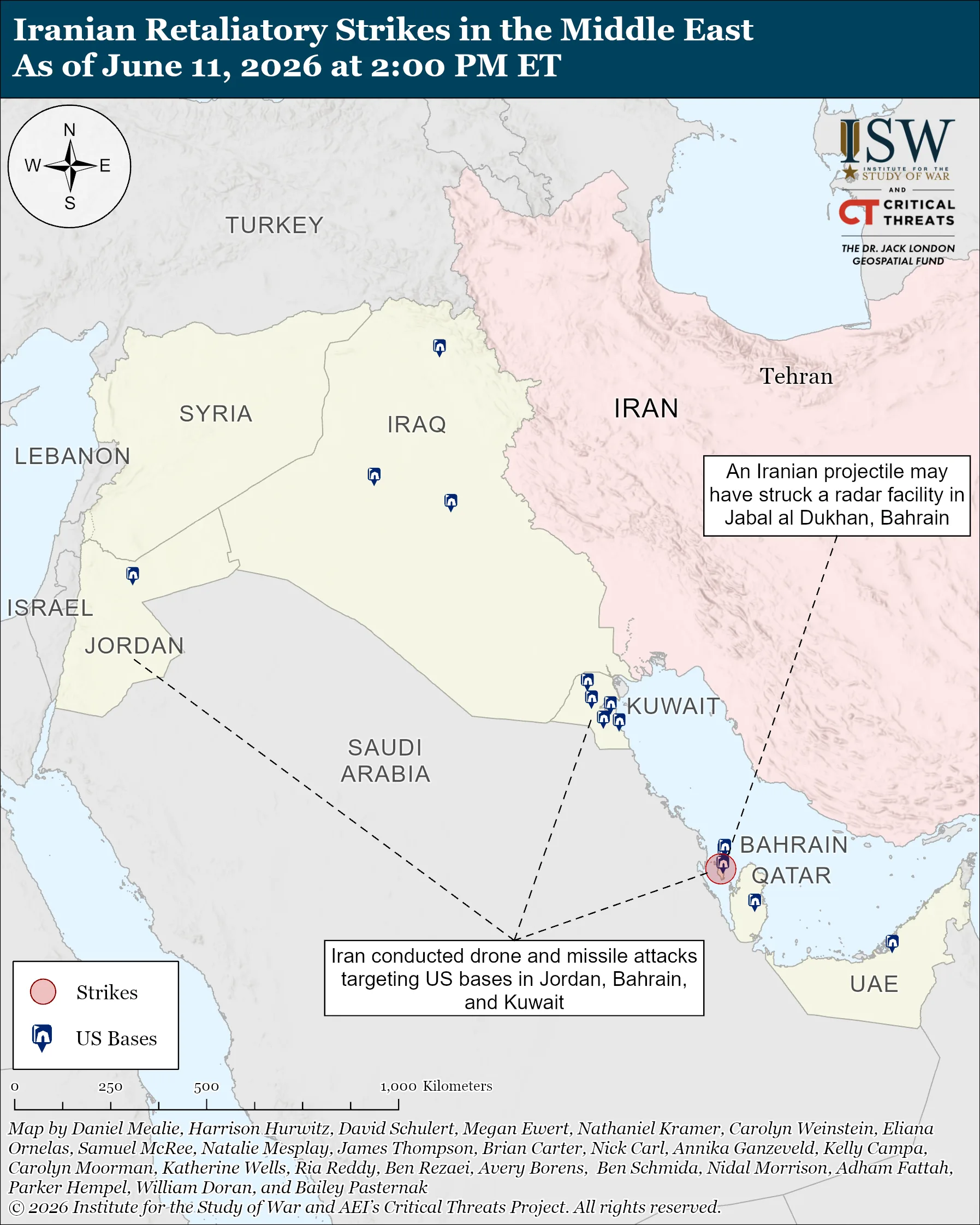
Iran's strikes on US bases and assets are also designed to have primarily informational and economic effects, rather than military effects. Iran responded to US airstrikes targeting Iranian military capabilities on June 11 (see below for report on US airstrikes and timeline of events) with drone and missile attacks on US bases in Bahrain, Kuwait, and Jordan, as Iran had previously done on June 10.[6] These strikes had little military effect. But the strikes appeared designed to upset markets—thereby increasing economic pressure on the United States—and trigger fears that Iran may be willing to resume the war.
Iran continues to demonstrate that it is unwilling to yield to US military pressure and come to an agreement. Axios also reported on June 11, citing unspecified sources, that Qatari and Iranian officials believed they had reached an ”agreed-upon text” that the United States would also accept.[7] The IRGC outlet's source also claimed that the United States will eventually have to accept the main frameworks of Iran's text.[8] Iran's denial and the narrative spread by the IRGC outlet suggest that Iran is trying to preserve its negotiating position and avoid creating the impression that US military pressure forced Iran to accept US terms as well.
Iran also knows that not conceding and amplifying its denial imposes political and economic cost on the United States as well. Supreme Leader Military Adviser Mohsen Rezaei warned on June 11 that the United States must choose between accepting Iran's terms and losing “the last shred of its credibility.”[9] Parliamentary National Security and Foreign Policy Committee member Esmail Kowsari similarly claimed on June 11 that the war has imposed pressure on the US economy and that Trump is pressuring Iran to achieve his goals.[10] Iran's announcement that it has “closed” the Strait of Hormuz is an extension of Iran's information operation to heighten political and economic pressure on the United States by amplifying its military operations in the region. The Persian Gulf Strait Authority separately announced on June 11 that the strait is closed and told vessels that previously received transit permits to remain “patient” and await further guidance.[11] It remains unclear whether Iran's statement will translate into changes to its existing coercive maritime behavior.
US President Donald Trump's announced on June 11 that he canceled scheduled strikes against Iran on the night of June 11 after discussions with Iran reached the “highest level” of Iranian leadership.[12] IRGC-linked Fars News Agency later denied that Iranian leaders had approved the deal, but later clarified that it would “likely” be approved because the United States approved Iran's text.[13] It is unclear what precisely is in the text. ISW-CTP will provide further analysis on June 12.
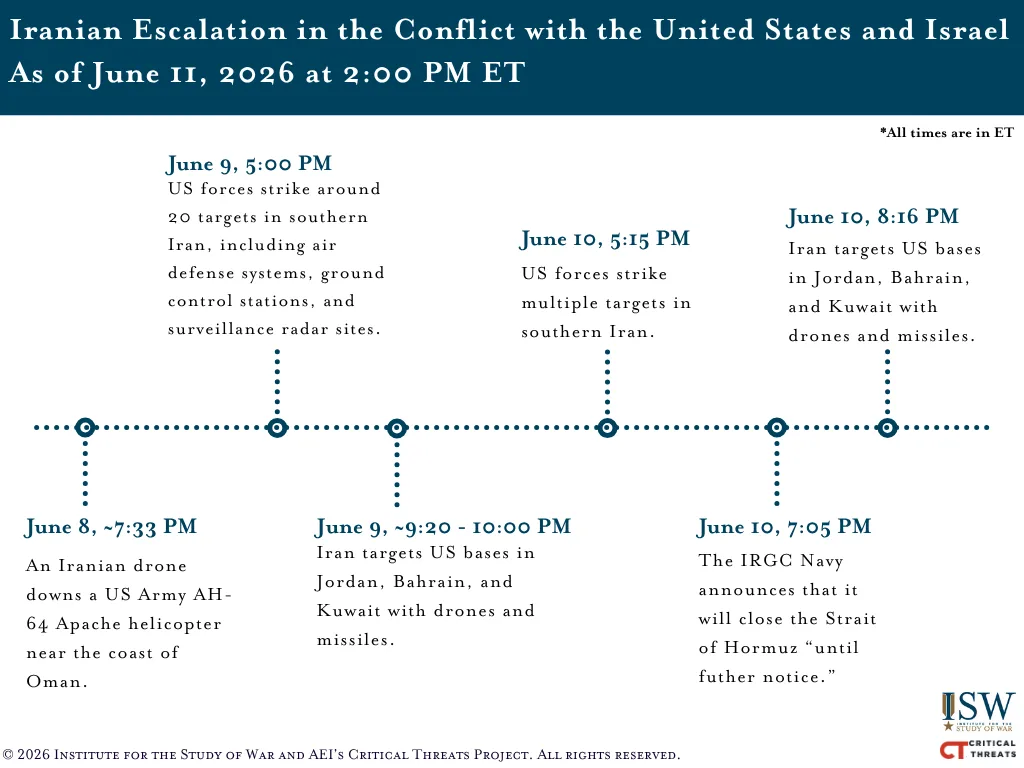
The United States is attempting to degrade Iran's ability to sense, target, and strike vessels moving through the Strait of Hormuz and US air assets protecting their transit. US Central Command (CENTCOM) announced on June 10 that US forces struck Iranian air defenses, surveillance assets, radar systems, and drone command units in southern Iran to degrade Iran's ability to track, coerce, and attack US forces and commercial vessels in the Strait of Hormuz.[14] Satellite imagery confirmed that US forces struck Bandar Abbas International Airport on June 10, and open-source social media users and Iranian media reported explosions across southern Iran, including Qeshm Island, Kish Island, and Minab City in Hormozgan Province near the Strait of Hormuz on June 10.[15] The June 10 strikes followed an exchange of fire between the United States and Iran on June 9. Iran initiated the most recent escalation when an Iranian drone downed a US Apache helicopter off Oman on June 8 while it was operating over the strait.[16] US forces also struck multiple targets on the outskirts of Tehran City, but ISW-CTP is unable to verify what these strikes targeted at this time.[17]
The United States has also continued to enforce its blockade on Iranian ports as part of its economic pressure campaign on Iran. CENTCOM announced that US forces disabled the Guinea-Bissau-flagged oil tanker M/V Jalveer on June 10 after the vessel attempted to violate the US blockade and transport Iranian oil outside of Iran.[18] The strike that disabled the vessel injured some crew members.[19] This is the third Iranian-linked vessel that US forces have disabled this week for failing to comply with the US blockade.[20] CENTCOM forces also disabled the Palau-flagged oil tanker M/T Settebello as it transited the Gulf of Oman on June 9 and disabled the Palau-flagged oil tanker M/T Marivex as it transited international waters in the Gulf of Oman toward Iran on June 8.[21] CENTCOM also announced on June 11 that US forces have disabled ”nine non-compliant vessels,” redirected 135 ships that attempted to run the US blockade, and allowed 42 vessels with humanitarian aid to transit since the United States initiated the blockade on April 13.[22]
Senior Emirati and Iranian national security officials held an in-person meeting for the first time since the start of the US-Israeli war against Iran, according to Bloomberg on June 11, citing people familiar with the matter.[23] The United Arab Emirates (UAE)’s motivation to meet with Iran was to reportedly ease tensions with Iran, according to the sources.[24] Emirati officials have reportedly become more disillusioned with the prospect of Iranian regime change and the United States and Iran achieving a political settlement.[25] Emirati officials also reportedly remain concerned about the fragility of the US-Iran ceasefire and threats to shipping through the Strait of Hormuz — both of which have damaged the UAE’s economy and security.[26] Iranian officials pushed for a high-level meeting with the UAE, but the Emiratis waited until their Iranian point of contacts could prove they had a direct line to Supreme Leader Mojtaba Khamenei and the IRGC, according to Bloomberg’s sources.[27] Bloomberg assessed that the talks had positive results for the Emiratis and noted that Iran has not fired at the UAE since Iran targeted the Barakah Nuclear Power Plant on May 17.[28] Iran has targeted Kuwait, Bahrain, and Jordan on June 9 and 10, however.[29]
The Israeli Foreign Ministry claimed on June 11 that Hezbollah launched drones targeting three locations within Israeli territory on June 10 and 11.[30] Hezbollah claimed that it launched fixed-wing drones targeting an Israel Defense Forces (IDF) border post at Nimr al Jamal, northern Israel, on June 11.[31] The IDF did not report any attacks targeting Israeli territory on June 10 or 11. The IDF did report Hezbollah drone attacks on Israeli forces in southern Lebanon, which triggered air raid sirens in near-border Israeli communities, however.[32] Israeli political leaders and the IDF have repeatedly warned since June 1 that the IDF would conduct airstrikes on Hezbollah targets in the Beirut area if Hezbollah attacks northern Israel.[33]
more + maps: https://understandingwar.org/research/middle-east/iran-update-special-report-june-11-2026/