
Posted on 10/08/2022 1:05:38 PM PDT by nuconvert
Iranian Regime national tv Channel One hacked about an hour ago. During a broadcast of Khamenie speech, a red crosshair appeared over his face and chanting of Women. Life. Freedom. There was writing to the side saying "Rise up. Join us". Also 4 photos at the bottom of the screen of young people killed and additional writing: "The blood of our youth is dropping from your paws".
Also, there was a huge banner in the middle of Tehran highway today that read: We are no longer afraid of you. We will fight.
Also, attempted attack on IRI ambassador in Denmark. Her bodyguard was stabbed. Diplomatic Security intervened before the attacker could stab the ambassador.
IRGC, not only cruel, but also sadistic. Punishing families even potentially the children by promising then denying a final visit. Perhaps this man did kill, but perhaps his final judge will become the next target. Israel/Mossad seems good at that.
Senior Iranian officials continue to demand guarantees against future US-Israeli attacks as a precondition for negotiations, and the Iranian regime likely views recognized control over the Strait of Hormuz as one such guarantee. Islamic Revolutionary Guards Corps (IRGC) Baghiyatollah Sociocultural Headquarters Commander Major General Mohammad Ali Jafari stated on May 14 that the United States must satisfy Iranian “confidence-building” measures before Iran will negotiate.[1] The regime has consistently pursued recognition for its control over the strait and likely views recognized control over the strait as a deterrent against future US or Israeli military action, which means that recognition effectively serves as a “confidence-building” measure.
Jafari’s statements likely reflect the Iranian regime's position and decision-making, given his position and relative influence within the regime at this time. The Baghiyatollah Sociocultural Headquarters oversees the regime's internal messaging and cognitive warfare apparatus, which means it is the principal mechanism through which the IRGC shapes political discourse, including by suppressing opposition to hardline factions.[2] ISW-CTP previously assessed that Jafari’s statements likely reflect the negotiating position of IRGC Commander Ahmad Vahidi, who appears to currently be playing a central decision-making role in Iran.[3] Jafari has a close relationship with Vahidi that dates to the Iran-Iraq War, and Jafari previously served as IRGC commander from 2007 to 2019.[4] Jafari and other senior IRGC officials, including Vahidi, also reportedly supported Supreme Leader Mojtaba Khamenei’s succession after the death of Ali Khamenei.[5]
The People's Republic of China (PRC) does not appear to have made a clear commitment to support US efforts to secure freedom of navigation through the Strait of Hormuz. US President Donald Trump asserted that the PRC “would like to be of help” in reopening the strait after meetings with Chinese Communist Party (CCP) General Secretary Xi Jinping from May 13 to 15.[6] US Treasury Secretary Scott Bessent said that he is expecting the PRC to work “behind the scenes” to influence Iran to open the strait because reopening the strait would serve PRC interests.[7] PRC readouts and statements on the summit downplayed discussions on Iran, however, and reiterated standard rhetoric on the issue.[8]
Iran's assertion of control over the strait is inconsistent with the stated PRC position. PRC Ambassador to the United Nations Fu Cong emphasized in April that the safety and security of shipping lanes must be secured.[9] He added that the PRC does not support Iranian attacks on Gulf states or the ”blockade“ on the Strait of Hormuz and expressed hope that “normal” navigation will resume soon. The PRC likely recognizes that any Iranian authority over transit through the strait would increase PRC dependence on Iran and establish a problematic precedent for international maritime law and freedom of navigation. The PRC appears unwilling to involve itself in a manner necessary to reopen and secure the strait, however.
Iran may have decided to deprioritize certain restrictive measures in the Strait of Hormuz, such as toll collection, in order to encourage states such as the PRC to cooperate with Iran and implicitly recognize its control over the strait. Iranian officials previously emphasized their ability to impose tolls on vessels transiting the strait, but Iran only announced its first toll payment on April 23.[10] Iran has exempted so-called “friendly” countries, including Iraq, Pakistan, and Malaysia, from toll requirements, which suggests that Iran now prioritizes securing international recognition of its control over the strait over toll collection.[11] The PRC has explicitly opposed the toll system, and its vessels have continued to transit the strait via the Iranian-approved route through the strait, although it is unclear if these vessels paid any tolls.[12] ISW-CTP previously assessed that Iran is likely prioritizing the implementation of the protocol over the tolls at this time in order to present itself as a reasonable actor that is willing to “open” the strait to “free” travel without tolls.[13] Iran may calculate that reducing overtly problematic measures such as tolls will encourage more states to cooperate with Iranian procedures and, therefore, strengthen Iranian authority over the strait. Legitimizing any aspect of Iranian control over the strait, with or without tolls, is extremely detrimental to global shipping. Iranian officials have not indicated any willingness to relinquish control over the strait. Officials claim that Iran will “open” the strait while preserving Iran's authority to regulate and permit vessel transit, which would leave Iran with the ability to restrict international shipping at its discretion and target any country, including through attacks on civilian vessels.[14]
The Iranian regime is attempting to ease economic pressures that the US naval blockade on Iranian ports is imposing upon the Iranian economy. The United States has continued to enforce the blockade, which will continue to impose economic pressure on Iran. The US Navy redirected three vessels between 4:00 PM ET on May 14 and 9:00 AM ET on May 15.[15] US Central Command (CENTCOM) announced that US forces have redirected 75 commercial vessels and disabled four since the blockade began on April 13.[16]
The Iranian regime is simultaneously taking measures to preserve necessary economic resources, such as foreign currency and raw materials, while attempting to keep the Iranian public calm ahead of expected shortages. The regime remains concerned that prolonged economic strain could trigger social unrest in Iran. The Agricultural Jihad Ministry introduced a new foreign exchange ceiling and updated the official price references within its import system for rice and oil-based products on May 15 in an attempt to evade food shortages and avoid mass price inflation.[17] An official from Mobarakeh Steel Company emphasized in a statement on May 15 that Iran has sufficient domestic steel supplies, even though the combined force destroyed the facilities responsible for about 25 to 30 percent of Iran's annual steel output.[18] The combined force struck the Mobarakeh Steel Company's facilities during the war. Mobarakeh Steel Company also recently shut down a project that led to the cutting of 1,000 jobs, according to a contractor employee who partnered with the company.[19] Iran's Energy Consumption Optimization Director also asserted on May 15 that 76 petrochemical complexes remain operational with a combined capacity of 100 million tons of petrochemicals annually, and Iran has continued efforts to import raw materials to offset shortages.[20] Israeli strikes on at least two Iranian petrochemical complexes rendered ”more than 85 percent of Iran's petrochemical export capacity inoperable” during the most recent war, according to the Israel Defense Forces (IDF).[21] The Iranian government is also designing a support package for firms affected by internet disruptions.[22]
Iranian leaders also appear to be emphasizing internal unity as economic pressures mount. Supreme Leader Mojtaba Khamenei’s social media accounts called for national unity in resisting external pressure in a statement made in celebration of Persian Language Day on May 15.[23] Foreign Affairs Ministry spokesperson Esmail Baghaei attempted to reinforce domestic cohesion by thanking Kurdish communities for safeguarding Iran's borders on a visit to Kurdistan Province in western Iran on May 15.[24] These regime efforts come after an Iranian intelligence assessment warned that worsening economic conditions could trigger renewed unrest during a Supreme National Security Council meeting in April 2026, according to informed sources speaking to anti-regime media.[25]
The United Arab Emirates (UAE) announced on May 15 that it will accelerate efforts to double the export capacity in Fujairah in order to bypass the Strait of Hormuz and reduce the UAE’s strategic vulnerability.[26] Abu Dhabi Crown Prince Sheikh Khaled bin Mohamed bin Zayed directed the Abu Dhabi National Oil Company (ADNOC) to fast-track the West–East Pipeline project, which would increase the UAE’s crude export capacity from Fujairah to as much as 3.6 million barrels per day by 2027.[27] This increases the export capacity from Fujairah by an additional 1.8 million barrels per day. The UAE currently exports 1.8 million barrels per day through the Strait of Hormuz. Iran launched several drone and missile attacks targeting the Fujairah oil field and pipeline during the most recent war.[28] The UAE’s initiative reflects a broader strategy that Gulf states are adopting to safeguard energy exports from future disruption through chokepoints like the Strait of Hormuz. Saudi Arabia is similarly leaning on its East-West pipeline to Yanbu on its Red Sea coast.[29]
Unspecified Western diplomats told Western media on May 14 that Saudi Arabia is discussing pursuing a potential non-aggression pact with Iran after the war.[30] It is unclear how much meaningful progress there has been towards such a pact.[31] Iran repeatedly attacked Gulf states’ civilian infrastructure while claiming to target US military assets.[32] Iran could theoretically attack Gulf states under the guise of targeting US assets in each country, even under such a pact.
The recent war has showcased the UAE’s adoption of a more assertive posture against Iran amid its deepening security ties with Israel. Bloomberg reported on May 15 that the UAE unsuccessfully attempted to persuade fellow Gulf states, including Saudi Arabia, to participate in a coordinated attack on Iran shortly after the US-Israeli campaign began.[33] The UAE’s efforts to rally the other Gulf states ultimately failed, and the UAE and Saudi Arabia conducted strikes on Iran independently.[34] The UAE also appears to have blocked a joint statement that Iran sought to issue at the BRICS Foreign Ministers summit that would have condemned the US-Israeli war against Iran.[35] A representative from India, the summit‘s host, cited ”differing views among some members,” likely in reference to the UAE’s blocking of the statement.[36] Iranian Foreign Affairs Minister Abbas Araghchi suggested that certain countries prevented consensus on portions of the statement and reiterated that Iran's military actions have targeted US bases, even when located in other regional countries.[37] Araghchi’s statement is false: the Iranian military targeted civilian infrastructure across the Gulf countries and fired into major cities.[38] The UAE is showcasing a more aggressive diplomatic and military posture towards Iran as it has deepened security ties with Israel during the war. A senior Israeli official characterized the UAE-Israeli relationship as a “tightening alliance” to Israeli media on May 14.[39] Israel and the UAE have been expanding their defense cooperation since the UAE normalized its relations with Israel by signing the Abraham Accords in 2020.[40]
US authorities charged senior Iranian-backed Iraqi militia Kataib Hezbollah commander Mohammad Baqer Saad Dawoud al Saadi with planning attacks targeting civilians in the United States, Canada, and Europe.[51] Turkey detained and then handed over Saadi to the United States. US prosecutors have charged Saadi with planning attacks on at least 20 civilian targets in Europe and Canada, and conspiracy to conduct attacks on Jewish civilians in the United States.[52] The US government identified Kataib Hezbollah as the group that abducted US journalist Shelly Kittleson in Baghdad on March 31.[53]
https://understandingwar.org/research/middle-east/iran-update-special-report-may-15-2026/
The Iranian regime is introducing a formalized toll system under the guise of maritime insurance policies and continuing to deploy incentives and threats to vessels in the Persian Gulf as part of their efforts to normalize and solidify Iranian control over the strait. This system appears designed to be more palatable than an outright “toll” by framing it as a “maritime insurance policy.” The insurance presumably insures the vessel against an Iranian attack. Iran's Economy Ministry is pursuing a new scheme to force shipping companies to pay “verifiable insurance policies,” according to a document viewed by Islamic Revolutionary Guards Corps (IRGC) affiliated media outlet Fars on May 16.[1] Iranian Parliament National Security Committee Chairman Ebrahim Azizi also stated on May 16 that Iran has prepared a “professional mechanism” to manage traffic along Iran's designated route “within the framework of its [Iranian] national sovereignty while guaranteeing international trade security.”[2] Azizi said that the details of the plan will be revealed soon.[3] Azizi’s comments are consistent with the document that Fars cites.[4] Iran would collect fees for unspecified “specialized services” as part of the scheme that Azizi described.[5] These ”specialized services” may be ”insurance.” Azizi clarified that “only commercial vessels and parties cooperating with Iran” would benefit from the new mechanism, which likely means countries that cooperate with Iranian protocols and have ”friendly” or ”non-hostile” relations with Iran. The IRGC Navy is permitting the passage of ships from East Asian countries such as the People's Republic of China (PRC), Japan, and Pakistan, according to Iranian state media on May 16. Iranian regime media also reported that the IRGC Navy has begun negotiations with unspecified European actors for passage through the strait.[6]
Access would remain restricted for actors associated with the US-led Project Freedom, however, which demonstrates that Iran seeks to retain the ability to coerce other states into adopting policies palatable to Iran by withholding access to the strait.[7] The United States launched Project Freedom to secure traffic through the internationally recognized traffic separation scheme in the strait.[8] US President Donald Trump temporarily paused Project Freedom on May 5 amid ongoing negotiations with Iran.[9]
Iran continues to employ both incentives and threats in order to solidify its control over the strait. The Iranian Port and Maritime Organization announced on May 6 that it would provide fuel, medical, and mechanical assistance to vessels operating in regional and Iranian waters.[10] Armed Forces General Staff-run outlet Defa Press on May 16 also continued to highlight Iran's capability to interdict shipping through fast attack craft swarm tactics designed to intimidate larger vessels, however.[11]
Iran is trying to circumvent the US naval blockade by expanding alternative overland and rail trade routes through the PRC, Pakistan, and Iraq. These alternative trade routes are unlikely to replace the scale and efficiency of maritime trade through the Persian Gulf and the Strait of Hormuz, however. IRGC-affiliated Fars News Agency reported on May 16 that Iran-PRC rail trade has tripled since the start of the US naval blockade on Iranian ports.[12] Fars stated that Pakistan has launched a new transit route with Iran that allows third-country goods to transit through Pakistani territory into Iran.[13] Fars added that new Iraqi Prime Minister Ali al Zaidi directed Iraqi customs authorities in northern, central, western, and southern Iraq, in addition to Baghdad International Airport customs and air cargo authorities, to activate transit transport and re-export operations with Iran.[14]
US Central Command (CENTCOM) reported on May 16 that US forces have redirected 78 commercial ships and disabled four ships “to ensure compliance” with the blockade.[15]
https://understandingwar.org/research/middle-east/iran-update-special-report-may-16-2026/
It probably goes without saying that UAVs do not pose a threat to a nuclear power plant’s reactor; rather, they can disrupt power lines and are primarily a political weapon.
In Arabic: Pakistani Interior Minister to [Iranian speaker] Qalibaf: We witnessed your steadfastness during the Islamabad talks in defending your country's interests and your efforts to resolve and settle issues. The peoples of our two countries are now closer than ever, and Pakistanis are praying for the success of the government and people of Iran
https://x.com/Tasnimarabic/status/2056026316915482634
Tasnim News Agency is a semi-official news agency in Iran associated with the Islamic Revolutionary Guard Corps (IRGC) https://en.wikipedia.org/wiki/Tasnim_News_Agency
” The peoples of our two countries (Pakistan and Iran) are now closer than ever, and Pakistanis are praying for the success of the government and people of Iran.
Well the aim of these prayers depends on whether Pakistan wants success for Iran’s government or for the majority of its people. Sounds to me like Pakistan may not be the most even handed party in hosting these negotiations.
The United States and Iran continue to pursue fundamentally incompatible negotiating positions. Unspecified sources familiar with the US response to the latest Iranian counterproposal told Islamic Revolutionary Guards Corps (IRGC)-affiliated Fars News Agency on May 17 that the United States laid out its five main conditions in response to the latest Iranian proposal.[1] The reported US response rejected war reparations, required Iran to transfer 400 kilograms of uranium to the United States, limited Iran to one operational nuclear facility, and refused to release more than 25 percent of frozen Iranian assets. The war would only end if negotiations were successful, and there would be no guarantees that the United States or Israel would not attack Iran in the future.[2]
Iran sent its most recent counterproposal to the United States on May 10, which US President Donald Trump later called “totally unacceptable.”[3] IRGC Baghiyatollah Sociocultural Headquarters Commander and former IRGC commander Major General Mohammad Ali Jafari stated on May 11 that Iran will not enter negotiations with the United States until the United States accepts Iran's terms.[4] Jafari stated that Iran's terms include an end to the war on “all fronts,” the lifting of sanctions, the release of frozen Iranian assets, compensation for war-related damages, and recognition of Iran's sovereignty over the Strait of Hormuz.[5]
The reported US conditions directly conflict with the demands that Iranian officials and senior IRGC officials publicly outlined on May 11.[6] CTP-ISW previously assessed that Iranian officials sought terms that would result in the loss of US leverage before meaningful negotiations could begin, which would likely make it more difficult for the United States to secure major nuclear concessions from Iran.[7]
Likely Iranian or Iranian-backed forces launched three drones targeting the Barakah Nuclear Power Plant in Abu Dhabi, the United Arab Emirates (UAE), on May 17.[8] Regime media attempted to drive a wedge between the UAE and Saudi Arabia by blaming Saudi Arabia for the attack.[9] Radiation levels at the plant remain normal. The Emirati Defense Ministry announced that its air defenses intercepted two drones while the other struck an electrical generator at the Barakah Nuclear Power Plant in Abu Dhabi, causing a fire.[10] The Ministry noted that the attacks came from the direction of “the western border.”[11] The International Atomic Energy Agency stated that the radiation levels at Barakah remained normal and that no casualties were reported.[12]
Iran has previously used drones to approach a target from an unexpected direction to obscure its responsibility and create challenges for air defenses. Iranian forces attacked Saudi oil facilities at Abqaiq in 2019 using several drones that Iranian forces fired from Iranian territory, but approached the target from the west, not the east.[13] The Houthi movement claimed the 2019 attack, even though there was little evidence of Houthi culpability.[14]
IRGC-affiliated media used the attack to attempt to drive a wedge between the UAE and other Gulf States by blaming Saudi Arabia for the attack. IRGC-affiliated media suggested on May 17 that Saudi Arabia launched the drones because it is the country to the west of the UAE.[15] Armed Forces General Staff-affiliated Defa Press Agency claimed on May 17 that the United States and Israel launched attacks against ”regional countries” and then attributed the attacks to Iran.[16] Iran has previously launched attacks against the UAE in an attempt to drive a wedge between the UAE and other Gulf states, likely in response to growing cooperation between the United States, Israel, and the UAE.[17]
IRGC-affiliated Tasnim News Agency reported on May 17 that Iranian Parliament Speaker Mohammad Bagher Ghalibaf became Iran's special representative for the People's Republic of China (PRC) affairs.[19] Tasnim reported that Iranian President Masoud Pezeshkian proposed appointing Ghalibaf to the position, and Supreme Leader Mojtaba Khamenei approved the appointment.[20] Tasnim highlighted that Ghalibaf’s appointment differs from previous PRC-related representative roles in terms of “level of authority.”[21] Iranian Ambassador to the PRC Abdolreza Fazli Rahmani previously served only as the president's representative for PRC affairs, while former Supreme National Security Council Secretary Ali Larijani served as the Supreme Leader's special representative for PRC affairs.[22]
Iraqi officials told the New York Times on May 17 that Israel built two clandestine outposts in the Iraqi desert in late 2024.[23] Western media previously reported on May 9 that the Israel Defense Forces (IDF) built one outpost near al Nukhayb, Anbar Province.[24] The IDF used this outpost for air support, refueling, and “medical treatment” during the 12-day war in June 2025, according to two regional officials speaking to the New York Times on May 17.[25] Israeli and Western media also reported in May 2026 that the IDF deployed commando units and search-and-rescue teams to this outpost before the start of the recent US-Israeli campaign in Iran to recover Israeli pilots if Iranian forces shot down Israeli fighter jets.[26] The New York Times reported that the outpost near al Nukhayb is no longer operational.[27] Two Iraqi officials, including senior Wisdom Movement official Hassan Fadaam, told the New York Times on May 17 that there is a second undisclosed Israeli outpost in the Iraqi desert.[28] The status and location of this second outpost were not specified, however.[29]
Two Iraqi security officials also told the New York Times on May 17 that the United States “compelled” Iraq to shut down its radars to protect US aircraft during the 12-day war in June 2025 and the recent conflict.[30] Iranian-backed Iraqi actors will likely use this report, in conjunction with the reports of Israeli bases in Iraq, to pressure the Iraqi government to pursue the purchase of advanced air defense systems. Several Iranian-backed Iraqi parliamentarians previously called on the Iraqi government to modernize its air defenses and diversify its arms supplies in June 2025.[31]
https://understandingwar.org/research/middle-east/iran-update-special-report-may-17-2026/
Cuba has acquired more than 300 military drones and recently began discussing plans to use them to attack the U.S. base at Guantanamo Bay, U.S. military vessels and possibly Key West, Fla., 90 miles north of Havana, according to classified intelligence shared with Axios.
https://www.axios.com/2026/05/17/us-military-drones-cuba
If Cuba decides to target Guantanamo, how will they differentiate prisoners from US staff?
Which leads to the question, how many prisoners, and from what countries are there currently?
Iran's latest counterproposal does not appear to meet US demands. Reuters reported on May 18 that Iran sent a new proposal with similar terms to proposals previously rejected by the United States.[1] A senior US official and source briefed on the matter told Axios on May 18 that Iran's counterproposal does not contain a commitment “about suspending uranium enrichment or handing over its existing stockpile of highly enriched uranium (HEU).”[2] The US official added that the Trump Administration believes Iran's proposal is “insufficient.” Islamic Revolutionary Guards Corps (IRGC)-affiliated media reported on May 18 that “major disagreements” remain between the United States and Iran and stated that Iran would never agree to “an end to the war in return for nuclear commitments.”[3] US demands have been and continue to be that Iran must give its HEU to the United States, dismantle its nuclear facilities, and pause uranium enrichment for at least 20 years.[4]
US President Donald Trump announced on Truth Social on May 18 that he canceled a scheduled US military strike against Iran that was planned for May 19.[5] Trump stated that Qatari Emir Sheikh Tamim bin Hamad al Thani, Saudi Crown Prince Mohammed bin Salman, and Emirati President Mohamed bin Zayed asked him to suspend the strike “for two or three days” due to ongoing negotiations.[6] A US official and an unspecified source told Axios that the three Gulf leaders warned that they would “pay the price” if the United States conducted new strikes on Iran and expressed concerns that Iran would retaliate by targeting their energy and oil infrastructure.[7] Trump noted that the Gulf leaders believe that the United States and Iran can reach a deal that is “very acceptable to the United States” and that would prevent Iran from obtaining nuclear weapons.[8] Trump added that he instructed US Defense Secretary Pete Hegseth, US Chairman of the Joint Chiefs of Staff General Dan Caine, and the US military to remain prepared to launch a “full, large-scale assault” against Iran on short notice if negotiations fail.[9]
Iran continues to formalize and institutionalize its claimed control over transit through the Strait of Hormuz in contravention of the UN Convention on the Law of the Sea (UNCLOS). The newly established Persian Gulf Strait Authority (PGSA) stated on X on May 18 that it serves as the “legal institution and representative authority” of the Iranian regime for managing transit through the strait.[10] Iran has incorrectly asserted that this is “legal” under the UNCLOS because the Strait of Hormuz is within Iran's territorial waters.[11] Article 37 of the UNCLOS states that straits “used for international navigation between one part of the high seas or an exclusive economic zone and another part of the high seas or an exclusive economic zone” are international straits.[12] Article 38 guarantees that “all ships and aircraft enjoy the right of transit passage” through such straits, and Article 44 prohibits bordering states — like Iran — from “hampering” or suspending passage.[13] The PGSA added that navigation through the designated zone requires “full coordination” with the authority and warned that transit without authorization would be considered illegal.[14] This is an Iranian effort to hamper passage. Iranian state media separately highlighted that 1,500 vessels are currently waiting for Iranian permission to transit the strait as part of broader regime efforts to portray Iran as the sole authority responsible for managing transit through the strait.[15]
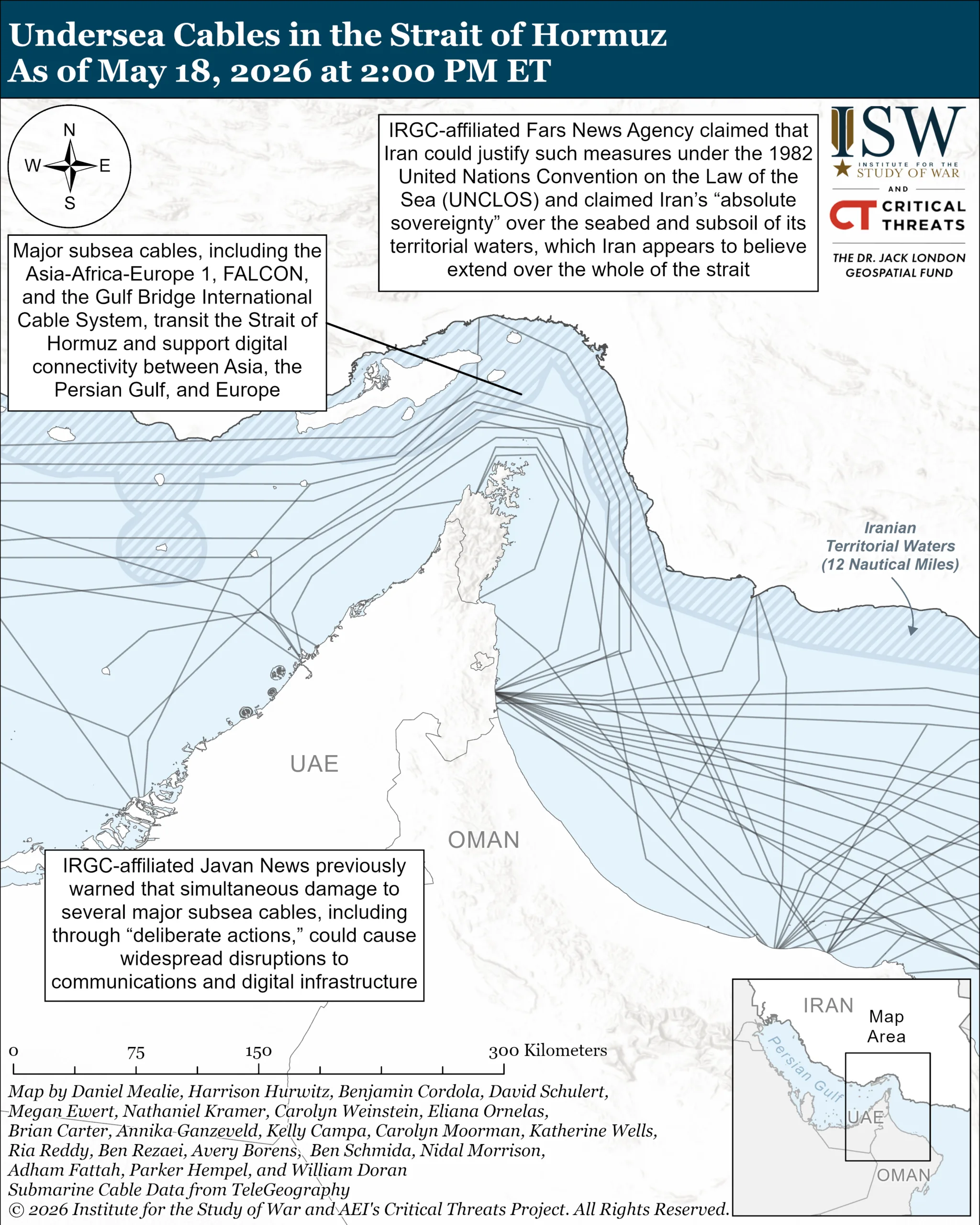
IRGC-affiliated outlets continue to threaten commercial and digital activity linked to the Strait of Hormuz as part of broader regime efforts to institutionalize Iranian authority over the waterway. IRGC-affiliated Fars News Agency reported on May 18 that Iran could impose permits, oversight measures, and sovereign fees on fiber-optic cables transiting the strait after implementing “management” over the strait.[16] Fars warned that disruptions to the corridor could impose high direct and indirect costs on the regional and global economy.[17] Major subsea cables, including the Asia-Africa-Europe 1 (AAE-1), FALCON, and the Gulf Bridge International Cable System, run through the strait of Hormuz and support digital connectivity between Asia, the Gulf, and Europe.[18] Three of seven cables — FALCON, GBICS, OMRAN/EPEG cables — connect to Iran and run through the strait.[19] IRGC-affiliated Javan News previously warned that simultaneous damage to several major subsea cables, including through “deliberate actions,” could cause widespread disruptions to communications and digital infrastructure.[20] Fars also claimed that Iran could justify such measures under the 1982 UNCLOS and claimed Iran's “absolute sovereignty” over the seabed and subsoil of its territorial waters.[21]
Likely Iranian-backed Iraqi militias launched three drones targeting Saudi Arabia on May 17.[28] The Saudi Defense Ministry stated on May 17 that it intercepted three drones launched from Iraq that entered Saudi airspace.[29] Iraqi media reported on May 18 that the Iraqi Ministry of Foreign Affairs expressed “concern” about the incident.[30] This attack comes after likely Iranian or Iranian-backed Iraqi militias launched three drones targeting the Barakah Nuclear Power Plant in the United Arab Emirates (UAE) on May 17, one of which hit an electrical generator.[31] Likely Iranian-backed Iraqi militias have conducted several drone attacks targeting Gulf states since the onset of the US-Iran ceasefire in early April.[32]
https://understandingwar.org/research/middle-east/iran-update-special-report-may-18-2026/
The United States continues to pressure Iran economically through its naval blockade and sanctions, which impose costs on Iran's economy. The blockade is especially affecting oil exports. It does not follow, however, that these economic damages alone will compel Iran to accept US negotiating demands. US Central Command (CENTCOM) reported redirecting 88 commercial vessels and disabling four as part of the blockade of Iranian ports.[1] Iran has expanded its oil storage by reusing 10 aging tankers to hold oil, according to United Against Nuclear Iran and Financial Times.[2] These tankers are now clustered around Kharg Island and Chabahar Port. This indicates that Iran is experiencing challenges in storing the oil it produces because aging tankers are suboptimal for holding oil.[3]
Iran has continually expanded its storage facilities since the conflict began, though some of the storage facilities will become increasingly suboptimal. There is presumably a point at which Iran will run out of even minimally effective storage assets, like aging tankers it can reactivate, but it is not clear at what point this will occur from open-source reporting. Maritime intelligence firm Kpler estimated that Iran has stored 42 million crude oil barrels on Iranian tankers in the Middle East, a 65 percent increase since the conflict began, and has roughly 24 million barrels of additional floating storage on empty tankers within the US blockade area.[4] Energy intelligence firm Kayrros assessed that Iran's onshore storage has also risen by about 10 million barrels to 64 percent capacity, leaving only a few weeks’ worth of oil production space.[5] The US Treasury Department has separately intensified economic pressure on Iran on May 19 by sanctioning the Amin Exchange and associated front companies tied to hundreds of millions in oil-related transactions, blocking 19 vessels linked to illicit Iranian oil exports, and urging global partners to enforce sanctions more strictly.[6]
These economic restrictions are increasingly evident in Iran, as Iranian officials express ongoing concern about the economy, and reports highlight growing frustration among citizens. President Masoud Pezeshkian called for long-term planning to mitigate war-related economic impacts on May 19, while officials warned of rising drug prices potentially fueling public discontent.[7] Anti-Iranian regime media reports detailed gasoline shortages and at least one localized worker protest over wages in Zanjan City in northwestern Iran on May 19.[8]
Restrictions and concerns from Iranian officials or citizens do not, on their own, imply that Iranian leaders will drop negotiating demands. Other factors, such as (but not limited to) a proven threat to regime stability, could trigger a rethink among Iranian leaders about their negotiating positions. Iranian leaders have proven that they care little for the economic well-being of the Iranian people beyond the impact the economic well-being of the people has on regime stability.
Some North Atlantic Treaty Organization (NATO) countries reportedly support a plan to escort ships through the Strait of Hormuz beginning in early July if Iran continues to impose its blockade, according to a senior NATO official speaking to Bloomberg on May 19.[9] One NATO diplomat stated that several NATO countries support the idea, but that there is not the required unanimous support to enact it. The diplomat added that some NATO countries are still reluctant to get involved in the conflict, but that NATO is generally concerned about the economic consequences of keeping the strait closed.
Iran reportedly analyzed US military aircraft flight patterns to try to improve its ability to intercept and target US and allied aircraft during the war. The New York Times, citing a US military official, reported that Iranian military commanders studied the flight patterns of US fighter jets and bombers, likely ahead of and throughout the recent war.[10] The official suggested that the downing of a US F-15E and an A-10 on April 3, and the damage suffered to an F-35 on March 19, indicated that US flight patterns had become too predictable.[11] The official added that Russia may have supported this effort as part of a broader Russian effort to help Iran target US and allied assets during the war.[12] Russia also provided Iran with satellite imagery of US bases and modified Shahed drones during the conflict.[13]
The US official is aware of the risk of predictable flight patterns, which means that the US military is aware of and could diagnose the issue of predictability during the ceasefire. A shootdown of an aircraft would presumably trigger an after-action review. A close study of flight patterns can nonetheless enable Iranian forces to “ambush” aircraft flying in a predictable manner when combined with other tactics and technological tools. Serbian forces shot down a US Air Force F-117 Nighthawk in 1999, for example, by studying the predictable ingress and egress routes of US aircraft as they evaded Serbian air defenses.[14] Serbian forces combined this knowledge with low-band radars to successfully shoot down the F-117. [15]
The US and Iranian negotiating positions remain inconsistent with each other. Reuters, citing two Iranian officials, reported on May 18 that the United States agreed to release 25 percent of frozen Iranian assets under an unspecified timetable.[16] Iran reportedly sought a complete release of these funds instead. Iran also sought a halt to uranium enrichment for a period shorter than the 20-year pause that the US side has demanded.[17] Iran also proposed diluting some of its highly enriched uranium (HEU) and sending the rest to Russia, while maintaining the right to ”reclaim it” if the United States violates the agreement.[18] The US demand has been and continues to be that Iran must hand over its HEU to the United States and dismantle Iran's nuclear facilities.[19]
Likely Iranian-backed Iraqi militias launched six drones targeting the United Arab Emirates (UAE) from May 17 to 19.[40] The Emirati Defense Ministry announced on May 19 that it intercepted six drones that originated from Iraq targeting “civilian and vital areas” in the country over the past 48 hours.[41] This appears to include the May 17 drone attack on the Barakah Nuclear Power Plant, which the UAE confirmed originated from Iraq. This report comes after the Saudi Defense Ministry stated on May 17 that it intercepted three drones launched from Iraq that entered Saudi airspace.[42]
IRGC-affiliated media used the most recent drone attacks on the UAE to drive a wedge between Israel and the UAE by blaming Israel for the attack.[43] IRGC-affiliated media claimed on May 19 that Israel conducted the drone attack and warned the Emirati government that its relationship with Israel would undermine the UAE’s security and economy.[44] This is likely in response to growing cooperation between Israel and the UAE.[45] IRGC-affiliated media previously accused Saudi Arabia of attacking the UAE.[46]
Iranian-backed Iraqi militias are reportedly using surveillance drones to observe Saudi Arabia and Kuwait, according to four Iraqi security sources and one informed person speaking to Western media on May 13.[47] The sources added that the militias are sharing the intelligence with Iran.[48] Iranian-backed Iraqi militias have used FPV drones to perform reconnaissance tasks during the war.[49] ISW-CTP assessed on May 11 that Iran is likely providing Iraqi militias with FPV drone technology.[50]
https://understandingwar.org/research/middle-east/iran-update-special-report-may-19-2026/
Sal Mercogliano- What’s Going on With Shipping?
19MAY2026 The Hormuz Effect: Why Supertanker Volumes Dropped 36% & Stocks are Sliding
With the ongoing crisis in the Strait of Hormuz, the industry is seeing unprecedented disruptions. Supertanker (VLCC) cargo volumes have plummeted by 36%, yet voyages are getting longer as ships divert around the Cape of Good Hope. Sal breaks down the latest data from Lloyd’s List and the Baltic Exchange to explain why tanker stocks are sliding, how rates for different vessel types (VLCC, Suezmax, Aframax, and MR tankers) are stabilizing, and what this means for global energy costs.
https://www.youtube.com/watch?v=3vuezC8JnZo
Iran is likely using the ceasefire period to normalize Iranian control over the Strait of Hormuz by compelling oil-importing countries to establish a bilateral transit agreement with Iran while charging fees from vessels that are not part of the bilateral deals. The transit agreements and fee system use a multi-tiered system, according to Iranian officials speaking to Reuters on May 20.[1] Iranian strategic partners, like Russia and China, are prioritized at the top tier, while countries with close ties to Iran, like India and Pakistan, can operate within negotiated transit agreements. Other countries are handled on a case-by-case basis, and any vessel that has links to Iranian adversaries is denied access entirely. Finally, ships that do not fall under a bilateral agreement are required to pay fees, which are reportedly around $150,000. The Iranian Islamic Revolutionary Guards Corps (IRGC) runs the scheme. These fees are framed as “security” fees, but the fees are in reality part of a mafia-esque protection racket in which the vessels pay Iran so that the Iranian navy can “secure” the vessels against an attack by the Iranian navy or Iranian shore-based missiles and drones.
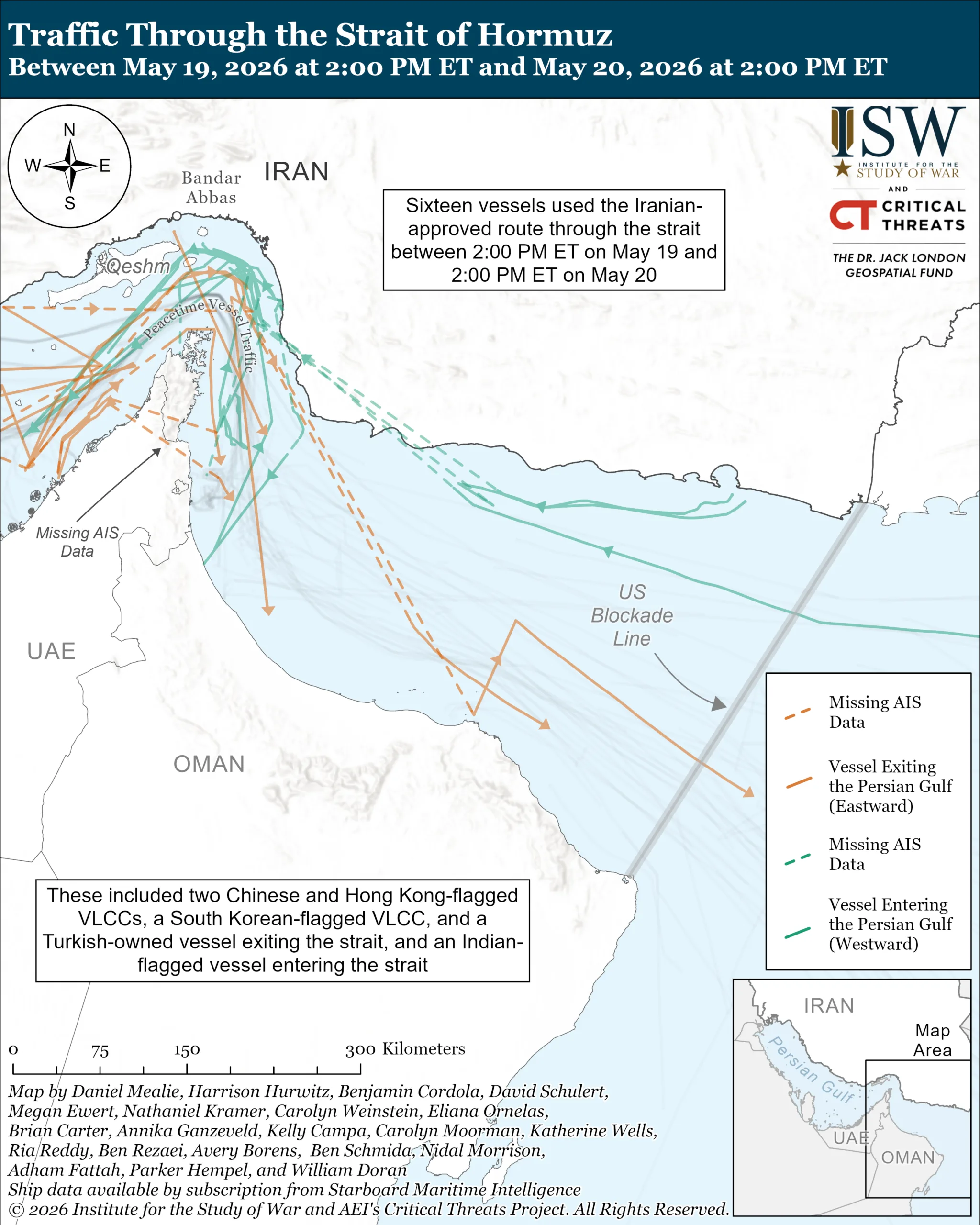
Evidence of Iran's mechanism is already visible in ad hoc arrangements. The Iraqi Government—under the supervision of then Prime Minister Mohammad Shia al Sudani— reportedly came to an agreement with Iran to facilitate the Greek-owned, Maltese-flagged Very Large Crude Carrier (VLCC) Agios Fanourios I carrying Iraqi crude oil on May 10, for example.[2] CTP-ISW recorded that 16 vessels took Iran's route through the strait between 2:00 PM ET on May 19 and 2:00 PM ET on May 20.[3] These included two Chinese and Hong Kong-flagged VLCCs, a South Korean-flagged VLCC, and a Turkish-owned vessel exiting the strait and an Indian-flagged vessel entering the strait, citing commercially available shipping data.[4]
Such a scheme could not be disrupted by a post-war “security” deployment by European states, as some countries have suggested. Several European states, including the United Kingdom and France, have proposed that they would help secure the strait once “conditions allow.”[5] Iran would likely attempt to stop, perhaps with force, any post-war “security force” if the war ends with an official or de facto recognition of Iranian sovereignty over the Strait.
A successful Iranian effort to normalize this structure would gradually increase the number of vessels moving through the strait to near pre-war levels. This reduces the visible economic costs of restricted access and therefore weakens the primary argument for mobilizing US allies to help reopen the strait. Such a decrease in the price of oil would be reliant on a number of other factors, including market reactions and the risk calculus of the shipping companies involved. It is unclear how long a decrease would take, and Iranian efforts to normalize control would need to bear fruit before any mobilization against Iranian activities in the strait. A NATO official told Bloomberg on May 19, for example, that at least some European countries are concerned about the economic consequences of the strait's closure, and some European states support an effort to reopen the strait if the situation fails to change by July 2026.[6] This creates a clear incentive for Iran to normalize traffic flows under its own framework before external pressure from the United States and its allies intensifies.
The United States continues to interdict vessels violating the US blockade of Iranian ports. Three US officials told the Wall Street Journal that US forces seized a US-sanctioned, Iranian-linked oil tanker, the M/T Skywave (IMO: 9328716), between May 19 and 20.[7] Commercially available ship tracking data showed that the Skywave transited the Strait of Malacca on May 14, before returning to the Indian Ocean on May 19, presumably after being seized by US forces.[8] It is unclear where the vessel was before May 14. The United States Treasury Department sanctioned the Skywave, under a different vessel name, on March 13 for its role in transporting Iranian oil.[9] US Central Command (CENTCOM) reported on May 20 that US Marines boarded the Iranian-flagged oil tanker M/T Celestial Sea (IMO: 9397030) on May 20 on suspicion of attempting to reach an Iranian port.[10] US forces released the vessel after searching it and directing it to change course.[11] CENTCOM reported that US forces redirected 91 vessels and disabled four others since the start of the blockade on Iranian ports on April 13.[12]
The IRGC threatened on May 20 to expand the war “far beyond the region” if US-Israeli strikes on Iran resume.[13] This threat almost certainly seeks to deter renewed US-Israeli strikes but could also reflect IRGC planning for a potential future conflict. IRGC-affiliated media previously used similar messaging ahead of the most recent round of conflict to try to exploit US concerns about a protracted regional war to try to deter a US attack.[14] IRGC-affiliated media Tasnim News warned on February 2 that a US attack on Iran could trigger a regional war because Iran could retaliate by attacking Israel, international shipping, or US bases in regional countries.[15] Iran may similarly calculate that threats of a conflict extending “beyond the region” could deter against renewed US-Israeli strikes or increase the pressure on the United States from its European allies. Iran does possess several capabilities with which it could operationalize these threats, including by conducting terror attacks abroad, disrupting shipping in other chokepoints, or firing ballistic missiles at longer range, however.
Terror Attacks Abroad: Iran could direct or support attacks in Europe or other regions to pressure governments to deny access, basing, and overflight privileges to US forces. US authorities recently charged Iranian-backed Iraqi militia Kataib Hezbollah commander Mohammad Baqer Saad Dawoud al Saadi for planning attacks targeting civilians in the United States, Canada, and Europe, for example.[16] Several European states, including France, Norway, and Belgium, have disrupted Iranian-backed or -linked attack plots during the war.[17]
Expand Attacks on International Shipping: Senior Iranian officials have threatened to “open new fronts” in any renewed conflict with the United States.[18] These officials may be referring to attacks on international shipping beyond the Strait of Hormuz and Persian Gulf, including the Red Sea and Bab el Mandeb Strait.[19] Arab officials told the Wall Street Journal on April 14 that Iran is pressuring the Houthis to “close” the Bab el Mandeb Strait.[20] Iran could rely on the Houthis to conduct such attacks in a potential future conflict. The Houthis, however, largely avoided direct involvement in the most recent round of conflict, and their willingness to participate in a future conflict remains unclear.
Longer-Range Missile Strikes: Iran could fire intermediate-range ballistic missiles (IRBM) towards Europe or the Mediterranean Sea, albeit this scenario remains less likely. Iran demonstrated a nascent long-range strike capability during the recent conflict when it unsuccessfully fired two ballistic missiles at the US-UK base at Diego Garcia, which is located approximately 4,000 kilometers from southern Iran.[21] One missile failed in-flight, and the United States intercepted the other.[22] A Dutch missile expert assessed that Iran would have needed either to reduce the payload of an MBRM “to virtually nothing” or incorporate a second stage booster to achieve that range.[23] The attack, nonetheless, demonstrated Iran's ability to strike beyond the self-imposed 2,000-kilometer missile range limit that Iranian officials have long cited publicly.
Pakistan is attempting to secure its own political and security interests by fulfilling its end of the Pakistan-Saudi Arabia defense agreement and helping mediate between the United States and Iran. Reuters reported on May 18 that Pakistan sent 8,000 troops, a squadron of fighter jets, and an air defense system to Saudi Arabia as part of their September 2025 mutual defense pact, citing three security officials and two government sources, all of whom described it as a “substantial” and “combat-ready” force that could defend against further attacks on Saudi Arabia.[24] Reuters added that Pakistan sent the aircraft in April but did not specify when it sent the other assets to Saudi Arabia.[25] These moves are necessary to uphold the Saudi-Pakistani defense agreement signed in September 2025, given the attacks on Saudi Arabia by Iran. A resumption of the war could challenge Pakistan's commitments to the agreement with Riyadh in new ways, as well, which makes Pakistan invest in avoiding a return to conflict. Pakistan is therefore simultaneously mediating between the United States and Iran, which has the added benefit of demonstrating Islamabad's political influence in the region.[26] Pakistani Interior Minister Mohsin Naqvi also travelled to Tehran on May 20 for talks with Iranian officials to continue mediation efforts.[27]
Qatar has reportedly also been playing a mediating role between the United States and Iran, which may be causing tensions with Pakistan.[28] An Arab official speaking to Axios on May 20 stated that Qatar sent a delegation to Iran in order to get more tangible commitments from Iran over its nuclear program and more specifics from the United States on the release of Iran's frozen assets.[29]
The Wall Street Journal reported on May 20 that Iran is still unable to enrich uranium because it would have to dig up fissile material buried underneath rubble.[30] US and Israeli strikes buried much of this material during the 12-Day War in June 2025. The United States severely damaged Iran's three most important nuclear facilities – Natanz, Fordow, and Esfahan – using bunker buster bombs and cruise missiles during the 12-Day War in June 2025.[31] The strikes resulted in the burying of Iran's highly enriched uranium stockpile and likely destruction of all or a significant number of centrifuges needed for enrichment.[32]
The Associated Press reported on May 20 that IRGC members are teaching Iranian civilians how to use arms.[33] The report added that the IRGC has displayed military vehicles mounted with machine guns and a ballistic missile at a wedding.[34] French media reported on May 19 that Iranian authorities had set up military training booths to teach Iranians the basics of carrying weapons.[35]
The New York Times, citing US officials briefed on the matter, reported on May 20 that Israel developed a plan to free former Iranian President Mahmoud Ahmadinejad from house arrest in order to lead regime change in Iran.[36] The officials and one of Ahmadinejad's associates added that Israeli airstrikes injured Ahmadinejad on February 28 and derailed the plan.[37] Israeli strikes reportedly killed three of Ahmadinejad's security detail on February 28.[38]
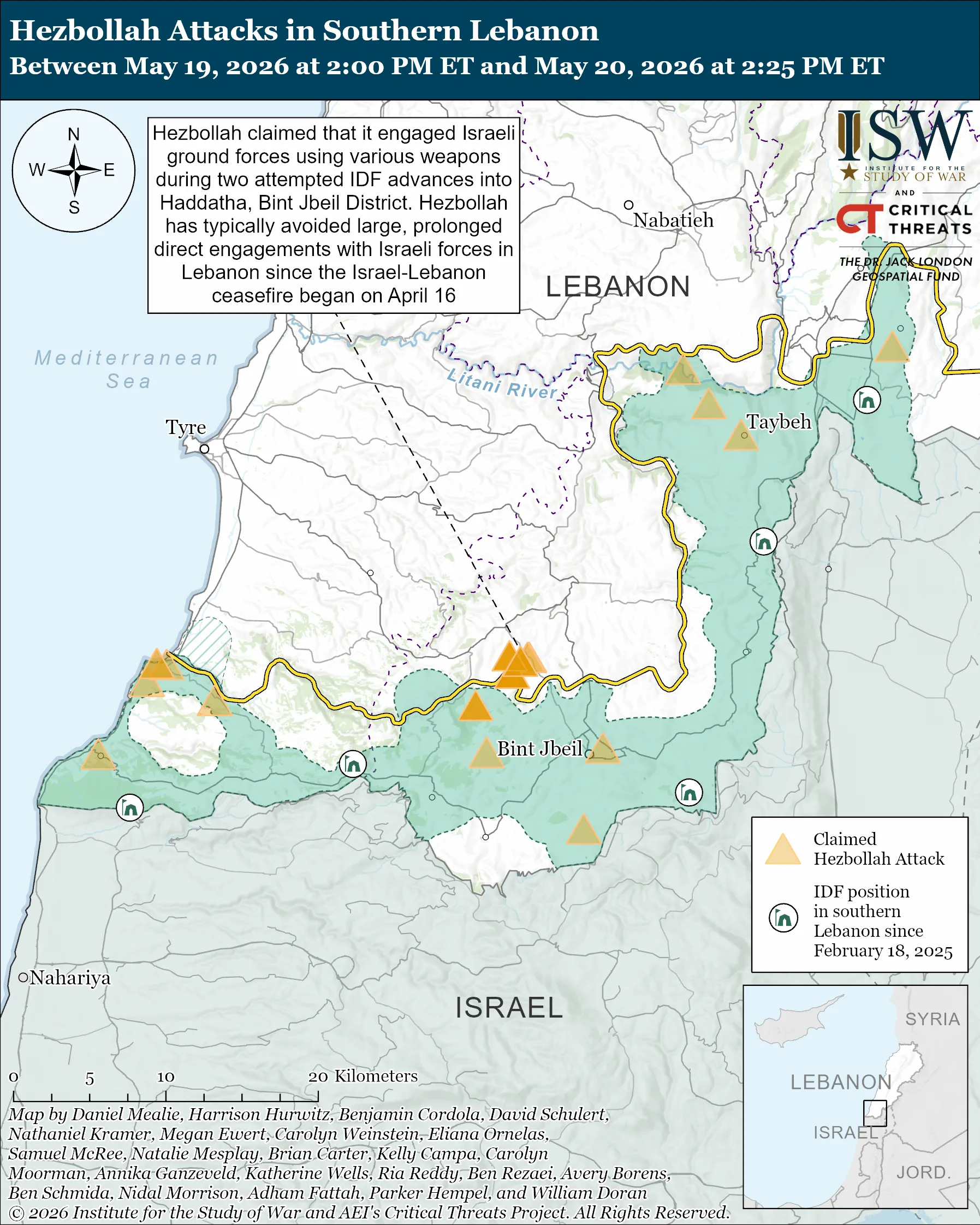
Hezbollah defended against an IDF assault into Haddatha, Bint Jbeil District, on May 19 and 20. The protracted Hezbollah defense is the first prolonged engagement between the IDF and Hezbollah since the ceasefire began. Hezbollah claimed that it defended against two major but separate IDF attacks using a variety of weapons, including small arms, mortars, rocket-propelled grenades (RPG), anti-tank guided missiles (ATGM), and first-person view (FPV) drones.[39] The first engagement lasted around seven hours, and the second lasted four hours. Hezbollah claimed to have repelled the first IDF advance on May 19 but did not claim that it repelled the second advance on May 20.[40] MTV reported IDF units destroyed homes in Haddatha after the second engagement on May 20, suggesting that the IDF dislodged Hezbollah.[41] Hezbollah has typically avoided prolonged and larger-scale direct ground engagements with the IDF since the ceasefire began on April 16, instead conducting most attacks using indirect fire platforms such as rockets and drones.[42] The currently limited reporting makes it difficult to assess why Hezbollah chose to defend at Haddatha, or whether Hezbollah's more prolonged defense sought to delay the IDF to cover the withdrawal of important assets or personnel. Israeli ground forces have operated near Haddatha at least six times since May 13, based on Hezbollah's claimed attacks.[43] Hezbollah previously detonated IEDs targeting Israeli armor and vehicles during earlier IDF activity near Haddatha, but did not claim to have used IEDs in its longer engagements on May 19 and May 20.[44]
The available reporting has not clarified how Hezbollah employed these systems together or the degree of coordination between defending Hezbollah infantry and drone operators. Hezbollah has made some efforts to organize its drone operators to support infantry directly. Tactical FPV drone operators are embedded into Hezbollah ground units responsible for geographic areas.[45] Hezbollah's longer-range drones are organized as part of Hezbollah Unit 127, by contrast.[46]
https://understandingwar.org/research/middle-east/iran-update-special-report-may-20-2026/
Iran has not submitted a response to the latest US proposal as multiple mediators continue efforts to narrow gaps between the United States and Iran. Both US and Iranian officials said on May 21 that nuclear weapons and the Strait of Hormuz remain the two “sticking points” on negotiations.[1] Axios reported on May 20 that Pakistan and Qatar drafted a revised memo to bridge US-Iran gaps, while other mediators, including Saudi Arabia, Turkey, and Egypt, have supported the effort.[2] Iranian media reported on May 21 that Iran is still reviewing the proposal and has not yet responded.[3] Iranian media added that Iran is discussing the Iranian text's overarching framework, some details, and confidence-building measures as guarantees.[4] It stated that the text has narrowed some gaps “to some extent,” but that further progress depends on whether the United States moves away from military threats.[5]
Iranian officials appear divided over potential nuclear concessions, especially whether Iran should send its highly enriched uranium (HEU) stockpile abroad. Two unspecified senior Iranian sources told Reuters on May 21 that Iranian Supreme Leader Mojtaba Khamenei issued a directive that Iran's HEU should remain inside Iran.[6] The sources added that top Iranian officials believe that sending the HEU stockpile abroad would leave Iran more vulnerable to future US and Israeli attacks.[7] An unspecified US official and another unspecified senior Iranian official denied the existence of a directive from Mojtaba on May 21, however.[8] The senior Iranian official confirmed that Iran's consistent position is to down-blend the stockpile inside Iran, however.[9] Iranian Foreign Affairs Ministry Spokesperson Esmail Baghaei stated on May 21 that the negotiations focus on ending the war on all fronts, including in Lebanon, “at this stage,” and that media claims about nuclear issues, including enriched materials or enrichment, “are merely media speculation and lack credibility.”[10]
The reporting does not clarify the seniority of the Iranian leakers or clarify their motives, but the leaks about the alleged directive from Mojtaba and subsequent denials suggest disagreement within the Iranian regime over nuclear concessions. Top US officials, including Vice President JD Vance and Secretary of State Marco Rubio, have highlighted the “fractures” in the regime in recent days and have noted that these fractures are causing challenges as negotiations continue.[11] ISW-CTP continues to assess that Islamic Revolutionary Guards Corps (IRGC) Commander Major General Ahmad Vahidi plays a dominant role in policy formation. Vahidi and those around him reportedly previously opposed discussions over the nuclear issue, while the Iranian negotiating team led by Mohammad Bagher Ghalibaf and Iranian Foreign Affairs Minister Abbas Araghchi discussed the nuclear issue during the first round of US-Iran talks in Islamabad.[12] The Associated Press also noted that Ghalibaf and Araghchi faced “criticism” for showing too much willingness to make concessions in Islamabad.[13] Ghalibaf and Araghchi reportedly discussed the nuclear issue “contrary to instructions from Tehran.”[14] Such instructions, ISW-CTP noted at the time, could have only come from Vahidi or the supreme leader.[15] The leaks and denials about Mojtaba’s directive on May 21 are emblematic of this debate, which has been playing out since April.
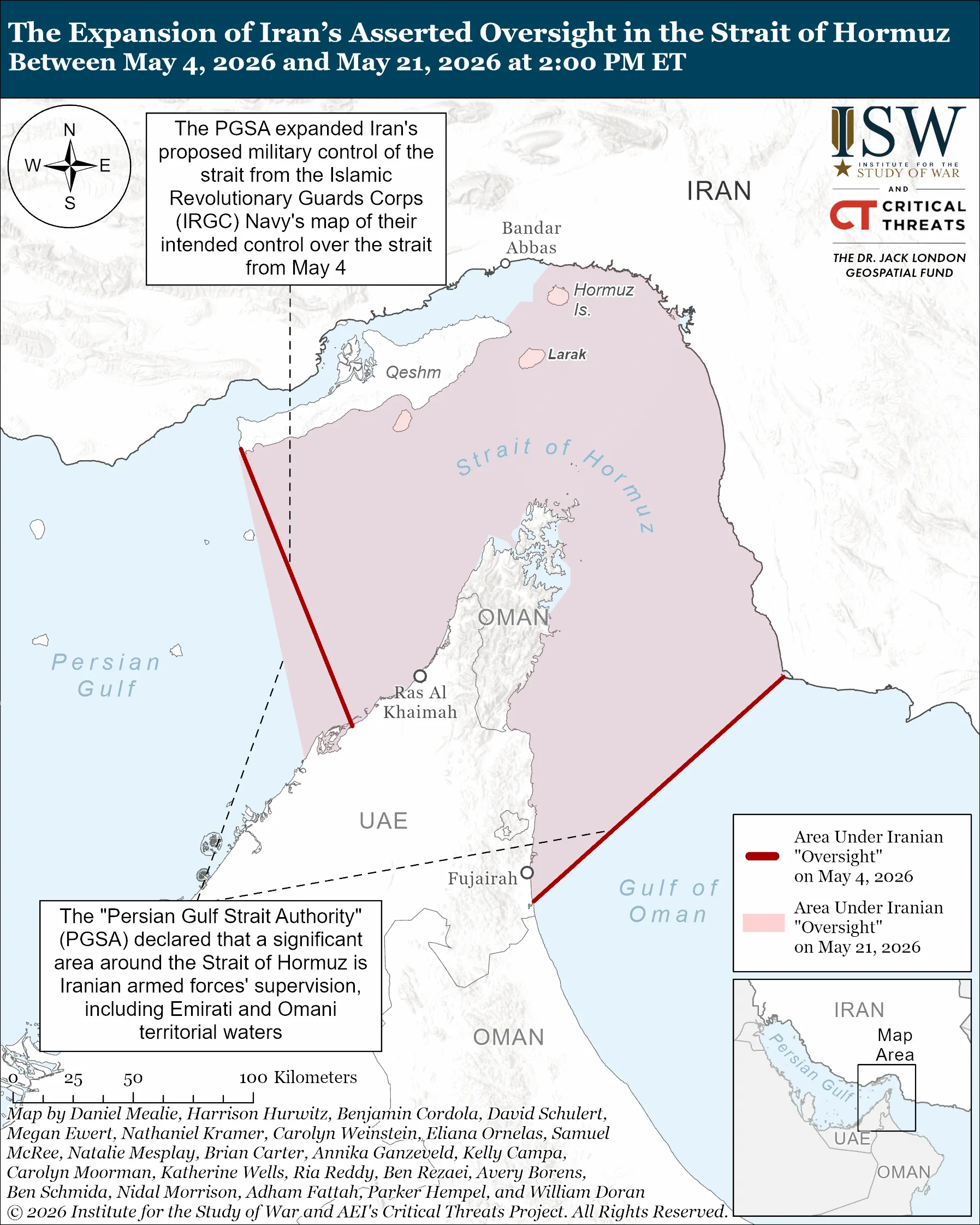
Iranian officials have coalesced around demands to formalize Iranian control over Strait of Hormuz transit, in contrast to their apparent division over the nuclear file. Iran's demands over the Strait of Hormuz demonstrate that Iranian officials believe they won the war because formalizing Iranian control over the Strait of Hormuz is a territorial claim on the sovereign territory of another country. Iran released a map of a Persian Gulf Strait Authority (PGSA)-defined maritime zone on May 20.[16] The PGSA’s new map appears to expand Iran's claimed management zone beyond the area Iran previously depicted on May 4.[17] The new PGSA-defined zone runs from Kuh Mobarak in Iran to southern Fujairah in the United Arab Emirates (UAE) in the east and from the end of Gheshm Island in Iran to Umm al Qaiwain in the UAE in the west.[18] This change lays explicit claim to control over the territorial waters of the UAE and Oman.
 Oversight-in-the-Strait-of-Hormuz-May-21-2026.webp
Iran continues to attempt to build support for its protection racket in the Persian Gulf, in which vessels must pay, coordinate with, or receive permission from Iran's preferred mechanism to transit the Strait of Hormuz in order to avoid attacks from Iranian forces. Iranian Ambassador to France Mohammad Amin Nejad told Bloomberg on May 21 that Iran and Oman are discussing a permanent toll system to formalize control over maritime traffic through the strait.[19] Iranian officials and state media also reported that commercial vessels coordinated with IRGC Navy forces to transit the strait, while IRGC framed this coordination as necessary for safe passage.[20] US Secretary of State Marco Rubio stated on May 21 that an Iranian toll system would be unacceptable and “would make a diplomatic deal unfeasible,” which shows that Iran's Strait demands remain a major obstacle to any US-Iran agreement.[21] ISW-CTP previously assessed that allowing Iran to continue enforcing protocols would be detrimental to US and international commercial interests, as it would mean Iran could prevent ships from traversing the strait anytime it wants.[22]
Iran is continuing to use the ceasefire period to reconstitute its drone and missile program. Sources familiar with US intelligence assessments on Iranian reconstitution told CNN on May 21 that Iran will likely be able to reconstitute damage to Iran's defense industrial base “in a matter of months, not years,” which is “much faster” than the US intelligence community estimated.[23] This information does not clarify which elements of the defense industrial base or how specific reconstitution would result in changes to reconstitution timelines, which makes the information difficult to judge on its own merits. These timelines are impossible to evaluate without answering such questions, and the assumptions underlying these timelines should be rigorously interrogated, therefore. The officials partially attribute this to some of Iran's defense industrial base remaining intact.[24] Iran has reportedly been replacing missile sites, launchers, and production sites destroyed during the airstrikes.[25] It is unclear what constitutes a ”production site” in this context. A production site could theoretically range from an entire factory complex (which would need to be rebuilt if destroyed) to a single piece of complex but rapidly replaceable machinery. The lack of clarification also makes this evaluation difficult to judge on its own merits. Iran still has 50 percent of its drone capabilities, which amounts to thousands of drones, as well as a “large percentage” of Iran's coastal defense cruise missile stockpile left, according to these officials.[26] Iran's drone program is far more difficult to degrade for long periods of time compared to the ballistic missile program. The drone program relies on less complex and more easily-produced systems compared to the ballistic missile program, which requires huge facilities with extremely specialized equipment (like planetary mixers for solid fuel, for example). The officials observed that Iran has around two-thirds of its missile launchers after digging out many during the ceasefire.[27] CNN noted that this estimation may still include buried launchers, however.[28]
The People's Republic of China (PRC) and Russia are helping Iran reconstitute its drone and missile program. The PRC has sent missile components, according to US officials familiar with intelligence assessments, speaking to CNN.[29] There is no evidence that these missile components reached Iran. CNN added that the US naval blockade on Iranian ports may have hindered Russian and Chinese efforts to support Iran's reconstitution.[30] US Central Command (CENTCOM) reported that US forces redirected 94 vessels and disabled four others since the start of the blockade on Iranian ports on April 13.[31] US forces previously seized the Iranian-flagged Touska in the Gulf of Oman on April 19, and its cargo, which was described as “conditional contraband,” including electronic components, computer systems, machinery, and power generation equipment.[32] Unspecified security sources told Reuters that the Touska was likely transporting dual-use items from the PRC to Iran because the vessel had done so previously.[33] The PRC has sent multiple shipments of missile fuel precursors to support Iranian missile reconstitution efforts following the June 2025 Israel-Iran War, even during the most recent war.[34] US officials told the New York Times on May 9 that Russia is shipping drone components to Iran through the Caspian Sea to help rebuild Iranian drone capabilities as well.[35]
https://understandingwar.org/research/middle-east/iran-update-special-report-may-21-2026/
The US-Iran negotiations have reportedly made “slight progress,” but Iran's highly enriched uranium (HEU) and the Strait of Hormuz remain the two key sticking points in negotiations. It is unclear from public reporting where specifically “progress” was made. An unspecified senior Iranian source told Reuters that both sides have narrowed gaps between their demands, but that Iran's uranium enrichment and the Strait of Hormuz remain sticking points.[1] An unspecified Pakistani diplomatic source told Saudi news media outlet Al Hadath that the main obstacle in the talks remains how to handle Iran's HEU, and that closing gaps will not be easy because both sides maintain “high demands.”[2] US Secretary of State Marco Rubio similarly stated that talks show “slight progress” but stressed again that Iran cannot obtain a nuclear weapon or remain in control of the Strait of Hormuz.[3] Iran has not signaled willingness to meet US demands to secure its HEU stockpile out of Iran, and there is a broad consensus in Tehran that Iran must retain control over the strait.[4] US officials have called an outcome wherein Iran continues to control the strait “unfeasible.”[5] Rubio warned that the president has “other options” if negotiations fail.[6]
Iran has launched an information operation to frame its protection racket in the Strait of Hormuz as a legitimate maritime security service. Iran's conduct toward commercial shipping in the Strait of Hormuz is a protection racket, which is a coercive extortion scheme in which an actor creates or threatens danger and then demands payment or compliance in exchange for protection from that danger. The New York Times reported on May 21 that Iran and Oman have discussed a system to charge vessels fees for maritime “services” rather than tolls for passage.[7] Iran likely seeks Omani support to legitimize its efforts to extend control over the entire strait. Iran‘s current “control” scheme makes territorial claims that infringe upon Emirati and Omani sovereignty.[8] The inclusion of Oman and not the UAE is notable in this context because Omani participation would legitimize Iranian efforts while still extending Iranian claims of sovereignty over Emirati territorial waters. The New York Times reported on May 21 that Oman initially rejected a partnership with Iran but added that Omani officials are now signaling willingness to use Oman's influence with Gulf neighbors and the United States to support the proposed fee system.[9] A fee and control system under which Iran and Oman control the strait together would still infringe upon Emirati sovereignty. Iran has claimed that its fee is in part for “security” or “insurance” for vessels that transit the strait. The Islamic Revolutionary Guards Corps (IRGC) Navy claimed on May 22 that 35 vessels transited the strait in the past 24 hours after obtaining Iranian “permission” and “security.” This “security” is effectively protection from attacks by Iranian forces, which is the only force that has threatened shipping in the Strait of Hormuz since February 2026. The US Navy, by comparison, is imposing a blockade upon Iranian ports—not the Strait of Hormuz. Commercial vessels only require such security guarantees to transit the strait because Iran has created insecurity through attacks, threats, and restrictions on international shipping. Iran now seeks to require vessels to secure Iranian permission and pay fees in exchange for protection from Iranian attacks or the denial of passage. Bloomberg reported that vessels dealing with Iran's new Persian Gulf Strait Authority have sometimes received payment requests of up to $2 million for safe passage, though Reuters reported on May 20 that most ships pay around $150,000.[10]
Iran's neighbors and the United States continue to reject Iranian efforts to normalize control over the strait. Bahrain, Kuwait, Qatar, Saudi Arabia, and the UAE wrote in a statement to the International Maritime Organization that Iran appears to be attempting “to control traffic” through the strait by forcing vessels to use a route within its territorial waters.[11] The statement warned that any recognition of Iran's proposed route or the PGSA would set “a dangerous precedent.”[12]
The war cannot end in a way that secures US and allied interests until Iran abandons its effort to control the strait. Recognition or compliance with Iranian transit rules would allow the regime to achieve de facto control over the strait. Iran's promise not to attack vessels would not secure freedom of navigation if the regime requires ships to obtain permits, pay fees, or coordinate with IRGC Navy forces. Full freedom of navigation through the strait, therefore, remains a necessary condition for any durable end to the war. ISW-CTP has assessed that Iranian leaders are positioning Iran to emerge from the war in a stronger strategic position, with veto power over access to the strait.[13] Iran is therefore not aiming to just “survive” the war.
The Iraqi Shia Coordination Framework has reportedly decided to form an Iraqi federal government committee to investigate recent likely Iranian-backed Iraqi militia drone attacks targeting Saudi Arabia and the United Arab Emirates (UAE).[14] Likely Iranian-backed Iraqi militias launched six drones targeting the UAE from May 17 to 19, including a drone that struck the Barakah Nuclear Power Plant.[15] Saudi Arabia also reported on May 17 that it intercepted three drones launched from Iraq.[16] Iranian-backed Iraqi militias conducted numerous drone attacks targeting the Gulf countries prior to the start of the ceasefire on April 7.[17] A Shia Coordination Framework source told Iraqi media on May 22 that the Iraqi federal government committee will include unspecified security specialists and representatives from the Interior, Defense, and Foreign Affairs ministries.[18] The committee will reportedly consist of one team that will review evidence, including the drone flight paths, in Saudi Arabia and the UAE, while the other team investigates within Iraq in order to identify the responsible actors.[19]
The Deputy Head of the Executive Council of Iranian-backed Iraqi militia Harakat Hezbollah al Nujaba, Hussein al Saidi, rejected on May 22 the disarmament of Iranian-backed Iraqi militias and any integration of the Iranian-backed Popular Mobilization Forces (PMF) into the Iraqi security establishment.[20] Harakat Hezbollah al Nujaba controls PMF brigades.[21] Iranian-backed groups like Harakat Hezbollah al Nujaba often respond to directives from Tehran, not Baghdad, even though they have forces in the PMF. Saadi referenced “talk” about merging the PMF, the Federal Police, and the Rapid Response Forces into a “Federal Security Ministry” and called this a “purely American project.”[22] The Federal Police and Rapid Response Forces operate under the Interior Ministry.[23] The United States has pressured the Iraqi federal government to reduce Iranian influence in Iraq, including via militia disarmament, since early 2025. The United States has redoubled its efforts in recent months due to militia attacks against US and foreign targets in Iraq and the region during the war.[24]
Saidi’s statement comes amid reports that an Iraqi committee comprised of Badr Organization head Hadi al Ameri, Prime Minister-designate Ali al Zaidi, and caretaker Prime Minister Mohammad Shia al Sudani is close to finalizing an “executive plan” to disarm the Iraqi militias.[25] A senior Iraqi political official told Asharq al Awsat on May 9 that the plan involves the confiscation of militias’ medium and heavy weapons, as well as the restructuring of the Iranian-backed Popular Mobilization Forces (PMF), but did not provide further details about the plan.[26] Saadi said that Iraqi officials who insist on integrating the PMF into the security establishment will “pay the price” politically.[27] Harakat Hezbollah al Nujaba head Akram al Kaabi also called disarmament a “red line” on May 6.[28] Kataib Sayyid al Shuhada and Kataib Hezbollah also reportedly reject disarmament.[29] These militias and Harakat Hezbollah al Nujaba have, both historically and during the war, been the most kinetically active and are more subordinate to Iran than other Iraqi militias.[30]
The Iraqi federal government's efforts to disarm the militias also come after Iran has separately pressured its Iraqi partners to stop all kinetic activity, likely to avoid US financial pressure against Iraq that negatively impacts Iran.[31] Iran hopes to benefit by increasing Iranian-backed Iraqi political control of the Iraqi government. Unidentified informed sources told Iraqi media on May 5 that Islamic Revolutionary Guards Corps (IRGC) Quds Force Commander Brigadier General Esmail Ghaani warned about “real dangers” that could result in a loss of unspecified military privileges and discussed the need for an “alternative plan” regarding militia disarmament during meetings with unspecified militias and framework leaders in Baghdad on April 1[32] Ghaani reportedly proposed a militia disarmament plan that seeks to avoid provoking the United States by ending the kinetic role of some militias, while simultaneously consolidating[33] ISW-CTP continues to assess that Iran could decide to build a new, loyal cadre of ideological militias, over which Iran has strong control, that would supplement the political activity of Iranian-backed Iraqi actors. US financial pressure on Iraq, such as the US Treasury Department's reported decision to halt shipments of Iraqi export oil revenue to Iraq, heavily impacts Iran due to Iran's use of the Iraqi economy for sanctions evasion and to help fund the Axis of Resistance.[34]
https://understandingwar.org/research/middle-east/iran-update-special-report-may-22-2026/
Updated link https://www.iranintl.com/en/liveblog/202605238115
Sal Mercogliano- What’s Going on With Shipping?
21MAY2026 Mission Critical: Drones helping in Hormuz | WGOWS Guests on a New Podcast
The Strait of Hormuz is one of the world’s most critical maritime chokepoints, with 11% of all global trade and 20% of the world’s oil passing through its narrow waters. But with rising tensions and the threat of “sea denial” tactics, how is the maritime industry keeping traffic moving?
In this episode of Mission Critical with Ryan Robertson, Sal Mercogliano of What’s Going on With Shipping joins the new Podcast, along with other naval experts, to explore the pivotal role of unmanned systems—or drones—in securing the strait. From surface reconnaissance craft to underwater mine-sweepers, we look at how technology is stepping in where traditional naval assets face unique challenges.
https://www.youtube.com/watch?v=IEeJEzRDmec
Iran's latest counterproposal front-loads all of Iran's key demands on the withdrawal of “a US threat to Iran,” financial relief, and Iran's “right” to manage the Strait of Hormuz while attempting to delay discussion of Iran's nuclear program. Iran's proposal corroborates ISW-CTP’s assessment that the regime believes it is winning the war and is negotiating from a position of strength.[1] Islamic Revolutionary Guards Corps (IRGC) affiliated media outlet Tasnim News Agency reported on May 23 that Iran's counterproposal was sent to Pakistani mediators.[2] Iran demanded an end to the war on all fronts, including in Lebanon, and the withdrawal of US forces from the ”warzone.”[3] Withdrawing US “threats to Iran” would constitute a withdrawal from the region, presumably, which both removes US military leverage and accomplishes a key Iranian objective: expelling US forces from the region. The proposal included demands that Iran will not discuss its nuclear program unless the war first ends, rejects transferring its highly enriched uranium (HEU) stockpile to the United States, and will not commit to dismantling its nuclear facilities, all of which are key US demands.[4] The United States would be forfeiting considerable leverage in the first phase of an agreement before discussing the nuclear issue. The proposal also included Iranian demands that the United States lift all sanctions on Iran and release all frozen Iranian assets in the first phase.[5] Iran emphasized in the proposal that the Strait of Hormuz will remain under some form of Iranian control and that Iran will not continue negotiations if the United States does not end its blockade of Iranian ports and ships.[6] The maximalist terms in the proposal indicate that Iran's regime believes it is negotiating from a position of strength due to its victory in the war.
You can read more in our latest analysis of Iran's efforts to assert control over the Strait of Hormuz here: How Iran Hopes to Control the Strait of Hormuz: It's Not Just About Fees by Brian Carter. https://understandingwar.org/research/middle-east/how-iran-hopes-to-control-the-strait-of-hormuz-its-not-just-about-fees/>
Iranian officials continue to emphasize Iranian management of the Strait of Hormuz as a key sticking point in negotiations. Iranian Foreign Affairs Ministry Spokesperson Esmaeil Baghaei stated on May 23 that the strait “does not concern” the United States and that Iran and Oman should define a mechanism for the waterway as coastal states.[7] The New York Times reported on May 21 that Iran and Oman have discussed a system to charge vessels fees for maritime “services” rather than tolls for passage.[8] This is illegal under international maritime law. IRGC-affiliated Tasnim News Agency reported on May 23 that Iran has demanded that the strait not return to its pre-war mechanism and ”legal regime.”[9] Tasnim added that Iran has demanded an end to the US naval blockade and said that negotiations will not proceed while the blockade remains in place.[10] IRGC-affiliated Fars News separately reported that Iran will only commit to restoring the number of vessels that transit the strait to pre-war levels, while Iran would determine which vessels receive approval and what route they must take.[11] The IRGC Navy reported on May 23 that 25 vessels crossed the strait in the past 24 hours after they received permission and transited under IRGC Navy coordination and security provision, which indicates that Iran is trying to portray itself as the manager and security provider for strait transit.[12]
US President Donald Trump stated on May 23 that he would decide by May 24 whether to resume strikes on Iran.[13] A US official familiar with the talks told Axios that negotiators have exchanged drafts every day without much progress.[14] Trump said the chances of reaching a deal with Iran or resuming strikes are a “solid fifty-fifty”.[15] Trump spoke with regional leaders on May 23 to discuss the latest Iranian proposal.[16] A source close to the negotiations told the Washington Times that the United States and Iran are expected to announce the finalization of a draft proposal to end fighting on all fronts by afternoon on May 24.[17] Trump said he would only accept a deal that addresses key issues, including Iran's uranium enrichment and its HEU stockpile.[18]
US media reported on May 22 that senior Iranian-backed Iraqi militia Kataib Hezbollah commander Mohammad Baqer Saad Dawoud al Saadi had planned attacks targeting members of US President Donald Trump's family prior to his arrest on May 15.[19] US authorities charged Saadi with planning at least 20 attacks targeting civilians in Europe, Canada, and the United States after Turkey detained and handed over Saadi to the United States.[20] A senior Iraqi military officer and another unnamed source told US media that Saadi sought to target Trump's family as retaliation for the US airstrike that killed former IRGC Quds Force commander Qasem Soleimani in January 2020.[21] A researcher who Kataib Hezbollah abducted in Baghdad and held hostage between 2023 and 2025 reported that Saadi was a close associate of Soleimani and the current Quds Force commander Esmail Ghaani.[22] The US government identified Kataib Hezbollah as the group that abducted US journalist Shelly Kittleson in Baghdad on March 31.[23]
https://understandingwar.org/research/middle-east/iran-update-special-report-may-23-2026/
We will not have peace with Iran until the ayatollahs and the IRGC are no longer in control and are all either dead or have fled the country. Any deal we make with them is just kicking the can down the road to allow it to bite us in the ass later.
https://x.com/Danielstilwell/status/2058354694326514101
Disclaimer: Opinions posted on Free Republic are those of the individual posters and do not necessarily represent the opinion of Free Republic or its management. All materials posted herein are protected by copyright law and the exemption for fair use of copyrighted works.