Iran Update Special Report, May 17, 2026
The United States and Iran continue to pursue fundamentally incompatible negotiating positions. Unspecified sources familiar with the US response to the latest Iranian counterproposal told Islamic Revolutionary Guards Corps (IRGC)-affiliated Fars News Agency on May 17 that the United States laid out its five main conditions in response to the latest Iranian proposal.[1] The reported US response rejected war reparations, required Iran to transfer 400 kilograms of uranium to the United States, limited Iran to one operational nuclear facility, and refused to release more than 25 percent of frozen Iranian assets. The war would only end if negotiations were successful, and there would be no guarantees that the United States or Israel would not attack Iran in the future.[2]
Iran sent its most recent counterproposal to the United States on May 10, which US President Donald Trump later called “totally unacceptable.”[3] IRGC Baghiyatollah Sociocultural Headquarters Commander and former IRGC commander Major General Mohammad Ali Jafari stated on May 11 that Iran will not enter negotiations with the United States until the United States accepts Iran's terms.[4] Jafari stated that Iran's terms include an end to the war on “all fronts,” the lifting of sanctions, the release of frozen Iranian assets, compensation for war-related damages, and recognition of Iran's sovereignty over the Strait of Hormuz.[5]
The reported US conditions directly conflict with the demands that Iranian officials and senior IRGC officials publicly outlined on May 11.[6] CTP-ISW previously assessed that Iranian officials sought terms that would result in the loss of US leverage before meaningful negotiations could begin, which would likely make it more difficult for the United States to secure major nuclear concessions from Iran.[7]
Likely Iranian or Iranian-backed forces launched three drones targeting the Barakah Nuclear Power Plant in Abu Dhabi, the United Arab Emirates (UAE), on May 17.[8] Regime media attempted to drive a wedge between the UAE and Saudi Arabia by blaming Saudi Arabia for the attack.[9] Radiation levels at the plant remain normal. The Emirati Defense Ministry announced that its air defenses intercepted two drones while the other struck an electrical generator at the Barakah Nuclear Power Plant in Abu Dhabi, causing a fire.[10] The Ministry noted that the attacks came from the direction of “the western border.”[11] The International Atomic Energy Agency stated that the radiation levels at Barakah remained normal and that no casualties were reported.[12]
Iran has previously used drones to approach a target from an unexpected direction to obscure its responsibility and create challenges for air defenses. Iranian forces attacked Saudi oil facilities at Abqaiq in 2019 using several drones that Iranian forces fired from Iranian territory, but approached the target from the west, not the east.[13] The Houthi movement claimed the 2019 attack, even though there was little evidence of Houthi culpability.[14]
IRGC-affiliated media used the attack to attempt to drive a wedge between the UAE and other Gulf States by blaming Saudi Arabia for the attack. IRGC-affiliated media suggested on May 17 that Saudi Arabia launched the drones because it is the country to the west of the UAE.[15] Armed Forces General Staff-affiliated Defa Press Agency claimed on May 17 that the United States and Israel launched attacks against ”regional countries” and then attributed the attacks to Iran.[16] Iran has previously launched attacks against the UAE in an attempt to drive a wedge between the UAE and other Gulf states, likely in response to growing cooperation between the United States, Israel, and the UAE.[17]
IRGC-affiliated Tasnim News Agency reported on May 17 that Iranian Parliament Speaker Mohammad Bagher Ghalibaf became Iran's special representative for the People's Republic of China (PRC) affairs.[19] Tasnim reported that Iranian President Masoud Pezeshkian proposed appointing Ghalibaf to the position, and Supreme Leader Mojtaba Khamenei approved the appointment.[20] Tasnim highlighted that Ghalibaf’s appointment differs from previous PRC-related representative roles in terms of “level of authority.”[21] Iranian Ambassador to the PRC Abdolreza Fazli Rahmani previously served only as the president's representative for PRC affairs, while former Supreme National Security Council Secretary Ali Larijani served as the Supreme Leader's special representative for PRC affairs.[22]
Iraqi officials told the New York Times on May 17 that Israel built two clandestine outposts in the Iraqi desert in late 2024.[23] Western media previously reported on May 9 that the Israel Defense Forces (IDF) built one outpost near al Nukhayb, Anbar Province.[24] The IDF used this outpost for air support, refueling, and “medical treatment” during the 12-day war in June 2025, according to two regional officials speaking to the New York Times on May 17.[25] Israeli and Western media also reported in May 2026 that the IDF deployed commando units and search-and-rescue teams to this outpost before the start of the recent US-Israeli campaign in Iran to recover Israeli pilots if Iranian forces shot down Israeli fighter jets.[26] The New York Times reported that the outpost near al Nukhayb is no longer operational.[27] Two Iraqi officials, including senior Wisdom Movement official Hassan Fadaam, told the New York Times on May 17 that there is a second undisclosed Israeli outpost in the Iraqi desert.[28] The status and location of this second outpost were not specified, however.[29]
Two Iraqi security officials also told the New York Times on May 17 that the United States “compelled” Iraq to shut down its radars to protect US aircraft during the 12-day war in June 2025 and the recent conflict.[30] Iranian-backed Iraqi actors will likely use this report, in conjunction with the reports of Israeli bases in Iraq, to pressure the Iraqi government to pursue the purchase of advanced air defense systems. Several Iranian-backed Iraqi parliamentarians previously called on the Iraqi government to modernize its air defenses and diversify its arms supplies in June 2025.[31]
https://understandingwar.org/research/middle-east/iran-update-special-report-may-17-2026/
Iran Update Special Report, May 18, 2026
Iran's latest counterproposal does not appear to meet US demands. Reuters reported on May 18 that Iran sent a new proposal with similar terms to proposals previously rejected by the United States.[1] A senior US official and source briefed on the matter told Axios on May 18 that Iran's counterproposal does not contain a commitment “about suspending uranium enrichment or handing over its existing stockpile of highly enriched uranium (HEU).”[2] The US official added that the Trump Administration believes Iran's proposal is “insufficient.” Islamic Revolutionary Guards Corps (IRGC)-affiliated media reported on May 18 that “major disagreements” remain between the United States and Iran and stated that Iran would never agree to “an end to the war in return for nuclear commitments.”[3] US demands have been and continue to be that Iran must give its HEU to the United States, dismantle its nuclear facilities, and pause uranium enrichment for at least 20 years.[4]
US President Donald Trump announced on Truth Social on May 18 that he canceled a scheduled US military strike against Iran that was planned for May 19.[5] Trump stated that Qatari Emir Sheikh Tamim bin Hamad al Thani, Saudi Crown Prince Mohammed bin Salman, and Emirati President Mohamed bin Zayed asked him to suspend the strike “for two or three days” due to ongoing negotiations.[6] A US official and an unspecified source told Axios that the three Gulf leaders warned that they would “pay the price” if the United States conducted new strikes on Iran and expressed concerns that Iran would retaliate by targeting their energy and oil infrastructure.[7] Trump noted that the Gulf leaders believe that the United States and Iran can reach a deal that is “very acceptable to the United States” and that would prevent Iran from obtaining nuclear weapons.[8] Trump added that he instructed US Defense Secretary Pete Hegseth, US Chairman of the Joint Chiefs of Staff General Dan Caine, and the US military to remain prepared to launch a “full, large-scale assault” against Iran on short notice if negotiations fail.[9]
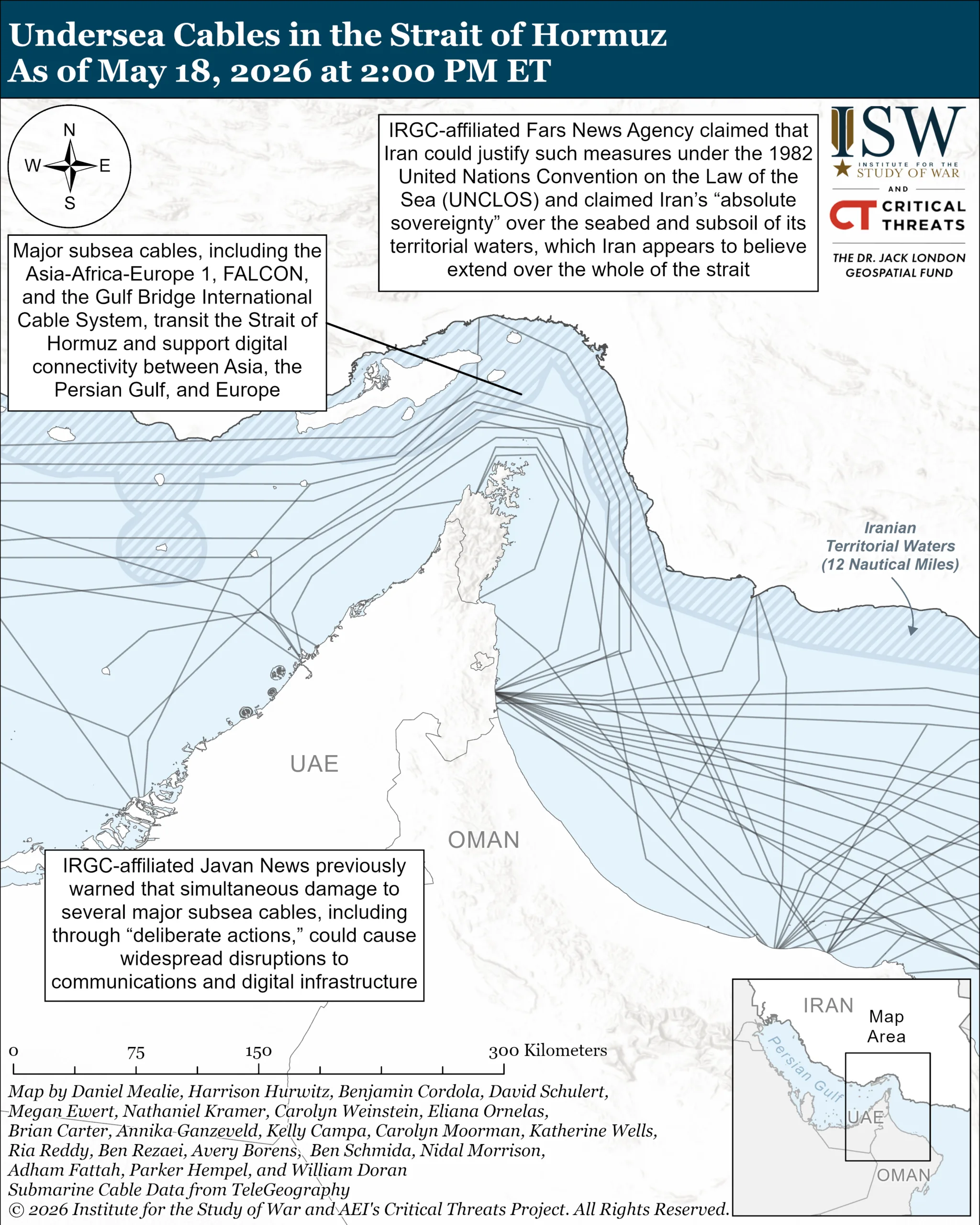
Iran continues to formalize and institutionalize its claimed control over transit through the Strait of Hormuz in contravention of the UN Convention on the Law of the Sea (UNCLOS). The newly established Persian Gulf Strait Authority (PGSA) stated on X on May 18 that it serves as the “legal institution and representative authority” of the Iranian regime for managing transit through the strait.[10] Iran has incorrectly asserted that this is “legal” under the UNCLOS because the Strait of Hormuz is within Iran's territorial waters.[11] Article 37 of the UNCLOS states that straits “used for international navigation between one part of the high seas or an exclusive economic zone and another part of the high seas or an exclusive economic zone” are international straits.[12] Article 38 guarantees that “all ships and aircraft enjoy the right of transit passage” through such straits, and Article 44 prohibits bordering states — like Iran — from “hampering” or suspending passage.[13] The PGSA added that navigation through the designated zone requires “full coordination” with the authority and warned that transit without authorization would be considered illegal.[14] This is an Iranian effort to hamper passage. Iranian state media separately highlighted that 1,500 vessels are currently waiting for Iranian permission to transit the strait as part of broader regime efforts to portray Iran as the sole authority responsible for managing transit through the strait.[15]
IRGC-affiliated outlets continue to threaten commercial and digital activity linked to the Strait of Hormuz as part of broader regime efforts to institutionalize Iranian authority over the waterway. IRGC-affiliated Fars News Agency reported on May 18 that Iran could impose permits, oversight measures, and sovereign fees on fiber-optic cables transiting the strait after implementing “management” over the strait.[16] Fars warned that disruptions to the corridor could impose high direct and indirect costs on the regional and global economy.[17] Major subsea cables, including the Asia-Africa-Europe 1 (AAE-1), FALCON, and the Gulf Bridge International Cable System, run through the strait of Hormuz and support digital connectivity between Asia, the Gulf, and Europe.[18] Three of seven cables — FALCON, GBICS, OMRAN/EPEG cables — connect to Iran and run through the strait.[19] IRGC-affiliated Javan News previously warned that simultaneous damage to several major subsea cables, including through “deliberate actions,” could cause widespread disruptions to communications and digital infrastructure.[20] Fars also claimed that Iran could justify such measures under the 1982 UNCLOS and claimed Iran's “absolute sovereignty” over the seabed and subsoil of its territorial waters.[21]
Likely Iranian-backed Iraqi militias launched three drones targeting Saudi Arabia on May 17.[28] The Saudi Defense Ministry stated on May 17 that it intercepted three drones launched from Iraq that entered Saudi airspace.[29] Iraqi media reported on May 18 that the Iraqi Ministry of Foreign Affairs expressed “concern” about the incident.[30] This attack comes after likely Iranian or Iranian-backed Iraqi militias launched three drones targeting the Barakah Nuclear Power Plant in the United Arab Emirates (UAE) on May 17, one of which hit an electrical generator.[31] Likely Iranian-backed Iraqi militias have conducted several drone attacks targeting Gulf states since the onset of the US-Iran ceasefire in early April.[32]
https://understandingwar.org/research/middle-east/iran-update-special-report-may-18-2026/