Iran is likely using the ceasefire period to normalize Iranian control over the Strait of Hormuz by compelling oil-importing countries to establish a bilateral transit agreement with Iran while charging fees from vessels that are not part of the bilateral deals. The transit agreements and fee system use a multi-tiered system, according to Iranian officials speaking to Reuters on May 20.[1] Iranian strategic partners, like Russia and China, are prioritized at the top tier, while countries with close ties to Iran, like India and Pakistan, can operate within negotiated transit agreements. Other countries are handled on a case-by-case basis, and any vessel that has links to Iranian adversaries is denied access entirely. Finally, ships that do not fall under a bilateral agreement are required to pay fees, which are reportedly around $150,000. The Iranian Islamic Revolutionary Guards Corps (IRGC) runs the scheme. These fees are framed as “security” fees, but the fees are in reality part of a mafia-esque protection racket in which the vessels pay Iran so that the Iranian navy can “secure” the vessels against an attack by the Iranian navy or Iranian shore-based missiles and drones.
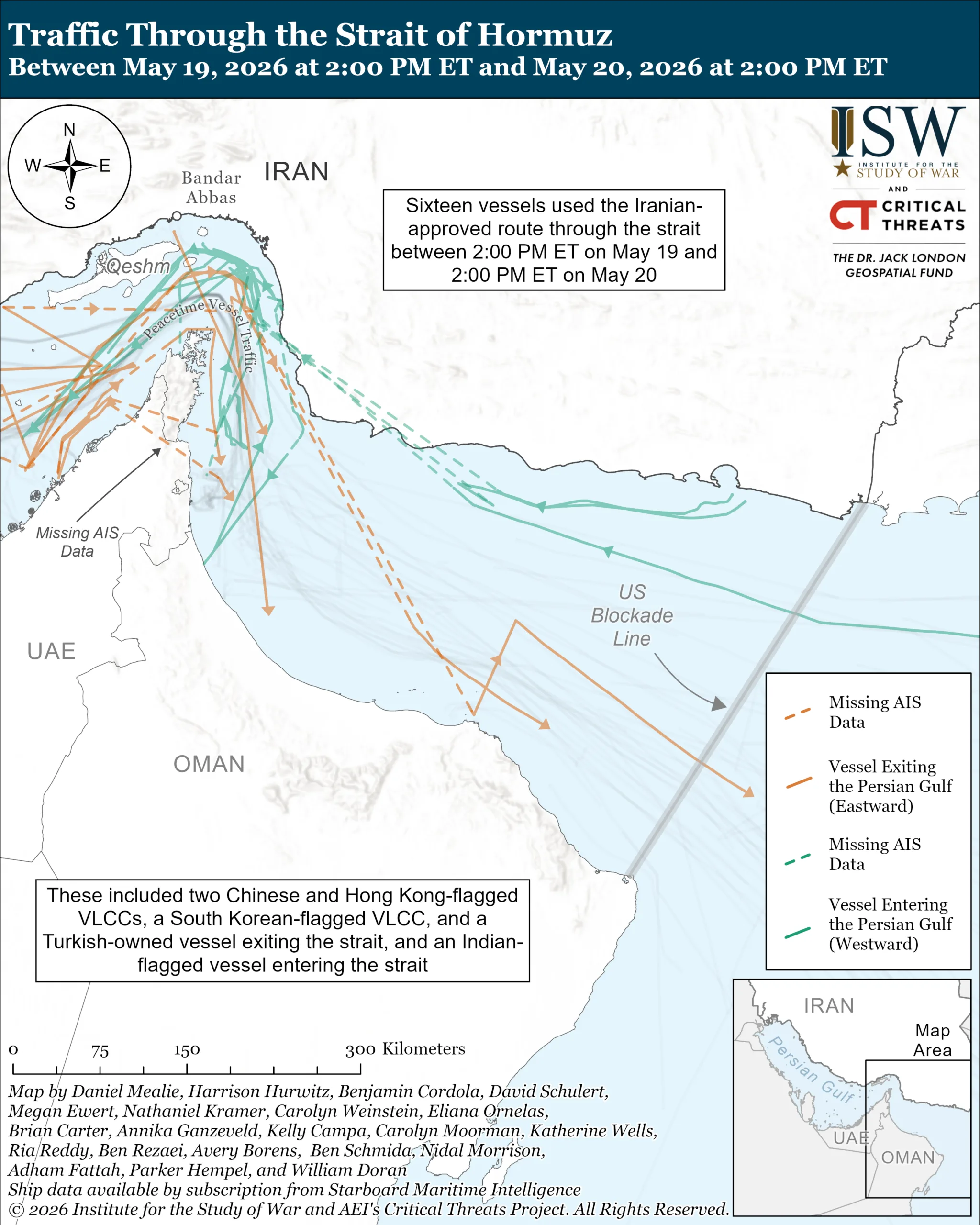
Evidence of Iran's mechanism is already visible in ad hoc arrangements. The Iraqi Government—under the supervision of then Prime Minister Mohammad Shia al Sudani— reportedly came to an agreement with Iran to facilitate the Greek-owned, Maltese-flagged Very Large Crude Carrier (VLCC) Agios Fanourios I carrying Iraqi crude oil on May 10, for example.[2] CTP-ISW recorded that 16 vessels took Iran's route through the strait between 2:00 PM ET on May 19 and 2:00 PM ET on May 20.[3] These included two Chinese and Hong Kong-flagged VLCCs, a South Korean-flagged VLCC, and a Turkish-owned vessel exiting the strait and an Indian-flagged vessel entering the strait, citing commercially available shipping data.[4]
Such a scheme could not be disrupted by a post-war “security” deployment by European states, as some countries have suggested. Several European states, including the United Kingdom and France, have proposed that they would help secure the strait once “conditions allow.”[5] Iran would likely attempt to stop, perhaps with force, any post-war “security force” if the war ends with an official or de facto recognition of Iranian sovereignty over the Strait.
A successful Iranian effort to normalize this structure would gradually increase the number of vessels moving through the strait to near pre-war levels. This reduces the visible economic costs of restricted access and therefore weakens the primary argument for mobilizing US allies to help reopen the strait. Such a decrease in the price of oil would be reliant on a number of other factors, including market reactions and the risk calculus of the shipping companies involved. It is unclear how long a decrease would take, and Iranian efforts to normalize control would need to bear fruit before any mobilization against Iranian activities in the strait. A NATO official told Bloomberg on May 19, for example, that at least some European countries are concerned about the economic consequences of the strait's closure, and some European states support an effort to reopen the strait if the situation fails to change by July 2026.[6] This creates a clear incentive for Iran to normalize traffic flows under its own framework before external pressure from the United States and its allies intensifies.
The United States continues to interdict vessels violating the US blockade of Iranian ports. Three US officials told the Wall Street Journal that US forces seized a US-sanctioned, Iranian-linked oil tanker, the M/T Skywave (IMO: 9328716), between May 19 and 20.[7] Commercially available ship tracking data showed that the Skywave transited the Strait of Malacca on May 14, before returning to the Indian Ocean on May 19, presumably after being seized by US forces.[8] It is unclear where the vessel was before May 14. The United States Treasury Department sanctioned the Skywave, under a different vessel name, on March 13 for its role in transporting Iranian oil.[9] US Central Command (CENTCOM) reported on May 20 that US Marines boarded the Iranian-flagged oil tanker M/T Celestial Sea (IMO: 9397030) on May 20 on suspicion of attempting to reach an Iranian port.[10] US forces released the vessel after searching it and directing it to change course.[11] CENTCOM reported that US forces redirected 91 vessels and disabled four others since the start of the blockade on Iranian ports on April 13.[12]
The IRGC threatened on May 20 to expand the war “far beyond the region” if US-Israeli strikes on Iran resume.[13] This threat almost certainly seeks to deter renewed US-Israeli strikes but could also reflect IRGC planning for a potential future conflict. IRGC-affiliated media previously used similar messaging ahead of the most recent round of conflict to try to exploit US concerns about a protracted regional war to try to deter a US attack.[14] IRGC-affiliated media Tasnim News warned on February 2 that a US attack on Iran could trigger a regional war because Iran could retaliate by attacking Israel, international shipping, or US bases in regional countries.[15] Iran may similarly calculate that threats of a conflict extending “beyond the region” could deter against renewed US-Israeli strikes or increase the pressure on the United States from its European allies. Iran does possess several capabilities with which it could operationalize these threats, including by conducting terror attacks abroad, disrupting shipping in other chokepoints, or firing ballistic missiles at longer range, however.
Terror Attacks Abroad: Iran could direct or support attacks in Europe or other regions to pressure governments to deny access, basing, and overflight privileges to US forces. US authorities recently charged Iranian-backed Iraqi militia Kataib Hezbollah commander Mohammad Baqer Saad Dawoud al Saadi for planning attacks targeting civilians in the United States, Canada, and Europe, for example.[16] Several European states, including France, Norway, and Belgium, have disrupted Iranian-backed or -linked attack plots during the war.[17]
Expand Attacks on International Shipping: Senior Iranian officials have threatened to “open new fronts” in any renewed conflict with the United States.[18] These officials may be referring to attacks on international shipping beyond the Strait of Hormuz and Persian Gulf, including the Red Sea and Bab el Mandeb Strait.[19] Arab officials told the Wall Street Journal on April 14 that Iran is pressuring the Houthis to “close” the Bab el Mandeb Strait.[20] Iran could rely on the Houthis to conduct such attacks in a potential future conflict. The Houthis, however, largely avoided direct involvement in the most recent round of conflict, and their willingness to participate in a future conflict remains unclear.
Longer-Range Missile Strikes: Iran could fire intermediate-range ballistic missiles (IRBM) towards Europe or the Mediterranean Sea, albeit this scenario remains less likely. Iran demonstrated a nascent long-range strike capability during the recent conflict when it unsuccessfully fired two ballistic missiles at the US-UK base at Diego Garcia, which is located approximately 4,000 kilometers from southern Iran.[21] One missile failed in-flight, and the United States intercepted the other.[22] A Dutch missile expert assessed that Iran would have needed either to reduce the payload of an MBRM “to virtually nothing” or incorporate a second stage booster to achieve that range.[23] The attack, nonetheless, demonstrated Iran's ability to strike beyond the self-imposed 2,000-kilometer missile range limit that Iranian officials have long cited publicly.
Pakistan is attempting to secure its own political and security interests by fulfilling its end of the Pakistan-Saudi Arabia defense agreement and helping mediate between the United States and Iran. Reuters reported on May 18 that Pakistan sent 8,000 troops, a squadron of fighter jets, and an air defense system to Saudi Arabia as part of their September 2025 mutual defense pact, citing three security officials and two government sources, all of whom described it as a “substantial” and “combat-ready” force that could defend against further attacks on Saudi Arabia.[24] Reuters added that Pakistan sent the aircraft in April but did not specify when it sent the other assets to Saudi Arabia.[25] These moves are necessary to uphold the Saudi-Pakistani defense agreement signed in September 2025, given the attacks on Saudi Arabia by Iran. A resumption of the war could challenge Pakistan's commitments to the agreement with Riyadh in new ways, as well, which makes Pakistan invest in avoiding a return to conflict. Pakistan is therefore simultaneously mediating between the United States and Iran, which has the added benefit of demonstrating Islamabad's political influence in the region.[26] Pakistani Interior Minister Mohsin Naqvi also travelled to Tehran on May 20 for talks with Iranian officials to continue mediation efforts.[27]
Qatar has reportedly also been playing a mediating role between the United States and Iran, which may be causing tensions with Pakistan.[28] An Arab official speaking to Axios on May 20 stated that Qatar sent a delegation to Iran in order to get more tangible commitments from Iran over its nuclear program and more specifics from the United States on the release of Iran's frozen assets.[29]
The Wall Street Journal reported on May 20 that Iran is still unable to enrich uranium because it would have to dig up fissile material buried underneath rubble.[30] US and Israeli strikes buried much of this material during the 12-Day War in June 2025. The United States severely damaged Iran's three most important nuclear facilities – Natanz, Fordow, and Esfahan – using bunker buster bombs and cruise missiles during the 12-Day War in June 2025.[31] The strikes resulted in the burying of Iran's highly enriched uranium stockpile and likely destruction of all or a significant number of centrifuges needed for enrichment.[32]
The Associated Press reported on May 20 that IRGC members are teaching Iranian civilians how to use arms.[33] The report added that the IRGC has displayed military vehicles mounted with machine guns and a ballistic missile at a wedding.[34] French media reported on May 19 that Iranian authorities had set up military training booths to teach Iranians the basics of carrying weapons.[35]
The New York Times, citing US officials briefed on the matter, reported on May 20 that Israel developed a plan to free former Iranian President Mahmoud Ahmadinejad from house arrest in order to lead regime change in Iran.[36] The officials and one of Ahmadinejad's associates added that Israeli airstrikes injured Ahmadinejad on February 28 and derailed the plan.[37] Israeli strikes reportedly killed three of Ahmadinejad's security detail on February 28.[38]
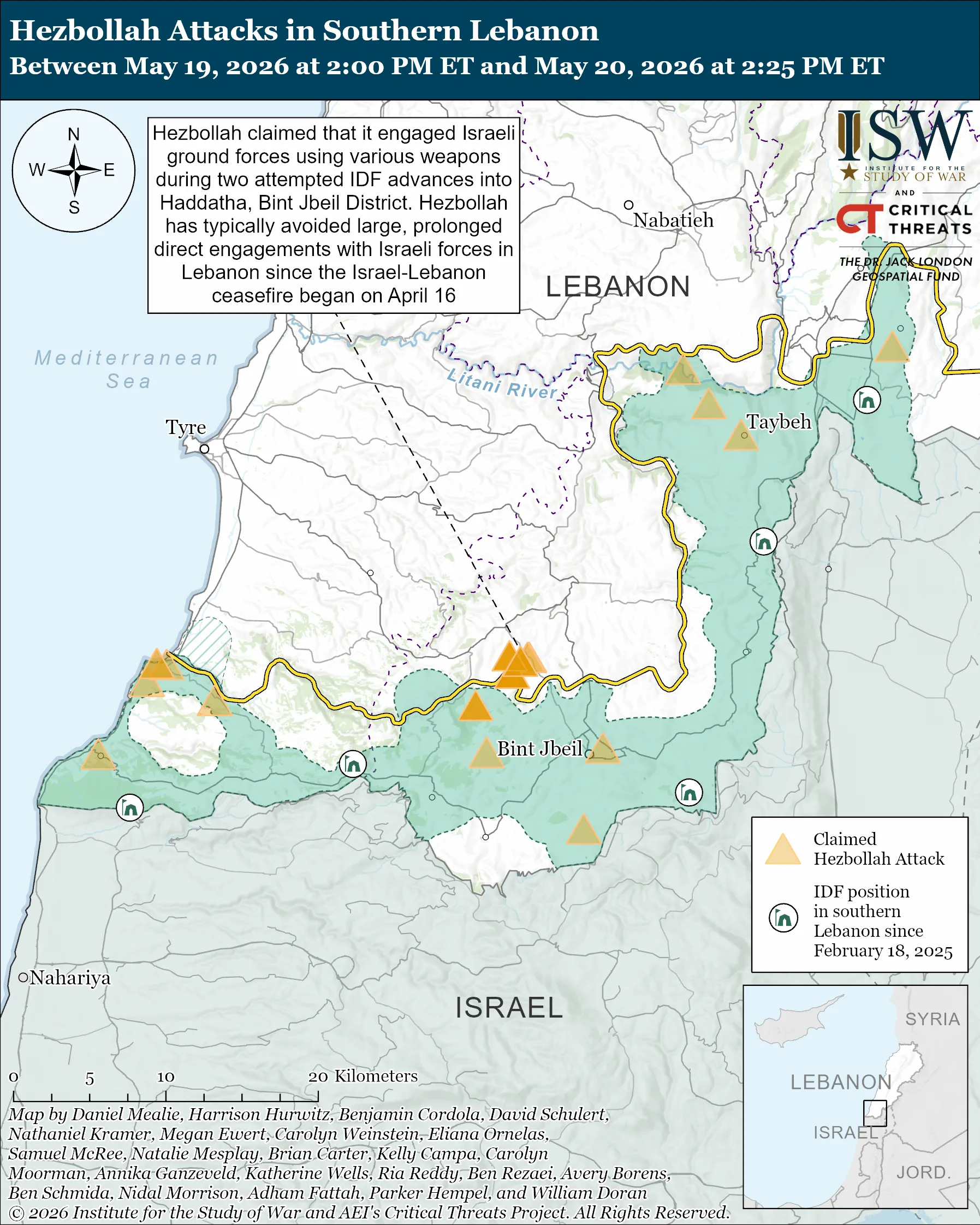
Hezbollah defended against an IDF assault into Haddatha, Bint Jbeil District, on May 19 and 20. The protracted Hezbollah defense is the first prolonged engagement between the IDF and Hezbollah since the ceasefire began. Hezbollah claimed that it defended against two major but separate IDF attacks using a variety of weapons, including small arms, mortars, rocket-propelled grenades (RPG), anti-tank guided missiles (ATGM), and first-person view (FPV) drones.[39] The first engagement lasted around seven hours, and the second lasted four hours. Hezbollah claimed to have repelled the first IDF advance on May 19 but did not claim that it repelled the second advance on May 20.[40] MTV reported IDF units destroyed homes in Haddatha after the second engagement on May 20, suggesting that the IDF dislodged Hezbollah.[41] Hezbollah has typically avoided prolonged and larger-scale direct ground engagements with the IDF since the ceasefire began on April 16, instead conducting most attacks using indirect fire platforms such as rockets and drones.[42] The currently limited reporting makes it difficult to assess why Hezbollah chose to defend at Haddatha, or whether Hezbollah's more prolonged defense sought to delay the IDF to cover the withdrawal of important assets or personnel. Israeli ground forces have operated near Haddatha at least six times since May 13, based on Hezbollah's claimed attacks.[43] Hezbollah previously detonated IEDs targeting Israeli armor and vehicles during earlier IDF activity near Haddatha, but did not claim to have used IEDs in its longer engagements on May 19 and May 20.[44]
The available reporting has not clarified how Hezbollah employed these systems together or the degree of coordination between defending Hezbollah infantry and drone operators. Hezbollah has made some efforts to organize its drone operators to support infantry directly. Tactical FPV drone operators are embedded into Hezbollah ground units responsible for geographic areas.[45] Hezbollah's longer-range drones are organized as part of Hezbollah Unit 127, by contrast.[46]
https://understandingwar.org/research/middle-east/iran-update-special-report-may-20-2026/