Skip to comments.
Iranian Regime tv Channel One hacked while it was airing Khamenie speech
various
| 10-8-22
Posted on 10/08/2022 1:05:38 PM PDT by nuconvert
Iranian Regime national tv Channel One hacked about an hour ago. During a broadcast of Khamenie speech, a red crosshair appeared over his face and chanting of Women. Life. Freedom. There was writing to the side saying "Rise up. Join us". Also 4 photos at the bottom of the screen of young people killed and additional writing: "The blood of our youth is dropping from your paws".
Also, there was a huge banner in the middle of Tehran highway today that read: We are no longer afraid of you. We will fight.
Also, attempted attack on IRI ambassador in Denmark. Her bodyguard was stabbed. Diplomatic Security intervened before the attacker could stab the ambassador.
TOPICS:
KEYWORDS: basij; deathtothemullahs; denmark; ebrahimrigi; erdogan; iran; iranprotests; iraq; irgc; iri; israel; khameini; khamenei; kurdistan; lebanon; mahsaamini; mullahloversonfr; mullahsmustbekilled; najisharifizindashti; protests; qudsforce; raisi; receptayyiperdogan; shahrammaroufmola; syria; turkey; yemen; zahedi
Navigation: use the links below to view more comments.
first previous 1-20 ... 1,941-1,960, 1,961-1,980, 1,981-2,000 ... 2,461-2,478 next last
Iran Update Special Report, April 26, 2026
Prospects for meaningful US-Iran negotiations remain low due to the Islamic Revolutionary Guards Corps’ (IRGC) domination of decision-making and opposition to compromise. Iranian Foreign Affairs Minister Abbas Araghchi travelled to Muscat, Oman, on April 26 to discuss security in the Strait of Hormuz with Omani Sultan Haitham al Tariq.[1] Araghchi then travelled to Islamabad, Pakistan, to discuss Iran's preconditions for talks with the United States with Pakistani mediators, including the end of the US blockade on Iranian ports.[2] IRGC-affiliated media reported on April 26 that Araghchi discussed the implementation of ”a new legal regime over the Strait of Hormuz,” war compensation, and a guarantee of no future US attacks.[3] There was no reported discussion of Iran's nuclear program, which is a key issue for the United States. US President Donald Trump said that Iran sent the United States a “much better” offer 10 minutes after he canceled US Special Envoy to the Middle East Steve Witkoff and Jared Kushner’s planned trip to Islamabad, Pakistan, for talks with Iran on April 25.[4] Trump said the new offer involves Iran not having a nuclear weapon but added that it is “not enough.”[5]
Israel deployed an Iron Dome battery and Israeli Defense Forces (IDF) personnel to the United Arab Emirates (UAE), which demonstrates the deepening of Israeli and Emirati security ties as a result of the war. Two Israeli officials and one US official told Western media on April 26 that Israeli Prime Minister Benjamin Netanyahu ordered the IDF to send an Iron Dome battery and “several dozen” IDF personnel to operate it after a phone call with Emirati President Mohammed bin Zayed.[6] Unspecified Israeli and Emirati officials also told Western media that both countries have been “coordinating closely military and politically” since the start of the war.[7] Israel and the UAE have been expanding their defense cooperation since the UAE normalized its relations with Israel by signing the Abraham Accords in 2020.[8]
The United States has continued to enforce its blockade on Iranian ports. US forces intercepted the US-sanctioned, Panamanian-flagged Sevan (IMO: 9177806) gas tanker on April 25 in the Arabian Sea.[9] The US Treasury Department sanctioned the Sevan on April 24 for transporting Iranian oil and gas products to foreign markets.[10] The Sevan entered the Strait of Hormuz on April 21 via the Iranian-approved route and crossed the US blockade line on April 24, according to commercially available shipping data. Maritime intelligence company Tanker Trackers said on April 25 that the Sevan recently loaded gas in Iran, and travels frequently to Bangladesh and Yemen.[11] US Central Command (CENTCOM) stated on April 25 that it has redirected 37 Iranian or Iranian-linked vessels since the start of the blockade.[12]
The IDF struck Lebanese Hezbollah infrastructure, fighters, and launchers across southern Lebanon on April 25 and 26.[15] Israeli Prime Minister Benjamin Netanyahu said that the IDF was operating with “significant force” after Hezbollah attacks on Israeli forces in Lebanon.[16] The IDF issued evacuation orders for seven Lebanese villages immediately north of the Litani River on April 26.[17] The IDF warned residents that Hezbollah violated the ceasefire.[18] The IDF said that it struck Hezbollah infrastructure and a rocket launcher.[19] Lebanese media reported Israeli strikes on targets in at least 16 villages and towns in southern Lebanon on April 26.[20]
Hezbollah launched drones targeting Israeli forces in southern Lebanon, framing its attacks as a “legitimate response” to alleged Israeli ceasefire violations. Netanyahu accused Hezbollah of “effectively eroding the ceasefire” through its continued attacks.[21] Hezbollah framed its attacks targeting Israeli towns and Israeli troops in southern Lebanon as a “legitimate response” to continued Israeli airstrikes and operations in Lebanon.[22] Hezbollah continued to fire drones targeting Israeli troops in southern Lebanon, including first-person view (FPV) drones. A Hezbollah FPV drone struck near an IDF tank in Taybeh, southeastern Lebanon, and killed a soldier from the 1st (Golani) Infantry Brigade (36th Armored Division).[23] Hezbollah also fired two other FPV drones targeting Israeli forces evacuating casualties.[24] The IDF also intercepted two unspecified Hezbollah drones in southern Lebanon.[25]
https://understandingwar.org/research/middle-east/iran-update-special-report-april-26-2026/
1,961
posted on
04/26/2026 11:20:41 PM PDT
by
AdmSmith
(GCTGATATGTCTATGATTACTCAT)
1,962
posted on
04/27/2026 5:37:32 AM PDT
by
AdmSmith
(GCTGATATGTCTATGATTACTCAT)
Perun: Military Lessons of the Iran War (so far) - Blockades, Bunkers & Ballistic Missiles
26APR2026: At this stage, any observations based on the war in the Middle East are going to be very preliminary and based on thoroughly incomplete information. That said, with the ceasefire extended (albeit with blockades still in place) I thought now was the perfect time to capture some tentative early lessons because some things already show in the data. For example, trade is frighteningly fragile, munitions evaporate at treasury melting rates in a high-intensity war, and there is a lot you can do with a combination of dirt and deception (concrete and rock certainly help as well).
https://www.youtube.com/watch?v=ApIb-nTdoLU
1,963
posted on
04/27/2026 5:55:52 AM PDT
by
AdmSmith
(GCTGATATGTCTATGATTACTCAT)
To: AdmSmith
Iran Update Special Report, April 27, 2026
Iran appears to be attempting to exploit its leverage over the Strait of Hormuz to end the war in a way that removes the US blockade of Iranian ports without Iran having to make nuclear concessions. Iran presented a new proposal to the United States in which it reportedly offered to “reopen” the Strait of Hormuz and end the war, while postponing US-Iran nuclear negotiations to a later date.[1] US President Donald Trump described the proposal on April 25 as “much better” than previous Iranian proposals but stated that the proposal is “not enough.”[2] US Press Secretary Karoline Leavitt said on April 27 that Trump discussed the Iranian proposal with his top national security aides and reiterated that Trump seeks to ensure freedom of navigation through the strait and to remove Iran's highly enriched uranium (HEU).[3] The Iranian proposal would not force Iran to make concessions regarding its HEU or ability to enrich uranium up front, but would rather grant Iran more time to engage in talks about these nuclear issues. It is unclear if Islamic Revolutionary Guards Corps (IRGC) Commander Major General Ahmad Vahidi and his inner circle, which ISW-CTP continues to assess dominates Iranian decision-making, support this new proposal. One source with knowledge on the topic told Axios on April 27 that Iranian Foreign Affairs Minister Abbas Araghchi told Pakistani, Egyptian, Turkish, and Qatari mediators in recent days that there is no consensus among Iran's leaders on how to address US demands.[4]
Iran's rapidly depleting oil storage capacity likely explains, at least in part, why Iran is pushing for a peace agreement that would lift the US naval blockade.[5] The Wall Street Journal reported on April 27 that the US blockade on Iranian ports has forced Iran to store oil in “disused oil tanks in poor condition” and in “containers” in the cities of Ahvaz, Khuzestan Province, and Asaluyeh, Bushehr Province, according to unspecified current and former Iranian officials.[6] Hamid Hosseini, the spokesperson for Iran's oil exporting union, told the Wall Street Journal that Iran is trying to send its oil to China by rail.[7] The Wall Street Journal noted that most exporters avoid transporting oil by rail because rail shipments are less efficient and less profitable than seaborne shipments, however.[8] The Wall Street Journal's April 27 report is consistent with a prior April 12 estimate from a US sanctions analyst that Iran had roughly 13 days of onshore storage capacity remaining before it would be forced to shut down oil production.[9] ISW-CTP is unable to independently assess the exact status of Iran's onshore and offshore storage capacity. Any shutdown of Iranian oil wells could cause permanent reservoir damage, however, which would affect Iran's ability to produce its most valuable export.[10]
An Iranian delegation led by Iranian Foreign Affairs Minister Abbas Araghchi emphasized the importance of Russo-Iranian strategic relations in a meeting with Russian President Vladimir Putin in St. Petersburg on April 27.[11] This meeting notably occurs as Iran prepares for a potential resumption of conflict with the United States and Israel. Russia has facilitated Iranian strikes in the Middle East throughout the war, such as by providing Iran with satellite imagery of US, Gulf, and Turkish military assets in the Middle East.[12]
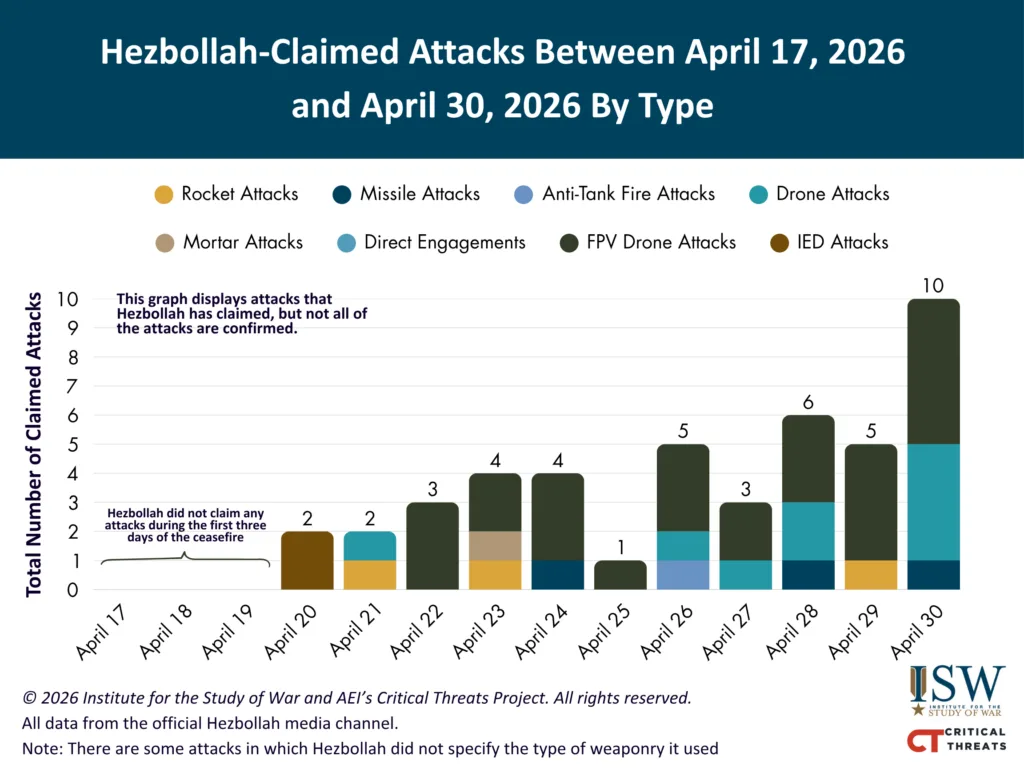
Hezbollah has increasingly used first-person view (FPV) drones to attack Israeli forces in Lebanon since the ceasefire came into effect on April 16.[13] Hezbollah has claimed that it used FPV drones in 12 of its 18 claimed attacks on Israeli ground forces in Lebanon since April 16.[14] Hezbollah has also posted footage of recent FPV drone attacks targeting Israeli personnel and vehicles.[15] Some of the footage shows Hezbollah operating fiber-optic FPV drones. Israeli media reported that Hezbollah has begun using fiber-optic FPV drones as its main strike platform for attacks on Israeli forces in southern Lebanon.[16] Israeli media claimed that Hezbollah's fiber-optic FPV drones have an operational range of up to 15 kilometers and can carry explosive payloads of up to six kilograms.[17] Fiber-optic FPV drones pose a greater threat to Israeli ground forces than rockets or other Hezbollah weapons because they are immune to jamming, difficult to intercept using conventional air defense systems, and can target individuals and vehicles with high precision.[18] A Hezbollah FPV drone attack killed one IDF soldier and wounded six others in Taybeh, Marjaayoun District, on April 26.[19] Hezbollah launched a subsequent FPV drone attack targeting the same Israeli unit while it was conducting a casualty evacuation from Taybeh. Israeli soldiers shot down the FPV drone several meters away from the evacuation site.[20]
https://understandingwar.org/research/middle-east/iran-update-special-report-april-27-2026/
1,964
posted on
04/27/2026 11:41:59 PM PDT
by
AdmSmith
(GCTGATATGTCTATGATTACTCAT)
To: nuconvert; BeauBo
Zineb Riboua Feb 28, 2026. The Iran Question Is All About China. Why Operation Epic Fury Is the Opening Act of the Indo-Pacific Century Iran's National Information Network, a state-controlled domestic intranet that progressively severs citizens’ access to the open internet, was modeled on the Great Firewall of China and built with Chinese technical assistance.
The practical consequences came into focus during the January 2026 massacres. When the regime imposed a near-total internet shutdown to prevent footage of the killings from reaching the outside world, it did so on infrastructure that Chinese firms had years helping to construct. The surveillance technology that enables the IRGC to track, identify, and suppress dissidents was supplied by the same companies that perform identical functionsfor the Chinese Communist Party in Xinjiang. Beijing is providing the Islamic Republic with the tools to survive its own population's rejection and is doing so for the same reason it buys the oil: a dependent Iran is a useful Iran.
China has stepped into this uncertainty with commercial patience and diplomatic ambition. Saudi Arabia now sells more oil to China than to any other country. The UAE has woven Huawei technology into its critical tech infrastructure. Chinese firms are building ports, railways, 5G networks, and smart cities across the Gulf. And in March 2023, Beijing brokered the Saudi-Iranian normalization agreement, a diplomatic achievement that announced China's arrival as a Middle Eastern power broker. That same year, Saudi Investment Minister Khalid Al-Falih declared publicly that a multipolar world had emerged and that cooperation between the Gulf states and China would be “a significant part of the new order.”
The pattern should be legible by now: Iran's threat pushes Gulf states to diversify their partnerships, and this very diversification increases Chinese leverage. And the more leverage China holds over Gulf capitals, the less likely those capitals are to side with Washington on the questions Beijing cares about most: Taiwan, semiconductor export controls, sanctions enforcement, and the future of the dollar-based financial order.
Trump didn't launch Operation Epic Fury to only punish Khamenei for his massacres. He launched it because every year Washington spends managing Tehran is another year Beijing buys in the Pacific, and the administration has decided the trade isn't worth it anymore. The orientation of the Middle East will determine whether the United States can prevail in the defining confrontation of this century: a Chinese move against Taiwan.
In January 2024, the IRGC launched ballistic missiles from shipping containers aboard a converted cargo vessel purchased for less than 20 million dollars—a fraction of what a warship costs, yet merchant hulls are far harder to sink than frigates, as decades of naval experience have shown. Iran now possesses a mobile, survivable, and largely undetectable strike platform that can operate from any port or shipping lane, hitting from vectors no existing defense plan anticipates. A state that can threaten American carriers from unmarked hulls in any ocean cannot be managed through arms control. Its total removal from the board changes the geometry of great-power competition entirely.
Chinese satellites provided Tehran with real-time intelligence on American force deployments, including detection of F-35A, F-15E, A-10C, and THAAD system arrivals at Muwaffaq Salti Air Base in Jordan.
And the desperation runs in both directions. At the SCO summit, Pezeshkian begged Xi to treat Iran as “a friendly and determined ally.” Beijing is obliging, because the collapse of the Islamic Republic under American pressure would sever China's corridors.
No comparable opportunity to inflict this kind of strategic damage on Chinese positioning has presented itself since the end of the Cold War.
It bears repeating: the Iran question was never about Iran. Remove the Islamic Republic from the equation and China loses its pawns for a Taiwan contingency. Leave it in place and the Middle East remains what Beijing designed it to be: a second front that Washington can never afford to leave and can never afford to stay in.
https://www.zinebriboua.com/p/the-iran-question-is-all-about-china
An interesting article—I encourage you to read the whole thing—but China's subsidized exports are destroying the manufacturing industry, and not just for consumer goods, in both Iran and other countries.
1,965
posted on
04/28/2026 12:47:30 AM PDT
by
AdmSmith
(GCTGATATGTCTATGATTACTCAT)
The Israel Defense Forces on Tuesday announced it had located and destroyed two major Hezbollah tunnels in the southern Lebanon town of Qantara, which it said were constructed by the terror group with “direct guidance” from Iran.
The tunnels were built over a decade, reaching depths of some 25 meters, and were “funded by the Iranian terror regime and as part of Hezbollah's plan to conquer the Galilee,” according to the military. The two tunnels — located near each other but not connected — spanned a total of some two kilometers in length, making it one of the longest underground systems found by the military in southern Lebanon to date.
The IDF said the tunnels were part of a larger underground network located in the towns of Rab al-Thalathin and Mays al-Jabal during the fighting in 2024.
The IDF believed the underground sites were intended by Hezbollah for use as a staging ground, where hundreds of terror operatives would arrive when called, gather equipment, and ready themselves to attack Israeli towns. Hezbollah's invasion plans never materialized. “One of the tunnels was recently used by operatives of Hezbollah's Radwan Force to advance terror attacks against the State of Israel and its citizens, thereby posing a direct threat to Israeli civilians and IDF troops,” the military said.
https://www.timesofisrael.com/idf-blows-up-2-vast-hezbollah-attack-tunnels-built-with-direct-guidance-from-iran/
2 videos
1,966
posted on
04/28/2026 11:46:34 AM PDT
by
AdmSmith
(GCTGATATGTCTATGATTACTCAT)
Iran Update Special Report, April 28, 2026
Iran's latest proposal in negotiations offers no concessions and represents an Iranian effort to end the war on Tehran’s terms. The proposal, according to unspecified officials familiar with the matter speaking to the Wall Street Journal and an Iranian political analyst close to the regime, centers on a three-stage plan.[1] In the first stage, the United States and Israel would commit to a permanent and guaranteed end to the war.[2] In the second stage, the United States and Iran would negotiate over the status of the Strait of Hormuz, and the United States would lift its blockade on Iranian ports.[3] Iran still aims to exert sovereignty over the Strait after the war by charging tolls on vessels passing the Strait and would seek to satisfy this demand in negotiations, according to the New York Times and Wall Street Journal.[4] In the third stage, Iran and the United States would begin negotiating over the nuclear issue.[5]
The proposal illustrates that Iran's current decisionmaker, Islamic Revolutionary Guards Corps Commander Major General Ahmad Vahidi, believes Iran is winning despite the serious damage Iran has suffered. This agreement satisfies Vahidi and his inner circle because it refuses to discuss the nuclear issue up front, and it demands nearly all of Iran's key demands, like a permanent and guaranteed end to the war and sovereignty over the Strait. Officials in Tehran, likely Vahidi and his inner circle, ordered the Iranian negotiating team not to discuss nuclear issues during the Islamabad talks.[6] Vahidi likely hopes to extract concessions from the United States, like an end to the blockade, without offering any serious concessions in response. Vahidi would have very little incentive to offer concessions on the nuclear program in the third phase of this plan if the United States committed to permanently ending hostilities with Iran and lifting the blockade. Iran and the United States remain far apart on the nuclear issue. Iran demanded a temporary suspension of enrichment for five years and stockpile dilution in its April 25 proposal.[7] The United States has asked for a 20-year enrichment suspension period.[8]
The United States remains opposed to the most recent April 26 proposal because it failed to address both Iran's nuclear program and enabled Iran to assert “control” over the Strait of Hormuz. US President Donald Trump was reportedly dissatisfied with Iran's revised April 26 proposal as it did not address Iran's nuclear program, according to administration officials speaking to Western media on April 27.[9] US Secretary of State Marco Rubio told Fox News on April 27 that the United States cannot tolerate Iran determining who uses an international waterway or charging for access.[10] Rubio’s comments, one day after the White House became aware of the Iranian proposal, represent implicit opposition to Iran's proposal.
Iran's growing challenges in storing and exporting its oil could be one mechanism by which Iranian calculations change in negotiations. A US Sanctions analyst at Foundation for Defense of Democracies assessed on April 12 that Iran had about 13 remaining days of usable oil storage, which he calculated based on 50 to 55 million barrels of total onshore storage that was 60% full on April 12.[11] Iran likely extended the number of days before its oil storage is full by using old oil tanks in poor condition. Iran reactivated a 30-year-old very large crude carrier (VLCC) during April to hold oil, for example.[12] The VLCC had been unused for three years.[13] Market intelligence firm Kpler assessed on April 27 that Iran has between 12 and 22 remaining days before its oil storage is full.[14] Kpler’s 12-day estimate assumes that not all storage tanks can be used, but the basis for that assumption is not clear. Iran has recently activated storage facilities that are suboptimal, but those storage facilities presumably have other costs for Iranian capacity and oil exports associated with them. US President Donald Trump posted on April 28 on Truth Social that Iran told the United States that it is in a “state of collapse” and that Iran wants an end to the US blockade as soon as possible.[15]
Iran faces significant pressure on other parts of its economy. Combined force strikes during the war, as well as Iran's difficulties with storing and exporting oil, have had negative ripple effects on other sectors of Iran's economy. Reuters reported on April 27 that combined force strikes, including strikes on major Iranian steel producers such as the Mobarakeh Steel Company and Khuzestan Steel Company, reportedly destroyed about 25 to 30 percent of Iran's total steel output.[16] A chemical engineer working at one of Iran's biggest private construction contractors told the Associated Press on April 28 that it had to shut down a project with Mobarakeh, which cost 1,000 jobs.[17] The son of an Iranian rugmaker told AP that around 80% of rug and carpet manufacturers have stopped operations in the industrial zone of Kashan, Esfahan Province, due to the plummet of Iranian exports during the war.[18] A US sanctions analyst assessed on April 27 that the US blockade has exacerbated Iran's gasoline crisis by preventing Iran from importing gasoline to sufficiently address Iran's fuel needs.[19] Gasoline shortages previously caused mass protests in 2019.[20]
It is unclear, however, whether this pressure on Iran's economy will cause Vahidi and his inner circle to make concessions to the United States. Vahidi is an ideologue who has served in various capacities in the regime since the revolution. His ideological nature means he is more likely to judge ultimate success on whether or not he upholds the precepts of the Islamic Revolution. General economic pain imposed on the populace is unlikely to seriously affect his calculus, therefore, unless such economic pain threatens his current position or the regime's stability.[21]
Iran's highest national security decision-making body is reportedly preparing for a potential protest wave as economic deterioration and social pressure intensify, according to anti-regime media. Anti-regime media reported on April 28 that the Supreme National Security Council (SNSC) convened a meeting chaired by SNSC Secretary Mohammad Bagher Zolghadr—a close ally of Vahidi—after intelligence assessments warned of a possible resumption of protests in the coming days.[22] Unspecified sources told anti-regime media that Iran's security institutions expressed concern about potential protest calls and assessed that worsening economic conditions, such as inflation, unemployment, and rising prices, could trigger renewed unrest.[23] The report stated that security agencies presented a highly critical picture of Iran's economy, citing shutdowns in the oil, petrochemical, and steel sectors, widespread unemployment partly driven by internet disruptions, and a broader halt in economic activity due to the closure of financial markets.[24] These assessments warned that Iran's economy cannot withstand more than six to eight weeks of a naval blockade and that reconstruction of damaged industrial sectors could take years.[25] The SNSC coordinates and authorizes the regime's protest response, while internal security forces execute the crackdown.[26] Former Supreme Leader Ali Khamenei ordered the SNSC in January 2026 to crush the protests “by any means necessary.”[27]
Iran's prolonged internet shutdown is also posing severe economic damage and accelerating unemployment, which likely increases pressure on regime stability. Iranian security institutions also assessed that approximately 20 percent of internet-dependent workers have lost their jobs and projected that up to two million additional private-sector workers could become unemployed by the end of spring.[28] An Iranian Chamber of Commerce official stated on April 14 that the internet shutdown is causing $30 to $40 million USD in “direct” daily losses and up to $80 million USD when including “indirect” losses, which he argued is equivalent to the destruction of multiple major infrastructure assets each day.[29] NetBlocks reported on April 28 that Iran's nationwide internet blackout, now exceeding 60 days, had severely disrupted financial transactions, commercial activity, and business operations.[30] NetBlocks estimates that the countrywide internet shutdown costs the Iranian economy over $37 million USD per day.[31]
Iranian Parliament Speaker Mohammad Bagher Ghalibaf appears to be trying to retain political support and remain a key actor in negotiations despite prior signs of opposition from Vahidi and his inner circle. Two hundred and sixty-one Iranian Parliament members issued a statement on April 27 declaring support for Iran's negotiating team and Ghalibaf.[32] Parliamentarians added that they trust the negotiating delegation, especially Ghalibaf, and expressed support for its defense of national interests.[33] This statement follows recent reports indicating that Ghalibaf has grown frustrated with internal divisions and has considered resigning from the negotiating delegation.[34] Some outlets have claimed that he has already resigned due to disagreements over nuclear concessions.[35] Ghalibaf publicly defended negotiations on Iranian state television on April 18, arguing that diplomacy with the United States, alongside military power, is necessary to secure Iran's objectives.[36] Ghalibaf also criticized hardline officials, including SNSC member Saeed Jalili and hardline parliamentarian Amirhossein Sabeti, both affiliated with the ultraconservative Paydari (Stability) Front, for opposing negotiations.[37] Paydari Front–affiliated members of Parliament also did not sign the recent parliament statement.[38]
Infighting among hardline factions has escalated into a public media confrontation amid intra-regime competition over negotiations. Intra-regime power struggle between pragmatic hardliners and ultrahardliners indicates the absence of a decisive central arbiter, which has allowed factional disputes to unfold publicly. IRGC-affiliated Tasnim published an Op-Ed on April 24 and criticized negotiation expectations by arguing that talks aim to avoid war and its costs and must proceed based on the principles of “dignity, wisdom, and expediency.”[39] Tasnim warned that some actors raise “unrealistic expectations,” including full sanctions relief, a comprehensive ceasefire that includes the Axis of Resistance, long-term peace guarantees for Iran, and economic flourishing.[40] Tasnim warned that viewing negotiations through an “unrealistic expectations” lens reflects unrealistic wishful thinking. Ultraconservative Paydari (Stability) Front-affiliated Raja News accused Tasnim of downplaying the Supreme Leader's red lines by framing these demands as unrealistic and argued that Tasnim’s proposed approach repeats the logic that led to the 2015 Joint Comprehensive Plan of Action because Tasnim depicts core demands such as full sanctions relief and a lasting ceasefire as ”unattainable.” [41] Raja News suggested that this logic resulted in ”pure damage.”[42] The lack of a decisive central authority due to Supreme Leader Mojtaba Khamenei’s absence has likely allowed these disputes to escalate into the public domain rather than remain contained within regime channels.
Iran continues to cooperate with key US adversaries, such as Russia and China, as it prepares for a potential resumption of conflict with the United States and Israel. An Iranian defense delegation, including Defense Ministry Spokesperson Brigadier General Reza Talaei Nik, attended the Shanghai Cooperation Organization defense ministerial summit in Bishkek, Kyrgyzstan, on April 27 and 28.[43] The Iranian delegation held separate meetings with the Russian, Chinese, and Belarusian defense ministers on the sidelines of the summit.[44] Talaei Nik and Russian Defense Minister Andrey Belousov emphasized that Iran and Russia will continue to support each other “regardless of the situation.”[45] The SCO summit comes after Iranian Foreign Affairs Minister Abbas Araghchi emphasized the importance of Russo-Iranian strategic relations in a meeting with Russian President Vladimir Putin in St. Petersburg on April 27.[46] These meetings may be part of a broader Iranian effort to secure support ahead of a potential resumption of conflict with the United States and Israel. Russia helped support Iranian strikes in the Middle East throughout the war, such as by providing Iran with satellite imagery of US, Gulf, and Turkish military assets in the Middle East.[47]
Lebanese military officials claim that Israeli military action and Lebanese Armed Forces (LAF) deployments have constrained Hezbollah's ability to smuggle weapons into Lebanon through Syria.[73] An unnamed Lebanese military source told Saudi media on April 28 that the Beirut-Damascus International Highway's closure since April 16 has hindered Hezbollah's attempts to replenish its arms and ammunition stocks.[74] Lebanese authorities closed the highway after the IDF conducted an airstrike targeting a segment of the roadway in the vicinity of Dahr al Baidar, central Lebanon, shortly before the ceasefire came into effect on April 16.[75] The source also claimed that the LAF’s newly established checkpoints have “contributed to stopping the movement of weapons and ammunition” between Hezbollah units in central and southern Lebanon.[76] Syrian authorities have interdicted several shipments of Hezbollah arms and ammunition, including Iranian-origin weapons, bound for Lebanon since Hezbollah began targeting Israel on March 2.[77]
Lebanese media reported on April 28 that Lebanese Parliament Speaker and longtime Hezbollah ally Nabih Berri privately supports Lebanese President Joseph Aoun’s stance on negotiations with Israel.[78] Lebanese media reported that Berri is “on board” with Aoun’s efforts to extend the ceasefire and pursue direct Israel-Lebanon talks, but cannot announce his support out of concern that it may alienate Berri’s Shia constituency.[79] Berri has reportedly urged Aoun to ensure that negotiations with Israel guarantee a “real” ceasefire, Israel's full withdrawal from southern Lebanon, the return of Lebanese prisoners from Israel, and reconstruction for southern Lebanon.[80] Berri and his political party, the Amal Movement, have historically aligned with Hezbollah, but Berri has distanced Amal from Hezbollah over disapproval of Hezbollah's attacks on Israel.[81] Berri‘s basic positions on the negotiations do not satisfy some key Israeli asks, however, such as the disarmament of Hezbollah. Amal supported the Lebanese government's decision to ban Hezbollah's military activities on March 2.[82]
https://understandingwar.org/research/middle-east/iran-update-special-report-april-28-2026/
1,967
posted on
04/28/2026 11:30:56 PM PDT
by
AdmSmith
(GCTGATATGTCTATGATTACTCAT)
13MAR2026
Lebanon's Parliament Speaker Nabih Berri receives more than $500,000 per month from the Islamic Republic in order to support Tehran’s interests and those of its allied group Hezbollah in Lebanon, informed sources told Iran International.
Officials in Tehran say the sums are meant to “buy” unity among Lebanon's Shiite leadership to ensure that they “act in accordance with Iran's interests, not Lebanon's interests.” Nabih Berri did not respond to Iran International's request for comment. One of his advisers said that Berri would not comment on the matter at this time.
Berri has not publicly opposed Hezbollah's attacks on Israel in support of Iran, the sources said, because he does not want to risk losing his financial resources. The 88-year-old politician heads Lebanon's Amal Movement and holds significant sway in Lebanon's domestic and foreign policy.
https://www.iranintl.com/en/202603124202
1,968
posted on
04/28/2026 11:40:17 PM PDT
by
AdmSmith
(GCTGATATGTCTATGATTACTCAT)
To: AdmSmith; PIF; nuconvert
I do hope our president will make specific warnings that recurrence of vicious crackdowns on possible demonstrations by blinding protesters with small shot, shooting women by snipers and speedy executions of protesters, and taking wounded protester from hospitals will not recur. Such behavior should result in our striking the responsible IRGC, Artesh, or police headquarters where such behavior is occurring.
1,969
posted on
04/29/2026 12:24:54 PM PDT
by
gleeaikin
(Question Authority: report facts and post their links" in your messages.)
Iran Update Special Report, April 29, 2026
Iran is unlikely to make meaningful concessions in its next proposal to the United States, which is expected in the next several days. Islamic Revolutionary Guards Corps (IRGC) Major General Ahmad Vahidi, whose hardline position on negotiations the regime has adopted, appears unwilling to concede on Iranian control over the Strait of Hormuz and Iran's nuclear program. Iran's delegation told Pakistani mediators on April 27 that it needed to consult Supreme Leader Mojtaba Khamenei before responding with an updated proposal following US President Donald Trump's dissatisfaction with Iran's lack of nuclear concessions in its April 26 three-stage plan.[1] Vahidi maintains near-exclusive access to Mojtaba and serves as a gatekeeper who conveys Mojtaba’s approval of decisions made by formal state institutions, according to several senior Iranian sources speaking to Western and anti-regime media in recent days.[2] The regime has adopted Vahidi’s hardline positions on negotiations, which indicates that Vahidi has significantly more power within the regime and influence over the outcome of policy decisions compared to other leaders who are more supportive of negotiations. The extent to which Vahidi or any other regime leader controls the decision making process is unclear, even though Vahidi seems to have significant influence over the outcome.
Mainstream Iranian politicians are consolidating around the decision to avoid discussing the nuclear issue before the United States lifts the naval blockade on Iranian ports, which was Vahidi’s preferred policy outcome. This illustrates that there is some level of political support for Vahidi’s policies within the broader regime, which suggests Iran's negotiating stance will not soften in the near term. Mojtaba approved these policies in his role as supreme leader, but he lacks the stature of his father and has struggled to behave as a neutral arbiter in internal debates, according to Reuters.[3] Assembly of Experts members and members of parliament have voiced their support for Mojtaba’s directive against discussing the nuclear issue before the US lifts the naval blockade on Iranian ports.[4] These statements reflect the same logic that led Iranian decision makers to withdraw the Iranian negotiators from the April 11 Islamabad negotiations.[5]
Other Iranian regime factions do not appear to materially constrain Vahidi’s uncompromising position. Saeed Jalili — also on the SNSC — and his Stability (Paydari) Front continue to advocate an even more uncompromising stance against negotiations.[6] These ultra-hardliners reinforce Vahidi’s position against concessions in negotiations. Parliamentary Speaker Mohammad Bagher Ghalibaf appears sidelined.[7] Ghalibaf’s recent unity statement, urging loyalty to the supreme leader, followed by an unusual April 29 audio message reiterating support for the supreme leader, suggests he has acquiesced to the dominant hardline position on negotiations.[8] Reformist voices, such as Pezeshkian and former President Hassan Rouhani, who previously called for negotiations to prioritize Iran's economy, appear absent from the current decision making and information space, further narrowing the range of policy options.[9] The regime-imposed internet shutdown, presumably enforced by the IRGC, is almost certainly contributing to the absence of dissenting views.[10]
The Iranian regime is likely attempting to modify and legitimize its plan to exert sovereignty over the Strait of Hormuz by including Oman in a scheme to collect tolls on shipping through the Strait. This would enable Iran to present a “new proposal” to the United States without compromising on any Iranian red lines. Iranian Foreign Affairs Minister Abbas Araghchi reportedly traveled to Oman to again float a proposal to split administrative control of the strait. Oman rejected this offer, according to multiple US and regional sources who spoke to the New York Post on April 29.[11] Araghchi’s reported proposal corroborates CTP-ISW’s previous assessments that Vahidi is prepared to risk a potential US military response and the continuation of the US naval blockade rather than concede in negotiations.[12]
Iranian leaders are preparing for a variety of contingencies and risks that could result from a hardline negotiating position that fails to lift the economic and military pressure Iran is under. Stalled negotiations could lead to an economic collapse that triggers economic unrest, a long-term blockade, or a resumption of the US-Israeli air campaign, among other courses of action that could become serious crises for the Iranian regime. None of these trajectories is mutually exclusive, and the preparations to meet each possible crisis will overlap.
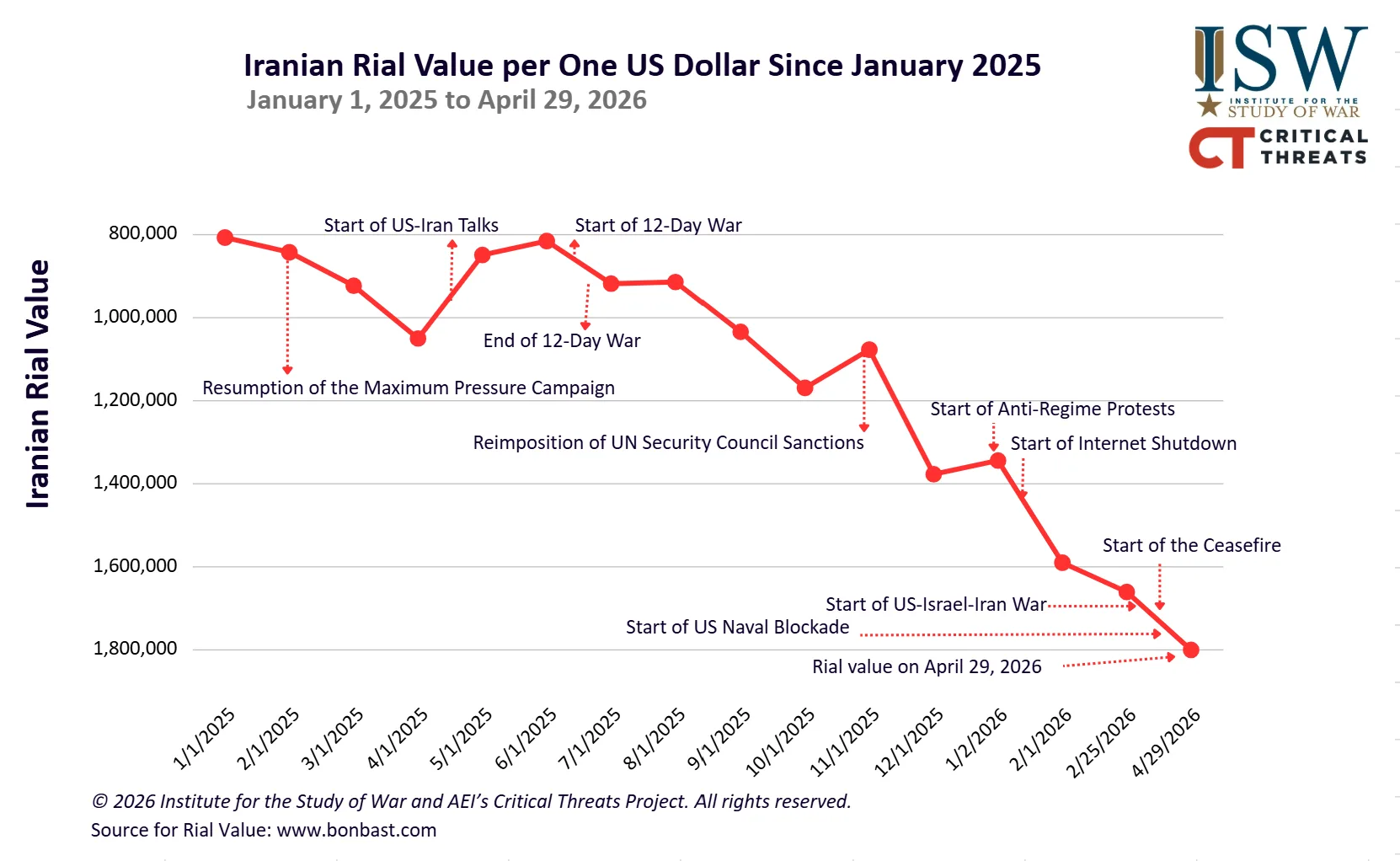
Iran has responded to growing pressure on the economy caused by the war, sanctions, and the blockade by shoring up internal unity, presumably as an initial step in a more comprehensive internal security plan. The Iranian economy is under significant pressure, with the rial hitting a record low on April 29, on top of soaring costs, millions of job losses, and other challenges. Anti-regime media reported on April 28 that the Supreme National Security Council (SNSC) convened a meeting chaired by Zolghadr—a close ally of Vahidi—after intelligence assessments warned of a possible resumption of protests in the coming days due to growing economic pains on the Iranian people.[13] Such a meeting, if confirmed, likely sought to plan precautions to prevent widespread unrest given the timing and alleged subject matter. Islamic Republic of Iran Broadcasting published an audio message by Parliament Speaker Mohamad Bagher Ghalibaf on April 29 in which he emphasized the importance of the Iranian people's unity.[14] It is highly unusual for a high-ranking official to release just an audio message when addressing the public. Ghalibaf stated that the US strategy is to impose economic pressure via the naval blockade and sow internal divisions in order to get Iran to capitulate to US demands.[15] The intention of Ghalibaf’s message is likely to place blame on the United States in order to build unity against an external enemy and prevent public outrage against the regime for Iran's dire economic conditions. Ghalibaf added that the blockade will likely continue until Iran and the United States have reached an agreement.[16] Ghalibaf’s statement indicates that the regime's decision makers understand that it is unlikely US-Iran talks will reach an agreement and accept the prospects of resumed conflict with the United States. Ghalibaf’s statement may also be a way to psychologically prepare the Iranian people that economic conditions will not improve in the near future. Building this internal unity could give way to a broader internal security plan that may or may not be visible in open-source reporting, given the internet blackout in Iran.
Iran is reportedly exploring alternative methods to circumvent the US blockade of its ports, which is a suboptimal way to alleviate some of the economic pressure Iran is currently under. Iranian Armed Forces General Staff (AFGS)-affiliated media Defa Press proposed multiple options Iran could utilize to break the US blockade on Iranian ports on April 29.[17] Defa said that Iran could seize US commercial ships or ships linked with Israel in retaliation for US forces interdicting several Iranian ships that violated the US blockade.[18] The Islamic Revolutionary Guards Corps (IRGC) Navy recently attacked and redirected two vessels towards Iran on April 22, in part, to extract concessions from the United States, such as ending the US blockade on Iranian ports.[19] Defa also hypothesized that Iran could circumvent the US blockade of Iranian ports by relying on trade with Russia and other countries bordering the Caspian Sea to export or import essential and strategic goods.[20] This report follows Iranian Foreign Minister Abbas Araghchi’s meeting with Russian President Vladimir Putin in St. Petersburg on April 27.[21] This also follows an April 27 Wall Street Journal report that Iran is attempting to export oil to China via rail.[22] Defa also hinted that Iran could coordinate further with the Houthis to convince them to close the Bab al Mandab Strait to further constrain international shipping and impose costs on the United States and Israel.[23] CTP-ISW continues to assess that the Houthis are unlikely to impose a blockade on the Bab al Mandab, given it would likely jeopardize their domestic position, however.[24]
The regime has also accepted the risk of and prepared for a resumption of the war. Iran has almost certainly used the ceasefire to reorganize and regenerate its missile and drone forces, which were badly degraded on the operational level prior to the ceasefire.[25] This includes tasks such as digging out buried launchers, stockpiles, and launcher crews.[26] It also includes reorganizing command structures and removing incompetent commanders.[27] Other assets, like the factories and logistics apparatus that sustain these forces, will be difficult to rapidly reconstitute, however.
Iran continues to face threats from anti-regime militant groups on its northwestern and southeastern borders. IRGC Ground Forces dismantled a four-member “terrorist” cell in Kurdistan Province, northwestern Iran, on April 28, seizing their weapons and communications devices.[28] Likely Mobarizoun Popular Front (MPF) fighters attacked an IRGC vehicle in Rask, Sistan and Baluchistan Province on April 29.[29] The MPF is a coalition of Baloch anti-regime groups operating in southeastern Iran. Likely MPF fighters killed two Law Enforcement Command (LEC) officers in Zahedan, Sistan and Baluchistan Province, on April 29.[30] LEC officers also clashed with likely MPF fighters in Iranshahr, Sistan and Baluchistan Province, on April 29, and killed two fighters, wounding two others, and seized their weapons.[31]
The Israel Defense Forces (IDF) is implementing battlefield adaptations to address the threat of Hezbollah's first-person view (FPV) drones, amid Hezbollah's increased use of FPV drones to target IDF units in southern Lebanon. Israeli Army Radio reported that the IDF presented possible drone countermeasures for Israeli units operating in Lebanon to the Israeli Knesset in the past week.[32] The IDF discussed multiple drone countermeasures, including reducing the permitted amount of time an Israeli helicopter is allowed to land in Lebanon, deploying unspecified radar systems “extensively” inside the Israeli “security zone” in southern Lebanon to increase drone detection capability, and issuing additional smart gun sights and anti-drone nets to Israeli forces in Lebanon.[33] Hezbollah FPV drones targeted an Israeli helicopter that was evacuating casualties near Taybeh, Marjaayoun District, on April 26, which presumably triggered a review of standard operating procedure.[34] Israeli media reported on April 28 that the IDF is examining the use of “lightweight acoustic radars” to improve IDF drone detection capabilities.[35] Multiple open-source intelligence (OSINT) accounts published footage on April 28 that purportedly shows a rifle‘s sight picture while using an Israeli Dagger smart gun sight mounted to an M4 rifle to improve their accuracy and shoot down two Hezbollah drones.[36] Israeli media and a Lebanese OSINT analyst published footage on April 29 of an Israeli unit using anti-drone netting to protect a vehicle operating in southern Lebanon.[37] Ukraine and Russia have extensively used anti-drone netting to protect personnel and vehicles against FPV drones.[38] The IDF has upgraded certain IDF vehicles, including Merkava tanks, with anti-drone armor in response to Hamas’s use of FPV drones in Gaza.[39]
Likely Iranian-backed Iraqi militia front group Saraya Awliya al Dam released fiber-optic FPV drone footage on April 28 showing an attack targeting a communications tower at Camp Victory, a former US military base located at Baghdad International Airport, on April 8.[52] This militia previously conducted two FPV drone attacks targeting fuel tanks at Camp Victory on April 2 and 7.[53] Iranian-backed Iraqi militias repeatedly targeted Baghdad International Airport and its co-located facilities, including Camp Victory and the diplomatic support center, before the US-Iran ceasefire.[54]
https://understandingwar.org/research/middle-east/iran-update-special-report-april-29-2026/
1,970
posted on
04/29/2026 10:37:32 PM PDT
by
AdmSmith
(GCTGATATGTCTATGATTACTCAT)
1,971
posted on
04/29/2026 10:38:47 PM PDT
by
AdmSmith
(GCTGATATGTCTATGATTACTCAT)
To: AdmSmith; BeauBo; nuconvert; adorno; blitz128; PIF
“Iran’s rial weakened to a record low of around 1.8 million per dollar on Wednesday, reflecting ongoing economic pressure.”
Sounds like an echo of post WW1 Germany when a wheelbarrow of paper marks was needed to buy a loaf of bread. I just hope the Iran situation recovers more sanely than Germany did at that time.
The “live link” posted at this comment led to a Summary by Trump of recent Iran related concerns. I then had to laugh when just below Trump’s Summary, I saw Russia’s Lavrov was declaring the Caspian needs to be a sea of peace. Like Russia has already promoted peace there by shooting down its neighbors airplane and killing so many people thereby.
1,972
posted on
04/30/2026 3:11:42 AM PDT
by
gleeaikin
(Question Authority: report facts and post their links" in your messages.)
To: gleeaikin
“Peace” in the Russian mir means control/surrender
To: gleeaikin
Actually the Summary in my comment above was not by Trump but was about Trump and Iran news. Also the Lavrov story had moved down below several newer stories. As a “live blog” new stories are introduced regularly and the minutes old age of each story is listed and changes over time.
1,974
posted on
04/30/2026 3:19:50 AM PDT
by
gleeaikin
(Question Authority: report facts and post their links" in your messages.)
To: gleeaikin
Graph exchange rate https://www.bonbast.com/graph/usd
However, trading volume is very low, so this only provides an approximate picture of the exchange rate—just like with the ruble.
1,975
posted on
04/30/2026 6:38:45 AM PDT
by
AdmSmith
(GCTGATATGTCTATGATTACTCAT)
To: AdmSmith
I just clicked your link for exchange rate of the Iranian rial, and suddenly the computer shifted to something with all kinds of different inputs, and was screaming my computer was infected and I had to call Microsoft immediately, and to NOT turn off my computer. Everything I clicked that I thought might eliminate items on that page did NOT work, so I closed the lid of my Chromebook, took it to my partner who hit the power button and turned it off. He then turned the computer back on and determined it was working again and your link must have been linked to this spam attack. (scareware)
1,976
posted on
04/30/2026 9:13:00 AM PDT
by
gleeaikin
(Question Authority: report facts and post their links" in your messages.)
To: gleeaikin
Website Malware & Security
No malware detected by scan (Low Risk)
No injected spam detected (Low Risk)
No defacements detected (Low Risk)
No internal server errors detected (Low Risk)
Website Blacklist Status
Domain clean by Google Safe Browsing
Domain clean by McAfee
Domain clean by Sucuri Labs
Domain clean by ESET
Domain clean by PhishTank
Domain clean by Yandex
Domain clean by Opera
https://sitecheck.sucuri.net/results/https/www.bonbast.com/graph/usd
No Threats Found
Safety Assessment for bonbast.com
Based on available scan data, no security engines flagged the domain at the time of this scan, and the site was also shown as clean in the checked blacklist and browsing-protection databases. Multiple web-classification providers categorized it as a finance or financial-services website, which aligns with the visible content showing exchange rates, gold prices, and market information.
One malware scan did mark the overall threat level as suspicious and flagged two privacy-policy pages, along with several referenced external links and domains as generic suspicious objects. However, the flagged items appear to be related to advertising or third-party privacy-policy references rather than clear evidence of active malware delivery on the main site. Findings of this type can sometimes result from embedded ad-tech, tracking, or broadly classified external resources, so they should be treated as cautionary indicators rather than definitive proof of compromise.
The domain’s age, signed DNSSEC, valid HTTPS certificate, and absence of blacklist hits modestly support legitimacy. At the same time, the presence of suspiciously classified third-party references and visible advertising means some caution may still be appropriate, especially for users who are sensitive to tracking or ad-related risks. Based on available scan data, no significant threats were detected at the time of this scan.
https://scanner.pcrisk.com/scan-results/bonbast.com
You’re safe
https://www.bitdefender.com/en-us/consumer/link-checker/safe
Norton Rating Safe
https://safeweb.norton.com/report?url=https:%2F%2Fwww.bonbast.com%2Fgraph%2Fusd
Pls check your computer
1,977
posted on
04/30/2026 11:40:50 AM PDT
by
AdmSmith
(GCTGATATGTCTATGATTACTCAT)
To: AdmSmith
It looks like you really did your due diligence. I will show all this to my partner who was the computer R & D guy for a major science organization. This was back in the COBAL JAVA days, but he has continued to remain abreast with Wired Magazine and the like.
Another possibility is that my computer jumped from the tab brought up by your link to a completely different tab. These jumps happen at least once every time I spend several hours on the computer. The worst is when I have spent some time writing a PM or comment here and the computer jumps to some other tab, not FR and I sometimes loose everything I already wrote in that FR box.
1,978
posted on
04/30/2026 1:28:01 PM PDT
by
gleeaikin
(Question Authority: report facts and post their links" in your messages.)
Iran Update Special Report, April 30, 2026
Supreme Leader Mojtaba Khamenei declared on April 30 that Iran will retain control over shipping through the Strait of Hormuz and maintain its nuclear and missile capabilities, which supports ISW-CTP’s assessment that the Iranian regime is unlikely to make meaningful concessions in its next proposal to the United States.[1] Mojtaba published a written statement on April 30 in which he stated that Iran will implement a “new management” in the strait—likely in reference to Iran's collection of tolls from vessels that transit the strait—as a means to “secure” the Persian Gulf and prevent “hostile” interference in the region.[2] Mojtaba also underscored that Iran will defend its nuclear, missile, and advanced technological capabilities as resolutely as it defends its territorial borders.[3] A senior Iranian official speaking to the Washington Post on April 30 similarly asserted that Iran's security establishment rejects compromise on key matters, such as Iran's ability to enrich uranium.[4] Mojtaba’s statement and the Washington Post report are consistent with ISW-CTP’s assessment that IRGC Commander Major General Ahmad Vahidi, who appears to be dominating regime decision-making, is unwilling to make concessions regarding Iran's control over the Strait of Hormuz or nuclear program.[5] Vahidi reportedly maintains near-exclusive access to Mojtaba and serves as a gatekeeper who conveys Mojtaba’s approval of decisions.[6] Pakistani mediators told Western media that Iran is expected to send them a revised proposal on May 1.[7]
Some Iranian officials who have advocated for a “pragmatist” approach toward negotiations may be aligning themselves behind Vahidi’s redlines, which Mojtaba publicly endorsed in his April 30 statement. Foreign Affairs Minister Abbas Araghchi has reportedly been acting in “full coordination” with Vahidi and following Vahidi’s “instructions” over the past two weeks, according to two informed sources speaking to anti-regime media on April 30.[8] This report suggests that Araghchi may have aligned himself with Vahidi’s position on negotiations despite previous disputes in which Araghchi called negotiations that did not address Iran's nuclear program a “death sentence.”[9] Araghchi’s reported coordination with Vahidi in recent weeks is consistent with an April 30 Washington Post report, citing an unspecified Iranian official, that Iranian officials “yielded to pressure” from military and political hardliners to “deprioritize negotiations” after the United States and Iran failed to reach a deal during the first round of negotiations on April 11 and 12.[10]
Parliament Speaker Mohammad Bagher Ghalibaf and President Masoud Pezeshkian are reportedly dissatisfied with Araghchi’s close cooperation with Vahidi and approach toward negotiations, even though they have publicly signaled their acquiescence to Vahidi’s hardline approach.[11] Two informed sources speaking to anti-regime media on April 30 claimed that Pezeshkian and Ghalibaf believe that Araghchi has increasingly served as an assistant to Vahidi rather than as a cabinet official implementing government policy.[12] The sources said that Araghchi has coordinated closely with Vahidi and acted on his instructions over the past two weeks without informing Pezeshkian.[13] Araghchi recently visited Pakistan, Oman, and Russia without Ghalibaf. ISW-CTP observed that Ghalibaf’s absence was notable because Ghalibaf had led the Iranian negotiating delegation in the first round of talks.[14] Pezeshkian has reportedly privately indicated to close associates that he would consider removing Araghchi from his post if the situation persists, according to the informed sources.[15] Pezeshkian and Ghalibaf’s private dissatisfaction with Araghchi comes after both officials publicly signaled their acquiescence to Vahidi’s hardline approach toward negotiations in the past week.
Iran is trying to sow divisions between the Gulf states and the United States as part of a longstanding Iranian effort to push the Gulf countries to expel US forces from their territory.[16] Supreme Leader Mojtaba Khamenei claimed in his April 30 statement that the US military presence in the Persian Gulf is “the most important factor” driving regional insecurity.[17] Mojtaba also claimed that US bases in the region cannot defend the United States’ Gulf partners.[18] Iran repeatedly attacked energy and other infrastructure in the Gulf states during the war, citing the presence of US bases in these countries as justification for its attacks.[19] Mojtaba’s statement is consistent with recent statements from other Iranian officials that have similarly sought to distance the Gulf states from the United States. An Iranian parliamentarian recently implicitly threatened that Iran would attack the Gulf states if the United States resumed conducting strikes on Iran.[20] The IRGC separately issued a statement on April 30 that called on the Gulf countries to participate in regional affairs without the presence of foreign powers and expressed optimism about expelling US forces from the region.[21]
https://understandingwar.org/research/middle-east/iran-update-special-report-april-30-2026/
"Vahidi reportedly maintains near-exclusive access to Mojtaba" LOL !
1,979
posted on
05/01/2026 3:18:02 AM PDT
by
AdmSmith
(GCTGATATGTCTATGATTACTCAT)
Iran Update Special Report, May 1, 2026
US President Donald Trump stated that he is “not satisfied” with Iran's latest proposal.[1] Iranian media reported on May 1 that Iran submitted a new proposal to the United States through Pakistani mediators on April 30.[2] An unspecified regional source told Axios on May 1 that Iran delivered its response to the United States’ amendments to Iran's previous proposal.[3] The source stated that US Special Envoy to the Middle East Steve Witkoff had sent amendments to Iran on April 27 that called on Iran to reinsert nuclear issues into the draft proposal and avoid moving enriched uranium from bombed facilities or resuming activity at those sites during negotiations.[4] Iran's previous proposal had sought to postpone US-Iran negotiations about nuclear issues to a later date.[5] Trump's dissatisfaction with Iran's latest proposal reflects continued Iranian inflexibility on key issues, such as the nuclear program and the Strait of Hormuz. The Wall Street Journal reported on May 1 that Iran's latest proposal calls for discussing “Tehran’s conditions for opening the Strait of Hormuz at the same time as US guarantees to end its attacks and unwind its blockade of Iranian ports.”[6] The Wall Street Journal noted that Iran had previously made the removal of the US blockade a precondition for talks.[7] A Wall Street Journal reporter separately stated that Iran's proposal “still puts nuclear [issues] in later stages of talks” and “rules out missile negotiations.”[8] Iranian officials have continued to reiterate that the nuclear file is “closed” and not subject to negotiations.[9] First Deputy Parliament Speaker Ali Nikzad stated that the Strait of Hormuz will not return to its previous state and framed both the strait and nuclear advancements as Iranian “rights.”[10] Supreme Leader Mojtaba Khamenei’s Telegram channel separately framed Iranian control over the Strait of Hormuz as a core pillar of Iran's regional strategy, which suggests that the regime has not softened its position on the Strait of Hormuz.[11]
Iran is exploiting the current ceasefire to try to reconstitute its missile and drone capabilities ahead of a potential resumption of conflict. An unspecified US official and two people familiar with the matter told NBC News on May 1 that Iran is trying to recover weapons that it hid underground or were buried under debris from US and Israeli airstrikes.[12] CNN previously reported on April 14 that satellite imagery showed that Iran was clearing debris at missile base entrances to regain access to missile launchers.[13] Iran would likely use these launchers to restart its attack campaign against US interests, Israel, and other regional countries in the event of a resumption of conflict.
Two unspecified senior Iranian sources separately told Reuters on May 1 that Iran has activated air defenses and plans to conduct a “wide” response if attacked.[14] The officials stated that Iran assesses that the United States may conduct “short, intensive” strikes followed by Israeli action.[15] Islamic Revolutionary Guards Corps (IRGC)-affiliated media reported on April 30 that Iranian air defenses activated across multiple areas of Tehran Province to counter small drones and reconnaissance drones.[16] US and Israeli combined strikes have significantly degraded Iran's air defense capabilities during the war.[17]
Iranian media and officials are attempting to deflect responsibility for Iran's dire economic conditions by attributing these conditions to US military and economic pressure. An Iranian media outlet criticized what it called a coordinated psychological campaign by anti‑regime media to portray Iran as facing socio‑economic collapse, political deadlock, and the threat of renewed protests as part of a broader US information operation against Iran.[18] The outlet's criticism followed a report from anti-regime media that the Supreme National Security Council recently met to discuss the potential for protests triggered by Iran's poor economic conditions.[19] This report came as Iran's currency plunged to a record low of roughly 1.8 million rials to one US dollar on April 29.[20] Iranian officials continue to blame the US naval blockade on Iranian ports and additional US sanctions for Iran's poor economic conditions. The blockade and US sanctions are certainly applying economic pressure on Iran, but the regime's historical mismanagement of the economy, corruption, and the IRGC’s dominance over economic institutions have played a major role in deteriorating the Iranian economy. Supreme Leader Mojtaba Khamenei, Parliament Speaker Mohammad Bagher Ghalibaf, and President Masoud Pezeshkian have publicly argued in recent days that US actions are constricting Iran's economy.[21] Mojtaba argued on April 30 that Iran's “management” of traffic through the Strait of Hormuz, presumably including the extraction of tolls from vessels that transit through the strait, is necessary to bolster the Iranian economy and enhance regional stability.[22] The US Treasury Department warned on May 1 that it could sanction vessels that pay tolls to Iran to transit through the strait.[23] Iranian leadership under IRGC Commander Major General Ahmad Vahidi appears to be dismissing concerns raised by “pragmatist” regime officials about the state of the Iranian economy.[24] Vahidi appears to view maintaining control over the Strait of Hormuz and retaining Iran's nuclear program as necessary for Iran's long-term interests, even at the cost of foregoing short‑term economic relief through an agreement with the United States.
The US Treasury Department designated Iranian entities involved in sanctions evasion on May 1 as part of the broader US economic pressure campaign against Iran.[26] The US Treasury Department designated three Iranian banking networks and their associated front companies for their involvement in Iranian sanctions evasion.[27] The US Treasury Department noted that these entities conduct tens of billions of US dollars’ worth of trade annually within Iran's “shadow banking” network.[28] These designations follow the US Treasury Department's designation of 35 entities and individuals involved in Iran's shadow banking network on April 28.[29] The United States has also targeted Iran's cryptocurrency sector, which Iran also uses to evade US sanctions. The US Treasury Department froze $344 million (USD) in cryptocurrency linked to Iran on April 29.[30] A US official told CNN that the Central Bank of Iran uses digital assets to obfuscate its involvement in cross-border transactions.[31] Reuters reported on May 1 that Iran's largest cryptocurrency exchange company, Nobitex, has processed between tens and hundreds of millions of dollars in transactions linked to the Central Bank of Iran and the IRGC.[32
Hezbollah has continued to target Israeli forces and military assets using drones, including first-person view (FPV) drones.[33] Hezbollah claimed that it used drones in eight of its twelve attacks targeting Israeli forces since ISW-CTP ‘s last data cutoff on April 30.[34] Hezbollah claimed that it used FPV drones in four of its drone attacks, all of which targeted Israeli forces and vehicles in southern Lebanon.[35] An Israeli journalist reported that a Hezbollah FPV drone impacted near Misgav Am, northern Israel, on May 1, injuring two individuals.[36] Hezbollah has increasingly employed FPV drones in its attacks against Israeli targets since April 22 (see graphic below).[37] The Wall Street Journal reported on April 30 that Hezbollah began to employ FPV drones in attacks against Israeli targets as early as June 2024 but stopped using these drones after the start of the Fall 2024 conflict.[38] An Israeli reservist operating in southern Lebanon told the Wall Street Journal on April 30 that Hezbollah flies FPV drones near Israeli forces at least 10 times per day.[39] A senior Hezbollah official told the New York Times on April 30 that FPV drones have made Israeli forces “easy targets.”[40] Hezbollah's Loyalty to the Resistance Bloc stated on May 1 that Hezbollah is conducting attacks to prevent the Israel Defense Forces (IDF) from establishing a security zone in southern Lebanon.[41] The bloc added that Hezbollah seeks to create a “new equation” in Lebanon that prevents the IDF from conducting operations “without a painful retaliatory response” to increase Hezbollah's deterrence against Israel.[42]
The IDF announced that it conducted airstrikes targeting at least 40 Hezbollah sites in southern Lebanon overnight between April 30 and May 1.[51] This is the highest number of IDF-confirmed airstrikes in Lebanon in a 24-hour period since the ceasefire went into effect on April 16. The IDF reported that it struck Hezbollah command headquarters, sites used by Hezbollah to plan and stage attacks against Israeli forces, and other military infrastructure in southern Lebanon.[52] The IDF warned that it will continue to target any threats to Israeli forces and civilians. [53]
https://understandingwar.org/research/middle-east/iran-update-special-report-may-1-2026/
1,980
posted on
05/02/2026 12:19:31 AM PDT
by
AdmSmith
(GCTGATATGTCTATGATTACTCAT)
Navigation: use the links below to view more comments.
first previous 1-20 ... 1,941-1,960, 1,961-1,980, 1,981-2,000 ... 2,461-2,478 next last
Disclaimer:
Opinions posted on Free Republic are those of the individual
posters and do not necessarily represent the opinion of Free Republic or its
management. All materials posted herein are protected by copyright law and the
exemption for fair use of copyrighted works.
FreeRepublic.com is powered by software copyright 2000-2008 John Robinson