US President Donald Trump stated that he is “not satisfied” with Iran's latest proposal.[1] Iranian media reported on May 1 that Iran submitted a new proposal to the United States through Pakistani mediators on April 30.[2] An unspecified regional source told Axios on May 1 that Iran delivered its response to the United States’ amendments to Iran's previous proposal.[3] The source stated that US Special Envoy to the Middle East Steve Witkoff had sent amendments to Iran on April 27 that called on Iran to reinsert nuclear issues into the draft proposal and avoid moving enriched uranium from bombed facilities or resuming activity at those sites during negotiations.[4] Iran's previous proposal had sought to postpone US-Iran negotiations about nuclear issues to a later date.[5] Trump's dissatisfaction with Iran's latest proposal reflects continued Iranian inflexibility on key issues, such as the nuclear program and the Strait of Hormuz. The Wall Street Journal reported on May 1 that Iran's latest proposal calls for discussing “Tehran’s conditions for opening the Strait of Hormuz at the same time as US guarantees to end its attacks and unwind its blockade of Iranian ports.”[6] The Wall Street Journal noted that Iran had previously made the removal of the US blockade a precondition for talks.[7] A Wall Street Journal reporter separately stated that Iran's proposal “still puts nuclear [issues] in later stages of talks” and “rules out missile negotiations.”[8] Iranian officials have continued to reiterate that the nuclear file is “closed” and not subject to negotiations.[9] First Deputy Parliament Speaker Ali Nikzad stated that the Strait of Hormuz will not return to its previous state and framed both the strait and nuclear advancements as Iranian “rights.”[10] Supreme Leader Mojtaba Khamenei’s Telegram channel separately framed Iranian control over the Strait of Hormuz as a core pillar of Iran's regional strategy, which suggests that the regime has not softened its position on the Strait of Hormuz.[11]
Iran is exploiting the current ceasefire to try to reconstitute its missile and drone capabilities ahead of a potential resumption of conflict. An unspecified US official and two people familiar with the matter told NBC News on May 1 that Iran is trying to recover weapons that it hid underground or were buried under debris from US and Israeli airstrikes.[12] CNN previously reported on April 14 that satellite imagery showed that Iran was clearing debris at missile base entrances to regain access to missile launchers.[13] Iran would likely use these launchers to restart its attack campaign against US interests, Israel, and other regional countries in the event of a resumption of conflict.
Two unspecified senior Iranian sources separately told Reuters on May 1 that Iran has activated air defenses and plans to conduct a “wide” response if attacked.[14] The officials stated that Iran assesses that the United States may conduct “short, intensive” strikes followed by Israeli action.[15] Islamic Revolutionary Guards Corps (IRGC)-affiliated media reported on April 30 that Iranian air defenses activated across multiple areas of Tehran Province to counter small drones and reconnaissance drones.[16] US and Israeli combined strikes have significantly degraded Iran's air defense capabilities during the war.[17]
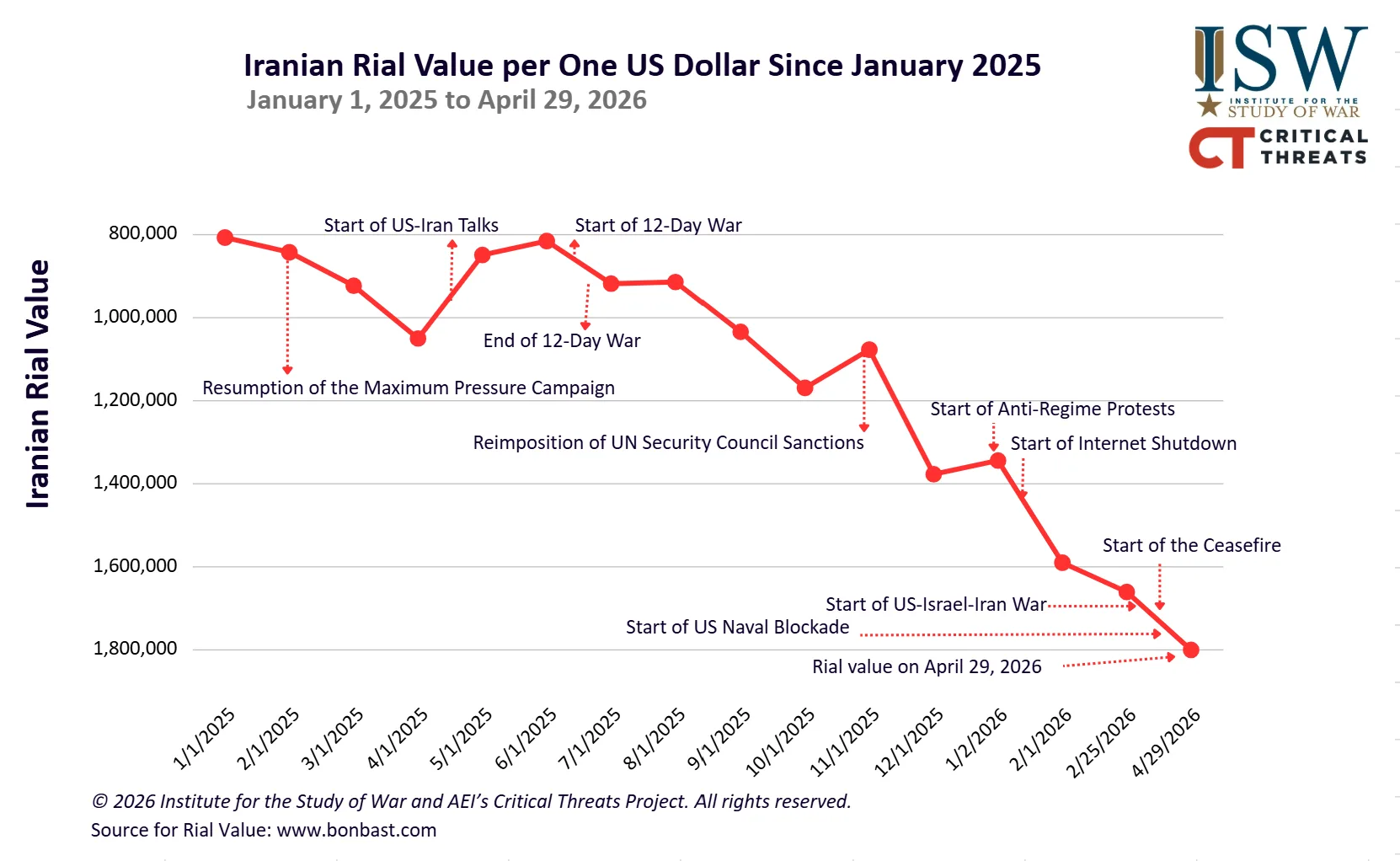
Iranian media and officials are attempting to deflect responsibility for Iran's dire economic conditions by attributing these conditions to US military and economic pressure. An Iranian media outlet criticized what it called a coordinated psychological campaign by anti‑regime media to portray Iran as facing socio‑economic collapse, political deadlock, and the threat of renewed protests as part of a broader US information operation against Iran.[18] The outlet's criticism followed a report from anti-regime media that the Supreme National Security Council recently met to discuss the potential for protests triggered by Iran's poor economic conditions.[19] This report came as Iran's currency plunged to a record low of roughly 1.8 million rials to one US dollar on April 29.[20] Iranian officials continue to blame the US naval blockade on Iranian ports and additional US sanctions for Iran's poor economic conditions. The blockade and US sanctions are certainly applying economic pressure on Iran, but the regime's historical mismanagement of the economy, corruption, and the IRGC’s dominance over economic institutions have played a major role in deteriorating the Iranian economy. Supreme Leader Mojtaba Khamenei, Parliament Speaker Mohammad Bagher Ghalibaf, and President Masoud Pezeshkian have publicly argued in recent days that US actions are constricting Iran's economy.[21] Mojtaba argued on April 30 that Iran's “management” of traffic through the Strait of Hormuz, presumably including the extraction of tolls from vessels that transit through the strait, is necessary to bolster the Iranian economy and enhance regional stability.[22] The US Treasury Department warned on May 1 that it could sanction vessels that pay tolls to Iran to transit through the strait.[23] Iranian leadership under IRGC Commander Major General Ahmad Vahidi appears to be dismissing concerns raised by “pragmatist” regime officials about the state of the Iranian economy.[24] Vahidi appears to view maintaining control over the Strait of Hormuz and retaining Iran's nuclear program as necessary for Iran's long-term interests, even at the cost of foregoing short‑term economic relief through an agreement with the United States.
The US Treasury Department designated Iranian entities involved in sanctions evasion on May 1 as part of the broader US economic pressure campaign against Iran.[26] The US Treasury Department designated three Iranian banking networks and their associated front companies for their involvement in Iranian sanctions evasion.[27] The US Treasury Department noted that these entities conduct tens of billions of US dollars’ worth of trade annually within Iran's “shadow banking” network.[28] These designations follow the US Treasury Department's designation of 35 entities and individuals involved in Iran's shadow banking network on April 28.[29] The United States has also targeted Iran's cryptocurrency sector, which Iran also uses to evade US sanctions. The US Treasury Department froze $344 million (USD) in cryptocurrency linked to Iran on April 29.[30] A US official told CNN that the Central Bank of Iran uses digital assets to obfuscate its involvement in cross-border transactions.[31] Reuters reported on May 1 that Iran's largest cryptocurrency exchange company, Nobitex, has processed between tens and hundreds of millions of dollars in transactions linked to the Central Bank of Iran and the IRGC.[32
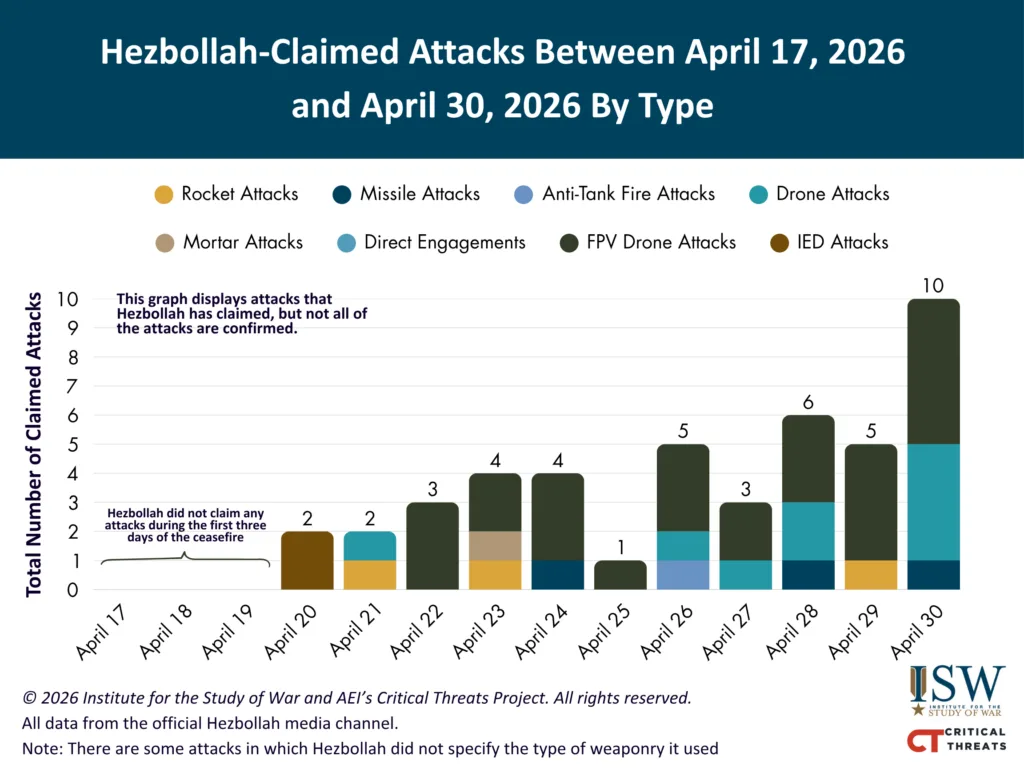
Hezbollah has continued to target Israeli forces and military assets using drones, including first-person view (FPV) drones.[33] Hezbollah claimed that it used drones in eight of its twelve attacks targeting Israeli forces since ISW-CTP ‘s last data cutoff on April 30.[34] Hezbollah claimed that it used FPV drones in four of its drone attacks, all of which targeted Israeli forces and vehicles in southern Lebanon.[35] An Israeli journalist reported that a Hezbollah FPV drone impacted near Misgav Am, northern Israel, on May 1, injuring two individuals.[36] Hezbollah has increasingly employed FPV drones in its attacks against Israeli targets since April 22 (see graphic below).[37] The Wall Street Journal reported on April 30 that Hezbollah began to employ FPV drones in attacks against Israeli targets as early as June 2024 but stopped using these drones after the start of the Fall 2024 conflict.[38] An Israeli reservist operating in southern Lebanon told the Wall Street Journal on April 30 that Hezbollah flies FPV drones near Israeli forces at least 10 times per day.[39] A senior Hezbollah official told the New York Times on April 30 that FPV drones have made Israeli forces “easy targets.”[40] Hezbollah's Loyalty to the Resistance Bloc stated on May 1 that Hezbollah is conducting attacks to prevent the Israel Defense Forces (IDF) from establishing a security zone in southern Lebanon.[41] The bloc added that Hezbollah seeks to create a “new equation” in Lebanon that prevents the IDF from conducting operations “without a painful retaliatory response” to increase Hezbollah's deterrence against Israel.[42]
The IDF announced that it conducted airstrikes targeting at least 40 Hezbollah sites in southern Lebanon overnight between April 30 and May 1.[51] This is the highest number of IDF-confirmed airstrikes in Lebanon in a 24-hour period since the ceasefire went into effect on April 16. The IDF reported that it struck Hezbollah command headquarters, sites used by Hezbollah to plan and stage attacks against Israeli forces, and other military infrastructure in southern Lebanon.[52] The IDF warned that it will continue to target any threats to Israeli forces and civilians. [53]
https://understandingwar.org/research/middle-east/iran-update-special-report-may-1-2026/