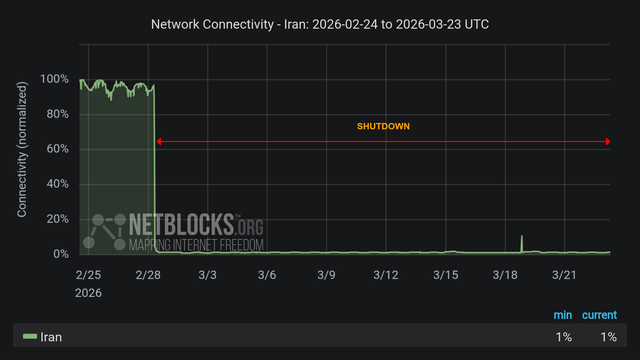
Posted on 10/08/2022 1:05:38 PM PDT by nuconvert
Iranian Regime national tv Channel One hacked about an hour ago. During a broadcast of Khamenie speech, a red crosshair appeared over his face and chanting of Women. Life. Freedom. There was writing to the side saying "Rise up. Join us". Also 4 photos at the bottom of the screen of young people killed and additional writing: "The blood of our youth is dropping from your paws".
Also, there was a huge banner in the middle of Tehran highway today that read: We are no longer afraid of you. We will fight.
Also, attempted attack on IRI ambassador in Denmark. Her bodyguard was stabbed. Diplomatic Security intervened before the attacker could stab the ambassador.
Iranian cities of Tehran, Yaz, Isfahan and Shiraz experiencing the most intense bombing of the war so far, over the night of 22-23 March.
Persian New Year shock and awe.
Iran Update Special Report: March 22, 2026
US President Donald Trump threatened on March 21 to “obliterate” Iranian power plants if Iran does not “fully open” the Strait of Hormuz within 48 hours.[1]
Iran has threatened to attack regional energy infrastructure if the United States attacks power plants in Iran. ISW-CTP has recorded several Iranian attacks on regional energy infrastructure since the war began on February 28, but the new threats could entail an expansion of such attacks. Iranian Parliament Speaker Mohammad Bagher Ghalibaf stated on March 22 that Iran would strike critical infrastructure and energy facilities in the region if Iranian power plants are attacked.[2] The Khatam ol Anbia Central Headquarters released a statement on March 22 and similarly threatened to “completely close” the Strait of Hormuz as well as target regional energy infrastructure and regional companies with US shareholders.[3] Iran’s Permanent Representative to the International Maritime Organization reiterated that Iran will not allow US, Israeli, or US-Israeli allied vessels to transit the strait.[4] Iran has attacked energy infrastructure in at least the United Arab Emirates, Saudi Arabia, Bahrain, Oman, and Israel since the war began.
The United Kingdom Maritime Trade Operations (UKMTO) reported on March 21 that an unknown projectile exploded near a vessel 15 nautical miles north of Sharjah, United Arab Emirates.[5] The UKMTO later classified the incident as “suspicious activity,” not an attack, because it could not confirm the intended target.[6] The UKMTO has reported 21 confirmed maritime incidents in the Strait of Hormuz since the war began.[7] The last confirmed Iranian attack on a vessel was on March 11.[8] Iranian officials have repeatedly stated that they will control which vessels transit the strait and that vessels affiliated with the United States, Israel, or their allies cannot pass.[9]
IRGC Ground Forces Commander Brigadier General Mohammad Karami visited unspecified IRGC Ground Forces units in western and northwestern Iran on March 22.[10] The combined force has struck several Ground Forces units in these areas since the beginning of the war. Iranian Armed Forces General Staff (AFGS)-affiliated media reported that Karami warned that Ground Forces units are ready to confront any ”aggressors” on Iran’s borders.[11] The IRGC Ground Forces are structured to confront any invading force while also having units positioned to violently suppress social unrest.[12] The visit of the IRGC Ground Forces commander to units in northwestern provinces along Iran’s border is notable given the combined force’s efforts to degrade internal security institutions in Iran’s western border region and reports about possible armed Kurdish mobilization along the Iran-Iraq border.[13] The combined force has reportedly struck at least two IRGC Ground Forces divisions and one brigade in northwestern and majority Kurdish areas of Iran since February 28 (see map below).[14] The combined force reportedly struck the 31st Ashoura Mechanized Division, which operates in Tabriz, East Azerbaijan Province, on March 4. Commercially available satellite imagery from March 4 and 5 also confirmed damage from combined force strikes to the 11th Amir ol Momenin Brigade base in Soltan Abad, Ilam Province, and the Nabi Akram Operational Division in Kermanshah City, Kermanshah Province.[15]
https://understandingwar.org/research/middle-east/iran-update-evening-special-report-march-22-2026/
Iran Update Special Report, March 23, 2026
US President Donald Trump extended his deadline for Iran to reach a deal with the United States to March 27.[2] Trump had previously threatened to strike Iranian power plants if Iran did not stop attacks around the Strait of Hormuz by March 23.[3] In extending the deadline, Trump said that Iran agreed tocease uranium enrichment, relinquish its existing stockpiles, and remain “low-key on the missiles.”[4] Trump told reporters that his team is “dealing with a man that I believe is the most respected, not the supreme leader, we have not heard from him.”[5] An Israeli official told Axios that US Special Envoy to the Middle East Steve Witkoff and Jared Kushner have spoken to Iranian Parliament Speaker Mohammad Bagher Ghalibaf.[6] A source with knowledge of the matter told Axios that there “did not appear” to have been direct talks with Ghalibaf, but that Egypt, Pakistan, and Turkey have passed messages between the United States and Iran and were pursuing a call between the Trump administration and Ghalibaf.[7]
Israeli Prime Minister Benjamin Netanyahu said on March 23 that Trump told him that the United States sees an opportunity to “leverage the military achievements of the war” to secure all strategic objectives through an eventual agreement.[8] Netanyahu conveyed that Trump believed such an agreement could safeguard shared US-Israeli interests, depending on how the emerging diplomatic channel unfolds.[9] A separate source familiar with the matter told Axios that the US Vice President JD Vance discussed United States-Iran negotiations with Netanyahu in a phone call on March 23.[10]
Ghalibaf publicly rejected reports of United States-Iran negotiations on X on March 23.[11] Ghalibaf added that all Iranian officials stand firmly behind Supreme Leader Mojtaba Khamenei and the Iranian people’s demand for “complete and remorseful punishment” of the United States and Israel.[12]
That Ghalibaf is leading diplomatic engagement with the United States is consistent with reports that he has consolidated tremendous influence in Iran, especially since the current war began. Ghalibaf is a former Islamic Revolutionary Guards Corps (IRGC) officer who maintains close ties to the military establishment but has operated primarily as a politician in recent decades.[13] Ghalibaf reportedly assumed an unprecedented senior command role during the 12-Day War, however, demonstrating his influence and authority in the regime.[14] Ghalibaf was also reportedly behind the formation of the Defense Council after the 12-Day War, which was meant to streamline decision-making and prepare the regime for future conflict against the United States and Israel.[15] More recently, Ghalibaf was reportedly among the small cadre of IRGC officers who aggressively intervened in the supreme leader succession process to ensure that Mojtaba Khamenei replaced his father.[16] Remarks from US and Israeli security officials on March 22 suggest that this inner circle of IRGC figures has been especially empowered since the ascension of Mojtaba, who remains badly wounded.[17] The killing of Supreme National Security Council Secretary Ali Larijani may have removed yet another constraint on Ghalibaf’s influence, given that Larijani played a similarly dominant role in Iranian foreign and defense policy and had opposed Mojtaba’s accession, instead backing his own brother, Sadegh Amoli Larijani, for supreme leadership.[18]
https://understandingwar.org/research/middle-east/iran-update-special-report-march-23-2026/
Iran Update Special Report, March 24, 2026
Iran has reportedly mined the Strait of Hormuz with about a dozen Maham 3 and Maham 7 limpet mines.[1] US officials told CBS News that Iran has laid at least a dozen Maham 3 and Maham 7 mines, but a separate US official told CBS that Iran has laid fewer than a dozen mines in the strait.[2] The Maham 3 is a high-explosive “moored, buoyant, anti-shipping” naval mine with a maximum depth of 100 meters, according to the Collective Awareness to Unexploded Ordnance (CAT-UXO) organization.[3] The Maham 3 is equipped with magnetic and acoustic sensors, which it uses to target vessels.[4] The Maham 3 can determine a ship’s presence from around three meters in all directions, according to CAT-UXO.[5] The Maham 7 is a high-explosive “bottom influence” mine that sits on the seafloor and is equipped with magnetic and acoustic sensors that it uses to target medium-sized ships, landing crafts, and small submarines.[6] The Maham 7 is lightweight and can be deployed by surface vessels as well as via parachute from aircraft or helicopters.[7] The number of mines that Iran has reportedly laid is relatively consistent with a March 10 Wall Street Journal report that Iran had laid fewer than ten mines.[8] Chairman of the Joint Chiefs of Staff General Dan Caine said on March 19 that US Central Command (CENTCOM) has destroyed 44 Iranian minelaying vessels.[9]
Iran is reportedly requiring some vessels to pay a fee to transit the Strait of Hormuz. Maritime intelligence company Lloyd’s List reported on March 23 that over 20 vessels have taken a “Tehran-approved route” to transit the Strait of Hormuz through Iranian territorial waters since the war began.[10] A senior reporter at Lloyd’s List reported that vessels that transit through the approved route pass by Larak Island, where the Islamic Revolutionary Guard Corps (IRGC) verifies vessel details and, in some cases, requires vessels to pay a fee.[11] Lloyd’s List reported that at least two vessels, including a Chinese state-owned feeder tanker, have paid Iran a fee in exchange for safe passage through the strait, with one fee reported to have been around $2 million USD.[12]
Iranian President Masoud Pezeshkian appointed former IRGC Deputy Commander and Expediency Discernment Council Secretary Mohammad Bagher Zolghadr as the Supreme National Security Council (SNSC) secretary on March 24, replacing Ali Larijani.[13] Pezeshkian reportedly appointed Zolghadr with Iranian Supreme Leader Mojtaba Khamenei’s approval.[14] Zolghadr is a hardline figure with deep connections to Iran’s military and judicial apparatuses. Zolghadr commanded the IRGC Ramadan Headquarters during the Iran-Iraq War.[15] Zolghadr served as the IRGC coordination deputy between 1989 and 1997 and IRGC deputy commander between 1997 and 2005.[16] Zolghadr was heavily critical of former reformist President Mohammad Khatami and was one of the primary architects of former hardline President Mahmoud Ahmadinejad’s election in 2005.[17] Zolghadr served as the security deputy in the Interior Ministry during Ahmadinejad’s term and later served as the Armed Forces General Staff deputy for Basij affairs, playing a large role in suppressing the 2009 Green Movement.[18] The UN sanctioned Zolghadr in 2007 for his involvement in developing Iran’s nuclear and missile programs.[19] Ali Larijani’s brother, Sadegh Amoli Larijani, appointed Zolghadr as Expediency Discernment Council secretary in 2021.[20]
Iran is attempting to conduct cyberattacks targeting Israel, the United States, and the Gulf states as part of its asymmetric strategy to try to degrade the combined force’s willingness to continue their war effort.[78] Israel National Cyber Directorate Chief Yossi Karadi said on March 24 that dozens of Iranian hacker groups have attempted to conduct both kinetic and cyber-attacks targeting Israeli utilities and businesses, as well as Gulf states’ infrastructure.[79] Karadi said that a hacker group broadcast false messages on Israel Railways’ monitors in a few locations on March 11.[80] Karadi also noted that Iran has increasingly coordinated cyberattacks with Hezbollah.[81] An Iranian-linked hacker group previously conducted a cyber-attack targeting a US healthcare company on March 11, likely to try to impose political pressure on the US administration.[82] The US Justice Department seized domains linked to the Iranian Intelligence and Security Ministry involved in recent cyberattacks or hacking attempts on March 19.[83]
Iran may be increasing its rate of drone attacks targeting Bahrain to compensate for its apparent pause in attacks targeting Qatar. Iranian drone attacks against Bahrain have increased in recent days. Iran fired 36 and 19 drones targeting Bahrain on March 23 and 24, respectively, compared to two drones on both March 21 and 22 (see graphs below).[88] The timing of this increase suggests that Iran may be redirecting drone fire away from Qatar and toward Bahrain.
Iran continued to target Saudi Arabia, Bahrain, Kuwait, and the United Arab Emirates (UAE) on March 24. Unspecified sources told Israeli media on March 22 that Iranian strikes against Bahrain, Kuwait, and the UAE will “continue as usual” even though Iran is reportedly avoiding attacking Qatar and Saudi Arabia.[89] Two unspecified sources told Israeli media on March 22 that Iran has decided to limit its attacks on Saudi Arabia due to concerns that continued strikes could trigger a direct Saudi military response.[90] The volume of Iranian drones targeting Saudi Arabia has fluctuated in recent days. Iran launched 47 drones at Saudi Arabia on March 23 but only launched one drone at Saudi Arabia on March 24 (see graph below). Iran also conducted the following attacks against Bahrain, Kuwait, and the UAE on March 24:
Bahrain: Iran launched 19 drones and six missiles targeting Bahrain on March 24.[91] The Emirati Defense Ministry reported that an Emirati army contractor was killed in an Iranian ballistic missile attack on Bahrain.[92] The attack also injured five other Emirati soldiers.[93]
Kuwait: Iran launched a slightly higher volume of missiles and drones targeting Kuwait on March 24 than it has in the past three days (see graph below). Iran fired 13 drones and 17 missiles targeting Kuwait.[94]
UAE: Iran launched 17 drones and five ballistic missiles targeting the UAE on March 24.[95] These volumes of drones and missiles are consistent with Iranian fire volumes over the past week targeting the UAE (see graph below).[96]
The Lebanese government has continued to act against Hezbollah and Iran. The Lebanese Foreign Ministry withdrew on March 24 accreditation from Iranian Ambassador to Lebanon Mohammad Reza Sheibani, declaring him persona non grata and demanding that he leave Lebanon.[153] Hezbollah condemned the Lebanese Foreign Ministry’s decision, stating that “it constitutes a coup against [Hezbollah].”[154] Hezbollah added that the decision ”opens the doors to internal division, deepens the national rift, and plunges the country into a highly dangerous path of dependency, weakness, and vulnerability.”[155] Lebanese authorities also reportedly arrested eight Hezbollah operatives transporting 21 rockets to southern Lebanon on March 24.[156] The Lebanese government’s actions are notable because no previous Lebanese government has taken such direct steps against Hezbollah or the IRGC.
US President Donald Trump told reporters on March 24 that the United States is negotiating with Iran.[178] Trump said that Iran would “like to make a deal.”[179] Unspecified sources told Axios on March 24 that the United States and regional partners, including Egypt, Turkey, and Pakistan, have discussed holding high-level peace talks with Iran on March 26 but are waiting for Iran’s response.[180] Pakistani Prime Minister Shehbaz Sharif said on March 24 that Pakistan would be willing to host the US-Iran talks.[181] An unspecified Iranian source told CNN on March 24 that the United States reached out to Iran via various intermediaries.[182] The source claimed that there have not been “full-on negotiations” between the United States and Iran.[183] Three senior sources in Tehran separately told Reuters on March 24 that Iran is hardening its position in any potential talks with the United States.[184] Iran would demand guarantees against future military action, compensation for wartime losses, formal control of the Strait of Hormuz, and no limits on its ballistic missile program, according to the sources.[185] Trump previously extended his deadline for Iran to reach a deal with the United States to March 27.[186]
mor + maps: https://understandingwar.org/research/middle-east/iran-update-special-report-march-24-2026/
Immunity for two key figures in the Iranian leadership:
Iran regime’s FM and Parliament Speaker get temporary immunity from the US and Israel, Channel 14’s @bardugojacob reports. Foreign Minister Abbas Araghchi and Parliament Speaker Mohammad Baqer Qalibaf received temporary immunity from Israel and the United States, valid at least for the entire five days of negotiations underway with Tehran. The revelations confirm and reinforce what has been talked about in the last two days regarding the ongoing talks with the regime in Tehran.
https://x.com/c14israel/status/2036572136635040062
Channel 14: Israel’s leading news channel. Official English curation of the Hebrew https://x.com/c14_news
Interesting info here https://x.com/c14israel
Ugh. Yesterday Michael Oren said it wasn’t Ghalibaf, but someone else in IRGC.
I don’t see how turning Iran into Myanmar helps to free the Iranian people.
EXCLUSIVE FROM TEHRAN: “You took all the money, and now your soldiers are suffering because there are no salaries. Give back what you stole.”
These are remarks by Iran’s Speaker of the Parliament, Mohammad-Bagher Ghalibaf, obtained by Senior Iran Analyst Dror Balazada. Ghalibaf’s comments reveal his desperate attempt to hold his jihadi coalition together, “I don’t trust you to stop the Americans at Kharg and Hormuz.”
Balazada shows how relentless American and Israeli attacks on the IRGC have pushed Ghalibaf, a corrupt, yet intelligent regime official, to be the one pushing for a deal with @potus
https://x.com/c14israel/status/2036519455727952045
Who is the “you” that he’s talking to?
The leaders of the IRGC.
according to Dror Balazada.
Mass text in Iran promotes Trump assassination campaign, $25m pledged
A mass text message sent to mobile users in Iran promoted what it described as an “international campaign to reward the assassination of Trump,” according to screenshots of the message shared with Iran International.
The message urges recipients to register their support through a website and to confirm participation by sending a number via SMS. It also directs users to further information on the domestic platform Rubika. The text included a link to the campaign’s website that could not be accessed from outside Iran.
Tehran-based Didban Iran reported that the campaign has gained around 290,000 supporters, with total pledged amounts reaching $25 million. The website says that these sums have not been collected and instead represent pledged amounts, according to the report.
A statement on the site said the campaign was launched following what it described as a jihad fatwa issued in response to the killing of Iran’s supreme leader, and that it aimed to fund a reward for the assassin of US President Donald Trump.
https://www.iranintl.com/en/liveblog/202603192844#202603256203
It’s not that hard to get a copy of that list. It will come in handy later.
The United States presented a 15-point proposal to Iran via Pakistan on March 24.[1] Pakistani Army Commander Asim Munir, who has reportedly served as the “key interlocutor” between the United States and Iran, delivered the proposal to Iran.[2] Munir also contacted Iranian Parliament Speaker Mohammad Bagher Ghalibaf and offered to host talks between the United States and Iran.[3] The 15-point proposal reportedly includes provisions requiring Iran to dismantle its nuclear program, end uranium enrichment, hand over its enriched uranium stockpile, grant full International Atomic Energy Agency (IAEA) access to Iranian nuclear facilities, limit its missile capabilities, cease support for the Axis of Resistance, and ensure freedom of navigation through the Strait of Hormuz.[4] Three unspecified sources familiar with the details of the proposal told Israeli media on March 24 that US Special Envoy to the Middle East Steve Witkoff and Jared Kushner are trying to establish a month-long ceasefire during which the United States and Iran would negotiate the 15-point proposal.[5] Iran separately proposed five conditions for a ceasefire, including the complete cessation of US and Israeli attacks, establishment of a mechanism to prevent renewed conflict, compensation for wartime damages, an end to attacks on the Axis of Resistance, and international recognition of Iran's authority over the Strait of Hormuz.[6] Unspecified Iranian officials told Iranian media that no direct negotiations are currently taking place between the United States and Iran and that Iran will set the timing and conditions for ending the war.[7] An Axios correspondent reported on March 25 that the Trump administration has not yet received a formal Iranian response to the US proposal for negotiations, citing an unspecified US official.[8] The White House threatened on March 25 to conduct further military action against Iran if the regime does not agree to a deal to end the conflict.[9]
A longtime observer of drone operations suggested on March 25 that drone footage posted by the Islamic Resistance in Iraq on March 24 is consistent with a fiber-optic first-person view (FPV) drone.[10] ISW-CTP is unable to authenticate the Islamic Resistance in Iraq's video, however. The Islamic Resistance in Iraq, which is a coalition of Iranian-backed Iraqi militias, claimed that it attacked the former US Victory Base at Baghdad International Airport and posted drone footage of the attack.[11] The United States transferred control of the Victory Base to the Iraqi federal government in 2011, but Iranian-backed Iraqi militias have continuously claimed attacks targeting the base since the start of the war.[12] The drone footage shows that the Islamic Resistance in Iraq targeted a helicopter and a US radar system.[13] ISW-CTP has not observed any evidence to support the Islamic Resistance in Iraq's claim that it attacked the Victory Base around March 24. Iraqi media reported two separate drone attacks targeting Baghdad International Airport on March 22 but did not provide enough information for ISW-CTP to assess whether the video that the Islamic Resistance in Iraq posted on March 24 was from one of those attacks.[14] Likely Iranian-backed Iraqi militia front group Saraya Awliya al Dam posted footage on March 17 that open-source intelligence (OSINT) analysts also assessed to be from a fiber-optic FPV reconnaissance drone flying inside the parameter of the US Embassy in Baghdad.[15] ISW-CTP assessed on March 17 that the group's decision to advertise its possession of such a weapon represented a threat aimed at the United States.[16]
If the Islamic Resistance in Iraq's video is authentic, Iran's ability to manufacture and operate fiber-optic FPV drones and transfer this technology to its regional proxies and partners would pose a significant challenge to US interests in the Middle East. Fiber-optic FPV drones are immune to jamming and can be used for intelligence, surveillance, and reconnaissance, or outfitted with strike capabilities to conduct precise targeting.[17] The drones have small ranges and generally carry small payloads but can impose financial costs when used to target expensive assets.[18] Russia and Ukraine have extensively used FPV drones in their war.[19] Russia has given drone components to Iran, and Iran reportedly possesses FPV drones, but it had been unclear until this point that Iran had begun to transfer this technology to its partners in Iraq.[20]
Iran sent a letter to International Maritime Organization member states on March 22 stating that “non-hostile” ships can pass through the Strait of Hormuz if they coordinate with Iran, according to the Financial Times.[21] Ships associated with the United States, Israel, or other “participants in the aggression” are not eligible for safe passage. This report is consistent with reports that at least 26 vessels have taken an Iranian-approved route through the Strait of Hormuz as of March 25.[22] Iran has reportedly required some of these vessels to pay a fee to transit the strait. Maritime intelligence firm Lloyd's List, citing three sources with direct knowledge of the new system, reported that vessel operators are required to contact intermediaries with connections to the Islamic Revolutionary Guard Corps (IRGC) before transiting through the strait.[23] Lloyd's List reported that 92 percent of the current traffic in the strait is comprised of Iranian (67 percent), Greek (15 percent), and Chinese (10 percent) vessels.[24]
The Wall Street Journal confirmed on March 24 that Israeli strikes on a major Caspian Sea port in northern Iran last week targeted Russian support for Iran in the ongoing war, according to unspecified people familiar with the matter.[25] This report is consistent with ISW-CTP’s previous reporting that the IDF struck a Caspian Sea port that Iran uses to trade both military and non-military goods with Russia.[26] The IDF targeted “dozens” of vessels, a command center, and a shipyard at Bandar Anzali Port, Gilan Province, on March 18.[27] The Israeli strike on the port followed reports that Russia has provided Iran with satellite imagery and Shahed drones since the war began.[28] Israeli media reported on March 19 that the Israeli strikes in Bandar Anzali “shut down” a critical supply line between Iran and Russia for both basic goods, such as wheat imports, and military equipment.[29] TheWall Street Journal added on March 24 that Russia uses the Caspian Sea to receive Iranian Shahed drones as well as artillery shells and other ammunition to resupply its troops on the front lines with Ukraine.[30] More than 300,000 artillery shells and a million rounds of ammunition were shipped from Iran to Russia in 2023 via the Caspian Sea, according to unspecified documents seen by the Wall Street Journal.
ISW-CTP has recorded an uptick in combined force strikes targeting Iranian defense industrial sites since its last data cutoff. This uptick comes amid a report that Israeli Prime Minister Benjamin Netanyahu ordered the IDF to destroy as much of Iran's arms industry as possible over the next 48 hours.[42] The New York Times reported on March 25 that Netanyahu ordered the IDF to maximize its destruction of Iran's arms industry over the next 48 hours, citing two senior Israeli officials.[43] The IDF reported that it struck two facilities in Tehran where Iran manufactured naval cruise missiles.[44] One strike targeted a building in the Shiyan neighborhood in eastern Tehran, while the other targeted the Shahid Motahari Applied Scientific Education Center in Imam Khomeini Town, northeastern Tehran.[45] The IDF said on March 25 that it also struck an air and naval weapons production site near Vandar, Ghazvin Province.[46] The IDF separately said on March 25 that it struck the Underwater Military Equipment Research and Development Center in northern Esfahan City, which is responsible for designing and developing submarines and support systems.[47] The IDF said that the facility is the only site in Iran responsible for developing submarines and auxiliary systems.[48] The submarine facility is located next to the Defense Industries Organization-affiliated Malek Ashtar University of Technology in Shahin Shahr, Esfahan Province, which the combined force struck on March 24.[49] These IDF strikes are consistent with the combined force's effort to degrade Iran's ability to threaten shipping in the Persian Gulf and Strait of Hormuz.
The combined force has continued to target IRGC commanders. IRGC-affiliated media reported on March 23 that the combined force killed IRGC 1st Naval District Commander Mosayeb Bakhtiari.[62] The combined force reportedly killed Bakhtiari in a strike in Bandar Abbas, Hormozgan Province.[63] The combined force has repeatedly struck Iranian naval facilities at the Bandar Abbas Port, which houses the IRGC Navy 1st Naval District and IRGC Navy Headquarters.[64] Iranian media also announced the death of the IRGC Ground Forces 41st Sarallah Division Commander Amir Mohammadi.[65] The combined force reportedly targeted the 41st Sarallah Division headquarters in Kerman City, Kerman Province, on March 20.[66] IRGC-affiliated media also confirmed on March 16 that IRGC commander Javad Bagheri was killed in combined force strikes.[67] Bagheri is the brother of former Armed Forces General Staff Chief Major General Mohammad Bagheri, whom Israel killed during the 12-Day War.[68]
The International Atomic Energy Agency (IAEA) confirmed that the Bushehr Nuclear Power Plant did not sustain damage after a projectile landed on the facility's premises. Iran notified the IAEA that an unspecified projectile landed in the Bushehr Nuclear Power Plant facility's premises on March 24.[69] Iran previously notified the IAEA of a “projectile incident” near the plant on March 17 that also caused no damage.[70] The Institute for Science and International Security identified an impact crater about 350 meters from the power plant's reactor in March 18 satellite imagery.[71] Rosatom reportedly evacuated 163 Russian technicians from the Bushehr Nuclear Power Plant on March 24.[72] Rosatom Director General Alexei Likhachev said that 300 Russian technicians currently remain at the power plant.[73] Likhachev stated that more Russian technicians will evacuate the plant in the future.[74] No technicians were injured in the March 17 and 24 incidents.
Iran continued to target Saudi Arabia, Bahrain, Kuwait, and the United Arab Emirates (UAE) on March 25. Two unspecified sources told Israeli media on March 22 that Iran had decided to limit its attacks on Saudi Arabia due to concerns that continued strikes could trigger a direct Saudi military response.[84] The rate of Iranian attacks on Saudi Arabia has fluctuated since then, however. Iran launched 7 drones at Saudi Arabia on March 22, 47 drones on March 23, 32 drones on March 24, and 6 drones on March 25.[85] Iran separately fired nine drones and 20 ballistic missiles targeting Kuwait on March 25.[86] One of the Iranian drones struck a fuel tank at the Kuwait International Airport in Kuwait City.[87] Iran launched thirty drones targeting Bahrain on March 25.[88] ISW-CTP previously noted that Iran may be increasing drone attacks against Bahrain to compensate for an apparent pause in drone attacks against Qatar. Iran also launched nine drones targeting the UAE on March 25.[89]
https://understandingwar.org/research/middle-east/iran-update-special-report-march-25-2026/
new liveblog link https://www.iranintl.com/en/liveblog/202603261868
How The Houthi’s Are Iran’s Last Line of Defence
In this episode of Conflicted, Thomas Small is joined by Conflicted’s first ever guest host, Nadwa Al-Dawsari, veteran researcher, conflict analyst, and policy advisor with 20 years of field experience in Yemen.
This episode covers:
The IRGC agents who are in control of Houthi war policy
Houthi spiritual beliefs
When the Houthis are likely to join the Iran War in force
What the military capabilities of the Houthis really are
Houthi techniques of indoctrination and control
The growing Houthi presence in the Horn of Africa
How the Houthis and Al Qaeda are now allies
Why Western decision-makers get the Middle East so disastrously wrong
https://www.youtube.com/watch?v=UbA4QUEd5cc
US Central Command (CENTCOM) Commander Admiral Brad Cooper said on March 25 that the combined force has struck over 10,000 sites across Iran since the war began.[9] The combined force has concentrated strikes around Tehran as well as western and central Iran.[10]
The IDF has continued targeting senior Iranian commanders to disrupt Iranian command and control and operations broadly. The IDF announced on March 26 that it killed Islamic Revolutionary Guards Corps (IRGC) Navy Commander Rear Admiral Alireza Tangsiri in Bandar Abbas, Hormozgan Province.[11] Tangsiri had served as IRGC Navy commander since August 2018.[12] Tangsiri previously served as IRGC Navy deputy commander from 2010 to 2018 and the Bandar Abbas-based IRGC 1st Saheb ol Zaman Naval District commander.[13] The Saheb ol Zaman Naval District has the central mission of controlling the Strait of Hormuz.[14] Its area of operations includes the IRGC Navy headquarters and command center as well as the 2nd Imam Sajjad Special Forces Brigade, the 16th Assef Coastal Missile Group, the 112th Zolfaghar Surface Combat Brigade, and underground fortifications on Abu Musa.[15] The IDF also killed IRGC Navy Intelligence Deputy Behnam Rezaei in Bandar Abbas, Hormozgan Province.[16] Rezaei reportedly was responsible for regional intelligence collection and coordination.[17] Tangsiri oversaw IRGC Navy operations, including attacks on international shipping and threats to US forces in the region.[18] The United States sanctioned Tangsiri in June 2019 for acting on behalf of the IRGC and his role in threatening to close the Strait of Hormuz and overseeing IRGC Navy activities responsible for the sabotage of vessels in international waters.[19]
The IRGC has reportedly continued to consolidate power within the Iranian regime and play an increasingly central role in key leadership decisions. Anti-regime media reported on March 26 that the IRGC pressured Iranian President Masoud Pezeshkian to appoint Mohammad Bagher Zolghadr as the Supreme National Security Council (SNSC) secretary, citing unspecified sources.[20] Zolghadr is a hardline figure with deep ties to Iranian military and judicial establishments.[21] The sources said that IRGC Commander Brigadier General Ahmad Vahidi was among the IRGC officers who pressured Pezeshkian.[22] The sources also said that there are no clear signs that Supreme Leader Mojtaba Khamenei influenced the decision to appoint Zolghadr, raising continued questions about how involved Mojtaba is in key decisions.[23] The sources added that Pezeshkian and other senior officials opposed Zolghadr’s appointment.[24] The reported IRGC role in Zolghadr’s appointment comes after a small group of IRGC officer intervened aggressively in the supreme leader succession process to ensure that Mojtaba replaced his father.[25] Statements from US and Israeli security officials indicate that this group of IRGC officers have gained significant influence since Mojtaba became supreme leader.[26]
An IRGC cultural official told state media that the IRGC has lowered the minimum recruitment age to 12.[27] This decision follows reports that the IRGC is facing difficulties with recruiting new personnel and managing broader operational disruptions. The official said that the IRGC is recruiting individuals to support patrols, checkpoints, and logistics.[28] Unspecified informed sources told anti-regime media on March 12 that IRGC efforts to mobilize reserve forces failed because many individuals did not report to military centers.[29] CTP-ISW assessed on March 19 that Israeli strikes on Iranian internal security forces, including decapitation strikes, have likely caused shock and confusion within the internal security apparatus and disrupted operations to some extent.[30]
Reuters reported on March 26 that Iranian hardliners have intensified calls to develop a nuclear weapon, citing unspecified sources in Iran.[31] Some hardliners have urged Iranian leadership to revise the nuclear doctrine, meaning pursue a nuclear weapon, to restore deterrence since October 2024. Iranian parliamentarians signed separate letters in October 2024—after the April and October Iranian missile attacks on Israel—and in September 2025—after the June 2025 Israel-Iran war—urging a revision of Iranian defensive doctrine.[32] They called on the SNSC to authorize and support nuclear weapons production.
IRGC-affiliated Tasnim News Agency published an op-ed on March 26 that urged Iran to withdraw from the Nuclear Non-Proliferation Treaty (NPT).[33] The Tasnim op-ed emphasized that Iran is committed to a peaceful nuclear program, however.[34] Iranian officials have threatened to withdraw from the NPT previously to deter Western action against Iran.[35]
Iranian state media reported that Iran officially sent its response rejecting the 15-point US proposal and is awaiting the US response.[36] The United States presented the proposal to Iran via Pakistan on March 24.[37] The proposal reportedly includes provisions requiring Iran to dismantle its nuclear program, end uranium enrichment, hand over its enriched uranium stockpile, grant full International Atomic Energy Agency (IAEA) access to Iranian nuclear facilities, limit its missile capabilities, cease support for the Axis of Resistance, and ensure freedom of navigation through the Strait of Hormuz.[38] The informed source added that Iran's response reiterated its demands for a ceasefire which include the complete cessation of US and Israeli attacks, the establishment of a mechanism to prevent renewed conflict, compensation for wartime damages, an end to attacks on the Axis of Resistance, and international recognition of Iran's “sovereignty” over the Strait of Hormuz.[39] A senior Iranian official speaking to Reuters confirmed that unspecified senior Iranian officials and a representative of Iranian Supreme Leader Mojtaba Khamenei reviewed the US proposal.[40] The senior Iranian official added that the proposal asks Iran to forgo its ability to defend itself in turn for a promise to lift sanctions.[41] The official reiterated that the United States and Iran have not arranged negotiations and that negotiations do not seem realistic at this stage of the conflict.[42]
Russia continues to expand its military cooperation with Iran to facilitate Iranian strikes on US and Israeli forces in the Middle East. The Financial Times (FT) reported on March 25, citing Western intelligence reports, that Russia is close to completing a phased shipment of unspecified drones, medicine, and food to Iran.[43] Two officials briefed on the intelligence told FT that Russia and Iran began discussing drone delivering soon after the US-Israeli campaign began and that subsequent deliveries processing started in early March. The officials stated that they expect Russia to complete the deliveries by the end of March. A Western security official told FT that the specific drone type that Russia agreed to send to Iran is unclear, but that Russia is likely only in a position to deliver models such as the Geran-2. Current and former Western officials told FT that Russia denied Iran's request for S-400 air defense systems. Russia has reportedly already been providing Iran with modified Shahed drone components and satellite imagery to assist recent Iranian strikes on US forces in the Middle East and US allies in the region.[44] ISW continues to assess that Russia sees aiding Iran's strike campaign as an effort to weaken the United States, as Russia has self-defined the United States as one of its primary geopolitical adversaries.[45]
The combined force continued to strike Iranian repressive institutions as part of the broader combined effort to degrade the regime's coercive capacity. The combined force reportedly hit the IRGC Ground Forces Ansar ol Hossein Provincial Unit in Hamedan City, Hamedan Province.[58] The IRGC Ground Forces plays a significant role in countering internal threats, including by violently suppressing protest activity.[59] The provincial units oversee IRGC ground elements that are largely dispersed across population centers.[60] The combined force previously struck Law Enforcement Command (LEC) sites in Hamedan City.[61] The LEC is Iran's national police force and the regime's first line of defense during civil unrest.[62] The IDF struck an IRGC headquarters around Bonab, East Azerbaijan Province.[63] The combined force previously struck an LEC building in Bonab.[64]
Iran is reportedly reinforcing defenses at Kharg Island.[74] Unspecified sources familiar with US intelligence reports told CNN on March 26 that Iran has reinforced Kharg Island with man-portable air-defense systems (MANPADS) in recent weeks.[75] Iran primarily operates domestically produced Misagh MANPAD, a variant of the Chinese QW-2 Vanguard missile system.[76] Iran recently signed an arms deal with Russia in December 2025 to acquire 500 Russian Verba MANPADS, but it is unclear if Russia delivered any before the start of the war.[77] The source added that Iran has also laid anti-personnel and anti-armor mines around the island, including on the shoreline.[78]
Iran continued to fire at Saudi Arabia, Bahrain, Kuwait, and the United Arab Emirates on March 26. Iran launched 37 drones at Saudi Arabia between 2:00 PM on March 25 and 2:00 PM on March 26.[81] Iran launched 19 drones and one missile at Bahrain.[82] Iran launched one drone and six ballistic missiles at Kuwait.[83] The Kuwaiti Army reported that the six missiles landed in open areas.[84] The Emirati Defense Ministry stated that it intercepted 11 Iranian drones and 15 missiles.[85]
more + maps: https://understandingwar.org/research/middle-east/iran-update-special-report-march-26-2026/
The timing of action is left to the leadership. We monitor developments and know when the right moment comes.” He added that Iran is currently “performing well” in the conflict and that the Houthis would reassess their position if circumstances change. If the Houthis open a new front, analysts say one of their most likely targets would be the Bab al-Mandeb Strait off Yemen's coast a narrow but strategic chokepoint controlling maritime traffic bound for the Suez Canal.
But the Houthis, who possess heavy weaponry capable of hitting Gulf states and disrupting shipping around the Arabian Peninsula, have so far stayed out of direct confrontation. mDiplomats and regional analysts believe the Houthis are waiting for the right moment to coordinate with Tehran and maximize pressure. The semi-official Iranian news agency Tasnim reported Wednesday that an unnamed Iranian military source suggested Tehran could open a new front in Bab al-Mandeb if its territory or islands were attacked.
https://yemenonline.info/politics/12090
Tasnim is owned by the IRGC
Iran may be attempting to maximize the effects of its limited capacity to launch large missile salvos at Israel by launching small missile salvos throughout the day to impose psychological effects on Israeli civilians by consistently forcing them to take shelter and keeping the country under constant alert. Iran has launched between five and 11 missile barrages at Israel per day over the past week.[1] The IDF reported on March 27 that Iran has launched about 10 missiles at Israel per day, which suggests that each Iranian barrage has consisted of either a single missile or a small number of missiles.[2] Iran is spreading out its launches throughout the day, often pausing for several hours between launches. Ballistic missiles take about 10 minutes to reach Israel once launched from Iran.[3] Spreading out ballistic missile launches over a long period of time presumably increases the number of times per day that Israeli civilians must seek shelter.
Such a strategy is suboptimal and likely reflects the US-Israeli combined force's degradation of Iran's ability to launch large-scale missile attacks. Iran has long sought to overwhelm Israeli air defenses through large missile and drone strike packages.[4] Iran launched hundreds of ballistic and cruise missiles and one-way attack drones targeting Israel in April and October 2024, for example.[5] The combined force's degradation of Iran's missile capabilities has prevented Iran from consistently launching large-scale missile attacks against Israel during the current conflict, however. The combined force has struck missile launchers, missile storage facilities, and dropped heavy munitions on hardened Iranian missile bases during the war.[6] Iran could be launching smaller salvos due to its depleted missile stockpile. The United States assesses ”with certainty” that the combined force has destroyed about a third of Iran's missile stockpile and assesses that the combined force has likely ”damaged, destroyed, or buried” another third of Iran's missile stockpile, according to five people familiar with US intelligence speaking to Reuters on March 27.[7] The decline could also reflect a deliberate Iranian strategy to protect missile launchers from combined force airstrikes by only fielding a small number of launchers at a time. The IDF has destroyed or rendered inoperable around 330 out of Iran's 470 missile launchers.[8] An Israeli OSINT account posted footage of an Iranian missile launch from the Yazd Missile Base on March 27.[9] The combined force struck the base several hours later, which highlights how the combined force is patrolling Iranian airspace and striking targets as they appear.[10]
The combined force's degradation of Iran's ballistic missile capabilities has likely caused the rate of Iranian fire at Israel to steadily decline since the start of the war on February 28. The current average of 10 missiles per day is a significant decrease from the volume of daily Iranian missile fire targeting Israel in the first week of the war.[11] Iran fired around 90 missiles targeting Israel on February 28 and 60 missiles on March 1, for example.[12] The rate of Iranian fire reduced to an average of 20 missiles per day over the subsequent four days of the war.[13] An average of 10 missiles per day in the campaign's fourth week is consistent with US military assessments that Iranian missile fire has reduced by around 90 percent since the beginning of the campaign.[14] Other factors may also be contributing to the decline in Iranian fire, such as reported desertions among Iranian missile crews.[15]
Iran has increasingly used cluster munitions in its attacks on Israel during the war, which likely reflects Iran's inability to meaningfully threaten discrete military targets in Israel and efforts to inflict psychological effects on Israeli civilians. Cluster munitions disperse over a wide area and are intended to maximize damage. Many of the Iranian missile attacks that have caused damage and casualties in Israel have involved missiles with cluster munition warheads. The IDF said on March 10 that around 50 percent of the missiles that Iran was firing at Israel contained cluster munition warheads.[16] This percentage has since increased to around 70 percent.[17] Iran launched a cluster munition on March 27 that dispersed over central Israel.[18]
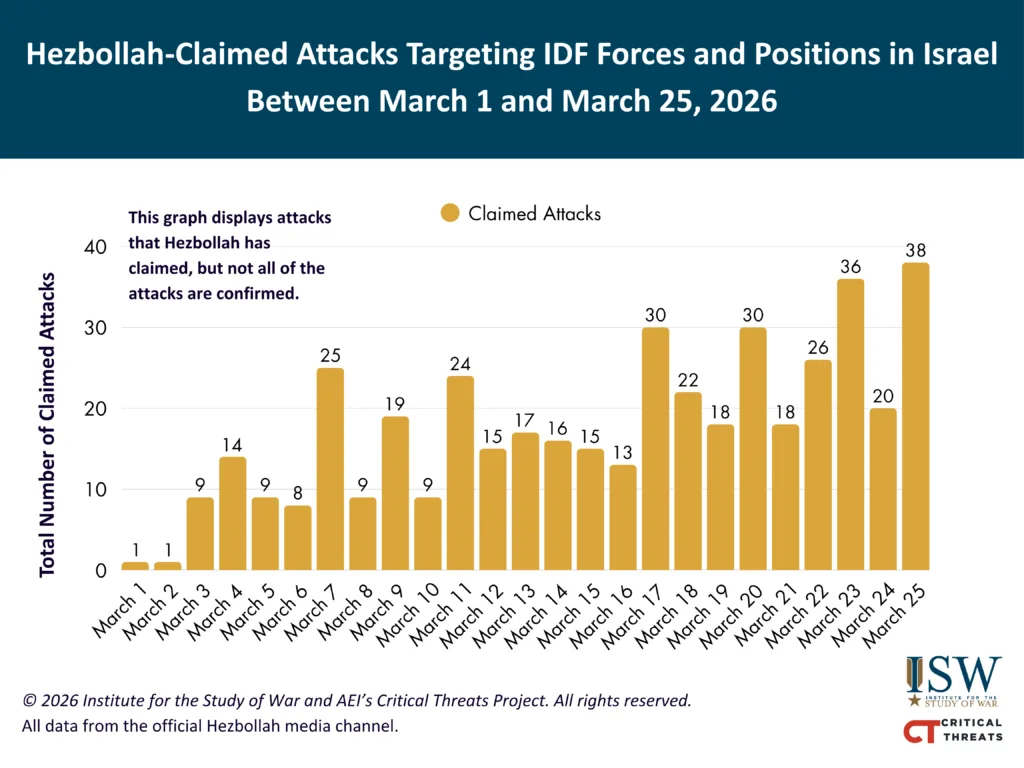
Hezbollah may be pursuing a similar strategy through its increasing rocket and drone attacks targeting Israeli towns. Hezbollah is currently conducting a campaign intended to impose costs on Israel for its involvement in the war against Iran and its operations in southern Lebanon. Hezbollah has conducted an increasing number of attacks targeting Israeli forces or positions and Israeli towns since joining the war on March 1 (see graph below). Hezbollah claimed 48 attacks targeting Israeli forces and positions in northern and central Israel on March 26, for example.[19] This marks the highest number of attacks that Hezbollah has claimed in a 24-hour period in the conflict thus far.[20] Hezbollah may be attempting to achieve a similar effect as Iran by sending Israelis to shelters throughout the day and disrupting normal life. Israelis along the northern border are often given 15 seconds of warning or less to take shelter.[21] It is unclear if Hezbollah is coordinating with Iran to achieve this effect. Hezbollah has coordinated its fire with Iran in at least one instance during the war.[22]
Ukraine and Saudi Arabia concluded a defense cooperation agreement on March 27. The Ukrainian Presidential Office reported that Ukraine will help Saudi Arabia with air defenses under the agreement, which also outlines the foundations for further contacts and includes technological cooperation and investments.[28] Ukrainian President Volodymyr Zelensky signed the agreement ahead of further talks with Saudi Crown Prince Mohammad bin Salman al Saud. Zelensky stated that such cooperation can be mutually beneficial as Saudi Arabia has “something that Ukraine is interested in.”[29] Zelensky and al Saud discussed possible energy cooperation. Zelensky also met with Ukrainian military experts who have been supporting air defense operations in Saudi Arabia for over a week (since at least March 20) and discussed additional measures to support Saudi Arabia's air defense operations.[30] ISW continues to assess that Ukraine can offer the United States and US allies in the Middle East unique insights into how to counter Iranian strikes, as the Ukrainian military has institutionalized and operationalized the fighting experience that Ukraine has learned throughout the past four years of war.[31]
The combined force struck several Iranian steel plants on March 27. The IDF struck the Mobarekeh Steel Company south of Mobarekeh, Esfahan Province, and the Khuzestan Steel Company near Ahvaz, Khuzestan Province.[59] An Israeli military correspondent reported that the Mobarekeh and Khuzestan steel factories are partially owned by the IRGC and that Israeli Prime Minister Benjamin Netanyahu and Israeli Defense Minister Israel Katz ordered the strikes on the factories.[60] The United States sanctioned Mobarakeh Steel Company in 2018 for providing material support to an IRGC-affiliated organization.[61] The correspondent added that the strikes on the factories are “expected to cause major damage” to the Iranian economy.[62] Iranian Foreign Affairs Minister Abbas Araghchi warned that Iran will exact a “heavy price” for the IDF’s strikes on the Mobarekeh and Khuzestan steel factories.[63] The combined force also reportedly struck the Saba Steel Plant near Zarrinshahr, Esfahan Province.[64]
https://understandingwar.org/research/middle-east/iran-update-special-report-march-27-2026/
The Houthis conducted a ballistic missile attack and a drone and cruise missile attack targeting southern Israel on March 27 and 28, marking the group's first involvement in the war.[1] Israeli air defense systems intercepted both attacks, and neither attack caused any injuries.[2] Israeli air defense systems intercepted a Houthi drone over Eilat in southern Israel. Houthi spokesperson Yahya Saree claimed that the Houthis launched a barrage of ballistic missiles targeting “sensitive” Israeli military sites in southern Israel and a barrage of drones and cruise missiles targeting “vital and military sites” in southern Israel.[3] The spokesperson stated that the Houthis will continue to conduct unspecified operations until the United States and Israel cease their operations against Iran and the Axis of Resistance.[4] The Houthis repeatedly conducted drone and missile attacks targeting Israel and international shipping during the October 7 War.[5] The Houthis launched multiple drone and missile attacks targeting Israel during the 12-Day War in June 2025.[6] ISW-CTP has not recorded any Houthi attacks on international shipping since September 2025.[7] The Houthis’ decision, as of now, to participate in the war by conducting drone and missile attacks against Israel instead of attacking international shipping suggests that the Houthis may be pursuing a relatively cautious approach designed to avoid an immediate escalation with the United States and Israel.
Iranian Supreme Leader Mojtaba Khamenei’s Telegram channel published an infographic about the regime's long‑standing concept of a “resistance economy” on March 28.[8] The publication of this type of infographic is disconnected from the present economic and social realities, particularly amid the ongoing military conflict. The infographic explained the “path to defeating the enemy in the economic war,” and emphasized the themes of national unity and sanctions evasion.[9] Mojtaba recently declared ”resistance economy in the shadow of national unity and national security” as Iran's Nowruz slogan.[10] Mojtaba’s predecessor and father, Ali Khamenei, had for years called for the development of a “resistance economy” to resist Western economic pressure, particularly international sanctions.[11] The publication of this infographic may reflect an effort to project normalcy and portray Mojtaba as a conventional Supreme Leader, particularly around Nowruz, when it is customary for the Supreme Leader to highlight his chosen Nowruz slogan. The publication of this infographic may also reflect an effort to portray Mojtaba as an active leader amid reports that he is seriously wounded.[12]
Iran and Russia have held “very active” discussions in March about transferring a limited shipment of “upgraded” Russian drones to Iran, according to US and European officials speaking to the Associated Press.[13] An unspecified US defense official stated that the scale, frequency, and transport method of the potential shipment remain unclear.[14] The United Kingdom's latest intelligence assessment indicates that Russia has already provided Iran with drone‑related training, intelligence, and electronic warfare support.[15] This report follows a March 25Financial Times report, citing Western intelligence, that Russia is close to completing a phased delivery to Iran of unspecified drones alongside food and medicine.[16] The Financial Times reported that officials said that Russia is likely only able to supply Iran with systems such as Geran‑2 drones and denied Iran's request for S‑400 air defense systems.[17] Israeli media separately reported on March 19 that Russia had begun providing Iran with modified Shahed drone components and satellite imagery to support Iranian strikes in the region.[18] Ukrainian President Volodymyr Zelensky told CNN on March 15 that Russia had been providing Iran with drones with ”Russian details.“[19] Russia began domestically producing Shahed drones in 2023 and has adapted them to increase their firepower and defensive capabilities.[20] These adaptations include equipping Shaheds with Verba shoulder‑fired man-portable air-defense systems (MANPADS) to increase their capacity to target enemy aircraft.[21] Iran recently purchased 500 Verbas and 2,500 9M336 infrared homing missiles from Russia in December 2025, according to the Financial Times in February 2026.[22]
Ukraine continues to conclude bilateral defense cooperation agreements with Gulf states. Ukrainian President Volodymyr Zelensky announced on March 28 that Ukraine and Qatar signed a 10-year defense agreement that includes developing technologies, air defenses, counter-drone measures, military training, experience sharing, cybersecurity, artificial intelligence (AI), and control systems.[23] Zelensky stated that the agreement includes building joint production factories in both Ukraine and Qatar.[24] Zelensky stated that Ukraine will soon conclude a similar agreement with the United Arab Emirates (UAE) but noted that these agreements do not mean that Ukraine is obligated to help defend these states.[25] Ukraine and Saudi Arabia concluded a defense cooperation agreement on March 27.[26] ISW continues to assess that Ukraine can offer the United States and US allies in the Middle East unique insights into how to counter Iranian strikes, as the Ukrainian military has institutionalized and operationalized the fighting experience that Ukraine has learned throughout the past four years of war.[27]
https://understandingwar.org/research/middle-east/iran-update-special-report-march-28-2026/
Disclaimer: Opinions posted on Free Republic are those of the individual posters and do not necessarily represent the opinion of Free Republic or its management. All materials posted herein are protected by copyright law and the exemption for fair use of copyrighted works.
