Iran Update Special Report, March 25, 2026
The United States presented a 15-point proposal to Iran via Pakistan on March 24.[1] Pakistani Army Commander Asim Munir, who has reportedly served as the “key interlocutor” between the United States and Iran, delivered the proposal to Iran.[2] Munir also contacted Iranian Parliament Speaker Mohammad Bagher Ghalibaf and offered to host talks between the United States and Iran.[3] The 15-point proposal reportedly includes provisions requiring Iran to dismantle its nuclear program, end uranium enrichment, hand over its enriched uranium stockpile, grant full International Atomic Energy Agency (IAEA) access to Iranian nuclear facilities, limit its missile capabilities, cease support for the Axis of Resistance, and ensure freedom of navigation through the Strait of Hormuz.[4] Three unspecified sources familiar with the details of the proposal told Israeli media on March 24 that US Special Envoy to the Middle East Steve Witkoff and Jared Kushner are trying to establish a month-long ceasefire during which the United States and Iran would negotiate the 15-point proposal.[5] Iran separately proposed five conditions for a ceasefire, including the complete cessation of US and Israeli attacks, establishment of a mechanism to prevent renewed conflict, compensation for wartime damages, an end to attacks on the Axis of Resistance, and international recognition of Iran's authority over the Strait of Hormuz.[6] Unspecified Iranian officials told Iranian media that no direct negotiations are currently taking place between the United States and Iran and that Iran will set the timing and conditions for ending the war.[7] An Axios correspondent reported on March 25 that the Trump administration has not yet received a formal Iranian response to the US proposal for negotiations, citing an unspecified US official.[8] The White House threatened on March 25 to conduct further military action against Iran if the regime does not agree to a deal to end the conflict.[9]
A longtime observer of drone operations suggested on March 25 that drone footage posted by the Islamic Resistance in Iraq on March 24 is consistent with a fiber-optic first-person view (FPV) drone.[10] ISW-CTP is unable to authenticate the Islamic Resistance in Iraq's video, however. The Islamic Resistance in Iraq, which is a coalition of Iranian-backed Iraqi militias, claimed that it attacked the former US Victory Base at Baghdad International Airport and posted drone footage of the attack.[11] The United States transferred control of the Victory Base to the Iraqi federal government in 2011, but Iranian-backed Iraqi militias have continuously claimed attacks targeting the base since the start of the war.[12] The drone footage shows that the Islamic Resistance in Iraq targeted a helicopter and a US radar system.[13] ISW-CTP has not observed any evidence to support the Islamic Resistance in Iraq's claim that it attacked the Victory Base around March 24. Iraqi media reported two separate drone attacks targeting Baghdad International Airport on March 22 but did not provide enough information for ISW-CTP to assess whether the video that the Islamic Resistance in Iraq posted on March 24 was from one of those attacks.[14] Likely Iranian-backed Iraqi militia front group Saraya Awliya al Dam posted footage on March 17 that open-source intelligence (OSINT) analysts also assessed to be from a fiber-optic FPV reconnaissance drone flying inside the parameter of the US Embassy in Baghdad.[15] ISW-CTP assessed on March 17 that the group's decision to advertise its possession of such a weapon represented a threat aimed at the United States.[16]
If the Islamic Resistance in Iraq's video is authentic, Iran's ability to manufacture and operate fiber-optic FPV drones and transfer this technology to its regional proxies and partners would pose a significant challenge to US interests in the Middle East. Fiber-optic FPV drones are immune to jamming and can be used for intelligence, surveillance, and reconnaissance, or outfitted with strike capabilities to conduct precise targeting.[17] The drones have small ranges and generally carry small payloads but can impose financial costs when used to target expensive assets.[18] Russia and Ukraine have extensively used FPV drones in their war.[19] Russia has given drone components to Iran, and Iran reportedly possesses FPV drones, but it had been unclear until this point that Iran had begun to transfer this technology to its partners in Iraq.[20]
Iran sent a letter to International Maritime Organization member states on March 22 stating that “non-hostile” ships can pass through the Strait of Hormuz if they coordinate with Iran, according to the Financial Times.[21] Ships associated with the United States, Israel, or other “participants in the aggression” are not eligible for safe passage. This report is consistent with reports that at least 26 vessels have taken an Iranian-approved route through the Strait of Hormuz as of March 25.[22] Iran has reportedly required some of these vessels to pay a fee to transit the strait. Maritime intelligence firm Lloyd's List, citing three sources with direct knowledge of the new system, reported that vessel operators are required to contact intermediaries with connections to the Islamic Revolutionary Guard Corps (IRGC) before transiting through the strait.[23] Lloyd's List reported that 92 percent of the current traffic in the strait is comprised of Iranian (67 percent), Greek (15 percent), and Chinese (10 percent) vessels.[24]
The Wall Street Journal confirmed on March 24 that Israeli strikes on a major Caspian Sea port in northern Iran last week targeted Russian support for Iran in the ongoing war, according to unspecified people familiar with the matter.[25] This report is consistent with ISW-CTP’s previous reporting that the IDF struck a Caspian Sea port that Iran uses to trade both military and non-military goods with Russia.[26] The IDF targeted “dozens” of vessels, a command center, and a shipyard at Bandar Anzali Port, Gilan Province, on March 18.[27] The Israeli strike on the port followed reports that Russia has provided Iran with satellite imagery and Shahed drones since the war began.[28] Israeli media reported on March 19 that the Israeli strikes in Bandar Anzali “shut down” a critical supply line between Iran and Russia for both basic goods, such as wheat imports, and military equipment.[29] TheWall Street Journal added on March 24 that Russia uses the Caspian Sea to receive Iranian Shahed drones as well as artillery shells and other ammunition to resupply its troops on the front lines with Ukraine.[30] More than 300,000 artillery shells and a million rounds of ammunition were shipped from Iran to Russia in 2023 via the Caspian Sea, according to unspecified documents seen by the Wall Street Journal.
ISW-CTP has recorded an uptick in combined force strikes targeting Iranian defense industrial sites since its last data cutoff. This uptick comes amid a report that Israeli Prime Minister Benjamin Netanyahu ordered the IDF to destroy as much of Iran's arms industry as possible over the next 48 hours.[42] The New York Times reported on March 25 that Netanyahu ordered the IDF to maximize its destruction of Iran's arms industry over the next 48 hours, citing two senior Israeli officials.[43] The IDF reported that it struck two facilities in Tehran where Iran manufactured naval cruise missiles.[44] One strike targeted a building in the Shiyan neighborhood in eastern Tehran, while the other targeted the Shahid Motahari Applied Scientific Education Center in Imam Khomeini Town, northeastern Tehran.[45] The IDF said on March 25 that it also struck an air and naval weapons production site near Vandar, Ghazvin Province.[46] The IDF separately said on March 25 that it struck the Underwater Military Equipment Research and Development Center in northern Esfahan City, which is responsible for designing and developing submarines and support systems.[47] The IDF said that the facility is the only site in Iran responsible for developing submarines and auxiliary systems.[48] The submarine facility is located next to the Defense Industries Organization-affiliated Malek Ashtar University of Technology in Shahin Shahr, Esfahan Province, which the combined force struck on March 24.[49] These IDF strikes are consistent with the combined force's effort to degrade Iran's ability to threaten shipping in the Persian Gulf and Strait of Hormuz.
The combined force has continued to target IRGC commanders. IRGC-affiliated media reported on March 23 that the combined force killed IRGC 1st Naval District Commander Mosayeb Bakhtiari.[62] The combined force reportedly killed Bakhtiari in a strike in Bandar Abbas, Hormozgan Province.[63] The combined force has repeatedly struck Iranian naval facilities at the Bandar Abbas Port, which houses the IRGC Navy 1st Naval District and IRGC Navy Headquarters.[64] Iranian media also announced the death of the IRGC Ground Forces 41st Sarallah Division Commander Amir Mohammadi.[65] The combined force reportedly targeted the 41st Sarallah Division headquarters in Kerman City, Kerman Province, on March 20.[66] IRGC-affiliated media also confirmed on March 16 that IRGC commander Javad Bagheri was killed in combined force strikes.[67] Bagheri is the brother of former Armed Forces General Staff Chief Major General Mohammad Bagheri, whom Israel killed during the 12-Day War.[68]
The International Atomic Energy Agency (IAEA) confirmed that the Bushehr Nuclear Power Plant did not sustain damage after a projectile landed on the facility's premises. Iran notified the IAEA that an unspecified projectile landed in the Bushehr Nuclear Power Plant facility's premises on March 24.[69] Iran previously notified the IAEA of a “projectile incident” near the plant on March 17 that also caused no damage.[70] The Institute for Science and International Security identified an impact crater about 350 meters from the power plant's reactor in March 18 satellite imagery.[71] Rosatom reportedly evacuated 163 Russian technicians from the Bushehr Nuclear Power Plant on March 24.[72] Rosatom Director General Alexei Likhachev said that 300 Russian technicians currently remain at the power plant.[73] Likhachev stated that more Russian technicians will evacuate the plant in the future.[74] No technicians were injured in the March 17 and 24 incidents.
Iran continued to target Saudi Arabia, Bahrain, Kuwait, and the United Arab Emirates (UAE) on March 25. Two unspecified sources told Israeli media on March 22 that Iran had decided to limit its attacks on Saudi Arabia due to concerns that continued strikes could trigger a direct Saudi military response.[84] The rate of Iranian attacks on Saudi Arabia has fluctuated since then, however. Iran launched 7 drones at Saudi Arabia on March 22, 47 drones on March 23, 32 drones on March 24, and 6 drones on March 25.[85] Iran separately fired nine drones and 20 ballistic missiles targeting Kuwait on March 25.[86] One of the Iranian drones struck a fuel tank at the Kuwait International Airport in Kuwait City.[87] Iran launched thirty drones targeting Bahrain on March 25.[88] ISW-CTP previously noted that Iran may be increasing drone attacks against Bahrain to compensate for an apparent pause in drone attacks against Qatar. Iran also launched nine drones targeting the UAE on March 25.[89]
https://understandingwar.org/research/middle-east/iran-update-special-report-march-25-2026/
1,853 posted on
03/26/2026 3:31:52 AM PDT by
AdmSmith
(GCTGATATGTCTATGATTACTCAT)
1,854 posted on
03/26/2026 3:33:56 AM PDT by
AdmSmith
(GCTGATATGTCTATGATTACTCAT)
To: nuconvert; BeauBo; gleeaikin
Iran Update Special Report, March 26, 2026
US Central Command (CENTCOM) Commander Admiral Brad Cooper said on March 25 that the combined force has struck over 10,000 sites across Iran since the war began.[9] The combined force has concentrated strikes around Tehran as well as western and central Iran.[10]
The IDF has continued targeting senior Iranian commanders to disrupt Iranian command and control and operations broadly. The IDF announced on March 26 that it killed Islamic Revolutionary Guards Corps (IRGC) Navy Commander Rear Admiral Alireza Tangsiri in Bandar Abbas, Hormozgan Province.[11] Tangsiri had served as IRGC Navy commander since August 2018.[12] Tangsiri previously served as IRGC Navy deputy commander from 2010 to 2018 and the Bandar Abbas-based IRGC 1st Saheb ol Zaman Naval District commander.[13] The Saheb ol Zaman Naval District has the central mission of controlling the Strait of Hormuz.[14] Its area of operations includes the IRGC Navy headquarters and command center as well as the 2nd Imam Sajjad Special Forces Brigade, the 16th Assef Coastal Missile Group, the 112th Zolfaghar Surface Combat Brigade, and underground fortifications on Abu Musa.[15] The IDF also killed IRGC Navy Intelligence Deputy Behnam Rezaei in Bandar Abbas, Hormozgan Province.[16] Rezaei reportedly was responsible for regional intelligence collection and coordination.[17] Tangsiri oversaw IRGC Navy operations, including attacks on international shipping and threats to US forces in the region.[18] The United States sanctioned Tangsiri in June 2019 for acting on behalf of the IRGC and his role in threatening to close the Strait of Hormuz and overseeing IRGC Navy activities responsible for the sabotage of vessels in international waters.[19]
The IRGC has reportedly continued to consolidate power within the Iranian regime and play an increasingly central role in key leadership decisions. Anti-regime media reported on March 26 that the IRGC pressured Iranian President Masoud Pezeshkian to appoint Mohammad Bagher Zolghadr as the Supreme National Security Council (SNSC) secretary, citing unspecified sources.[20] Zolghadr is a hardline figure with deep ties to Iranian military and judicial establishments.[21] The sources said that IRGC Commander Brigadier General Ahmad Vahidi was among the IRGC officers who pressured Pezeshkian.[22] The sources also said that there are no clear signs that Supreme Leader Mojtaba Khamenei influenced the decision to appoint Zolghadr, raising continued questions about how involved Mojtaba is in key decisions.[23] The sources added that Pezeshkian and other senior officials opposed Zolghadr’s appointment.[24] The reported IRGC role in Zolghadr’s appointment comes after a small group of IRGC officer intervened aggressively in the supreme leader succession process to ensure that Mojtaba replaced his father.[25] Statements from US and Israeli security officials indicate that this group of IRGC officers have gained significant influence since Mojtaba became supreme leader.[26]
An IRGC cultural official told state media that the IRGC has lowered the minimum recruitment age to 12.[27] This decision follows reports that the IRGC is facing difficulties with recruiting new personnel and managing broader operational disruptions. The official said that the IRGC is recruiting individuals to support patrols, checkpoints, and logistics.[28] Unspecified informed sources told anti-regime media on March 12 that IRGC efforts to mobilize reserve forces failed because many individuals did not report to military centers.[29] CTP-ISW assessed on March 19 that Israeli strikes on Iranian internal security forces, including decapitation strikes, have likely caused shock and confusion within the internal security apparatus and disrupted operations to some extent.[30]
Reuters reported on March 26 that Iranian hardliners have intensified calls to develop a nuclear weapon, citing unspecified sources in Iran.[31] Some hardliners have urged Iranian leadership to revise the nuclear doctrine, meaning pursue a nuclear weapon, to restore deterrence since October 2024. Iranian parliamentarians signed separate letters in October 2024—after the April and October Iranian missile attacks on Israel—and in September 2025—after the June 2025 Israel-Iran war—urging a revision of Iranian defensive doctrine.[32] They called on the SNSC to authorize and support nuclear weapons production.
IRGC-affiliated Tasnim News Agency published an op-ed on March 26 that urged Iran to withdraw from the Nuclear Non-Proliferation Treaty (NPT).[33] The Tasnim op-ed emphasized that Iran is committed to a peaceful nuclear program, however.[34] Iranian officials have threatened to withdraw from the NPT previously to deter Western action against Iran.[35]
Iranian state media reported that Iran officially sent its response rejecting the 15-point US proposal and is awaiting the US response.[36] The United States presented the proposal to Iran via Pakistan on March 24.[37] The proposal reportedly includes provisions requiring Iran to dismantle its nuclear program, end uranium enrichment, hand over its enriched uranium stockpile, grant full International Atomic Energy Agency (IAEA) access to Iranian nuclear facilities, limit its missile capabilities, cease support for the Axis of Resistance, and ensure freedom of navigation through the Strait of Hormuz.[38] The informed source added that Iran's response reiterated its demands for a ceasefire which include the complete cessation of US and Israeli attacks, the establishment of a mechanism to prevent renewed conflict, compensation for wartime damages, an end to attacks on the Axis of Resistance, and international recognition of Iran's “sovereignty” over the Strait of Hormuz.[39] A senior Iranian official speaking to Reuters confirmed that unspecified senior Iranian officials and a representative of Iranian Supreme Leader Mojtaba Khamenei reviewed the US proposal.[40] The senior Iranian official added that the proposal asks Iran to forgo its ability to defend itself in turn for a promise to lift sanctions.[41] The official reiterated that the United States and Iran have not arranged negotiations and that negotiations do not seem realistic at this stage of the conflict.[42]
Russia continues to expand its military cooperation with Iran to facilitate Iranian strikes on US and Israeli forces in the Middle East. The Financial Times (FT) reported on March 25, citing Western intelligence reports, that Russia is close to completing a phased shipment of unspecified drones, medicine, and food to Iran.[43] Two officials briefed on the intelligence told FT that Russia and Iran began discussing drone delivering soon after the US-Israeli campaign began and that subsequent deliveries processing started in early March. The officials stated that they expect Russia to complete the deliveries by the end of March. A Western security official told FT that the specific drone type that Russia agreed to send to Iran is unclear, but that Russia is likely only in a position to deliver models such as the Geran-2. Current and former Western officials told FT that Russia denied Iran's request for S-400 air defense systems. Russia has reportedly already been providing Iran with modified Shahed drone components and satellite imagery to assist recent Iranian strikes on US forces in the Middle East and US allies in the region.[44] ISW continues to assess that Russia sees aiding Iran's strike campaign as an effort to weaken the United States, as Russia has self-defined the United States as one of its primary geopolitical adversaries.[45]
The combined force continued to strike Iranian repressive institutions as part of the broader combined effort to degrade the regime's coercive capacity. The combined force reportedly hit the IRGC Ground Forces Ansar ol Hossein Provincial Unit in Hamedan City, Hamedan Province.[58] The IRGC Ground Forces plays a significant role in countering internal threats, including by violently suppressing protest activity.[59] The provincial units oversee IRGC ground elements that are largely dispersed across population centers.[60] The combined force previously struck Law Enforcement Command (LEC) sites in Hamedan City.[61] The LEC is Iran's national police force and the regime's first line of defense during civil unrest.[62] The IDF struck an IRGC headquarters around Bonab, East Azerbaijan Province.[63] The combined force previously struck an LEC building in Bonab.[64]
Iran is reportedly reinforcing defenses at Kharg Island.[74] Unspecified sources familiar with US intelligence reports told CNN on March 26 that Iran has reinforced Kharg Island with man-portable air-defense systems (MANPADS) in recent weeks.[75] Iran primarily operates domestically produced Misagh MANPAD, a variant of the Chinese QW-2 Vanguard missile system.[76] Iran recently signed an arms deal with Russia in December 2025 to acquire 500 Russian Verba MANPADS, but it is unclear if Russia delivered any before the start of the war.[77] The source added that Iran has also laid anti-personnel and anti-armor mines around the island, including on the shoreline.[78]
Iran continued to fire at Saudi Arabia, Bahrain, Kuwait, and the United Arab Emirates on March 26. Iran launched 37 drones at Saudi Arabia between 2:00 PM on March 25 and 2:00 PM on March 26.[81] Iran launched 19 drones and one missile at Bahrain.[82] Iran launched one drone and six ballistic missiles at Kuwait.[83] The Kuwaiti Army reported that the six missiles landed in open areas.[84] The Emirati Defense Ministry stated that it intercepted 11 Iranian drones and 15 missiles.[85]
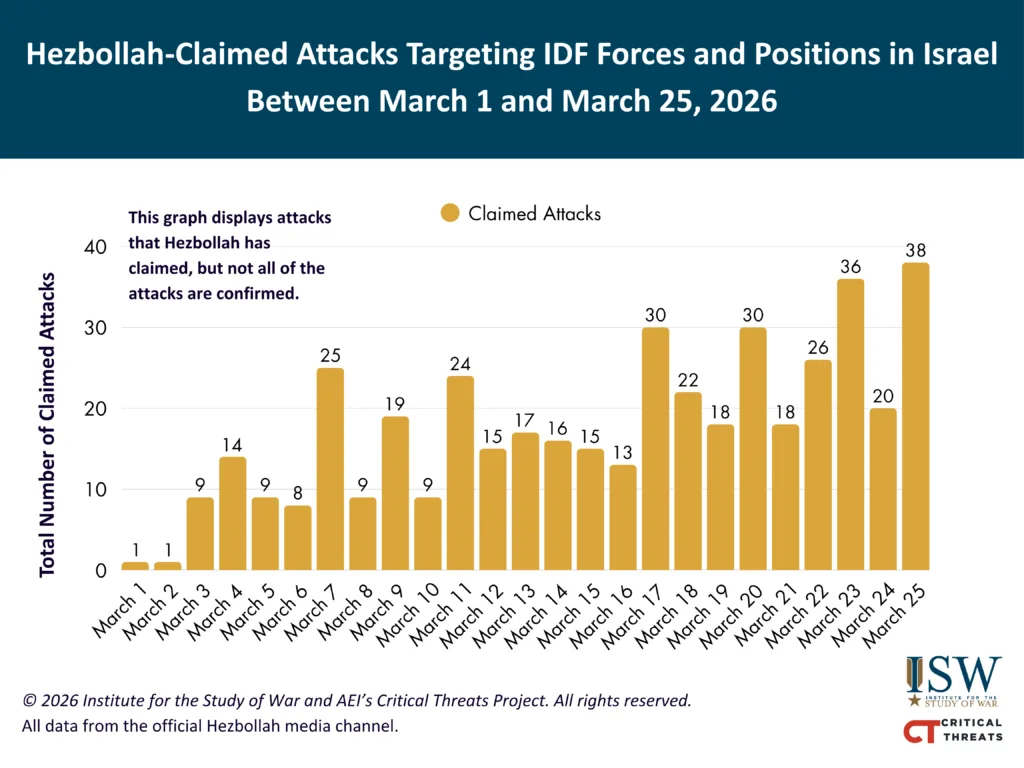
more + maps: https://understandingwar.org/research/middle-east/iran-update-special-report-march-26-2026/
1,856 posted on
03/27/2026 12:09:37 AM PDT by
AdmSmith
(GCTGATATGTCTATGATTACTCAT)
FreeRepublic.com is powered by software copyright 2000-2008 John Robinson