Skip to comments.
Iranian Regime tv Channel One hacked while it was airing Khamenie speech
various
| 10-8-22
Posted on 10/08/2022 1:05:38 PM PDT by nuconvert
Iranian Regime national tv Channel One hacked about an hour ago. During a broadcast of Khamenie speech, a red crosshair appeared over his face and chanting of Women. Life. Freedom. There was writing to the side saying "Rise up. Join us". Also 4 photos at the bottom of the screen of young people killed and additional writing: "The blood of our youth is dropping from your paws".
Also, there was a huge banner in the middle of Tehran highway today that read: We are no longer afraid of you. We will fight.
Also, attempted attack on IRI ambassador in Denmark. Her bodyguard was stabbed. Diplomatic Security intervened before the attacker could stab the ambassador.
TOPICS:
KEYWORDS: basij; deathtothemullahs; denmark; ebrahimrigi; erdogan; iran; iranprotests; iraq; irgc; iri; israel; khameini; khamenei; kurdistan; lebanon; mahsaamini; mullahloversonfr; mullahsmustbekilled; najisharifizindashti; protests; qudsforce; raisi; receptayyiperdogan; shahrammaroufmola; syria; turkey; yemen; zahedi
Navigation: use the links below to view more comments.
first previous 1-20 ... 1,141-1,160, 1,161-1,180, 1,181-1,200 ... 2,401-2,416 next last
1,161
posted on
11/19/2024 1:33:08 AM PST
by
AdmSmith
(GCTGATATGTCTATGATTACTCAT)
Iran Update, November 19, 2024
The International Atomic Energy Agency (IAEA) told IAEA member states on November 19 that Iran has offered to limit its stockpile of uranium enriched up to 60% if the E3 (the United Kingdom, France, and Germany) abandon their resolution against Iran’s nuclear program at the IAEA Board of Governors meeting this week.[77] An unspecified senior diplomat said that Iran has offered to cap its stockpile of uranium enriched up to 60% at around 185 kg. The IAEA reported that Iran has 182.3 kg of uranium enriched up to 60% as of October 26.[78] The E3 resolution would require the IAEA to produce a “comprehensive report” on Iranian nuclear activities that would almost certainly confirm Iranian non-compliance with the Joint Comprehensive Plan of Action and lay the foundation for the E3 to reimpose UN Security Council sanctions on Iran, known as “snapback” sanctions.[79] CTP-ISW will provide further details on the IAEA Board of Governors meeting and Iran’s nuclear activities in the update on November 20.
https://www.understandingwar.org/backgrounder/iran-update-november-19-2024
1,162
posted on
11/19/2024 10:58:01 PM PST
by
AdmSmith
(GCTGATATGTCTATGATTACTCAT)
China's crude import from Malaysia in hit 1.78mbpd in October while imports from #Iran and #Venezuela were reported unchanged at 0 in the data of the customs office (Note: Malaysia crude production is around 0.5mbpd)
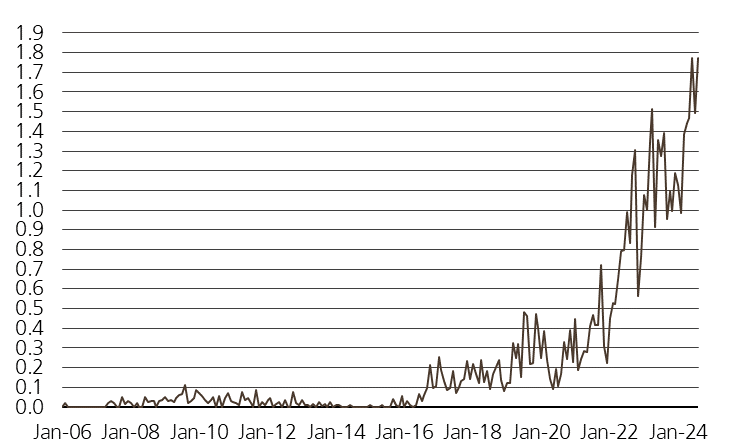
https://x.com/staunovo/status/1859131282652819900
Bloomberg The Clandestine Oil Shipping Hub Funneling Iranian Crude to China
A burgeoning group of dark fleet vessels operating with impunity on the edge of a major maritime thoroughfare is moving hundreds of millions of barrels of sanctioned oil — and risking an environmental catastrophe.
Forty miles east of the Malaysian peninsula sits the world's largest gathering point for dark fleet tankers. Aging ships, often operating under flags of convenience and without insurance, come here daily to transfer cargo away from prying eyes. It's how billions of dollars of sanctioned Iranian oil finds its way to China annually — even though the country, officially, hasn't imported a drop in more than two years.
A Bloomberg analysis of nearly five years of satellite images from the hotspot shows the vast size of the shadow industry that's developed as the US has tightened its sanctions on Iran.
https://www.bloomberg.com/graphics/2024-iran-south-china-sea-oil-trade/
1,163
posted on
11/19/2024 11:13:09 PM PST
by
AdmSmith
(GCTGATATGTCTATGATTACTCAT)
Iran Update, November 20, 2024
The United States and E3 (the United Kingdom, France, and Germany) submitted a censure resolution against Iran to the International Atomic Energy Agency (IAEA) Board of Governors on November 19 in response to Iran not fully cooperating with the IAEA.[23] The IAEA Board of Governors is expected to vote on the resolution on November 21.[24] The proposed censure resolution comes after the IAEA issued a report on November 19 showing that Iran has increased its stockpile of highly enriched uranium since August 2024.[25] The IAEA reported that Iran possessed 182.3 kilograms of uranium enriched up to 60 percent as of late October 2024.[26] This amount marks a 17.6 kilogram increase in the Iranian stockpile of uranium enriched up to 60 percent since August 2024.[27] The IAEA added that Iran possessed a total of 6,604.4 kilograms of enriched uranium, which marks an 852.6 kilogram increase in the Iranian total enriched uranium stockpile since August 2024.[28] A US weapons expert reported on November 19 that Iran’s breakout timelines have thus reduced significantly since August 2024.[29] The expert stated that Iran can make enough weapons-grade uranium, which is uranium that is enriched to 90 percent purity, to produce almost 10 nuclear weapons in a month, 13 in two months, 14 in three months, 15 in four months, and 16 in five months.[30]
Iran is trying to prevent the IAEA Board of Governors from approving the censure resolution by offering to cap its stockpile of uranium enriched up to 60 percent and threatening unspecified consequences if the IAEA censures Iran. Iran offered to cap its stockpile of uranium enriched up to 60 percent at 185 kilograms in exchange for the IAEA rejecting the censure resolution.[31] Iran notably did not offer to reduce the amount of 60 percent enriched uranium that it currently possesses but instead only offered to not further increase its 60 percent enriched uranium stockpile. 185 kilograms of 60 percent enriched uranium is enough uranium, if enriched further, to produce four nuclear weapons.[32] Senior Iranian officials, including Foreign Affairs Minister Abbas Araghchi, have warned that Iran will respond “appropriately and proportionately” if the IAEA censures Iran.[33] An Iranian outlet claimed on November 19 that Iran could retaliate by activating a “significant number” of advanced centrifuges.[34] The outlet may have been referring to the IR-6 centrifuges that Iran has installed at Fordow in recent months.[35] The IAEA confirmed in August 2024 that Iran installed eight cascades of IR-6 centrifuges at Fordow but that the centrifuges were not yet operational.[36] Iran previously installed new centrifuges at its nuclear facilities at Natanz and Fordow in response to an IAEA censure resolution in June 2024.[37]
https://www.understandingwar.org/backgrounder/iran-update-november-20-2024
1,164
posted on
11/21/2024 12:39:57 PM PST
by
AdmSmith
(GCTGATATGTCTATGATTACTCAT)
Iran Update, November 20, 2024
The International Atomic Energy Agency (IAEA) Board of Governors passed the E3 (the United Kingdom, France, and Germany) censure resolution against Iran on November 21.[1] The resolution censured Iran for failing to cooperate with the IAEA and comply with the Nuclear Nonproliferation Treaty.[2] The resolution requires that the IAEA to produce a “comprehensive report” on Iranian nuclear activities by spring 2025.[3] CTP-ISW previously assessed that the report would almost certainly confirm Iranian noncompliance with the 2015 Joint Comprehensive Plan of Action (JCPOA) and lay the foundation for the E3 to reimpose UN Security Council sanctions on Iran—known as “snapback” sanctions.[4] The censure resolution comes after the IAEA issued a report on November 19 showing that Iran has increased its stockpile of highly enriched uranium since August 2024.[5] The Atomic Energy Organization of Iran (AEOI) Director Mohammad Eslami responded to the censure resolution by ordering the activation of a ”large collection of new and advanced centrifuges of various types.”[6] The AEOI stated that Iran will continue to cooperate with the IAEA, though it remains unclear to what extent. CTP-ISW will provide further assessments and details in the coming days.
The United States and E3 (the United Kingdom, France, and Germany), prior to the IAEA Board of Governors vote on the censure resolution, called on Iran to “immediately dispose” of its highly enriched uranium stockpile on November 21. US Ambassador to the IAEA Laura Holgate said that Iran should stop producing uranium enriched up to 60 percent and “downblend its 60 percent [enriched uranium] stockpile entirely.”[7] Downblending is the process of converting highly enriched uranium into low-enriched uranium.[8] The E3 issued a joint statement similarly requesting that Iran “immediately dispose of its high enriched uranium stockpile.”[9] Iran previously offered to cap its stockpile of uranium enriched up to 60 percent at 185 kilograms in exchange for the IAEA Board of Governors rejecting the censure resolution.[10] The E3 stated that a cap of 185 kilograms would mean Iran still “retain[s] an excessively large stockpile of high enriched uranium as well the capability to resume enrichment to 60 percent at any point,” however.[11] 185 kilograms of 60-percent enriched uranium is enough, if enriched further, to produce four nuclear weapons.[12]
https://www.understandingwar.org/backgrounder/iran-update-november-21-2024
1,165
posted on
11/22/2024 7:02:19 AM PST
by
AdmSmith
(GCTGATATGTCTATGATTACTCAT)
Iran Update, November 22, 2024
Iran is activating a “substantial number” of advanced centrifuges, increasing the rate of Iranian uranium enrichment.[1] Iran is responding to the International Atomic Energy Agency (IAEA) Board of Governors passing a censure resolution submitted by the E3 (the United Kingdom, France, and Germany) on November 21.[2] The resolution condemns Iran for failing to fully cooperate with the IAEA.[3] Atomic Energy Organization of Iran Spokesperson Behrouz Kamalvandi said on November 22 that Iran will “significantly increase” its uranium enrichment capacity in response.[4] Iran could activate some of the IR-6 or IR-2m centrifuges that it has installed at the Fordow and Natanz nuclear facilities, respectively, in recent months. The IAEA confirmed in August 2024 that Iran had installed but not yet activated eight cascades of IR-6 centrifuges at Fordow.[5] The IAEA also confirmed in August 2024 that Iran had installed 10 cascades of IR-2m centrifuges at Natanz.[6] Iran has installed six additional cascades of IR-2m centrifuges at Natanz since August 2024, bringing the total number of cascades of IR-2m centrifuges at Natanz to 37.[7] Only 15 out of these 37 cascades had been activated as of November 2024.[8] Iran currently has around 182.3 kilograms of uranium enriched up to 60 percent, which is enough uranium, if enriched further, to produce four nuclear weapons.[9]
Lead Iranian nuclear negotiator Kazem Gharib Abadi threatened on November 22 that Iran would withdraw from the Treaty on the Non-Proliferation of Nuclear Weapons (NPT) if the E3 triggers the “snapback” mechanism in the 2015 Joint Comprehensive Plan of Action (JCPOA). The JCPOA snapback mechanism allows its signatories to reimpose UN Security Council sanctions on Iran in the event of “significant non-performance by Iran of JCPOA commitments.”[10] The E3 censure resolution requires the IAEA to produce a “comprehensive report” on Iranian nuclear activities by spring 2025.[11] CTP-ISW previously assessed that the report would almost certainly confirm Iranian noncompliance with the JCPOA and lay the foundation for the E3 to impose “snapback” sanctions.[12] UK media reported in early November 2024 that the United Kingdom is prepared to trigger snapback sanctions against Iran.[13] Iranian officials have long threatened to withdraw from the NPT, but Gharib Abadi’s warning is noteworthy given the current standoff between Iran and the E3. Gharib Abadi’s warning also comes amid numerous indications that Iran has very likely restarted its nuclear weapons research program.[14]
Iranian Defense and Armed Forces Logistics Minister Brigadier General Aziz Nasir Zadeh and Venezuelan President Nicolas Maduro concluded the 10th Iran-Venezuela Joint Economic Commission in Caracas, Venezuela on November 21.[109] Iranian and Venezuelan officials signed cooperation agreements to enhance trade, industrial projects, and technology transfer.[110] Both sides emphasized joint efforts to resist global hegemony and strengthen economic ties, building on a 20-year partnership agreement signed in June 2022 during Maduro’s visit to Tehran.[111]
https://www.understandingwar.org/backgrounder/iran-update-november-22-2024
1,166
posted on
11/23/2024 12:07:56 AM PST
by
AdmSmith
(GCTGATATGTCTATGATTACTCAT)
Iran Update, November 23, 2024
Iranian media reported that Iran is activating 5,000 centrifuges in response to the censure resolution that the International Atomic Energy Agency (IAEA) Board of Governors passed on November 21.[1] The IAEA Board of Governors censured Iran for failing to fully cooperate with the IAEA. Hardline newspaper Khorasan reported on November 23 that Iran is activating around 5,000 centrifuges, including IR-6, IR-4, and IR-2m centrifuges, by injecting uranium hexafluoride gas (UF6) into them.[2] The IAEA confirmed in August 2024 that Iran had installed but not yet activated eight cascades of IR-6 centrifuges at Fordow.[3] The IAEA also confirmed in August 2024 that Iran had installed 10 cascades of IR-2m centrifuges at Natanz.[4] Iran has installed six additional cascades of IR-2m centrifuges at Natanz since August 2024, bringing the total number of cascades of IR-2m centrifuges at Natanz to 37.[5] Only 15 out of these 37 cascades had been activated as of November 2024.[6] Khorasan reported that activating the 5,000 centrifuges will increase Iranian uranium enrichment at the Natanz and Fordow nuclear facilities to 40,000 separative work units (SWU).[7] SWU measure the effort required to separate U-235 and U-238 isotopes in the uranium enrichment process.[8] Iran currently has a total installed enrichment capacity of around 52,900 SWU per year and an enriching centrifuge capacity of around 31,400 SWU per year, according to the Institute for Science and International Security.[9] Iran currently has around 182.3 kilograms of uranium enriched up to 60 percent, which is enough uranium, if enriched further, to produce four nuclear weapons.[10]
Iranian hardliners are continuing to lobby Supreme Leader Ali Khamenei to revoke his fatwa that prohibits the production and use of nuclear weapons to restore deterrence against Iran's “enemies.” The Pardisan, Qom Province, Friday prayer leader “desperately requested” on November 23 that Khamenei “reconsider” his nuclear fatwa because “[Iran's] enemies have rows of nuclear warheads” and threaten to use nuclear weapons against Iran.[11] The Friday prayer leader argued that possessing nuclear weapons would “bring [Iran] security.”[12] Hardline Parliamentarian Ahmad Bakhshayesh Ardestani separately claimed on November 23 that “a large part” of the Iranian population supports acquiring a nuclear weapon.[13] Ardestani added that possessing a nuclear weapon would increase Iran's “deterrence power.”[14] These statements implicitly acknowledge that the Iranian drone and missile attacks on Israel in April and October 2024 failed to restore deterrence with Israel and that additional drone and missile attacks would similarly fail to restore deterrence. These statements also come amid numerous indications that Iran has very likely restarted its nuclear weapons research program.[15]
The Iranian Parliamentary National Security and Foreign Policy Committee chairman threatened to withdraw from the nuclear weapons Non-Proliferation Treaty (NPT). The chairman, Ebrahim Azizi, threatened on November 23 that Iran would withdraw from the NPT if the United States acted “coercively” against Iran.[16] Azizi likely made this statement after some Trump administration transition officials, including former Special Envoy for Iran Brian Hook, said that the incoming administration will reimpose “maximum pressure” sanctions on Iran.[17] Lead Iranian nuclear negotiator Kazem Gharib Abadi separately threatened on November 22 that Iran would withdraw from the NPT if the E3 (the United Kingdom, Germany, and France) triggers the “snapback” mechanism in the JCPOA.[18] Iranian officials have long threatened to withdraw from the NPT, but these statements are noteworthy given the current standoff between Iran and the West over Iranian nuclear activities.
Iranian-backed militias have attacked US forces 206 times since October 2023, according to the Pentagon.[72] These attacks include 125 attacks targeting US forces in Syria, 79 attacks targeting US forces in Iraq, and two attacks targeting US forces in Jordan. The Pentagon previously announced in January 2024 that Iranian-backed militias had conducted 151 attacks targeting US forces in the Middle East since October 2023.[73] The Quarter 1 2024 Department of Defense Lead Inspector General Report for Operation Inherent Resolve reported that Iranian-backed militias had conducted at least 170 attacks targeting US forces since October 2023.[74]
https://www.understandingwar.org/backgrounder/iran-update-november-23-2024
1,167
posted on
11/24/2024 2:41:37 AM PST
by
AdmSmith
(GCTGATATGTCTATGATTACTCAT)
Iran Update, November 24, 2024
Larijani stated that Iran will not “take any steps” to address the International Atomic Energy Agency’s (IAEA) concerns about Iran’s nuclear program in the recent IAEA censure resolution if there is no compromise with the IAEA.[3] The resolution censured Iran for failing to cooperate with the IAEA and comply with the Nuclear Nonproliferation Treaty.[4] Iran will meet with the E3 countries, the United Kingdom, France, and Germany, for nuclear negotiations in Geneva on November 29.[5] Iranian media reported on November 23 that Iran is activating 5,000 centrifuges in response to the censure resolution, and Iran‘s parliamentary speaker confirmed that Iran activated the centrifuges on November 24.[6] Atomic Energy Organization (AEOI) Spokesperson Behrouz Kamalvandi told Iranian media on November 23 that the AEOI will activate thousands of centrifuges that will increase Iran’s uranium enrichment rate over the next four to six months.[7]
https://www.understandingwar.org/backgrounder/iran-update-november-24-2024
1,168
posted on
11/24/2024 11:23:00 PM PST
by
AdmSmith
(GCTGATATGTCTATGATTACTCAT)
Iran Update, November 25, 2024
Iranian Deputy Foreign Affairs Minister for Political Affairs Majid Takht Ravanchi traveled to Oslo, Norway, on November 25 to discuss bilateral relations and international developments.[58] The Iranian Foreign Affairs Ministry has not provided details about Ravanchi’s visit to Norway but denied that his visit is related to upcoming nuclear talks between Iran and the E3 in Geneva on November 29.[59]
Ravanchi is scheduled to visit Geneva on November 29 to meet with senior E3 (the United Kingdom, France, and Germany) diplomats to discuss Iran’s nuclear program, nuclear negotiations, and recent EU sanctions on Iranian aviation and shipping companies.[60] Ravanchi was part of the Iranian nuclear negotiating team under former President Hassan Rouhani that helped conclude the 2015 nuclear deal.[61] The visit comes after the International Atomic Energy Agency (IAEA) Board of Governors passed the E3 censure resolution against Iran on November 21.[62] Iran is reportedly activating 5,000 centrifuges in response.[63] Iranian media affiliated with Iranian Supreme Leader Adviser Ali Shamkhani criticized the upcoming nuclear negotiations in Geneva as “only for the benefit of Europe.” [64] Shamkhani was an obstacle to reaching the Joint Comprehensive Plan of Action (JCPOA) in 2015 and reviving it after 2018.[65] This suggests ongoing internal divisions within Iranian leadership over Iran’s nuclear doctrine and negotiations.[66]
https://www.understandingwar.org/backgrounder/iran-update-november-25-2024
1,169
posted on
11/26/2024 1:27:43 AM PST
by
AdmSmith
(GCTGATATGTCTATGATTACTCAT)
Iran Update, November 26, 2024
Iran is actively violating the Chemical Weapons Convention (CWC) and continues to advance its ability to develop and deploy its chemical weapons capabilities both inside and outside of Iran. The Institute for Science and International Security (ISIS) published a report on November 26 stating that Iran continues to develop capabilities to produce and deliver pharmaceutical-based chemical agents (PBAs) for offensive purposes.[28] The report cites research conducted from 2005 to 2023 by individuals affiliated with Iran's defense establishment, including the Islamic Revolutionary Guard Corps (IRGC) and the Ministry of Defense. PBAs are dual-purpose chemicals that can be used in medical settings but also be weaponized for offensive purposes.[29] The ISIS report focuses on research on fentanyl and medetomidine, which are both agents capable of incapacitating victims by targeting the central nervous system. ISIS identified Iranian research in three key areas: developing large-scale cost-effective methods to synthesize these compounds, exploring techniques to aerosolize these agents for propellant purposes, and creating delivery systems to disperse the agents through grenades, bullets, and drones.[30] The report noted that Iran could use its drones to deliver ammunition containing PBAs. Iranian media released a video in June 2023 showing a multirotor drone dropping rounds of smoke grenades and a bomb, likely containing tear gas.[31]
Iran can use its PBA weapons program both internally and externally. Iranian media confirmed that Iran extensively used grenades against civilians during the Mahsa Amini protests in 2022.[32] Civilian reports indicated symptoms consistent with both fentanyl and medetomidine exposure, rather than traditional riot control gases. Iran has also likely supplied its partners and proxy groups with weaponized PBAs, which the Axis of Resistance could deploy in future military conflicts.[33] Member states of the Organization for the Prohibition of Chemical Weapons are meeting in The Hague from November 25 to 29 to discuss CWC implementation and treaty compliance.[34]
Prominent Iranian Shia clerics Ahmad Khatami and Hashem Hosseini Bushehri lost their seats on the Supreme Qom Seminary Council.[86] The Supreme Qom Seminary Council is comprised of seven members who are recommended by the Society of Seminary Teachers of Qom and approved by the Supreme Leader.[87] Bushehri is the current head of the Society of Seminary Teachers of Qom and Khatami is a member of this organization.[88] Mahmoud Abdollahi and Mohammad Gharavi replaced Khatami and Bushehri in the Supreme Qom Seminary Council.[89] Khatami previously lost his seat on the Assembly of Experts leadership board in May 2024.[90] Iranian opposition media previously claimed that Khatami lost his seat on the Assembly of Experts leadership border due to his opposition to Supreme Leader Ali Khamenei’s son, Mojtaba Khamenei, who is considered a top contender to become Iran's next supreme leader.[91]
https://www.understandingwar.org/backgrounder/iran-update-november-26-2024
1,170
posted on
11/27/2024 12:26:54 AM PST
by
AdmSmith
(GCTGATATGTCTATGATTACTCAT)
Iran Update, November 27, 2024
Israeli forces interdicted a significant shipment of weapons that Iran sent to Palestinian militias in Jenin in the West Bank.[24] The IDF announced on November 27 that it seized the shipment, which included explosive devices, remote detonators, mortars, rocket-propelled grenades, small arms and sniper rifles, and other military equipment.[25] Israeli media reported that the shipment included three 107-millimeter rockets as well.[26] This shipment is especially noteworthy given that it included weapons, such as mortars and rockets, that are more advanced than what Palestinian militias in the West Bank typically use.[27] CTP-ISW has observed no previous instances of Palestinian militias in the West Bank using rockets since the October 7 War began, though this shipment of only three rockets is relatively minor. The interdiction of this shipment comes as Israel has observed renewed Iranian efforts to smuggle materiel into the West Bank in recent months.[28] Israeli forces thwarted two other weapons smuggling attempts into the West Bank in recent days.[29] Iran may be intensifying its efforts to arm proxy and partner militias in the West Bank to compensate for the defeat of Hamas in the Gaza Strip.
The IDF Air Force struck Hezbollah's largest precision missile production facility in the Bekaa Valley on November 26.[65] Hezbollah manufactured surface-to-surface missiles and weapons components, and stored precision missiles at the underground facility in Janta near the Lebanon-Syria border. The IDF said that the facility was 1.4 km long.[66] The IDF said that Hezbollah used the facility to smuggle fighters and thousands of weapons components from Syria into Lebanon. The IDF said that Hezbollah built the facility with Iranian assistance and that IRGC operatives worked at the site alongside Hezbollah members. The IDF also conducted strikes targeting Hezbollah infrastructure near the production facility, including a training camp for Radwan Force fighters.[67] The IDF began expanding the range of its air campaign into northern and eastern Lebanon, which is where Hezbollah reportedly stores its long-range precision missiles, in late September 2024.[68] The IDF also conducted airstrikes on several Hezbollah weapons transportation routes along the Syria-Lebanon border.[69] The IDF stated that these strikes are part of its efforts to prevent Hezbollah from arming itself.[70]
Atomic Energy Organization of Iran head Mohammad Eslami announced on November 27 that Iran has begun injecting gas into “thousands of advanced centrifuges” in response to the recent International Atomic Energy Agency (IAEA) Board of Governors censure resolution against Iran.[95] The IAEA Board of Governors censured Iran on November 21 for failing to fully comply with the IAEA.[96] A hardline Iranian newspaper reported on November 23 that Iran would activate around 5,000 centrifuges, including IR-6, IR-4, and IR-2m centrifuges, by injecting uranium hexafluoride gas (UF6) into them.[97] Activating these centrifuges will significantly increase Iran's uranium enrichment capacity. Iran currently has around 182.3 kilograms of uranium enriched up to 60 percent, which is enough uranium, if enriched further, to produce four nuclear weapons.[98]
https://www.understandingwar.org/backgrounder/iran-update-november-27-2024
1,171
posted on
11/28/2024 12:01:45 AM PST
by
AdmSmith
(GCTGATATGTCTATGATTACTCAT)
Iran Update, November 29, 2024
Iran notified the International Atomic Energy Agency (IAEA) that it plans to expand its uranium enrichment capacity significantly. These plans include installing over 6,000 additional centrifuges and activating others at the Fordow and Natanz nuclear facilities.[43] This notification is consistent with the Atomic Energy Organization announcing on November 27 that it began injecting gas into “thousands of advanced centrifuges.”[44] Iran is retaliating for the IAEA Board of Governors passing on November 21 a censure resolution proposed by the E3 (France, Germany, and the United Kingdom). The resolution condemned Iran for failing to cooperate fully with the IAEA over outstanding questions about the Iranian nuclear program. The activation and installation of additional centrifuges comes as Iran has very likely restarted its nuclear weapons program in early 2024.[45] CTP-ISW is not prepared to assess that Iranian leaders have decided to build a nuclear weapon at this time, however.
https://www.understandingwar.org/backgrounder/iran-update-november-29-2024
1,172
posted on
11/29/2024 11:45:25 PM PST
by
AdmSmith
(GCTGATATGTCTATGATTACTCAT)
Photos and videos shared on social media purportedly show Syrian rebels taking down and trampling on the pictures of Iran’s Supreme Leader Ali Khamenei and his predecessor Rouhollah Khomeini, apparently after their recent advances in northern Syria.
https://x.com/IranIntl_En/status/1862580050890997964
1,173
posted on
11/29/2024 11:48:42 PM PST
by
AdmSmith
(GCTGATATGTCTATGATTACTCAT)
Iran Update, November 30, 2024
Syrian opposition forces seized Aleppo City and advanced toward Hama City on November 30.[1] Opposition forces made this progress after launching their surprise offensive only three days prior.[2] The Syrian Arab Army (SAA) acknowledged that its forces have withdrawn from Aleppo City to “strengthen” defensive lines and “prepare for a counterattack.”[3] The SAA also acknowledged that opposition forces have entered “large parts of Aleppo [City].”[4] A pro-Syrian regime social media account reported that the SAA suffered command-and-control problems in Aleppo City, possibly leading to the rapid collapse of SAA defenses.[5] Fateh Mubin—one of the main opposition groups leading the offensive—announced on November 29 that opposition forces had separately taken control of Khan Sheikoun, which is about 20 miles from Hama City.[6] Geolocated footage posted on November 30 similarly showed opposition forces advancing through towns en route to Hama City.[7] CTP-ISW cannot verify whether opposition forces are operating in Hama City at the time of this writing.
Pro-regime forces have failed to mount an effective defense against the surprise offensive by opposition forces. The Syrian regime and affiliated sources claimed that the SAA was preparing defensive lines in northern Hama Province on November 30. It appears that opposition forces have advanced past northern Hama Province at this time, however.[8] Russian forces have separately conducted multiple airstrikes—some in cooperation with the SAA—targeting opposition forces in Aleppo City.[9] Russian and Syrian airstrikes have continued to target opposition positions in the Aleppo, Hama, and Idlib countrysides as well.[10]
Syrian opposition forces have likely captured valuable military equipment that the SAA and other pro-regime forces abandoned amid disorderly withdrawals.[11] Social media accounts claimed that opposition forces have captured armored vehicles and heavy artillery pieces.[12] Opposition forces also entered the Abu al Duhur and Nairab military airports in Idlib Province and Aleppo City, respectively.[13]
https://www.understandingwar.org/backgrounder/iran-update-november-30-2024
1,174
posted on
12/01/2024 3:24:40 AM PST
by
AdmSmith
(GCTGATATGTCTATGATTACTCAT)
Syria
“During this week, we are witnessing a series of extensive attacks and significant developments in Syria. The forces of the Damascus regime have suffered substantial losses in many areas, particularly in Aleppo. These attacks are being directly orchestrated by the Turkish occupation, with the clear aim of occupying all Syrian territory. Notably, these attacks also target the autonomous regions, with the intent of disrupting the peaceful coexistence of Kurds, Arabs, and all other groups in the region.
In Shehba and Aleppo, our people face a widespread and deliberate plan of genocide. This situation is a defining moment for all the Syrian people, especially for those in the democratic autonomous regions. The purpose of these assaults extends beyond the areas under the control of the SDF, as it seeks the full invasion of Syrian territory. It is an attempt to exact revenge on all the peoples of the region.
Over the past few days, our fighters—whether on the Manbij front or the western front of the Euphrates—have demonstrated extraordinary resistance and unmatched bravery in confronting these attacks.
The Syrian Democratic Forces, comprising all their diverse components, have historically fulfilled their duty to liberate and protect the region. We will continue to shoulder this responsibility, no matter the cost. We remain unwavering in our commitment to defending the region and safeguarding the Syrian people. Let there be no doubt about this resolve. This is a historical struggle, and it requires the active participation of all the region’s inhabitants. General mobilization is essential, and all communities must work in unity with the defense forces, including the SDF and local security forces.
In these critical times, we call upon our people to stand shoulder to shoulder on the defense fronts to protect our villages, cities, and the entire region within the framework of the revolutionary people’s war.
We particularly urge the youth of the region—Kurds, Arabs, Syrians, Assyrians, Armenians, Turkmen, and Circassians—to embrace their historical responsibility. Join the resistance and align with the SDF ranks, including the YPJ and YPG.
This war is a fight for honor and humanity, for the principles and values that bind us together. It is a battle against the darkness represented by ISIS and Erdogan’s mentality. It is a fight for freedom and a future of coexistence, guaranteeing the shared life of brotherhood and sisterhood among all peoples.
We reiterate our call: the youth of the region must rise to this historic challenge by joining the SDF and contributing to the construction of a free and peaceful future. We firmly believe that with the united strength of our people and the active involvement of our youth, we will thwart the Turkish occupation’s plans and neutralize its mercenaries.
General Command of the Syrian Democratic Forces (SDF)
December 1, 2024
https://x.com/karimfranceschi/status/1863216328351330603
1,175
posted on
12/01/2024 7:49:42 AM PST
by
AdmSmith
(GCTGATATGTCTATGATTACTCAT)
Since the beginning of the Syrian conflict, Iran and Hezbollah have invested billions to support the Assad regime, with estimates ranging from $20 billion to $30 billion. This investment has included not only direct military aid such as weapons, troops, and training but also efforts to build key infrastructure and establish supply routes critical to maintaining their influence in Syria.
Aleppo was one of the most important of these strategic hubs. Iran used the city as both a military stronghold and a logistical center, ensuring supply lines for its forces and allied militias while helping to secure the Assad regime’s hold on the north. Control of Aleppo was vital for projecting Iranian power in the region, especially in maintaining a corridor between Iran, Iraq, Syria, and Lebanon.
However, in a stunning turn of events, the city’s capture by opposition forces in just four days has effectively nullified years of Iranian investment. What had taken Iran and Hezbollah years to build was undone in a matter of days, highlighting the fragile and unpredictable nature of the conflict.
https://x.com/Caucasuswar/status/1863296133243511011
1,176
posted on
12/01/2024 11:37:10 AM PST
by
AdmSmith
(GCTGATATGTCTATGATTACTCAT)
Iran Update, December 1, 2024
Syrian regime leadership held several diplomatic meetings with regional officials almost certainly to coordinate with allies and other stakeholders amid the opposition offensive. President Bashar al Assad was reportedly in Moscow, Russia on November 30, though the Kremlin spokesperson declined to comment on the matter.[27] Assad met with Iranian Foreign Affairs Minister Abbas Araghchi in Damascus on December 1 to discuss Iranian support for Assad’s regime in Syria.[28] Iranian Foreign Affairs Minister Abbas Araghchi will meet with Turkish officials in Ankara, Turkey after he visits Damascus on December 1.[29] Assad also spoke with Iraqi Prime Minister Mohammad Shia al Sudani on November 30.[30] Syrian Foreign Affairs Minister Bassem Sabbagh also spoke with his Jordanian counterpart Ayman Safadi in a telephone conversation.[31]
Iranian President Masoud Pezeshkian stressed the importance of cohesion among Islamic countries in countering “regional terrorism” in a telephone conversation with Iraqi Prime Minister Mohammad Shia al Sudani on December 1.[32] The phone conversation focused on northern Syria.
Some of Assad’s allies have already begun assisting the regime. Iranian-backed Iraqi militias have reportedly been active in northwestern Syria since Syrian opposition forces began their surprise offensive on November 27. Iranian-backed Iraqi militia Kataib Sayyid al Shuhada’s Secretary General, Abu Alaa al Walai, claimed that Kataib Sayyid al Shuhada helped to defend against Turkish-backed SNA offensives on November 30.[33] A Syrian journalist claimed that Iranian-backed Iraqi militia the Badr Organization deployed fighters in an unspecified area in Syria.[34] These militias have long operated in Syria to support the Syrian regime.[35] Iran and Iranian-backed Iraqi militias will probably deploy additional forces into Deir ez Zor Province to secure ground lines of communication between Iraq and the frontline areas if Iranian-backed militias continue to fight in northwestern Syria.
https://www.understandingwar.org/backgrounder/iran-update-december-1-2024
1,177
posted on
12/01/2024 10:56:39 PM PST
by
AdmSmith
(GCTGATATGTCTATGATTACTCAT)
Iran Update, December 2, 2024
Iran is coordinating with Syria and Russia to counter the rebel offensive in Syria. Iranian President Masoud Pezeshkian discussed countering “the spread of terrorism” in a telephone conversation with President Bashar al Assad on December 2.[13] Assad blamed the United States and Israel for their interference in the region. Iranian Parliament speaker Mohammad Bagher Ghalibaf also reiterated Iran's support for Syria in a phone call with Syrian counterpart Hammouda Sabbagh on December 2.[14] Pezeshkian reemphasized regional cohesion to counter “terrorism” in Syria in separate calls with Russian President Vladimir Putin and Qatari Emir Sheikh Tamim bin Hamad al Thani on December 2.[15]
Iran and Turkey continue to hold different desired political goals in Syria, which could cause increased friction as the Syrian opposition offensive continues. Iranian Foreign Affairs Minister Abbas Araghchi and Turkish Foreign Affairs Minister Hakan Fidan both agreed on the preservation of Syria's territorial sovereignty and returning to the Astana process in a joint press conference in Ankara on December 2.[16] Araghchi acknowledged the “differences of opinion” between Iran and Turkey and emphasized Iran's support for Assad's regime.[17] Fidan said that Turkey believes Assad is ignoring the “legitimate demands“ of the Syrian opposition.[18] Turkey's ”legitimate demands“ would presumably include some role for Turkey's allies in Syria because a total Assad takeover of the country, as Assad and Iran desire, would trigger massive refugee flows north towards Turkey.[19] Turkish President Recep Tayyip Erdogan stated that Turkey will prioritize its national security on December 2.[20] Erdogan almost certainly believes that the collapse of Turkish allies would endanger Turkish national security by increasing refugee flows as well as the threat from Kurdish militants.
The Iranian parliament approved the Chastity and Hijab bill on December 2, introducing new restrictions and penalties for women.[116] The law will take effect on December 13. Iranian media published the full text of the legislation.[117] The law defines improper dress for women as clothing that exposes areas below the neck, above the ankles, or above the wrists, or clothing that “tempts” others.[118] The law includes a surveillance provision that allows government agencies to use their footage to identify ’violators’. Individuals who break the law can face fines of up to $2000 and encounter difficulties with passport renewal, vehicle registration, driver's license registration, and obtaining country exit permits if they fail to pay. Iran recently opened the “Clinic for Quitting Hijab Removal” in Tehran, targeting women who refuse to comply with the mandatory hijab law and labeling them as mentally ill.[119] This is emblematic of the lack of serious changes in regime policies despite Masoud Pezeshkian, a moderate, assuming the presidency.
German aviation magazine Flug Revue reported that Iran received two Su-35 fighter jets from Russia on November 18.[120] The Iranian Artesh Air Force reportedly received them during a private ceremony at the Komsomolsk-on-Amur Aircraft Plant in eastern Russia. The jets were disassembled and sent to Mehrabad Airport in Tehran where they will be transferred to the 3rd Tactical Air Base near Hamedan for assembly. Flug Revue claimed that Iran has ordered an additional 25 Su-35s, increasing the total number to 50. CTP-ISW cannot verify these claims. Constrained Russian manufacturing capacity and Russia's demands in Ukraine could limit Russia's ability to send fighter jets to Iran, however.
https://www.understandingwar.org/backgrounder/iran-update-december-2-2024
1,178
posted on
12/03/2024 12:15:54 AM PST
by
AdmSmith
(GCTGATATGTCTATGATTACTCAT)
Iran Update, December 3, 2024
Iran appears to be trying to coordinate with Iraq and Russia to support the Syrian regime against the Syrian opposition forces. Iranian Armed Forces General Staff Chief Major General Mohammad Bagheri held separate phone calls with Iraqi Army Chief of Staff General Abdul Amir Rashid Yarallah, Russian Defense Minister Andrei Belousov, and SAA Chief of Staff General Abdel Karim Mahmoud Ibrahim on December 3.[33] Bagheri said that Iraq and Russia agreed to provide “decisive support” for the Syrian regime and “take the necessary measures” to back the SAA. Bagheri claimed that the surprise opposition offensive was a “coordinated” US-Israeli effort to “weaken” the Axis of Resistance.
Iranian state media outlet al Alam reported that Brigadier General Javad Ghaffari traveled to Damascus with a team of Iranian military advisers to support the Assad regime against the opposition forces. Ghaffari has a long history of supporting pro-regime forces in Syria and had for a time served as the overall Iranian commander in the country. Ghaffari is known as the ‘Butcher of Aleppo’ for his role in the pro-regime campaign to retake Aleppo City in 2016.[34] Syrian President Bashar al Assad expelled Ghaffari in 2021 for his alleged involvement in attacks on US forces as well as deploying Iranian weapons in “unapproved places.”[35] Ghaffari returned to Tehran to head the IRGC Intelligence Organization's Special Operations division, where he had served until his latest deployment back to Syria.[36]
Senior Iranian officials and state media criticized Turkish policy in Syria amid the ongoing Syrian opposition offensive. Turkey maintains ties with and has historically supported some opposition groups against the Bashar al Assad regime. This dynamic has created tensions between Iran and Turkey throughout the Syrian civil war. Iranian Supreme Leader International Affairs Adviser Ali Akbar Velayati accused Turkey of betraying its Islamic roots and siding with the United States and Israel.[37] Velayati claimed that “anti-Islamic” elements in the Turkish government are “committing acts that desecrate Islam.”[38] Media affiliated with the Islamic Revolutionary Guards Corps (IRGC) separately warned that Iranian trust in Turkish President Recep Tayyip Erdogan could decrease if the Syrian opposition weakens the Axis of Resistance.[39] The IRGC-affiliated outlet proceeded to suggest that Iran might in turn refrain from supporting Erdogan during future crises.[40] Iranian media also circulated images of Iranians protesting in front of the Turkish Embassy in Tehran on December 1.[41] These statements and reports follow Iranian Foreign Affairs Minister Abbas Araghchi’s visit to Turkey on December 2, where he held “frank” discussions with his Turkish counterpart.[42]
Iran oversees an oil smuggling network in Iraq that generates around a billion dollars per year for Iran and its Axis of Resistance, according to unspecified sources speaking to Reuters on December 3.[105] Two unspecified sources stated that the network diverts between 3.4 and 5 million barrels of Iranian oil from Iraqi asphalt plants each month. Iran exports the diverted oil primarily to Asia. The network also blends Iranian oil with Iraqi fuel in order to evade US sanctions on Iranian energy exports. Unspecified entities and individuals from Iraq, Iran, and the Gulf states are involved in the operation, according to five unspecified sources and three Western intelligence reports. The sources stated that the operation has “flourished” since Iraqi Prime Minister Mohammad Shia al Sudani took office in 2022, highlighting how Iran has been able to increase its economic influence in Iraq in recent years. One source noted that US officials discussed the oil smuggling operation with Sudani during his visit to the United States in September 2024.
The United States sanctioned 35 entities and vessels on December 3 that help facilitate illicit Iranian oil exports.[106] The US Treasury Department noted that Iranian oil revenues enable Iran to fund its nuclear program, develop advanced drones and missiles, and provide financial and material support to the Axis of Resistance.
https://www.understandingwar.org/backgrounder/iran-update-december-3-2024
1,179
posted on
12/04/2024 12:13:44 AM PST
by
AdmSmith
(GCTGATATGTCTATGATTACTCAT)
Iran Update, December 4, 2024
Iran is trying to prevent the E3 (the United Kingdom, France, and Germany) from triggering “snapback sanctions” by threatening Iranian withdrawal from the Nuclear Nonproliferation Treaty (NPT).[65] Deputy Foreign Affairs Minister for Political Affairs Majid Takht Ravanchi warned that Iran could leave the NPT if the E3 reimposes UN security council sanctions on Iran through the snapback mechanism. Iranian officials have long threatened to withdraw from the NPT, but these statements are noteworthy given the current standoff between Iran and the West over Iranian nuclear activities.[66] Ravanchi stated that Iran will likely hold another round of discussions with European countries following his meetings with the E3 in Geneva on November 29.[67]
Iranian leadership met with Chinese officials in Tehran on December 4. Iranian President Masoud Pezeshkian said that Iran will continue implementing the 25-year Sino-Iranian cooperation agreement, which Iran and China signed in March 2021, during a meeting with Chinese Vice Premier Zhang Guoqing.[68] Iranian First Vice President Mohammad Reza Aref separately met with Guoqing to discuss the expansion of Sino-Iranian economic cooperation.[69]
https://www.understandingwar.org/backgrounder/iran-update-december-4-2024
1,180
posted on
12/05/2024 12:30:10 AM PST
by
AdmSmith
(GCTGATATGTCTATGATTACTCAT)
Navigation: use the links below to view more comments.
first previous 1-20 ... 1,141-1,160, 1,161-1,180, 1,181-1,200 ... 2,401-2,416 next last
Disclaimer:
Opinions posted on Free Republic are those of the individual
posters and do not necessarily represent the opinion of Free Republic or its
management. All materials posted herein are protected by copyright law and the
exemption for fair use of copyrighted works.
FreeRepublic.com is powered by software copyright 2000-2008 John Robinson