Posted on 07/13/2022 1:15:26 PM PDT by Red Badger
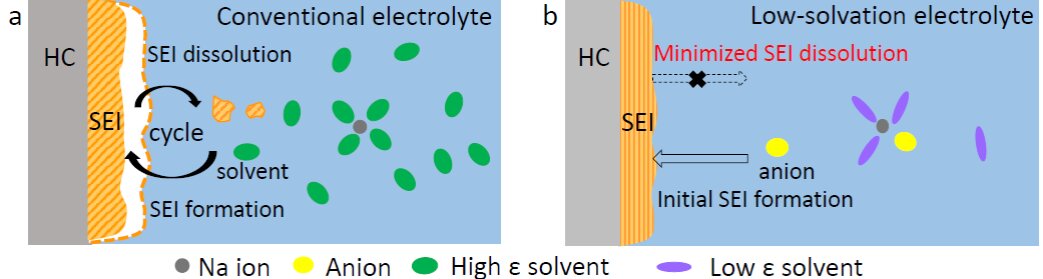
The new electrolyte design principles to suppress the SEI dissolution for highly stable high-voltage sodium-ion batteries introduced by the researchers. a, In the conventional electrolyte, SEI dissolution leads to continuous side reactions and irreversible capacity loss. b. In the low-solvation electrolyte, SEI dissolution is suppressed and the cycle life of batteries can be improved. Credit: Jin et al. In years to come, sodium-ion batteries (NIBs) could potentially be a great alternative to current energy storage systems. Despite their advantages, including the abundance of sodium and a potentially long cycle life, these sodium-based batteries are often less stable than lithium-based batteries, due to the instability of the solid-electrolyte interphase (SEI), a passivation layer that forms on electrode surfaces after repeated battery operation cycles.
Past studies have showed that in NIBs with a high voltage cathode, the SEI dissolves more rapidly than that in lithium-ion batteries (LIBs). This causes a series of side reactions, as well as the rapid depletion of the electrolyte and an irreversible loss of capacity, dramatically decreasing the stability and performance of NIBs.
Researchers at the Pacific Northwest National Laboratory have recently developed a new electrolyte that lowers the solvation ability of the SEI on the anode of NIBs batteries, while also forming a stable protective layer to protect the cathode. This electrolyte, introduced in a paper published in Nature Energy, could enable the development of high-voltage sodium-ion batteries that are both stable and reliable.
"Our recent paper is about a novel electrolyte that can stabilize the anode in a high voltage (4.2V) sodium ion battery and extent its cycle life," Ji-Guang Zhang, one of the researchers who carried out the study, told TechXplore. "Existing electrolytes typically lead to a short cycle life when used at more than 4V. The primary objective of our work was to allow sodium ion batteries to operate at higher voltage and increase its energy density."
For an NIB to retain its stability over time, the anode (i.e., negatively charged electrode in a battery) inside it requires a protection layer, known as the SEI, with a long lifecycle. If this layer is dissolved while a battery is operating, as observed in past studies, the battery's performance will decrease dramatically. To overcome the limitations of previously developed NIBs, Zhang and his colleagues thus set out to design a new electrolyte that would extend the lifecycle of SEIs.
The new electrolyte design principles to suppress the SEI dissolution for highly stable high-voltage sodium-ion batteries introduced by the researchers. a, In the conventional electrolyte, SEI dissolution leads to continuous side reactions and irreversible capacity loss. b. In the low-solvation electrolyte, SEI dissolution is suppressed and the cycle life of batteries can be improved. Credit: Jin et al.
==============================================================
"Our new electrolyte suppresses the dissolution of the anode's protection layer," Zhang explained. "The electrolyte is made of a more stable salt (sodium bis(fluorosulfonyl)imide (NaFSI)) and a solvent with a lower dielectric constant. Unlike the conventional electrolytes that forms a protection layer which is rich in organic components and easy to dissolve, the new electrolyte leads to the formation of a protection layer that is rich in inorganic components, so it's more stable during cycling and storage."
The researchers tested their electrolyte in an HC||NaNMC full cell and found that it attained remarkable results. Specifically, the cell could retain over 90% of its capacity after 300 cycles when charged to 4.2 V. These findings suggest that the electrolyte could potentially enable production of more stable and better performing sodium-based energy storage solutions.
"We successfully reduced the solvability of the anode protection layer and therefore enabled the long-term operation of high voltage sodium ion batteries," Zhang added. "In our next studies, we plan to further increase the operation voltage of sodium-based batteries and improve their cycle life."
Explore further
Block copolymer electrolyte used to make stable sodium metal batteries More information: Yan Jin et al, Low-solvation electrolytes for high-voltage sodium-ion batteries, Nature Energy (2022). DOI: 10.1038/s41560-022-01055-0 Journal information: Nature Energy
Brawndo?
It’s got what plants crave

Yes, but, exposure to the new electrolyte causes one leg to grow shorter than the other.
Sodium?
Lithium?
Totally fun elements to play with.
You can't say that until you also know the amp-hour capacity of the cell.
In 1967 in Chemistry class my lab-mate and I managed to blowup our apparatus while generating hydrogen with sodium. Got lots of attention from our professor.
LOL
“At 4.2V per cell, you will need 2/3 less batteris...........”
Nominal EV cell voltage is about 3.7 v. To determine how many batteries you need many other factors have to be considered including energy density and rated current flow.
Red: 2/3 less
How many is 2/3 less?
Energy in a battery is measured in Watt/Hours, or how many watts can the battery put out over what time period.
Watts are measured by Amps times Volts.
Just because a battery of a given volume has three times the voltage of another battery of the same volume does not mean that it can deliver three times the energy.
Most likely, a battery with three times the voltage can only provide a given current for one third the time of the lower voltage battery, so both batteries end up supplying the same amount of energy.
So for battery A, you may need three cells in series to deliver X amps at Y volts, for Z watts over a measured time period.
Battery B may need need three cells in parallel to deliver the same X amps at Y volts, for the same Z watts over the same time period.
But, how many is 2/3 less?
signed, Ex Navy Sub Electrician
Lithium?
Totally fun elements to play with.
When I was at GE in the late '70s, they were trying to get sodium-sulfur batteries working. These things were made in a long steel pipe. They had to be maintained at a temperature above something like 400°F. Inside they had a bunch of molten sulfur separated from a bunch of molten sodium by a thin-walled cup made of alumina, which (as you may know) is a brittle ceramic. The cup was pretty much the same length as the steel pipe. It had to be think enough for allow ion exchange while keeping the sodium and sulfur separate.
If the alumina cup cracked, the results were violent and smelly and toxic. On one occasion, the resulting blast cut through the lab wall and shot out into the hallway.
They moved that research to a remote facility.
Amazing that this was more than 40 years ago, and even then they had already invested ten or fifteen years on the technology. I guess people are still working on it today. Shows how valuable a good high-capacity, fast-charging electricity storage technology is.
Yeah, it’s too bad peeps haven’t gotten energy dense capacitors to work well either.
signed, Ex Navy Sub Electrician
Oops, sorry for the totally unnecessary electricity lesson!
Signed, ex Air Force Electronic Technician.
I don't like the convention, either, but:
X-(2/3)X= 2/3 less.
GE apparently abandoned sodium sulfur for sodium halide and launched the Durathon battery.
Then they abandoned that and now supply grid storage using commercially acquired lithium ion batteries.
https://www.greencarcongress.com/2010/05/durathon-20100518.html
Well, it DOES have electrolytes!
Disclaimer: Opinions posted on Free Republic are those of the individual posters and do not necessarily represent the opinion of Free Republic or its management. All materials posted herein are protected by copyright law and the exemption for fair use of copyrighted works.