Posted on 07/27/2021 2:42:42 PM PDT by MtnClimber
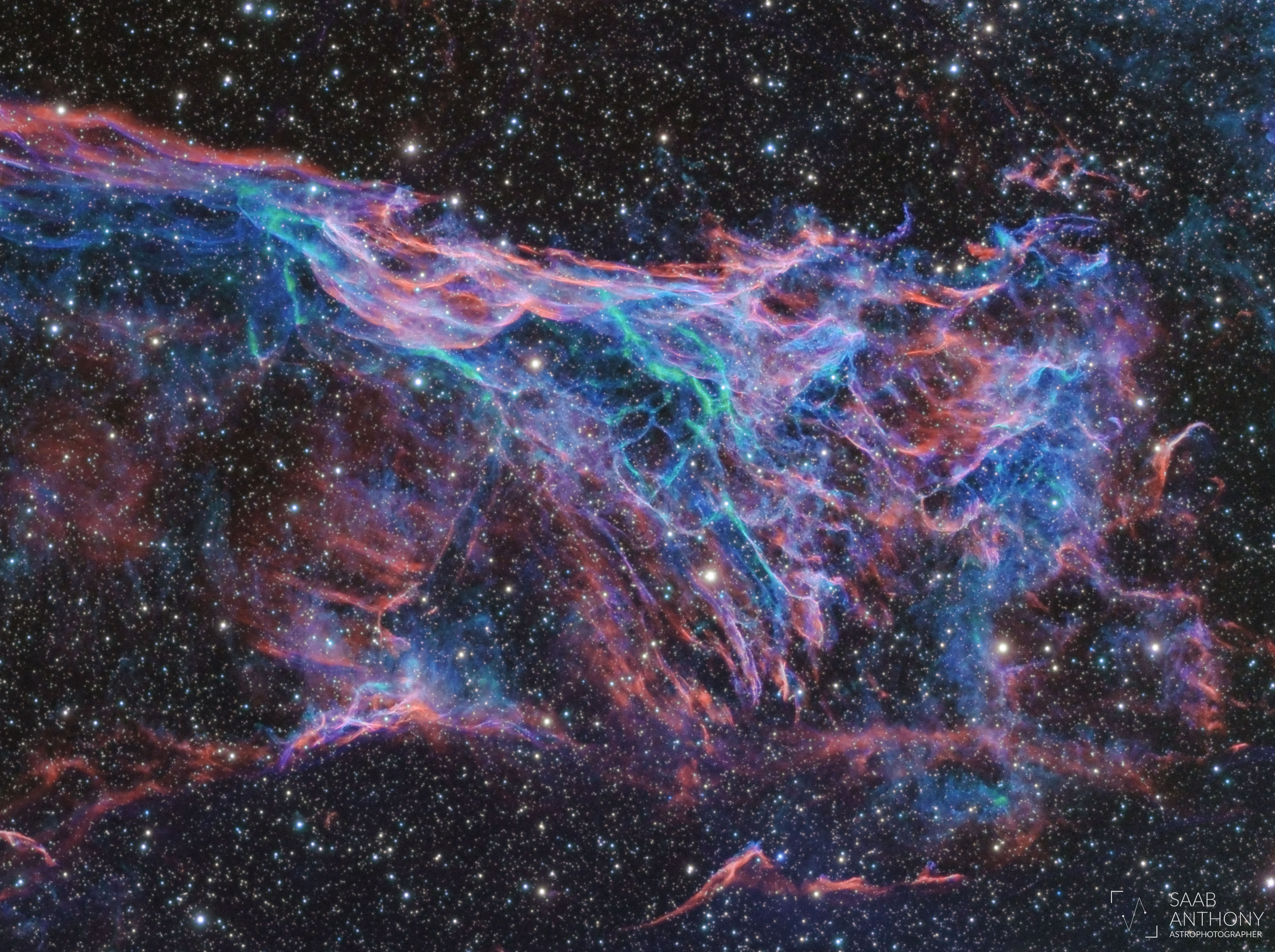
Explanation: Chaotic in appearance, these tangled filaments of shocked, glowing gas are spread across planet Earth's sky toward the constellation of Cygnus as part of the Veil Nebula. The Veil Nebula itself is a large supernova remnant, an expanding cloud born of the death explosion of a massive star. Light from the original supernova explosion likely reached Earth over 5,000 years ago. The glowing filaments are really more like long ripples in a sheet seen almost edge on, remarkably well separated into the glow of ionized hydrogen atoms shown in blue and oxygen in red hues. Also known as the Cygnus Loop and cataloged as NGC 6979, the Veil Nebula now spans about 6 times the diameter of the full Moon. The length of the wisp corresponds to about 30 light years, given its estimated distance of 2,400 light years. Often identified as Pickering's Triangle for a director of Harvard College Observatory, it is also named for its discoverer, astronomer Williamina Fleming, as Fleming's Triangular Wisp.
For more detail go to the link and click on the image for a high definition image. You can then move the magnifying glass cursor then click to zoom in and click again to zoom out. When zoomed in you can scan by moving the side bars on the bottom and right side of the image.
I see an Ichthyosaurus.
I see a monkey petting a Dashhound.
Cheese wisps aren’t bad. I’m guessing red and blue must be some kind of berry wisp.
bttt
FTA: Light from the original supernova explosion likely reached Earth over 5,000 years ago. -snip- The length of the wisp corresponds to about 30 light years, given its estimated distance of 2,400 light years.
The numbers do not add up. Is it 5,000 light years away or 2,400 light years away?
What kind of telescope is the source of this picture?
It’s probably in the description but I didn’t see it...
I could not find any information in the article or in a web search It seems the photographer has an Instagram site, but I don’t have an account so I couldn’t view it.
The distance is 2,400 light years. The supernova was probably seen on earth about 5,000 years ago which means the supernova actually happened 5,000 + 2,400 years ago. The image would be the expansion over the approximately 5,000 years since the supernova was first seen. We are seeing what it looked like 2,400 years ago.
With the advancements in astrophotography being made, it could be Joe Smith in his back yard with a 8 inch Celestron and a good camera.
If they guys 100 years ago could see what some folks have now, they would be killing people and stealing their scopes and cameras left and right.
But, it was probably Hubble.
That is too much math : )

This is a Hunter Biden $375K original. He was drunk on wine and cheese, and sneezed on the dining room wall. You can own this today and put it on your refrigerator with a magnet.
Did it look like the pic 2400 years ago...to the naked eye???
Stunningly, it’s a private astro-photographer.
If you have Insta check it out here. https://www.instagram.com/anthonyrsaab/
And things will just get better for amateurs....and it doesn’t even have to be darker, as they have filters now for different types of light pollution.
Personally, I prefer dark dark skies, and, my eye as the camera. Give me OLD photons!
Disclaimer: Opinions posted on Free Republic are those of the individual posters and do not necessarily represent the opinion of Free Republic or its management. All materials posted herein are protected by copyright law and the exemption for fair use of copyrighted works.