To: ETL
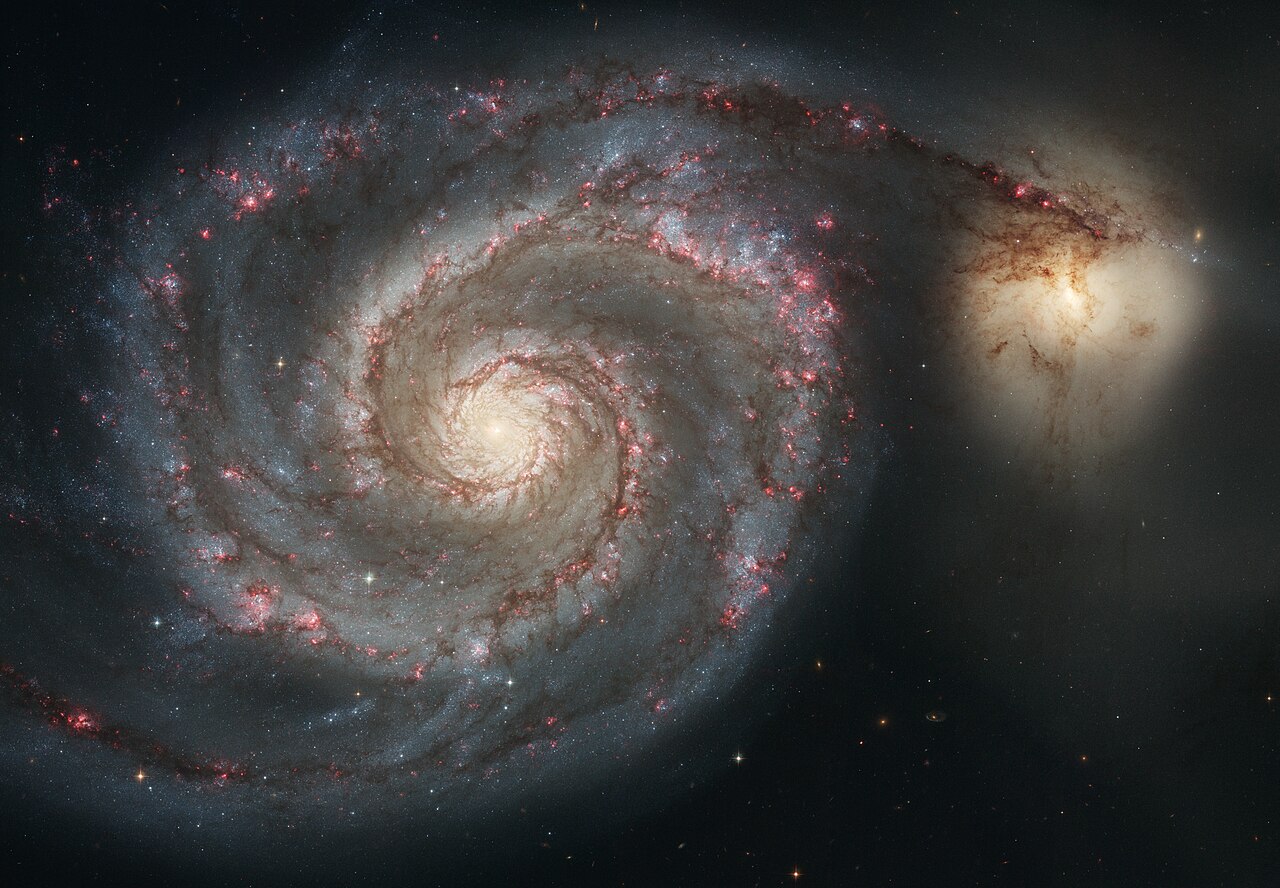
I went to an astronomy lecture and asked at the end why the smaller galaxy of the Whirlpool cluster was red shifted so far back from the big galaxy that they could not possibly have an effect on each other, yet there looks to be a matter stream between them.
The astronomer got angry and told me they weren't going to throw away theories based on some isolated phenomenon.
In later years, radio astronomy verified a bridge between the galaxies. I don't know how they explained the difference in red shift unless the previous measurements were incorrect.
44 posted on
12/05/2018 10:42:08 AM PST by
sparklite2
(See more at Sparklite Times)
To: sparklite2
He was pissed because you threw him off his “lecture stride”. He couldn’t think on his feet fast enough to come up with an answer. So he just didn’t know & didn’t want to admit it.
45 posted on
12/05/2018 10:48:55 AM PST by
Reily
To: sparklite2
I don't know the answer, but I found this at the NASA site...
The graceful, winding arms of the majestic spiral galaxy M51 appear like a grand spiral staircase sweeping through space. They are actually long lanes of stars and gas laced with dust. Such striking arms are a hallmark of so-called grand-design spiral galaxies. In M51, also known as the Whirlpool galaxy, these arms serve an important purpose: they are star-formation factories, compressing hydrogen gas and creating clusters of new stars.
Some astronomers think that the Whirlpool’s arms are particularly prominent because of the effects of a close encounter with NGC 5195, the small, yellowish galaxy at the outermost tip of one of the arms. The compact galaxy appears to be tugging on the arm, the tidal forces from which trigger new star formation. Hubble’s clear view shows that NGC 5195 is passing behind M51. The small galaxy has been gliding past the Whirlpool for hundreds of millions of years.
In Hubble’s captivating image of M51, the red represents infrared light as well as hydrogen within giant star-forming regions. The blue color can be attributed to hot, young stars while the yellow color is from older stars.
Discovered by Charles Messier in 1773, M51 is located 31 million light-years from Earth in the constellation Canes Venatici. It has an apparent magnitude of 8.4 and can be spotted with a small telescope most easily during May. The Whirlpool galaxy’s beautiful face-on view and closeness to Earth allow astronomers to study a classic spiral galaxy’s structure and star-forming processes.
For more information about Hubble’s observations of M51, see:
http://hubblesite.org/news_release/news/2005-12
http://hubblesite.org/news_release/news/2011-03
http://hubblesite.org/news_release/news/2001-10
http://hubblesite.org/news_release/news/1996-17
source:
https://www.nasa.gov/feature/goddard/2017/messier-51-the-whirlpool-galaxy
47 posted on
12/05/2018 10:54:27 AM PST by
ETL
(Obama-Hillary, REAL Russia collusion! Uranium-One Deal, Missile Defense, Iran Deal, Nukes: Click ETL)
To: sparklite2
48 posted on
12/05/2018 10:55:31 AM PST by
ETL
(Obama-Hillary, REAL Russia collusion! Uranium-One Deal, Missile Defense, Iran Deal, Nukes: Click ETL)
To: sparklite2
I went to an astronomy lecture and asked at the end why the smaller galaxy of the Whirlpool cluster was red shifted so far back from the big galaxy that they could not possibly have an effect on each other, yet there looks to be a matter stream between them. The astronomer got angry and told me they weren't going to throw away theories based on some isolated phenomenon.
In 1966, world renowned astronomer, Halton Arp, collected his observations of 338 such unusual galaxies in a book entitled, "Atlas of Peculiar Galaxies".
Most all of the galaxies presented in the book are of the type you describe.
In most cases, those galaxies and their conjoined companions were observed to have very different red shifts, which caused Arp to conclude that red shift is not an indicator of speed or distance, but an indicator of age.
Naturally, the astronomical community, which had already accepted the Big Bang theory as gospel, thoroughly rejected Arp's findings out of hand, and labeled him a kook heretic. They did so (and continue to do so) despite the clear associations between these objects and the wild variances in their red shifts.
In subsequent decades, thousands of such objects have been added to Arp's original catalog.
The ramifications of these observations can't be overstated. Arp essentially disproved the Big Bang theory.
65 posted on
12/05/2018 1:10:12 PM PST by
Windflier
(Pitchforks and torches ripen on the vine. Left too long, they become black rifles.)
To: sparklite2
I went to an astronomy lecture and asked at the end why the smaller galaxy of the Whirlpool cluster was red shifted so far back from the big galaxy that they could not possibly have an effect on each other, yet there looks to be a matter stream between them.Harlton Arp — ‘Seeing Red’ an astronomer’s treatise on quantum red shift and red shift not being related to distance.
Summary - Alignments, Quasars, BL Lac's and Galaxy Clusters 1) Objects which appear young are aligned on either side of eruptive objects. This implies ejection of protogalaxies.
2) The youngest objects appear to have the highest redshifts. This implies that intrinsic redshift decreases as the object ages.
3) As distance from the ejecting central object increases, the quasars increase in brightness and decrease in redshift. This implies that the ejected objects evolve as they travel outward.
4) At about z= .3 and about 400 kpc from that parent galaxy the quasars appear to become very bright in optical and X-ray luminosity. This implies there is a transition to BL Lac Objects.
5) Few BL Lac objects are observed implying this phase is short-lived.
6) Clusters of galaxies, many of which are strong X-ray sources, end to appear at comparable distances to the BL Lac's from the parent galaxy. This suggests the clusters may be a result of the breaking up of a BL Lac.
7) Clusters of galaxies in the range z= .4 to .2 contain blue, active galaxies. It is implied that they continue to evolve to higher luminosity and lower redshift.
8) Abell clusters from z= .01 to .2 lie along ejection lines from galaxies like CenA. Presumably they are evolved products of the ejections.
9) The strings of galaxies which are aligned through the brightest nearby spirals have redshifts z= .01 to .02. Presumably they are the last evolutionary stage of the ejected protogalaxies before they become slightly higher redshift companions of the original ejecting galaxies. (p166-7)
Quantization of Redshifts
The fact that measured values of redshift do not vary continuously but come in steps- certain preferred values- is so unexpected that conventional astronomy has never been able to accept it, in spite of the overwhelming observational evidence. Their problem is simply that if redshifts measure radial components of velocities, then galaxy velocities can be pointed at any angle to us, hence their redshifts must be continuously distributed. For supposed recession velocities of quasars, to measure equal steps in all directions in the sky means we are at the center of a series of explosions. This is an anti-Copernican embarrassment. So a simple glance at the evidence discussed in this Chapter shows that extragalactic astronomy and Big Bang theory is swept away. (p195)
On the theoretical front it has become more persuasive that particle masses determine intrinsic redshifts and that these change with cosmic age. Therefore episodic creation of matter will imprint redshift steps on objects created at different epochs. In addition it appears increasingly useful to view particle masses to be communicated by wave like carriers in a Machian universe. Therefore the possibility of beat frequencies, harmonics, interference and evolution through resonant states is opened up. (p195)
My attitude toward this result is that in a Machian universe there must be some signal carrier for inertial mass coming from distant galaxies. (p202)
In the phenomena of quantization, we have a connection from the redshifts of the quasars, to the redshifts of the galaxies, to the properties of the solar system and finally to the properties of fundamental particles like the electrons. The quantization of physical parameters would seem to be governed by the laws of non-local physics, i.e. like quantum mechanics in which the fundamental parameter appears to be time- for example the repetition rate of a spinning electron. It is clear that we are not running out of problems to solve. In fact, contrary to some rumors that we are reaching an end to physics, the more we learn the more primitive our previous understanding appears, and the more challenging the problems become. (p223)
72 posted on
12/05/2018 2:35:53 PM PST by
Swordmaker
(My pistol self-identifies as an iPad, so you must accept it in gun-free zones, you hoplaphobe bigot)
FreeRepublic.com is powered by software copyright 2000-2008 John Robinson