Skip to comments.
On this date in 1863
Posted on 07/04/2018 6:19:14 AM PDT by Bull Snipe
A glorious 4th of July for the Union cause. General Lee's Army of Northern Virginia begins it retreat from Pennsylvania after having been defeated by General Meade's Army of the Potomac at the Battle of Gettysburg. General Grant accepts the surrender of the City of Vicksburg from General Pemberton. About 32,000 Confederate soldiers stack their weapons and are paroled by the Union forces. This is the second Confederate Army to surrender to Grant. The Union now controls the Mississippi river and the Confederate state is split into two parts.
TOPICS: History
KEYWORDS: militaryhistory
Navigation: use the links below to view more comments.
first previous 1-20 ... 161-180, 181-200, 201-220, 221-237 last
To: jeffersondem; rockrr; x; DoodleDawg; Leaning Right; Bull Snipe; DiogenesLamp
jeffersondem:
"Your use of repetition (e.g. slavery in the U.S. constitution is unacknowledged) brings to mind what one European socialist said sometime back:" I'll take that as your admission of abject defeat & surrender on the question of slavery "enshrined" in the Constitution.
Now you've fled & retreated to the position that it's merely not "unacknowledged".
Fine, in my little metaphor, the husband sneaks his new mistress into his home, "acknowledging" only by calling her a "maid".
When challenged he says, "yes, but look up the definition of the word 'maid' -- it includes 'other services' doesn't it?"
My objection here is to your term "enshrined", which implies a religious-like reverence for slavery which never, ever existed among our Founders.
jeffersondem quoting: "It would not be impossible to prove with sufficient repetition and a psychological understanding of the people concerned that a square is in fact a circle.
They are mere words, and words can be molded until they clothe ideas and disguise."
Sounds to me like the perfect description of Lost Causers' work on these threads.
221
posted on
07/15/2018 4:49:18 AM PDT
by
BroJoeK
((a little historical perspective...))
To: jeffersondem
jeffersondem:
"An insult may not be a nice thing to utter - that’s why I work so hard to avoid them - but they can be the truth." Maybe, but hardly when coming from Lost Causers' endless defense of Big Lies.
Such insults would be more like a badge of honor.
222
posted on
07/15/2018 4:56:30 AM PDT
by
BroJoeK
((a little historical perspective...))
To: BroJoeK; wardaddy; rustbucket; DiogenesLamp; Pelham; FLT-bird; Rome2000; Ambrosia; Ohioan; ...
“Fine, in my little metaphor, the husband sneaks his new mistress into his home, “acknowledging” only by calling her a “maid”. When challenged he says, “yes, but look up the definition of the word ‘maid’ — it includes ‘other services’ doesn't it?”
When southerners cite the constitution, you cite rigamarole.
To: jeffersondem; wardaddy; rustbucket; DiogenesLamp; Pelham; FLT-bird; Rome2000; Ambrosia; Ohioan
jeffersondem:
"When southerners cite the constitution, you cite rigamarole." I heard you the first time, no need for you to repeat your abject surrender on the question slavery "enshrined" in the US Constitution.
It's not and you acknowledge that by saying now only: it's not "unacknowledged".
That's fine, snuck in the back door, claimed to be something else, but sure, not "unacknowledged".
Of course slavery was absolutely enshrined, glorified & worshipped even, in the Constitution... of the Confederacy.
You got me on that one, I surrender to your point.
224
posted on
07/15/2018 4:39:52 PM PDT
by
BroJoeK
((a little historical perspective...))
To: BroJoeK
Please remove me from the ping list, thanks.
225
posted on
07/15/2018 4:57:37 PM PDT
by
Ambrosia
(Born in NC, then PA, NY,WV, NM, SC, and FL & back God/Freedom=Priority!)
To: jeffersondem
Please remove me from the ping list, thank you.
226
posted on
07/15/2018 4:59:04 PM PDT
by
Ambrosia
(Born in NC, then PA, NY,WV, NM, SC, and FL & back God/Freedom=Priority!)
To: BroJoeK
None of those were the maps I asked you for.
227
posted on
07/15/2018 8:01:59 PM PDT
by
DiogenesLamp
("of parents owing allegiance to no other sovereignty.")
To: DiogenesLamp
DiogenesLamp:
"None of those were the maps I asked you for." But they show the important point which is that slavery was not entirely based on cotton plantations and could be used for many other purposes.
228
posted on
07/16/2018 3:21:42 AM PDT
by
BroJoeK
((a little historical perspective...))
To: BroJoeK
Hardly, but that isn’t the point i’m interested in at the moment. I want to show where the 70-80% of US exports came from. I want to show which ports were creating the money, and which ports were receiving the money.
229
posted on
07/16/2018 6:37:04 AM PDT
by
DiogenesLamp
("of parents owing allegiance to no other sovereignty.")
To: DiogenesLamp
“the merchants and industrialists of New York had garnered enough support in Congress to get laws passed that favored the use of their City for the vast bulk of the European trade, and they had acquired favorable conditions, both through congress and some occurring naturally, to monopolize the shipping of US exports to Europe as well as the coastal packet trade.”
Cite the laws that were passed by Congress that specifically that favored the use of New York City that favored the use of the city for European trade. If you can.
You have a long tradition of saying laws were passed to favor Northern business and trade interests, but you have been almost totally unwilling or incapbable of citing the specific legislation that you claimed favored Northern business interests to the adversity of Southern business interests. The only law that you have ever cited is the navigation act of
To: Bull Snipe
Cite the laws that were passed by Congress that specifically that favored the use of New York City that favored the use of the city for European trade. Have done so numerous times. The navigation act of 1817 did most of the damage to other ports. I think there was also a warehousing act that did more damage, but I don't recall the details on it. Federal subsidies for Northern shipping interests made things more difficult for competitors that were located anywhere else.
New York already had a natural advantage. It was one of the closest American ports to Europe. To go an extra 800 miles to Charleston would require some sort of incentive. 30% savings from lower tariffs would have done it.
231
posted on
07/16/2018 8:58:19 PM PDT
by
DiogenesLamp
("of parents owing allegiance to no other sovereignty.")
To: DiogenesLamp
You have not. The only law you have cited by title in these discussions is the 1817 Navigation act. What was the warehousing law you cite.
The Navigation act restricts the shipment of cargos between American port to American flagged ships. Southern ship owners would have been protected from foreign completion
in that trade, just as much as Northern shippers were.
Southern cargos such as cotton bound for Europe could be carried by any ship from any nation. Cargos bound from Europe to Southern ports could be carried on any ship flying any flag.
You are correct that New York and the other Northern ports had advantage in location. Also, both private businesses and the states concerned invested a lot of capitol in developing these ports. Something that Southern states and investors were much less likely to do. Without Federal money, Charleston harbor would have been almost useless, the Government paid to have that harbor dredged 3 times before the war. They also built the lighthouses at allowed mariners to enter the harbor safely.
To: BroJoeK; wardaddy; rustbucket; DiogenesLamp; Pelham; FLT-bird; Rome2000; central_va
“That's “enshrined”, slavery was never “enshrined” it was never even explicitly mentioned, rather it was snuck in the back door under false pretenses, like a man bringing his mistress home for a dalliance, hoping nobody would notice. . . Fine, in my little metaphor, the husband sneaks his new mistress into his home, “acknowledging” only by calling her a “maid”. When challenged he says, “yes, but look up the definition of the word ‘maid’ — it includes ‘other services’ doesn't it?”
You have previously painted those who owned slaves as one-dimensional “slavers.” Now, you create an ill-compounded narrative depicting the founding fathers of the United States as not just slave masters, but whore masters.
That's a little over-the-top, even by your devolving standards.
To: DiogenesLamp
DiogenesLamp:
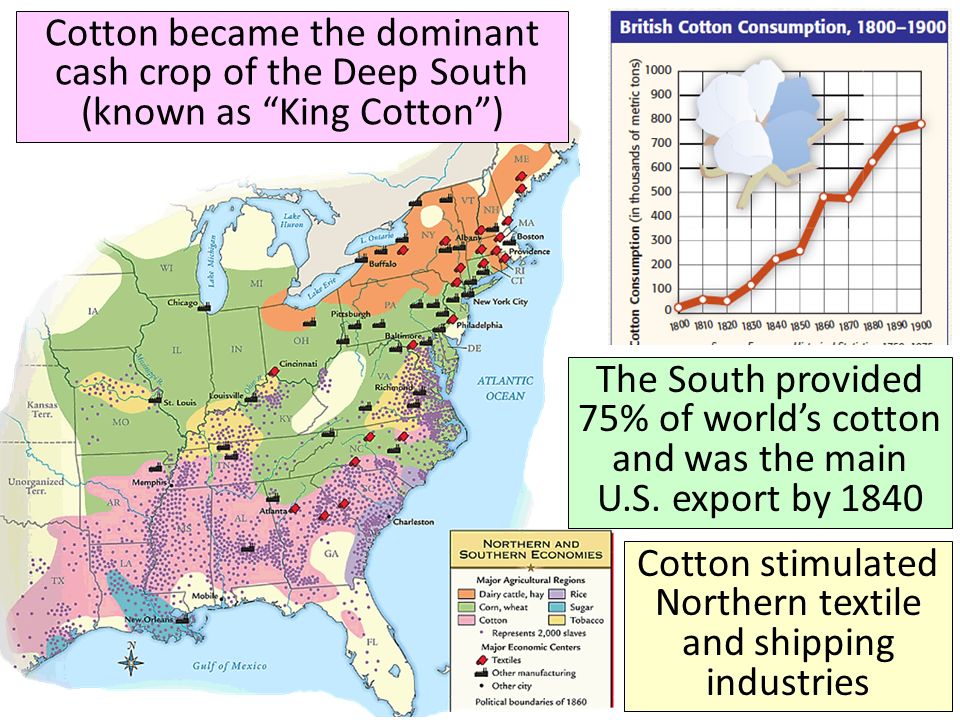
"Hardly, but that isn’t the point i’m interested in at the moment." Still, it's important because you've argued repeatedly that slavery was dependent on large cotton plantations and without them, slavery could not expand.
And of course, that's nonsense because in fact slavery did not depend on cotton plantations and millions of US slaves lived in regions where no cotton was grown.
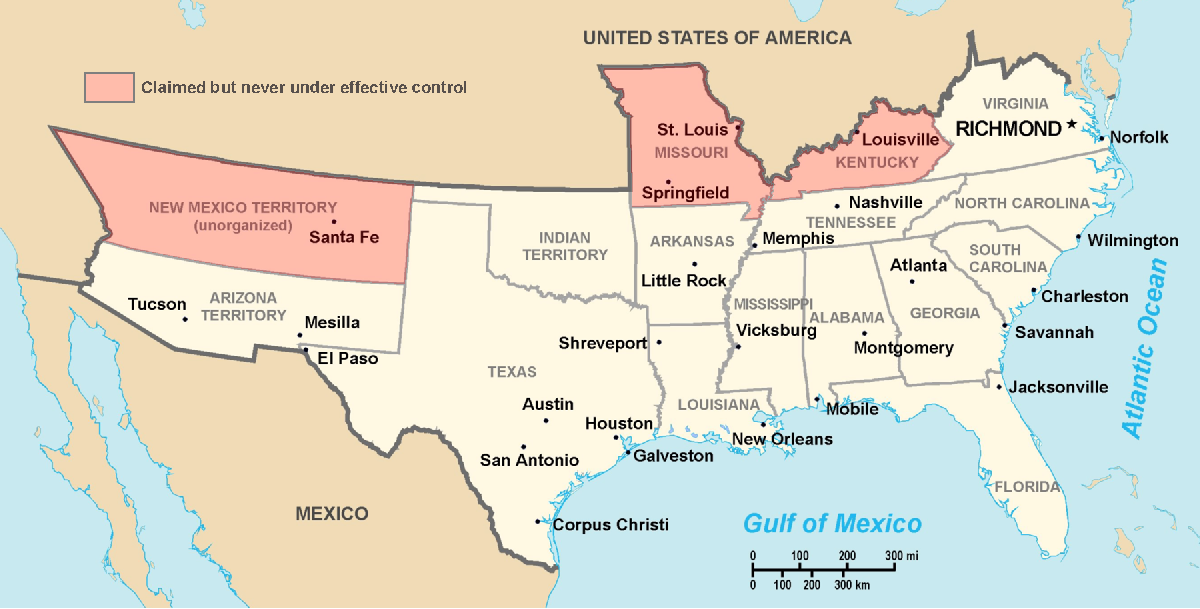
Indeed, you should take a minute to consider this question: if, as you say, slavery needed cotton plantations and no cotton could grow in the US Far West, therefore US slavers did not really want to expand into Western Territories, if that's true, then why did Confederates claim & send armies into such non-cotton regions as as New Mexico, Arizona, Oklahoma, Missouri & Kentucky?
DiogenesLamp: "I want to show where the 70-80% of US exports came from."
I've seen no such map, but you can get to $70-80% if you assume that all exports listed as "Southern Products" were produced exclusively in the South and if you discount the value of gold & silver exports.
Then 1860 "Southern Products" total $229 million or 72% of $316 million total US exports.
1860 Northern & Western exports totaled $88 million, or 28%.
But as I have often pointed out:
- Specie exports also paid for imports and those added $66 million making total exports $400 million.
- Of that only cotton was exclusively Deep South exports and that accounted for 50% or about $200 million.
- Everything else classified as "Southern Products" was actually produced in Union states as demonstrated in 1861 when Confederate exports were 100% deleted from US totals.
So, botton line: at 50% of total exports cotton was hugely important, but just not as important as Deep South Fire Eaters imagined.
DiogenesLamp: "I want to show which ports were creating the money, and which ports were receiving the money."
We don't have numbers on exports per US port, but port city populations should serve as rough proxies.
Using those we see that New Orleans and Baltimore were the biggest Southern ports by far, accounting for 72% of Southern port city populations.
Charleston, Mobile, Richmond, Savanah & Wilmington combined added 28% of which Charleston was 8%.
And if we look at the map of cotton production, it's clear South Carolina was nowhere near the top of that list, with at most 15% of total cotton exported.
234
posted on
07/17/2018 7:36:14 PM PDT
by
BroJoeK
((a little historical perspective...))
To: jeffersondem; wardaddy; rustbucket; DiogenesLamp; Pelham; FLT-bird; Rome2000; central_va; x; ...
jeffersondem:
"You have previously painted those who owned slaves as one-dimensional “slavers.” And what one-dimensional name would you use for them?
What two-dimensional name would you use?
jeffersondem: "Now, you create an ill-compounded narrative depicting the founding fathers of the United States as not just slave masters, but whore masters."
And what, exactly, would you call slavers, keeping in mind the following:
Would you say any of those European-ancestry fathers of mulatto children "enshrined" the mothers in holy matrimony?
Or did they just sneak around when nature called?
Please, take your time thinking it over.
Answer carefully, FRiend.
235
posted on
07/17/2018 7:50:33 PM PDT
by
BroJoeK
((a little historical perspective...))
To: BroJoeK; wardaddy; rustbucket; DiogenesLamp; Pelham; FLT-bird; Rome2000; central_va
“What two-dimensional name would you use?”
In the case of George Washington: “The Father of Our Country.”
To: jeffersondem
jeffersondem:
"In the case of George Washington: 'The Father of Our Country.' " Sorry, but you can't have Washington, he's on our side:
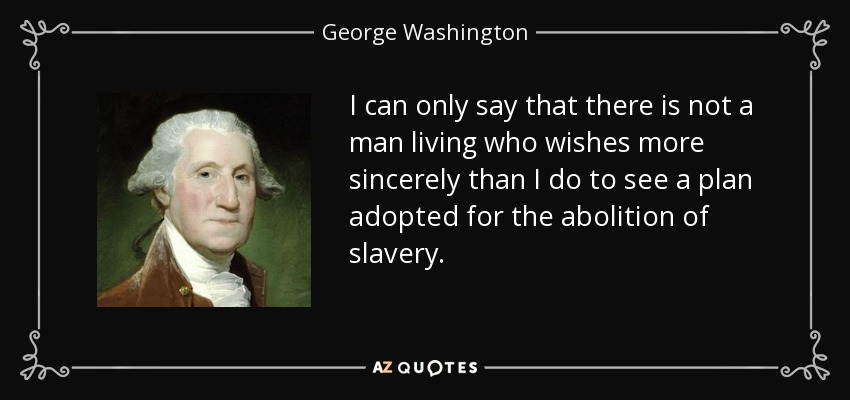
- "I can only say that there is not a man living who wishes more sincerely than I do to see a plan adopted for the abolition of it (slavery); but there is only one proper and effectual mode by which it can be accomplished, and that is by Legislative authority; and this, as far as my suffrage (vote and support) will go, shall never be wanting."
- Letter to Robert Morris, April 12, 1786."
- "I wish from my soul that the legislature of this State could see the policy of a gradual Abolition of Slavery."
George Washington
- "I never mean, unless some particular circumstances should compel it, to possess another slave by purchase, it being among my first wishes to see some plan adopted, by which slavery in this country may be abolished by law."
- "Not only do I pray for it, on the score of human dignity, but I can clearly forsee that nothing but the rooting out of slavery can perpetuate the existence of our union, by consolidating it in a common bond of principle."
- Washington told Edmund Randolph, according to Thomas Jefferson's notes, that if the country were to split over slavery, Washington "had made up his mind to move and be of the northern."[29]
237
posted on
07/18/2018 9:31:49 AM PDT
by
BroJoeK
((a little historical perspective...))
Navigation: use the links below to view more comments.
first previous 1-20 ... 161-180, 181-200, 201-220, 221-237 last
Disclaimer:
Opinions posted on Free Republic are those of the individual
posters and do not necessarily represent the opinion of Free Republic or its
management. All materials posted herein are protected by copyright law and the
exemption for fair use of copyrighted works.
FreeRepublic.com is powered by software copyright 2000-2008 John Robinson