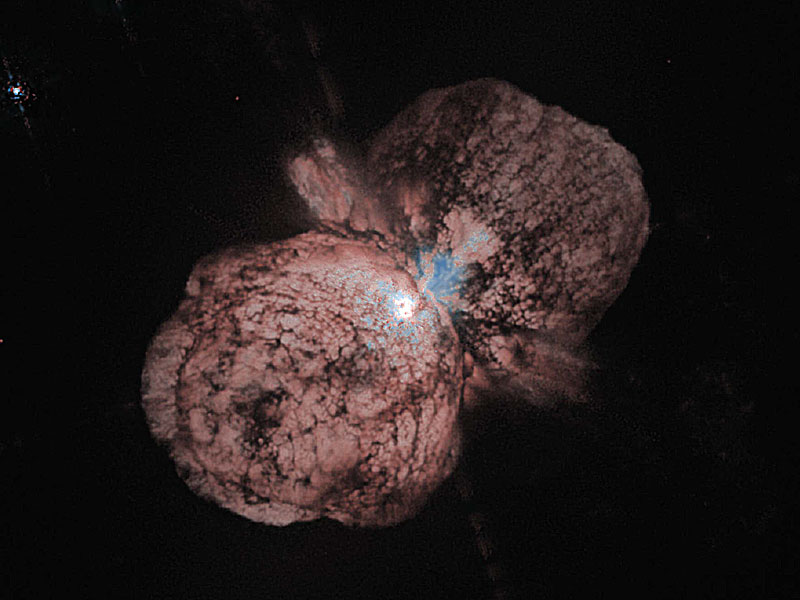
Eta Carinae is 12 times farther away, but it will still put on a doozy of a lightshow, visible in daylight.
Posted on 01/21/2011 1:20:10 PM PST by markomalley
The Earth could soon have a second sun, at least for a week or two.
The cosmic phenomenon will happen when one of the brightest stars in the night sky explodes into a supernova.
And, according to a report yesterday, the most stunning light show in the planet’s history could happen as soon as this year.
Earth will undoubtedly have a front row seat when the dying red supergiant star Betelgeuse finally blows itself into oblivion.
The explosion will be so bright that even though the star in the Orion constellation is 640 light-years away, it will still turn night into day and appear like there are two suns in the sky for a few weeks.
The only real debate is over exactly when it will happen.
In stellar terms, Betelgeuse is predicted to crash and burn in the very near future. But that doesn’t necessarily mean you have to rush out and buy sunglasses.
Brad Carter, Senior Lecturer of Physics at the University of Southern Queensland in Australia, claimed yesterday that the galactic blast could happen before 2012 – or any time over the next million years.
(Excerpt) Read more at dailymail.co.uk ...
Betelguese is red.
Two points:
1) Betelguese is not our moon.
2) Sun turned black like sackcloth, not the total opposite "another star shines bright as the sun."
You Premillennial Dysfunctionalists are supposed to take pride in being literal with your wresting of Scripture.
This disturbance traveled at 640 times the speed of light? Color me doubtful.
Eta Carinae is 12 times farther away, but it will still put on a doozy of a lightshow, visible in daylight.
 |
||
| · join · view topics · view or post blog · bookmark · post new topic · subscribe · | ||
| Google news searches: exoplanet · exosolar · extrasolar · | ||
 |
||
| · join · view topics · view or post blog · bookmark · post new topic · subscribe · | ||
He sure narrows it down. That’s only a range of 1 million years.
Cool, like land of the lost, I’m sure Chaka will know what to do ...
Watch this YouTube video on the size of our Sun vs others that out there, pretty eye opening ...
http://www.youtube.com/watch?v=HEheh1BH34Q
Well....Scratch that from my vacation-destination list!
The most stunning light show in the planet's history would have been the week preceding the flood:
Isaiah 30:26 "...the light of the moon shall be as the light of the sun, and the light of the sun shalll be sevenfold, as the light of the seven days..."
Love the cat’s expression.
>>Two points:
1) Betelguese is not our moon.
2) Sun turned black like sackcloth, not the total opposite “another star shines bright as the sun.”
>You Premillennial Dysfunctionalists are supposed to take pride in being literal with your wresting of Scripture.
Wow, I’ve never been called a “Premillennial Dysfunctionalist” before. I hope to know what that actually means before I join the group.
Here’s the thing - A supernova would dim the sun during the day (estimated magnitude would be brighter than the moon) and paint the moon red during the night, especially during new and crescent moons.
Here’s the thing - A supernova would dim the sun during the day (estimated magnitude would be brighter than the moon) and paint the moon red during the night, especially during new and crescent moons.
Really?
(sigh)
Let me emphasize "Dysfunction" because not only is the Scripture wresting awful, but the science behind that statement sounds like something the notable scientist and intellectual Sheila Jackson Lee or Rosie O'donnell would say.
Chicks dig scars
A supernova would control or obscure the sun and moon just how?
If it were as bright as the sun, that wouldn’t diminish the brightness of the sun but compete with it. If it were brighter than the moon, it wouldn’t do so by dimming the moon, it would merely be brighter by comparison.
If a supernova were close enough to somehow obscure the sun and moon, we wouldn’t be discussing this on FR, we’d all be dead.
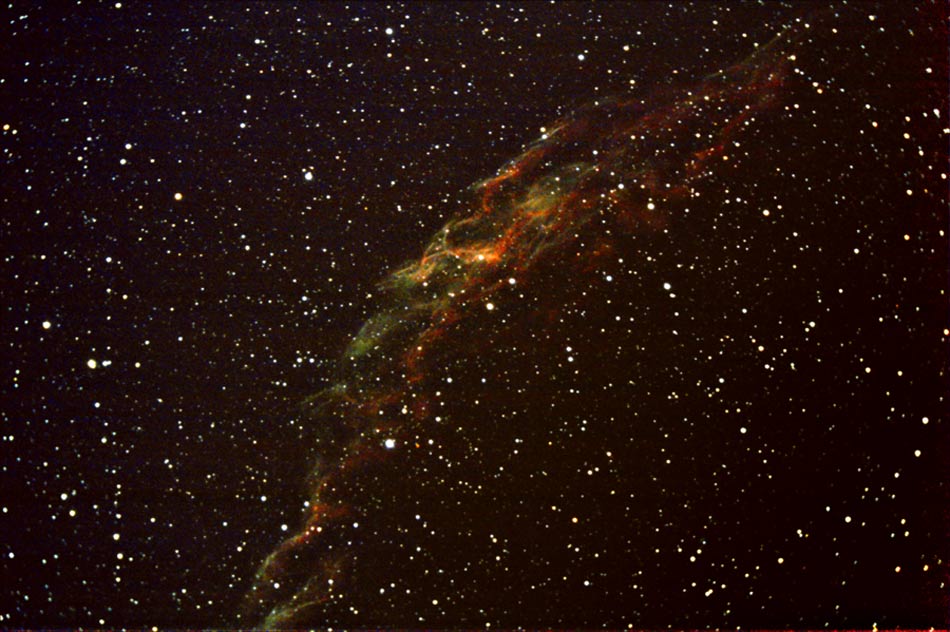
This part of the Veil Nebula, which is an old supernova remnant in the constellation Cygnus. It is the remains of cataclysmic explosion of star that exploded between 5,000 and 8,000 years ago. This nebula is about 1,860 light-years distance.
10"SCT- A series of 16x150second, exposures+darks+flats,6.3focal reducer, w/CLS LP filters, stacked&cabibrated in DSS.
M27 Planetary Nebula - about 1360 light years away

The nebula forms as the star's outer shell are blown off into space, with a visible glow generated by atoms of the dying star's intense but invisible ultraviolet light. Looking close, what is left of the star is near the exact center of the nebula. The nebula, is over 2.5 light-years across and about 1,200 light-years away in the constellation Vulpecula.
M27 Taken 9/4/2010 19x135second exposures, ISO 800-total exposure 42m45s, 6.3FR, calibrated aligned and stacked in DSS.
Disclaimer: Opinions posted on Free Republic are those of the individual posters and do not necessarily represent the opinion of Free Republic or its management. All materials posted herein are protected by copyright law and the exemption for fair use of copyrighted works.
