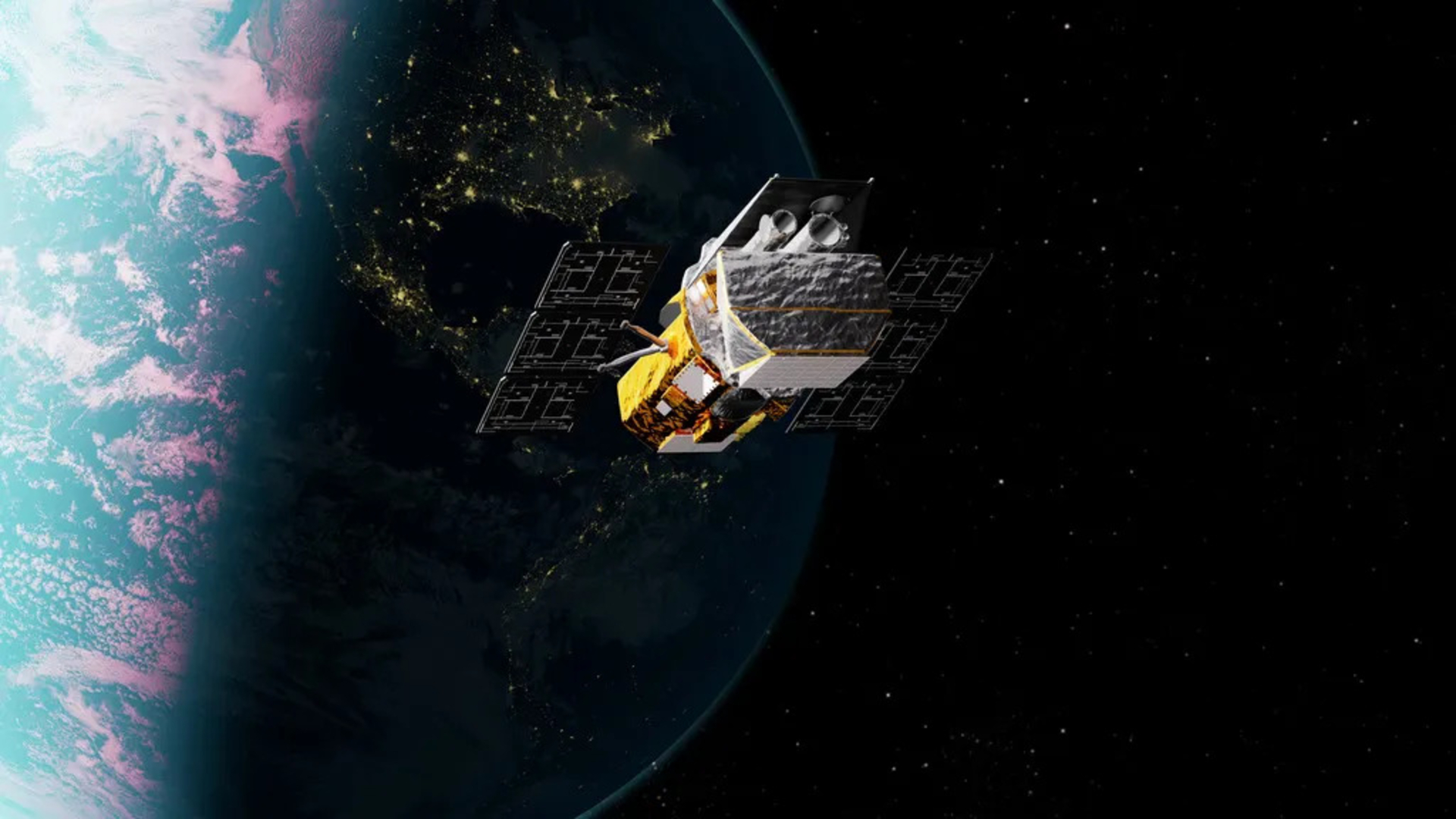
NASA's Neil Gehrels Swift Observatory, shown in this artist's concept, orbits Earth as it studies the ever-changing universe.Image credit: NASA's Goddard Space Flight Center Conceptual Image Lab
Posted on 02/19/2026 10:53:42 PM PST by SunkenCiv
"It's the only launch vehicle that can meet the orbit, the schedule and the cost to achieve something unprecedented with emerging technology."
A history-making robotic rescue mission scheduled to launch next year will fly on a rocket dropped from a plane.
In September, NASA announced that it has chosen Arizona company Katalyst Space Technologies to boost the altitude of its Neil Gehrels Swift Observatory, a space telescope whose orbit has gotten dangerously low since its November 2004 launch...
The $500 million Swift observatory was built by Orbital Sciences, a company that in 2014 became Orbital ATK, which was then acquired by Northrop Grumman in 2018. The space telescope has been studying gamma-ray bursts -- the most powerful explosions in the universe since the Big Bang -- from low Earth orbit (LEO) for two decades.
But that orbit has decayed considerably over the years, from an initial 373 miles (600 kilometers) to about 249 miles (400 km) today. As Swift gets lower and lower, it encounters more frictional drag from Earth's atmosphere, so its descent is accelerating -- and the observatory has no thrusters to counteract the process.
If nothing changes, Swift will likely crash back to Earth by the end of 2026, and there's no replacement mission in the works. So NASA decided to fund a rescue effort, leveraging the capabilities of private industry to meet a tight timeline.
(Excerpt) Read more at space.com ...
NASA's Neil Gehrels Swift Observatory, shown in this artist's concept, orbits Earth as it studies the ever-changing universe.Image credit: NASA's Goddard Space Flight Center Conceptual Image Lab
Sounds like having thrusters on the machine would have been the proper cost & foresight option. It must have telecom capability already.
NASA does some of the coolest stuff, and then makes some of the dumbest choices in things “not done”.
What part of the universe that is ever changing, is it studying? That’s a drag....what we learn today will be irrelevant tomorrow?
The space telescope has been studying gamma-ray bursts -- the most powerful explosions in the universe since the Big Bang -- from low Earth orbit (LEO) for two decades.
-PJ
The Katalyst spacecraft will head to an orbit similar to that of Swift, then spend two to three weeks closing in on the observatory. The boost vehicle will inspect its target “from reasonable standoff distances, to allow us to get high-resolution imagery and understand the current state,” Wilson said.
Once that state is understood, the rescuer — which is about 4.9 feet (1.5 m) tall and weighs 770 pounds (350 kg) — will close in and capture Swift using its three robotic arms.
After a successful capture, the Katalyst spacecraft will haul Swift back up to its initial altitude of 373 miles (600 km) or so, if all goes to plan.
I went to HS with Neil. Nice guy and smart as hell. RIP, the world is a bit poorer for his passing.
Hope boffins can get the bird back on step.
Will Katalyst then release the space telescope and return safely to Earth, to be re-used on future missions with other satellites in need of boosting? Or will it remain physically linked to the space telescope, perhaps boosting its orbit again at some later date, when its orbit has again decayed? Or will Katalyst perform its mission, release the space telescope, de-orbit, and so deliberately burn up in the atmosphere? Or what?
Regards,
ike having thrusters on the machine
________________
It was scheduled to work for 10 years.
And it is to a degree failing already. (lost 2 gyros, left with two only)
I think, they are trying the robotic rescue mission, which is quite innovative, so it can be used on other satellites.
I posted an excerpt.
Since I’m not NASA, you’ll have to ask them your questions.

Thrusters are more for attitude and “pointing” the satellite. To increase/decrease altitude you need a rocket motor for a more powerful “push”.
There goes my son’s Guiness Book World Record for closest satellite formation flying.
He’s an astronautical engineer. His mission held the previous record. He wasn’t with them when they earned it but told me that he’d flown the array closer than the record so I guess it counts.
He now works for a private space agency doing stuff similar to Katalyst
I wonder if the last time in-orbit satellite servicing has been attempted was the fix performed on the Hubble when some committee of nimrods approved the wrong mirrors and they had to be switched out in orbit? That repair cost way more than this operation will.
😊
Before Elon, the previous “doesn’t have competition” aerospace guy was Burt Rutan. He did a lot of design work, and some of it was for DARPA. The first aircraft that circumnavigated the Earth without refueling or even landing was his project, and the primary pilot was his brother.
[snip] Burt Rutan played a key role in the development of the Pegasus air-launched rocket, designing and manufacturing its wing and tail fin structures for Orbital Sciences Corporation (later Northrop Grumman). The Pegasus, the world’s first privately developed orbital launch vehicle, is carried aloft by a modified L-1011 aircraft and released at approximately 40,000 feet before igniting its solid rocket motors to reach orbit. [/snip]
According to the article, the mission is slated for June of this year. No exact date announced yet. This will be a neat mission to follow. I hope they will have on board cameras, and televise the attempt. That may be asking too much, however.
Disclaimer: Opinions posted on Free Republic are those of the individual posters and do not necessarily represent the opinion of Free Republic or its management. All materials posted herein are protected by copyright law and the exemption for fair use of copyrighted works.