|
Posted on 08/28/2003 12:00:28 AM PDT by SAMWolf
|
|
 are acknowledged, affirmed and commemorated.
|

| Our Mission: The FReeper Foxhole is dedicated to Veterans of our Nation's military forces and to others who are affected in their relationships with Veterans. In the FReeper Foxhole, Veterans or their family members should feel free to address their specific circumstances or whatever issues concern them in an atmosphere of peace, understanding, brotherhood and support. The FReeper Foxhole hopes to share with it's readers an open forum where we can learn about and discuss military history, military news and other topics of concern or interest to our readers be they Veteran's, Current Duty or anyone interested in what we have to offer. If the Foxhole makes someone appreciate, even a little, what others have sacrificed for us, then it has accomplished one of it's missions. We hope the Foxhole in some small way helps us to remember and honor those who came before us.
|
|
Shortly after defeating the Japanese at the battle of Midway, the United States decided to push into the strategically important area of the southwest Pacific. Now that Hawaii was deemed secure from immediate attack it was time to take the fight to the Japanese. Both American C.O.'s in the Pacific,General Douglas MacArthur (SW Pacific) and Admiral Chester Nimitz (Pacific Ocean) were offensive minded, aggressive leaders, and welcomed the directive that came from the Joint Chiefs on July 2, 1942. This directive called for parallel attacks on Rabaul Island, New Guinea, and the Solomon Islands Chain. Plans were started for attacking in these areas immediately.  Just as fast the plans had to be looked at from a different angle, when air recon showed that the Japanese were moving troops from Tulagi to Guadalcanal and building an airfield on the latter. These islands were next to each other in the lower Solomon Chain. The Americans had been warned earlier by Australian Coast watchers that the Japanese were starting to occupy Guadalcanal,an island 90 miles by 25 miles and covered mostly by rain forests,mountains, and swamps. A Japanese airfield here would jeopardize all U.S.forces in the area. Guadalcanal had to be taken and taken right away. Normally the island would fall under the command of MacArthur,but for now the boundary between the two commands was moved, giving command of the operation to Nimitz.  Marines quickly exit their landing craft directly in the palm tree line. Landing close to the trees gave the Marines cover from possible Japanese defenses. Preparation and training started at a feverish pace. Nimitz assiagned three carrier groups (Saratoga, Wasp, and Enterprize) under the command of Admiral Fletcher to support the operation. Fletcher was in over-all command of the operation. Admiral Turner was in command of the landing force. This force consisted of the lst Marine division and a regiment of the 2nd Marine Division.(19,000 men) General Vandergrift commanded these troops. Lastly the operation was backed up by a joint force (TF44) of American and Australian cruisers and destroyers.  Raising the Colors on Guadalcanal after the initial landings, circa 7 August 1942. Officer standing second from right in this group appears to be the First Marine Division commander, Major General Alexander A. Vandegrift, USMC. At 0900 hours on 8/7/42 (8 months to the day after the sneak attack on Pearl harbor) 11,000 Marines landed on Guadalcanal after a lengthy naval and air bombardment. The landing was not contested by the Japaese and the airfield was secured that first day. Tulagi was also hit by a force of 1,000 Marines and it was a different story. The Japanese resisted fiercely and in two days fighting the Marines killed just about all of them. On the 2nd day things became more difficultt for the Marines on Guadalcanal. Fletcher withdrew the Carrier groups for fear of air attacks from Rabaul. Turner did the same with the transports. The Marines were now on their own in enemy territory. To make matters worse for them, Turner's transports held much needed supplies and equipment. In addittion to the supplies there were also 1,000 Marines still on the transports that would be sorely needed in the coming hours. The only naval force in the area were the patrolling ships of TF44. Vandergrift put the Marines in a five mile long defensive perimeter and started to finish building the airfield with the equipment he had, plus that which the Japanese left.  Captain Warren Frederick Martin Clemens, British Solomon Islands Protectorate Defense Force (BSIPDF), with six members of the BSIPDF Scouts, on Guadalcanal circa the later part of 1942. Clemens identifies these men as (standing beside him): Daniel Pule (left) and Andrew Langabaea. Those seated are (left to right): Olorere, Gumu, Chaparuka and Chaku. Each of the Scouts is armed with a British SMLE #1 rifle. Clemens, the British Colonial Service District Officer on Guadalcanal, had remained on the island throughout its May-August 1942 occupation by the Japanese. The Japanese Commander in the area, Admiral Mikawa, sent a naval force from Rabaul down between the islands of the Solomon Chain (known as "The Slot") on the night of the 8th and hit TF 44 by suprise. In two quick battles off savo Island the allied force lost the Canberra, Quincy, Astoria, Vincennes, and the Chicago with a great loss of life.  On the night of the 20th of August the Japanese that had been landed earlier hit the Marine line at the Tenaru River in a fanatical "Banzai" attack. The young Marines held their ground and slaughtered the attackers. When the sun came up the ground before the Marine line was littered with over 800 dead Japanese. These young Americans who had been civilians a short time ago had stood up to a professional, experienced army and beat them. Their hardships and heroism was just starting though. August 20th was also the day the first Marine fighter planes landed on the now usable airfield. They quickly dubbed themselves "the Cactus Air Force." The field itself was named Henderson Field in honor of Major Lofton R. Henderson killed in the Battle of Midway.  Temporary grave with marker which reads, "Here lies a Devil Dog", The Japanese kept underestimating the strength of the Americans on Guadalcanal and kept putting their troops ashore piecemeal. They also kept up the pressure on the U.S. Navy which returned to the area. In ensuing sea battles the Enterprise was crippled by bombs. The Japanese lost a seaplane carrier(the Chitose) and over 70 planes. A Jap troop ship was also sunk, and the USS Saratoga was put out of action for 3 months by torpedoes. The Wasp and the battle ship North Carolina were also sunk. The loss of life inflicted upon the sailors engaged was extremely high. The battle for the island continued with the Americans landing troops and supplies during daylight hours and the Japanese doing the same after dark. This procedure the Japanese used with ships (mostly destroyers) shuttling troops in at night became known to the Marines as "the Tokyo Expess." The night of the 21st of August was the scene of another "Banzai" attack against Henderson Field. l,000 Japanese ran screaming into the Marine positons and 800 were killed before morning.  Japanese Navy Type 1 land attack planes (later nicknamed "Betty") fly low through anti-aircraft gunfire during a torpedo attack on U.S. Navy ships maneuvering between Guadalcanal and Tulagi in the morning of 8 August 1942. Note that these planes are being flown without bomb-bay doors. The "Tokyo Express" dropped off another 6,000 troops and on the 13th of September 3,500 of them hit the south perimeter of the airfield. This area was defended by the lst Marine Raider Battallion under the command of Lt.Col. Merritt (Red Mike) Edson. They were dug in on a ridge and bore the brunt of wave after wave of "banzai" attacks. Edson was all over the field of battle, exhorting his men, and fighting right in the line wih them. At one point the Japanese breached his line and he ordered a pullback and then called in artillery strikes on their previous positions catching the attackers in the open. This area became known as "Bloody Ridge." Dawn broke over the bodies of l,000 Japanese lying in and around the Marine positions. The balance had fled back into the jungle. After the battle, Vandergrift sent large patrols into the jungle after the retreating enemy. There was almost a serious setback when a battallion of Marines were hit by a large body of Japanese and were pushed back to the beach. It looked like they'd be overrun until a destroyer responded and bombarded the attacking Japanese while the Marines were evacuated by landing crafts. It was during this operation that Coastguardsman Douglas Munro put himself in harms way while evacuating the Marines and received the Medal of Honor posthumously. He was the only member of the Coast Guard to receive this honor.
|
|
Air Power |
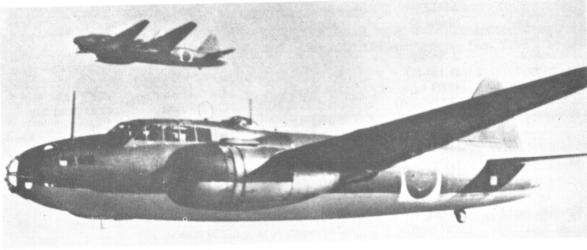
One of the best-known Japanese aircraft of the war, the twin-engine G4M Type 1 medium bomber (allied code name Betty) performed in ways that rivaled many four-engine bombers. Almost 200 were in service at the time of the Pearl Harbor attack, and they operated wherever land bases were available to the Japanese. Twenty-six of these planes joined with G3M 'Nell' bombers to sink the Prince of Wales and Repulse. These aircraft flew against land and naval targets throughout the Pacific area, and near the end of the war were modified to carry Baka suicide aircraft.
The Mitsubishi G4M was designed as teh successor to the G3M 'Nell'; the prototype flew in Oct. 1939 and it was put into production that same month as the G6M1 long-range escort fighter. That project, however, was quickly abandoned with the thirty units completed being deployed as transports and trainers. In April 1941 the bomber version entered production. The much-improved G4M2 prototype flew in Nov. 1942. Total Betty production was 2,416 aircraft-more than any other Japanese bomber. These included sixy G4M3 variants with more protection, a fire extinguishing system, and more powerful engines, but the U.S. bombing raids dusrupted production of these advanced aircraft. Late-prdouction aircraft also had a surface-search radar.
The mid-wing 'Betty' had a rounded appearance, with glazed nose and tail positions; it was a mid-wing aircraft with twin radial engines and a large tail fin. The aircraft was fitted with an internal bomb bay that could carry an aerial torpedo or up to 2,200 pounds of bombs. The excellent performance of the 'Betty' was achieved at teh expense of armor for the crew and fuel tanks, making the aircraft highly vulnerable to attack.
The G4M2a variant could reach 272 mph and was credited with a range of 2,260 miles. Defensive armament in the F4m2a variant consisted of four 20 mm cannon and one 7.7 mm machine gun, all in flexible mounts. The crew numbered seven.
Specifications:
Manufacturer: Mitsubishi Jukogyo K.K.
Primary Role: Ground based Medium Bomber
First flight: (prototype) 23 October 1939
Operational Service: 1940 - 1945
Number produced: 2.446 total, 1.200 G4M1
Crew 7: pilot, co-pilot, navigator/bombardier, radio operator/gunner, three gunners
Powerplant: 2 × Mitsuishi MK4A Kasei 11 radial, rated at 1530 hp (1140.6 kW) each
Dimensions:
Length: 65 ft 7.25 inch
Height: 19 ft 8.25 inch
Empty weight: 14991 lb
Operational weight: 20944 lb max
Wing Span: 82 ft 0.25 inch
Performance :
Service ceiling: 29,363 ft (8950 m)
Maximum speed: 266 mph at 13780 ft
Cruising speed: 196 mph at 9845 ft
Initial climb rate: Climb to 22,965 ft in 18 min 0 sec
Range: 3749 miles max
Fuel capacity: internal 1,078 Imp gal (1,294 US gal)
Armaments:
Machine guns
1 × 0.303 inch Type 92 trainable forward-firing in the nose
1 × 0.303 inch Type 92 trainable rearward-firing in a dorsal blister position
2 × 0.303 inch Type 92 trainable lateral-firing, 1 in each beam position
Cannons 1 × 20 mm Type 99 Model 1 trainable rearward-firing in the tail turret
Bomb load Up to 1,764 lb, carried on underfuselage hardpoints as:
1,764 lb of free-fall bombs or
1 × 1,764 lb torpedo instead of bombs


All photos Copyright of their respective websites
Of course, as we have discussed before, stupid Japanese tactics helped us out. Feeding units in piecemeal and later dividing their forces was a definite plus for us. Do the Japanese just not believe that mass or concentration of effort is a principle of war??


Hi Sam and Snippy
During the opening days of the Phillipines landings in OCT 44..several Cans found themselves alloted for [ call fire ] missions in support of the beachead breakout.
Was able to track the armies movement at Leyte in a seires written after the war.
From 11:00 PM -20TH to 05:00 on the 21ST the USS Isherwood DD-520 moved into callfire station offshore.
The Dec log and action reports from DD-520 list 3 seperate fire controlers over a 5 mile front which called in rounds and Star Shells.
DD-520 was released at 5:30 with a congrats for turning a Japanese counter attack.
As I studied the Armies records of this evening..a more grim picture emerged.
The Japanese had a massed counter attack on a flanking movement inland just a few miles from shore.
Troops from the primary landings had be set in this quadrant for rest..and were not expecting opposition.
Things were tight..the line barely held..losses were high..fighting was hand to hand at some points.
Like other Islands..the Japanese ran on the U.S. forces in full kamikaze/suicide run to break the line.
Again this occured over a 5 mile line..in the dark..with no support except Isherwoods callfire and Army mortar teams.
Outnumbered 2-1 the U.S. held the line that night..but as history goes..Japan was not quite finished in its counter attack strategem at Leyte Gulf.
The U.S. got pressed hard at Leyte...the valor of the U.S. army..the slug fest off Surigao a few days later..plucky Taffy 2 Going head to head with Japanese Battleships.
At a Reunion in Frisco..some of the crew of 520 commented that the ship had the rabbits foot...near trouble..but not really in the gravest part of it.
Attached to Admiral Jessie Oldendorfs southern Battleship group..DD-520 saw action..and the Surigao..but things could have been very different..if She was assigned to Taffy 2..as the "Little Wolves" wrote history..most not comming home off Letye Gulf.
Guadalcanal was very much Like Leyte Gulf..except it was not over in days..it went on and on..fortitude carried the day.
The Japanese didn't have it..the U.S. Did : )
Fleet protocal off Okinawa called for 'Night Retirement'...Battlegroups and their screens...transports and their screens would sail out to sea..and do circuits..returning to Okinawa around 5:00 AM.
Many ship action reports mention Betty's circling out on the periphery of 5" mount range.
Saliors could see the erie green glow of the Betty's cockpit...general quarters ringing...ships in evasive pattern...mines in the water..torpedoes.
USS Halligan was lost of Kerram Retto moving to fire support..the next morning when she had been off TBS for hours..here shattered hull was found.
The entire bow to the bridge was violently blown away.
Wether she had sailed into a mine field..or had inadvertantly sailed into mines dropped by Betty's..her end came sudden..only a few officers survived to recount Halligans loss.
The Betty was not a sophisticated bomber..but it was flexable..and gave U.S. Forces in the Pacific fits.

CAP and CAP directer teams on the outlying Radar Picket Destroyers really made thier mark off Okinawa..the system worked ..by May I believe..the Army had set up 90MM radar guided arty..really thinned out the Betty's and Kamikazes.
Once the 90's were locked on..there was hardly a chance for escape.
Have read many scarry acounts from pilots who flew CAP off Okinawa.
Navy was trigger happy for sure..but hard to blame the crews..they saw alot of thier sister ships on station go up in fireballs hundreds of ft and sink.
Ya..it took nerve to follow a Val or Zero over the fleet in a Corsair.
I bet the Cosair pilots talked to God alot : )
...fortitude carried the day.
Something Americans have proved in many battles!
Thanks for your insight today.
We figured you might have some catching up to at work to do after being on vacation even though you have stopped in since. I've been meaning to let you know that we did a thread on Saipan while you were gone.
Just in case you may have missed a few while you were at your in-laws here are the links.
The FReeper Foxhole Remembers The Battle for Saipan (Jun - July, 1944) - July 29th, 2003
The FReeper Foxhole Remembers The Sinking of the USS Indianapolis (Jul-1945) - July 30th, 2003
The FReeper Foxhole Remembers The Gulf of Tonkin Incident (8/2/64) - Aug. 3rd, 2003
I realize you're busy but I generally expect to see you chime in on the Naval threads and therefore have double the reason to look forward to them.
Hope all is well with you and yours.
:)
Disclaimer: Opinions posted on Free Republic are those of the individual posters and do not necessarily represent the opinion of Free Republic or its management. All materials posted herein are protected by copyright law and the exemption for fair use of copyrighted works.


