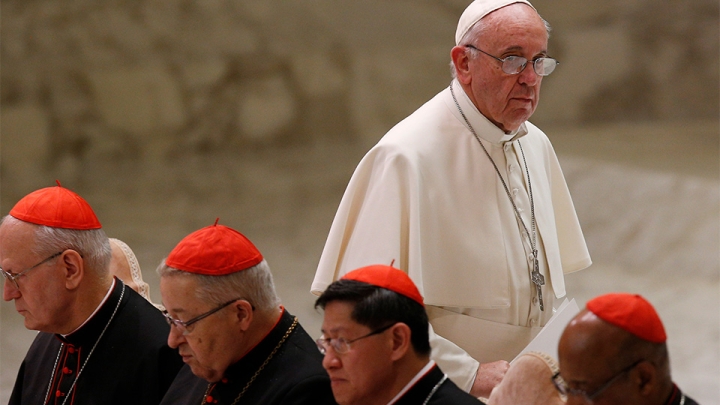
Posted on 07/11/2024 9:59:07 AM PDT by ebb tide
“Ecumenical dialogue is fundamental to fostering an understanding of synodality and the unity of the Church. Above all, it drives us to imagine authentically ecumenical synodal practices, including forms of consultation and discernment on shared and urgent concerns.” (Synod on Synodality, Instrumentum Laboris for the Second Session (October 2024))
Although we have already seen more than enough to unequivocally condemn Francis’s Synod on Synodality as a blasphemous assault on the Catholic Church, it is worth considering how the newly released Instrumentum Laboris refines the Synodal Church’s anti-Catholic contours. As discussed in a recent article, it has been evident for some time that Francis’s Synodal Church is shaping up to be Protestantism in union with a Bishop of Rome. The new Instrumentum Laboris elaborates on two key aspects of the Protestantization of the Synodal Church: celebrating diversity of religious belief, and decentralizing doctrinal decisions.
The Synodal architects show their true intent in the third passage: “Taking this plurality of forms seriously avoids hegemonic tendencies and mitigates the risk of reducing the message of salvation to a single understanding of ecclesial life and its liturgical, pastoral, or moral expression” This removes all reasonable doubt — it is evident that the Synodal Church celebrates not only diversity of culture but also diversity of “ecclesial life” and “liturgical, pastoral, [and] moral expression.”
Celebrating Diversity of Religious Belief. We have seen that the Synodal Church encourages confused Catholics to embrace the sins of those who do not follow the Catholic moral teaching, but the new Instrumentum Laboris includes a few passages that make it clear that members of the Synodal Church must also celebrate diversity of religious belief:
This may seem subtle, but the Synodal architects show their true intent in the third passage: “Taking this plurality of forms seriously avoids hegemonic tendencies and mitigates the risk of reducing the message of salvation to a single understanding of ecclesial life and its liturgical, pastoral, or moral expression” This removes all reasonable doubt — it is evident that the Synodal Church celebrates not only diversity of culture but also diversity of “ecclesial life” and “liturgical, pastoral, [and] moral expression.”
By now there can be little excuse for those who go along with the Synod, hoping that it will avoid taking a major step such as approving the ordination of women. Those headline issues now appear to be deliberate distractions to keep otherwise rational Catholics from realizing that Francis and his collaborators have been creating a universalized form of Protestantism in union with a Bishop of Rome.
Decentralizing Doctrinal Decisions. The Instrumentum Laboris also reveals another aspect of the Protestantization of the Synodal Church that is even more clear, the decentralization of doctrinal decisions:
At first glance, the third passage may not seem to relate specifically to decentralization of doctrinal decisions but it has the most intriguing implications because it allows for decision-making at the level of “Institutes of consecrated life and Societies of apostolic life” that may span various geographies. As discussed in a recent article, this may help explain why Rome has (at least temporarily) shown favor to the ex-Ecclesia Dei communities (e.g., the FSSP and ICKSP): it validates the model for “recognizing” the Catholicity not only of actual Catholic institutes that dissent from Francis’s revolution but also non-Catholic groups (i.e., Protestants) that dissent from both Francis’s revolution and Catholicism.
Again, we did not need anything further to alert us to the need to fight against Francis’s Synodal Church, but the new Instrumentum Laboris may open the eyes of some who have yet to see. By now there can be little excuse for those who go along with the Synod, hoping that it will avoid taking a major step such as approving the ordination of women. Those headline issues now appear to be deliberate distractions to keep otherwise rational Catholics from realizing that Francis and his collaborators have been creating a universalized form of Protestantism in union with a Bishop of Rome.
All of this helps us better understand why the German and other heretical bishops remain in good standing while Archbishop Carlo Maria Viganò has been “excommunicated.” Diversity of religious belief is celebrated in Francis’s new Synodal Church and those who make too much of a show about saying that the non-Catholics are wrong (and need to convert) will not be welcome. May God grant us all the grace to hold firm to beliefs that are not welcome in Francis’s blasphemous Synodal Church. Immaculate Heart of Mary, pray for us!
Ping
This mass of gobbledygook hurts my brain. When did the Church stop speaking in intelligible sentences?
kinda like how Americans aren’t welcome in America.
I’ll give ya an AMEN!
I don’t have any difficulty with the style of verbal exposition; I do have great difficulty with Bergoglio the Churchbreaker and his Anti-Catholic Crusades.
Don’t care about the anti-pope and his “church”, by the blood of Jesus Christ I will be welcome in Heaven and that is enough for me.
It is another thing entirely for churches to unite their separate belief systems when all of the others are in someway deficient.
.....Celebrating Diversity of Religious Belief. We have seen that the Synodal Church encourages confused Catholics to embrace the sins of those who do not follow the Catholic moral teaching, but the new Instrumentum Laboris includes a few passages that make it clear that members of the Synodal Church must also celebrate diversity of religious belief.....
That’s a lot like the ELCA!
About 1962 AD
GotQuestions.org
https://www.synod.va/en/the-synod-on-synodality/what-is-the-synod-about.html
Needs a clearer explanation
Quote:
This mass of gobbledygook hurts my brain. When did the Church stop speaking in intelligible sentences?
_____________________
325 AD
“When did the Church stop speaking in intelligible sentences?” ... “I’ll give ya an AMEN!”
and I’ll join the chorus!
Agreed. They always write in obtuse platitudes and sophistry. It seems the intent is it hide their true meaning rather than reveal it.
Except for the Traditional Latin Mass.
We can't have that?
That is just too OLD.
Disclaimer: Opinions posted on Free Republic are those of the individual posters and do not necessarily represent the opinion of Free Republic or its management. All materials posted herein are protected by copyright law and the exemption for fair use of copyrighted works.