Skip to comments.
US airman rescued from Iran shares unbelievable tale of survival with ‘60 Minutes’: ‘Most terrifying thing I’ve ever seen’
New York Post ^
| Sep. 13, 2026
| Zoe Hussain
Posted on 09/13/2026 10:16:14 PM PDT by nickcarraway
The US Air Force colonel rescued from Iran in April revealed Sunday that the “most terrifying moment” of surviving nearly two days on enemy lines was plummeting to earth with a damaged parachute after his F-15E Strike Eagle was shot down.
The weapons systems officer — identified only by the mission call sign Dude 44 Bravo — spoke publicly about his unbelievable tale of survival for the first time in an interview with CBS “60 Minutes” host Norah O’Donnell for the show’s 59th season premiere Sunday evening.
Bravo’s plane was shot down by an Iranian with a shoulder-fired missile on April 3, and crashed in the Kohgiluyeh and Boyer-Ahmad province in the southwestern part of Iran near Iraq. The impact of the missile was like “getting hit by a freight train,” Bravo said.
(Excerpt) Read more at nypost.com ...
TOPICS: Foreign Affairs; Iran; News/Current Events
KEYWORDS: 60minutes; airman; iran
Navigation: use the links below to view more comments.
first 1-20, 21-30 next last
To: nickcarraway
Thank the Iranian peoole. They filled the streets in all the towns in the area to slow down the IRGC.
2
posted on
09/13/2026 10:28:57 PM PDT
by
Jonty30
(When a woman tells dad jokes, she is being a faux-pa.)
To: nickcarraway
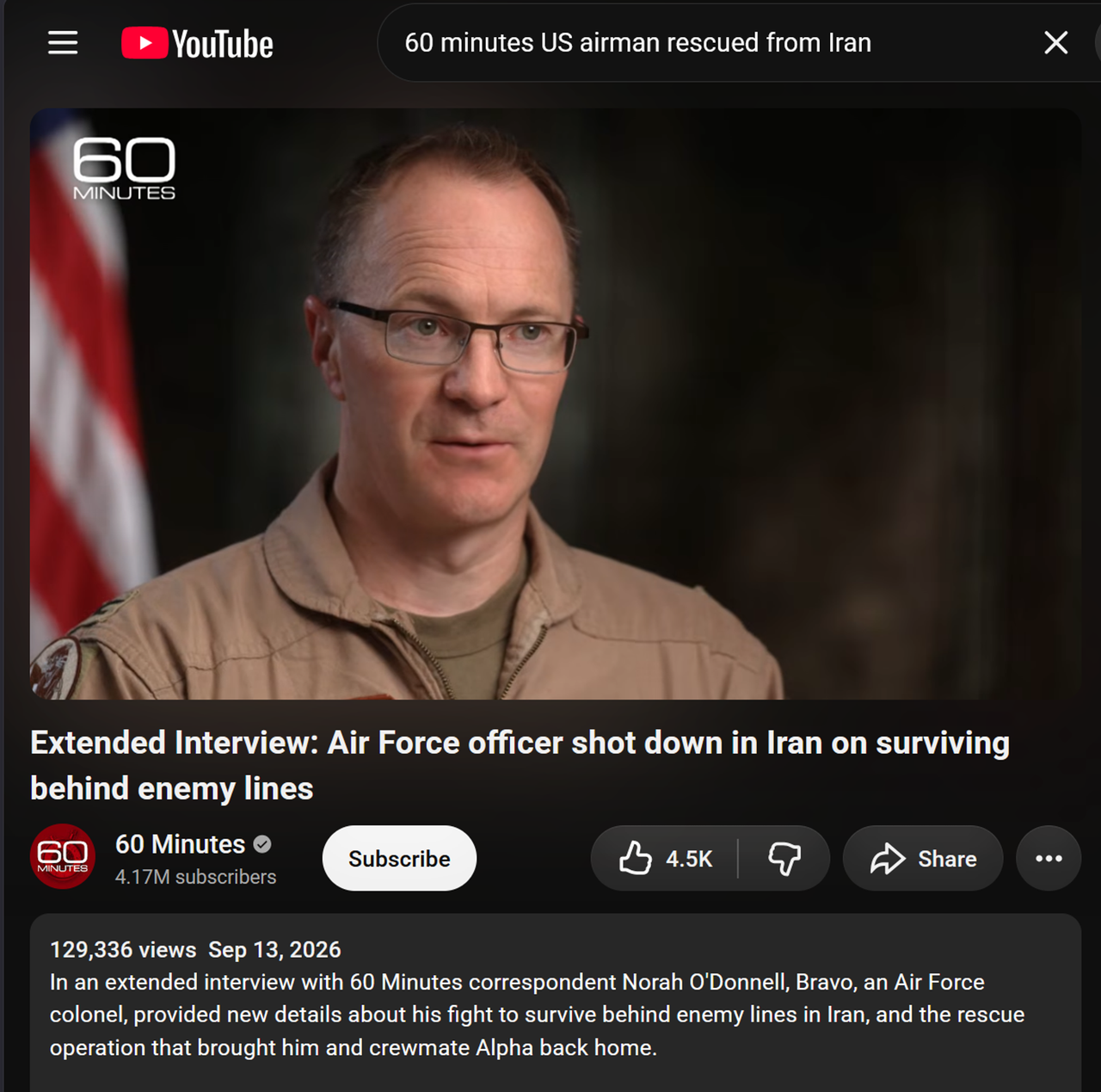
Video Transcript Summary
Detailed summary of the 60 Minutes interview with “Bravo” (weapons systems officer of F-15E “Dude-44”)
In April, roughly five weeks into a costly and unpopular war, an American F-15E Strike Eagle (call sign Dude-44) was shot down by an Iranian shoulder-fired missile while flying a nighttime mission over a mountainous desert region south of Isfahan, Iran. The two-man crew—pilot “Alpha” and weapons systems officer “Bravo”—ejected and landed miles apart. Both quickly had Iranian bounties on their heads. What followed was one of the largest combat search-and-rescue operations in U.S. military history, lasting about 50 hours. This was Bravo’s first public interview about the ordeal; he had previously discussed details only with medical staff and close friends.
The shoot-down and ejection
Bravo described the F-15E as America’s premier “war horse”—twin-engine, twin-crew, long-range, heavily armed. He and Alpha had never flown together before, which is not unusual given standardized training. The jet was hit with extreme violence that Bravo likened to being struck by a freight train. Systems failed catastrophically, including damage to Bravo’s ejection seat. Despite the damage, the seat performed beyond design specifications thanks to the maintainers’ work; Bravo credits them with saving his life. The crew ejected almost simultaneously (with a slight staggered timing for safety), and Bravo found himself parachuting over the heart of Iran.
His parachute was damaged in the initial attack. At one point he looked up and saw none, an experience he called the most terrifying of his life. He prayed, “Lord, your will be done. But if I’m getting through this, I need help,” and worked to unfurl or free the canopy using SERE (Survival, Evasion, Resistance, Escape) training. He hit the ground at an estimated 70–100 mph. Injuries included a broken back, broken arm, broken shoulder, sprained ankle, and bleeding cuts and scrapes to the head and face. He attributes survival—without catastrophic injuries that would have prevented movement—to a “modern-day miracle” and God’s provision, supported by medical records and equipment evidence.
Evasion on the ground
Bravo immediately moved away from the landing site despite his injuries, guided by SERE priorities: distance from the enemy, concealment, communication opportunities, and defeating detection. He had no full survival kit (it was lost with the damaged seat) but carried a survival vest with limited water, basic signaling/communication gear, and tools. He treated external bleeding when possible and adapted movement to internal injuries. Iran is vast (comparable to Alaska), with high-desert valleys and craggy cliffs; Bravo chose higher ground for better survival odds and climbed a roughly 7,000-foot ridgeline. His motivation: “Never let a lack of motivation put you on Iranian TV.” He applied the warrior ethos he had instilled in his airmen, determined to match the standard he had preached.
He delayed radio contact until he reached concealment, then transmitted whenever feasible without compromising evasion. Iranian forces and armed groups actively hunted him (news anchors announced bounties; videos of search parties circulated). U.S. sources later said Iranians came within a few hundred meters. Bravo was armed and prepared for close contact but focused only on controllable next steps rather than worst-case outcomes. He endured cold, wind, and exposure on the high cliffs with minimal gear, almost no food or water, for a full additional day and night after Alpha’s rescue.
Witnessing Alpha’s rescue
About six hours after the shoot-down, U.S. forces rescued Alpha in a risky daytime operation involving helicopters (part of a larger 21-aircraft effort) that took fire; declassified video showed the raid. From his ridgeline vantage, Bravo watched and called it “the proudest dad moment of my life” (with apologies to his actual children). Many of the rescuers were from his own unit. Seeing them uphold the “so that others may live” ethos reinforced his belief that America keeps its promises and boosted his will to survive. The same force searched unsuccessfully for Bravo and withdrew. That evening Bravo sent messages including “I’m hurt. I’m moving. God is good,” reflecting on the successive miracles of surviving the missile strike, the high-speed impact, and ongoing evasion.
Final rescue and extraction
The CIA ran a multi-pronged effort that included deception to confuse Iranian forces and specialized technology to pinpoint Bravo. American bombers and drones struck nearby Revolutionary Guard units to clear the area (newly declassified video shows the strikes). Nearly two days after the shoot-down, rescue forces arrived on two large search-and-rescue aircraft that landed on a makeshift desert airstrip, then deployed small Little Bird helicopters to reach Bravo’s ridgeline. Declassified video shows Bravo waiting; elite Air Force pararescue jumpers (PJs) reached him. He described their arrival as one of the greatest moments of his life and simply said “Let’s go.”At the airstrip the planes’ landing gear became stuck in sand. A clandestine U.S. Air Force unit extracted Bravo and more than 90 special operators. The U.S. then bombed its own stranded aircraft to prevent technology from falling into Iranian hands. Bravo was safely recovered as the sun rose on Easter Sunday—about 50 hours after being shot down. He later called his wife; he praised her strength and emphasized that entire families serve when service members deploy.
Reflections
Bravo stressed that the story is not primarily about him but about teamwork, rigorous training, faith, leadership, and the U.S. commitment to leave no one behind. He never doubted rescue would come. Faith underpinned his actions as a “backstop” to training rather than a substitute for it. He intends to continue serving. Alpha (back flying) declined an interview but issued a statement expressing awe at the professionalism of the combat search-and-rescue specialists and joint force, both in theater and behind the scenes, and profound gratitude from his family.
Throughout, Bravo repeatedly credited maintainers, SERE trainers, the rescue force, PJs, the broader joint team, and the support of the American people and families. He remains recovering from injuries but is overall doing well and deeply grateful.
3
posted on
09/13/2026 10:53:43 PM PDT
by
E. Pluribus Unum
(The right of Democrats to embezzle elections shall not be infringed. )
To: E. Pluribus Unum
“In April, roughly five weeks into a costly and unpopular war...”
These writers never stop.
I recall watching an old news video of the first major combat in Vietnam in the Ia Drang Valley (”We were soldiers once and young”).
While that battle was a victory for the U.S., it did come at a cost of life for our guys; as war does. One of the correspondents (a well-know broadcaster later on - I forget who though now) said something like: “And while the Army claims a victory, it remains to be seen how long the parents back home will put up with having their sons return home in body bags.”
The very first battle!
4
posted on
09/13/2026 11:00:31 PM PDT
by
21twelve
(Ever Vigilant - Never Fearful)
To: E. Pluribus Unum
Mother-in-law had 60 minutes on - it was an interesting show. When I read the news when it happened on FR my reaction was “Great - they got them out.” Not really thinking too much about it.
After watching the show I’m struck by how much effort it really took to get him out. 90 boots on the ground - all putting themselves in harm’s way. Thousands in the air and command posts.
I wonder if that display of humanity ever enters into the enemies’ heads? “Gee - maybe USA is a good place? If something like that happened to me nobody would spend that kind of effort to save me.”
5
posted on
09/13/2026 11:09:28 PM PDT
by
21twelve
(Ever Vigilant - Never Fearful)
To: nickcarraway
6
posted on
09/13/2026 11:27:50 PM PDT
by
Red6
To: 21twelve
“ I wonder if that display of humanity ever enters into the enemies’ heads? “Gee - maybe USA is a good place? If something like that happened to me nobody would spend that kind of effort to save me.””
What enemy? These guys?
Absolutely not
A lot of my suburban women buddies think all people can become nice people.
They don’t consider the way some people are formed. I can’t change the mind of a suburban American woman. So, no, can’t influence any of these guys.
But people won’t stop pretending
7
posted on
09/13/2026 11:40:20 PM PDT
by
stanne
To: Jonty30
Thank the Iranian peoole. They filled the streets in all the towns in the area to slow down the IRGC.How do you know this? The airman was rescued in a very remote area that didn't appear to have many, if any towns.
8
posted on
09/13/2026 11:54:42 PM PDT
by
Avalon Memories
(It seems to be a law of nature...that those who will not risk cannot win. --John Paul Jones)
To: Avalon Memories
The IRGC would have to pass through towns to get to the mountains. If the reports are true, then in these towns the kocals did what they could to pose a problem.
There cant be absolute verification on this, because the IRGC would kill entire towns in retribution, so.you cant know everything now.
From Chatgpt:
I dug further into the Iranian-language reporting and the later U.S. account. **There is some interesting evidence of local opposition to the IRGC search, but I would not go as far as saying it has been proven that Iranian civilians deliberately prevented the IRGC from capturing the airman.**
### What the evidence actually shows
- **There were Iranian social-media posts explicitly calling on locals to protect the American airman.** One post from the Yasuj area said, in Persian, essentially: _“I ask all the people of the Yasuj region to shelter the American pilot. Don’t let him fall into the hands of the IRGC.”_ That is evidence of people advocating helping him, although a social-media post by itself doesn’t establish that anyone actually did so. Instagram
- **Iranian authorities were actively mobilizing locals to find him.** AP reports that Iranian state television was telling residents in the mountainous area to turn over an “enemy pilot” to police and offering a reward for doing so. AP News
- **The airman himself appears to have survived primarily through evasion and concealment.** The later U.S. account says he was badly injured, moved away from the crash site, climbed into mountainous terrain and hid for nearly two days. U.S. intelligence simultaneously conducted a deception campaign intended to mislead Iranian forces about his location. AP News+1
- There are also reports of **armed local tribesmen firing at the American rescue helicopters**. That’s important because it shows that the local population was _not_ uniformly sympathetic to the Americans. In fact, some locals appear to have actively opposed the U.S. rescue operation. AP News
### The particularly interesting part
The reports appear to have gotten mixed together.
There really **were people in Iran who wanted to help the American airman**, and there were calls online for locals to hide/protect him. But I haven’t found reliable evidence demonstrating that those people actually **blocked IRGC units, physically prevented a capture, or escorted the airman to safety**.
Conversely, the evidence for the **IRGC being deliberately deceived and misdirected** is quite strong. The U.S. says the CIA ran a deception operation while Iranian forces were searching for Bravo. AP News+1
And there’s a fascinating detail: **Iranian state media was simultaneously encouraging locals to capture him**, while some Iranian social-media users were encouraging locals to protect him. So there appears to have been a genuine split between the regime’s objective and at least some people’s attitudes toward it.
### My assessment
I’d rank the claims this way:
| Claim | Assessment |
| -— | -— |
| Iranians were searching for the airman | **Confirmed** |
| Iranian authorities asked locals to help capture him | **Confirmed** |
| Some Iranians publicly urged locals to protect/hide him | **Documented** |
| Locals actually helped him evade the IRGC | **Plausible, but unproven** |
| Locals physically blocked IRGC search teams | **Unverified** |
| The U.S. deliberately deceived Iranian forces | **Strongly supported** |
| Local armed groups fired on the U.S. rescue force | **Reported by U.S. sources; substantial evidence** |
So **yes, there is more substance to the story than I initially suggested**, particularly regarding Iranian civilians _wanting_ to help him. But the specific viral claim that “the Iranian people stopped the IRGC from getting the American airman” is still too strong based on the evidence I’ve been able to find.
One thing I would particularly like to investigate further is the **Persian-language videos from Dehdasht/Yasuj posted during those 48 hours**. Those could potentially show whether civilians were actually interfering with IRGC/Basij movements rather than merely expressing support online.
9
posted on
09/14/2026 12:35:45 AM PDT
by
Jonty30
(When a woman tells dad jokes, she is being a faux-pa.)
To: stanne
Yeah - I did a quick search on it on how the enemy sees it. They see it as a chance to capture one of our guys and then make a trade for 10 of their guys. And/or inflict damage on the teams that they know are going to go in to attempt a rescue.
10
posted on
09/14/2026 12:50:23 AM PDT
by
21twelve
(Ever Vigilant - Never Fearful)
To: Jonty30
If this region has been a victim of the IRGC’s corrupt, bungled management of the water supply, or has been a victim of the murderous IRGC suppression of “water protests”, the locals might have good reason to try to sort of “passively” snarl up the IRGC...
11
posted on
09/14/2026 2:43:17 AM PDT
by
Paul R.
(Who else but Dolly Parton could go so far by being so genuine about being so fake?)
To: E. Pluribus Unum
Interviewed by a liberal, America hating POS O’Donnell
12
posted on
09/14/2026 2:43:36 AM PDT
by
albie
To: Jonty30
This is the best post I’ve read in a long time. Thanks.
13
posted on
09/14/2026 3:05:39 AM PDT
by
Gen.Blather
(Oh, gosh! I said that out loud. I'm so sorry.)
To: Gen.Blather
I dont usually watch these type of movies. However, I would watch this if it was made mostly historically accurate. Show the good Iranians and collusive Iranians, the mustakes by the US military and just how close the US got to losing these men.
I would watch this at least twice.
14
posted on
09/14/2026 3:14:49 AM PDT
by
Jonty30
(When a woman tells dad jokes, she is being a faux-pa.)
To: nickcarraway
I was an Army AH-64D/E Aviator for 18 years of my 22 year career. The lengths to which our nation will go to rescue one person is unique in the world.
It is the reason I flew mission after mission knowing that if I ever went down, I would be recovered if I could survive 24-48 hours.
It made doing dangerous things a lot easier knowing that we’d move heaven and earth if any of us ever went down.
15
posted on
09/14/2026 3:53:24 AM PDT
by
Nathan _in_Arkansas
(Hoist the black flag and begin slitting throats. )
To: 21twelve
I admit I speed read most of it but what happened to the “crew”?... his copilot?
16
posted on
09/14/2026 4:01:19 AM PDT
by
sit-rep
(I may be Dumb, but I'm not Stupid!)
To: Red6
17
posted on
09/14/2026 4:11:17 AM PDT
by
Savage Beast
(When the student is ready, the teacher appears. When the people are ready, the hero appears.)
To: 21twelve
On a similar vein, I forget who it was but an adversary of the US once said “America takes better care of their dead than we do of our living.”
18
posted on
09/14/2026 4:50:55 AM PDT
by
cyclotic
(Don’t be part of the problem. Be the entire problem)
To: 21twelve
I wonder if that display of humanity ever enters into the enemies’ heads? “Gee - maybe USA is a good place? If something like that happened to me nobody would spend that kind of effort to save me.”
......
No not at all. It is seen as enormous weakness.
JAMES MITCHELL: No. Eh, here’s what Americans I think don’t know. When they kill people, it’s an act of worship. One of the things that became clear to me when I was talking with these guys is that one way they show their love for Allah and one way they show how powerful Allah is, is by slaughtering people who are helpless to prevent it. So when they, you know, they cut the throat of a Yazidis sex slave and she bleeds out in a bowel, that’s actually an act of worship. It’s not an act of aggression.
You know, when they crucify children or burn people in cages or in KSM’s case when he decapitated Daniel Pearl and then dismembered his [Mark: right] cut his arms and legs off and stacked him a hole, that was not a, an, act of anger. It was an act of love for his god and he feels as though he shows his god how powerful his god is by how helpless innocent people are to prevent their destruction.
JAMES MITCHELL: Well we assume it’s important for them to like us. [Mark: Yeah] And that, and that if they, if they only liked us, if they only understood that we want to live in peace with them, then everything would be okay, but it’s actually the opposite. What KSM told me was that our judicial system, our Bill of Rights, our civil liberties, our desire to have other people in the world like us were all weapons that Allah had placed in our minds so that we could be defeated by the Islamists who were the true, had the true dominion of the world.
....
This is who they are. Not going to change.
To: 21twelve
“ Yeah - I did a quick search on it on how the enemy sees it. They see it as a chance to capture one of our guys and then make a trade for 10 of their guys. And/or inflict damage on the teams that they know are going to go in to attempt a rescue.”
Pretty standard bad guy stuff
20
posted on
09/14/2026 5:31:43 AM PDT
by
stanne
Navigation: use the links below to view more comments.
first 1-20, 21-30 next last
Disclaimer:
Opinions posted on Free Republic are those of the individual
posters and do not necessarily represent the opinion of Free Republic or its
management. All materials posted herein are protected by copyright law and the
exemption for fair use of copyrighted works.
FreeRepublic.com is powered by software copyright 2000-2008 John Robinson