
Click here: to donate by Credit Card
Or here: to donate by PayPal
Or by mail to: Free Republic, LLC - PO Box 9771 - Fresno, CA 93794
Thank you very much and God bless you.
Posted on 10/22/2026 3:25:59 PM PDT by ebb tide
The Dicastery for the Doctrine of the Faith has released a new text titled Venite ad me: Considerations on the Transmission of the Faith in an Epochal Change — signed by Cardinal Víctor Manuel Fernández and approved by Leo XIV. The document continues the same pattern seen in Amoris Laetitia and Fiducia Supplicans: it uses vague language to loosen the Church’s clear moral teaching, especially on morality. The practical effect is to make people feel better about living outside the Church’s rules without formally changing those rules.
This is the same approach used to bless same-sex “couples” in Fiducia Supplicans and to allow Communion for the divorced and “remarried” in Amoris Laetitia. It makes people think the “old” rules of morality aren’t really binding anymore if they feel too hard.
Here are three examples from the text. First, from paragraph 80:
… drawing on the numerous documents and resources prepared by the Dicastery for Evangelization, it is now more urgent than ever to examine wisely and with discernment the current ways of organizing catechesis, so that the transmission of the faith is not confined to language that can be labeled as ‘scholastic,’ ‘dogmatic,’ or ‘moralistic.’ All too often, repetitive and self-referential communication of the Gospel message risks failing to speak to the hearts of the faithful. For this reason, the language of faith must not be limited to a cold exposition of concepts.
From paragraph 83, quoting Francis’ Evangelii Gaudium:
The centrality of the kerygma calls for stressing those elements which are most needed today: it has to express God’s saving love which precedes any moral and religious obligation on our part; it should not impose the truth but appeal to freedom; it should be marked by joy, encouragement, liveliness and a harmonious balance which will not reduce preaching to a few doctrines which are at times more philosophical than evangelical.
From paragraph 84:
… it does not seem fitting—when communicating the faith to new generations, adult catechumens, and so-called ‘returnees’—to get lost in the many areas of Catholic doctrine, however important they may be, and thus lose sight of what is most ‘solid, profound, secure, [and] meaningful’ within it: namely, the love of God, which is like a flame capable of restoring life, joy, hope, and trust to every human existence.
The new Vatican text also wants to “expand opportunities for women to participate in the leadership of ecclesial processes” (n. 116), more of the synod-style changes wanted by Leo XIV.
When so many prelates have been compromised by homosexuality, especially since they have easy access to other men in the clergy, people have begun to wonder if the preference for ambiguous wording which confounds doctrine is not calculated. If people are assuaged in their consciences about their own sexual moral disorders, such as pornography or adultery, they will be much more likely to accept the deviancy of homosexuality, even among the clergy. The homosexual agenda of the clergy is thus advanced under the cover of pastoral mercy and now new ways to transmit the faith.
|
|
Click here: to donate by Credit Card Or here: to donate by PayPal Or by mail to: Free Republic, LLC - PO Box 9771 - Fresno, CA 93794 Thank you very much and God bless you. |
Here are three examples from the text. First, from paragraph 80:
… drawing on the numerous documents and resources prepared by the Dicastery for Evangelization, it is now more urgent than ever to examine wisely and with discernment the current ways of organizing catechesis, so that the transmission of the faith is not confined to language that can be labeled as ‘scholastic,’ ‘dogmatic,’ or ‘moralistic.’ All too often, repetitive and self-referential communication of the Gospel message risks failing to speak to the hearts of the faithful. For this reason, the language of faith must not be limited to a cold exposition of concepts.
Ping
“For this reason, the language of faith must not be limited to a cold exposition of concepts.” Ebb, I don’t know what a ‘cold exposition of concepts’ is.
The pope needs to scold God for having such moralistic language in the 10 commandments!
Except for two references to St. Augustine, all other sources were post-conciliar.
Ideas are no longer permitted. Only feelings.
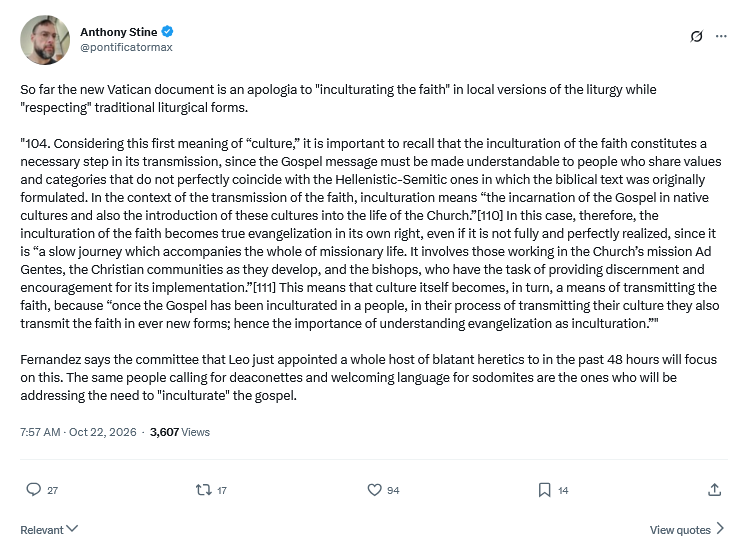
Except for traditional Catholics. Right, Tucho?
Disclaimer: Opinions posted on Free Republic are those of the individual posters and do not necessarily represent the opinion of Free Republic or its management. All materials posted herein are protected by copyright law and the exemption for fair use of copyrighted works.