
Posted on 09/04/2026 6:42:44 PM PDT by ebb tide
The diplomatic farce of the Vatican’s Ostpolitik has reached a new, desolate peak. Last August 31, Paul Liu Honggang was consecrated bishop of Datong. The appointment had been formalized by Pope Leo XIV on August 10, months after the Chinese Patriotic Catholic Association had unilaterally “elected” him on April 28. As is now established practice: Beijing chooses, Rome ratifies and consecrates.
The figure of Liu Honggang perfectly embodies the drama of the “sinicization” of Catholicism: a process that does not explain the faith to the local culture, as the defenders of the Sino-Vatican mechanism set up under the direction of Bergoglio and Parolin in recent years would have it, but subordinates the doctrine of the Gospel to Marxist ideology.
The curriculum of the new bishop of Datong speaks for itself. In October 2018, Liu personally led flag-raising ceremonies to promote the “core socialist values.” When, in November 2018, eight faithful from his diocese signed and published on AsiaNews a desperate letter, denouncing the destruction of a cross, a church, and the seizure of Bibles, Liu did not act as a shepherd, but turned into a denier of the persecution, publishing a letter in which the accusations made by his own faithful were dismissed as fabrications.
“The letter is completely fabricated,” it reads. “After conducting an investigation, we have found that no church or prayer meeting place in my diocese has been closed or suspended, nor has any cross or icon been destroyed.”
The Holy See has placed its seal on a man who formed his priests in the mythology of Mao rather than in the doctrine of Jesus Christ.Tweet this quote
As if that were not enough, Liu sought to turn the accusation around: “These eight individuals are not parishioners of our diocese, yet they falsely used the names of our parishioners to jointly sign the statement. […] Our diocese strongly requests that your association [Asia News] remove this article and publicly declare the matter.”
Asia News indirectly responded last August 31 to Liu’s accusation, stating:
“After two episcopal ordinations in Chifeng and Bameng in July, a new ordination took place in China under the agreement between the Holy See and the Chinese government. […] As is the case in such ceremonies, the Chinese Catholic Patriotic Association’s website reported that ‘Father Yang Yu, secretary general of the Council of Chinese Catholic Bishops, read the Council’s decree of approval [that is, Patriotic Association’s],’ without citing the new bishop’s appointment by Pope Leo XIV. […] For the past 20 years, like many other dioceses in China, Shanxi [that is, the province in which the diocese of Datong is located] has endured ever-tightening restrictions imposed by the Communist Party. In February 2023, a historic building belonging to the local Catholic community, located in an area of high urban value, was demolished.”
In June 2021, Liu even led his fellow priests on a “political re-education” trip to the Dongfanghong Museum to study and venerate Mao Zedong’s relics, culminating the effort with the composition of a veritable lyrical hymn celebrating the centenary of the Chinese Communist Party.
With this appointment, the Holy See has placed its seal on a man who formed his priests in the mythology of Mao rather than in the doctrine of Jesus Christ. While the Vatican entrenches itself behind an embarrassing and scandalous silence so as not to compromise bilateral channels with Beijing, Chinese Catholics faithful to Rome find themselves doubly betrayed, crushed by state violence and abandoned by the one who should act as the vicar of Christ and successor of Saint Peter.
Furthermore, the disparity in treatment between the bishops of the Chinese Patriotic Church and those of the Society of Saint Pius X is becoming increasingly indefensible.
Liu’s consecration as bishop of Datong is nothing but the extreme outcome, already foreseen by many, of the disastrous and pharisaical Sino-Vatican agreement signed under Francis and already renewed several times.
The first significant steps in the complex diplomatic path that led to the signing of the pacts date back – as far as we can know – to the early 2000s, when then-Monsignor Pietro Parolin established the first contacts with the Chinese authorities to unravel a delicate and confidential “Asian question.”
At the time, John Paul II was still reigning, but the Secretariat of State was already acting in parallel and in an almost autonomous manner, seeking to pursue a different policy of dialogue with the Communist bloc. Pope Wojtyla, in fact, was pursuing a project of Realpolitik. For this reason too, he was hated by broad sectors within the Vatican (mostly Freemasons and Jesuits) who, for reasons that sometimes diverged, preferred to act in affinity and not in open opposition with the Soviet Union.
Realpolitik, later defended also by Benedict XVI, is a pragmatic policy based on concrete reality and not on abstract ideological principles, which recognizes the existence of geopolitical blocs but acts to protect its own sphere of interest, exerting pressure on the adversary through the soft power of culture.
According to John Paul II, the Soviet Communist regime was a system intrinsically destined to collapse, insofar as it acted by denying the spiritual nature of man; the Polish Pontiff’s objective was therefore not to coexist with it or “manage it,” but to overcome it by accelerating, if possible, its collapse.
By contrast, Ostpolitik, historically developed by the Secretariat of State of Cardinal Agostino Casaroli and later applied by Pietro Parolin and his emerging protégé, Paolo Rudelli (current Substitute of the Secretariat of State), pursues the “policy of small steps” through constant bilateral dialogue and agreements in an attempt to obtain gradual margins of freedom for local Catholic communities. This approach considers the totalitarian regime as a necessary interlocutor with whom to coexist, an interlocutor to be “managed,” accepting compromises and imposing on the Holy See a strict diplomacy of media silence regarding internal persecutions in order to preserve the fragile negotiating channels with the authorities.
Within this framework of informal channels came the private visit to Beijing in August 2003 made by the controversial Cardinal Theodore McCarrick. Two years later, in 2005, there was official recognition by the Vatican of the Patriotic bishop Aloysius Jin Luxian. Pope Benedict XVI was still reigning.
The German Pontiff himself sought to curb this drift by firmly reaffirming, in 2007, the official line of the Holy See. In his well-known Letter to the Catholics of China, the Pope recalled the indispensable necessity of full communion with Peter, ruling out the possibility that diplomacy could ever prevail over the consistency of the Catholic faith or over the pontifical right to appoint bishops.
The disparity in treatment between the bishops of the Chinese Patriotic Church and those of the Society of Saint Pius X is becoming increasingly indefensible.Tweet this quote
Despite this, with the election of Francis, Casaroli’s Ostpolitik prevailed, but the true institutional turning point came on September 22, 2018, with the signing in Beijing of the first secret provisional Agreement on the appointment of bishops, strongly desired by Francis and negotiated by Secretary of State Parolin. The agreement, theoretically intended to promote reconciliation between official and underground clergy, immediately provoked the firm opposition of Cardinal Joseph Zen.
The secret Sino-Vatican agreements must be understood not only in light of the doctrine of Ostpolitik pursued by Parolin, but also and above all in light of Bergoglio’s political-economic thinking.
There was, in fact, a profound affinity of vision, priorities, and geopolitical sensibilities between Francis and Xi Jinping. This ideological convergence was the key factor that led the Vatican Curia to consider the secret agreements of 2018 not only diplomatically useful, but doctrinally coherent.
The main affinities concerned anti-Americanism understood as anti-capitalism, the multilateral approach to geopolitical tensions, and a strong Third Worldist imprint. Already in 2016, Cardinal Theodore McCarrick described the harmony between the two leaders as a historic opportunity, highlighting that issues crucial to Beijing – such as concern for the poor and especially ecology – were precisely the same sensibilities close to Francis’s heart.
Another point of affinity is the conception of the State. Xi Jinping and Francis (and today Leo XIV) recognize an almost absolute right of state control over the lives of citizens, understood by them as a decisive solution to poverty, allegedly caused by Western capitalism.
The affinities also extend to liturgical and ecclesiological aspects, such as the inculturation of the liturgy and synodalism. Prominent figures of the official Church submitted to the regime, such as Bishop Aloysius Jin Luxian, justified the interference of the Communist regime in the appointment of bishops by arguing that in the early Church pastors were elected by the “people” (a concept widely instrumentalized by Communist leaders), and advocating a cultural contamination of Eucharistic rites entirely analogous to that promoted by various neo-modernist theologians under Francis.
Finally, Francis’s own theological formation was linked – as is now widely known and documented – to Argentine theology of the people, a social doctrine focused on the popular classes, an offshoot of liberation theology (condemned by John Paul II) characterized by “less markedly red” nuances, but which nevertheless prepared the Vatican line of government for dialogue and compromise with socialist regimes.
The protests and Cardinal Zen’s attempt to meet Bergoglio in Rome to persuade him to reconsider the agreements proved futile. At the same time, the regime’s grip tightened on the civil and religious front: on June 30, 2020, Beijing imposed the restrictive National Security Law on Hong Kong, which led to the arrest of the well-known Catholic publisher Jimmy Lai, on the following August 10, 2020.
Despite this intensification of the persecution of Christians, in October 2022 the second two-year renewal of the secret agreement was reached, amid growing tension also evidenced by the arrest of Cardinal Zen himself, in May of the same year.
The fragile balance showed deep cracks on April 4, 2023, when Beijing unilaterally ordered the transfer of Joseph Shen Bin to the prestigious leadership of the Diocese of Shanghai, indirectly informing the Holy See only shortly before the installation through the media and blatantly violating the spirit of the pacts.
On that occasion, everyone understood that the secret Agreements were a farce and a sign of the Vatican’s total capitulation to the will of the Chinese Communist regime.
Despite this, Vatican diplomacy maintained the line of silence and thus, on October 22, 2024, went so far as to decide on a renewal no longer for two years but for four years of the agreement, extending its validity until October 2028.
The secret Agreements were a farce and a sign of the Vatican’s total capitulation to the will of the Chinese Communist regime.Tweet this quote
Only one month later, in November 2024, Shen Bin personally led a seminar in Shanghai urging the clergy to study the ideology of the Communist Party and the “sinicization of religions” theorized by Xi Jinping, revealing the ideological drift imposed on the official Church.
Sinicization is the political and cultural strategy promoted by Xi Jinping to fully subordinate all religious expressions, and Catholic faith in particular, to Marxist-Leninist ideology and the core values of socialism. Rather than an authentic cultural adaptation, it takes the form of a process of forced assimilation in which Christian doctrine is stripped of its supernatural identity in order to be clothed in propaganda, going so far as to impose on the clergy the study of Xi Jinping’s thought instead of the Pope’s magisterium.
The election of the new pontiff, Leo XIV, seemed to open an initial and very brief semblance of a turning point: on June 5, 2025, Leo appointed Joseph Lin Yuntuan, a member of the underground clergy, as auxiliary bishop of Fuzhou, an appointment formally accepted by the Chinese government on June 11 of the same year. It seemed, therefore, that the order had been reversed: Rome appoints, Beijing approves. But this was merely an appearance.
Indeed, pressure from Beijing regained strength by exploiting the previous period of the vacant See following the death of Francis, during which the Patriotic Association selected figures favored by the regime. On August 11, 2025, the Holy See secretly approved the ordination of Ignatius Wu Jianlin as auxiliary of Shanghai (subsequently consecrated on October 15, 2025), bowing to the unilateral decision previously made by Communist officials.
On July 8, 2025, Leo XIV had even proceeded to suppress the historic “underground” dioceses of Xuanhua and Xiwanzi in order to establish the Diocese of Zhangjiakou, redrawing the diocesan boundaries established by the State. To this new see, the Pontiff confirmed the Patriotic bishop Wang Zhengui, consecrated on September 10, 2025 and known for having enforced, in 2019, the strict state decrees banning minors from accessing the sacraments.
To consolidate ideological control, on September 15, 2025, Beijing’s Department of Religious Affairs issued the strict “Code of Conduct for Clergy on the Internet” to systematically censor preaching and online formation.
The dramatic trajectory of the agreements and the Holy See’s silence continued into 2026. On February 8, the Hong Kong court sentenced Catholic publisher Jimmy Lai to twenty years in prison, a harsh sentence that the Holy See met with an embarrassing diplomatic silence. Pope Leo explicitly stated: “I cannot comment on this.”
Between May 14 and 15, the bilateral summit between Donald Trump and Xi Jinping was held in Beijing, an occasion in which it was the U.S. president, and not papal diplomacy, who publicly denounced the violation of human rights and expressly called for the release of Jimmy Lai.
When the Gospel becomes an instrument of geopolitical balance, the Altar yields to the demands of the Throne.Tweet this quote
We must not forget that the near “dogmatization” of this Ostpolitik took place under Leo XIV, when on May 15 he published his first encyclical, Magnifica Humanitas. In this document, the Pontiff elevates the diplomatic practice of dialogue and multilateral compromise to a genuine doctrinal necessity, identifying the “crisis of the multilateral system” as the main cause of today’s wars and condemning political “false realism” – namely Realpolitik – based, in his view, solely on military force and deterrence.
The Vatican obviously does not use the term Ostpolitik to refer to its doctrine. It prefers to use the expression “multipolarism” (or geopolitical “multilateralism”): a global arrangement in which power is no longer polarized between only two opposing blocs, as it was during the Cold War, but is distributed among a plurality of emerging nations and major supranational institutions such as the UN and the EU.
In this scenario, the Holy See chooses to act as a mere mediator within the system in order to preserve global coexistence, even at the cost of attenuating its prophetic freedom and remaining silent in the face of systematic religious persecution.
Liu Honggang’s consecration is not merely a diplomatic mistake, but the symbol of a Church that lost its transcendence. When the Gospel becomes an instrument of geopolitical balance, the Altar yields to the demands of the Throne. It is clear that sinicization is not cultural dialogue, but a spiritual surrender: Catholicism reduced to state catechism. And while Rome remains silent, Beijing evangelizes not only China, but the entire world, with its new “ritual Maoism.”
So much for Rome's supposed primary mission: the salvation of souls.
Ping
The pope is a Godless commie pig like his hero Mao. Of course he would approve. Disgusting that this garbage is an American.
At least they don’t pray the Mass in Latin.
“Disgusting that this garbage is an American.”
He’s an Islamocommie from Chicago chosen by Obummer,etc.
The vatican probably got paid handsomely to install Bobby Prevost the prick from Obummerland.
question 1: do the communist party approved bishops promote the communist party or communism in any way?
question 2: do these bishops say or do or teach anything that is contrary to Catholicism?
Yes, absolutely!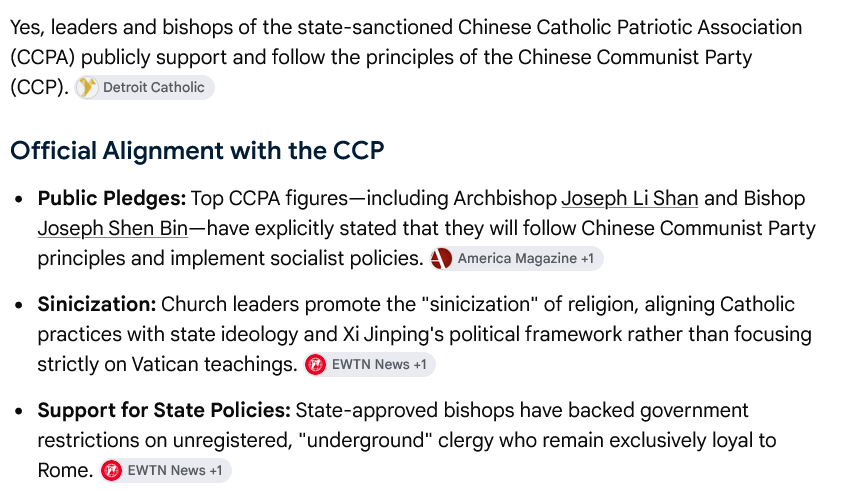
The delegates unanimously accepted the work report of the Ninth Standing Committee on church efforts and activities in the promotion of patriotism, socialism, and sinicization in the Catholic Church as outlined by President Xi Jinping.
Sinicization is a political ideology that aims to impose strict rules on societies and institutions based on the core values of socialism, autonomy, and supporting the leadership of the Chinese Communist Party, reported ucanews.com.
Yes, absolutely!
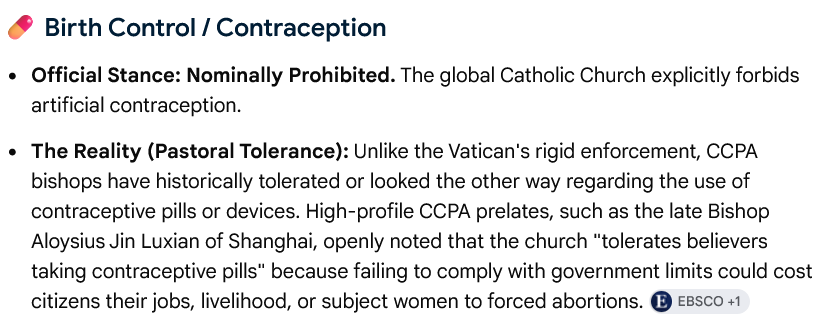
Chinese Catholic Patriotic Association (CCPA) bishops do not allow children under 18 years of age to attend Masses.
Bishops belonging to the state-sanctioned Chinese Catholic Patriotic Association (CCPA) have historically accepted and supported the Chinese government's family planning laws, including the former one-child policy.
Disclaimer: Opinions posted on Free Republic are those of the individual posters and do not necessarily represent the opinion of Free Republic or its management. All materials posted herein are protected by copyright law and the exemption for fair use of copyrighted works.