The massive stones used in the wall’s construction exhibit the hallmark of Roman engineering, characterized by their size and precision. This further supports the argument that the wall is a remnant of Fort Antonia rather than the Temple."
Posted on 03/13/2026 7:26:34 AM PDT by Antoninus
Like clockwork, whenever there's a military conflict in the Middle East, articles begin popping up regarding the rebuilding of the Third Jewish Temple in Jerusalem. Some claim that construction is already secretly underway. Others maintain that the Temple can not be rebuilt except by the Messiah. The topic even came up at a White House press briefing last October when a reporter asked Press Secretary Karoline Leavitt if the topic of rebuilding the Temple had been brought up in Trump cabinet meetings.
"It has not," Ms. Leavitt replied. "No it hasn't"
Given that the Temple Mount is currently occupied by the Al-Aqsa mosque, building the Third Temple would entail destroying the third holiest site in Islam. So for the foreseeable future, it seems that no serious attempt can be made. And honestly, it's better that way.
The Second Temple was destroyed by the Romans in AD 70 at the climax of the Jewish Revolt. Christ Himself predicted the Temple's annihilation some 40 years before the fact as recorded in the Gospel of Saint Matthew 24:1-2:
And Jesus being come out of the temple, went away. And His disciples came to show Him the buildings of the temple. And He answering, said to them: "Do you see all these things? Amen I say to you there shall not be left here a stone upon a stone that shall not be destroyed."
The looting and razing of the Second Temple by Roman soldiers after the capture of Jerusalem is memorialized on the Arch of Titus in Rome.
Roman relief showing the looting of the Second Temple in Jerusalem by the soldiers of Titus.
The subsequent Bar Kokhba rebellion, which ended in AD 136, resulted in the defeat of the Jews by the Romans and their expulsion from Judea.
Between then and the present day, only one serious attempt was made to reconstruct the Jewish Temple on the Temple Mount. That effort was spearheaded by the Roman emperor Julian the Apostate in the early 360s AD. According to the 5th century historian Hermias Sozomen, whose Ecclesiastical History is well worth reading in its entirety, Julian showed favor to the Jewish people, but this was not inspired by any particular love for them. Instead, his goodwill toward the Jews was motivated by a desire to provoke his former co-religionists:
Click for more information.
Though the emperor hated and oppressed the Christians, he manifested benevolence and humanity towards the Jews. He wrote to the Jewish patriarchs and leaders, as well as to the people, requesting them to pray for him, and for the prosperity of the empire. In taking this step he was not actuated, I am convinced, by any respect for their religion; for he was aware that it is, so to speak, the mother of the Christian religion, and he knew that both religions rest upon the authority of the patriarchs and the prophets; but he thought to grieve the Christians by favoring the Jews, who are their most inveterate enemies. [Ecclesiastical History of Sozomen, Book V, Chapter 22]Sozomen offers the following rationale for why Julian allowed and encouraged the Jews to rebuild the temple:
[Julian] sent for some of the chiefs of the race and exhorted them to return to the observance of the laws of Moses and the customs of their fathers. On their replying that because the temple in Jerusalem was overturned, it was neither lawful nor ancestral to do this in another place than the metropolis out of which they had been cast, he gave them public money, commanded them to rebuild the temple, and to practice the cult similar to that of their ancestors, by sacrificing after the ancient way. [Ecclesiastical History of Sozomen, Book V, Chapter 22]
With the cautionary wisdom of hindsight, Sozomen explains how fully and joyfully the Jews—and even many pagans—took to the monumental, but ultimately futile, task:
The Jews entered upon the undertaking, without reflecting that, according to the prediction of the holy prophets, it could not be accomplished. They sought for the most skillful artisans, collected materials, cleared the ground, and entered so earnestly upon the task, that even the women carried heaps of earth, and brought their necklaces and other female ornaments towards defraying the expense. The emperor, the other pagans, and all the Jews, regarded every other undertaking as secondary in importance to this. Although the pagans were not well-disposed towards the Jews, yet they assisted them in this enterprise, because they reckoned upon its ultimate success, and hoped by this means to falsify the prophecies of Christ. Besides this motive, the Jews themselves were impelled by the consideration that the time had arrived for rebuilding their temple. [Ecclesiastical History of Sozomen, Book V, Chapter 22]
They had not long been at this work, however, when tragedy struck:
en they had removed the ruins of the former building, they dug up the ground and cleared away its foundation; it is said that on the following day when they were about to lay the first foundation, a great earthquake occurred, and by the violent agitation of the earth, stones were thrown up from the depths, by which those of the Jews who were engaged in the work were wounded, as likewise those who were merely looking on. The houses and public porticos, near the site of the temple, in which they had diverted themselves, were suddenly thrown down; many were caught thereby, some perished immediately, others were found half dead and mutilated of hands or legs, others were injured in other parts of the body. [Ecclesiastical History of Sozomen, Book V, Chapter 22]
This earthquake, which is well attested in literary sources of the period and via archaeological evidence, was very destructive, but it was not enough to discourage these eager builders from a task which was mandated not only by the emperor but, they felt, by God himself. Yet, their desire to resume the work met such a serious check that the builders found themselves unable to continue:
[I]nstead of regarding this unexpected earthquake as a manifest indication that God was opposed to the re-erection of their temple, [the Jews] proceeded to recommence the work. But all parties relate, that they had scarcely returned to the undertaking, when fire burst suddenly from the foundations of the temple, and consumed several of the workmen. This fact is fearlessly stated, and believed by all; the only discrepancy in the narrative is that some maintain that flame burst from the interior of the temple, as the workmen were striving to force an entrance, while others say that the fire proceeded directly from the earth. In whichever way the phenomenon might have occurred, it is equally wonderful. [Ecclesiastical History of Sozomen, Book V, Chapter 22]
This second disaster was enough to dampen the ardor of even the most enthusiastic of the re-builders. Beyond that, Sozomen claims that yet another miraculous occurrence connected to the Temple re-build led many to embrace the Christian religion:
A more tangible and still more extraordinary prodigy ensued; suddenly the sign of the cross appeared spontaneously on the garments of the persons engaged in the undertaking. These crosses were disposed like stars, and appeared the work of art. Many were hence led to confess that Christ is God, and that the rebuilding of the temple was not pleasing to Him; others presented themselves in the church, were initiated, and besought Christ, with hymns and supplications, to pardon their transgression. [Ecclesiastical History of Sozomen, Book V, Chapter 22]
These events took place in AD 363, a few months before Julian himself was killed while on campaign in Persia. With the emperor's death, the Christian Jovian was elevated to the throne, thus ending the short-lived reconstruction effort on the Temple Mount.
It is easy to discard Sozomen's account as the fantastical tale of a later Christian. While it's true that Sozomen was not a contemporary of Julian, he was likely born within 20 to 30 years of Julian's demise, and was actively writing within the living memory of the events. It should also be remembered that Sozomen was a native of Bethelia, a town in Roman Palestine near Gaza, and it is clear from his writing about other historical episodes in and around Palestine that he was intimately familiar with the local lore. From his closing passage on this particular topic, Sozomen hints that he himself had spoken to those who witnessed the failed effort to resurrect the Jewish Temple:
If any one does not feel disposed to believe my narrative, let him go and be convinced by those who heard the facts I have related from the eyewitnesses of them, for they are still alive. Let him inquire, also, of the Jews and pagans who left the work in an incomplete state, or who, to speak more accurately, were able to commence it. [Ecclesiastical History of Sozomen, Book V, Chapter 22]
For any who may find the preceding story a tough one to swallow coming as it does from an unapologetic Christian source of great antiquity, perhaps consider that there are numerous other accounts of it, including one from the Roman History of Ammianus Marcellinus. Recall that Marcellinus was a pagan and furthermore, was a direct contemporary of Julian, even accompanying that emperor on his doomed campaign against the Persians. His short account of Julian's efforts regarding the Temple reads as follows:
[B]eing eager to extend the recollection of his reign by the greatness of his exploits, [Julian] proposed to rebuild at a vast expense the once magnificent temple of Jerusalem, which after many deadly contests was with difficulty taken by Vespasian and Titus, who succeeded his father in the conduct of the siege. And he assigned the task to Alypius of Antioch, who had formerly been proprefect of Britain. But though Alypius applied himself vigorously to the work, and though the governor of the province co-operated with him, fearful balls of fire burst forth with continual eruptions close to the foundations, burning several of the workmen and making the spot altogether inaccessible. And thus the very elements, as if by some fate, repelling the attempt, it was laid aside. [The Roman History of Ammianus Marcellinus, Book XXIII, Chapter 1]
This and the several similar accounts found in the works of St. Gregory Nazianzan, Socrates Scholasticus, St. John Chrysostom, and even oblique references in the extant fragments of Julian's own letters, make it abundantly clear that the Julian the Apostate did make an attempt to rebuild the Jerusalem Temple, and this this effort failed under mysterious—perhaps miraculous—circumstances.
For a deeper dive into the multitude of ancient sources which recorded this event, visit the Eternal Christendom site.
Here are links to several additional articles on Julian that have appeared on this blog. If nothing else, Julian is a fascinating historical figure. Though unlikely, it may be hoped that he repented on his deathbed.
* A passionate longing to acquire (and destroy) books ~ The cognitive dissonance of Julian the Apostate
* The Sudden Collapse of Greco-Roman Paganism and Rise of Christianity during the 4th century AD ~ Some Stark Clues Courtesy of Julian the Apostate
* "A monarch more wicked than all the nations of the earth" ~ Julian the Apostate and the martyrdom of Saints Juventius and Maximus
* "He hated the entire city intensely" ~ St. Eupsychius and Julian the Apostate's reaction to the destruction of the Temple of Fortune in Caesarea in Cappadocia
* December 2 ~ Saint Bibiana, 4th century martyr during the reign of Julian the Apostate. "Martyrs Neither Ignoble Nor Few" ~ The death of Hypatia and mob violence against Christians during the reign of Julian the Apostate
Not to mention that Jesus himself is the temple. His one sacrifice was sufficient to atone for the sin of the world. No more temples are needed to offer new and empty sacrifices.
Catholic / Patristics ping!
Thank you and can we keep the thread to the end of time and those true believers leaving the rest behind and flying into heaven in their underpants to at least 1 thread a day so all of the doomsday neocons can circle jerk on each other?
Im getting sick of this side of the wing praying for Jews over Americans thinking they will fly in heaven in their underwear and starting global wars hoping for the end of the world. This BS will stop, trust me in 15 years most of these whacks will be long gone and not really missed for the majority. Poorly educated and minds easily taken over buy a cult of death. Was it too much pork spam in your youth that you had to walk uphill both ways to go to school. BS the previous generation used that, do not just follow a better generation whilst your degrade every generation below you. Trust me, millions will not miss the bile that comes out off supposed conservative peoples. 90% here were conservatives in less than a decade became neocons.
1Co_3:16 Don’t you realize that all of you together are the temple of God and that the Spirit of God lives in you?
1Co_3:17 God will destroy anyone who destroys this temple. For God’s temple is holy, and you are that temple.
1Co_6:19 Don’t you realize that your body is the temple of the Holy Spirit, who lives in you and was given to you by God? You do not belong to yourself,
2Co_6:16 And what union can there be between God’s temple and idols? For we are the temple of the living God. As God said: “I will live in them and walk among them. I will be their God, and they will be My people.
Eph_2:21 We are carefully joined together in Him, becoming a holy temple for the Lord.
1Pe_2:4 You are coming to Christ, who is the living cornerstone of God’s temple. He was rejected by people, but He was chosen by God for great honor.
1Pe_2:5 And you are living stones that God is building into His spiritual temple. What’s more, you are His holy priests. Through the mediation of Jesus Christ, you offer spiritual sacrifices that please God.
If you look up the definition of “swimming against the tide,” there is a picture of Julian the Apostate. Nothing that he did worked or was swept away by the tide of history.
Jesus declared that not even one stone of the Second Temple would remain upon another stone of it.
Why doubt that this is true?
_______________
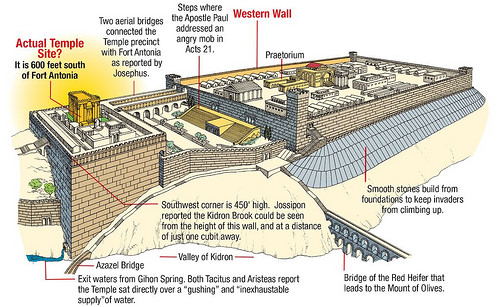
The Wailing Wall: A Surviving Wall of the Roman Fort Antonia
Posted on April 1, 2025 by H.R. Beebe
The Wailing Wall, also known as the Western Wall, is often regarded as a sacred site for Jewish prayer and reflection. However, its historical significance extends beyond its association with the Jewish Temple.
In fact, many scholars argue that this iconic structure is not merely a remnant of the Second Temple but rather a surviving wall of the Roman Fort Antonia, which was built during the reign of Herod the Great.
To understand this perspective, it is essential to delve into the history of the area. The Fort Antonia was constructed around 19 BCE as a military fortress to secure the region and maintain control over Jerusalem.
It was strategically located adjacent to the Temple Mount, serving both defensive and administrative purposes. As a result, the walls of Fort Antonia were designed to be robust and imposing, reflecting the power of the Roman Empire.
When the Second Temple was destroyed in 70 CE by the Romans, much of the surrounding architecture was also affected. However, the Western Wall remained intact, leading many to mistakenly associate it solely with the Temple itself.
This misconception has overshadowed the wall’s true origins and its connection to Roman military architecture.
The architectural style of the Western Wall aligns more closely with Roman construction techniques than those typically associated with ancient Jewish structures.
The massive stones used in the wall’s construction exhibit the hallmark of Roman engineering, characterized by their size and precision. This further supports the argument that the wall is a remnant of Fort Antonia rather than the Temple.
Moreover, the significance of the Wailing Wall as a place of mourning and prayer can be seen as a response to the historical trauma experienced by the Jewish people following the destruction of the Temple.
While it serves as a poignant symbol of loss, it is also a testament to resilience and continuity in Jewish faith and identity. The wall has become a focal point for communal prayer and reflection, drawing visitors from around the world who seek to connect with their heritage.
Conclusion: While the Wailing Wall is revered as a sacred site for Jewish worship, its historical roots may lie deeper within the remnants of the Roman Fort Antonia. Understanding this context enriches our appreciation of the wall’s significance, highlighting the complex interplay between history, culture, and spirituality.
As we reflect on this enduring structure, we are reminded of the layers of meaning it holds for countless individuals seeking solace and connection in a tumultuous world.
Many regard the so-called Wailing Wall (multiple stones upon stones) as having been part of the second Temple.
By definition, those individuals doubt what Jesus said.
Diocletian was probably the last emperor who had a real chance to stop Christianity from taking over but even he probably didn’t have a good chance. It was probably too entrenched with the urban elites at that point. But Julian? At that point there was no power base for paganism. Maybe the Senate? But the Senate was toothless. If Julian wasn’t killed in his disastrous Sassanid campaign, he would have been assassinated.
The massive stones used in the wall’s construction exhibit the hallmark of Roman engineering, characterized by their size and precision. This further supports the argument that the wall is a remnant of Fort Antonia rather than the Temple."
“God said in many places the temple will indeed be built again.”
Okay. Just cite one verse.
“It will not be a believers temple.”
Then how can God give his unction to it, which is required for it to be a temple of God.
“Christ will come back and either cleanse the temple, or bulldoze it and create a NEW temple where he will teach the nations.”
How can a temple built by unbelievers be a temple of God, and how can such a temple be cleansed?
No need to rebuild. The antichrist will stand in the Vatican.
What matters is whether Jesus thought so, not what "many regard". The Wailing Wall is part of the retaining wall of the platform the Temple is built on. It doesn't make much sense to call that "the Temple," and I doubt that any first-century Jew would have called it "the Temple". "The Temple" started where the court of the Gentiles started.
As I pointed out on another thread, the Romans torched the Temple, but they didn't disassemble it. People later on disassembled the ruins to get at the gold which had melted down and run between the stones. The retaining wall wouldn't have had gold between the stones.
Ping
Disclaimer: Opinions posted on Free Republic are those of the individual posters and do not necessarily represent the opinion of Free Republic or its management. All materials posted herein are protected by copyright law and the exemption for fair use of copyrighted works.