Posted on 02/26/2026 9:41:48 AM PST by ebb tide
Editor’s note: In Part 3 of Father Enoch’s 5-part essay, he continues his analysis of Pope Leo XIV’s October 26, 2025, homily at a Jubilee Mass for synodal teams at St. Peter’s Basilica in Rome, after first critiquing Cardinal Mario Grech’s opening address to synodal teams who were gathered in Rome. To read Parts 1 and 2, click here and here.
To purchase his book The Trojan Horse, click here.
(LifeSiteNews) — The “synodal process,” while it claims to aim at including “everyone,” appears in reality to be a top-down, autocratic method – like the Synod on Synodality itself, which as Cardinal Gerhard Müller observed, “was ‘very controlled’ and quite manipulated, with most of the interventions coming from only a few keynote speakers.”[1]
One can get a sense of this same dynamic by viewing the talks delivered at the meetings of the “synodal teams” that took place on Friday and Saturday, October 24 and 25, 2025, in the days preceding the Sunday Mass at which Pope Leo delivered his homily in the presence of these teams. These talks are available on the Vatican website.[2]
In the first session, on October 24, Cardinal Mario Grech, the Secretary General of the Synod of Bishops, delivered the opening address to the participants gathered for the Jubilee of Synodal teams. He began his address by telling the participants, “I am inclined to greet you as our collaborators” in the synodal process.[3] Later in his address he said we must “re-imagine” how the Church “listens, discerns and walks together”; and that all this activity must be motivated by love, because:
love is the virtue which holds us steady when everything else is uncertain … love chooses to engage with reality as it is, with all its fragility, complexity and beauty. In the context of synodality, love is not a passive sentiment; it is an active commitment to communion even when the path isn’t clear and communications are difficult. Only love can make us stay at the table when understanding fails. Love is a decision to remain present; it is a refusal to disengage when tensions arise; the willingness to listen when voices clash; and the courage to stay at the table when consensus seems distant. It is the spiritual maturity that recognizes that unity is not uniformity; and that true communion grounded in the Holy Spirit is forged not in agreement alone but in mutual respect and shared purpose. [4]
The burning question here is: Why this talk about “staying at the table” when the topics of discussion are not even mentioned in his address? And might this be language to “soften up” a broader audience for what is coming, so when those who are faithful to the Deposit of Faith and the Church’s constant teaching which condemns contraception, divorce and “remarriage,” and homosexual sodomy (issues that some may consider “complex” when dealing with “fragile” human beings) refuse to change their thinking, they will be accused of “failing to love”?
Moreover, in this context Grech’s exhortation to “love” is not based in Christian charity, which is founded on the proclamation of the truth to all peoples in all nations. Rather, it is based on sentiment. But Jesus never commanded His apostles, nor does He command us, to “go forth and invite those of other faiths to come to the table to dialogue, listen to one another, and then to walk, together.”
Just consider what Grech goes on to say, in what may be called his Modernist Manifesto, rooted in feelings and sentimentality to appeal to the prevailing mentality of our troubled culture:
In the synodal process love expresses itself through tenderness and fidelity. Tenderness towards those who feel unheard, excluded; and fidelity to the Church as a living body, called to grow and evolve. Love is what allows us … to honor the dignity of every single voice; to trust that the Spirit is at work, even in our disagreements.
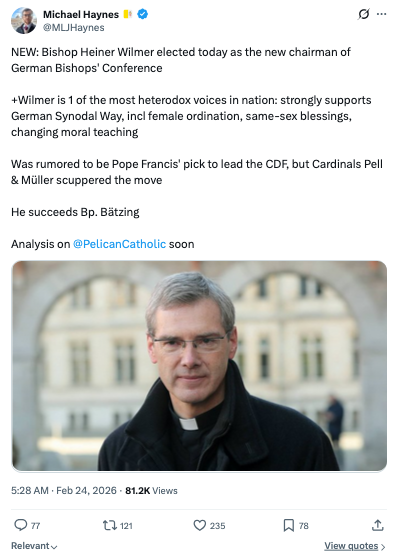
READ: German bishops elect new leader who rejected Church teaching on homosexuality
Really? The Church is called to “grow and evolve” in order to accommodate those who feel “unheard” and “excluded” – for example, the divorced and civilly “remarried,” and those involved in same-sex relationships? Recall that the Modernist heresy proposes the evolution of doctrine to conform to the thinking and consciousness of the age.[5]
And does “love” require that we “honor the dignity of every single voice,” trusting the “the Spirit is at work” – even when some voices insist, in devilish fashion, that actions revealed by God and consistently taught by the Church as intrinsically evil are now permitted? No! Authentic charity requires that we speak the truth and condemn such actions, as did St. Paul (see, e.g., 1 Cor 6:9-11). But not with Grech, who goes on to insist that “a synodal journey” requires a “radical listening to all the People of God.” But to reiterate, Christ’s announcement that “the truth will set you free” (Jn 8:32) does not refer to some vague, unthinking sentimentality that rejects the truth of our human nature, the meaning and purpose of our God-given procreative gifts, and our baptismal call to holiness.
Now, back to Pope Leo’s homily. What is the basis for his bold claim that because the the synodal teams and participants call on the Holy Spirit, ipso facto the Holy Spirit guides them? This was the same canard used by leaders and participants at both sessions of the Synod of Synodality, and which Cdl. Müller, in an article in Frist Things, condemned for their attempts to engineer a “180-degree turn” on matters of doctrine, liturgy, and morality to make the Church “compatible with a neo-gnostic woke ideology.” Meanwhile, those gathered at the synod claimed “direct communication between the Holy Spirit and synod participants,” which Müller said makes them “guilty in various ways of a ‘sin against the Holy Spirit’ (Matt 12:31; Mark 3:29; Luke 12:10).”[6]
And this same mentality was evident at the sessions of the Jubilee for Synodal Teams in October of 2025. In the session on Saturday, October 25, a bishop from Cameroon gave his personal testimony regarding synodality at the parish level, praising how lay people:
are part of the decision making…. Listening becomes a spiritual exercise … because a conversation in the Spirit raises you above just the physical. You listen to the Holy Spirit who is the protagonist of all that we are doing. So when you listen in a spiritual way you discover that all of you around the table begin to reason almost towards the same direction…. Once the Spirit is with you, you reason together and things become easier.[7]
This sounds more like New Age channeling rather than seeking a deeper understanding of truths revealed by Christ found in Scripture and Tradition. Of course, to assert that in such a setting it is the Holy Spirit who guides everyone becomes a self-serving statement which, as Müller notes, borders on blasphemy. What if everyone present agrees that same-sex couples can express their “love” in a sexual manner? Or agrees that married couples should be permitted to use contraception? Or that women be admitted to the priesthood?
His Eminence Joseph Cardinal Zen, bishop emeritus of Hong Kong, expressed the same thought as Müller in his intervention at the first consistory of cardinals called by Pope Leo XIV, which met January 7-8, 2026. Referring to Pope Francis’ “Accompanying Note” to the Final Document (FD) of the Synod on Synodality in which he formally recognized the document as “part of the ordinary Magisterium [teaching office] of the Successor of Peter,”[8] Zen criticized the synodal process for “bypassing the Episcopal College [of bishops]” and claiming to listen “directly to the People of God.” He rhetorically asked: “Has the Pope been able to listen to the entire People of God?”; and “So the lay people [who were present at the Synod on Synodality] represent the People of God?” Then Zen said:
The ironclad manipulation of the [synodal] process is an insult to the dignity of the bishops, and continual reference to the Holy Spirit is ridiculous and almost blasphemous (they expect surprises from the Holy Spirit; what surprises? That He should repudiate what He inspired in the Church’s two-thousand year Tradition?)[9]
Zen also pointed out that Pope Francis, in his Accompanying Note, said that while the FD is magisterial, “is not strictly normative…. the churches [dioceses] are called upon to implement [the FD’s authoritative proposals] in their different contexts … [which] does not preclude various ways of interpreting some aspects of that teaching.” Zen then asked: “Does the Holy Spirit guarantee that contradictory interpretations will not arise (especially given the many ambiguous and tendentious expressions in the document)?” And will “differing interpretations and choices not lead our Church to the same division (fracture) found in the Anglican communion?”[10]
We see an example of “differing interpretations” and applications of the FD’s “authoritative proposals” unfolding at present in Germany, which having followed this type of “synodal process” for years preceding the Synod on Synodality (the German Synodal Way began in December of 2019),[11] is on the verge of possibly going into formal schism with the Catholic Church. To wit, the Central Committee of German Catholics is demanding not only that the laity be placed on an equal level as the bishops in matters of Church governance (especially regarding financial control), but also (in keeping with the heresy of Modernism) that it be granted “decision-making power and be able to introduce changes to doctrine by majority vote.”[12]
As I note in The Trojan Horse, for many years now the German Synodal Way has proposed heretical doctrines and practices. For example, in the area of human sexuality: that homosexual acts be no longer considered gravely sinful, and permitting same-sex “marriage” and contraception. Cardinal Reinhard Marx, former President of the German Episcopal Conference, in 2019 called for a “binding synodal process” regarding key issues such as priestly celibacy, the Church’s teaching on sexual morality, and “the necessary reduction of [clerical] power.”[13]
Although the FD does not specifically state that episcopal conferences are endowed with authority over doctrine, Paragraph 97 of the Instrumentum laboris [the working document] for the second session of the synod in 2024 proposed granting “recognition of Episcopal Conferences as ecclesial subjects endowed with doctrinal authority, assuming socio-cultural diversity within the framework of a multifaceted Church.”[14] Are these words a signal to Germany and other “progressive” nations of what may be possible in the future?
Moreover, there is the very real danger that Germany’s proposed “democratic model” will likely spread to other nations and their episcopal conferences. Thus, Pope Francis’ call to implement a new “synodal church” may have set in motion a locomotive train that will not slow down; ignited a fire that may soon turn into a blazing conflagration.[15]
But let us return once again to Pope Leo’s homily of October 27. What does he mean when he says that by all the faithful “walking together” we will “expand the ecclesial space so that it [the Church] becomes collegial and welcoming”? Note the intentional choice of the term “collegial” – commonly used in the Catholic Church to refer to an equal sharing among bishops in episcopal authority; but here used in reference to the laity. Why? Are they to become sharers in authority with the bishops in the new synodal church? And note well the latter term – “welcoming” – often a code word for accepting the homosexual agenda.
Continuing, Leo says: “This will enable us to live with confidence and a new spirit amid the tensions that run through the life of the Church: between unity and diversity, tradition and novelty, authority and participation.” This sounds like a call for the “synodal church” to jump on the DEI bandwagon with diversity, equity, and inclusion – excluding no one but welcoming “everyone, everyone” (e.g., those actively engaging in adulterous and homosexual actions?) to receive the Holy Eucharist.
Pope Leo then insists:
We must allow the Spirit to transform [these tensions] so that they do not become ideological contrapositions and harmful polarizations. It is not a question of resolving them by reducing one to the other, but of allowing them to be purified by the Spirit, so they may be harmonized and oriented towards a common discernment…. ecclesial discernment requires “interior freedom, humility, prayer, mutual trust, an openness to the new and a surrender to the will of God. It is never just a setting out of one’s own personal or group point of view or a summing up of differing individual opinions” (Final Document, no. 82). Being a synodal Church means recognizing that truth is not possessed, but sought together, allowing ourselves to be guided by a restless heart in love with Love.
READ: Pope Leo-appointed bishop calls same-sex ‘blessings’ a ‘step forward’ for the Church
Are these lines intended as a subtle warning to those who adhere uncompromisingly to the Deposit of Faith, to the Church’s constant teaching on sexual morality, and to the traditional Latin form of the liturgy? A warning to not cling, in “ideological fashion,” to one’s position; for doing so would constitute “harmful polarization” within the Church, especially when – as Leo here clearly implies – those who are searching for “common ground,” who are not claiming that their way is the only way, and who are “open to the new” ways of thinking, are the authentic followers of Jesus? Precisely because they are not “closed in on their own way of thinking,” believing that they possess the truth – which, stresses Leo, “is not possessed, but sought together”? One might even say that these lines seem to reflect a mindset of cynical skepticism like that of Pontius Pilate who, in the presence of the Truth and Wisdom Incarnate, asked infamously and contemptuously, “What is truth?” (Jn 18:38). Does the Catholic Church possess the fullness of truth, or not? And does the Holy Spirit lead and guide the Church in “all truth” as Jesus promised (cf. Jn 16:13)?
In light of these words by Pope Leo, are we to conclude that on the one hand, the pro-homosexualist messages of those like Cardinal Robert McElroy and Father James Martin are not polarizing, but rather an attempt to engage in “common discernment” and are therefore a stellar example of the “synodal process” because they claim to be “guided by a heart in love with Love”? But on the other hand, that refusal to be “open” to and discuss the possibility of the Church changing its teaching is polarizing and not in keeping the spirit of the synodal church; that it is simply to insist on “one’s own personal or group point of view”? Because, after all, as Leo asserts, “no one possesses the whole truth”; and, “Being a synodal Church means recognizing that truth is not possessed, but sought together.”
These words appear to indicate a tacit refusal to acknowledge that the Catholic Church possesses the fullness of the truth as revealed by Jesus Christ and that has come to us through Scripture and Tradition; that the Church has always taught that there are acts, such as adultery and sodomy, which are always and everywhere immoral (adultery) and intrinsically disordered (sodomy); and that the Church’s teaching on these truths, based both on divine revelation and the natural law, are immutable; they cannot be changed.
In fact, Leo’s words seem to reveal a mindset in line with the heresy of Modernism, which holds that there is no unchanging doctrine; that doctrine can evolve, and even contradict itself, in keeping with changes in the “common consciousness” or “collective conscious” of people in any given age or culture, in keeping with their changing attitudes and shared experiences; and that the Church’s magisterium must be subservient to this collective conscious.[16] Or, as Pope Francis insisted, that bishops have the obligation of “following that portion of God’s flock entrusted to [their] care.”[17]
And here we should recall Pope Leo’s September, 2025, interview with Elise Allen. When asked about the Church’s approach to the LGBT agenda and how he will approach this issue, he said: “[A]s we’ve seen at the synod [on synodality], any issue dealing with the LGBTQ questions is highly polarizing within the Church.” Leo left open the possibility that a change in the Church’s teaching on marriage and sexuality could happen – though not likely “in the near future,” because a change in “attitudes” (or in “consciousness,” to use the lingo of the modernists) must precede any change in doctrine:
At some point, when specific questions come up … People want the Church doctrine to change, want attitudes to change. I think we have to change attitudes before we even think about changing what the Church says about any given question. I find it highly unlikely, certainly in the near future, that the Church’s doctrine in terms of what the Church teaches about sexuality, what the Church teaches about marriage, [will change].[18]
In this age of confusion and diabolical disorientation surrounding the Church’s moral teachings, we must ask: Why is it that the synodal process does not have as one of its chief goals to faithfully communicate the fullness of the truth as revealed by Christ and possessed and taught by the Church throughout the ages – that truth which the world so desperately needs to hear? Why is its apparent “goal” nothing more than (in Modernist style) engaging in an endless process of dialogue, mutual listening, and discernment where everyone “remains at the table” and refrains, in a “non-judgmental” manner, from insisting on the truth? This suggests its true goals, as I argue in The Trojan Horse, are to invert the hierarchical structure of the Church and to overturn the entire moral order by means of a “synodal process” of “walking with” and “listening” to “everyone” in order to reach a “consensus” or “common consciousness” on topics chosen by those directing the implementation of the “synodal process”?[19]
And in the area of morality, normalizing acts of homosexual sodomy is the epitome of this demonic revolution; for if homosexual sodomy is not evil, then nothing is evil.
To be continued…
To purchase Father Enoch’s book The Trojan Horse, click here.
[1] Avail. at https://www.ncregister.com/interview/cardinal-mueller-says-synod-on-synodality-is-being-used-by-some-to-prepare-the-church-to-accept-false-teaching.
[2] See videos of the sessions from Friday and Saturday, Oct. 25 and 26, 2025; avail. at https://www.synod.va/en/highlights/jubilee-of-synodal-teams-and-participatory-bodies.html.
[3] Video of first session, Friday Oct. 24, beginning at 43 min. 30 sec.
[4] Ibid., beginning at 46 min.
[5] See my discussion of Modernism in the context of the Synod on Synodality in The Trojan Horse, 48-58. N.B.: The Oath Against Modernism (from Pope St. Pius X’s motu proprio, Sacrorum Antistitum, Sept. 1, 1910), to which all priests at one time had to swear, contains this line: “I entirely reject the heretical misrepresentation that dogmas evolve and change from one meaning to another, different from the one which the Church held previously”; avail. at https://sspx.org/en/anti-modernist-oath-30330.
[6] First Things (Nov. 22, 2024); avail. at https://www.firstthings.com/web-exclusives/2024/11/the-seven-sins-against-the-holy-spirit-a-synodal-tragedy.
[7] See video of the Final Session of the Jubilee of Synodal teams & Participatory bodies, Saturday, October 25, 2025; avail. at https://www.synod.va/en/highlights/jubilee-of-synodal-teams-and-participatory-bodies.html (beginning roughly at 1 hour 30 min.).
[8] “Accompanying note by the Holy Father Francis”; avail. at https://www.synod.va/content/dam/synod/news/2024-10-26_final-document/ENG—Documento-finale.pdf. (N.B.: Francis’ Note precedes the Final Document, found at the same link.) See my discussion of the Accompanying Note in The Trojan Horse, 17-19, 43-44, 135.
[9] “Cardinal Zen Denounces ‘Bergoglian Synodality’ as ‘Ironclad Manipulation’ at Extraordinary Consistory,” [Edward Pentin substack] (Jan. 9, 2026). Following the consistory, Cardinal Zen, in a written account, complained that the consistory in many ways replicated the Synod on Synodality with all the cardinals “sitting around round tables”; moreover, with only two 45-minute plenary sessions, barely fifteen cardinals were able to speak, and these were limited to three minutes, which prevented him from reading his full text; see “Cardinal Zen expresses his gratitude to Leo XIV and a frontal criticism of the ‘synodal model’,” INFOVATICANA (Jan. 20, 2026); avail at https://infovaticana.com/en/2026/01/20/cardinal-zen-expresses-his-gratitude-to-leo-xiv-and-a-direct-criticism-of-the-synodal-model/.
[10] Ibid. See my discussion of the same in The Trojan Horse, 42-48, 124-27, wherein I discuss similar dire consequences for Holy Mother Church if Pope Leo implements the FD in Bergoglian fashion.
[11] See The Trojan Horse, 37-41, 84-86.
[12] Doug Mainwaring, “Schism fears arise as Catholic Church in Germany aims to put laity on ‘same level’ as bishops,” LifeSiteNews (Jan. 17, 2026); avail. at https://www.lifesitenews.com/news/schism-fears-arise-as-catholic-church-in-germany-aims-to-put-laity-on-same-level-as-bishops/?utm_source=most_recent&utm_campaign=usa; who quotes from Nico Sputoni’s report in the Italian newspaper Il Giornale.
[13] “German bishops announce ‘synodal process’ on celibacy, sexual morality,” Catholic News Agency (March 14, 2019); avail. at https://www.catholicnewsagency.com/news/40810/german-bishops-announce-synodal-process-on-celibacy-sexual-morality. See The Trojan Horse, 84-86.
[14] “Instrumentum laboris for the Second session of the 16th Ordinary General Assembly of the Synod of Bishops (October 2024), 09.07.2024”; avail. at https://press.vatican.va/content/salastampa/en/bollettino/pubblico/2024/07/09/240709d.html.
[15] The Saturday Oct. 25 session ended with some final words from Cardinal Mario Grech (see video at about 1 hour 39 min.), in which he compared synodality to faith, saying that just as “faith is not taught, but caught,” so with synodality. In good modernist fashion he urged all synodal teams participants to go home “not to teach, but to share this experience, . . . because even synodality is contagious; and this I can prove to you from the experience we are learning from our Secretariat [of the Synod]. Synodality is gradually gathering momentum. So let’s go for it!”
[16] See my discussion of the heresy of Modernism in The Trojan Horse, 48 ff; and Pope St. Pius X’s encyclical Pacendi (on Modernism), in which he stresses that the modernists “make consciousness and revelation synonymous” (no. 8).
[17] Pope Francis’ Oct. 2, 2024 address to the second session of the Synod on Synodality, op. cit.; see The Trojan Horse, pp. 34-35.
[18] Avail. at https://cruxnow.com/vatican/2025/09/pope-leo-speaks-to-cruxs-elise-ann-allen-about-lgbtq-issues-and-the-liturgy.
[19] Cf. the words of Sister Maria from the Society of the Sacred Heart, in the aforementioned video from the Final Session of the Jubilee of Synodal teams on Saturday October 25, 2025 (beginning at 1 hour, 12 min.), who claims, “As we learn from one another, each of us can teach one another”; and those of Anglican “Archbishop” Ian Ernest (at 1 hour 19 min.), who says that “this synodal process doesn’t only concern the Catholic Church; it goes beyond the frontiers of the Catholic Church. . . . The Anglican communion is a synodal church.” Ah, yes, we recall how the “communion” of Anglican “bishops” at their Lambeth Conference in 1930 voted to permit contraception between married couples, thereby rejecting 1900 years of Christian teaching and practice. And at 16 min. 45 sec. into the same video is featured a program (called “Mission Possible”) from Bangkok, Thailand regarding education of Buddhist youth in synodality at Mater Dei Catholic School. In the new synodal church which accommodates the pan-religion of the New World Order, there is no mention of converting these pagan youth to the Gospel of Christ; only educating them in “synodality” – whatever that means.
Ping
love is the virtue which holds us steady when everything else is uncertain … love chooses to engage with reality as it is, with all its fragility, complexity and beauty. In the context of synodality, love is not a passive sentiment; it is an active commitment to communion even when the path isn’t clear and communications are difficult. Only love can make us stay at the table when understanding fails. Love is a decision to remain present; it is a refusal to disengage when tensions arise; the willingness to listen when voices clash; and the courage to stay at the table when consensus seems distant. It is the spiritual maturity that recognizes that unity is not uniformity; and that true communion grounded in the Holy Spirit is forged not in agreement alone but in mutual respect and shared purpose.
————————
OK. Now do the TLM and the SSPX.
Anti pope.
“reframing doctrine as evolving consensus while ignoring divine revelation.” What is evolving in the Bible, padre?
Disclaimer: Opinions posted on Free Republic are those of the individual posters and do not necessarily represent the opinion of Free Republic or its management. All materials posted herein are protected by copyright law and the exemption for fair use of copyrighted works.