
Posted on 02/22/2026 12:01:51 PM PST by CharlesOConnell
Unwise people will say to a parent who has had the marrow ripped out of their souls, having a child die on them, "I understand what you're going through."
Oh, you understand? -- that you are feeling discomfort at this situation; but if you were my peer, if you also lost a child, you would never say "I understand", you would have the sense to shut your face and say NOTHING, after you own experience of personally having to fend off all the goody-two-shoes "sympathetic" people who are actually morbidly afraid of death and so have to "stim" (self-stimulate) emotionally to process their own lack of true compassion, "suffering with".
I, this writer, say this, having just lost my eldest child within the last year, as an analogy with people suffering from a different kind of torment, scrupulosity.
My recently deceased, Eldest Child, with eyes of sorrow, at his own Grandfather's funeral
It's easy to criticize scrupulous people, to raise your eyebrows (superciliosity), to pat them on the head and say "I understand". (If you did, you'd never say that; you don't really "know better than them", at all; you don't know anything.)
Scrupulosity is apparently at an intersection of spirituality and psychology, in the Christian scheme of virtues and vices, never feeling that you can be forgiven, or that everything you could do will be wrong.
Scrupulosity is treading towards despair, which is almost the third rail of "the [truly] unforgiveable sin, that against the Holy Spirit".
So scrupulosity is very dangerous to your ultimate salvation.
(If so, there must be a sub-section of one of the levels of hell, the people who denied God His infinite power to forgive all sin, even Hitler's, if he had repented in the last seconds after his aide shot him in the head.)
So I shouldn't speak, except that I have to learn at least, what to avoid saying, on behalf of another of my children, who suffers the torment of serious scrupulosity.
(I think I can say on behalf of that child, "no one chooses it".)
But to increase my own understanding, or to compensate for my own ignorance, I have to explore a certain issue.
Here is a quote attributed to Francis de Sales, a very nice man that walked the extra mile with very many people, who was all things with all people, a quote that seems deliberately, cognitively dissonant, against the main trend in Christian thought.
"We should not be too anxious to discover whether we are pleasing to God, but rather whether God is pleasing to us."
We read in First Corinthians 5:11 that "with many of them God was not well pleased".
So this Salesian assertion seems the opposite, as if God has to be pleasing us.
A comment:
Taken by itself, the sentence sounds almost backwards, even provocative. But the key is that Francis de Sales often used deliberately paradoxical wording to correct a different spiritual error, not to overturn Christian teaching.
The mainstream Christian teaching stresses,
* We seek to please God, not ourselves.
* The moral life is measured by conformity to God's will.
* Scrutiny of conscience and conversion are necessary.
So if the quote meant:
"Don't care whether you please God — just ask whether God pleases you,"
it would indeed contradict Christian doctrine.
(Martin Luther, who was thought to suffer from scrupulosity, proclaimed, "sin boldly.")
But that apparent overturn, is not what de Sales is doing.
Francis de Sales wrote largely for:
* devout ordinary Christians
* people prone to scrupulosity
* souls who obsessively asked:
"Am I in God's favor? Am I good enough? Is God satisfied with me?"
This constant self-measuring can become:
* anxious
* self-centered
* spiritually exhausting
Ironically, the person becomes fixated on himself, not on God.
De Sales often flips language to shift attention away from anxious self-analysis.
The underlying meaning is closer to:
Stop anxiously analyzing yourself.
Instead, ask:
"Do I really love God?"
"Do I delight in Him? Is my heart turned toward Him?"
Not
* Am I successful?"
But
* "Is God truly my joy and desire?"
("God doesn't want our success, just our fidelity." - Mother Theresa of Calcutta)
This is a redirection from self-preoccupation to love.
What "whether God is pleasing to us" really means
In de Sales' spirituality:
"Is God pleasing to us?" means:
* Do we accept God's will even when difficult?
* Do we love God?
* Do we desire Him for Himself — not merely His rewards?
It is about holy indifference and trust.
So the contrast is:
Scrupulous approach | De Sales' correction
"Am I good enough?" | "Do I truly love God?"
— Self-focused anxiety | + God-focused affection
— Fear of displeasing | + Loving surrender
Why this is actually very traditional
This approach fits deeply within Catholic spirituality.
You see similar themes in:
* Augustine of Hippo: "Love God and do what you will."
* Thérèse of Lisieux: childlike trust over self-analysis.
* John of the Cross: purification from self-centered spiritual concern.
The movement is:
* from fear → to love
* from self-measurement → to self-gift
The Hidden Paradox
Here is the irony de Sales is exploiting:
* A person who truly finds God pleasing is already the person most likely to please God.
(If a man love me, he will keep my words: and my Father will love him, and we will come unto him, and make our abode with him. - John 14:23)
Because:
* love fulfills the law (Romans 13:10)
* charity is the form of all virtue
So the sentence sounds inverted, but spiritually it is aimed at the same goal.
Why it sounds dissonant to modern ears
Modern readers tend to hear:
"Does God please me?"
as if it meant:
* judging God
("…that You may be justified in Your words and may overcome when You art judged." - Psalm 51:4 in KJV, Psalm 50:6 in Douay Rheims.)
* placing oneself above Him
* consumer-style spirituality
(Spiritual materialism)
But de Sales means something much more interior:
"Do I delight in God enough to forget myself?"
The best way to read the quote:
"Do not anxiously examine whether God approves of you; rather, examine whether your heart truly loves and prefers God."That is very much aligned with Christian tradition.
The statement (Does God please me?) is:
* not a doctrinal reversal
* but a pastoral correction aimed at scrupulosity and self-focus.
Francis de Sales uses a paradox to shift attention:
— from anxiety about oneself → to joyful love of God.
I can't say this is any help to a person God is allowing to suffer from scrupulosity. (Perhaps there is some mystical insight in the Book of Job.)
But at least it should stop do-gooders who know better than everyone else from rampaging in peoples' lives like a bull in a China shop.
St. Francis de Sales is very good reading for those who tend towards scrupulosity. I would NOT recommend St. Alphonsus Liguori, especially since his original written language is Italian, which has modes that are purposefully extra flowery and over-the-top, in a way that does not translate well int English.
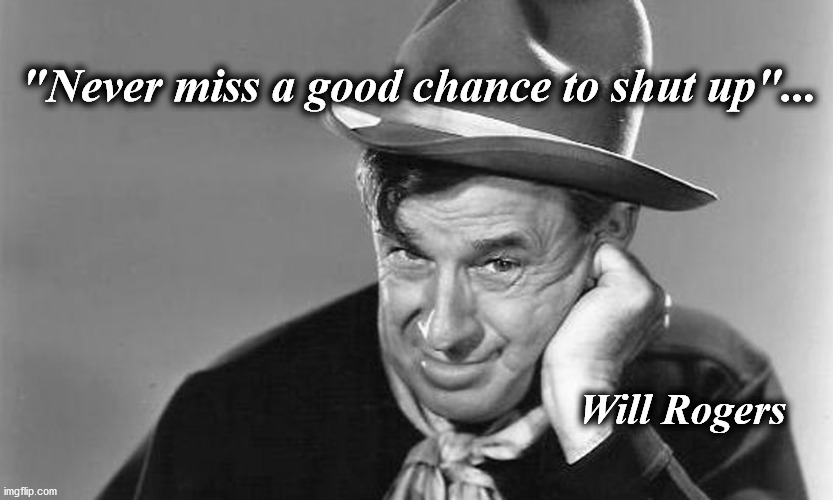
Good Will Rogers quote.
Here’s another I should try harder to live by.
“Nothing is often the best thing to do and is nearly always the best thing to say.”
—Will Durant
I’ve tended toward scrupulosity.
As to loss of a loved one, four days from now is the fourth anniversary of my beloved wife Joy’s unexpected death at home.
From reading a number of grief books one thing stands out:
When someone is newly in mourning, the only thing to say is “I am sorry for your loss.”
Not “They’re in a better place now” as Catholic priests say that assumes we humans know better than God and are certain of any time in Purgatory being of short duration as we pray to be so.
Norman Vincent Peale on mourning: Do not assume to understand God’s plan or try to justify the death as a divine, necessary action, as this can be insensitive.
More:
Avoid minimizing a griever’s pain with platitudes like “at least you had them for so long,” “everything happens for a reason,” or “they are in a better place”. Steer clear of telling them to “be strong,” “move on,” or “keep busy”. Never say “I know how you feel,” as it invalidates their unique experience.
Not “It’s good they went without more suffering. That’s good.” Not to the person in pain from losing them and wondering if there was some intervention months ago that might have worked.
Lots more are flawed so advice from many experts is “I am so sorry for your loss.”
Maybe a third of the people will tell you something helpful, a third something that neither helps or hurts, and a third will say something harmful.
I've never heard a Catholic priest say such a thing at a funeral and at my age I've witnessed numerous Catholic funerals, and the Church doesn't teach it. The whole point of a Catholic funeral is to pray for the repose of the soul of the deceased one--prayers that would be unnecessary if one assumed "they were now in a better place".
No. Please understand that sentence was poorly written.
If meant the phrase is opposed by all Catholic priests and Bishops because it assumes the human person has the word about what God is doing. NOT that they USE the phrase. Just that they don’t want others to use it.
Sorry I led you to that honest misunderstanding. My fault.
My father’s father committed suicide when my father was nine.
The priest told my father his father went to Hell.
Told him that at the time.
Would this count as “solicited” advice?
Because I gave up “unsolicited” advice for lent.
It has been a looooong lent so far.
Are we there yet? Lol.
If I were scrupulous, I would get tired and stop. I’m too lazy. It’s a blessing, and a curse.
I could almost hear the tiny fist pumping in the air and the screech of the whiny voice.
No, people do not understand how you feel. What they are doing is feeling sympathy for you. Not empathy as that is the most useless of emotions. But sympathy. Accept it as given. Be grateful they give a damn because most people do not and move on with your grief rather then taking it out on them.
Stop being a narcissus.
Everyone is carrying a big ol bag of pain. If they are not right now they will in the future. Your pain is not special.
People with melancholic dispositions suffer from this disproportionately.
Scrupulosity is a form of obsessive-compulsive disorder which can afflict Catholic priests. A perfectionism in the search for salvation. Driven by the fear that one has sinned in some way they may have overlooked and may therefore be unknowingly damned. Martin Luther suffered from scrupulosity, which explains his despair that “works” could ever be good enough to earn salvation; hence his primary thesis that one must live in a state of continual repentance, hoping for salvation only by God’s unearned grace, through faith alone.
If he could have lightened up on himself just a little bit, the whole history of western civilization might be different.
Thank you.
Even when we are in pain, we still have a responsibility to be understanding of other people.
Sometimes, people are just socially unaware or inept; it doesn’t mean they’re driven by some weird Freudian inner demon (or this author’s strange notion of ‘scrupulosity’). It just means they don’t know what to say.
I would be grateful for anyone who offered their condolences. It should be one of those moments when we mutually recognize our shared humanity.
That was how I felt. When people say something like “I understand what you’re going through” they may be off base, but I suspect 99.9% of the time that they don’t, but...they are just trying to find a way to be comforting.
A gracious person would accept it as offered, say a quiet “Thank you” and move on without the rage and anger.
A lot of people simply do not know what to say, so they say something if they care for you because they want to find a way to express it and do it poorly.
Well said, Jamestown1630.
Well said.
Terribly sad.
In one of his TV episodes and the book on the topic Fr. Chris Alar said a lot about the newer stances including that no one can tell how mentally ill a person is who would resort to that, so assume they are released from logical thinking and responsibility, not condemnation. His lectures on this topic are on YouTube.
Book is After Suicide: There’s Hope For Them and For You.
https://paulinestore.com/after-suicide-theres-still-hope-for-them-you-qs1000308-179207.html
“””””My father’s father committed suicide when my father was nine. The priest told my father his father went to Hell.”””””
Memory can play games, especially many years later from when a person was 9 and is relating what an adult religious leader was saying, it may have happened that way, or not.
My brother was killed in a car accident when he was 20. The grief broke my parents, particularly my dad. They, too, died that night. I never figured out why it had to happen and it took me 45 years to see the accident site. But one of the hardest parts was that my parents never could just plain talk about him and their loss to anyone else because people avoided them like death is contagious. They crossed the street so a not to have to speak to my dad. It was a small town and my folks felt that they could not confide their suffering in anyone. I prayed for them to be healed and their healing never happened on this side of the earth veil. God bless you in your sorrow and I pray that your son’s siblings, children, or anyone else who loved your son heals from the shock and pain of his loss. The love never dies.
Nonsense. I had something very similar said to me by a Catholic woman in the neighborhood when I was about the same age. Those things stab very deeply and kids of that age know very well what was said to them, and don’t forget it.
Some people are just thoughtless and arrogant in their personal religious beliefs.
Disclaimer: Opinions posted on Free Republic are those of the individual posters and do not necessarily represent the opinion of Free Republic or its management. All materials posted herein are protected by copyright law and the exemption for fair use of copyrighted works.