Posted on 11/02/2024 6:41:16 AM PDT by CharlesOConnell
The dominant historical account of the issues and reasons behind the Protestant Reformation frequently features the sale of indulgences, relating to the now nearly-forgotten belief in the Catholic teaching on Purgatory. (Dominant narrative interpretation, by the victors in the change from medieval to modern world view, is that the fact that, in a minority of cases, indulgences were once sold, supposing to invalidate the Catholic belief in purgatory.) A minority view of these issues, presenting facts and situations generally, fully excluded from the dominant narrative, were presented by English Protestant, political dissenter against the majority, elite Whig account of history, William Cobbett in his “History of the Protestant Reformation in England & Ireland” 1896. The following is a general account of this historical-revisionist view contrary to history as written by the victors.
The suppression of the monasteries and appropriation of their assets by the class which were the lower-noble and higher-commercial political supporters of King Henry VIII, is generally portrayed as justified because of abuses of monastic assets by the archetypically envisioned fat abbot drinking the best wines in the monastery cellars and eating the best produce of the land. (This surely must have occurred at some time and in some place; but when balanced against the overall thrust of the change from the medieval to the modern, it may be viewed as a black legend, a pretext justifying a tremendous transfer of wealth.)
The period known as Christendom has been argued to have extended for a millennium approximately from 410-1410. During this time, the high eastern civilization of Byzantium, to which colonial subjects as far afield as Syria and Egypt were denied admittance without special passports, was at marked contrast with the relatively barbarian remnants of western Rome. Potentially fertile lands were unreclaimed, swamps and forests must be cleared and cultivated in order for the manorial-feudal medieval civilization to arise. The lead was set by the monastic system, which occupied approximately half the available land, after the monks had originally developed the reclamation and cultivation techniques and taught them to the peasants who were in economic relation to the warrior class of the manor-holders, the esquires who owed feudal duties to fight for their liege lords. (The Romans had lacked the deep furrowing plow, which was a technological artifact of invading Gothic hordes whose descendants would form a substantial proportion of the medieval population.) The medieval peasants owed a certain quota of days per year directly cultivating the Lords’ lands and ceding some of their own agricultural produce; but generally, with a large number of holy days on which work could not be performed, peasants enjoyed much better working conditions in the medieval period than in the cottage industries and the great factories of the Dickensian 19th century industrial revolution. Peasants were guaranteed a certain, if scanty share in the best lands by ancient custom, until in the early modern period every aspect of life began to be monetized, shrewd members of the early capitalist monied class began to critically rate rents and enclose lands with fences in the interest of the international wool trade with Italy, supposedly to prevent animals from overrunning fields to which their owners were not entitled access.
The monastic side of this civilization was regulated by the evangelical counsels of poverty, chastity and obedience. The Reformation would transgress the chastity counsel by forcibly laicizing sisters from convents, in some cases voluntarily and in some cases not, so that, for instance, Fr. Martin Luther, who during his more traditional period was subject to scrupulosity, would eventually, when he posed the release of his passions in a theological context (“The Enslaved Will”, De Servo Arbitrio, i.e. “God [or the devil] made me do it”), trafficked in sisters from the convents, offering one of the most attractive to the Elector Archbishop of Mainz under the arrangement that the new Protestant Churches could function independently of Rome as long as the royalty and the new capitalist class could operate in the modern capitalist political economy without interference. Painter Sandro Botticelli underwent conversion from painting voluptuous subjects, in the Bonfire of the Vanities, under the influence of Dominican preacher Fra Girolamo Savonarola who opposed “worst Pope” Alexander VI’s who reversed Church discipline forbidding loan-sharking, “usury” (43 1/3 % interest on loans). Savonarola was hung and burned.

During Christendom, the evangelical counsel of poverty ensured that monasteries accumulated, in monetized terms, vast stores of economic value over centuries of their existence, owing to the fact that the monks worked but did not spend. (My family is acquainted with a priest, a Fr. David McWhirter, who has gone into the restored monastery of St. Benedict of Nursia, now in the Italian town of Norcia, to be a brewmaster, but without receiving personal benefit beyond what is required for his sustenance, to enable him to work and pray, “ora et labora”.) It was this accumulated economic value of the monasteries that King Henry VIII’s friends pillaged, forming the basis of Whig wealth for centuries to come; the image is portrayed in relation to Cobbett’s work, of the gold cover of an illuminated Bible ripped off, the pricesless velum hand-illustrated manuscript thrown in the mud and trampled by horses' hoofs as the pillagers rode off with the gold to the next monastery. In the centuries before the modernist revolution, a destitute pilgrim could count on only having to walk 9 miles on average between monastic institutes in order to receive a night’s lodging and meals.
The issue of purgatory and indulgences subsided in the stable institution, in exchange for virtuous practices in the present life, to remit of long extents of purging suffering for the temporal punishment due to sin, the minority of guilt not remitted by Christ. (Numerous biblical references support this belief; one is the account is sending 2,000 silver drachmas to support prayer for the deceased combatants who were found with pagan idols under their cloaks, in the original 1611 King James translation, https://www.sing-prayer.org/hymns-for-the-release-from-purgatory-of-the-holy-souls#2ndMaccabees12--36-45. ) Purgatorial societies were established about the monasteries, so that in exchange for praying for property holders after death, the monks were allowed to graze their flocks on the benefactors’ lands.
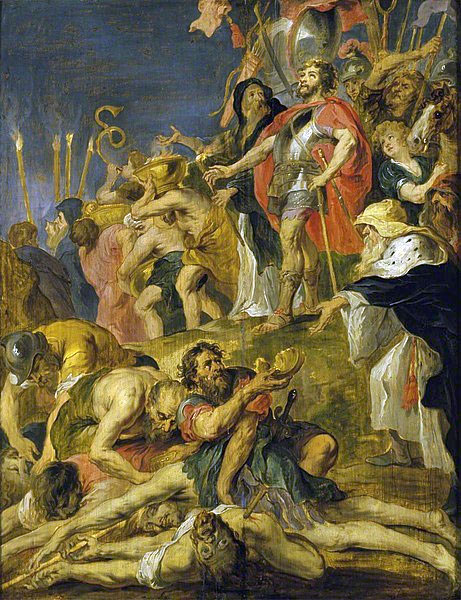
Judas Maccabaeus sending 2,000 Drachmas to Jerusalem for Prayers for the Dead – Victor Wolfvoet II after Peter Paul Rubens (2nd Maccabees 12:36-45)
These facts and circumstances are not represented in the dominant narrative. It is supposed that the abuses of the fat monks drinking fine wines and eating good beef were relieved by the new Protestant capitalists taking the monasteries lands and assets which they could not claim righteously to hold.
Interesting thanks.
bfl
COC, others may know already. But at the risk of sounding dense. A member of the One True Faith will typically leave no doubt of this fact. Yet, having read much of what you wrote, This Guy frankly is left scratching his head.
Wonders if you would care to go on the record. To clarify.
Catholics are still encouraged to pay for masses for their loved ones in purgatory, and some do their great personal sacrifice. What is the difference? It’s a beautiful painting showing a scene from a book rejected from the canon as not inspired , no doubt holds much historical and cultural relevance.
Burning ministers at the stake for translating/preaching the Word of God. To me, the rest is obfuscation.
So your side is blameless for confiscation of lands and buildings from the church, murdering priests and the faithful, and banning the church from your countries?
Sounds like willful blindness.
You don’t need to give alms for an indulgence.
It took a while for them to throw off the bad habits they learned as Catholics.
So blame the Catholics for your own actions? Ridiculous. You have free will. You made your own choices.
For instance, the witch trials and burnings that occurred in America and Europe were in Protestant areas. No Catholics even allowed in some of these areas. But the logic you’re using is that the Catholics made you do it.
Leave the religion of Luther and come back to the one true faith.
LOL, what was that about, what actions by me?
For that matter that Salem British village burned some witches?
The poor Catholics.
The poor, poor, poor Catholics.
Just oppressed victims by those nasty Protestants.
And somehow they managed to dominate the Western world. All of South and Central America... predominantly Catholic.
Largest Christian denomination/category in America. Zero Protestant Evangelicals of ANY denomination on the Supreme Court. Few in government at all, despite being a significantly large part of the population.
At least Protestants and Catholics aren’t currently mass murdering each other... for now.
The Reformation didn’t start in England and Ireland. What happened there was the result of opportunistic royal politics, not a desire to return to the faith. The sellers of indulgences were well known throughout the continent, and essentially were a fundraiser for the Vatican.

So now the sob story?
If we wanted Protestants killed it would be easy to do so.
Instead we want to do the living thing and convert them to the one true faith.
Why would it be easy to kill Protestants?
Nobody is blameless except the Lamb of God: Jesus Christ.
Matthew 6:20
But lay up for yourselves treasures in heaven, where neither moth nor rust doth corrupt, and where thieves do not break through nor steal
That wasn’t my point. But ok.
I think the author is trying to address some forgotten or misunderstood history of the Catholic/Protestant divide while pretending to be a neutral, third-party observer. Maybe not.
Either way, I think it’s a futile exercise apart from considering the supernatural ramifications.
What was God’s role or purpose in the Reformation? Was He behind it? Or was it the Devil? Or should we dismiss both sides or even religion altogether?
I grew up Protestant, but there are many ideas from my upbringing that I reject. I have explored Catholic beliefs and cannot reconcile them with the Bible. I categorically reject the notion that The Church or any church abdicates us of our personal responsibility to seek the truth and hear from God directly.
While exploring the history and role of things like indulgences and purgatory are useful to the understanding and discussion of the topic, they are not at the heart of the matter. Divine revelation is what’s at stake.
“If we wanted Protestants killed it would be easy to do so.”
I think it will make a comeback soon.
But I never thought I’d see the day when the Pope wasn’t Catholic, or even more so, that the time would come when I’d prefer him to be a Catholic far more than whatever it is that he is.
And look at the night and day difference between so-called Catholics in the halls of power. John Roberts, Clarence Thomas, and Samuel Alito are Catholic. But so are Joe Biden and Sonia Sotomayor. JD Vance is Catholic. Probably Trump’s best pick of anyone to join his team since he first decided to run for office. Certainly better than the stodgy and possibly traitorous Pence who many of us conservative Evangelicals (myself included) rooted for in Trump’s first candidacy.
When you consider the extreme heresies and apostasy within both branches of Christendom (Catholic and Protestant, I mean), it’s interesting that (I feel) there is more of an alliance of ideology between folks without as much regard to this particular distinction (i.e. of denomination). Take the issues of abortion, homosexuality, and transgenderism. Positions on these issues align traditional Catholics, traditional Evangelical Protestants, and conservative Jews together, even if we strongly disagree on theology. Within Christendom and Judaism, there is a liberal movement that is diametrically opposed to us on these issues.
That is, as bad as things have been between Protestants and Catholics in the past, and despite their potential to return to such hostility, I’d say we both have a common enemy that is far, far worse than each other.
We can have heated but civil debates over the nature of sin and how and when forgiveness is obtained, but at least we agree considerably that the aforementioned homosexual sex, abortion, etc. ARE sins. The left is presently making them the centerpiece of their new religion.
How does a Catholic who’s family doesn’t have a lot of money to buy their way out of purgatory, tap into that mythical Treasury of Merit, for points?
chickenlips, you are , again, wrong.
In England, Scotland, Scandinavia and Geneva, witch trials were carried out by Protestant states. The Spanish Inquisition executed only two witches in total. More accused witches were executed in the last decade of Elizabeth I’s reign (1558–1603) than under her successor, James I (1603–25).
If you look back at the Reformation, the largest numbers of witch trials took place in Germany, but there were also significant cases in England and its colonies, Scotland, France, Austria, Switzerland, and Sweden.
You’ll note that France and Austria were the only states on the list with a Catholic majority
However, it wasn’t that witch hysteria was a Catholic thing or a Protestant thing as much as it was a product of religious tensions. During the Reformation, people were subjected to a constant propaganda war where each side - Catholic or Protestant - portrayed their opponents as literally cooperating with the Devil. There’s actually a very strong correlation between how deeply a region was divided - and, not coincidentally, how high religious tensions were - and the level of witch hysteria.
Germany was sharply divided between Catholics and Protestants, and suffered through the Thirty Years War. France remained Catholic, but it had a substantial Protestant minority and brutal religious conflicts. The conflict wasn’t as bad in Scotland, but the Reformation still erupted into violence fairly quickly, with the bishop of St. Andrews being hung from the ramparts of his own castle. Austria had converted to Lutheranism but was under tremendous (and ultimately successful) pressure to re-convert to Catholicism.
By contrast, there was comparatively little support for Protestantism in Ireland, Spain, Portugal, and Italy, and very little evidence of witch trials in any of them (and, yes, that’s with the Spanish Inquisition). Similarly, we see very little evidence of witch hysteria in places like Denmark or Bohemia, which converted to Protestantism fairly quickly.
Disclaimer: Opinions posted on Free Republic are those of the individual posters and do not necessarily represent the opinion of Free Republic or its management. All materials posted herein are protected by copyright law and the exemption for fair use of copyrighted works.