I don’t, as a rule, listen to podcasts. Not because I am uninterested or have nothing to learn from others, it’s just that in a crowded marketplace where originality is so rare and the theft of intellectual property is, even unwittingly, so common, I find the easiest way to avoid echoing others is to avoid the echo-chamber. As such, academic psychologist-turned-social commentator Jordan Peterson was late to appear on my radar. I had, of course, heard of the Canadian, and as a Bible-believing evangelical Christian, what I saw of him, usually a social media post featuring him skewering the woke mob, I liked.
Then I discovered my youngest son Zachary was a Peterson fan.
“You would like him, Dad,” Zachary said. “He’s gaining popularity with young men of my generation [Gen Z] because he’s exposing the woke garbage for what it is.”
My middle son, Christopher, a seminary graduate and pastor, had a different take: “Hmm. I think you won’t like him — his core philosophy, anyway. Zachary sees that you two are birds of a feather in your dislike of radical ideologies. But you can identify why you don’t like them. Peterson can’t.”
It was about this time last year when we began recording the first episodes of the “Ideas Have Consequences” podcast, and a few members of the staff were urging me to have Peterson on the show — some because they liked him, others because they wanted me to debate him. All of this was a glimpse of Peterson’s influence.
In 2 Corinthians 10:5, the Apostle Paul says, “We destroy arguments and every lofty pretention that sets itself up against the knowledge of God…”
That verse has formed a part of my personal mission statement. To that end, I have crossed swords with the late atheist-journalist Christopher Hitchens, Oxford atheist Richard Dawkins, Tufts cognitive scientist Daniel Dennett (who died last month), Skeptic Magazine Editor Michael Shermer, and a cohort of Muslim apologists on CNN International, Al Jazeera, and, where the true Muslim believers gather, in Hyde Park, London.
But debate Peterson?
A Bible Teacher and Spiritual Leader
The idea of debating Peterson seemed strange given his reputation with conservatives. In these days of child mutilation and a surging globalist tyranny, one finds unexpected allies. Who knew Elon Musk would be a de facto Trump supporter or that Shakira would be a champion of traditional (binary!) sex roles? Peterson is far more ideologically aligned with a biblical worldview than either of these and frequently voices his appreciation for the Bible even if he has not become a Christian himself. If they are not against us, they are for us, right?
That’s what Jesus said in Mark 9:40 of those doing Christian ministry, and that’s what ultimately got my attention with Peterson. He began doing Christian ministry. Not actual Christian ministry, but the appearance of it as a kind of deist pastor-at-large teaching the Jordan B. Peterson Biblical Series. Then, after his move to The Daily Wire, Peterson’s already ascendant popularity soared still higher, and with no demographic was he more popular than with Christians. Peterson, for his own part, rewarded them with a book: We Who Wrestle with God.
This struck me as more than a little odd given the fact that Peterson, by his own admission, is not a Christian.
That might come as a surprise to Peterson’s Christian fans, who are legion, because he speaks favorably of Jesus (though he can’t seem to decide if he thinks he was real); “the idea of god,” as he puts it; religion in general (he described himself as “pro-Muslim”); and the Bible. But when asked on repeated occasions if he believes in God or if he is a Christian, Peterson, who is otherwise precise, is ambiguous.
“I don’t like that question,” he says. “It’s none of your damn business.”
Like it or not, Peterson doesn’t seem to realize that it became a fair line of questioning the moment he deviated from his field of expertise to pontificate in others where he has none, teaching the Bible, giving spiritual counsel, writing a book about God, and even offering his advice to churches. I wonder, would Peterson be similarly annoyed if someone asked him if he believed in psychology, a field he teaches and in which he is eminently qualified? I doubt it.
Peterson’s “stock” response to the question is to reduce it to a lecture about the question itself. One comes away with the feeling that he’s listening to Ketanji Brown Jackson’s response to Sen. Marsha Blackburn’s question: “Can you provide a definition for the word ‘woman’?” But never do you come away with a clear answer.
There is no small measure of irony in this. Peterson catapulted to fame, not as a religious teacher where he is utterly lost, but as one who offered a biting critique of a Western culture that has come off the rails and practical advice to young men who desperately needed it. To the delight of sensible people everywhere, he mercilessly mocked Wokesters who had a habit of obfuscating meaning and distorting reality.
But that is what Peterson does when it comes to the God of the Bible. Worse, he contorts historic biblical meaning to fit his own humanistic agenda. In a recent interview on the “Impact Theory” podcast, Peterson says of Oxford University atheist Richard Dawkins:
Dawkins believes in the redeeming power of the communicated truth. Well, there’s no difference between that and worshipping the Word, the Divine Word. It’s the same thing. … Dawkins, though he doesn’t know it, is mostly a Christian.
One might think that what Peterson means is that Dawkins “is mostly a Christian” insofar as his own intellectual assumptions rest on Christian foundations, an assertion that I have made many times. But that’s not his meaning. “Divine Word” is a reference to John 1:1: “In the beginning was the Word, and the Word was with God, and the Word was God.” Peterson tosses 2,000 years of Christian biblical theology and redefines what it means to be a Christian as mere truth-seeking — no repentance, no regeneration, no profession of faith, and it seems not even a conscious decision to become a follower of Jesus Christ. This Christ-less Christianity is so cut-rate as to make what Dietrich Bonhoeffer called “cheap grace” look downright expensive.
One of many astute listeners tweeted Peterson a clear definition of what it means to be a Christian:
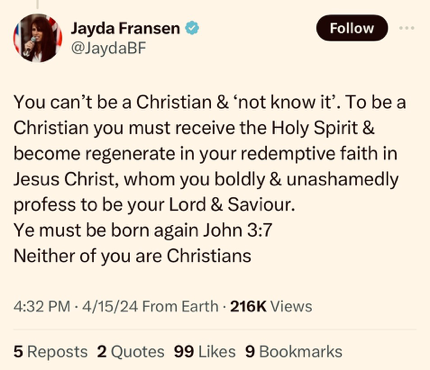
There was no snark. Jayda Fransen’s tweet offered a historic Christian definition with scripture reference. Peterson, instead of clarifying that he wasn’t talking about salvation, ridiculed her:
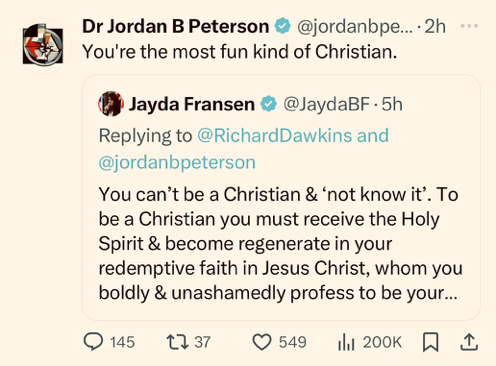
But Fransen wasn’t alone in her understanding of Peterson’s meaning. Dawkins, who clearly understood Peterson to be speaking of more than his intellectual suppositions, offered this terse correction:

In so doing, Dawkins demonstrated that he has a better understanding of what it means to be a Christian than Peterson does. Dawkins isn’t a Christian, and he knows it. He also knows that believing the Bible isn’t optional for Christians.
Richard Dawkins is instructive here. When I first made my way to the professional atheist’s Oxford home in the summer of 2006 beginning a decade-long odyssey, I was prepared to be overwhelmed by his anti-Christian arguments. If I thought this was going to be a test of my own belief, and I think I did, then I was disappointed. While articulate and interesting, Dawkins’ arguments were simply repackaged objections of skeptics centuries, no, millennia, past.
This is post-atheist (but definitely pre-Christian) Peterson. Interesting and profound within the confines of his expertise, he’s out of his depth when it comes to God. Christian Theology 101 is fascinating when he who teaches it has mastery of the subject well beyond the level he elucidates. By contrast, Peterson’s musings are elementary or just plain wrong because the subject surpasses his (current) understanding. To listen to him on Christianity is to listen to the stream of consciousness of a man who is trying to figure it out — but hasn’t.
Atheists are helpful to us in this discussion because their tests of authentic Christian belief are, sadly, more stringent than those of Peterson’s Christian defenders. British atheist podcaster Alex O’Connor thinks Peterson’s popularity can be attributed to the fact that he punts on the truth of the Bible and speaks instead of the models it provides. That resonates with the experience of Michael Shermer who couldn’t pin Peterson down on the question of the virgin birth.
Dawkins, who has debated Bible-believing Christians and knows what they sound like, senses Peterson is a fraud: “It’s bullsh-t. When he talks religion, he doesn’t make any sense at all. … People think, ‘Oh, it must be terribly profound because I can’t understand.’” He knows that Peterson’s belief is of the Jeffersonian à la carte variety: I’ll take some Jesus as a teacher of ethics and exemplar of self-sacrifice, hold the creation story and resurrection. Smelling blood in the water, Dawkins trolled him: “I’m still waiting for the in-person conversation Peterson keeps talking about…”
I’ve seen this movie before. Indeed, I moderated it. It was a debate between mathematician and writer David Berlinski, a self-described “secular Jew,” and atheist journalist Christopher Hitchens. Berlinski is as close to a Renaissance man as I have ever met. Brilliant. But Hitchens made short work of him in debate for the simple reason that Berlinski was defending a vague deity in whom he didn’t really believe. Hitchens saw this for what it was: hypocrisy. So, he proceeded to heap scorn on his opponent, going so far as to try to get me to debate him since Berlinski would not. (A month later, I did.) Hitchens had, in effect, exposed Berlinski as a covert atheist.
If Peterson proposes to take such a position in a discussion with Dawkins, you can expect a similar outcome because it’s not just Jesus who spits out the lukewarm (Revelation 3:16). Hitchens did it, and Dawkins will too.
Peterson’s ‘Cracked and Crooked Foundation‘
This is because Peterson’s theology, as well-known pastor and theologian Doug Wilson put it, sits on a “cracked and crooked foundation.” Like me, Wilson appreciates much of what Peterson has to say. He also knows a thing or two about celebrities who flirt with Christian conversion and readily recognizes that the whole trajectory of Peterson’s God-talk hits wide of the mark because he rejects the central premise of Christianity: the Lordship of Jesus Christ. Peterson says he finds the possibility of a historic Jesus who was God in the flesh “too terrifying a reality to really believe.” As a result, the theological errors begin early and often.
Take, for example, this lecture in which Peterson says that to call oneself a Christian is to make “a claim to moral virtue.” It is one of his stock responses to those who ask if he’s a Christian. Peterson has made a habit of shaming those who dare call themselves Christians. Does he not know that it is a biblical designation? As if doing so is a supreme act of self-righteousness. But that is precisely what being a Christian is not as every child who paid attention in vacation Bible school knows. It is the recognition that we are fallen, broken, and incapable of any good or of saving ourselves apart from the redeeming power of Jesus Christ. “Apart from me,” Jesus told the disciples, “you can do nothing.”
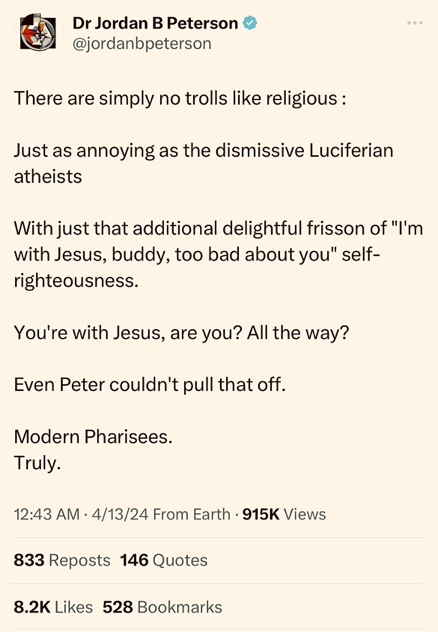
Again, Peterson’s Christian defenders will say he is early in his personal spiritual journey or he is seeking the truth and therefore deserves our unswerving support. Perhaps. But this is not what a fledgling faith looks like. That looks more like Ayaan Hirsi Ali.
Less than a year ago, the Somali-born activist, politician, and writer announced her conversion to the Christian faith. This was no small thing given the fact that she had fled Islam at age 23 and joined the ranks of prominent Western atheists to denounce not only that religion, but all religions. No doubt to Peterson’s horror, she isn’t reluctant to call herself a Christian. Nor, to my knowledge, is Hirsi Ali offering a lecture series on the Bible or Christian theology. (Perhaps when her faith matures, she will.) Her declarations about her new faith are measured, modest: “I still have a great deal to learn about Christianity. I discover a little more at church each Sunday.”
That one statement, humble and self-aware, bears no resemblance to anything we are seeing from Jordan Peterson.
Peterson isn’t on a private Quest for God, to borrow the title of the late historian Paul Johnson’s memoir about his journey to faith, a book written once the author had arrived at the right spiritual destination. Peterson is wandering in his own spiritual wilderness while teaching the Jordan B. Peterson Biblical Series and hawking a book about the God in whom he has yet to really believe and doesn’t understand.
To put it another way, would Peterson think it odd if I rejected the main tenets of psychology but nonetheless offered the Larry A. Taunton Psychology Series and wrote a book titled, We Who Wrestle with Psychologists? I think he would. He’s like one standing on the “Field of Dreams” who can’t see the players who practice there but is sure he has much wisdom to impart to those of us who can see them. It’s the Dunning-Kruger Effect. Having achieved command in one field (behavioral psychology), Peterson seems to think that qualifies him to pronounce authoritatively in other fields (biblical theology). As one Christian friend put it, “Seekers should be listeners, not teachers.” Someone should tell Peterson that.
To make sure I wasn’t behind on Peterson’s evolution on God, a frequent claim of his fans, I listened to this just-released interview with Shawn Ryan. It was more of the same.
“God isn’t a thing you believe in,” Peterson declared with misplaced self-assurance. “To believe in God is to commit your life. It isn’t the statement, ‘I believe in God.’ … It is commitment to a pattern.”
While there are many vague cultural meanings attached to the word Christian, in this essay we are only interested in the biblical one, and that book is very clear where Peterson is not. Romans 10:9-10 says:
If you declare with your mouth, ‘Jesus is Lord,’ and believe in your heart that God raised him from the dead, you will be saved. For it is with your heart that you believe and are justified, and it is with your mouth that you profess your faith and are saved.
It turns out that it is a statement, a profession from the heart but verbalized with the mouth, of belief in the resurrected Jesus. And lest there be any misunderstanding, Jesus is a person, God made flesh, not “a pattern.” On yet other occasions, Peterson offers another one of his stock responses to the question about his own personal belief in God by saying, “I decided to act as if God exists long ago.” To which the Bible responds: “You believe that God is one; you do well. Even the demons believe — and shudder!”
The Bible According to Jordan Peterson
Peterson’s theological landscape crumbles whenever the Bible is brought to bear, and the Bible is, according to Peterson in an interview with Joe Rogan, “way more true than just true.” That’s a curious statement when one considers Peterson’s penchant for ignoring biblical meaning whenever it suits him.
“So, here’s an example,” he tells Ryan. “This is very complicated, but here’s an example. … God for Abraham was the spirit of adventure. The call to adventure. This is a definition. This is very much worth knowing. People have no idea what to do with the concept of God. God is the call to adventure. That’s a definition [Peterson’s emphasis]…”
Whose definition?
Well, Peterson’s, of course, because it’s certainly not the biblical definition. “When Christ calls a man,” wrote Bonhoeffer famously, “he bids him come and die.” But this is typical of Peterson who sees everything through the lens of self-improvement. In his telling of the biblical story, it’s always about us, our development, our potential, our yearnings, our sacrifice, our growth, and not about God. And that goes far to explain Peterson’s appeal. At bottom, Peterson is a self-help guru.
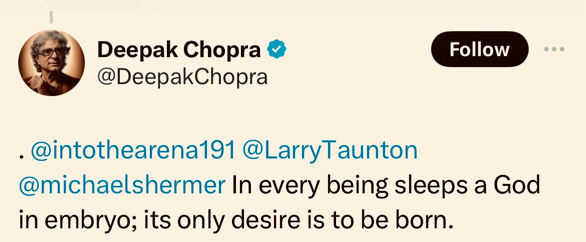
Compare Peterson’s claim that there is a “spark of divinity” within each of us waiting to unleash our potential with Indian-American self-help guru Deepak Chopra’s tweet to Michael Shermer and me on the eve of our Seattle debate in 2015: “In every being sleeps a God in embryo; it’s only desire is to be born.”
For Peterson, God is self-actualization. This has more in common with Eastern meditation than it does with Christianity. Among those themes the Bible reiterates time and again, that there is nothing good or divine within us is certainly one of them.
There is more of the postmodern about Peterson’s philosophy than one might imagine. This was my son Christopher’s meaning when he said Peterson’s objections to the woke mob are absent an anchor in the absolute. As a consequence, he’s all sail, at times sounding like a Stoic philosopher, a New Age spiritualist, or a hippie on an acid trip, but never like someone who should be giving lectures on the Bible.
Consider his ramblings about the Bible in the same interview with Rogan. If the view count is any indication, some have understood this to be a profound monologue. It’s nothing of the sort. For several minutes Peterson casts about trying to explain the importance of the Bible in our culture, but he never lands at the right place: The Bible is the Word of God. It is the absolute, eternal truth that he can’t seem to find. Instead, he has adopted a God of his own making, syncretic and benign who just wants to help us be better people. What exactly is the point of the cross in Peterson’s theology? That, too, is ambiguous, but it seems to represent a model of self-sacrifice rather than a real space-time propitiatory act to redeem a lost world.
Perhaps nothing reveals Peterson’s ignorance of the Bible so much as his assumption that Christians, Jews, and Muslims are all worshipers of the same God and just need to get along. This, of course, is nonsense given the fact that each says very different things about who God is. According to Christianity, Jesus is God made flesh who died for the sins of those who believe in Him and His bodily resurrection. In Judaism, Jesus was a crackpot who was executed for blasphemy. Islamic tradition says Jesus was a prophet who did not die on the cross at all. These differences are irreconcilable.
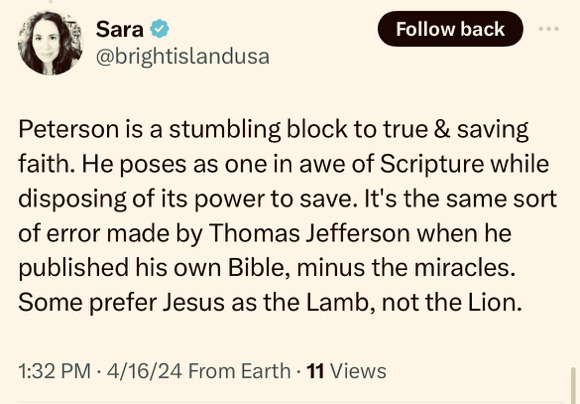
In perhaps his most revealing lecture, Peterson said tearfully:
Who would have the audacity to claim that they believed in God if they examined the way they lived. Who would dare say that? To have the audacity to claim that means you live it out fully. That’s an unbearable task, in some sense, to live that out…
He is only partially correct: It is an unbearable task. It was the purpose of the Law, the Decalogue, to drive this point home. What Peterson describes is how anyone who considers the Law should feel because, if he’s honest with himself, he will know that he has violated God’s Law in total. But Peterson stops short of the Gospel undoubtedly because he doesn’t know it: Christ has fulfilled the demands of the Law.
Romans 8:1-4 reads:
There is therefore now no condemnation for those who are in Christ Jesus. For the law of the Spirit of life has set you free in Christ Jesus from the law of sin and death. For God has done what the law, weakened by the flesh, could not do. By sending his own Son in the likeness of sinful flesh and for sin, he condemned sin in the flesh, in order that the righteous requirement of the law might be fulfilled in us, who walk not according to the flesh but according to the Spirit.
And this brings us to the heart of what Peterson fails to understand: grace. In this, he is no different than any atheist with whom I have ever argued: Dawkins, Dennett, Ehrman, Hitchens, Shermer — any of them. For Peterson, Christianity is a system, “a pattern,” a code of ethics, a myth, and the Bible is the ultimate guide to self-improvement. They are none of the above. Christianity pivots on one person (Jesus Christ) and one event (the resurrection), and the Bible is our means of knowing and understanding both.
We Who Wrestle with Jordan Peterson
It has not been my intention in this essay to denigrate Jordan Peterson the man nor even Jordan Peterson the cultural commentator. Far be it from me to think I am better than anyone. If grace has taught me anything, it is that I need no less of it than anyone else. No, I want Jordan Peterson to fully commit.
I hope to accomplish one of two things: to see him come to authentic faith in Jesus Christ or to push him back into the secular lane where this iteration of Peterson belongs. There he can hold forth on subjects in which he is genuinely an expert as, say, the late social critic Neil Postman once did, and who among us didn’t benefit from Postman’s superb books Amusing Ourselves to Death and Technopoly? Postman’s eulogy, delivered by his son Andrew, is possibly the greatest of all time.
Perhaps Peterson will convert. We can hope. But to date, he has not, and coupling that with the fact that he has had the Gospel explained to him in very clear terms is a sign of nothing good. In using the “wrestle with God” motif in a manner that is inconsistent with the Bible story from which it is derived, it feels like Peterson is engaging in a kind of fashionable, handwringing intellectual exercise in which he endlessly rides the fence. He speaks incessantly of how “complicated” it all is, hedging theological assertions with “in a sense,” thus leaving the backdoor open should there be an attempt to corner him. In Peterson’s conception of Him, God waits patiently while Jordan Peterson decides what he thinks about Him. He brings to mind the Apostle Paul’s warning about those who are “always learning but never able to come to a knowledge of the truth.”
Of course, I don’t question Peterson’s right to do any of these things. I question the thinking of Christians who see him as a source of profound spiritual and biblical insight. It is a sad commentary on biblical literacy. So desperate are evangelicals for intellectual heroes the world respects that they often rush to elevate someone like Jordan Peterson to a status he has not actually attained.
In Galatians 2, the Apostle Paul confronts the Apostle Peter “to his face” because, in the latter’s behavior, he had obscured the path of salvation. Since it was not a matter of private sin but of de facto public teaching, the confrontation was public too. So it is with Peterson, who maintains a vast public platform that attracts millions of people, young men in particular. How many of them come away thinking they are Christians by virtue of their truth-seeking when, in fact, they remain as lost as Peterson is? More than a few, I suspect. There is a reason why the Bible warns us of the beguiling nature of philosophy.
The late medieval historian Etienne Gilson seems to have had this very thing in mind when he wrote, “No matter how high science may be, it is only too clear that Jesus Christ did not come to save men by science or philosophy; he came to save all men — even philosophers and scientists.”
Indeed. Let us pray for Jordan Peterson.