Posted on 03/06/2023 10:19:44 AM PST by ebb tide
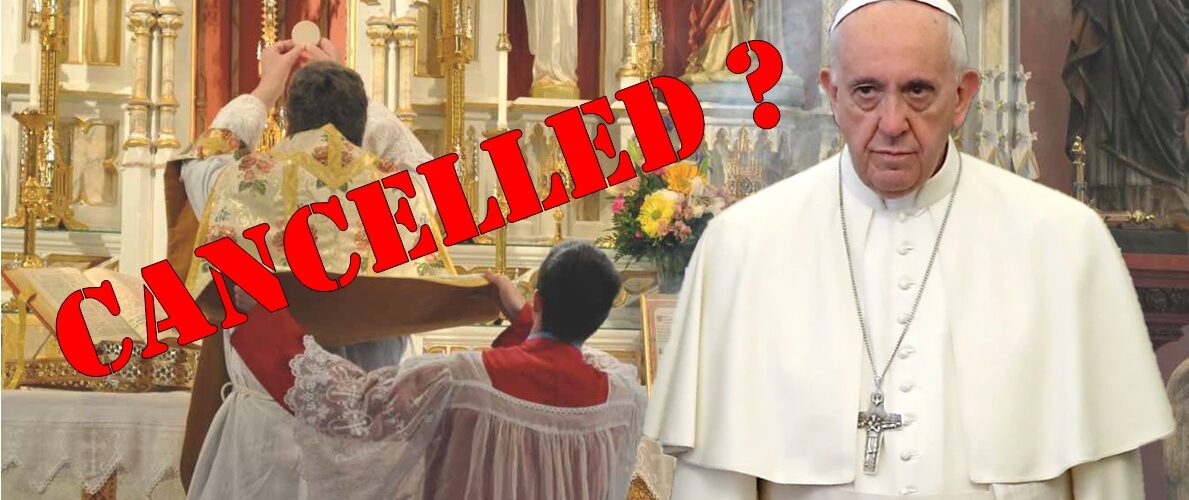
Reports from various credible sources indicate that Pope Francis will soon issue a new document (most likely, an Apostolic Constitution) designed to close canonical loopholes and ensure that Traditionis Custodes is enforced to the letter by all diocesan bishops around the world — especially art. 3 § 2, which forbids the offering of the Traditional Latin Mass “in the parochial churches”.
In addition to addressing other related matters (e.g., further restrictions on the traditional rites for the other sacraments, including ordination), the document may even go further than Traditionis Custodes and claim to abolish the Traditional Mass altogether, and thus forbid priests to offer it henceforth.
In the face of such prospects, Catholics would do well to ask a very basic question: Does the Pope have the authority to abolish what the Council of Trent calls “the received and approved rites of the Catholic Church”? Other pertinent questions include:
These are the questions we seek to address in this article. Along the way, we will review some common prooftexts to which hyperpapalists appeal in favor of their erroneous position that the Pope has virtually absolute power over the Church’s liturgical rites.
Even from apostolic times, liturgical stability has played a vital role in maintaining unity and integrity of faith for the universal Church. The reason for this is summed up by the ancient axiom lex orandi, lex credendi — “the law of prayer is the law of belief.” In other words, the Church’s liturgy (public worship and prayer) shows forth and gives expression to the Deposit of Faith.
All throughout Church history, heretics have sought to change the Church’s lex orandi in order to accommodate and propagate their heretical lex credendi. St. Robert Bellarmine cites an example from “the times of the Emperor Constantine,” during which “Catholics and Arians were customarily distinguished because the former would sing Gloria Patri, et Filio, et Spiritui Sancto at the end of the Psalms [during Mass], whereas the latter used: Gloria Patri, per Filium [through the Son], in Spiritu Sancto [in the Holy Ghost].”[1] The purpose of the Arian Gloria Patri was, of course, to deny that the Son and the Holy Ghost are consubstantial with the Father.
As it was during the Arian crisis (fourth century), so also during the Protestant revolt (16th century). Liturgical scholar Fr. Adrian Fortesque (d. 1923) observes in his classic work The Mass: A Study of the Roman Liturgy:
“The Protestant Reformers naturally played havoc with the old liturgy. It was throughout the expression of the very ideas (the Real Presence, Eucharistic Sacrifice and so on) they rejected. So they substituted for it new Communion services that expressed their principle but, of course, broke away utterly from all historic liturgical evolution [development].”
In response to these attacks, the Council of Trent (1545–1563)
“wished the Roman Mass to be celebrated uniformly everywhere. The medieval local uses [i.e., variations of the Roman Rite as celebrated in particular cities or regions] had lasted long enough. They had become very florid and exuberant; and their variety caused confusion. It would be better for all Roman Catholics to go back to an older and simpler form of the Roman rite. In its eighteenth session (16 Feb. 1562) the Council appointed a commission to examine the missal, to revise it and restore its earlier form. … They accomplished their task very well. It was not to make a new missal, but to restore the existing one ‘according to the custom and rite of the holy Fathers,’ [Pope St. Pius V, Quo Primum] using for that purpose the best manuscripts and other documents.”[2]
Thus, the Roman Missal prepared by the Tridentine liturgical commission and promulgated by Pope St. Pius V in 1570 exemplifies a true liturgical reform, that is, a restoration and codification of the “received and approved” Roman Rite. And regarding the permanent value of this traditional rite, Fr. Michael Fiedrowicz explains near the end of his scholarly work on the subject:
“The traditional rite of the Mass proves itself to be a clear and complete testimony of the central truths of the Faith, a demonstration of the true Faith, so that the rule of prayer (lex orandi) at the same time presents an authentic rule of faith (lex credendi). Not a single core element of the depositum fidei is concealed, diminished, or ambivalently formulated. Unambiguous and unabbreviated, the traditional form of the Mass manifests that which the Church believes, has ever believed, and ever will believe. Accordingly, this liturgy is referred to [by Dom Prosper Guéranger] as ‘tradition in its most powerful and solemn form,’ and [by Bishop Jacques-Bénigne Bossuet] as ‘the most important instrument of tradition.’
The celebration of the liturgy in its traditional form thus constitutes an effective counterweight for all levelings, reductions, dilutions, and banalizations of the Faith.”[3]
This brings us to the specific decrees of the Council of Trent with respect to liturgical development and the extent of the Church’s power over liturgical rites. During Session VII (March 3, 1547), convened under Pope Paul III (r. 1534-1549), the Fathers of Trent issued a Decree on the Sacraments and several sets of related canons (anathemas), among which we find the following:
“If anyone says that the received and approved [receptos et approbatos] rites of the Catholic Church that are customarily used in the solemn administration of the sacraments may be despised or omitted without sin by the ministers as they please or that they may be changed to other new rites by any pastor in the Church: let him be anathema.” (Can. 13 on the Sacraments in General; D.H. 1613)
Liturgical rites are obviously “approved” by the Church (and the Pope, in particular), but what does it mean for them to be “received”? St. Basil the Great (d. 379) provides some helpful insights:
“Of the beliefs and practices whether generally accepted or publicly enjoined which are preserved in the Church some we possess derived from written teaching; others we have received delivered to us in a mystery by the tradition of the Apostles; and both of these in relation to true religion have the same force. … What writing has taught us to turn to the East at the prayer? Which of the saints has left us in writing the words of the invocation at the displaying of the bread of the Eucharist and the cup of blessing? For we are not, as is well known, content with what the Apostle or the Gospel has recorded, but both in preface and conclusion we add other words as being of great importance to the validity of the ministry, and these we derive from unwritten teaching.”[4] (Emphasis added)
In short, a “received” liturgical rite is one that is rooted in “the tradition of the Apostles” and, as such, has been “preserved by the [Church] Fathers,” to quote St. Athanasius (d. 373).[5] The approval and preservation of a given liturgical rite is a consequence of it having been “received” from apostolic tradition — it is “approved” and preserved precisely because it is “received”.
Now, those who tend to overinflate papal authority point to other passages from the Council of Trent as “proof” that the Church and her visible head, in particular, have tremendous discretionary power over the liturgy. They cite, for example, the following text from Session XXI (July 16, 1562), over which Pope Pius IV (r. 1559-1565) presided:
“Furthermore, [the holy council] declares that, in the administration of the sacraments — provided their substance is preserved — there has always been in the Church that power to determine or modify what she judged more expedient for the benefit of those receiving the sacraments or for the reverence due to the sacraments themselves — according to the diversity of circumstances, times, and places.” (Decree on Communion under Both Species and the Communion of Young Children, Ch. 2; D.H. 1728, emphasis added)
What hyperpapalists fail to mention, however, is the context of this statement, namely, an explanation of why Communion under the species of bread alone is sufficient (since Christ is wholly present under either species), which had been the custom of the Roman Church for many centuries by the time of Trent’s decree. It has nothing to do with making radical changes to the order or texts of the Mass.
Hyperpapalists will also quote from Session XXII (Sept. 17, 1562), likewise held during Pius IV’s reign:
“And as human nature is such that it cannot easily raise itself up to the meditation of divine realities without external aids, Holy Mother Church has for that reason duly established certain rites, such as that some parts of the Mass should be said in quitter tones and others in louder; and she has provided ceremonial such as mystical blessings, lights, incense, vestments, and many other rituals of that kind from apostolic order and tradition, by which the majesty of this great sacrifice is enhanced and the minds of the faithful are aroused by those visible signs of religious devotion to contemplation of the high mysteries hidden in this sacrifice.” (Decree on the Sacrifice of the Mass, Ch. 5; D.H. 1746, emphasis added)
They focus on the affirmation that “Holy Mother Church has … duly established certain rites,” reasoning that the Church can abolish what she herself has established, while neglecting that the aforementioned ceremonies come “from apostolic order and tradition….” The above passage, far from proving a power to suppress, actually demonstrates the principle that liturgical development results in enhancement (growth) over time, not reduction (minimalism).
Moreover, the same decree’s teaching on the Roman Canon testifies to the Church’s deep concern for preserving not only “apostolic traditions” (those which derive from the Deposit of Faith) but also ecclesiastical traditions (those established after the death of the Apostles):
“Holy things must be treated in a holy way, and this sacrifice [the Mass] is the most holy of all things. And so, that this sacrifice might be worthily and reverently offered and received, the Catholic Church many centuries ago instituted the sacred canon. It is so free from all error that it contains nothing that does not savor strongly of holiness and piety and nothing that does not raise to God the minds of those who offer. For it is made up of the words of our Lord Himself [Scripture], of apostolic traditions [Tradition], and of devout instructions of the holy pontiffs [ecclesiastical traditions].” (Decree on the Sacrifice of the Mass, Ch. 4; D.H. 1745)
And to drive home the seriousness of the subject matter, the Fathers of Trent anathematized anyone who would dare to say that “the canon of the Mass contains errors and therefore should be abolished” (Can. 6 on the Sacrifice of the Mass; D.H. 1756).
Following the Council of Trent, the popes themselves have understood that the duty to faithfully preserve and hand on the Church’s “received and approved rites” applies, first and foremost, to the Supreme Pontiff.
Roughly a year after Trent had concluded, Pope Pius IV included the following in his Tridentine Profession of Faith (Nov. 13, 1564):
“I most firmly accept and embrace the apostolic and ecclesiastical traditions and all other observances and constitutions of the same [Catholic] Church. … I also profess that there are truly and properly speaking seven sacraments of the New Law, instituted by Jesus Christ our Lord and necessary for the salvation of the human race…. I also admit and accept the rites received and approved in the Catholic Church for the solemn administration of all the sacraments mentioned above.” (Bull Iniunctum Nobis; D.H. 1863-1864, emphasis added)
The same Pope who approved Trent’s decrees which recognize the Church’s “power to determine or modify” how the sacraments are administered (Session XXI), as well as her power to duly establish “certain rites” (Session XXII), clearly saw himself as being bound to “admit and accept the rites received and approved in the Catholic Church,” thus acknowledging his duty to preserve and hand them on.
A little over 300 years later, towards the beginning of the First Vatican Council (Session II), Pope Pius IX repeated his predecessor’s words nearly verbatim:
“Apostolic and ecclesiastical traditions and all other observances and constitutions of that same [Catholic] Church I most firmly accept and embrace. … I profess also that there are seven sacraments of the new law, truly and properly so called, instituted by our Lord Jesus Christ and necessary for salvation…. I likewise receive and accept the rites of the Catholic Church which have been received and approved in the solemn administration of all the aforesaid sacraments.”[6] (Emphasis added)
Note well: The same Pontiff who defined papal infallibility and reaffirmed the Pope’s “full and supreme power of jurisdiction over the whole Church, not only in matters that pertain to faith and morals, but also in matters that pertain to the discipline and government of the Church throughout the whole world,”[7] also clearly recognized that he himself was bound to “firmly accept and embrace” not only “apostolic and ecclesiastical traditions” — including “the rites … which have been received and approved” — but also “all other observances and constitutions” of the Church.
Those who claim that the Pope has virtually absolute power over the Church’s liturgical rites must reckon with these solemn professions made by Pius IV (1564) and Pius IX (1870), both of whom adhered to the Council of Trent’s teaching that the Church’s “received and approved rites” must be preserved and handed on.
While it is true that popes have added, removed, or modified various liturgical prayers and ceremonies over the centuries, such changes were introduced with great reverence and care to preserve the substance of the rite as a whole (and obviously never to appease heretics). Moreover, there eventually came a time (relatively early, in the grand scheme of Church history) when significant alterations ceased. On this point, Fr. Fortesque notes:
“The reign of St. Gregory the Great (590–604) marks an epoch in the history of the Mass. He left the Roman liturgy practically in the state in which we still have it [referring to the Traditional Latin Mass]. … There is moreover a constant tradition that St. Gregory was the last to touch the essential part of the Mass, namely the Canon. … From, roughly, the time of St. Gregory we have the text of the Mass, its order and arrangement, as a sacred tradition that no one ventured to touch except in unimportant details.”[8] (Emphasis added)
Popes are indeed guardians of tradition (traditionis custodes). They are not absolute monarchs “whose thoughts and desires are law,” as Pope Benedict XVI reminded us at the beginning of his pontificate.[9]
Let us now turn to Pope Pius XII’s landmark Encyclical Mediator Dei on the Sacred Liturgy (Nov. 20, 1947). Before surveying some key passages, it is crucial to understand the historical context and impetus behind the document.
Simply put, Pius XII issued Mediator Dei to affirm all that was good in the Liturgical Movement, which began in the late 1800s and was encouraged by Pope St. Pius X (r. 1903-1914), while also condemning Modernist errors which had crept into the movement closer to the time of his pontificate (r. 1939-1958).[10] This context puts Pius XII’s teachings into proper perspective, including his statement that “the Sovereign Pontiff alone enjoys the right to recognize and establish any practice touching the worship of God, to introduce and approve new rites, as also to modify those he judges to require modification” (MD, 58). In other words, the Pope’s unique power is always in the service of guarding the Church’s liturgical patrimony against those who are “over-eager in their search for novelty” and end up “straying beyond the path of sound doctrine and prudence” (MD, 8).
Below are some key passages from Mediator Dei in which Pius XII discusses the nature of the Church’s liturgical rites and the scope of her power over them, interspersed with some brief commentary (emphasis added throughout):
Note that Pius XII did not say the ecclesiastical hierarchy has the right to abolish “the received and approved rites of the Catholic Church” (Council of Trent). Notice, also, how he mentions that the hierarchy’s role over the centuries has been to enrich, not impoverish, the Church’s liturgical rites.
Again, his description of “various modifications” over the centuries underscores the fact that additions have been “gradual” and “development” has been slow and measured, not abrupt and eager for novelty.
This is critical. Pius XII specifies that the Church’s “right of control over liturgical observance” is directly tied to her duty “to protect the purity of divine worship against abuse from dangerous and imprudent innovations,” which heretics invariably seek to introduce. Thus, the Church’s power over the liturgy is primarily one of preservation and “defense” of her “legitimate rites,” that is, her “received and approved rites” (Council of Trent).
This is a clear rebuke of Modernists within the Liturgical Movement, who sought to “introduce novel liturgical practices” and revive “obsolete rites”. It is also a prophetic indictment of the radical reforms which began in earnest just 20 years later under Pope Paul VI.
Dr. Peter Kwasniewski comments on this passage (a favorite of hyperpapalists) in his latest book, The Once and Future Roman Rite, explaining that it “is often quoted out of context, as if it amounts to blanket endorsement of any and all ‘recent liturgical rites.’ Yet this encyclical was published in 1947, prior to any major changes that would be made to the Roman rite in the years thereafter; the noble Roman rite was still very much intact.”
“Consequently,” he goes on, “Pius’s mention of ‘more recent liturgical rites’ refers to everything medieval and Baroque — that is, everything subsequent to that ancient period of which the Liturgical Movement tended to be enamored. … By the time we reach the pontificate of Pius XII, this collective body of liturgy — which was simultaneously ancient, medieval, and Baroque, as an organic reality that had passed through all of these periods and had acquired elements from each of them — was already highly stabilized and consistent for four hundred years,” and he further notes that this “treasure of great perfection and beauty … was lovingly kept and handed down by the ordering of Divine Providence, which no pope dared to disturb or oppose.”
“Indeed,” Kwasniewski observes, “this passage from Mediator Dei [n. 61] reads rather like a commentary on the famous Canon 13 of the Seventh Session of the Council of Trent,”[11] to which we have referred repeatedly throughout this article.
Is this not an indictment of the manifold errors and abuses we have witnessed since the advent of Paul VI’s radical liturgical reform? And all of them, including the Novus Ordo Missae itself, are rooted in the same “exaggerated and senseless antiquarianism” which Pius XII rightly condemned.
For some final background to Mediator Dei and the Pope who issued it, let us recall the startling comments made by Cardinal Eugenio Pacelli (the future Pius XII) in 1931:
“I am worried by the Blessed Virgin’s messages to little Lucia of Fatima. This persistence of Mary about the dangers which menace the Church is a divine warning against the suicide of altering the faith, in her liturgy, her theology and her soul…. I hear all around me innovators who wish to dismantle the Sacred Chapel, destroy the universal flame of the Church, reject her ornaments and make her feel remorse for her historical past….
A day will come when the civilized world will deny its God, when the Church will doubt as Peter doubted. She will be tempted to believe that man has become God. In our churches, Christians will search in vain for the red lamp where God awaits them. Like Mary Magdalene, weeping before the empty tomb, they will ask, ‘Where have they taken Him?’”[12] (Emphasis added)
In light of these comments, does anyone honestly believe that Pius XII would have approved of Paul VI’s attempt to replace the Traditional Latin Mass with what Cardinal Ratzinger famously called “a banal product of the moment” (referring to the New Mass)?[13] On the contrary, Pius XII would surely have agreed with Cardinals Ottaviani and Bacci, who warned Paul VI that “the Novus Ordo represents, both as a whole and in its details, a striking departure from the Catholic theology of the Mass as it was formulated in Session XXII of the Council of Trent.”[14]
Based on the sources we have covered in this article, it is clear that the answer to our basic question — Does the Pope have the authority to abolish “the received and approved rites of the Catholic Church”? — is a resounding no. Hence, if Pope Francis tries to abolish and forbid the Traditional Latin Mass, Catholics will be well within their rights to resist such an abuse of power.
As Dr. Kwasniewski sums up in his work True Obedience in the Church:
“… the postconciliar liturgical reform, its subsequent ruthless implementation, and Pope Francis’s renewed efforts to extinguish the preceding tradition are unreasonable, unjust, and unholy, and therefore cannot be accepted as legitimate or embraced as the will of God. As St. Thomas Aquinas famously says: unjust laws ‘are acts of violence rather than laws … Wherefore they do not bind in conscience.’ [ST I-II, q. 96, art. 4] A repudiation of our Catholic liturgical patrimony is tantamount to disobedience to God; and we will be obedient to God through our ‘disobedience’ to the revolutionaries.”[15]
May Our Lord and Our Lady give us the graces we will need for whatever lies ahead, and may we take to heart the following words of Dom Prosper Guéranger found in The Liturgical Year (Feast of St. Cyril of Alexandria, Feb. 9):
“When the shepherd becomes a wolf, the first duty of the flock is to defend itself. … The true children of Holy Church at such times are those who walk by the light of their Baptism, not the cowardly souls who, under the specious pretext of submission to the powers that be, delay their opposition to the enemy in the hope of receiving instructions which are neither necessary nor desirable.”[16]
Ping
He probably will using some FJB technique. I don’t think he can understand Latin.
Ignore the jackass.
Maybe it’s time to rethink the First Vatican Council’s ruling of papal infallibility.
“Can the Pope Abolish the Traditional Latin Mass?”
Not if he’s really a Pope.
I find this absolutely bizarre.
So after 2000 years of accepted tradition and 500 years of clear codification in Canon Law - Vatican II, and especially Pope Francis are like: “yeah, all that old stuff - you can disregard it. Because we know better than that, we were able to figure out what’s best, and now we’ll force you to do it.”
I believe he’s supposed to be infallible ruling Ex Cathedral. If the matter is considered a subject of faith or morals it may well be within his reach.
Did he flunk latin?
I even made it through Latin I, I probably should have taken more, but in some respects I was a bit of a slacker in high school. I did all the maths though.
Francis...the pope of the end times.
No pope has spoken ex Cathedra since Pius XII.
As far as faith and morals, Bergoglio is batting 0.000.
Maybe it’s time to thing about Bergoglio’s election.
IMHO it’s a problem with the concept of apostolic secession. The apostle Paul told us to test all things taught to us (see tagline). Apostolic secession says don’t test teachings from someone who’s in the official clique.
Pope Socialista Faggato needs to go, he is all about destroying the church.
"Furthermore, by these presents [this law], in virtue of Our Apostolic authority, We grant and concede in perpetuity (forever) that, for the chanting or reading of the Mass in any church whatsoever, this Missal is hereafter to be followed absolutely, without any scruple of conscience or fear of incurring any penalty, judgment, or censure, and may freely and lawfully be used..."
If Benedict’s “resignation” was coerced, it may have been invalid.
If Benedict’s resignation was invalid, the subsequent election of a new Pope was invalid.
If the subsequent election of a new Pope was invalid, then Jorge Bergoglio isn’t Pope.
If Jorge Bergoglio isn’t Pope, he isn’t protected by the charism of infallibility.
FWIW.
If you give a mouse a cookie ....
The problem with the bible, doctrine, canon etc .... is that those given authority to "interpret" have the potential to make words mean whatever they want them to mean. We see this in absurd interpretations of our Constitution and absurd court rulings. E.g., The right to privacy was interpreted to include the right to abortion. It took 51 years for the SCOTUS to reverse itself. The Magisterium has the task of interpreting scripture and making judgments on “tradition” within the Catholic Church, making official statements as to the authenticity of such traditions. Just as the SCOTUS has not always gotten it right - there is the potential that the Magisterium will not always be right. We would all like to believe that the Magisterium is led by the Holy Spirit and could never oppose Christ's will - but ...
"As soon as night had fallen, the brothers sent Paul and Silas away to Berea. On arriving there, they went into the Jewish synagogue. Now the Bereans were more noble-minded than the Thessalonians, for they received the message with great eagerness and examined the Scriptures every day to see if these teachings were true. As a result, many of them believed, along with quite a few prominent Greek women and men." - Acts 17:10-12
Setting aside the question of whether it is licit for a Pope to abrogate the TLM -- assuming that it is, +Francis could abrogate the TLM tomorrow and un-abrogate it next week, and Papal infallibility would never come into play.
Disclaimer: Opinions posted on Free Republic are those of the individual posters and do not necessarily represent the opinion of Free Republic or its management. All materials posted herein are protected by copyright law and the exemption for fair use of copyrighted works.