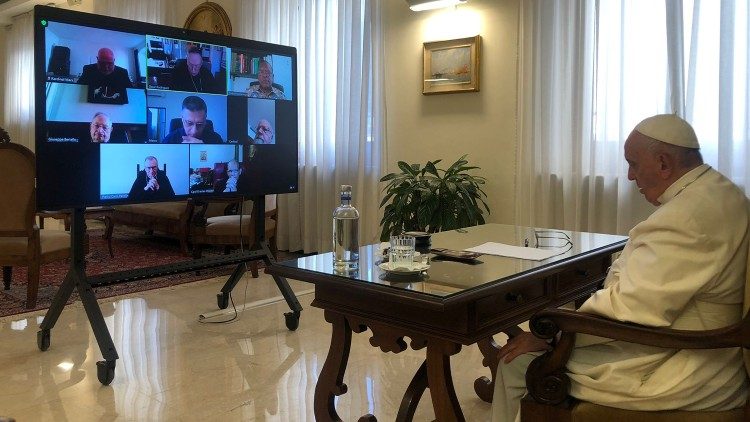
Francis falls asleep during Sin-Nod Zoom session.
Posted on 09/22/2021 2:49:55 PM PDT by ebb tide
(LifeSiteNews) – The man who glowingly sketched Pope Francis as a “great reformer” only a year and a half into his papacy is now predicting the upcoming synod of bishops on synodality may bring a revolutionary transformation to the Catholic Church.
Austen Ivereigh wrote Thursday about the objectives of the synod “For a Synodal Church,” set to begin in October, calling it a “historic shake-up” and “potentially the most transformative moment in Catholicism since the Second Vatican Council, which it seeks to embed permanently into the life of the Church.”
“The two-year ‘synod on synodality,’” wrote Ivereigh in Commonweal, “is set to mark Christianity forever.” He went to note, “Yet so far the disengagement has been almost total. (Has your parish priest mentioned anything? I thought so.)”
Perhaps the most “transformative” aspect of the synod, wrote Ivereigh, is that the “People of God” will no longer be “passive spectators,” but seriously consulted to discern the voice of the Holy Spirit. The bishops remain the “ discerners-in-chief,” and the Pope the final decision-maker in this process.
Ivereigh wrote, “Thus, ‘the purpose of this synod’ — and indeed, the point of a synodal Church — ‘is to listen, as the entire People of God, to what the Holy Spirit is saying to the Church.’” He further noted that the Preparatory Document for the synod claimed it was the role of the devil (“the diabolos”) “to try and separate” the People of God, the Holy Spirit, and the bishops in a synod.
The vademecum, or synod handbook, expressly states that the synod’s discernment process of “listening” must include “Catholics who rarely or never practice their faith, etc.,” and goes so far as to demand listening to “people who have left the practice of the faith, people of other faith traditions, people of no religious belief, etc.”
“No one — no matter their religious affiliation — should be excluded from sharing their perspective and experiences, insofar as they want to help the Church on her synodal journey of seeking what is good and true,” reads the text.
According to Ivereigh, this consultation process will not be in service of a particular ideological “program”: “A synod is not called to defend or to change anything; it is called to enable an assembly that discerns what the Holy Spirit asks of the Church at this time in relation to the mission for which it exists: to evangelize.”
Indeed, the preparatory document’s “thematic nuclei” to be explored during the synod are somewhat vague and more process-oriented than “issue”-oriented. These topics include variations of the theme of “synodality,” which Cardinal Mario Grech explained “is the form of communion of the Church — People of God.” Accordingly, the “thematic nuclei” include “the journeying companions,” “listening,” “speaking out,” and “dialogue in Church and society,” among other topics.
But Ivereigh also believes that synodality results in a kind of synthesis, or what he calls “alchemy,” of different views: “To enter into synodality is to embrace an alchemy in which the Spirit acts as a complexio oppositorum, in which what is good and valid on all sides is preserved in a new vision,” he wrote.
Ivereigh’s expectations of the upcoming synod as published in Commonweal echo themes of his 2014 biography of Pope Francis, “The Great Reformer: Francis and the Making of a Radical Pope.”
As one reviewer of this biography explained, Ivereigh said there are three “keys to the papacy of Francis.” One of these keys is Francis’ determination to “learn and hear the infallibility of God’s holy faithful people.” Ivereigh reiterated this in an interview with Raymond Arroyo, saying that Pope Francis has “always rooted himself in what he calls God’s holy faithful people.”
Part of another “key” is the need of the Pope to “assemble real synods of governance and dismantle structures” in order to bring about “institutional reform” of the Church. At the heart of this is what Ivereigh argued has been a determined goal of Bergoglio’s backers from the beginning: Church implementation of collegiality.
Ivereigh’s biography does not limit itself to describing Pope Francis’ past and ideology, but makes a point of predicting how Pope Francis’ “ambitious program” will “likely end,” because Ivereigh has come to an intimate knowledge of the long-held and determined agenda of the group of cardinals who backed Bergoglio: the “St. Gallen mafia.”
While Ivereigh does not refer to them as a “mafia,” Cardinal Godfried Daneels, one of the group’s inner circle, revealed in 2015 that this is what the group called itself.
Karim Schelkens, one of the biographers of Daneels, said in a 2015 interview, “The election of Bergoglio was prepared in Sankt-Gallen, without doubt. And the main lines of the program the Pope is carrying out are those that Danneels and Co were starting to discuss more than ten years ago.”
Ivereigh wrote in Pope Francis’ biography that the St. Gallen group was formed in the late 1990s due to “growing concern” about a “position” that “looked to some critics as if it were harking back to the days before the Second Vatican Council”: the position that there is “only one ‘Magisterium,’ or teaching authority, in the Church, and that the universal church is ‘ontologically prior’ to the local church.”
The St. Gallen group considered this traditional position to be opposed to true “collegiality,” which Ivereigh describes as one of its most fervently desired goals for the Church. According to Ivereigh, collegiality is a kind of joint authority wherein the bishops help govern the church cum et sub Petro — with and under the Pope. In his idea of collegiality, the “local Church shar[es] in the governance of the universal Church.”
“The St. Gallen group believed that what was needed was a thorough reform of governance, a restoration of the balance between the local and universal Churches, toward an authentic collegiality,” wrote Ivereigh.
The self-described “mafia” lamented the lack of Church collegiality as an obstacle to evangelization, as well as to “Christian unity.” Something as fundamental as the “assertion of papal power” after the Reformation, Ivereigh wrote, was “cited as a major stumbling block” by leaders of the “reformed or orthodox traditions.”
This radical and heterodox take on collegiality was articulated by one of the members of the St. Gallen group, now-Cardinal Walter Kasper, in opposition to a 1992 document by Cardinal Ratzinger.
Ivereigh explained that Kasper argued “in a widely published article in December 2000” that Cardinal Ratzinger’s position “became ‘really problematic when the one universal Church is identified with the Roman Church, and de facto with the Pope and the Roman Curia,’ describing it as ‘an attempt to restore Roman centralism.’”
Ivereigh said Kasper “went on to argue that collegiality was vital to resolve pastoral questions such as the admission of divorced and remarried persons to Communion, as well as making credible the Catholic invitation to unity with other Christians. Progress on unity depended, he argued, on this recognition of the value of the local Church. ‘The ultimate aim is not a uniform united Church, but one Church in reconciled diversity.’ The phrase ‘reconciled diversity’ was one Bergoglio adopted in Buenos Aires when discussing relations with other Christians and other faiths.”
Ivereigh explained that these early concerns of the St. Gallen group carried into discussions during the conclave following Pope Benedict XVI’s resignation. “There was much talk of reform of governance … and for fluid contact between Rome and the local Church,” wrote Ivereigh. He quoted Vatican spokesman Fr. Federico Lombardi as telling journalists on March 9, a few days prior to the papal conclave, that “collegiality had been ‘a constant theme in these discussions.”
Ivereigh also quoted Cardinal Seán O’Malley of Boston as recalling, “‘We were all pretty certain that there would be dramatic changes and a new way of looking at the Curia, with more collegiality.’”
“The diagnosis of the St. Gallen group in the early 2000s was now the plat du jour,” wrote Ivereigh.
Ivereigh himself is the former assistant of Cardinal Murphy-O’Connor, whom Ivereigh described in “The Great Reformer” as part of the “core” of the St. Gallen group from its beginning.
In a September 2017 article for The Tablet, Ivereigh described Murphy-O’Connor as a “kingmaker” in the conclave that elected Pope Francis. Ivereigh said the cardinal was “proud to have opened that channel for the Holy Spirit to get to work.”
Barf Alert Ping
The pope of the billionaires and big business.
That is NOT "balance", that is anarchy!
The conclusion is that Martin Luther was right and the Council of Trent was wrong.
The power Christ conveyed on Peter in Mt 18:18 was "whatsoever you shall bind upon earth, shall be bound also in heaven; and whatsoever you shall loose upon earth, shall be loosed also in heaven."
It certainly was not an invocation of the "infallibility of the faithful".
Like the media, universities, and the military I fear the Catholic Church has become another once proud institution permanently captured by the left.
Indeed, it has. The fix is in. They’re going to say that they talked to the non-practicing Catholics and the seldom-practicing Catholics, and, hell why not, to the non-Catholics and the atheists as well, and asked how the Church could be improved, and the answers that they got were...
womenpriests
gay marriage
gay priests
gay-married priests
abortion on demand
yada yada yada
And this alleged vox populi will be deemed the voice of the Holy Spirit and all of that will be implemented. At least that’s the plan.
Leave it to the secular Jew to have a better grasp of human nature and our relationship to Jesus Christ than this Puerto Rican pope does.
His time must be short.
There is nothing less permanent than the Left.
So the False Prophet makes it official.
He could go to sleep one night and not wake up. That applies to any of us of course. Happened to my Dad at the same age.
THE CHURCH IS NOT A DEMOCRACY. However I am happy to skew the results with my very Traditional input.
Oh, let me guess, This Holy Spirit of the Pocket will suddenly reveal the following:
Woman shall be ordained.
Gays and Lesbians shall be married in the Church.
Artificial contraceptive is now permitted.
Liturgical dance is cool.
Climate crisis denial is a sin.
I Am A Catholic! Of Course I Wish For Francis To Die!
(not my words, but I can emphasize with the reasoning)
P.S. The author states:
Mind you: I wish the man death, but I do not wish him hell. This would, without any mistake, be a mortal sin, and I have no intention of wilfully incurring in one. No, I would love to, one day, be with the man in heaven, all our past sins and miseries cleansed and both happy in Christ’s presence. Believe me, this is a sincere wish.
Christ is what is good and true, you degenerate moron.
When Christ Jesus returns, these folks like the Pope and those who pervert the church will not be going to Heaven. Hate to tell them they are apostates. They are of the devil.
Just like Adam and Eve. All sins come from pride. God has spoken on these things, the pope and his minions risk their souls and the souls of those in their care.
The Church will continue to lose some faithful but Jesus’ promise is true and enduring, that the gates of hell will not prevail over her.
We call upon God, saying “How long Lord?” but we do not know His time or His mind.
Have faith. It is still His Church.
The last Pope?
"Not God's holy people": faithful, traditional Catholics.
(According to +Francis)
Disclaimer: Opinions posted on Free Republic are those of the individual posters and do not necessarily represent the opinion of Free Republic or its management. All materials posted herein are protected by copyright law and the exemption for fair use of copyrighted works.