Posted on 07/12/2021 8:40:37 PM PDT by ebb tide
Over one century ago, G.K. Chesterton wrote a masterpiece poem titled The Ballad of the White Horse. Today, more than ever, it strikes chords in the hearts of all who love the Catholic Church and her traditions. In soul-stirring rhymes, Chesterton tells the story of ragged King Alfred, who mournfully wanders through his once Catholic kingdom, now overrun with pagan Danes. The ballad weaves a tapestry of medieval legends, but its essence rings as true as historical fact. It is the story of the fight for truth, goodness, and beauty in a fallen world. The profound sorrow experienced by Alfred at the sight of his afflicted kingdom bears a striking resemblance to the sorrow of Catholics today who, realizing what the Church has lost, yearn for the restoration of beauty, tradition, and true Catholic culture.
In the first book of the ballad, Alfred begs Our Lady to tell him if he will ever succeed in driving the Danes from his land. She gives a cryptic reply that includes two of the ballad’s most resounding stanzas:
I tell you naught for your comfort,
Yea, naught for your desire,
Save that the sky grows darker yet
And the sea rises higher.Night shall be thrice night over you,
And heaven an iron cope.
Do you have joy without a cause,
Yea, faith without a hope? [1]
These ominous words resonate much with us in our own dark days, awash with the waves of scandal, apostasy, and unprecedented internal attacks. The Mother of God does not minimize the Cross. She who speaks of darkness to Alfred speaks as one who watched God die on a cross when darkness came over the whole land (Matthew 27:45). When we acknowledge the dark state of things and open our eyes to the black reality of evil, we find something deeper and more resilient than consolation — it is a sort of naked hope like that of the martyrs, who, though they could see, hear, and feel nothing but atrocities in their final moments, nevertheless rejoiced in the infinite goodness of God.
Some Catholics today hide their eyes from the Church’s affliction like frightened children at the sight of a wound. They cannot bear to look at reality because the magnitude of its evil swallows their shrunken idea of God and the Church His bride. In a pharisaical attempt to save the nation (John 11:50–51), they haggle and make compromises with secularists as if the Church were an earthly kingdom that must bow to the powers of the world in order to survive. This denial of reality closes them off from the mysterious and liberating naked hope that dawns only when one fully embraces reality, which is the Cross itself. The Mother of God beheld the horror of the Cross far more clearly and painfully than any other disciple, but such was her faith in God, that the enormity of the evil only deepened her adoration. For those who embrace the Cross, great evil will always point to an infinitely greater God.
The fight for the Church, tradition, and culture continues under desperate conditions. Unchecked moral relativism in secular education systems and abysmal catechesis within the Church combine to produce individuals who seem to lack the ability to ask even the most basic philosophical questions. A vast part of the population even within the Church does not think to ask, “Where did I come from?” and “Where am I going?” Amazingly, in the midst of this stupor, a few sparks of sanity have ignited the traditional movement.
Very few Catholics who love tradition are unharmed by the disastrous catechetical neglect of the last several decades. Nor do they easily elude the toxic fumes of relativism that permeate the very walls of the Church. But despite these misfortunes of the past and dangers of the present, they struggle on. They know beyond doubt that their Church is not a bureaucracy, but a bride, and that a bride is worth fighting for.
Chesterton captures the spirit of these people, the “kind of Christ,” in another portion of Our Lady’s message to Alfred:
But you and all the kind of Christ
are ignorant and brave,
And you have wars you hardly win
And souls you hardly save.
This stanza is an apt description of the distressed faithful in the Church today. Even those of us who claim to know something of the Faith cannot really understand God’s reasons for the Church’s present suffering. We can only fight on in ignorance, striving to save our own souls and the souls of others as best we can. But Chesterton, never one for pessimism, deftly draws each of his lines up from man’s weakness to poetic summits that illuminate the victorious power of God: Christ, brave, win, save. All dissonance resolves in these resounding tonic chords, and we find ourselves spurred on once again by the mysterious naked hope.
Our Lady touches again on the inevitable ignorance of Christians in the face of their sufferings when she says to Alfred:
The men of the East may spell the stars,
And times and triumphs mark,
But the men signed of the cross of Christ
Go gaily in the dark.
This reference to ignorance, the Cross, and darkness bears with it a new development: gaiety. This is gaiety in the old and true sense, that word that so richly describes a joyful and brilliant mirth. Alfred experiences this mirth when a servant woman strikes him across the face because she believes he is a beggar rather than the king. So, too, we can experience it only when we cease to regard ourselves as powerful people and see only our total dependence on God.
After hearing Our Lady’s beautiful exhortation, Alfred finds himself full of courage. He enters the Danes’ camp and sings a song that masterfully captures the splendor of the persecuted Christian spirit. I quote two stanzas here:
That though you hunt the Christian man
Like a hare on the hill-side,
The hare has still more heart to run
Than you have heart to ride.That though all lances split on you,
All swords be heaved in vain,
We have more lust again to lose
Than you to win again.
Indeed, in the battle for souls and the Church we love, we are often “hares on a hillside” with little success, much humiliation, and much loss. Our lances split on the vast barricades of modernism found everywhere in the Church, but like Alfred, we never lose the heart to run. We lust for loss because loss in the fight for the Catholic Church, in all her traditional splendor, still far exceeds the tainted rewards of compromise.
Our enemies both within the Church and without ridicule us, and we are no more than ragged beggars before them. They gleefully arm themselves with reports of scandals, changing doctrine (as if that were possible), and all manner of groundless accusations to convince us and the rest of the world how foolish we are. In answer to their jeers, we must simply say with Alfred,
But though I lie on the floor of the world,
With the seven sins for rods,
I would rather fall with Adam
Than rise with all your gods.
We aren’t experts, we aren’t elite, and we have many sins. We stand with darkness bearing down upon us like an iron cope, but we hold fast to the One of whom the psalmist says, “[S]icut tenebrae eius, ita et lumen eius. — Darkness is as light to You” (Psalm 138) [2]. Perhaps many hopes and happy dreams of our own have died painful deaths, and perhaps in our lives on this Earth, we will never see an end of the shocking internal discord suffered by Holy Mother Church. Nevertheless, our faith is not without a hope. The naked hope is hopeless only insofar as it does not rely on worldly victories to keep its flame alive. Indeed, the naked hope flares up in reckless grandeur when all view of success is completely obscured and the only thing left is the Cross itself. Let us stand with the Mother of God at the foot of the Cross in the midst of the present darkness and recall with joy that, by the strange and beautiful providence of God, the dawn of the Resurrection will surely follow the night of the Cross.
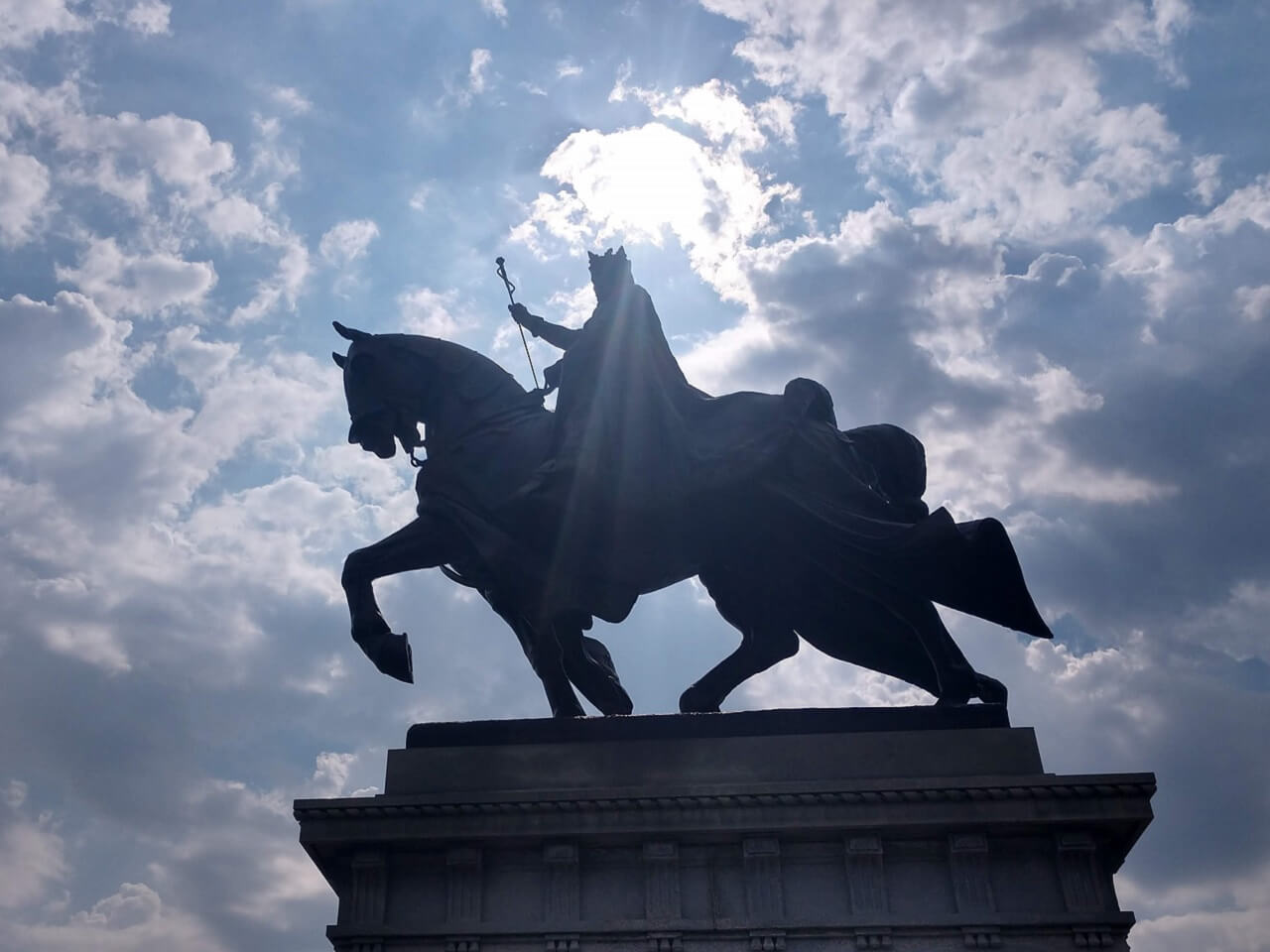
Image: Statue of St. Louis IX, another exemplary Catholic king. Originally published on July 1, 2019.
[1] G.K. Chesterton, Ballad of the White Horse, Project Gutenberg. All subsequent stanzas are taken from the same.
[2] Baronius, Roman Breviary, Volume II, page 581
Ping
A turncoat member of Parliament sponsors an Islamic invasion of England; the Muslims outlaw the sale of alcohol. One man defies the odds with a barrel of liquor which he takes from place to place and *gives* away one drink at a time...
Today, in England, there’s more truth than fiction in that novel.
Chesterton bump!
Marking my place.
The Great Peacemaker and prophet that came to the Mohawks and convinced them to form the Iroquois Confederacy in 1451 predicted this.
A white spirit will come and first befriend and then betray the red spirit. Then a black spirit will come and destroy the white spirit.
That’s 41 years before Columbus.
Isn’t the legend a little more detailed than that?
Rudyard Kipling’s predictions in Gods of the Copybook Headings were pretty-much spot-on, also.
http://www.kiplingsociety.co.uk/poems_copybook.htm
Anyone wanting an introduction to why conservatives enjoy Chesterton should start with his fine essays. The White Horse isn wonderful poetry but not that easy to absorb. Heretics or Orthodoxy are two nice choices. As a writer in the early twentieth century, he was not schooled in the short clip prose of Hemingway, but instead in the complex sentences of Burke and Johnson.
Disclaimer: Opinions posted on Free Republic are those of the individual posters and do not necessarily represent the opinion of Free Republic or its management. All materials posted herein are protected by copyright law and the exemption for fair use of copyrighted works.