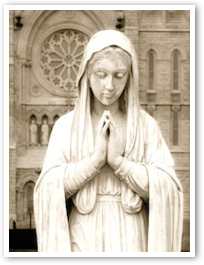
 Most of the issues people have with Mary are really issues about something else. "Where is the Assumption of Mary in the Bible?" isn't really a question about Mary. It's a question about the validity of Sacred Tradition and the authority of the Church. "Why should I pray to Mary?" isn't really about Mary, either. It's actually a question about the relationship of the living and the dead in Christ. "Do Catholics worship Mary?" isn't a question about Mary. It's concerned more with whether or not Catholics countenance idolatry and what the word "honor" means. And curiously enough, all these and many more objections both pay homage to and completely overlook the central truth about Mary that the Catholic Church labors to help us see: that her life, in its entirety, is a referred life.
Mary would, after all, be of absolutely no consequence to us if not for her Son. It is because she is the mother of Jesus Christ that she matters to the world at all. If He hadn't been born, you never would have heard of her. John, with characteristic economy of expression, captures this referred life in her own words: "Do whatever He tells you" (John 2:5). And, of course, if this were all the Church had to say about her, Evangelicals would be more than happy to let her refer us to Jesus and be done with it. What baffles so many non-Catholics is the Church's tendency to keep referring us to her. Ad Iesum per Mariam! we say, to which many non-Catholics nervously respond, "Isn't Christianity supposed to be about a relationship with Jesus Christ? Why do Catholics honor Mary so much?"
Sublime Neglect
As an Evangelical, that question sounded reasonable right up until another question began to bother me: If Catholics honor Mary too much, exactly how do we Evangelicals honor her "just enough"? For the reality was that my native Evangelicalism recoiled from any and all mention of Mary. This was odd. After all, Evangelicals could talk all day about Paul and never feel we were "worshiping" him or giving him "too much honor." We rightly understood that God's word comes to us through St. Paul, and there's no conflict between the two (even though Paul exhibits more character flaws than Mary).
Yet the slightest mention of Mary by a Catholic immediately brought a flood of warnings, hesitations, scrutinies of her lack of faith (allegedly demonstrated in Mark 3:21), and even assertions that Jesus was less pleased with her than He was with His disciples (because He called her "Woman," not "Mom"; and because He commended His own disciples as "my brother and sister and mother" [Mark 3:35]). And all this was despite the fact that not just God's word (e.g. the Magnificat), but God's Word, came to us through Mary (John 1:14). As Evangelicals we could say, "If not for Paul, the gospel would never have reached the Gentiles." But we froze up if somebody argued that, "If not for Mary, the gospel would never have reached the earth." Suddenly, a flurry of highly speculative claims about how "God would simply have chosen somebody else!" would fill the air, as though Mary was a mere incubation unit, completely interchangeable with any other woman on earth. "No Paul, no gospel for the Gentiles" made perfect sense. But "No Mary, no incarnation, no death, no resurrection, no salvation for the world" was just too extreme.
Indeed, from Evangelical piety and preaching as it is actually practiced, one could be forgiven for getting the sense that Jesus didn't really even like His mother (like a teenager irritated because Mom just doesn't understand him). Having "Mary Is No Big Deal" hammered home whenever her name was raised tended to give you the feeling that after her brief photo-op for the Hallmark Christmas card industry Jesus was glad to spend time away from the family in the Temple discussing higher things. The position in Evangelicalism was more or less that we should do likewise and not lavish any attention on the mother who was too dim to understand who He was and whom He "rebuked" by saying, "Why were you looking for me? Did you not know that I must be in my Father's house?"
And so, our claims to honor her "just enough" effectively boiled down to paying no shred of positive attention to her beyond singing "round yon Virgin, mother and Child" each Christmas. The rest of the time it was either complete neglect or jittery assurances of her unimportance and dark warnings not to over-emphasize the woman of whom inspired Scripture said, "From this day all generations will call me blessed."
It was a startling paradigm shift to realize we treated her so allergically and one that, I have since noticed, isn't unusual for converts. Dale Ahlquist, president of the American Chesterton Society, told me once that when he was still hanging back from the Church because of Mary, a blunt priest he knew asked him, "Do you believe her soul magnifies the Lord? It's right there in Scripture." Ahlquist reflexively answered back, "Of course I do! I know the Bible!" But even as he replied he was thinking to himself, "I never really thought of that before." It can be a disorienting experience.
But, in fact, it is right there in the Bible. Her soul magnifies the Lord, and from that day to this all generations have called her blessed. So why, when we Evangelicals looked at Jesus, did we never look at Him through the divinely appointed magnifying glass? Why were we so edgy about calling her "blessed" and giving her any honor? That realization was my first clue that it was, perhaps, Catholics who were simply being normal and human in honoring Mary, while we Evangelicals were more like teetotalers fretting that far too much wine was being drunk at the wedding in Cana.
The Cultural Obstacles
Part of the problem, I came to realize, was that Evangelical fears about Mary are visceral and not entirely theological. Indeed, much of the conflict between Catholics and Evangelicals is cultural, not theological. Evangelical culture (whether you're a man or a woman) is overwhelmingly masculine, while Catholic culture (again, whether you're a man or a woman) is powerfully feminine. And the two groups often mistake their cultural differences for theological ones.
The Catholic approach tends to be body-centered, Eucharistic, and contemplative. Prayer, in Catholic culture, is primarily for seeking union with God. Evangelical approaches to God tend to be centered on Scripture, verbal articulation of belief, mission, and the Spirit working in power. Prayer, in such a culture, is primarily for getting things done. Both are legitimate Christian ways of approaching the gospel. Indeed, they should both be part of the Catholic approach to the gospel. But because of these unconscious differences, Evangelicals and Catholics often clash about culture while they think they're debating theology. The feminine spirituality of the Catholic can regard the masculine Evangelical approach as shallow, noisy, and utilitarian, lacking an interior life. Meanwhile, Catholic piety can be seen by Evangelicals as cold, dead, ritualistic, biblically ignorant, and cut off from real life. Thus, Evangelicals frequently criticize the Catholic life as a retreat from reality into rituals and rote prayers.
Not surprisingly, the heroes of the two camps are (for Evangelicals) the Great Human Dynamo of Apostolic Energy, St. Paul; and (for Catholics) the Great Icon of Contemplative Prayer Issuing in Incarnation, the Blessed Virgin Mary. As an Evangelical, I found Paul much easier to appreciate, since he was "biblical" he wrote much of the New Testament, after all. You could talk about Paul since he'd left such a significant paper trail. Not so with Mary. Apart from the Magnificat and a couple remarks here and there plus, of course, the infancy narratives she didn't appear to occupy nearly as much psychic space for the authors of the New Testament as she did for Catholics. Marian devotion looked like a mountain of piety built on a molehill of Scripture.
Looks, however, can be deceiving. For as I got to know the Bible better, it became obvious to me that the authors of Scripture were not nearly as jittery about Mary as my native Evangelicalism. Furthermore, they accorded to her honors that looked a great deal more Catholic than Evangelical. Luke, for instance, likens her to the Ark of the Covenant in recording that the Holy Spirit "overshadowed" her. The same word in Greek is used to describe the way the Shekinah (glory of God) overshadowed the tabernacle in Luke 1:35. Likewise, John makes the same connection between Mary and the Ark of the Covenant when he announces in Revelation 11:19-12:2:
Then God's temple in heaven was opened, and the ark of his covenant was seen within his temple; and there were flashes of lightning, voices, peals of thunder, an earthquake, and heavy hail. And a great portent appeared in heaven, a woman clothed with the sun, with the moon under her feet, and on her head a crown of twelve stars; she was with child and she cried out in her pangs of birth, in anguish for delivery. The chapter goes on to describe the woman as giving birth to a male child who rules the nations with an iron scepter and who is almost devoured by a great red dragon.
As an Evangelical, my own tradition found it remarkably easy to detect bar codes, Soviet helicopters, the European Common Market, and the Beatles encoded into the narrative of Revelation. But when Catholics suggested that the woman of Revelation might have something to do with the Blessed Virgin occupying a place of cosmic importance in the grand scheme of things, this was dismissed as incredible. Everyone knew that the woman of Revelation was really the symbolic Virgin Daughter of Zion giving birth to the Church. A Jewish girl who stood at the pinnacle of the Old Covenant, summed up the entirety of Israel's mission, and gave flesh to the Head of the Church saying, "Behold, I am the handmaid of the Lord; let it be to me according to your word" what could she possibly have to do with those images? Why, that would suggest that she was the Virgin Daughter of Zion and the Flower of her People, the Model Disciple, the Icon of the Church, the Mother of Jesus and of all those who are united with Him by faith and Come to think of it, Scripture was looking rather Catholic after all.
The Heart of Marian Doctrine
That was the revolutionary thought that made it possible for me to press on, as a new Catholic, to find out what the Church was trying to get at with her Marian teaching. In coming to understand this, it seemed to me, I'd come a long way toward understanding why Mary figures so prominently, not merely in the heads, but in the hearts of Catholics. The first question that arises, of course, is, "Why Marian dogma at all?" Why not just dogmas about Christ and let Catholics think what they like about Mary? Why bind consciences here?
The answer is that Catholics do think what they like not only about Mary, but about lots of things. And sometimes they think deeply erroneous things. When they do, and that thought imperils some revealed truth to the point it threatens the integrity of the Church's witness, the Church will, from time to time, define its doctrine more precisely. This is a process that's already at work in the New Testament (cf. Acts 15), and it continues until the return of Christ.
So, for instance, in the fifth century there arose (yet again) the question of just who Jesus is. It was a question repeated throughout antiquity and, in this case, an answer to the question was proposed by the Nestorians. They argued that the mortal man Jesus and the Logos, or Second Person of the Trinity, were more or less two persons occupying the same head. For this reason, they insisted that Mary could not be acclaimed (as she had been popularly acclaimed for a very long time) as Theotokos, or "God bearer." Instead, she should only be called Christotokos, or "Christ bearer." She was, they insisted, the Mother of Jesus, not of God.
The problem with this was that it threatened the very witness of the Church and could even lead logically to the notion that there were two Sons of God, the man Jesus and the Logos who was sharing a room with Him in His head. In short, it was a doorway to theological chaos over one of the most basic truths of the Faith: that the Word became flesh, died, and rose for our sins.
So the Church formulated its response. First, Jesus Christ is not two persons occupying the same head. He is one person possessing two natures, human and divine, joined in a hypostatic union. Second, it was appropriate to therefore call Mary Theotokos because she's the Mother of the God-Man. When the God-Man had His friends over for lunch, He didn't introduce Mary saying, "This is the mother of my human nature." He said, "This is my mother." Why did the Church do this? Because, once again, Mary points to Jesus. The dogma of the Theotokos is a commentary on Jesus, a sort of "hedge" around the truth about Jesus articulated by the Church. Just as Nestorianism had tried to attack the orthodox teaching of Christ through Mary (by forbidding the veneration of her as Theotokos), now the Church protected that teaching about Christ by making Theotokos a dogma. That is a vital key to understanding Marian dogmas: They're always about some vital truth concerning Jesus, the nature of the Church, or the nature of the human person.
This is evident, for instance, in the definition of Mary as a Perpetual Virgin (promulgated in 553 at the Council of Constantinople). This tradition isn't so much explicitly attested as reflected in the biblical narrative. Yes, we must grant that the biblical narrative is ambiguous in that it speaks of Jesus' "brothers" (but does it mean "siblings" or merely "relatives"?). However, other aspects of the biblical narrative strongly suggest she remained a virgin. For instance, Mary reacts with astonishment at the news that she, a woman betrothed, will bear a son. If you are at a wedding shower and tell the bride-to-be, "You're going to have cute kids," and she responds, "How can that be?," you can only conclude one of two things: she either doesn't know about the birds and the bees, or she's taken a vow of virginity. In short, the promise of a child is an odd thing for a betrothed woman to be amazed about...unless, of course, she'd already decided to remain a virgin even after marriage.
Likewise, Joseph reacts with fear at the thought of taking Mary as a wife. Why fear? Modernity assumes it was because he thought her guilty of adultery, but the typical view in antiquity understood the text to mean he was afraid of her sanctity as a pious Jew would be afraid to touch the Ark of the Covenant. After all, think of what Mary told him about the angel's words: "The Holy Spirit will come upon you, and the power of the Most High will overshadow you; therefore the Child to be born will be called holy, the Son of God."
I'm not even a pious Jew, but with words like that echoing in my ears about my wife, I'd find it easy to believe that Joseph, knowing what he did about his wife, would have chosen celibacy. "But nothing is sure, based on the text alone. It's still ambiguous," says the critic. Right. The biblical text alone doesn't supply an unambiguous answer to this or a myriad of other questions, including "Is the Holy Spirit God?," "How do you contract a valid marriage?," and "Can you be a polygamist?" But the Tradition of the Church in union with the biblical text does supply an answer: Mary had no other children, a fact so commonly known throughout the early Church that when Jerome attacks Helvidius for suggesting otherwise, nobody makes a peep. In a Church quite capable of tearing itself to pieces over distinctions between homoousious and homoiousious, you hear the sound of crickets in response to Jerome, punctuated with the sound of other Fathers singing hymns to "Mary, Ever-Virgin." The early Church took it for granted and thought Helvidius as credible as Dan Brown.
But why a dogma about it? Because, again, Mary's life is a referred life. Her virginity, like Christ's, speaks of her total consecration to God and of our call as Christians to be totally consecrated as well. Her virginity is not a stunt or a magic trick to make the arrival of the Messiah extra-strange. It is, rather, a sign to the Church and of the Church. And that matters for precisely the reason I'd thought it did not matter when I was an Evangelical: because Christianity is indeed supposed to be about a relationship with Jesus Christ. But a relationship necessarily involves more than one person. What it comes down to is this: Jesus can do a world of wonderful things, but there is something even Jesus cannot do He cannot model for us what it looks like to be a disciple of Jesus. Only a disciple of Jesus can do that. And the first and best model of the disciple of Jesus is the one who said and lived "Yes!" to God, spontaneously and without even the benefit of years of training or the necessity of being knocked off a horse and blinded. And she continues to do so right through the agony of watching her Son die and the ecstasy of knowing Him raised again.
This is why the Church, like the Gospels, has always called Mary our Mother: because Mom is the best model for training children. The command to call her "Mother" comes, of course, from Jesus Himself. John doesn't record the words "Behold your mother" (John 19:27) because he thought his readers might be curious about domestic arrangements for childless Jewish widows. Rather, as with everything else John writes, "These are written that you may believe that Jesus is the Christ, the Son of God, and that believing you may have life in His name" (John 20:31). In other words, he doesn't record everything about Jesus, only those things that have a significant theological meaning. This includes Christ's words to the Beloved Disciple. For the Beloved Disciple is you and not merely John. Mary is your mother and you are her child. And so we are to look to her as mother and imitate her as she imitates Christ.
Defeating Destructive Ideologies
This brings us to the last two (and intimately related) Marian dogmas. Given that Marian dogma is always a commentary on Christ and His Church, what is the Church saying in its dogmatic teaching that (1) Mary was preserved at the moment of her conception from the stain of all sin, both original and actual; and (2) Mary was assumed bodily into heaven at the end of her earthly existence?
The great crisis that faced the Church in the 19th century (when the Holy Spirit, doing His job of leading the Church into all truth, led the Church to promulgate the dogma of the Immaculate Conception) was the rise of several ideologies still very much with us that called into question the origins and dignity of the human person. Darwin said the human person was an unusually clever piece of meat whose origins were as accidental as a pig's nose. Marx said humans were mere ingredients in a vast economic historical process. Laissez-faire capitalism saw people as natural resources to be exploited and thrown away when they lost their value. Eugenics said human dignity rested on "fitness." Much of Protestantism declared humans "totally depraved," while much of the Enlightenment held up the myth of human innocence, the "noble savage," and the notion of human perfectibility through reason. Racial theory advanced the notion that the key to human dignity was the shape of your skull, the color of your skin, and your membership in the Aryan or Teutonic tribe. Freud announced that your illusion of human dignity was just a veil over fathomless depths of unconscious processes largely centering in the groin or emerging out of issues with Mom and Dad.
All these ideologies and many others had in common the degrading rejection of human beings as creatures made in the image of God and intended for union with God (and the consequent subjection of the human person to some sort of creature). In contrast to them all, the Church, in holding up the icon of Mary Immaculate, held up an icon of both our true origin and our true dignity. That she was sinless was a teaching as old as the hills in the Church, which had hailed her as Kecharitomene, or "full of grace," since the time of Luke and saluted her as Panagia, or "all-holy," since the early centuries of the Church. So then why did the Holy Spirit move the Church to develop and focus this immemorial teaching more clearly?
Because what needed to be said loud and clear was that we were made in the image of God and that our fallenness, though very real, does not name or define us: Jesus Christ does. We are not mere animals; statistical averages; cogs in a machine; sophisticated primordial ooze; or a jangling set of complexes, appetites, tribal totems, Aryan supermen, naturally virtuous savages, or totally depraved Mr. Hydes. We were made by God, for God. Therefore sin, though normal, is not natural and doesn't constitute our humanity. And the proof of it was Mary, who was preserved from sin and yet was more human than the lot of us. She wasn't autonomously innocent, as though she could make it without God. She was the biggest recipient of grace in the universe, a grace that made her, in a famous phrase, "younger than sin." Because of it, she was free to be what Irenaeus described as "the glory of God": a human being fully alive. And as she is, so can the grace of Christ make us.
The 19th-century ideologies didn't, however, remain in libraries and classrooms. In the 20th century, they were enacted by the powers of state, science, business, entertainment, education, and the military into programs that bore abundant fruit in such enterprises as global and regional wars, the Holocaust, the great famines, the killing fields, the "great leap forward," the sexual revolution, and the culture of death, which is still reaping a rich bounty of spiritual and physical destruction. In short, as the 19th-century philosophies assaulted the dignity and origin of the human person, so the working out of those philosophies on the ground in the 20th century assaulted the dignity and destiny of the human person.
So what did the Holy Spirit do? Once again, in 1950, in the middle of a century that witnessed the biggest assault on the human person and on the family that the world has ever seen, the Church again held up Mary as an icon of who we really are and who we are meant to become by promulgating the doctrine of the assumption of Mary. Just as the immaculate conception held Mary up as the icon of the divine dignity of our origins, so the Church, in teaching "that the Immaculate Mother of God, the ever Virgin Mary, having completed the course of her earthly life, was assumed body and soul into heavenly glory," was now holding her up as the icon of the divine dignity of our destiny.
The Church is repeating, in effect, that the God who loves the world does not will that our fate be the oven, the mass grave, the abortuary, the anonymity of the factory, the brothel, the cubicle, or the street. The proper end of our life is supposed to be for us, as it already is for her, the ecstatic glory of complete union with the Triune God in eternity. Once again, God shows us something vital about our relationship to Himself through her, His greatest saint.
And that, in the end, is the point of Marian devotion and theology. Through Our Lady, we see Jesus Christ reflected in the eyes of His greatest saint. But we also see "what are the riches of his glorious inheritance in the saints, and what is the immeasurable greatness of his power in us who believe, according to the working of his great might" (Ephesians 1:18-19). For what He has already done for her, He will one day do also in us.