Credit: Lawrence OP via flickr. CC BY SA 2.0
Posted on 03/10/2021 6:39:22 PM PST by ebb tide
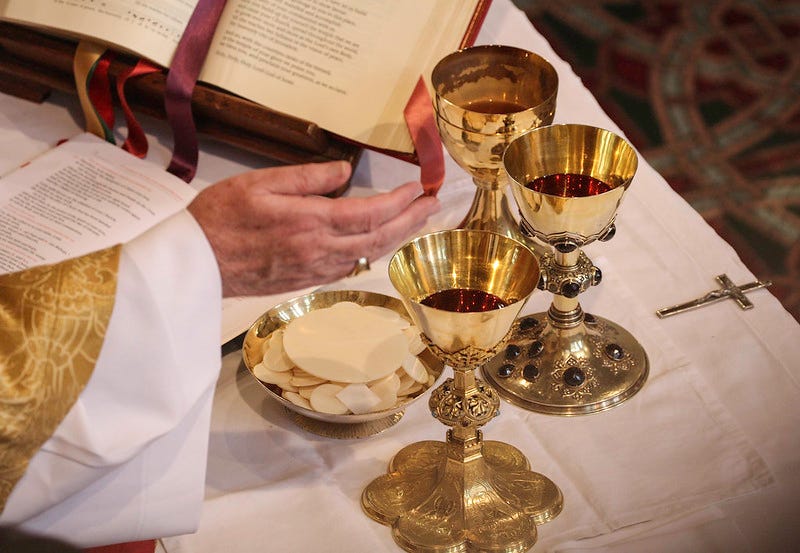
The U.S. bishops’ conference could be given a vote this June on whether to draft and publish a document addressing the question of administering the Eucharist to pro-choice Catholic politicians. The document could be finalized and approved as early as November, sources tell The Pillar.
The USCCB’s administrative committee discussed on Tuesday a path forward for a proposed document on “Eucharistic coherence,” several sources within the bishops’ conference told The Pillar. A plan to develop the statement had the approval of a majority of the committee’s members, sources confirmed.
According to sources present at the meeting, the document would address the Code of Canon Law’s canon 915, which prohibits those who “obstinately persevere in manifest grave sin” from admittance to Holy Communion. The canon’s relevance to Catholics politicians supportive of legal protection or public funding for abortion has been a matter of disagreement among U.S. bishops.
One source told The Pillar the intended statement would be “much broader” than canon 915, but would address the question.
Such a document was first proposed by a short-term working group on the Biden administration, launched in November by conference president Archbishop Jose Gomez. The idea has since been passed on to the conference committee on doctrine.
On March 1, Gomez sent a memo to U.S. bishops, which said the doctrine committee had been asked to develop a proposal for a statement on “Eucharistic coherence.” Such a statement would aim to “strengthen an understanding and deepen a common faith in the gift that has been given to us in the Sacrament of the Altar.”
The proposal would be considered by the USCCB’s administrative committee, as happened this week, and then the full body of bishops, Gomez said.
A source at the meeting Tuesday told The Pillar that there was debate among the administrative committee about the issue, but that the majority of bishops at the meeting wanted to “take the bull by the horns” on critical and controversial issues.
There was emphasis on “speaking to Catholics about what the bishops believe,” the source said.
The administrative committee consists of the conference’s elected officers, the heads of its committees, and regional representatives.
The proposal is now expected to be voted on by the membership of the bishops’ conference. If the bishops approve the development of a statement, it would be primarily drafted by the members of the doctrine committee.
Sources told The Pillar the document would be evaluated by the Vatican’s Congregation for the Doctrine of the Faith, but, if it garnered Vatican approval, it could come up for a vote on publication as early as November.
It is not clear whether the bishops would discuss the statement proposal during the public session of their virtual June meeting, or whether it would be scheduled for executive session, which is not open to the public.
The proposal is likely to trigger intense debate among the bishops. On previous occasions, USCCB members have appeared at odds over political advocacy on abortion, which the conference describes as the “preeminent priority” for Catholics in political life.
A spokesperson for the USCCB declined comment on discussions of the administrative committee and the possibility of a statement.
The issue of abortion and Catholic politicians was at the center of a public dispute between senior U.S. bishops at the time of President Biden’s inauguration. On the day of the inauguration, Gomez issued a statement which criticized the policy agenda of incoming Biden administration, especially the issue of abortion.
Chicago’s Cardinal Blase Cupich, a member of the USCCB administrative committee, later issued a statement via Twitter criticizing Gomez’s statement. The cardinal said the statement was it “ill-considered,” and charged that the release was “crafted without the involvement of the Administrative Committee, a collegial consultation that is normal course for statements that represent and enjoy the considered endorsement of the American bishops.”
The cardinal blamed unspecified “internal institutional failures” at the conference for the release of a statement.
The Pillar had previously reported that Cupich sought the intervention of the Vatican’s Secretariat of State to prevent the statement’s release.
Ping
Are US Catholic Bishops Catholic?
I know of one: Bishop Joseph Strickland who will never receive a red hat from Bergoglio.
Some are, and a few are even exemplary. But not nearly as many as there should be.
Author: Cardinal Joseph Ratzinger
Worthiness to Receive Holy Communion: General Principles
Cardinal Joseph Ratzinger
Prefect, Congregation for the Doctrine of the Faith
[Note: The following memorandum was sent by Cardinal Ratzinger to Cardinal McCarrick and was made public in the first week of July 2004.]
1. Presenting oneself to receive Holy Communion should be a conscious decision, based on a reasoned judgment regarding one’s worthiness to do so, according to the Church’s objective criteria, asking such questions as: "Am I in full communion with the Catholic Church? Am I guilty of grave sin? Have I incurred a penalty (e.g. excommunication, interdict) that forbids me to receive Holy Communion? Have I prepared myself by fasting for at least an hour?" The practice of indiscriminately presenting oneself to receive Holy Communion, merely as a consequence of being present at Mass, is an abuse that must be corrected (cf. Instruction "Redemptionis Sacramentum," nos. 81, 83).
2. The Church teaches that abortion or euthanasia is a grave sin. The Encyclical Letter Evangelium vitae, with reference to judicial decisions or civil laws that authorize or promote abortion or euthanasia, states that there is a "grave and clear obligation to oppose them by conscientious objection. [...] In the case of an intrinsically unjust law, such as a law permitting abortion or euthanasia, it is therefore never licit to obey it, or to 'take part in a propaganda campaign in favour of such a law or vote for it'" (no. 73). Christians have a "grave obligation of conscience not to cooperate formally in practices which, even if permitted by civil legislation, are contrary to God’s law. Indeed, from the moral standpoint, it is never licit to cooperate formally in evil. [...] This cooperation can never be justified either by invoking respect for the freedom of others or by appealing to the fact that civil law permits it or requires it" (no. 74).
3. Not all moral issues have the same moral weight as abortion and euthanasia. For example, if a Catholic were to be at odds with the Holy Father on the application of capital punishment or on the decision to wage war, he would not for that reason be considered unworthy to present himself to receive Holy Communion. While the Church exhorts civil authorities to seek peace, not war, and to exercise discretion and mercy in imposing punishment on criminals, it may still be permissible to take up arms to repel an aggressor or to have recourse to capital punishment. There may be a legitimate diversity of opinion even among Catholics about waging war and applying the death penalty, but not however with regard to abortion and euthanasia.
4. Apart from an individual's judgment about his worthiness to present himself to receive the Holy Eucharist, the minister of Holy Communion may find himself in the situation where he must refuse to distribute Holy Communion to someone, such as in cases of a declared excommunication, a declared interdict, or an obstinate persistence in manifest grave sin (cf. can. 915).
5. Regarding the grave sin of abortion or euthanasia, when a person’s formal cooperation becomes manifest (understood, in the case of a Catholic politician, as his consistently campaigning and voting for permissive abortion and euthanasia laws), his Pastor should meet with him, instructing him about the Church’s teaching, informing him that he is not to present himself for Holy Communion until he brings to an end the objective situation of sin, and warning him that he will otherwise be denied the Eucharist.
6. When "these precautionary measures have not had their effect or in which they were not possible," and the person in question, with obstinate persistence, still presents himself to receive the Holy Eucharist, "the minister of Holy Communion must refuse to distribute it" (cf. Pontifical Council for Legislative Texts Declaration "Holy Communion and Divorced, Civilly Remarried Catholics" [2002], nos. 3-4). This decision, properly speaking, is not a sanction or a penalty. Nor is the minister of Holy Communion passing judgment on the person’s subjective guilt, but rather is reacting to the person’s public unworthiness to receive Holy Communion due to an objective situation of sin.
[N.B. A Catholic would be guilty of formal cooperation in evil, and so unworthy to present himself for Holy Communion, if he were to deliberately vote for a candidate precisely because of the candidate’s permissive stand on abortion and/or euthanasia. When a Catholic does not share a candidate’s stand in favour of abortion and/or euthanasia, but votes for that candidate for other reasons, it is considered remote material cooperation, which can be permitted in the presence of proportionate reasons.]
They’re stalling for time. If this ever gets off the drawing board, it will be after Biden (Harris) has set up tax-funded infanticide clinics inside every Catholic church that BLM and Antifa have not burned to the ground.
The little weasels. Acting, no doubt, with the blessing of the Big Weasel in Rome.
Bishop Donald DeGrood of the Diocese of Sioux Falls is another good one.
Cordileone in San Francisco is pretty good (in a difficult diocese). Daly in Spokane is also good.
Have any positions been stated on abortion for rape, incest, or severe fetal deformity or genetic anomaly? I had a friend whose son died of Tay-Sacks disease, All 4 years she cared for her son were a nightmare, and she was afraid to ever get pregnant again.
Satanism, Freemasonry, homosexuality and political socialism in the Church all over the world.
Disclaimer: Opinions posted on Free Republic are those of the individual posters and do not necessarily represent the opinion of Free Republic or its management. All materials posted herein are protected by copyright law and the exemption for fair use of copyrighted works.