Posted on 11/20/2020 5:23:00 AM PST by Cronos
The Gospel from Wednesday’s Mass (Wed. of the 33rd Week – Luke 19:11-27) is known as the “Parable of the Ten Gold Coins.” It has an ending so shocking that, when I read it at Mass some years ago, a young child said audibly to her mother, “Wow, that’s mean!”
I’d like to look at it and ponder its shocking ending.
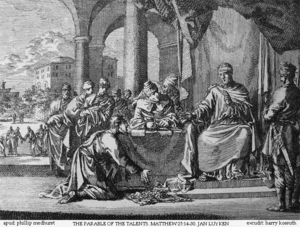
Today’s parable is like Matthew’s “Parable of the Talents,” but with some significant differences. In today’s parable, ten people each receive one gold coin. We only hear the reports of three of them (as in the Matthean account): two who show a profit and one who shows none.
Another difference is the interweaving of another parable (let’s call it the “Parable of the Rejected King”) within the story. Here is a shortened version, including the shocking ending:
A nobleman went off to a distant country to obtain the kingship for himself and then to return. His fellow citizens, however, despised him and sent a delegation after him to announce, “We do not want this man to be our king.” But when he returned after obtaining the kingship … [he said] “Now as for those enemies of mine who did not want me as their king, bring them here and slay them before me” (Luke 19:12,14, 27-28).
In analyzing a text like this I must say that I was disappointed at the silence of most commentaries with respect to this ending. The shocking phrase “slay them before me” goes largely unremarked.
The Church Fathers seem to say little about it. I was, however, able to find two references in St. Thomas Aquinas’s Catena Aurea. St. Augustine said of this verse, Whereby He describes the ungodliness of the Jews who refused to be converted to Him. Theophilus wrote, Whom he will deliver to death, casting them into the outer fire. But even in this world they were most miserably slain by the Roman army.
Hence both Fathers take the verse at face value, even declaring it historically fulfilled in the destruction of Jerusalem in 70 A.D. Josephus indicated in his work that 1.2 million Jews were killed in that dreadful war.
Historically fulfilled or not, Jesus’s triumphal and vengeful tone still puzzles me. If this verse does refer to the destruction of 70 A.D., then how do we account for Jesus’s tone here when just a few verses later He wept over Jerusalem?
As Jesus approached Jerusalem and saw the city, he wept over it and said, “If you, even you, had only known on this day what would bring you peace—but now it is hidden from your eyes. The days will come upon you when your enemies will build an embankment against you and encircle you and hem you in on every side. They will dash you to the ground, you and the children within your walls. They will not leave one stone on another, because you did not recognize the time of God’s coming to you” (Lk 19:41-44).
Certainly a variety of emotions can sweep over even the God-man Jesus, but let me also suggest some other contextual and cultural considerations that frame Jesus’s startling and “mean” words (Now as for those enemies of mine who did not want me as their king, bring them here and slay them before me).
1. Jesus was speaking in the prophetic tradition – Prophets often spoke this way, using startling and often biting imagery and characterizations. Though many today try to “tame” Jesus, the real Jesus spoke vividly, in the prophetic tradition. He often used shocking and paradoxical images. He spoke bluntly, as prophets do, calling his hostile interlocutors hypocrites, vipers, children of the devil, whitewashed tombs, evil, foolish, blind guides, and sons of those who murdered the prophets. He warned them that they would be sentenced to Hell unless they repented; He laid them out for their inconsistency and hardness of heart. This is the way prophets speak.
In speaking in this “mean” way, Jesus was firmly in the tradition of the prophets, who spoke similarly. Thus, in understanding these harsh words of Jesus’s, we cannot overlook the prophetic context. His words, which seem to us to be angry and even vengeful, were expected in the prophetic tradition from which He spoke; they were intentionally shocking. Their purpose was to provoke a response.
Prophets used hyperbole and shock to convey and frame their call to repentance. And while we ought not to simply dismiss Jesus’s words as exaggeration, we should not fail to see them in the traditional context of prophetic speech.
Hence Jesus’s words were not evidence of vengeance in His heart, but rather a prophecy directed at those who refused to repent: they will die in their sins. Indeed, their refusal to reconcile with God and their neighbors (in this case the Romans) led to a terrible war during which they were slain.
2. The Jewish culture and language often used hyperbole – Even beyond the prophetic tradition, the ancient Jews often used all-or-nothing language in their speech. Although I am no Hebrew scholar, I have been taught that the Hebrew language contains far fewer comparative words (e.g., more, less, greatest, fewest) than does English (and many other languages). If an ancient Jew were asked if he liked chocolate or vanilla ice cream more, he might reply, “I like chocolate and I hate vanilla.” By this he really meant “I like chocolate more than I like vanilla.” When Jesus said elsewhere that we must love Him and hate our parents, spouse, and children (e.g., Lk 14:26), He did not mean that we should hate them vengefully. Rather, this was a Jewish way of saying that we must love Him more.
This background explains the ancient Jewish tendency to use hyperbole. It is not that they did not comprehend nuances; they just did not speak in that manner, instead allowing the context to supply that “hate” did not mean literal hate.
This linguistic background helps to explain how the more extremist elements of prophetic language take shape.
We ought to be careful, however, not to simply dismiss things as hyperbole. We who speak English may love that our language allows for greater nuance, but sometimes we are so nuanced in our speech that we say very little. At some point we must say either yes or no; we must be with God or against Him. In the end (even if Purgatory intervenes) there is only Heaven or Hell.
The ancient Jewish way of speaking in a rather all-or-nothing manner was not primitive per se. It has a refreshing and honest way of insisting that we decide for or against God, that we decide what is right and just.
Thus, though Jesus’s words were harsh they did make an important point. For either we choose God and live, or we choose sin and die spiritually. For the wages of sin is death, but the gift of God is eternal life in Christ Jesus our Lord (Romans 6:23).
3. Jesus was speaking to hardened sinners – The audience here is important as well. As Jesus drew near to Jerusalem, He was entering hostile territory. The sinners and unbelievers He encountered were very rigid and had hardened their hearts against Him. Hence, Jesus’s words must be understood as strong medicine.
One can imagine a doctor saying to a stubborn patient, “If you don’t change your ways, you’ll die soon and I’ll see you at your funeral.” While some may consider this to be poor “bedside manner,” there are some patients for whom such language is both necessary and appropriate.
Because Jesus was dealing with hardened sinners, He spoke bluntly. They were headed for death and Hell and He told them so.
Perhaps we, who live in these “dainty” times, who are so easily offended and so afraid of giving offense, could learn from such an approach. There are some who need to hear from priests, parents, and others, “If you do not change your ways, I do not see how you can avoid being sentenced to Hell.”
4. A final thought—a theory really—that some have advanced – According to this theory, Jesus was referring to an actual historical incident and using it to disabuse His listeners of their fond thoughts of a new king. After the death of Herod the Great, his son Archelaus went to Rome to request the title of king. A group of Jews also appeared before Caesar Augustus, opposing Archelaus’s request. Although not given the title of king, Archelaus was made ruler over Judea and Samaria; he later had those Jews who opposed him killed.
Kings are often despots – Because many Jews thought that the Messiah (when he came) would be a king, some were hoping that Jesus was traveling to Jerusalem in order to take up the role of an earthly king. According to this theory, because the people were pining for a king, Jesus used this fearsome parable as a reminder that earthly kings are usually despotic. Jesus was thus trying to disabuse them of the idea that He or anyone else should be their earthly king.
While this theory has a lot to recommend it, especially historical precedent, it seems unlikely that the Gospel text would use such an historically localized event to make the point. Jesus was not just speaking to the people of that time and place; He is also speaking to us. Even if this explanation has partial historical context, the meaning needs to be extended beyond one ancient incident.
Well, there you have it. I am interested in your thoughts. Because the commentaries I consulted seemed rather silent on this, I am hoping that some of you have read commentaries worth sharing. Likewise, perhaps you know of some other quotes of the Fathers that I was unable to find.
Is Jesus being mean here? No. Is He being blunt and painfully clear? Yes. And frankly, some of us need it. In these thin-skinned times we may bristle at such talk, but that’s our problem. Honesty and a clear diagnosis are far more important than our precious feelings.
Yeshua’s “meanness” is comparable to the meanness of guardrails separating the roadway from the cliff.
The talents has always been my favorite parable
bump
Jesus Christ was prophetic.
“The day will come when your enemies encircle you,” he mentioned the wall and the destruction.
I have a hard time understanding this story; I really don’t consider Jesus Christ to be a mean person. He may have had to talk sternly on occasion but He was not “mean.”
Just my extremely humble opinion. I’m not a theologian.
A great sermon.
There was a poster here, years ago, that lost his faith because the Jesus in the Bible was “not nice”.
Jesus was not nice. Far from it. He beat the money changers in the temple. He mocked the teachers of the law. He was very hard on those who thought their own worth would get them into heaven.
And what is worse (to many) is he ate and drank with tax collectors and hookers. That would be like a good church going man eating with bookies and strippers. The church would probably kick him out.
Jesus was not nice. He was Good. Something that was beat into my thick skull by my old country pastor decades ago. Something this society and culture needs to remember. “Nice” is the wide road to hell.
Jesus is coming back and he will be pissed.........................
And he's gonna look like Charles Bronson.
We’re told to “be angry and sin not”. So He will have a righteous anger, no doubt about it. But vengeance does below to the Lord, not us...which is very, difficult for me quite often these days.
Probably so, and won’t have long hair, except for the sides, like the Hasidim wear................
When Auxiliary Bishop Austin Vaughan of New York publicly warned Governor Mario Cuomo that he risked going to Hell, it made the front page of the New York Post in 3 inch high letters, and plenty of “How dare he!” responses.
“All I was saying is what he learned, and I learned, and all of you learned in the first grade. If you commit a serious sin and die without repenting, you go to hell.” ( https://www.nytimes.com/2000/06/29/nyregion/bishop-austin-b-vaughan-72-criticized-cuomo-on-abortion.html )
I still remember the New York Post cartoon that ran shortly after, depicting a scared Mario Cuomo being brought to Hell by Satan, with Satan telling Cuomo, “We think you’ll like it here ... we’re mostly pro-choice.”
Vengeance simply implies ‘action’ of some sort, so as long as you don’t ‘act’ upon that anger I suppose it’s okay.............
Eh, not so sure. Think it depends what you do with those thoughts. Jesus did say if you lust after a woman (and that goes other way around too), you’ve already commit adultery in your heart. So when I think about bashing someone’s teeth in...like that little girl on FauxNews last night who called Giuliani a “liar” after his news conference....I really need to take a step back and say, oh no, please stop thinking like that :<(
Remember Jesus and the Fig tree.....................
Very, well.
If you have Netflix I suggest watching the Gospels by Lionsgate. I watch them all the time. The Gospel is read by the narrator word for word while the actors are speaking Aramaic in the background. Everything is shown as being period from the time. I can’t stop watching them. Totally awesome. So you get a lot of the scripture in your head/heart that way. I warn you, you will be addicted :)
Bkmk
No ‘Nutflakes’ in my house.....................
Well, in that case you could rent on YouTube or buy the DVD? Once you see the trailers you’ll understand why it’s worth it.
https://www.youtube.com/watch?v=p94kVjoXB-c
Sounds a lot like Mel Gibson’s ‘Passion’ movie.....................
No, absolutely nothing whatsoever like that piece of work. I tried to watch it, and thought it sucked. It focused on the pain Christ went through during the crucifixion, which indeed was horrific. BUT, it did not give one second to the resurrection.
These videos are the Gospel word for word. No highlighting any actors/actresses. ONLY highlighting Christ, His works, and Him alone. Like comparing night and day. If you have Netflix, see for yourself!
Disclaimer: Opinions posted on Free Republic are those of the individual posters and do not necessarily represent the opinion of Free Republic or its management. All materials posted herein are protected by copyright law and the exemption for fair use of copyrighted works.