Posted on 04/17/2020 9:36:58 AM PDT by Salvation
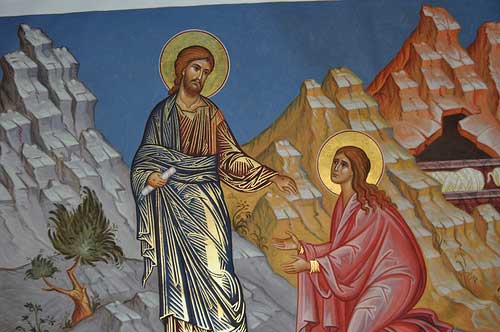
As the Easter Octave unfolds, we have in the Gospel this enigmatic statement of Our Lord Jesus to Mary Magdalene:
Do not cling to me, for I have not yet ascended to the Father; but go to my brothers and say to them, “I am ascending to My Father and your Father, to My God and your God” (John 20:17).
There is much to ponder and distinguish here.
First, we should set aside certain previous translations that rendered “Do not cling to me” as “Do not touch me.”
The latter sounds almost rude. The Greek expression Μή μου ἅπτου (Me mou haptou) is best rendered, “Do not go on clinging to me” because haptou is a verb in the middle voice.
The middle voice is one that English lacks. It is midway between the active and passive voices and indicates that the subject of the verb (in this case, Mary) both acts and is acted upon. Mary lays hold of the Lord but needs to do so because something is different. Something deeper is being shown to her and she is missing that. Mary actively sees Jesus but passively needs to receive something new about Him. This is the middle voice, containing elements of both the active and the passive.
Further, as Strong’s Greek dictionary sets forth, ἅπτω (haptou) means “to fasten to,” “to adhere to,” or “to cling to.” What the Lord asks of Mary is that she not merely cling to what is familiar but step back and see what is new. Jesus is no longer a mere rabbi or teacher. He is not merely the Jesus she knew; He is Lord and He is risen.
Second, we must ponder what Jesus means when He says that He is ascending.
St. Thomas Aquinas summarizes St. Augustine and St. John Chrysostom on the meaning of the Lord’s ascending:
[Augustine says] “… Jesus would have us to believe in Him, i.e., to touch Him spiritually, as being Himself one with the Father. For to that man’s innermost perceptions He is, in some sort, ascended unto the Father, who has become so far proficient in Him, as to recognize in Him the equal with the Father … whereas she as yet believed in Him but carnally, since she wept for Him as for a man.” Or as Chrysostom says (Hom. lxxxvi in Joan.): “This woman wanted to converse with Christ just as before the Passion, and out of joy was thinking of nothing great, although Christ’s flesh had become much nobler by rising again.” And therefore He said: “I have not yet ascended to My Father”; as if to say: “Do not suppose I am leading an earthly life; for if you see Me upon earth, it is because I have not yet ascended to My Father, but I am going to ascend shortly.” Hence He goes on to say: “I ascend to My Father, and to your Father” (Summa Theologiae III, Q. 55, Art. 6, Reply to Obj. 3).
In other words, Jesus’ ascent must take place in Mary (and in every other follower). He is far more than a man resuming mortal nature. He is more; He is Lord. We must come to see Him as Lord and God. He must ascend in our sight. We must see Him at a higher level and in a higher way. He is no mere sage or rabbi; He is Lord and God! He must ascend in this way, in our understanding.
In Jesus’ public ministry, Mary had rightly reverenced Jesus as teacher and rabbi, but Jesus the Lord is doing more now than merely leading an earthly life and fitting into earthly categories.
In effect, Jesus is saying to Mary, “Don’t go on clinging to what in Me is familiar to you. Step back, take a good look, and then go tell my brothers what you see.”
When Mary Magdalene has done this, she runs to the apostles and says, “I have seen the LORD” (Jn 20:18). I show the word “LORD” in uppercase in this quote because up until this point, Mary used the word “Lord” as a title of human respect. She said, “They have taken my Lord and I don’t know where they have put Him.” Of course, one doesn’t take Him and put Him anywhere! He is LORD, and He does as He pleases. No longer clinging to Him in merely a familiar way, Mary now says, “I have seen the LORD,” meaning it in a plenary and divine sense.
For Mary, the Lord is ascending. She is seeing Him in a higher way. The Lord has ascended for Mary Magdalene. Has He ascended for you?
Finally, what of the Lord’s expression that He is ascending to “My Father and your Father, to My God and your God”?
In English, we can use the word “and” in either an equivalent or a comparative sense. I could say to someone, “You are my brother and my friend.” This uses the “and of equivalence” because it indicates that you are both a brother and a friend to me in the same or in an equivalent way.
Other uses of the word “and” indicate a more comparative sense. When we say that Jesus is Son of God and Son of Mary, we mean that He is the Son of His Father in a different way than He is Son of Mary. He is the Son of both but in very different ways. In the liturgy, when the priest says, “Pray, brethren, that my sacrifice and yours may be acceptable to God the almighty Father,” he indicates that while his sacrifice and the sacrifice of the people are both sacrifices, they are sacrifices in different ways. The priest acts in persona Christi capitis (in the person of Christ the head), while the faithful act as members of the body. Both are rightly called sacrifices, but they are so in different ways.
Thus, when Jesus says that He is ascending to “My Father and your Father,” He does not use the “and of equivalence” but the “and of comparison.” As a man, Jesus can speak of God as His Father, but His human nature is hypostatically united to His divine nature as God, the Second Person of the Trinity. So, although God is our Father and Christ’s Father, He is Christ’s Father in a far richer and more profound way.
Jesus says, “My God and your God” not by way of equivalence, but by way of comparison.
In all these ways, the Lord Jesus must ascend in our understanding. He will do that provided we do not go on clinging to Him in a merely human and familiar way.
Let the Lord ascend in your life.
The title of the article was in html and I tried to change it, but could not.
Monsignor Pope Ping!
He didn’t want her getting caught in the transporter beam. Duh?
One of his better ones.
Jesus said why. “I have not yet ascended to the Father.”
The honor and delight of being the first one to embrace his darling Son was reserved for the Father after Jesus’ amazing and perfect sacrifice which took away the sins of the whole world and resurrection which justified us forever.
You know damn well what that consists of.
Tagline What a world, what a world.
It has been my understanding as a fundy protestant, that Christ was alluding to Mary that He must ascend to Heaven to present His Blood to the Father and sprinkle it on the Mercy Seat there. Bottom line; It seems very likely that one of the first orders of business when we’ve all finally arrived in Heaven, that there will be a huge Bible class to straighten out a lot of befuddled teachings.
Very good. Thanks for posting.
I believe that having just been raised from the dead, Jesus was physically in a state where touching him would have been dangerous.
He was a biological, chemical or radiation hazard.
What I’ve wondered was where was He if He hadn’t yet been to the Father? If He told the thief on the cross that he would be with Him that day in Paradise, and two days later He still hadn’t been with the Father, then is Paradise somewhere besides where the Father is?
Yes, Paradise does not equal heaven. Many people misunderstand this.
Paradise was the waiting place where the good people from the old testament were waiting for Jesus to open heaven. Jesus WAS the first on into heaven.
In one of the Gospels — I believe Matthew or Mark, the souls came out of their tombs and roamed around Jerusalem, visible to the believers but not the unbelievers. That’s what we are talking about when we say “Paradise.”
Maybe Mary was the clingy type?
Maybe Jesus didn’t want to get His robe wrinkled?
I mean He was about to go see the Father (God, not the dude in the building with the stained glass) and, well, if we’re about to go visit GOD I’d want to look my best too.
Just a coupe theories to throw out there, lest anyone get all splody-ego in their piety
What is the WORLD is a "fundy" protestant?
Well, ya got me. What is the "Mercy Seat"? As a Catholic I had NEVER, EVER heard of THAT before.
LoL. AMEN to that!
Scripture calls the abode of the dead, to which the dead Christ went down to "hell" - Sheol in Hebrew or Hades in Greek – because of those who are there are deprived of the vision of God. Such is the case for all the dead, whether evil or righteous, while they await the Redeemer: which does not mean that their lot is identical, as Jesus shows through the parable of the poor man Lazarus who was received into "Abraham's bosom": "It is precisely these holy souls, who awaited their Savior in Abraham's bosom, whom Christ the Lord delivered when he descended into hell." Jesus did not descend into hell to deliver the damned, nor to destroy the hell of damnation, but to free the just who had gone before him.
Source: https://www.vatican.va/archive/ccc_css/archive/catechism/p122a5p1.htm
** well, if we’re about to go visit GOD I’d want to look my best too.**
That’s why we need to ware Sunday Best to church. Dresses for ladies and suits and ties for men.
W meet God every time we go to Church in the Catholic Church.
Oops......wear
we meet with Him in the morning quiet time and church too.
I miss church though =o/
...imagine all believers do
#covidgoaway
Disclaimer: Opinions posted on Free Republic are those of the individual posters and do not necessarily represent the opinion of Free Republic or its management. All materials posted herein are protected by copyright law and the exemption for fair use of copyrighted works.