Posted on 11/23/2019 6:38:21 PM PST by SeekAndFind
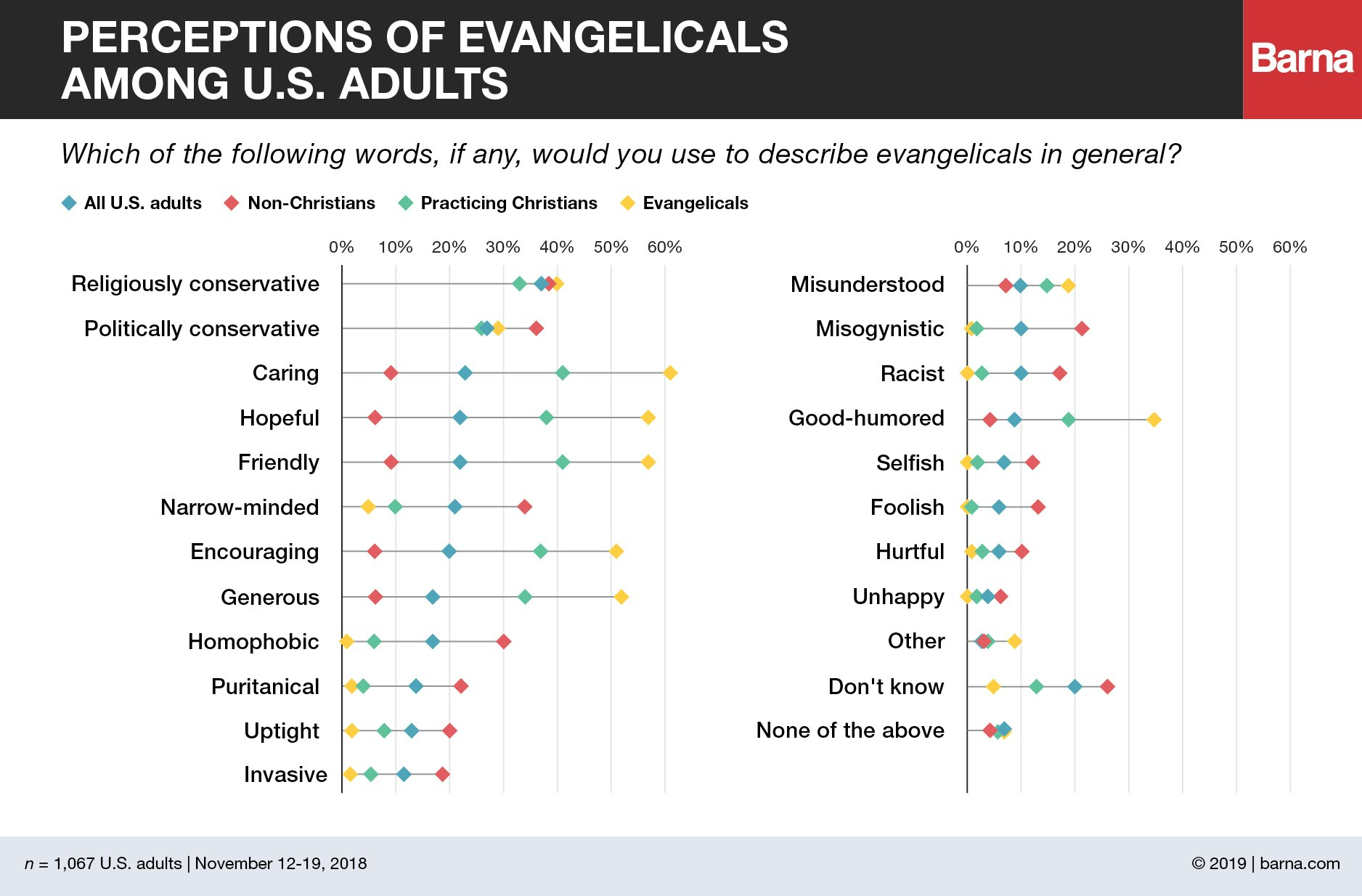
Thirty percent of adults in the United States have a “positive” perception of evangelicals as Americans increasingly view the religious demographic through a political lens, newly released Barna Group research indicates.
According to the evangelical polling firm, evangelicals make up about 6 percent of the U.S. population but have assumed a “unique place in national discourse.”
“Based on a nationwide study of U.S. adults, we found that, though many people still view evangelicals as a committed group of believers who put their faith first, their political connotation puts the future of American evangelicalism in a precarious spot,” a summary of the new report, “The Brand of Evangelicals,” reads.
The research comes as strong support for President Donald Trump and his administration’s socially conservative policies have placed white evangelicals in the national media spotlight in recent years.
According to Barna President David Kinnaman, the findings of the research show a “clear indication of the divided nature of the U.S. population” in which “evangelicals are at the epicenter of many of those differences of opinion, worldview, and practice.”
“On the one side, there are evangelicals and those favorable toward evangelicals; the other side includes those who hold unfavorable views of evangelicals,” Kinnaman wrote in the report’s conclusion. “It appears never the two shall meet.”
The report is based on interviews with adults 18 and older and included 1,067 online surveys conducted from Nov. 12-15, 2018. The sample includes a margin of error of 3 percentage points.
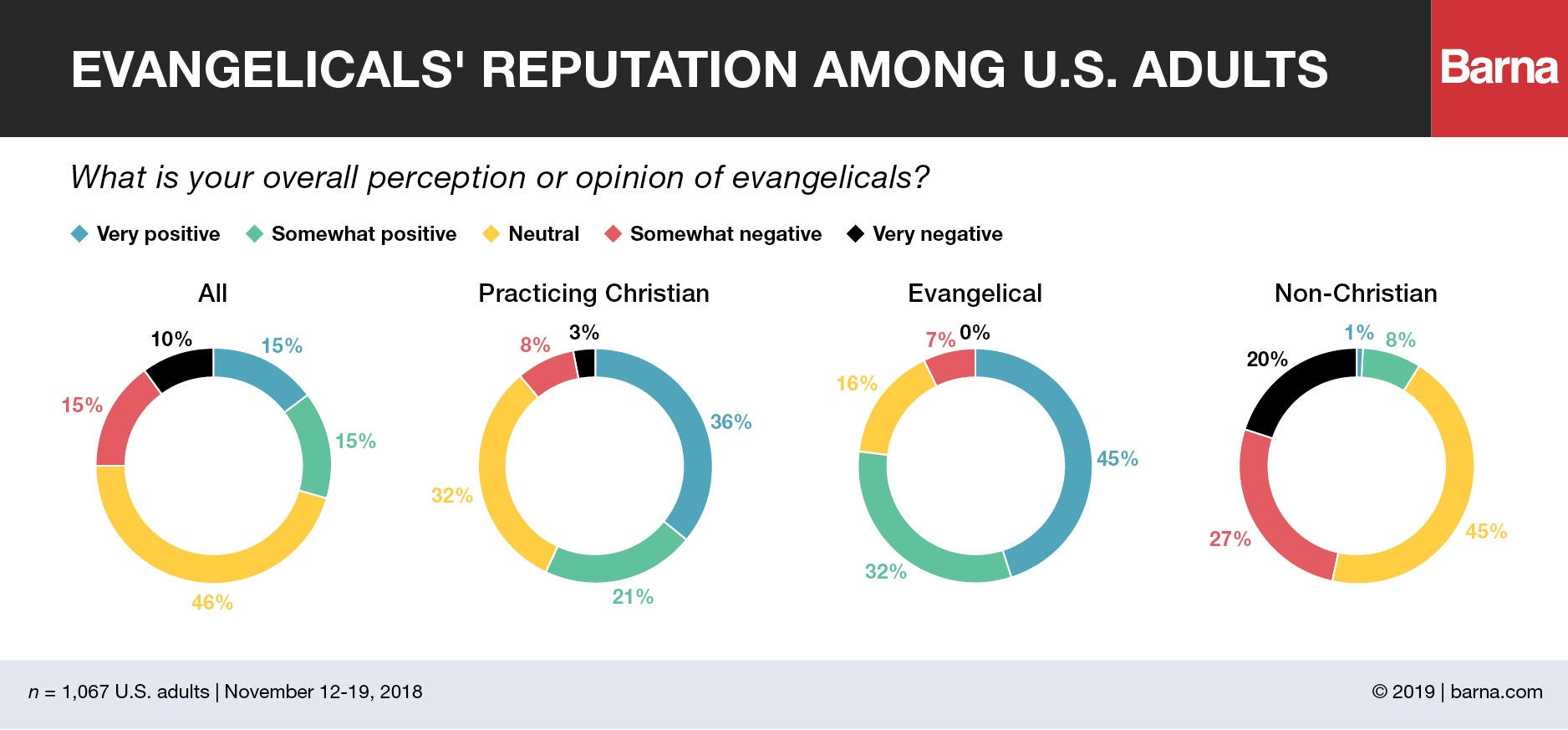
Respondents were asked to detail whether their own opinions or perceptions of evangelicals is positive or negative.
Fifteen percent of the 1,067 respondents said their perception or opinion of evangelicals is “very positive,” while another 15 percent said their view of evangelicals is “somewhat positive.”
Another 15 percent of respondents said their view of evangelicals is “somewhat negative,” and 10 percent said “very negative.”
Almost half (46 percent) of respondents said their view of evangelicals is “neutral.”
“In addition to those two sides of the ‘Divided States of America,’ an important part of understanding the perceptions of evangelicals is the large percentage of Americans who have no opinion of evangelicals — that is, who express neutrality or no opinion in response to the survey questions,” Kinnaman stressed.
“For these adults, there is an impregnable fortress of indifference toward evangelicals. The extreme views (both favorable or unfavorable) dominate the discussion, but the middle ground doesn’t really know what to think about evangelicalism. That’s not a sensational story these days, but it’s an important one.”
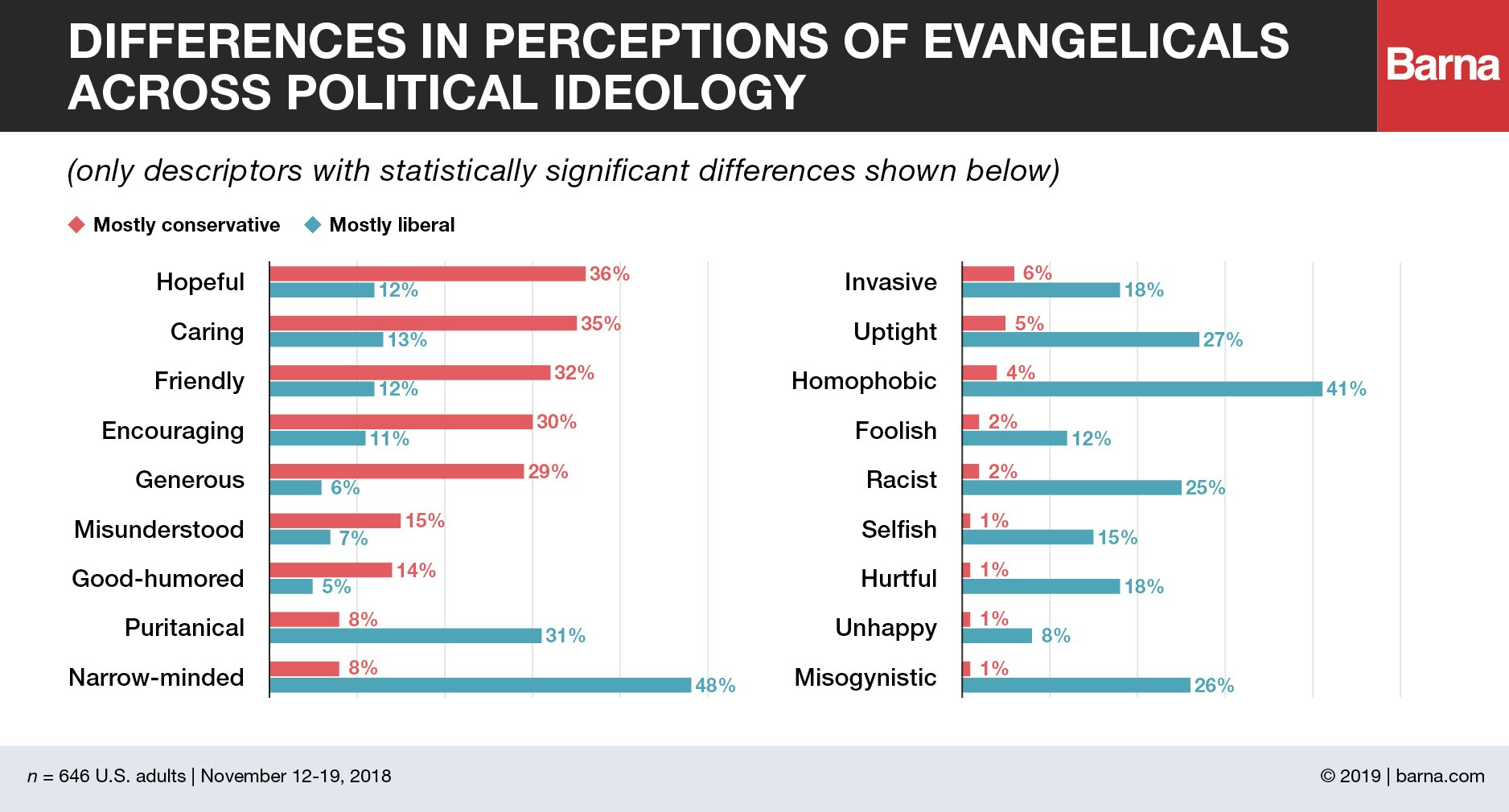
When broken down by political leanings, 49 percent of respondents who said they are “mostly conservative” said they have at least a somewhat positive perception of evangelicals, while 52 percent of respondents who are “mostly liberal” said they have at least a somewhat negative perception of evangelicals.
Forty-two percent of conservatives and 32 percent of liberals had neutral perceptions of evangelicals.
Fifty-seven percent of practicing Christians surveyed said they have at least a somewhat positive perception of evangelicals while 47 percent of non-Christians held at least a somewhat negative perception of evangelicals.
The data finds that the majority of millennial respondents (52 percent) had a neutral view of evangelicals. While 26 percent of millennial respondents had a positive perception of evangelicals, only 22 percent held a negative perception of evangelicals.
“Somewhat surprisingly, the research does not neatly fit the narratives that younger Americans are lining up against evangelicals or that support comes only or mainly from old-guard Christians,” Kinnaman explained. “What generational differences we found are more strongly correlated around things such as political, educational and religious lines.”
When asked for the reasons why they hold a positive perception of evangelicals, 61 percent of the 322 respondents who said they have positive opinions of evangelicals said it is because “they are committed to their beliefs.” Meanwhile, 51 percent said “they are loving” and 49 percent said “they are honest.”
Sixty-seven percent of the 268 respondents who held negative perceptions of evangelicals said they do so because “they are too pushy with their beliefs,” while 61 percent said, “they are hypocritical.” Fifty-one percent said “their beliefs are outdated” and 50 percent said “they are homophobic.”
Forty-one percent of respondents with a negative perception of evangelicals said “they are too conservative politically.” Almost four out of 10 (39 percent) said evangelicals are “too racist” and 30 percent said “they are misogynistic.”
“Taken together, these results may leave evangelicals to feel confused. For instance, one of the frequently noted positive qualities of evangelicals is that they have a commitment to their faith/beliefs,” the report reads.
“However, at the same time, many respondents also indicate that evangelicals are too pushy with their belief system. On its face, these two findings seem contradictory, yet public opinion research often finds that individuals can espouse two opinions that seem entirely incongruent.”
The report concludes that what can be inferred is that “many people admire that evangelicals are people of deep faith but want to make it clear that this same belief system would not work for them personally.”
“The findings strongly suggest that the perceptions of evangelicals are more barrier than bridge on the road to gaining a hearing for the Gospel,” Kinnaman concluded. “As such, the results of this research require much soul searching among Christians to discern a way forward with the current ‘evangelical brand.’”
The church I go to is growing. If liberals view me as unfavorable I wear it as a badge.
Evangelicals poll worse than pro life and anti gay marriage. What positions are they identified with that are unpopular with the American people?
Matthew 7:13-14
I honestly have no clue what an “evangelical” is.
They are mean to gays - and suburban white women just know that all gays are wonderful people, because they love their hairstylists and that settles it. :)
Too many whackadoodles hating left, right and center rather than evangelizing.
Christians are not supposed to be like the world. Therefore it makes sense. It really should be a smaller percentage actually.
I suspect televangelists are one of the reasons. Most come across as insincere hustlers. Billy and Franklin Graham are notable exceptions, in my opinion. The Bakers, Joel Osteen, Pat Roberts...found all of them obnoxious and unwatchable.
Yeah, a definition would be helpful. That term has been a moving target for a long time.
Totally agree
Only ¡YEB! can save us from Hillary Clinton, Donald Trump will never be the Republican nominee.
Most Americans don't answer their phone if the number is not on their contact list. Many people who do not only lie to pollsters, they openly hold conversations about funny ways to lie to pollsters.
So who gives the most accurate polls?
Pretty much nobody.
And it is not like this changes for polls about different subjects.
There is not a way to gather statistically significant samples of all demographic groups.
Hell, there isn't even a way to tell if there is any correlation of any kind between the way people who do answer polls respond and how people who refuse to participate would answer.
Pretty much every poll is a junk poll now.
This one included.
Believing the Bible as it is written.
I wonder why? I really can’t think of too many TV shows or movies where people with religious leanings are portrayed in a positive manner.
“Believing the Bible as it is written.”
Which is really what is boils down to. Hatred for good (the Bible) has been increasing exponentially.
There are now western countries where the Bible cannot be quoted, preached or read aloud, especially those pesky “homosexuality” is a sin parts. Good will become evil and evil good. Christians (Evangelicals) will become enemies of the state due to their belief in the Word of God. (U.S.)
Did anyone bother to find out if the tattooed and pierced millennials even knew what an evangelical was?
Disclaimer: Opinions posted on Free Republic are those of the individual posters and do not necessarily represent the opinion of Free Republic or its management. All materials posted herein are protected by copyright law and the exemption for fair use of copyrighted works.