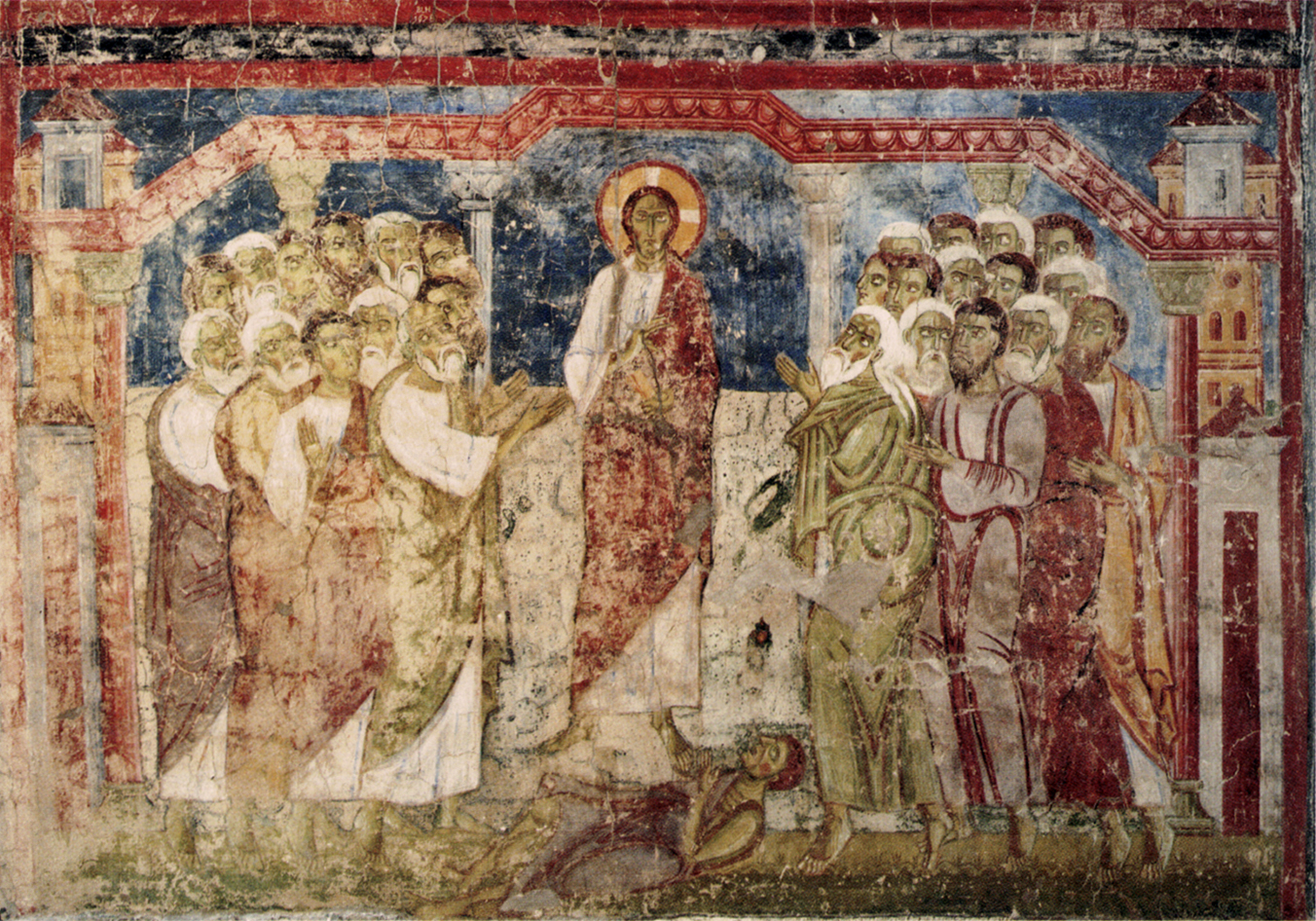
Exorcism at the Synagogue in Capernaum.
11th century
Posted on 09/02/2019 8:42:34 AM PDT by Salvation
KEYWORDS: catholic; lk4; ordinarytime; prayer;
Please FReepmail me to get on/off the Alleluia Ping List.
From: 1 Thessalonians 4:13-18
The Second Coming of the Lord
*********************************************************************************************
Commentary:
13. “Those who are asleep”: this expression, already to be found in some pagan
writings, was often used by the early Christians to refer to those who died in the
faith of Christ. In Christian writings it makes more sense, given Christian belief in
the resurrection of Jesus and in the resurrection of the body. It is not just a eu-
phemism: it underlines the fact that death is not the end. “Why does it say that
they are asleep”, St Augustine asks, “if not because they will be raised when
their day comes?” (”Sermon 93”, 6). Hence St. Escriva’s advice: “When facing
death, be calm. I do not want you to have the cold stoicism of the pagan, but the
fervor of a child of God who knows that life is changed, not taken away. To die is
to live!” (”Furrow”, 876).
Even though we have this hope, it is perfectly understandable for us to feel sad
when people we love die. This sadness, provided it is kept under control, is a
sign of affection and piety, but “to be excessively downcast by the death of
friends is to act like someone who does not have the spirit of Christian hope.
A person who does not believe in the resurrection and who sees death as total
annihilation has every reason to weep and lament and cry over those friends and
relations who have passed away into nothingness. But you are Christians, you
believe in the resurrection, you live and die in hope: why should you mourn the
dead excessively?” (Chrysostom, “Hom. on 1 Thess, ad loc.”).
14. “It is appointed for men to die once” (Heb 9:27). However, for a person who
has faith, death does not just mean the end of his days on earth. Our Lord Jesus
Christ died and rose again, and his resurrection is a pledge of our resurrection:
death “in Christ” is the climax of a life in union with him, and it is the gateway
to heaven. And so St Paul tells Timothy, “If we have died with him, we shall also
live with him; if we endure, we shall also reign with him” (2 Tim 2:11-12).
The resurrection the Christian will experience is not only similar to our Lord’s; his
resurrection is in fact the cause of ours. St Thomas Aquinas explains this as fol-
lows: “Christ is the model of our resurrection, because he took flesh and he rose
in the flesh. However, he is not only our model; he is also the efficient cause (of
our resurrection) because anything done by the human nature of Christ was done
not only by the power of his human nature but also by the power of the godhead
united to that nature. And so, just as his touch cured the leper by virtue of its
being the instrument of his godhead, so the resurrection of Christ is the cause
of our resurrection” (”Commentary on 1 Thess, ad loc.”). Although this passage
of the letter does not say so explicitly, it is implied that we will rise with our bo-
dies, just as Jesus rose with his.
15-17. The religious instruction of the Thessalonians was cut short because St
Paul had to leave the city in a hurry. One of the doubts remaining in their minds
can be expressed as follows: Will the dead be under any disadvantage vis-à-vis
those who are still alive when the Parousia of the Lord happens? The Apostle
replies in two stages: first he says that we will have no advantage of any kind
over them (vv. 15-18); then he makes clear that we do not know when that even
will come about (5:1-2).
In his reply he does not explicitly speak about the general resurrection; he refers
only to those who die “in Christ”. He distinguishes two groups as regards the si-
tuation people find themselves in at our Lord’s second coming—1) those who are
alive: these will be “caught up”, that is changed (cf. 1 Cor 15:51; 2 Cor 5:2-4) by
the power of God and will change from being corruptible and mortal to being in-
corruptible and immortal; 2) those who have already died: these will rise again.
St Paul’s reply is adapted to the tenor of the question; so, when he writes “we
who are alive, who are left” he does not mean that the Parousia will happen soon
or that he will live to see the day (cf. Pontifical Biblical Commission, “Reply” con-
cerning the Parousia, 18 June 1915). He uses the first person plural because at
the time of writing both he and his readers were alive. However, his words were
misinterpreted by some of the Thessalonians, and that was the reason he wrote
the second epistle a few months later (in which he puts things more clearly:
“Now concerning the coming of our Lord Jesus Christ and our assembling to
meet him, we beg you, brethren, not to quickly shaken in mind or excited [...],
to the effect that the day of the Lord has come” (2 Thess 2:1-2). However, even
in the first letter there are enough indications that St Paul was not saying the
Parousia was imminent, for he implies that he does not know when it will hap-
pen (cf. 5:1-2).
To describe the signs which will mark the Lord’s coming, St Paul uses imagery
typical of apocalyptic writing—the voice of the archangel, the sound of the trum-
pet, the clouds of heaven. These signs are to be found in the Old Testament
theophanies or great manifestations of Yahweh (cf. Ex 19:16); on the day of the
Parousia, too, they will reveal God’s absolute dominion over the forces of nature,
as also his sublimity and majesty.
When the Lord Jesus comes in all his glory, those who had died in the Lord
(who already were enjoying the vision of God in heaven) and those who have
been changed will go to meet the Lord “in the air”, for both will now have glori-
fied bodies (cf. 1 Cor 15:43) endowed with the gift of “agility”, “by which the
body will be freed from the heaviness that now presses it down, and will take
on a capability of moving with the utmost ease and swiftness, wherever the
soul pleases” (”St. Pius V Catechism”, I, 12, 13).
After the general judgment, which will take place that day, the righteous will be
“always with the Lord.” That is in fact the reward of the blessed—to enjoy forever,
in body and soul, the sight of God, thereby attaining a happiness which more
than makes up for whatever they have had to do to obtain it, for “the sufferings
of this present life are not worth comparing with the glory that is to be revealed
to us” (Rom 8:18). “If at any time you feel uneasy at the thought of our sister
death because you see yourself to be such a poor creature, take heart. Think
of this: Heaven awaits us; what will it be like when all the infinite beauty and
greatness and happiness and Love of God are poured into the poor clay vessel
that the human being is, to satisfy it eternally with the freshness of an ever-new
joy?” (St. J. Escriva, “Furrow”, 891).
*********************************************************************************************
Source: “The Navarre Bible: Text and Commentaries”. Biblical text from the
Revised Standard Version and New Vulgate. Commentaries by members of
the Faculty of Theology, University of Navarre, Spain.
Published by Four Courts Press, Kill Lane, Blackrock, Co. Dublin, Ireland, and
by Scepter Publishers in the United States.
From: Luke 4:16-30
Jesus Preaches in Nazareth
[18] “The Spirit of the Lord is upon Me,
because He has anointed Me to preach good news to the poor.
He has sent Me to proclaim release to the captives
and recovering of sight to the blind,
to set at liberty those who are oppressed,
[19] to proclaim the acceptable year of the Lord.”
[22] And all spoke well of Him, and wondered at the gracious words which pro-
ceeded out of His mouth; and they said, “Is not this Joseph’s son?” [23] And He
said to them, “Doubtless you will quote to Me this proverb, ‘Physician, heal your-
self; what we have heard you did at Capernaum, do here also in your own coun-
try.’” [24] And He said, “Truly, I say to you, no prophet is acceptable in his own
country. [25] But in truth, I tell you, there were many widows in Israel in the days
of Elijah, when the heaven was shut up three years and six months, when there
came a great famine over all the land; [26] and Elijah was sent to none of them
but only to Zarephath, in the land of Sidon, to a woman who was a widow. [27]
And there were many lepers in Israel in the time of the prophet Elisha; and none
of them was cleansed, but only Naaman the Syrian.” [28] When they heard this,
all in the synagogue were filled with wrath. [29] And they rose up and put Him
out of the city, and led Him to the brow on the hill on which their city was built,
that they might throw Him down headlong. [30] But passing through the midst
of them He went away.
*********************************************************************************************
Commentary:
16-30. For the Jews the Sabbath was a day of rest and prayer, as God comman-
ded (Exodus 20:8-11). On that day they would gather together to be instructed in
Sacred Scripture. At the beginning of this meeting they all recited the “Shema”,
a summary of the precepts of the Lord, and the “eighteen blessings”. Then a pas-
sage was read from the Book of the Law — the Pentateuch — and another from
the Prophets. The president invited one of those present who was well versed in
the Scriptures to address the gathering. Sometimes someone would volunteer
and request the honor of being allowed to give this address — as must have hap-
pened on this occasion. Jesus avails Himself of this opportunity to instruct the
people (cf. Luke 4:16ff), as will His Apostles later on (cf. Acts 13:5, 14, 42, 44;
14:1; etc.). The Sabbath meeting concluded with the priestly blessing, recited
by the president or by a priest if there was one present, to which the people an-
swered “Amen” (cf. Numbers 6:22ff).
18-21. Jesus read the passage from Isaiah 61:1-2 where the prophet announces
the coming of the Lord, who will free His people of their afflictions. In Christ this
prophecy finds its fulfillment, for He is the Anointed, the Messiah whom God has
sent to His people in their tribulation. Jesus has been anointed by the Holy Spirit
for the mission the Father has entrusted to Him. “These phrases, according to
Luke (verses 18-19), are His first messianic declaration. They are followed by the
actions and words known through the Gospel. By these actions and words Christ
makes the Father present among men” (John Paul II, “Dives In Misericordia”, 3).
The promises proclaimed in verses 18 and 19 are the blessings God will send
His people through the Messiah. According to Old Testament tradition and Jesus’
own preaching (cf. note on Matthew 5:3), “the poor” refers not so much to a parti-
cular social condition as to a very religious attitude of indigence and humility to-
wards God, which is to be found in those who, instead of relying on their posses-
sions and merits, trust in God’s goodness and mercy. Thus, preaching good
news to the poor means bringing them the “good news” that God has taken pity
on them. Similarly, the Redemption, the release, which the text mentions, is to
be understood mainly in a spiritual, transcendental sense: Christ has come to
free us from the blindness and oppression of sin, which, in the last analysis, is
slavery imposed on us by the devil. “Captivity can be felt”, St. John Chrysostom
teaches in a commentary on Psalm 126, “when it proceeds from physical ene-
mies, but the spiritual captivity referred to here is worse; sin exerts a more severe
tyranny, evil takes control and blinds those who lend it obedience; from this spiri-
tual prison Jesus Christ rescued us” (”Catena Aurea”). However, this passage is
also in line with Jesus’ special concern for those most in need. “Similarly, the
Church encompasses with her love all those who are afflicted by human misery
and she recognizes in those who are poor and who suffer the image of her poor
and suffering Founder. She does all in her power to relieve their need and in them
she strives to serve Christ” (Vatican II, “Lumen Gentium”, 8).
18-19. The words of Isaiah which Christ read out on this occasion describe very
graphically the reason why God has sent His Son into the world — to redeem men
from sin, to liberate them from slavery to the devil and from eternal death. It is true
that in the course of His public ministry Christ, in His mercy, worked many cures,
cast out devils, etc. But He did not cure all the sick people in the world, nor did
He eliminate all forms of distress in this life, because pain, which entered the
world through sin, has a permanent redemptive value when associated with the
sufferings of Christ. Therefore, Christ worked miracles not so much to release the
people concerned from suffering, as to demonstrate that He had a God-given mis-
sion to bring everyone to eternal salvation.
The Church carries on this mission of Christ: “Go therefore and make disciples
of all nations, baptizing them in the name of the Father and of the Son and of the
Holy Spirit, teaching them to observe all that I have commanded you; and lo, I am
with you always, to the close of the age” (Matthew 28:19-20). These simple and
sublime words, which conclude the Gospel of St. Matthew, point out “the obliga-
tion to preach the truths of faith, the need for sacramental life, the promise of
Christ’s continual assistance to His Church. You cannot be faithful to our Lord if
you neglect these supernatural demands — to receive instruction in Christian faith
and morality and to frequent the Sacraments. It is with this mandate that Christ
founded His Church [...]. And the Church can bring salvation to souls only if she
remains faithful to Christ in her constitution and teaching, both dogmatic and
moral.
“Let us reject, therefore, the suggestion that the Church, ignoring the Sermon on
the Mount, seeks a purely human happiness on earth, since we know that her
only task is to bring men to eternal glory in Heaven. Let us reject any purely natu-
ralistic view that fails to value the supernatural role of divine grace. Let us reject
materialistic opinions that exclude spiritual values from human life. Let us equal-
ly reject any secularizing theory which attempts to equate the aims of the Church
with those of earthly states, distorting its essence, institutions and activities into
something similar to those of temporal society” (St. J. Escriva, “In Love with the
Church”, 23 and 31).
18. The Fathers of the Church see in this verse a reference to the three persons
of the Holy Trinity: the Spirit (the Holy Spirit) of the Lord (the Father) is upon Me
(the Son); cf. Origen, “Homily 32”. The Holy Spirit dwelt in Christ’s soul from the
very moment of the Incarnation and descended visibly upon Him in the form of a
dove when He was baptized by John (cf. Luke 3:21-22).
“Because He has anointed Me”: this is a reference to the anointing Jesus re-
ceived at the moment of His Incarnation, principally through the grace of the hy-
postatic union. “This anointing of Jesus Christ was not an anointing of the body
as in the case of the ancient kings, priests and prophets; rather it was entirely
spiritual and divine, because the fullness of the Godhead dwells in Him substan-
tially” (”St. Pius X Catechism” 77). From this hypostatic union the fullness of all
graces derives. To show this, Jesus Christ is said to have been anointed by the
Holy Spirit Himself — not just to have received the graces and gifts of the Spirit,
like the saints.
19. “The acceptable year”: this is a reference to the jubilee year of the Jews,
which the Law of God (Leviticus 25:8) lays down as occurring every fifty years,
symbolizing the era of redemption and liberation which the Messiah would usher
in. The era inaugurated by Christ, the era of the New Law extending to the end of
the world, is “the acceptable year”, the time of mercy and redemption, which will
be obtained definitively in Heaven.
The Catholic Church’s custom of the “Holy Year” is also designed to proclaim
and remind people of the redemption brought by Christ, and of the full form it will
take in the future life.
20-22. Christ’s words in verse 21 show us the authenticity with which He
preached and explained the Scriptures: “Today this scripture has been fulfilled
in your hearing.” Jesus teaches that this prophecy, like the other main prophe-
cies in the Old Testament, refers to Him and finds its fulfillment in Him (cf. Luke
24:44ff). Thus, the Old Testament can be rightly understood only in the light of
the New — as the risen Christ showed the Apostles when He opened their minds
to understand the Scriptures (cf. Luke 24:45), an understanding which the Holy
Spirit perfected on the day of Pentecost (cf. Acts 2:4).
22-29. At first the people of Nazareth listened readily to the wisdom of Jesus’
words. But they were very superficial; in their narrow-minded pride they felt hurt
that Jesus, their fellow-townsman, had not worked in Nazareth the wonders He
had worked elsewhere. They presume they have a special entitlement and they
insolently demand that He perform miracles to satisfy their vanity, not to change
their hearts. In view of their attitude, Jesus performs no miracle (His normal res-
ponse to lack of faith: cf., for example, His meeting with Herod in Luke 23:7-11);
He actually reproaches them, using two examples taken from the Old Testament
(cf. 1 Kings 17:9 and 2 Kings 5:14), which show that one needs to be well-dis-
posed if miracles are to lead to faith. His attitude so wounds their pride that they
are ready to kill Him. This whole episode is a good lesson about understanding
Jesus. We can understand Him only if we are humble and are genuinely resolved
to make ourselves available to Him.
30. Jesus does not take flight but withdraws majestically, leaving the crowd para-
lyzed. As on other occasions men do Him no harm; it was by God’s decree that
He died on a cross (cf. John 18:32) when His hour had come.
*********************************************************************************************
Source: “The Navarre Bible: Text and Commentaries”. Biblical text from the
Revised Standard Version and New Vulgate. Commentaries by members of
the Faculty of Theology, University of Navarre, Spain.
Published by Four Courts Press, Kill Lane, Blackrock, Co. Dublin, Ireland, and
by Scepter Publishers in the United States.
Liturgical Colour: Green.
| First reading |
|---|
| 1 Thessalonians 4:13-18 © |
| Do not grieve about those who have died in Jesus |
|---|
| Responsorial Psalm |
|---|
| Psalm 95(96):1,3-5,11-13 © |
| Gospel Acclamation | Jn8:12 |
|---|
| Or: | Lk4:18 |
|---|
| Gospel | Luke 4:16-30 © |
|---|
| 'This text is being fulfilled today, even as you listen' |
|---|
| Luke | |||
| English: Douay-Rheims | Latin: Vulgata Clementina | Greek NT: Byzantine/Majority Text (2000) | |
| Luke 4 |
|||
| 16. | And he came to Nazareth, where he was brought up: and he went into the synagogue, according to his custom, on the sabbath day; and he rose up to read. | Et venit Nazareth, ubi erat nutritus, et intravit secundum consuetudinem suam die sabbati in synagogam, et surrexit legere. | και ηλθεν εις την ναζαρετ ου ην τεθραμμενος και εισηλθεν κατα το ειωθος αυτω εν τη ημερα των σαββατων εις την συναγωγην και ανεστη αναγνωναι |
| 17. | And the book of Isaias the prophet was delivered unto him. And as he unfolded the book, he found the place where it was written: | Et traditus est illi liber Isaiæ prophetæ. Et ut revolvit librum, invenit locum ubi scriptum erat : | και επεδοθη αυτω βιβλιον ησαιου του προφητου και αναπτυξας το βιβλιον ευρεν τον τοπον ου ην γεγραμμενον |
| 18. | The Spirit of the Lord is upon me. Wherefore he hath anointed me to preach the gospel to the poor, he hath sent me to heal the contrite of heart, | Spiritus Domini super me : propter quod unxit me, evangelizare pauperibus misit me, sanare contritos corde, | πνευμα κυριου επ εμε ου εινεκεν εχρισεν με ευαγγελισασθαι πτωχοις απεσταλκεν με ιασασθαι τους συντετριμμενους την καρδιαν κηρυξαι αιχμαλωτοις αφεσιν και τυφλοις αναβλεψιν αποστειλαι τεθραυσμενους εν αφεσει |
| 19. | To preach deliverance to the captives, and sight to the blind, to set at liberty them that are bruised, to preach the acceptable year of the Lord, and the day of reward. | prædicare captivis remissionem, et cæcis visum, dimittere confractos in remissionem, prædicare annum Domini acceptum et diem retributioni. | κηρυξαι ενιαυτον κυριου δεκτον |
| 20. | And when he had folded the book, he restored it to the minister, and sat down. And the eyes of all in the synagogue were fixed on him. | Et cum plicuisset librum, reddit ministro, et sedit. Et omnium in synagoga oculi erant intendentes in eum. | και πτυξας το βιβλιον αποδους τω υπηρετη εκαθισεν και παντων εν τη συναγωγη οι οφθαλμοι ησαν ατενιζοντες αυτω |
| 21. | And he began to say to them: This day is fulfilled this scripture in your ears. | Cœpit autem dicere ad illos : Quia hodie impleta est hæc scriptura in auribus vestris. | ηρξατο δε λεγειν προς αυτους οτι σημερον πεπληρωται η γραφη αυτη εν τοις ωσιν υμων |
| 22. | And all gave testimony to him: and they wondered at the words of grace that proceeded from his mouth, and they said: Is not this the son of Joseph? | Et omnes testimonium illi dabant : et mirabantur in verbis gratiæ, quæ procedebant de ore ipsius, et dicebant : Nonne hic est filius Joseph ? | Et omnes testimonium illi dabant : et mirabantur in verbis gratiæ, quæ procedebant de ore ipsius, et dicebant : Nonne hic est filius Joseph ? |
| 23. | And he said to them: Doubtless you will say to me this similitude: Physician, heal thyself: as great things as we have heard done in Capharnaum, do also here in thy own country. | Et ait illis : Utique dicetis mihi hanc similitudinem : Medice cura teipsum : quanta audivimus facta in Capharnaum, fac et hic in patria tua. | Et ait illis : Utique dicetis mihi hanc similitudinem : Medice cura teipsum : quanta audivimus facta in Capharnaum, fac et hic in patria tua. |
| 24. | And he said: Amen I say to you, that no prophet is accepted in his own country. | Ait autem : Amen dico vobis, quia nemo propheta acceptus est in patria sua. | ειπεν δε αμην λεγω υμιν οτι ουδεις προφητης δεκτος εστιν εν τη πατριδι αυτου |
| 25. | In truth I say to you, there were many widows in the days of Elias in Israel, when heaven was shut up three years and six months, when there was a great famine throughout all the earth. | In veritate dico vobis, multæ viduæ erant in diebus Eliæ in Israël, quando clausum est cælum annis tribus et mensibus sex, cum facta esset fames magna in omni terra : | επ αληθειας δε λεγω υμιν πολλαι χηραι ησαν εν ταις ημεραις ηλιου εν τω ισραηλ οτε εκλεισθη ο ουρανος επι ετη τρια και μηνας εξ ως εγενετο λιμος μεγας επι πασαν την γην |
| 26. | And to none of them was Elias sent, but to Sarepta of Sidon, to a widow woman. | et ad nullam illarum missus est Elias, nisi in Sarepta Sidoniæ, ad mulierem viduam. | και προς ουδεμιαν αυτων επεμφθη ηλιας ει μη εις σαρεπτα της σιδωνος προς γυναικα χηραν |
| 27. | And there were many lepers in Israel in the time of Eliseus the prophet: and none of them was cleansed but Naaman the Syrian. | Et multi leprosi erant in Israël sub Elisæo propheta : et nemo eorum mundatus est nisi Naaman Syrus. | και πολλοι λεπροι ησαν επι ελισσαιου του προφητου εν τω ισραηλ και ουδεις αυτων εκαθαρισθη ει μη νεεμαν ο συρος |
| 28. | And all they in the synagogue, hearing these things, were filled with anger. | Et repleti sunt omnes in synagoga ira, hæc audientes. | και επλησθησαν παντες θυμου εν τη συναγωγη ακουοντες ταυτα |
| 29. | And they rose up and thrust him out of the city; and they brought him to the brow of the hill, whereon their city was built, that they might cast him down headlong. | Et surrexerunt, et ejecerunt illum extra civitatem : et duxerunt illum usque ad supercilium montis, super quem civitas illorum erat ædificata, ut præcipitarent eum. | και ανασταντες εξεβαλον αυτον εξω της πολεως και ηγαγον αυτον εως οφρυος του ορους εφ ου η πολις αυτων ωκοδομητο εις το κατακρημνισαι αυτον |
| 30. | But he passing through the midst of them, went his way. | Ipse autem transiens per medium illorum, ibat. | αυτος δε διελθων δια μεσου αυτων επορευετο |
(*) κηρυξαι αιχμαλωτοις αφεσιν και τυφλοις αναβλεψιν αποστειλαι τεθραυσμενους εν αφεσει -- belongs to verse 19 in the translations.
Pray for Pope Francis.
50 Boko Haram Islamic Radicals Killed; 1,000 Hostages, Women and Children, Rescued in Nigeria
Nigeria: In the Face of Ongoing Islamist Attacks, the Faith is Growing
US Promises to Help Nigeria Exterminate Boko Haram
Is This Bishop Right about the Rosary Conquering Boko Haram? [Catholic Caucus]
Why Boko Haram and ISIS Target Women
Report reveals scale of Boko Haram violence inflictef on Nigerian Catholics
Military evacuating girls, women rescued from Boko Haram
Echos of Lepanto Nigerian bishop says rosary will bring down Boko Harm
After vision of Christ, Nigerian bishop says rosary will bring down Boko Haram (Catholic Caucus)
Nigerian Bishop Says Christ Showed Him How to Beat Islamic Terror Group
We thank you, God our Father, for those who have responded to your call to priestly ministry.
Accept this prayer we offer on their behalf: Fill your priests with the sure knowledge of your love.
Open their hearts to the power and consolation of the Holy Spirit.
Lead them to new depths of union with your Son.
Increase in them profound faith in the Sacraments they celebrate as they nourish, strengthen and heal us.
Lord Jesus Christ, grant that these, your priests, may inspire us to strive for holiness by the power of their example, as men of prayer who ponder your word and follow your will.
O Mary, Mother of Christ and our mother, guard with your maternal care these chosen ones, so dear to the Heart of your Son.
Intercede for our priests, that offering the Sacrifice of your Son, they may be conformed more each day to the image of your Son, our Lord and Savior, Jesus Christ. Amen.
Saint John Vianney, universal patron of priests, pray for us and our priests
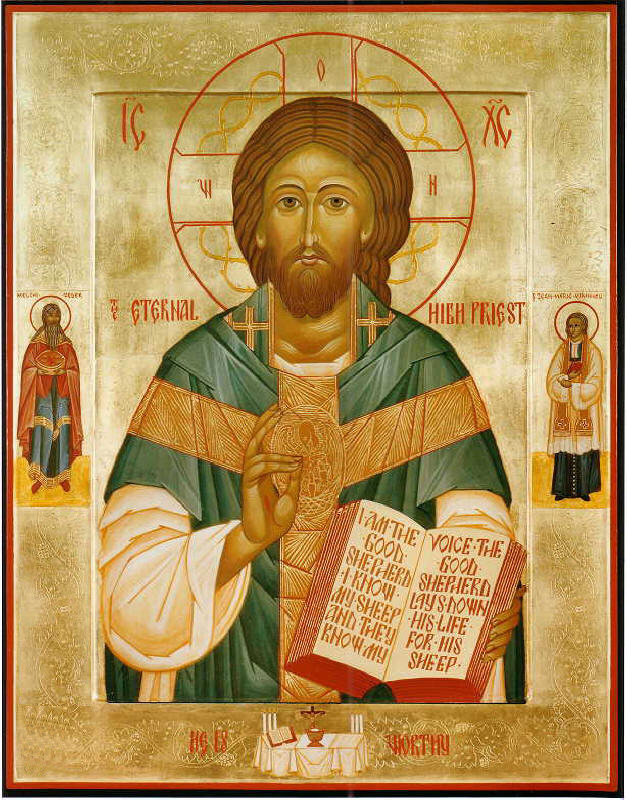
This icon shows Jesus Christ, our eternal high priest.
The gold pelican over His heart represents self-sacrifice.
The border contains an altar and grapevines, representing the Mass, and icons of Melchizedek and St. Jean-Baptiste Vianney.
Melchizedek: king of righteousness (left icon) was priest and king of Jerusalem. He blessed Abraham and has been considered an ideal priest-king.
St. Jean-Baptiste Vianney is the patron saint of parish priests.

1. Sign of the Cross: In the name of the Father, and of the Son, and of the Holy Spirit. Amen.
2. The Apostles Creed: I BELIEVE in God, the Father almighty, Creator of heaven and earth, and in Jesus Christ, His only Son, our Lord, who was conceived by the Holy Spirit, born of the Virgin Mary, suffered under Pontius Pilate, was crucified, died, and was buried. He descended into hell; on the third day he rose again from the dead; he ascended into heaven, and is seated at the right hand of God, the Father Almighty; from there He shall come to judge the living and the dead.
I believe in the Holy Spirit, the holy catholic Church, the communion of saints, the forgiveness of sins, the resurrection of the body, and the life everlasting. Amen.
3. The Lord's Prayer: OUR Father, who art in heaven, hallowed be Thy name. Thy kingdom come. Thy will be done on earth as it is in heaven. Give us this day our daily bread and forgive us our trespasses as we forgive those who trespass against us. And lead us not into temptation, but deliver us from evil. Amen.
4. (3) Hail Mary: HAIL Mary, full of grace, the Lord is with thee. Blessed art thou amongst women and blessed is the fruit of thy womb, Jesus. Holy Mary, Mother of God, pray for us sinners, now, and in the hour of our death. Amen. (Three times)
5. Glory Be: GLORY be to the Father, and to the Son, and to the Holy Spirit. As it was in the beginning, is now, and ever shall be, world without end. Amen.
6. Fatima Prayer: Oh, my Jesus, forgive us our sins, save us from the fires of hell, lead all souls to heaven, especially those in most need of your mercy.
Announce each mystery, then say 1 Our Father, 10 Hail Marys, 1 Glory Be and 1 Fatima prayer. Repeat the process with each mystery.
End with the Hail Holy Queen:
Hail, Holy Queen, Mother of Mercy, our life, our sweetness and our hope! To thee do we cry, poor banished children of Eve! To thee do we send up our sighs, mourning and weeping in this vale of tears! Turn then, most gracious advocate, thine eyes of mercy towards us; and after this, our exile, show unto us the blessed fruit of thy womb, Jesus!
O clement, O loving, O sweet Virgin Mary! Pray for us, O holy Mother of God, that we may be made worthy of the promises of Christ.
Final step -- The Sign of the Cross
The Mysteries of the Rosary By tradition, Catholics meditate on these Mysteries during prayers of the Rosary. The biblical references follow each of the Mysteries below.
The Joyful Mysteries
(Mondays and Saturdays)
1. The Annunciation (Luke 1:26-38) [Spiritual fruit - Humility]
2. The Visitation (Luke 1: 39-56) [Spiritual fruit - Love of Neighbor]
3. The Nativity (Luke 2:1-20) [Spiritual fruit - Poverty of Spirit]
4. The Presentation (Luke 2:21-38) [Spiritual fruit - Purity of mind & body]
5. The Finding of Jesus in the Temple (Luke 2:41-52) [Spiritual fruit - Obedience ]

St. Michael the Archangel
~ PRAYER ~
St. Michael, the Archangel, defend us in battle
Be our protection against the wickedness
and snares of the devil;
May God rebuke him, we humbly pray,
and do thou, O Prince of the heavenly host,
by the power of God,
Cast into hell Satan and all the evil spirits
who prowl through the world seeking the ruin of souls.
Amen
+

Sea of Sorrow
Oh! on what a sea of sorrow
Was the Virgin-Mother cast,
When her eyes with tears o'erflowing
Gazed upon her Son aghast,
From the bloodstained gibbet taken,
Dying in her arms at last.
In her bitter desolation,
His sweet mouth, His bosom too,
Then His riven side beloved,
Then each hand, both wounded through,
Then His feet, with blood encrimsoned,
Her maternal tears bedew.
She, a hundred times and over,
Strains Him closely to her breast
Heart to Heart, arms arms enfolding,
Are His wounds on her impressed:
Thus, in sorrow's very kisses,
Melts her anguished soul to rest.
Oh, dear Mother! we beseech thee,
By the tears thine eyes have shed,
By the cruel death of Jesus
And His wounds' right royal red,
Make our hearts o'erflow with sorrow
From thy heart's deep fountainhead.
To the Father, Son, and Spirit,
Now we bend on equal knee:
Glory, sempiternal glory,
To the Most High Trinity;
Yea! perpetual praise and honor
Now and through all ages be.

Novena Prayer To Our Sorrowful Mother
Most Blessed and afflicted Virgin, Queen of Martyrs, who didst stand generously beneath the cross, beholding the agony of thy dying Son; by the sword of sorrow which then pierced thy soul, by the sufferings of thy sorrowful life, by the unutterable joy which now more than repays thee for them; look down with a mother's pity and tenderness, as I kneel before thee to compassionate thy sorrows, and to lay my petition with childlike confidence in thy wounded heart. I beg of thee, O my Mother, to plead continually for me with thy Son, since He can refuse thee nothing, and through the merits of His most sacred Passion and Death, together with thy own sufferings at the foot of the cross, so to touch His Sacred Heart, that I may obtain my request,
For to whom shall I fly in my wants and miseries, if not to thee, O Mother of mercy, who, having so deeply drunk the chalice of thy Son, canst most pity us poor exiles, still doomed to sigh in this vale of tears? Offer to Jesus but one drop of His Precious Blood, but one pang of His adorable Heart; remind Him that thou art our life, our sweetness, and our hope, and thou wilt obtain what I ask, through Jesus Christ our Lord. Amen.
Hail Mary
Virgin Most Sorrowful, pray for us
(Seven times each)

Mary, most holy Virgin and Queen of Martyrs, accept the sincere homage of my filial affection. Into thy Heart, pierced by so many swords, do thou welcome my poor soul. Receive it as the companion of thy sorrows at the foot of the Cross, on which Jesus died for the redemption of the world. With thee, O sorrowful Virgin, I will gladly suffer all the trials, contradictions, and infirmities which it shall please Our Lord to send me. I offer them all to thee in memory of thy sorrows, so that: every thought of my mind and every beat of my heart may be an act of compassion and of love for thee. And do thou, sweet Mother, have pity on me, reconcile me to thy Divine Son, Jesus; keep me in His grace and assist me in my last agony, so that I may be able to meet thee in Heaven and sing thy glories.
Most holy Virgin and Mother, whose soul was pierced by a sword of sorrow in the Passion of thy Divine Son, and who in His glorious Resurrection wast filled with never ending joy at His triumph, obtain for us who call upon thee, so to be partakers in the adversities of Holy Church and the Sorrows of the Sovereign Pontiff, as to be found worthy to rejoice with them in the consolations for which we pray, in the charity and peace of the same Christ our Lord. Amen.

Litany of the Seven Sorrows
| Lord, have mercy on us. Lord, have mercy on us. Christ, hear us. Christ, graciously hear us. God, the Father of heaven, God the Son, Redeemer of the world, . God the Holy Ghost, Holy Mary, Mother of God, Holy Virgin of virgins, Mother of the Crucified, Sorrowful Mother, Mournful Mother, Sighing Mother, Afflicted Mother, Foresaken Mother, . Desolate Mother, Mother most sad, Mother set around with anguish, Mother overwhelmed by grief, Mother transfixed by a sword, Mother crucified in thy heart, Mother bereaved of thy Son, Sighing Dove, Mother of Dolors, Fount of tears, Sea of bitterness, Field of tribulation, Mass of suffering, Mirror of patience, Rock of constancy, Remedy in perplexity, Joy of the afflicted, Ark of the desolate, Refuge of the abandoned,. Shiled of the oppressed, Conqueror of the incredulous, Solace of the wretched, Medicine of the sick, Help of the faint, Strength of the weak, Protectress of those who fight, Haven of the shipwrecked, Calmer of tempests, Companion of the sorrowful, Retreat of those who groan, Terror of the treacherous, Standard-bearer of the Martyrs, Treasure of the Faithful, Light of Confessors, Pearl of Virgins, . Comfort of Widows, . Joy of all Saints, Queen of thy Servants, Holy Mary, who alone art unexampled, Pray for us, most Sorrowful Virgin, |
Christ, have mercy on us. Christ, graciously hear us. |
|
| Let us pray, --- O God, in whose Passion, according to the prophecy of Simeon, a sword of grief pierced through the most sweet soul of Thy glorious Blessed Virgin Mother Mary: grant that we, who celebrate the memory of her Seven Sorrows, may obtain the happy effect of Thy Passion, Who lives and reigns world without end, Amen. |
||
| The Seven Sorrows of Our Lady 1. The Prophecy of Simeon 2. The Flight into Egypt . 3. The Loss of Jesus in the Temple 4. Mary meets Jesus Carrying the Cross 5. The Crucifixion 6. Mary Receives the Dead Body of Her Son 7. The Burial of Her Son and Closing of the Tomb. |
||
| Consecration to Our Lady of Sorrows Most holy Virgin and Queen of Martyrs, Mary, would that I could be in Heaven, there to contemplate the honors rendered to thee by the Most Holy Trinity and by the whole Heavenly Court! But since I am still a pilgrim in this vale of tears, receive from me, thy unworthy servant and a poor sinner, the most sincere homage and the most perfect act of vassalage a human creature can offer thee. In thy Immaculate Heart, pierced with so many swords of sorrow, I place today my poor soul forever; receive me as a partaker in thy dolors, and never suffer that I should depart from that Cross on which thy only begotten Son expired for me. With thee, O Mary, I will endure all the sufferings, contradictions, infirmities, with which it will please thy Divine Son to visit me in this life. All of them I offer to thee, in memory of the Dolors which thou didst suffer during thy life, that every thought of my mind, every beating of my heart may henceforward be an act of compassion to thy Sorrows, and of complacency for the glory thou now enjoyest in Heaven. Since then, O Dear Mother, I now compassionate thy Dolors, and rejoice in seeing thee glorified, do thou also have compassion on me, and reconcile me to thy Son Jesus, that I may become thy true and loyal son (daughter); come on my last day and assist me in my last agony, even as thou wert present at the Agony of thy Divine Son Jesus, that from this painful exile I may go to Heaven, there to be made partaker of thy glory. Amen. |
Litany of Sorrows
|
|
|

Prayer To Our Lady of Sorrows, by St. Bridget
O Blessed Virgin Mary, Immaculate Mother of God, who didst endure a martyrdom of love and grief beholding the sufferings and sorrows of Jesus! Thou didst cooperate in the benefit of my redemption by thine innumerable afflictions and by offering to the Eternal Father His only begotten Son as a holocaust and victim of propitiation for my sins. I thank thee for the unspeakable love which led thee to deprive thyself of the Fruit of thy womb, Jesus, true God and true Man, to save me, a sinner. Oh, make use of the unfailing intercession of thy sorrows with the Father and the Son, that I may steadfastly amend my life and never again crucify my loving Redeemer by new sins, and that, persevering till death in His grace. I may obtain eternal life through the merits of His Cross and Passion. Amen.
Mother of love, of sorrow and of mercy, pray for us.

Saint Alphonsus Liguori's Prayer To The Mother Of Sorrows
O, my Blessed Mother, it is not one sword only with which I have pierced thy heart, but I have done so with as many as are the sins which I have committed. O, Lady, it is not to thee, who art innocent, that sufferings are due, but to me, who am guilty of so many crimes. But since thou hast been pleased to suffer so much for me, by thy merits, obtain me great sorrow for my sins, and patience under the trials of this life, which will always be light in comparison with my demerits; for I have often deserved Hell.
Amen.

Lists Every Catholic Should be Familiar With: The 7 Sorrows (Dolours) and 7 Joys of Our Lady
The Seven Dolors (Sorrows) of Mary [Catholic/Orthodox Devotional]
Apparition in Africa: Our Lady of Sorrows [Catholic/Orthodox Caucus]
Feast of the Seven Sorrows of the Blessed Virgin Mary [Catholic Caucus Devotional]
Feast of Our Lady/Mother of Sorrows
Homilies on Our Lady of Sorrows
Starkenburg:Pilgrimage to Our Lady of Sorrows Shrine
Our Mother of Sorrows
ST. ALPHONSUS LIGUORI, OF THE DOLOURS OF MARY, The Glories [Sorrows] of Mary
Our Lady of Sorrows - Sep 15
Disclaimer: Opinions posted on Free Republic are those of the individual posters and do not necessarily represent the opinion of Free Republic or its management. All materials posted herein are protected by copyright law and the exemption for fair use of copyrighted works.