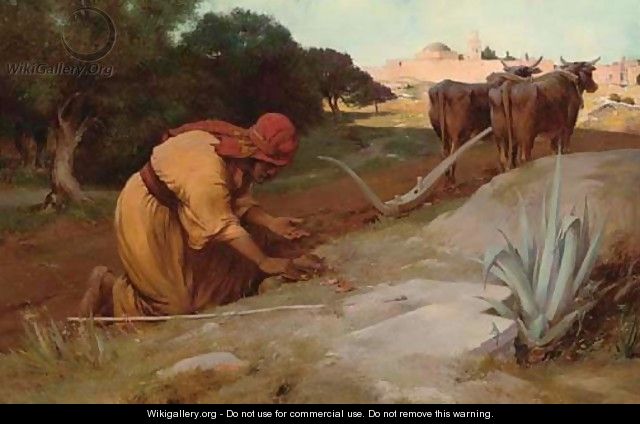
The parable of the talents
John Morgan (1822 – 1885)
Oil on Canvas
Posted on 08/30/2019 10:30:07 PM PDT by Salvation
KEYWORDS: catholic; mt25; ordinarytime; prayer;
Please FReepmail me to get on/off the Alleluia Ping List.
From: 1 Thessalonians 4:9-11
Charity and Good Use of Time
*********************************************************************************************
Commentary:
9-10. “The greatest commandment of the law is to love God with one’s whole
heart and one’s neighbor as oneself (cf. Mt 22:37-40). Christ has made this love
of neighbor his personal commandment and has enriched it with a new meaning
when he willed himself, along with his brothers, to be the object of this charity,
saying, ‘When you did it to one of the least of these my brethren, you did it to me’
(Mt. 25:40). In assuming human nature he has united to himself all mankind in a
supernatural solidarity which makes of it one single family. He has made charity
the distinguishing mark of his disciples, in the words: ‘By this all men will know
that you are my disciples, if you have love for one another’ (Jn 13:35). In the early
days the Church linked the ‘agape’ to the eucharistic supper, and by so doing
showed itself as one body around Christ united by the bond of charity. So too, in
all ages, love is its characteristic mark” (Vatican II, “Apostolicam Actuositatem”,
8). Love for the other members of the Church is fraternal love, a love which bro-
thers and sisters should have for one another, for the Church is one large family.
The Thessalonians practised this love not only among themselves but also with
the other believers living in Macedonia; fraternal charity is absolutely necessary
for the unity of Christians.
“No tongue can tell the heights to which love uplifts us”, St Clement of Rome
teaches. “Love unites us to God; love casts a veil over innumerable sins; there
are no limits to love’s endurance, no end to its patience. There is nothing base,
nothing proud, about love [...] It was in love that all God’s chosen ones were
made perfect. Without love nothing is pleasing to God” (”Letter to the Corin-
thians”, 1, 49).
11-12. Everyone has certain obligations connected with his position in life which
he should conscientiously fulfill. They include, particularly, duties to do with work
and family, and they provide us with an opportunity for conversation with God. St
John Chrysostom teaches, for example: “A woman working in the kitchen or do-
ing some sewing can always raise her thoughts to heaven and fervently invoke
the Lord. If someone is on the way to market or is traveling alone, he can easily
pray attentively. Someone else who is in his wine-cellar, engaged in stitching
wine skins, is free enough to raise his heart to the Master” (”Fifth Homily on An-
na”, 4, 6).
Work is something of immense human and supernatural value, for it is a means
readily at hand for personal sanctification and cooperation with others. It would
be unworthy of a Christian to live an idle life and expect to be supported by the
charity of others. St Paul counsels everyone who can to look after his family and
“be dependent on nobody”. And so we find the following in one of the very earli-
est Christian documents: “If someone wants to settle down among you, and is
a skilled worker, let him find employment and earn his bread. If he knows no
trade, use your discretion to make sure that he does not live in idleness on the
strength of being a Christian. If he does not want to work, he is only trying to ex-
ploit Christ. Be on your guard against people of that sort” (”Didache”, 12). So, a
person cannot be regarded as a good Christian if he does not try to work well, for
“our professional vocation is an essential and inseparable part of our condition as
Christians. Our Lord wants you to be holy in the place where you are, in the job
you have chosen” (St. J. Escriva, “Friends of God”, 60).
In addition to promoting personal sanctification and cooperation with others, work
gives the Christian a share in Christ’s work of Redemption. “Sweat and toil, which
work necessarily involves in the present condition of the human race, present the
Christian and everyone who is called to follow Christ with the possibility of sha-
ring lovingly in the work that Christ came to do (cf. Jn 17:4). This work of salva-
tion came about through suffering and death on a Cross. By enduring the toil of
work in union with Christ crucified for us, man in a way collaborates with the Son
of God for the redemption of humanity. He shows himself a true disciple of Christ
by carrying the cross in his turn every day (cf. Lk 9:23) in the activity that he is
called upon to perform” (Bl. John Paul , “Laborem Exercens”, 27).
*********************************************************************************************
Source: “The Navarre Bible: Text and Commentaries”. Biblical text from the
Revised Standard Version and New Vulgate. Commentaries by members of
the Faculty of Theology, University of Navarre, Spain.
Published by Four Courts Press, Kill Lane, Blackrock, Co. Dublin, Ireland, and
by Scepter Publishers in the United States.
From: Matthew 25:14-30
The Parable of the Talents
[19] Now after a long time the master of those servants came and settled ac-
counts with them. [20] And he who received the five talents came forward, brin-
ging five talents more, saying, ‘Master, you delivered to me five talents; here I
have made five talents more.’ [21] His master said to him, ‘Well done, good and
faithful servant; you have been faithful over a little, I will set you over much; enter
into the joy of your master.’ [22] And he also who had the two talents came for-
ward, saying, ‘Master, you delivered to me two talents; here I have made two ta-
lents more.’ [23] His master said to him, ‘Well done, good and faithful servant;
you have been faithful over a little, I will set you over much; enter into the joy of
your master.’ [24] He also who had received the one talent came forward, saying,
‘Master, I knew you to be a hard man, reaping where you did not sow, and gathe-
ring where you did not winnow; [25] so I was afraid, and I went and hid your talent
in the ground. Here you have what is yours.’ [26] But his master answered him,
‘You wicked and slothful servant! You knew that I reap where I have not sowed,
and gather where I have not winnowed? [27] Then you ought to have invested my
money with the bankers, and at my coming I should have received what was my
own with interest. [28] So take the talent from him, and give it to him who has the
ten talents. [29] For to every one who has will more be given, and he will have
abundance; but from him who has not, even what he has will be taken away. [30]
And cast the worthless servant into the outer darkness; there men will weep and
gnash their teeth.’”
*********************************************************************************************
Commentary:
14-30. A talent was not any kind of coin but a measure of value worth about fifty
kilos (one hundred pounds) of silver.
In this parable the main message is the need to respond to grace by making a
genuine effort right through one’s life. All the gifts of nature and grace which God
has given us should yield a profit. It does not matter how many gifts we have re-
ceived; what matters is our generosity in putting them to good use.
A person’s Christian calling should not lie hidden and barren: it should be out-
going, apostolic and self-sacrificial. “Don’t lose your effectiveness; instead, tram-
ple on your selfishness. You think your life is for yourself? Your life is for God,
for the good of all men, though your love for our Lord. Your buried talent, dig it
up again! Make it yield” (St. J. Escriva, “Friends of God”, 47).
An ordinary Christian cannot fail to notice that Jesus chose to outline his tea-
ching on response to grace by using the simile of men at work. Here we have a
reminder that the Christian normally lives out his vocation in the context of ordi-
nary, everyday affairs. “There is just one life, made of flesh and spirit. And it is
this life which has to become, in both soul and body, holy and filled with God.
We discover the invisible God in the most visible and material things. There is
no other way. Either we learn to find our Lord in ordinary, everyday life, or else
we shall never find Him” (St. J. Escriva, “Conversations”, 114).
*********************************************************************************************
Source: “The Navarre Bible: Text and Commentaries”. Biblical text from the
Revised Standard Version and New Vulgate. Commentaries by members of
the Faculty of Theology, University of Navarre, Spain.
Published by Four Courts Press, Kill Lane, Blackrock, Co. Dublin, Ireland, and
by Scepter Publishers in the United States.
Liturgical Colour: Green.
| First reading |
|---|
| 1 Thessalonians 4:9-11 © |
| You have learnt from God how to love one another |
|---|
| Responsorial Psalm |
|---|
| Psalm 97(98):1,7-9 © |
| Gospel Acclamation | Ph2:15-16 |
|---|
| Or: | Jn13:34 |
|---|
| Gospel |
|---|
| Matthew 25:14-30 © |
| You have been faithful in small things: come and join in your master's happiness |
|---|
| Matthew | |||
| English: Douay-Rheims | Latin: Vulgata Clementina | Greek NT: Byzantine/Majority Text (2000) | |
| Matthew 25 |
|||
| 14. | For even as a man going into a far country, called his servants, and delivered to them his goods; | Sicut enim homo peregre proficiscens, vocavit servos suos, et tradidit illis bona sua. | ωσπερ γαρ ανθρωπος αποδημων εκαλεσεν τους ιδιους δουλους και παρεδωκεν αυτοις τα υπαρχοντα αυτου |
| 15. | And to one he gave five talents, and to another two, and to another one, to every one according to his proper ability: and immediately he took his journey. | Et uni dedit quinque talenta, alii autem duo, alii vero unum, unicuique secundum propriam virtutem : et profectus est statim. | και ω μεν εδωκεν πεντε ταλαντα ω δε δυο ω δε εν εκαστω κατα την ιδιαν δυναμιν και απεδημησεν ευθεως |
| 16. | And he that had received the five talents, went his way, and traded with the same, and gained other five. | Abiit autem qui quinque talenta acceperat, et operatus est in eis, et lucratus est alia quinque. | πορευθεις δε ο τα πεντε ταλαντα λαβων ειργασατο εν αυτοις και εποιησεν αλλα πεντε ταλαντα |
| 17. | And in like manner he that had received the two, gained other two. | Similiter et qui duo acceperat, lucratus est alia duo. | ωσαυτως και ο τα δυο εκερδησεν και αυτος αλλα δυο |
| 18. | But he that had received the one, going his way digged into the earth, and hid his lord's money. | Qui autem unum acceperat, abiens fodit in terram, et abscondit pecuniam domini sui. | ο δε το εν λαβων απελθων ωρυξεν εν τη γη και απεκρυψεν το αργυριον του κυριου αυτου |
| 19. | But after a long time the lord of those servants came, and reckoned with them. | Post multum vero temporis venit dominus servorum illorum, et posuit rationem cum eis. | μετα δε χρονον πολυν ερχεται ο κυριος των δουλων εκεινων και συναιρει μετ αυτων λογον |
| 20. | And he that had received the five talents coming, brought other five talents, saying: Lord, thou didst deliver to me five talents, behold I have gained other five over and above. | Et accedens qui quinque talenta acceperat, obtulit alia quinque talenta, dicens : Domine, quinque talenta tradidisti mihi, ecce alia quinque superlucratus sum. | και προσελθων ο τα πεντε ταλαντα λαβων προσηνεγκεν αλλα πεντε ταλαντα λεγων κυριε πεντε ταλαντα μοι παρεδωκας ιδε αλλα πεντε ταλαντα εκερδησα επ αυτοις |
| 21. | His lord said to him: Well done, good and faithful servant, because thou hast been faithful over a few things, I will place thee over many things: enter thou into the joy of thy lord. | Ait illi dominus ejus : Euge serve bone, et fidelis : quia super pauca fuisti fidelis, super multa te constituam ; intra in gaudium domini tui. | εφη δε αυτω ο κυριος αυτου ευ δουλε αγαθε και πιστε επι ολιγα ης πιστος επι πολλων σε καταστησω εισελθε εις την χαραν του κυριου σου |
| 22. | And he also that had received the two talents came and said: Lord, thou deliveredst two talents to me: behold I have gained other two. | Accessit autem et qui duo talenta acceperat, et ait : Domine, duo talenta tradidisti mihi, ecce alia duo lucratus sum. | προσελθων δε και ο τα δυο ταλαντα λαβων ειπεν κυριε δυο ταλαντα μοι παρεδωκας ιδε αλλα δυο ταλαντα εκερδησα επ αυτοις |
| 23. | His lord said to him: Well done, good and faithful servant: because thou hast been faithful over a few things, I will place thee over many things: enter thou into the joy of thy lord. | Ait illi dominus ejus : Euge serve bone, et fidelis : quia super pauca fuisti fidelis, super multa te constituam ; intra in gaudium domini tui. | εφη αυτω ο κυριος αυτου ευ δουλε αγαθε και πιστε επι ολιγα ης πιστος επι πολλων σε καταστησω εισελθε εις την χαραν του κυριου σου |
| 24. | But he that had received the one talent, came and said: Lord, I know that thou art a hard man; thou reapest where thou hast not sown, and gatherest where thou hast not strewed. | Accedens autem et qui unum talentum acceperat, ait : Domine, scio quia homo durus es ; metis ubi non seminasti, et congregas ubi non sparsisti : | προσελθων δε και ο το εν ταλαντον ειληφως ειπεν κυριε εγνων σε οτι σκληρος ει ανθρωπος θεριζων οπου ουκ εσπειρας και συναγων οθεν ου διεσκορπισας |
| 25. | And being afraid I went and hid thy talent in the earth: behold here thou hast that which is thine. | et timens abii, et abscondi talentum tuum in terra : ecce habes quod tuum est. | και φοβηθεις απελθων εκρυψα το ταλαντον σου εν τη γη ιδε εχεις το σον |
| 26. | And his lord answering, said to him: Wicked and slothful servant, thou knewest that I reap where I sow not, and gather where I have not strewed: | Respondens autem dominus ejus, dixit ei : Serve male, et piger, sciebas quia meto ubi non semino, et congrego ubi non sparsi : | αποκριθεις δε ο κυριος αυτου ειπεν αυτω πονηρε δουλε και οκνηρε ηδεις οτι θεριζω οπου ουκ εσπειρα και συναγω οθεν ου διεσκορπισα |
| 27. | Thou oughtest therefore to have committed my money to the bankers, and at my coming I should have received my own with usury. | oportuit ergo te committere pecuniam meam numulariis, et veniens ego recepissem utique quod meum est cum usura. | εδει ουν σε βαλειν το αργυριον μου τοις τραπεζιταις και ελθων εγω εκομισαμην αν το εμον συν τοκω |
| 28. | Take ye away therefore the talent from him, and give it to him that hath ten talents. | Tollite itaque ab eo talentum, et date ei qui habet decem talenta : | αρατε ουν απ αυτου το ταλαντον και δοτε τω εχοντι τα δεκα ταλαντα |
| 29. | For to every one that hath shall be given, and he shall abound: but from him that hath not, that also which he seemeth to have shall be taken away. | omni enim habenti dabitur, et abundabit : ei autem qui non habet, et quod videtur habere, auferetur ab eo. | τω γαρ εχοντι παντι δοθησεται και περισσευθησεται απο δε του μη εχοντος και ο εχει αρθησεται απ αυτου |
| 30. | And the unprofitable servant cast ye out into the exterior darkness. There shall be weeping and gnashing of teeth. | Et inutilem servum ejicite in tenebras exteriores : illic erit fletus, et stridor dentium. | και τον αχρειον δουλον εκβαλετε εις το σκοτος το εξωτερον εκει εσται ο κλαυθμος και ο βρυγμος των οδοντων |
Amen!
Pray for Pope Francis.
50 Boko Haram Islamic Radicals Killed; 1,000 Hostages, Women and Children, Rescued in Nigeria
Nigeria: In the Face of Ongoing Islamist Attacks, the Faith is Growing
US Promises to Help Nigeria Exterminate Boko Haram
Is This Bishop Right about the Rosary Conquering Boko Haram? [Catholic Caucus]
Why Boko Haram and ISIS Target Women
Report reveals scale of Boko Haram violence inflictef on Nigerian Catholics
Military evacuating girls, women rescued from Boko Haram
Echos of Lepanto Nigerian bishop says rosary will bring down Boko Harm
After vision of Christ, Nigerian bishop says rosary will bring down Boko Haram (Catholic Caucus)
Nigerian Bishop Says Christ Showed Him How to Beat Islamic Terror Group
We thank you, God our Father, for those who have responded to your call to priestly ministry.
Accept this prayer we offer on their behalf: Fill your priests with the sure knowledge of your love.
Open their hearts to the power and consolation of the Holy Spirit.
Lead them to new depths of union with your Son.
Increase in them profound faith in the Sacraments they celebrate as they nourish, strengthen and heal us.
Lord Jesus Christ, grant that these, your priests, may inspire us to strive for holiness by the power of their example, as men of prayer who ponder your word and follow your will.
O Mary, Mother of Christ and our mother, guard with your maternal care these chosen ones, so dear to the Heart of your Son.
Intercede for our priests, that offering the Sacrifice of your Son, they may be conformed more each day to the image of your Son, our Lord and Savior, Jesus Christ. Amen.
Saint John Vianney, universal patron of priests, pray for us and our priests
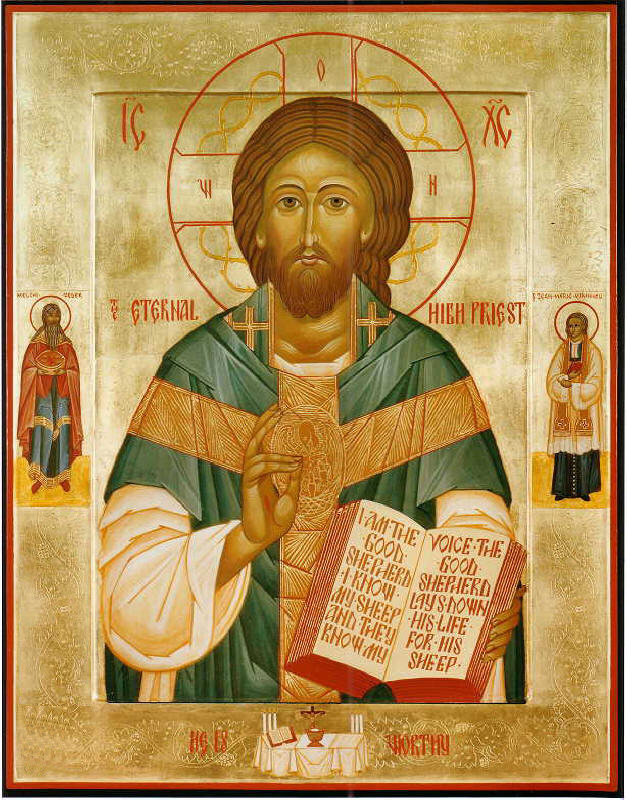
This icon shows Jesus Christ, our eternal high priest.
The gold pelican over His heart represents self-sacrifice.
The border contains an altar and grapevines, representing the Mass, and icons of Melchizedek and St. Jean-Baptiste Vianney.
Melchizedek: king of righteousness (left icon) was priest and king of Jerusalem. He blessed Abraham and has been considered an ideal priest-king.
St. Jean-Baptiste Vianney is the patron saint of parish priests.

1. Sign of the Cross: In the name of the Father, and of the Son, and of the Holy Spirit. Amen.
2. The Apostles Creed: I BELIEVE in God, the Father almighty, Creator of heaven and earth, and in Jesus Christ, His only Son, our Lord, who was conceived by the Holy Spirit, born of the Virgin Mary, suffered under Pontius Pilate, was crucified, died, and was buried. He descended into hell; on the third day he rose again from the dead; he ascended into heaven, and is seated at the right hand of God, the Father Almighty; from there He shall come to judge the living and the dead.
I believe in the Holy Spirit, the holy catholic Church, the communion of saints, the forgiveness of sins, the resurrection of the body, and the life everlasting. Amen.
3. The Lord's Prayer: OUR Father, who art in heaven, hallowed be Thy name. Thy kingdom come. Thy will be done on earth as it is in heaven. Give us this day our daily bread and forgive us our trespasses as we forgive those who trespass against us. And lead us not into temptation, but deliver us from evil. Amen.
4. (3) Hail Mary: HAIL Mary, full of grace, the Lord is with thee. Blessed art thou amongst women and blessed is the fruit of thy womb, Jesus. Holy Mary, Mother of God, pray for us sinners, now, and in the hour of our death. Amen. (Three times)
5. Glory Be: GLORY be to the Father, and to the Son, and to the Holy Spirit. As it was in the beginning, is now, and ever shall be, world without end. Amen.
6. Fatima Prayer: Oh, my Jesus, forgive us our sins, save us from the fires of hell, lead all souls to heaven, especially those in most need of your mercy.
Announce each mystery, then say 1 Our Father, 10 Hail Marys, 1 Glory Be and 1 Fatima prayer. Repeat the process with each mystery.
End with the Hail Holy Queen:
Hail, Holy Queen, Mother of Mercy, our life, our sweetness and our hope! To thee do we cry, poor banished children of Eve! To thee do we send up our sighs, mourning and weeping in this vale of tears! Turn then, most gracious advocate, thine eyes of mercy towards us; and after this, our exile, show unto us the blessed fruit of thy womb, Jesus!
O clement, O loving, O sweet Virgin Mary! Pray for us, O holy Mother of God, that we may be made worthy of the promises of Christ.
Final step -- The Sign of the Cross
The Mysteries of the Rosary By tradition, Catholics meditate on these Mysteries during prayers of the Rosary. The biblical references follow each of the Mysteries below.
The Joyful Mysteries
(Mondays and Saturdays)
1. The Annunciation (Luke 1:26-38) [Spiritual fruit - Humility]
2. The Visitation (Luke 1: 39-56) [Spiritual fruit - Love of Neighbor]
3. The Nativity (Luke 2:1-20) [Spiritual fruit - Poverty of Spirit]
4. The Presentation (Luke 2:21-38) [Spiritual fruit - Purity of mind & body]
5. The Finding of Jesus in the Temple (Luke 2:41-52) [Spiritual fruit - Obedience ]

St. Michael the Archangel
~ PRAYER ~
St. Michael, the Archangel, defend us in battle
Be our protection against the wickedness
and snares of the devil;
May God rebuke him, we humbly pray,
and do thou, O Prince of the heavenly host,
by the power of God,
Cast into hell Satan and all the evil spirits
who prowl through the world seeking the ruin of souls.
Amen
+
Disclaimer: Opinions posted on Free Republic are those of the individual posters and do not necessarily represent the opinion of Free Republic or its management. All materials posted herein are protected by copyright law and the exemption for fair use of copyrighted works.