Posted on 08/29/2019 9:14:02 AM PDT by Salvation
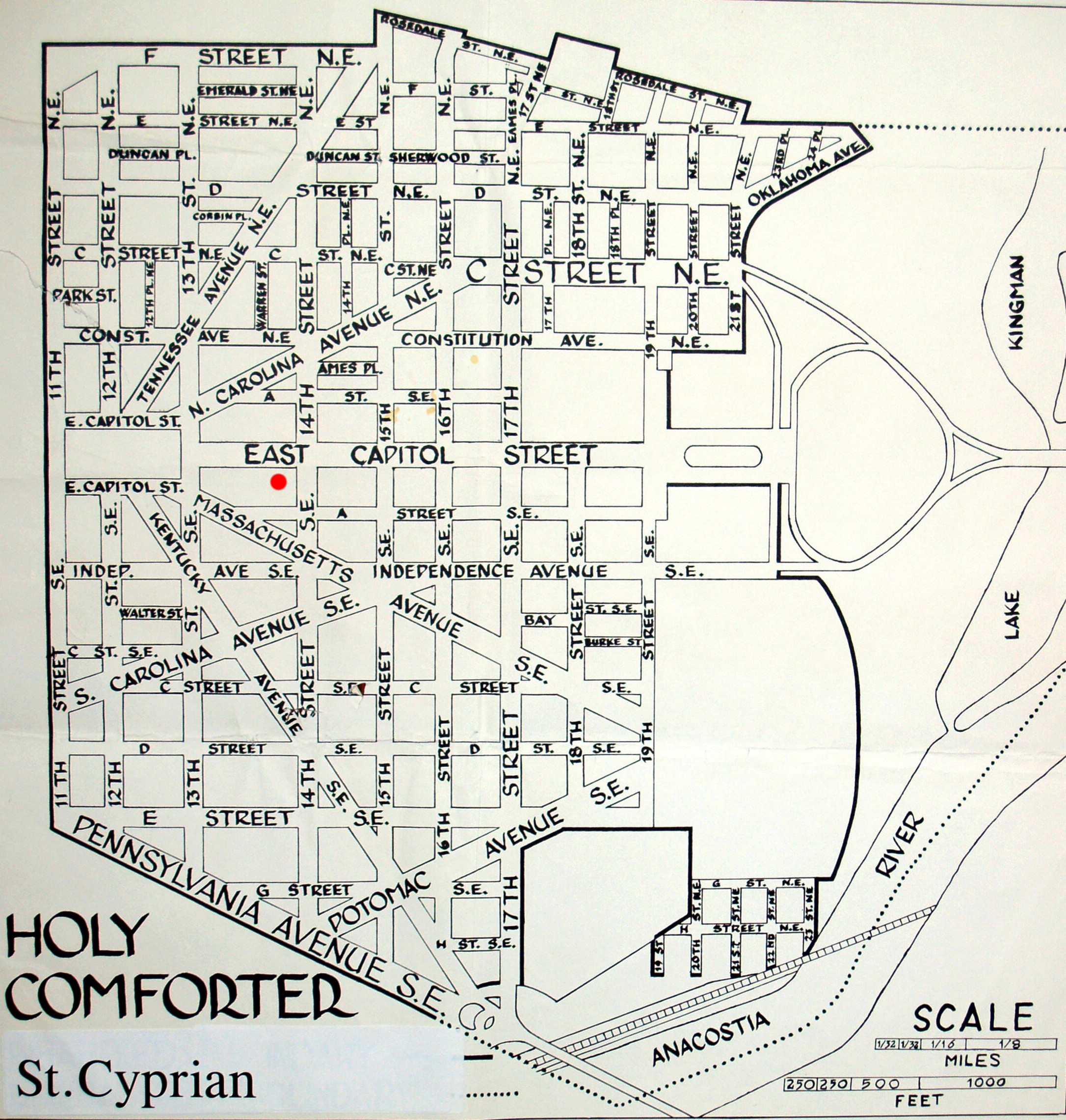
In my thirty years of priesthood I have come to see the genius in the fact that every Catholic diocese is divided into parishes with definitive geographical boundaries; the strongest parishes seem to be those that assume primary care for those in their territory. (See the territory of my parish in the diagram on the right.)
Prior to about 1980, parish boundaries were fairly strictly enforced, and in the absence of extenuating circumstances, Catholics were expected to attend Mass in the parish of their residence. Since that time, however, not only are they seldom enforced, they are rarely even known about by Catholics. Except in certain arcane matters of canon law and jurisdiction for the sacraments, they rarely come into play. Catholics thus often “shop around,” looking for a parish whose liturgical style, preaching, music, or Mass schedule most suit them. There are also parishes that seek to address a particular niche market, extending their outreach to particular ethnic or racial groups or by offering Mass in different languages.
I have come to believe that this trend is fatally flawed. A parish may successfully cater to a certain liturgical niche or ethnic tradition for a while – even for many years – but unless it focuses on its geographic neighborhood, it becomes, in effect, a “commuter parish,” with people driving past numerous other parishes to be able to partake of what they offer. Often, though, the appeal does not extend to the next generation. For example, parents who have moved to another part of town may still drive back and attend their parish, but experience tells me that this enthusiasm and dedication doesn’t transfer to their children and certainly not to their grandchildren. Hence, parishes that are living on a past legacy and not reaching out to their current residents become isolated and start to empty as the commuters age and eventually die.
Permit me to use the example of a parish within my own diocese. For the purpose of discretion, I will refer to it as “St. Wow,” but the story is a fairly common one.
St Wow’s Parish was once huge. The church building seated more than 1,000 people and in the halcyon days of the 1950s and early 1960s it was largely filled for ten Masses every Sunday. The school had 1,500 students and a long waiting list. It was located in a working-class suburb of second-generation Italians and Irish, who had moved there as the inner city became increasingly populated by African-Americans.
The neighborhood was established just after the Second World War and by the 1960s was heavily populated by Catholics. The Monsignor who oversaw the construction of the church was a legend and a king in his own right. He sat atop a miniature city of Catholics and was both respected and feared by local politicians. He and his parish were a beacon and destination for Catholics in a very tight knit community. There were dinners, bingo nights, school plays, carnivals, movie nights, sports leagues, men’s and women’s groups, a credit union, and even a bowling alley and pool in the Knights of Columbus hall. St Wow’s covered the equivalent of a city block and was the hub of the community; its vast parking lot was full most days until late in the evening.
By the late 1970s, the Black community began to spread to the closest suburbs. Racial dynamics sadly being what they were, many of St. Wow’s parishioners moved further south. Yet St. Wow was still their parish and the grizzled Monsignor had their loyalty. Numbers remained fairly strong through the 1980s.
The problem was that St. Wow’s now looked nothing like the residents in its neighborhood. The parish was 90 percent White while the area was 90 percent African-American. The parish had become insular and was not evangelizing within its boundaries; the writing was on the wall. The commuters aged, and then the famous Monsignor died. Numbers started slipping; parents couldn’t understand why their adult children weren’t as interested as they were in such a great parish. Today the commuters are largely gone; the folk group gave way to a gospel choir, and what is left is now is a smaller but viable group of African-American parishioners who live in the neighborhood. Unfortunately, the parish school couldn’t be saved and closed some years ago. One wonders if this could have been avoided if the parish had vigorously evangelized its new residents beginning in the 1970s.
Stephen Bullivant, interviewed in Catholic World Report about his book Mass Exodus, paints a similar picture, one that has been consistently repeated in the urban and ethnic northern United States:
Several factors, on both sides of the Atlantic, combined to erode those classic, urban Catholic neighborhoods That’s a very big part of the book’s argument: i.e., that the “social architecture” that had sustained and strengthened Catholic life and identity was well on the road to passing away by the time the Council came along.
The full story is too big to précis in any detail here, but consider just one U.S. case. Suppose you were brought up in an inner-city Polish or Italian neighborhood in the 20s or 30s in somewhere like Chicago or Milwaukee, where the parish was the center of social and cultural and educational and (quite probably) sporting life just as much as it was of your religious life. Then you go off to war, meet—and live and serve alongside—non-Catholics for the first time. Maybe you meet a girl while stationed somewhere—the first romantic interest you’ve ever properly spoken to not from your or a neighboring parish. Anyway, you come back from war with much wider horizons than you left with, and—thanks to the GI Bill—the prospect of going off to college. When you do get married, you’re a) significantly more likely, on average, to be marrying a non-Catholic than in your parents’ generation; and b) unlikely to be moving back to your home neighborhood. You’re a graduate now, remember, and hey—don’t those new suburban communities look just a swell place to raise Junior? When they do get ’round to building a proper Catholic church in Levittown—a Catholic school was the main priority—it’s a good couple of miles away. And while you have got a shiny new car to get to Sunday Mass, there’s plenty more exciting places you can drive to in it than just the round of parish rosary, sodalities, and fish fries that your parents still frequent back home.
I could go on, but you get the picture: Junior is brought up in a very, very different world than you were, and even if you’re still faithful Mass-goers, it’s a far less close-knit parish than your parents’ was. (Their parish, incidentally, ends up being merged with several others in the 1980s, before being sold off as luxury condos—as, I might add, was the Chicago church (St Boniface) that adorns the front cover of Mass Exodus.)
In examples like this, we see that a parish can ill afford to depend on parishioners who move away to keep commuting back. A Polish or Italian parish cannot long remain that if the Poles and Italians have moved away! It is essential to retool and gracefully adapt to welcome new people. It is certainly important to maintain traditions that still sustain the parish and make sense, but it is also time to adapt to the needs of the current population as well.
Parishes that do not prioritize reaching out to and evangelizing the residents of their neighborhood but instead remain focused on ethnic or racial groups that have moved away, or rely on the charisma of their pastor, or depend on the loyalty of former residents, can survive for a while—perhaps even ten or twenty years—but not forever. After all, charismatic pastors can be moved or die, and loyalty can fade.
There is no substitute for working with the residents within a parish’s boundaries. The genius of the Catholic Church is that we have divided the entire world up into parishes defined by geographical boundaries. The pastor and the parish together are responsible for the evangelization and salvation of every man, woman, and child within those boundaries. Parish boundaries used to tell Catholics where they were supposed to belong and attend Mass. Nowadays parish boundaries tell the parish where it is supposed to go to gather parishioners: here are the people for whom we are responsible even if they don’t look like us or speak our language or have our exact liturgical sensibilities. They are ours; we exist for them and to bring them to the Lord.
Parish boundaries still matter.
Monsignor Pope Ping!
Church Shopping is also a problem for Protestant churches.........
I’ve heard this is also an issue with some Jewish congregations, in older cities with changing neighborhoods.
I would question how well old Catholic parishes can proselytize in changing neighborhoods to keep their membership numbers up.
In protestant churches, it’s usually a new preacher that causes an exodus.............
Sadly there are many parishes run by “Father Clown” and “Sister Shrew” and they are not welcoming parishes for the orthodox. In my area we are debating a bill essentially legalizing infanticide and the concern from the pulpit seems to be facilitating illegal immigration/population replacement.
Methinks the Monsignor is onto something. As distinct from the Protestant churches, the Catholics divide up the territory. Each parish has a monopoly locally and a non-compete clause with its adjoining parishes. This should force each parish to evangelize within its territory, rather than poach believers from other parishes. But, says Msgr. Pope, the parishes failed to do this when the white ethnics fled to the suburbs and were replaced by blacks. Church attendance collapsed, as did support for the broader mission of the church to include schools. Msgr. Pope doesn’t say this, but it could also be said that rather than embrace the values of its members, this freed the clergy to pursue its own values, and rather than rely on funds raised from its members, the church turned increasingly to the government as in the support of refugees.
Can this really be a Catholic Caucus thread since it makes a claim like this?
“The genius of the Catholic Church is that we have divided the entire world up into parishes defined by geographical boundaries. The pastor and the parish together are responsible for the evangelization and salvation of every man, woman, and child within those boundaries. “
Or rather not welcoming to the “conservative”.
I was born in the small formerly industrial city of Meriden, CT. The Catholic churches were all ethnic, and within a few blocks of each other, Our Lady of Mt. Carmel (Italian) in the shadow of St. Joseph’s (Irish) which is up the street from St. Mary’s (German) which isn’t too far from St. Laurent (French). You have to go maybe a mile where St. Rose (Spanish) and St. Stanislaus (Polish) are about half a mile away from each other.
I couldn’t imagine drawing up boundaries that would make sense once people started driving instead of walking or taking a street car or horse or whatever they took in Meriden in 1890. So, most people would go based on preference, including ethnicity, even as the ethnicities themselves started to become a bit obsolete, and a couple of the churches hang by their fingertips, are closed, or have merged.
“rather than embrace the values of its members, this freed the clergy to pursue its own values, and rather than rely on funds raised from its members, the church turned increasingly to the government as in the support of refugees.”
I would argue the Church and clergy, both Catholic and Protestant, did embrace the values of its members, which were increasing non-Biblical. Instead of the church adhering to the Bible and influencing culture, the world is dominating the church.
[Catholic caucus] thread of possible geographic and demgraphic interest.
You guys need to make up your minds.
Non-Catholics complain that we don't post threads as caucus threads as it causes "division". Non-Catholics complain when we do post threads as caucus.
I think non-Catholics here are just whiners who complain.
Perhaps you are confusing the general public with church-goers.
For many years, the clergy of Presbyterians were stymied by those who sat in their pews. Eventually, they got who remained to go along with their liberal values.
The clergy among the Methodists and the Episcopalians are dealing with their African bishops. Nationally, they’re in charge, but not world-wide.
The Catholics aren’t directly accountable to those who sit in the pews. JPII was amazing, and Benedict deeply rooted in the traditional teachings of the church. But, now there’s somebody else in charge.
“Perhaps you are confusing the general public with church-goers.”
Are the pastors just responding to wants of the remaining church-goers and the perceived wants of the un-churched? How many denominations or churches have strictly adhered to the Bible? How many church-goers really want to?
There are BIG differences in church attendance and in belief in the various religions.
Attendance (the second chart breaks out the data by group)
https://www.pewforum.org/religious-landscape-study/attendance-at-religious-services/
Belief in objective right and wrong (among other beliefs that are surveyed)
https://www.pewforum.org/religious-landscape-study/belief-in-absolute-standards-for-right-and-wrong/
You ask the chicken and the egg question. Which comes first, the clergy divorcing itself from the members, or the deterioration of church attendance and of belief in the traditional teachings of the Church.
Sorry, I can’t give you a definitive answer to your question. “Why” is always a theory. Here is what I can tell you: churches that are strong retain their members and attract new members. Churches that are weak, lose members, and eventually disappear.
We see this in the so-called Mainline Protestant churches, fast heading to oblivion. The Catholics maintain their numbers by gaining immigrants at the rate they lose members. There are a lot of merely nominal Christians in these churches, and the children of these merely nominal Christians will probably be atheists.
This lose of members is just fine with the clergy of these churches because these churches are heavily endowed and/or substantially rely on taxpayer support (e.g., to day-care, grants and loans to students at church affiliated schools, reimbursement of patient expenses at church affiliated hospitals and, now, grants in support of immigrants classified as refugees).
To get back to the topic of this thread, it is Mgsr. Pope’s observation that the Catholic’s had a brilliant idea of organizing their church by parishes, so as to wed the corporate church with its people. But, unfortunately, the Catholics got away from that idea, with their churches becoming commuter-churches for a generation, and then becoming empty churches when the subsequent generation fell away from the church.
Please delete the following threads mentioning or posted by non-Catholics on a Catholic Caucus thread.
http://www.freerepublic.com/focus/f-religion/3775307/posts?page=4#4
http://www.freerepublic.com/focus/f-religion/3775307/posts?page=5#5
http://www.freerepublic.com/focus/f-religion/3775307/posts?page=6#6
http://www.freerepublic.com/focus/f-religion/3775307/posts?page=9#9
You'd be having a kitten if a non-Roman Catholic were posting.
I presume you'll ask the RM to have the caucus thread protection removed as you're not objecting to the mentioning of Protestant.
Disclaimer: Opinions posted on Free Republic are those of the individual posters and do not necessarily represent the opinion of Free Republic or its management. All materials posted herein are protected by copyright law and the exemption for fair use of copyrighted works.