
The Last Judgement
Petrus Christus
1452
Oak, 134 x 56 cm
Staatliche Museen, Berlin
Posted on 08/25/2019 11:08:59 PM PDT by Salvation
KEYWORDS: catholic; mt23; ordinarytime; prayer;
Please FReepmail me to get on/off the Alleluia Ping List.
From: 1 Thessalonians 1:1-5, 8b-10
Greetings
Thanksgiving for the Thessalonians’ Fidelity
[8b] but your faith in God has gone forth everywhere, so that we need not say
anything. [9] For they themselves report concerning us what a welcome we had
among you, and how you turned to God from idols, to serve a living and true God,
[10] and to wait for his Son from heaven, whom he raised from the dead, Jesus
who delivers us from the wrath to come.
*********************************************************************************************
Commentary:
1. The heading is in keeping with the style of the period: it identifies the writer
and the addressees and contains a greeting. The names of Silvanus and Timo-
thy, co-workers of St Paul, appears alongside his own. The heading is affectio-
nate in tone but it is not the kind of opening typical of a simple family letter.
This is an official letter, which is why two witnesses vouch for its content (in
line with legal requirements: cf. Deut 17:6).
As in certain other letters (cf. 2 Thess, Phil, Philem), St Paul does not describe
himself as an Apostle; the mention of his name is enough to convey his authority.
Silvanus is the same person as Silas whom Acts describes as “prophet” and one
of the “leading men among the brethren” in Jerusalem (cf. Acts 15:22, 32); here
the Latin transcription of his name is used. He had worked alongside St Paul in
the evangelization of Thessalonica, so he would have been well known to the be-
lievers in that city (cf. Acts 17:4). Timothy was son of Gentile father and a Jewish
mother (his mother was a Christian convert); Paul gave him instruction in the faith
when he passed through Lystra during his second missionary journey, and ever
since then he had always been a faithful helper of the Apostle. When St Paul
was writing this letter, Timothy had just arrived in Corinth from Thessalonica with
good reports of the spiritual health of that church (cf. 1 Thess 3:6).
The letter is addressed to “the church of the Thessalonians”. The Greek word
“ekklesia”, meaning “assembly, gathering of the people”, was used from the apo-
stolic age onwards to describe the Church, the new people of God. St Thomas
Aquinas used this verse for his definition of the Church as “the assembly of the
faithful brought together in God the Father and in the Lord Jesus Christ, through
faith in the Trinity and in the divinity and humanity of Christ” (”Commentary on 1
Thess, ad loc.”). “All those, who in faith look toward Jesus, the author of salvation
and the principle of unity and peace, God had gathered together and established
as the Church, that it may be for each and everyone the visible sacrament of this
saving unity” (Vatican II, “Lumen Gentium”, 9).
“Grace to you and peace”: a favorite greeting of St Paul’s, expressing the wish
that they will attain the fullness of heavenly good things. See the note on Rom
1:7).
3. The spiritual life of the Christian is based on the practice of the theological vir-
tues, for “faith encourages men to do good, charity to bear pain and effort, and
hope to resist patiently” (Severian of Gabala, “Commentary on 1 Thess, ad loc.”).
Faith needs to be reflected in one’s conduct, for “faith apart from works is dead”
(Jas 2:26). As St John Chrysostom teaches, “belief and faith are proved by works
— not by simply saying that one believes, but by real actions, which are kept up,
and by a heart burning with love” (”Hom. on 1 Thess, ad loc.”).
The service of others for God’s sake is a proof of charity. A person who practices
this virtue always rises to the occasion and does not try to dodge sacrifice or
effort.
Hope is a virtue which “enables one to endure adversity” (St Thomas, “Commen-
tary on 1 Thess, ad loc.”). St Paul encourages us to rejoice in hope and be pa-
tient in tribulation (cf. Rom 12:12), for hope fills the soul with joy and gives it the
strength to bear every difficulty for love of God.
4. All men are “beloved by God” and, as St Thomas points out, this is the case
“not just in the ordinary sense of having received natural existence from him, but
particularly because he has called them to eternal good things” (”Commentary
on I Thess, ad loc.”). Man’s last end is happiness, and happiness cannot be
found (other than in a relative sense) in wealth, honors, health or sensual satis-
faction; it can only be found in knowing and loving God. By raising man to the
supernatural order, God gave him a supernatural goal or end, which consists in
“seeing God himself, triune and one, as he is, clearly” (Council of Florence,
“Laetentur Coeli”).
Deprived as he was of sanctifying grace on account of original sin and his per-
sonal sins, man was unable to attain any end exceeding his natural powers. But
God loved us so much that he deigned to enable us “to share in the inheritance
of the saints in light. He has delivered us from the dominion of darkness and
transferred us to the kingdom of his beloved Son” (Col 1:12-13). Therefore, those
who have been given the preaching of the Gospel and the fruits of Redemption
through Baptism and the other sacraments are the object of a special divine
“choice”. This “choice” or election is not the same as “salvation”; it is an initia-
tive on God’s part prior to the attainment of salvation. To be saved one must
second this action of God by responding freely to grace.
5. St Paul reminds them that what he preached was the “gospel” foretold by the
prophets (cf. Is 40:9; 52:7; 60:6; 61:1) and fulfilled by the Incarnation of the Word
and by his work of salvation. The Apostle was pressed into service by the Holy
Spirit to forward his work of sanctification. The Thessalonians were not won over
by mere human words but by the “power” of God, who made those words effective.
The term “power” refers not only to miraculous actions but also to the Holy Spirit
moving the souls of those who heard Paul’s preaching.
It is true that this activity, like all actions of God outside himself, is something
done by all three Persons of the Blessed Trinity; but in the language of Scripture
and of the Church it is customary “to attribute to the Father those works of the
Divinity in which power excels; to attribute to the Son, those in which wisdom
excels; and to the Holy Spirit, those in which love excels” (Leo XIII, “Divinum Illud
Munus”, 5).
In the early years of the Church the proclamation of the Gospel was often marked
by special graces of the Holy Spirit, such as prophecy, miracles, or the gift of
tongues (cf. Acts 2:8). This profusion of gifts made it clear that the messianic era
had begun (cf. Acts 2:16), for it meant the fulfillment of the ancient prophecies: “I
will pour out my spirit on all flesh; your sons and your daughters shall prophesy,
your old men shall dream dreams, and your young men shall see visions. Even
upon the menservants and maidservants in those days, I will pour out my spirit”
(Joel 3:1-3).
“In power and in the Holy Spirit”: in line with the divine plan of salvation, the time
of the Old Testament, which prepared the way for the coming of the Messiah, has
reached its end, and a new era has begun, the Christian era, the key feature of
which is the activity of the Spirit of God: “It must be said that the Holy Spirit is
the principal agent of evangelization: it is he who impels each individual to pro-
claim the Gospel, and it is he who in the depths of consciences causes the word
of salvation to be accepted and understood” (Paul VI, “Evangelii Nuntiandi”, 75).
6. St Paul rejoices at the effect God has had on the Thessalonians. It is true that
Christ is “the” model to be imitated, but the Apostle’s own example played its part
in leading them to Christ (cf. 1 Cor 11:1). “To follow Christ: that is the secret. We
must accompany him so closely that we come to live with him, as the first Twelve
did; so closely, that we become identified with him. Soon we will be able to say,
provided we have not put obstacles in the way of grace, that we have put on, have
clothed ourselves with, our Lord Jesus Christ (cf. Rom 13:14). Our Lord is then
reflected in our behavior, as in a mirror. If the mirror is as it ought to be, it will
capture our Savior’s most lovable face without distorting it or making a caricature
of it; and then other people will have an opportunity of admiring him and following
him” (St. J. Escriva, “Friends of God”, 299).
“Joy”, which is one of the fruits of the Holy Spirit (cf. Gal 5:22-23), is linked to
unconditional acceptance of the word of God, and helps a person to overcome
any obstacle he or she may meet on his way (cf. Acts 5:41). “One can be joyful
despite lashes and blows, when these are accepted in the cause of Christ”, St
John Chrysostom comments. “A feature of the joy of the Holy Spirit is that it
causes an uncontainable happiness to grow even out of affliction and sorrow [...].
In the natural course of events afflictions do not produce joy: joy is the privilege
of those who accept sufferings for Jesus Christ’s sake; it is one of the good
things bestowed by the Holy Spirit” (”Hom. on 1 Thess, ad loc.”).
7-8. Thessalonica was an important center of trade and a hub of communications
for all Greece. The Christians in the city included a number of important people
and even some women of the aristocracy (cf. Acts 17:4). The social standing of
the converts and the prestige of the city partly explain the rapid spread of Chris-
tian teaching throughout the region.
What the Apostle says here only goes to show that when the Christian life is
given full rein it spreads far and wide. This should give us every encouragement
“always to act in public in accordance with our holy faith” (St. J. Escriva, “Fur-
row”, 46).
9. We can see how happy the Apostle is to learn that the work of evangelization
has borne fruit of conversion to God—which is the whole purpose of Gospel prea-
ching. “For the Church, evangelization means bringing the Good News into all
the strata of humanity, and through its influence transforming humanity from
within and making it new” (Paul VI, “Evangelii Nuntiandi”, 18).
It is moving to see the way good news spread among the early Christian com-
munities. Obviously anecdotes about the apostolate would go from church to
church; this gave them an occasion to praise God while at the same time pro-
viding encouragement to stay true to Christ and to spread the Gospel.
10. The Christian message has this feature which differentiates it from Judaism—
hope in Christ and expectation of Christ. Two central points of Christian teaching
emerge from this verse: Jesus Christ is the Son of God, who rose from the dead,
and he will come again to judge all. St John Chrysostom observes that “in a sin-
gle text St Paul brings together a number of different mysteries concerning Jesus
Christ—his glorious resurrection, his victorious ascension, his future coming, the
judgment, the reward promised to the righteous, and the punishment reserved for
evildoers” (”Hom. on 1 Thess, ad loc.”).
This verse probably contains a form of words used in oral preaching, and perhaps
a profession of faith belonging to early Christian liturgy.
“To wait for his son (to come) from heaven”: that Jesus Christ will come again is
a truth of faith professed in the Creed: “He will come again in glory to judge the
living and the dead.” Christ will be the Judge of all mankind. Everyone will be
personally judged by God twice: “The first judgment takes place when each one
of us departs this life; for then he is instantly placed before the judgment-seat
of God, where all that he has ever done or spoken or thought during life shall be
subjected to the most rigid scrutiny. This is called the particular judgment. The
second occurs when on the same day and in the same place all men shall stand
together before the tribunal of their Judge, that in the presence and hearing of all
human beings of all time each may know his final doom and sentence [...]. This
is called the general judgment” (”St Pius V Catechism”, I, 8, 3).
The “wrath to come” is a metaphor referring to the just punishment of sinners.
Our Lord Jesus Christ will exempt from it those who have consistently tried to
live in the state of grace and fellowship with God. St Teresa of Avila warns that
“it will be a great thing at the hour of death to know that we are going to be
judged by him whom we have loved above all things. We can approach this trial
with confidence. It will not be like going into a strange land but into our own land,
for it is the land that belongs to him whom we love so much and who loves us”
(”Way of Perfection”, 70, 3).
*********************************************************************************************
Source: “The Navarre Bible: Text and Commentaries”. Biblical text from the
Revised Standard Version and New Vulgate. Commentaries by members of
the Faculty of Theology, University of Navarre, Spain.
Published by Four Courts Press, Kill Lane, Blackrock, Co. Dublin, Ireland, and
by Scepter Publishers in the United States.
From: Matthew 23:13-22
Jesus Indicts the Scribes and Pharisees
[16] “Woe to you, blind guides, who say, ‘If any one swears by the temple, it is
nothing; but if any one swears by the gold of the temple, he is bound by his oath.’
[17] You blind fools! For which is greater, the gold or the temple that has made
the gold sacred? [18] And you say, ‘If any one swears by the altar, it is nothing;
but if one swears by the gift that is on the altar, he is bound by his oath.’ [19]
You blind men! For which is greater, the gift or the altar that makes the gift sa-
cred? [20] So he who swears by the altar, swears by it and everything on it; [21]
and he who swears by the temple, swears by it and by him who dwells in it; [22]
and he who swears by Heaven, swears by the throne of God and by Him who
sits upon it.”
*********************************************************************************************
Commentary:
13. Here comes our Lord’s invective against the behavior of the scribes and Pha-
risees: His “woes” condemn their past conduct and threaten them with punish-
ment if they do not repent and mend their ways.
14. As RSV points out, “other authorities add here (or after verse 12) verse 14,
“Woe to you, scribes and Pharisees, hypocrites! For you devour widows’ houses
and for a pretense you make long prayers; therefore you will receive greater con-
demnation.” Our Lord is not reproaching them for praying long prayers but for their
hypocrisy and cupidity. By going in for a lot of external religious practices, the
Pharisees wanted to be recognized as devout men and then trade on that reputa-
tion particularly with vulnerable people. Widows, for example, would ask them to
say prayers; the Pharisees in turn would ask for alms. What Jesus means here
is that prayer should always come from an upright heart and a generous spirit.
15. “Proselyte”: a pagan convert to Judaism. The root of the word means “he
who comes”, he who—coming from idolatry—joins the chosen people in response
to a calling from God. The Pharisees spared no effort to gain converts. Our Lord
reproaches them not for this, but because they were concerned only about hu-
man success, their motivation being vainglory.
The sad thing about these proselytes was that, after receiving the light of Old
Testament revelation, they remained under the influence of scribes and Phari-
sees, who passed on to them their own narrow outlook.
22. Our Lord’s teaching about taking oaths is given in the Sermon on the Mount
(Matthew 5:33-37). Jesus does away with the nitpicking casuistry of the Phari-
sees by focusing directly on the uprightness of the intention of the oath-taker
and by stressing the respect due to God’s majesty and dignity. What Jesus
wants is a pure heart, with no element of deceit.
Our Lord particularly reproves any tendency to undermine the content of an oath,
as the Doctors of the Law tended to do, thereby failing to respect holy things and
especially the holy name of God. He therefore draws attention to the command-
ment of the Law which says, ‘You shall not take the name of the Lord your God
in vain” (Exodus 20:7; Leviticus 19:12; Deuteronomy 5:11).
*********************************************************************************************
Source: “The Navarre Bible: Text and Commentaries”. Biblical text from the
Revised Standard Version and New Vulgate. Commentaries by members of
the Faculty of Theology, University of Navarre, Spain.
Published by Four Courts Press, Kill Lane, Blackrock, Co. Dublin, Ireland, and
by Scepter Publishers in the United States.
Liturgical Colour: Green.
| First reading |
|---|
| 1 Thessalonians 1:1-5,8-10 © |
| You broke with idolatry when you were converted to God |
|---|
| Responsorial Psalm | Psalm 149:1-6,9 © |
|---|
| Gospel Acclamation | Jn17:17 |
|---|
| Or: | Jn10:27 |
|---|
| Gospel |
|---|
| Matthew 23:13-22 © |
| Alas for you, blind guides! |
|---|
| Matthew | |||
| English: Douay-Rheims | Latin: Vulgata Clementina | Greek NT: Byzantine/Majority Text (2000) | |
| Matthew 23 |
|||
| 13. | But woe to you scribes and Pharisees, hypocrites; because you shut the kingdom of heaven against men, for you yourselves do not enter in; and those that are going in, you suffer not to enter. | Væ autem vobis scribæ et pharisæi hypocritæ, quia clauditis regnum cælorum ante homines ! vos enim non intratis, nec introëuntes sinitis intrare. | 23:14 ουαι υμιν γραμματεις και φαρισαιοι υποκριται οτι κλειετε την βασιλειαν των ουρανων εμπροσθεν των ανθρωπων υμεις γαρ ουκ εισερχεσθε ουδε τους εισερχομενους αφιετε εισελθειν |
| 14. | Woe to you scribes and Pharisees, hypocrites: because you devour the houses of widows, praying long prayers. For this you shall receive the greater judgment. | Væ vobis scribæ et pharisæi hypocritæ, quia comeditis domos viduarum, orationes longas orantes ! propter hoc amplius accipietis judicium. | 23:13 ουαι δε υμιν γραμματεις και φαρισαιοι υποκριται οτι κατεσθιετε τας οικιας των χηρων και προφασει μακρα προσευχομενοι δια τουτο ληψεσθε περισσοτερον κριμα |
| 15. | Woe to you scribes and Pharisees, hypocrites; because you go round about the sea and the land to make one proselyte; and when he is made, you make him the child of hell twofold more than yourselves. | Væ vobis scribæ et pharisæi hypocritæ, quia circuitis mare, et aridam, ut faciatis unum proselytum, et cum fuerit factus, facitis eum filium gehennæ duplo quam vos. | ουαι υμιν γραμματεις και φαρισαιοι υποκριται οτι περιαγετε την θαλασσαν και την ξηραν ποιησαι ενα προσηλυτον και οταν γενηται ποιειτε αυτον υιον γεεννης διπλοτερον υμων |
| 16. | Woe to you blind guides, that say, Whosoever shall swear by the temple, it is nothing; but he that shall swear by the gold of the temple, is a debtor. | Væ vobis duces cæci, qui dicitis : Quicumque juraverit per templum, nihil est : qui autem juraverit in auro templo, debet. | ουαι υμιν οδηγοι τυφλοι οι λεγοντες ος αν ομοση εν τω ναω ουδεν εστιν ος δ αν ομοση εν τω χρυσω του ναου οφειλει |
| 17. | Ye foolish and blind; for whether is greater, the gold, or the temple that sanctifieth the gold? | Stulti et cæci : quid enim majus est ? aurum, an templum, quod sanctificat aurum ? | μωροι και τυφλοι τις γαρ μειζων εστιν ο χρυσος η ο ναος ο αγιαζων τον χρυσον |
| 18. | And whosoever shall swear by the altar, it is nothing; but whosoever shall swear by the gift that is upon it, is a debtor. | Et quicumque juraverit in altari, nihil est : quicumque autem juraverit in dono, quod est super illud, debet. | και ος εαν ομοση εν τω θυσιαστηριω ουδεν εστιν ος δ αν ομοση εν τω δωρω τω επανω αυτου οφειλει |
| 19. | Ye blind: for whether is greater, the gift, or the altar that sanctifieth the gift? | Cæci : quid enim majus est, donum, an altare, quod sanctificat donum ? | μωροι και τυφλοι τι γαρ μειζον το δωρον η το θυσιαστηριον το αγιαζον το δωρον |
| 20. | He therefore that sweareth by the altar, sweareth by it, and by all things that are upon it: | Qui ergo jurat in altari, jurat in eo, et in omnibus quæ super illud sunt. | ο ουν ομοσας εν τω θυσιαστηριω ομνυει εν αυτω και εν πασιν τοις επανω αυτου |
| 21. | And whosoever shall swear by temple, sweareth by it, and by him that dwelleth in it: | Et quicumque juraverit in templo, jurat in illo, et in eo qui habitat in ipso : | και ο ομοσας εν τω ναω ομνυει εν αυτω και εν τω κατοικησαντι αυτον |
| 22. | And he that sweareth by heaven, sweareth by the throne of God, and by him that sitteth thereon. | et qui jurat in cælo, jurat in throno Dei, et in eo qui sedet super eum. | και ο ομοσας εν τω ουρανω ομνυει εν τω θρονω του θεου και εν τω καθημενω επανω αυτου |
(*) v. 19 μωροι, "dull" is omitted in translations.
Amen!
Pray for Pope Francis.
50 Boko Haram Islamic Radicals Killed; 1,000 Hostages, Women and Children, Rescued in Nigeria
Nigeria: In the Face of Ongoing Islamist Attacks, the Faith is Growing
US Promises to Help Nigeria Exterminate Boko Haram
Is This Bishop Right about the Rosary Conquering Boko Haram? [Catholic Caucus]
Why Boko Haram and ISIS Target Women
Report reveals scale of Boko Haram violence inflictef on Nigerian Catholics
Military evacuating girls, women rescued from Boko Haram
Echos of Lepanto Nigerian bishop says rosary will bring down Boko Harm
After vision of Christ, Nigerian bishop says rosary will bring down Boko Haram (Catholic Caucus)
Nigerian Bishop Says Christ Showed Him How to Beat Islamic Terror Group
We thank you, God our Father, for those who have responded to your call to priestly ministry.
Accept this prayer we offer on their behalf: Fill your priests with the sure knowledge of your love.
Open their hearts to the power and consolation of the Holy Spirit.
Lead them to new depths of union with your Son.
Increase in them profound faith in the Sacraments they celebrate as they nourish, strengthen and heal us.
Lord Jesus Christ, grant that these, your priests, may inspire us to strive for holiness by the power of their example, as men of prayer who ponder your word and follow your will.
O Mary, Mother of Christ and our mother, guard with your maternal care these chosen ones, so dear to the Heart of your Son.
Intercede for our priests, that offering the Sacrifice of your Son, they may be conformed more each day to the image of your Son, our Lord and Savior, Jesus Christ. Amen.
Saint John Vianney, universal patron of priests, pray for us and our priests
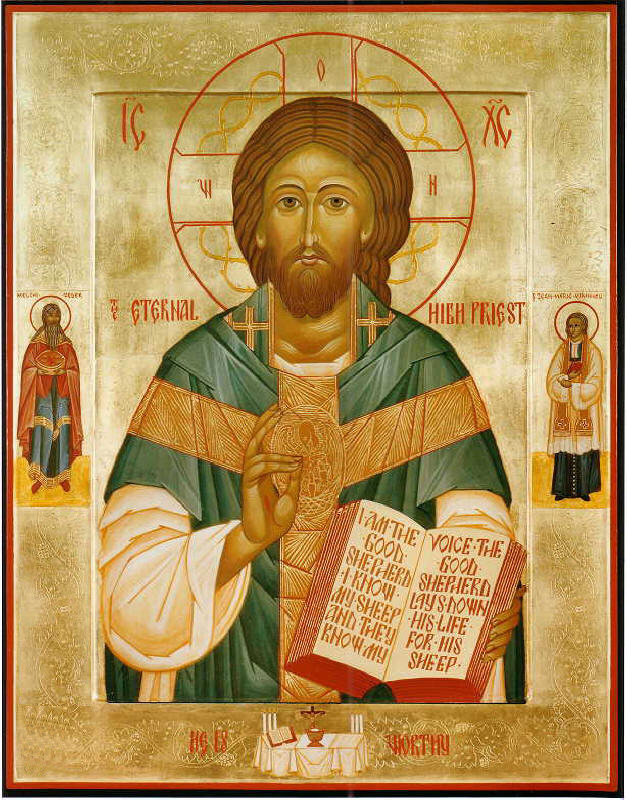
This icon shows Jesus Christ, our eternal high priest.
The gold pelican over His heart represents self-sacrifice.
The border contains an altar and grapevines, representing the Mass, and icons of Melchizedek and St. Jean-Baptiste Vianney.
Melchizedek: king of righteousness (left icon) was priest and king of Jerusalem. He blessed Abraham and has been considered an ideal priest-king.
St. Jean-Baptiste Vianney is the patron saint of parish priests.

1. Sign of the Cross: In the name of the Father, and of the Son, and of the Holy Spirit. Amen.
2. The Apostles Creed: I BELIEVE in God, the Father almighty, Creator of heaven and earth, and in Jesus Christ, His only Son, our Lord, who was conceived by the Holy Spirit, born of the Virgin Mary, suffered under Pontius Pilate, was crucified, died, and was buried. He descended into hell; on the third day he rose again from the dead; he ascended into heaven, and is seated at the right hand of God, the Father Almighty; from there He shall come to judge the living and the dead.
I believe in the Holy Spirit, the holy catholic Church, the communion of saints, the forgiveness of sins, the resurrection of the body, and the life everlasting. Amen.
3. The Lord's Prayer: OUR Father, who art in heaven, hallowed be Thy name. Thy kingdom come. Thy will be done on earth as it is in heaven. Give us this day our daily bread and forgive us our trespasses as we forgive those who trespass against us. And lead us not into temptation, but deliver us from evil. Amen.
4. (3) Hail Mary: HAIL Mary, full of grace, the Lord is with thee. Blessed art thou amongst women and blessed is the fruit of thy womb, Jesus. Holy Mary, Mother of God, pray for us sinners, now, and in the hour of our death. Amen. (Three times)
5. Glory Be: GLORY be to the Father, and to the Son, and to the Holy Spirit. As it was in the beginning, is now, and ever shall be, world without end. Amen.
6. Fatima Prayer: Oh, my Jesus, forgive us our sins, save us from the fires of hell, lead all souls to heaven, especially those in most need of your mercy.
Announce each mystery, then say 1 Our Father, 10 Hail Marys, 1 Glory Be and 1 Fatima prayer. Repeat the process with each mystery.
End with the Hail Holy Queen:
Hail, Holy Queen, Mother of Mercy, our life, our sweetness and our hope! To thee do we cry, poor banished children of Eve! To thee do we send up our sighs, mourning and weeping in this vale of tears! Turn then, most gracious advocate, thine eyes of mercy towards us; and after this, our exile, show unto us the blessed fruit of thy womb, Jesus!
O clement, O loving, O sweet Virgin Mary! Pray for us, O holy Mother of God, that we may be made worthy of the promises of Christ.
Final step -- The Sign of the Cross
The Mysteries of the Rosary By tradition, Catholics meditate on these Mysteries during prayers of the Rosary. The biblical references follow each of the Mysteries below.
The Joyful Mysteries
(Mondays and Saturdays)
1. The Annunciation (Luke 1:26-38) [Spiritual fruit - Humility]
2. The Visitation (Luke 1: 39-56) [Spiritual fruit - Love of Neighbor]
3. The Nativity (Luke 2:1-20) [Spiritual fruit - Poverty of Spirit]
4. The Presentation (Luke 2:21-38) [Spiritual fruit - Purity of mind & body]
5. The Finding of Jesus in the Temple (Luke 2:41-52) [Spiritual fruit - Obedience ]
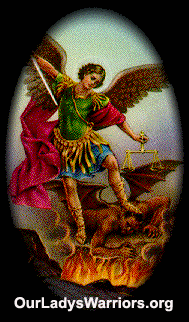
St. Michael the Archangel
~ PRAYER ~
St. Michael, the Archangel, defend us in battle
Be our protection against the wickedness
and snares of the devil;
May God rebuke him, we humbly pray,
and do thou, O Prince of the heavenly host,
by the power of God,
Cast into hell Satan and all the evil spirits
who prowl through the world seeking the ruin of souls.
Amen
+
Disclaimer: Opinions posted on Free Republic are those of the individual posters and do not necessarily represent the opinion of Free Republic or its management. All materials posted herein are protected by copyright law and the exemption for fair use of copyrighted works.