Skip to comments.
Slavery, the Bible and Christianity
Christian Post ^
| 08/22/2019
| Eric Bryant
Posted on 08/22/2019 7:00:25 AM PDT by SeekAndFind
Slavery in the United States began 400 years ago.
This month in 1619, Africans were sold as slaves to colonists.
Tragically, our nation which was founded by many God-fearing Christians gave into the ways of the world when it came to embracing the institution of slavery and taking over the new world from the indigenous peoples.
For some people, their rejection of Christianity and the Bible is a direct result of this dark history.
Those who have used the Bible to promote racism or slavery have manipulated the meaning of the Scriptures for their own evil intentions and have not actually looked at the words being written and the context of what was being shared.
The Bible is the most revolutionary book from ancient times which calls for the end of slavery and the end of injustice. The world needs to know this!
So many issues at the heart of the Christian faith have been politicized so that cultural Christians are seen as against immigrants and for white nationalism.
The world around us should know that we are for them as broken as they may be, yet we are against the evils of racism, bigotry, white nationalism, and injustice.
Unfortunately, our silence has been perceived as endorsement. Our unwillingness to acknowledge the evils of our nation's past makes it seem like we are in agreement with injustice continuing.
We are those who are forgiven by Jesus because we were willing to repent so we should be the first willing to repent on behalf of our country because of the evil perpetrated on people who look differently. Consider the prayer of Daniel for his nation in Daniel 9 as he repented on behalf of his nation and those who came before him.
So what does the Bible really say about slavery?
When something doesn’t make sense, we need to look at the context and use the Scriptures to interpret the Scriptures.
So many people throw out all of God’s Word because some of it doesn’t make sense at first glance.
Remember, the historical accounts are descriptive rather than prescriptive. In other words, we are reading what happened not necessarily what God intended or wanted from His people.
In terms of slavery, even though Paul encourages slaves to submit to their masters (and masters to be kind to them), there is something bigger going on.
This seems so backwards to us, but consider a few elements of context.
We have to realize that in the ancient world no one was talking or writing like Paul who was advocating on behalf of women, Gentiles, and slaves. The early house churches bore the fruit of that as they became the most inclusive, diverse, and free communities on the planet!
Slavery mentioned in the New Testament is not like the African slave trade where families were separated, kidnapped, taken hostage on a boat and sent across the ocean to a new world where they knew no one and were mistreated.
Instead, up to 80% of the Roman Empire was enslaved. Slavery is how the economy worked. Scholar N.T. Wright equated the importance of slavery to the economy of the ancient world to the way we depend on electricity today. Slavery is also how most people survived. They needed a place to stay and a job to do and a way to take care of their family.
In those days, slavery had nothing to do with race. You could be a king one day, lose a battle and be enslaved the next day. Many of those enslaved were paying off a debt. They chose servitude as a way to get out of their difficult circumstances. Even in the Old Testament, the Bible calls for those who were enslaved to be freed every 7 years (which is very different than forced slavery).
The Bible does not advocate slavery.
Instead Paul is writing to help slaves know how to handle their difficult circumstances.
A Trajectory Towards Freedom
Even still, there is a trajectory towards freedom in the Bible. For example, Paul’s letter to Philemon was a letter asking him to free his slave Onesimus.
Paul's letters to the early churches, church leaders, and in particular his letter to Philemon was a ticking time bomb written by Paul that would go off and lead followers of Jesus to become advocates for abolishing slavery.
In a cultural context where slavery is still so commonplace, Paul advocates for freedom!
Both Jesus’ and Paul’s approach were spiritual and long-term rather than a short-term fix that may not have had any lasting effect. If Jesus and Paul had advocated for a slave rebellion, even if it had worked, it would have been localized and short term. Instead, Jesus came to free all the captives and that freedom included freedom from all sin. Paul tells slaves to become free, if they can and conversely tells free people to not become slaves. The early church leaders knew that as people were freed from spiritual slavery, then the end of physical enslavement was soon to follow.
There are other New Testament texts as well like Ephesians 6, Colossians 3, and 1Timothy, but Paul is advocating for a subversive undoing of an institution in daily life.
Remarkably, in his letters Paul is writing to slaves directly. This shows he sees those who are enslaved as people too and not as just property. Also, this makes clear that there were Christ-followers who were enslaved. He is reminding them that their suffering is not in vain. In fact, we know some of the most important figures of the Bible like Joseph and Daniel were actually slaves at one point in their lives!
Paul even mentions that anyone who chooses to follow Jesus receives spiritual gifts including women and those who were enslaved. In other words, women and slaves could very well have the spiritual gift of leadership or teaching.
Paul writes an incredible declaration of freedom and equality for women and those who were slaves. He writes:
"There is neither Jew nor Gentile, neither slave nor free, nor is there male and female, for you are all one in Christ Jesus." – Galatians 3:28
This is revolutionary!!
The Subversive Undoing of Slavery
As a result of the teachings of the Scriptures, church leaders advocated for the end of slavery as early as the 600s and William Wilberforce of England became anti-slavery after becoming a follower of Jesus. John Wesley, a pastor wrote his friend Wilberforce encouraging him to keep up the fight against slavery:
“Unless God has raised you up for this very thing, you will be worn out by the opposition of men and devils. But if God be for you, who can be against you? Are all of them together stronger than God? O be not weary of well doing! Go on, in the name of God and in the power of his might, till even American slavery (the vilest that ever saw the sun) shall vanish away before it.’” John Wesley - 1791
One of the greatest testaments to the fact that the Bible is for oppressed people is that it was written by oppressed people and oppressed people are most open to following Jesus.
Even as slave owners in the South would try to use the Bible to oppress and control people they had taken hostage, beaten, mistreated, and enslaved, many of those who were enslaved fell in love with Jesus. So many of the old spirituals came from the story of when the Israelites were slaves in Egypt.
Southern slave owners edited the Bible to keep the people they oppressed from knowing the full story of the Scriptures. It was called the Slave Bible.
Also the story of Phyllis Wheatley is really compelling. She had been enslaved as a young girl, but the family who owned her allowed her an education. Eventually, she gained her freedom and became a writer. She used the Scriptures to point out the evils of slavery but in a very subtle way as she was writing in the late 1700s.
Museum of the Bible on Phyllis Wheatley
The reality is that all nations informed by Christianity (informed by the Bible) have moved away from slavery throughout history. We still have a long way to go towards equality and righting the wrongs of injustice, but the trajectory that began in the Scriptures moves towards value and worth and love beyond what any culture would be like naturally.
As followers of Jesus who pray that God's Kingdom comes to earth as it is in heaven, we are to work towards a world that looks like the new earth and new heaven described in Revelation 21:3-4 where John hears: “Look! God’s dwelling place is now among the people, and he will dwell with them. They will be his people, and God himself will be with them and be their God. 4 ‘He will wipe every tear from their eyes. There will be no more death’[b] or mourning or crying or pain, for the old order of things has passed away.”
TOPICS: History; Moral Issues; Religion & Culture; Religion & Politics
KEYWORDS: bible; christianity; slavery
Navigation: use the links below to view more comments.
first 1-20, 21-23 next last
To: SeekAndFind
God identifies himself to Israel as the one who led them out of Egypt, “out of the house of bondage”.
He only had to say he was God, worship Me, or else. But he identified himself as the one who freed them — unnecessary, unless he considered bondage was a bad thing to be done away with.
To: SeekAndFind
Cabeza de Baca was a slave of the American Indians long before Africans were ever brought here. (Actually, there was an African slave with this expedition)
Álvar Núñez Cabeza de Vaca, an early explorer and first historian of Texas, .... All survived by becoming slaves of Coahuiltecan Indians
https://tshaonline.org/handbook/online/articles/fca06
To: SeekAndFind
The world around us should know that we are for them as broken as they may be, yet we are against the evils of racism, bigotry, white nationalism, and injustice. Unfortunately, our silence has been perceived as endorsement. Our unwillingness to acknowledge the evils of our nation's past makes it seem like we are in agreement with injustice continuing.
BULL-Loney!!! Racism, bigotry and white nationalism exist only in the minds of liberals and leftists.
4
posted on
08/22/2019 7:21:21 AM PDT
by
Fiji Hill
To: Fiji Hill
5
posted on
08/22/2019 7:24:36 AM PDT
by
sport
To: SeekAndFind
The New York Times Magazine is packed with liars and revisionists
The first blacks to arrive in America were not slaves but indentured servants.
In 1619, all indentured servants (white or black) had specified periods of servitude ranging from four to seven years and received precisely the same treatment and rewards. At the conclusion of their respective periods of servitude, each was entitled to freedom, citizenship and a land grant of 25 to 50 acres. Throughout the early colonial period when all land was held in trust for the king, the basis of land disposition were grants, dispensed by the local government in accordance with the king’s wishes.
"Father of U.S. slavery was a black man"
FReegards!


6
posted on
08/22/2019 9:01:13 AM PDT
by
Agamemnon
(Darwinism is the glue that holds liberalism together)
To: Agamemnon
Thank you. Will read later at your link.
7
posted on
08/22/2019 9:16:45 AM PDT
by
Mrs. Don-o
(Woe to those who call evil good and good evil, turn darkness to light and light to darkness. Is 5:20)
To: SeekAndFind
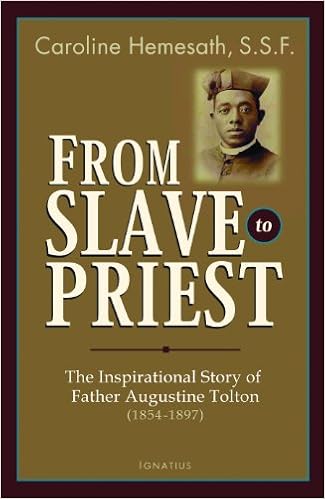
A great book about the trials of the black person is portrayed in the book, From Slave to Priest. It's the story of Fr. Augustine Tolton based on fact and written is a prose style by a nun.
8
posted on
08/22/2019 9:20:20 AM PDT
by
Salvation
("With God all things are possible." Matthew 19:26)
To: SeekAndFind; Mrs. Don-o
9
posted on
08/22/2019 9:23:31 AM PDT
by
Salvation
("With God all things are possible." Matthew 19:26)
To: SeekAndFind
10
posted on
08/22/2019 9:33:23 AM PDT
by
Albion Wilde
(It is fatal to enter any war without the will to win it. --Douglas MacArthur)
To: SeekAndFind
One girl I like doesn’t like the Bible because she believes it justifies female slavery. I asked her to skip over those parts in her thinking and try it again.
I do see her point, through. Some of the Bible, especially the OT, is hard to take, such as with Jephthah’s oath and burnt offering.
And woe and pity for the poorly dressed wedding guest!
11
posted on
08/22/2019 9:47:00 AM PDT
by
GBA
(Here in the matrix, merrily, merrily, life is but a dream.)
To: GBA
... such as with Jephthah’s oath and burnt offering.
READ THIS:
12
posted on
08/22/2019 9:55:17 AM PDT
by
SeekAndFind
(look at Michigan, it will)
To: SeekAndFind
I have found it sad that some apologists have maintained that the Bible doesn't condemn slavery as practiced in the 1800s in America. The Bible doesn't condemn indentured servitude but that wasn't what was practiced in the American plantations. The slavery practiced here was manstealing. Under Biblical law, those who kidnapped someone for slavery
and those who owned the slaves were subject to execution:
Exodus 21:16 - Whoever steals a man and sells him, and anyone found in possession of him, shall be put to death.
I had ancestors who were on the wrong side of the slavery issue and some who gave their lives in defense of what God sees are serious sin. Had Moses done Reconstruction, a lot of plantation owners would have been executed.
13
posted on
08/22/2019 10:14:55 AM PDT
by
CommerceComet
(Hillary: A unique blend of arrogance, incompetence, and corruption.)
To: SeekAndFind
The OT commanded that slaves be set free after 7 years, if they so desired. If they wanted to remain a slave, they were to have their ear pierced by their master. This reinforces my belief that slavery, at least for OT Jews, was nothing like slavery as practiced by the rest of the world, then OR now. They were commanded to treat slaves humanely. I look at that type of slavery as akin to a servant working for room and board, which, up until the 20th century, was a condition of many people who went into domestic service, though without the forced aspect of slavery. It allowed uneducated people with no way to make a living, or any family money, to survive, instead of starve. Not ideal, certainly, but better than starving, stealing, or prostitution.
There surely are many millions of people today, in much of the world, being forced into actual slavery of the cruelest type. I’m not saying ANY type of slavery is good, but there is a vast difference between Biblical Jewish slavery, and any other type.
To: GBA; ConservativeMind; ealgeone; Gamecock; HarleyD; Luircin; imardmd1; aMorePerfectUnion; ...
And woe and pity for the poorly dressed wedding guest! And when the king came in to see the guests, he saw there a man which had not on a wedding garment: And he saith unto him, Friend, how camest thou in hither not having a wedding garment? And he was speechless. Then said the king to the servants, Bind him hand and foot, and take him away, and cast him into outer darkness; there shall be weeping and gnashing of teeth. For many are called, but few are chosen. (Matthew 22:11-14)
That was a parable, using earthly realities which corresponded to spiritual ones, and in which the lack of a wedding garment represents one who is not spiritually fit for the kingdom of God, being clothed in his own presumed righteousness, rather than the the robe of righteousness on Christ's account, given to those of effectual heart-purifying faith.
To him give all the prophets witness, that through his name whosoever believeth in him shall receive remission of sins. (Acts 10:43)
And God, which knoweth the hearts, bare them witness, giving them the Holy Ghost, even as he did unto us; And put no difference between us and them, purifying their hearts by faith. (Acts 15:8-9)
...but ye are washed, but ye are sanctified, but ye are justified in the name of the Lord Jesus, and by the Spirit of our God. (1 Corinthians 6:11)
And I said unto him, Sir, thou knowest. And he said to me, These are they which came out of great tribulation, and have washed their robes, and made them white in the blood of the Lamb. (Revelation 7:14)
I will greatly rejoice in the Lord, my soul shall be joyful in my God; for he hath clothed me with the garments of salvation, he hath covered me with the robe of righteousness, as a bridegroom decketh himself with ornaments, and as a bride adorneth herself with her jewels. (Isaiah 61:10)
To God be the glory.
15
posted on
08/24/2019 4:35:38 PM PDT
by
daniel1212
( Trust the risen Lord Jesus to save you as a damned and destitute sinner + be baptized + follow Him)
To: Flaming Conservative
The OT commanded that slaves be set free after 7 years, if they so desired. In the 7th year, but only Israelites. See here by God's grace.
16
posted on
08/24/2019 4:46:01 PM PDT
by
daniel1212
( Trust the risen Lord Jesus to save you as a damned and destitute sinner + be baptized + follow Him)
To: daniel1212
Heal me, O LORD, and I will be healed; save me, and I will be saved, for You are my praise.
Jeremiah 17:14
17
posted on
08/24/2019 7:24:20 PM PDT
by
GBA
(Here in the matrix, merrily, merrily, life is but a dream.)
To: GBA
**And woe and pity for the poorly dressed wedding guest! **
Representing the fact that he or she was NOT baptized.
18
posted on
08/24/2019 7:27:31 PM PDT
by
Salvation
("With God all things are possible." Matthew 19:26)
To: SeekAndFind
I am sorry but I am going to roll my eyes at this weeping and wailing and gnashing of teeth of an article.
We were not even a nation at that time.
And as for the "We have to repent for what people who lived in our general physical location did 400 years ago"?
Try this scripture.
“In those days, it will no longer be said: ‘The fathers have eaten sour grapes, and this has set the children’s teeth on edge.’
Instead, each will die for his own iniquity. If anyone eats the sour grapes, his own teeth will be set on edge.
Jeremiah 31:29,30
19
posted on
08/24/2019 7:36:22 PM PDT
by
Harmless Teddy Bear
(Human beings don't behave rationally. We rationalize our behavior.)
To: GBA
And woe and pity for the poorly dressed wedding guest! The wedding guests were given a wedding garment. If you were not wearing the garment given to you you were not part of the wedding celebration but were a wedding crasher.
In the days when it was common to attack weddings and kidnap brides it was important to know who belonged and who did not.
20
posted on
08/24/2019 7:40:28 PM PDT
by
Harmless Teddy Bear
(Human beings don't behave rationally. We rationalize our behavior.)
Navigation: use the links below to view more comments.
first 1-20, 21-23 next last
Disclaimer:
Opinions posted on Free Republic are those of the individual
posters and do not necessarily represent the opinion of Free Republic or its
management. All materials posted herein are protected by copyright law and the
exemption for fair use of copyrighted works.
FreeRepublic.com is powered by software copyright 2000-2008 John Robinson