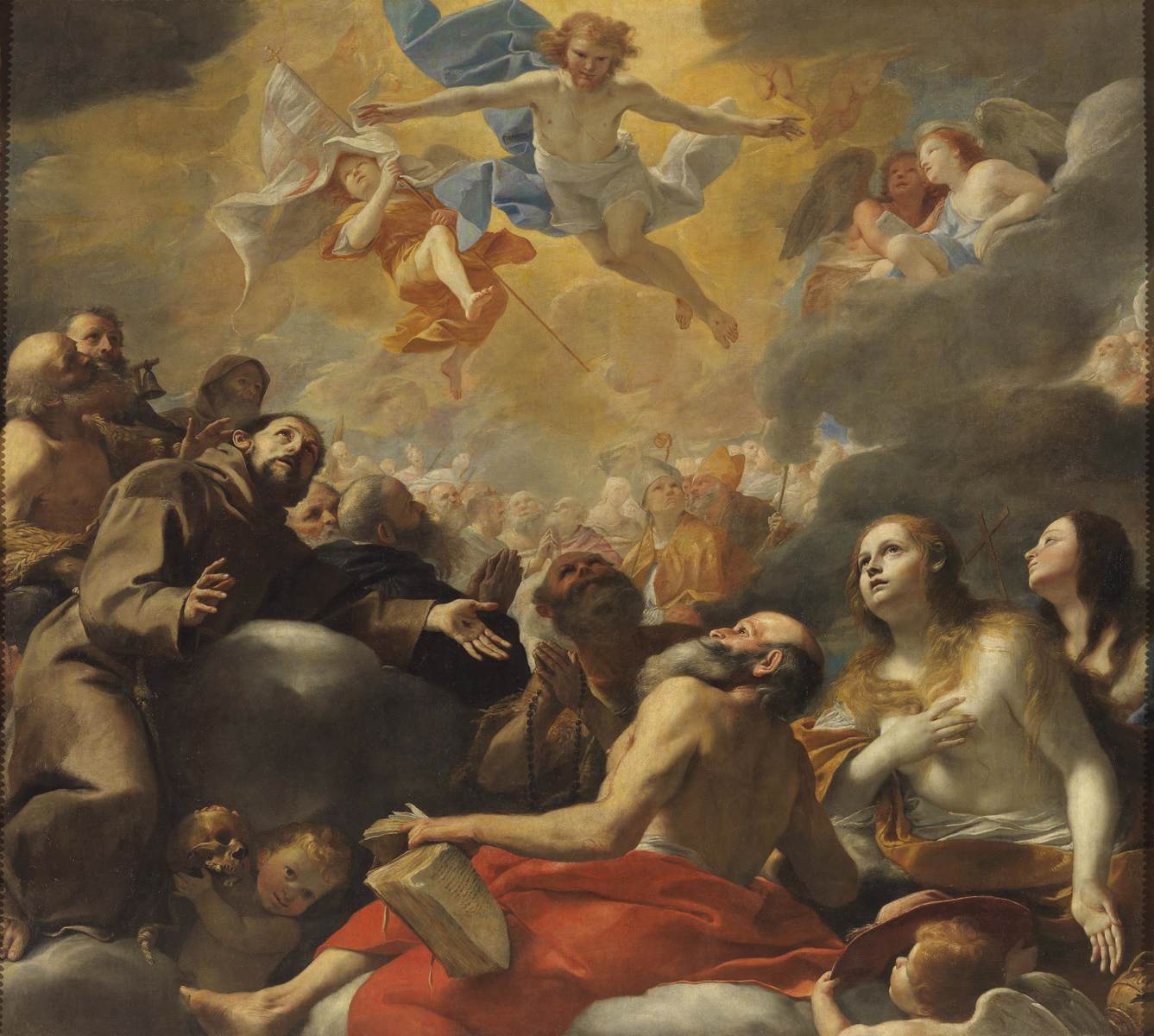
Christ in Glory
Mattia Preti
c. 1660
Oil on canvas, 220 x 253 cm
Museo del Prado, Madrid
Posted on 08/19/2019 9:40:33 PM PDT by Salvation
KEYWORDS: catholic; mt19; ordinarytime; prayer; saints;
Please FReepmail me to get on/off the Alleluia Ping List.
From: Judges 6:11-24a
God calls Gideon
[19] So Gideon went into his house and prepared a kid, and unleavened cakes
from an ephah of flour; the meat he put in a basket, and the broth he put in a
pot, and brought them to him under the oak and presented them.” [20] And the
angel of God said to him, “Take the meat and unleavened cakes, and put them
on this rock, and pour the broth over them.” And he did so. [21] Then the angel
of the Lord reached out the tip of the staff that was in his hand, and touched the
meat and the unleavened cakes; and there sprang up fire from the rock and con-
sumed the flesh and the unleavened cakes; and the angel of the Lord vanished
from his sight; [22] Then Gideon perceived that he was the angel of the Lord;
and Gideon said, “Alas, O Lord God! For now I have seen the angel of the Lord
face to face.” [23] Then Gideon built an altar there to the Lord.
*********************************************************************************************
Commentary:
6:11-32. This is one of the oldest accounts of calling in Holy Scripture; in it the
sacred writer includes features to be found in all instances of vocation.
God’s choice falls on a man who never would have expected a vocation; he re-
ceives the call in the course of his ordinary work, when he is grinding corn (v.
11). The call is God’s initiative. In some particularly important cases (such as
this), the Lord uses an angel to convey his message (cf. Lk 1:11, 28). His gree-
ting begins with references to the fact that the Lord is close to his chosen one —
“The Lord is with you” (v. 12; cf. Lk 1:28) – and to the mission being assigned
him: God has seen the needs of his people and is going to send this man to
their aid (v. 14). the Lord did not pick this man because he deserved it or be-
cause he came of a distinguished family (v. 15).
The usual reaction to a call from God is a reluctance to respond. Gideon recites
all the difficulties and limitations which would disqualify him from the task: how
did we get into this situation (v. 13)?, how can I deliver Israel (v. 15)?. And he
even asks for a sign to confirm that the call really does come from God (v. 17).
On this occasion God gives him tangible proof, and Gideon is quite bowled over
when he sees that it really is the Lord (vv. 19-22). Then, when he decides to ac-
cept the role God is offering him, he is given words of consolation (”Do not fear”)
and feels at peace (v. 23).
In the Old Testament we meet many people who are called by God and accept
that call – Samuel (cf. 1 Sam 3:1-18), David (cf. 1 Sam 16:1-13), Elisha (cf. 1
Kings 19:19-21), etc. And in the New Testament the positive response to their
callings given by the Blessed Virgin (Lk 1:26-38), the apostles (Mt. 4:18-22 and
par.; 9:9 and par.; Jn 1:35-51), St Paul (Acts 9:1-19), etc. were crucial to salva-
tion history. God continues to call men and women today, to yield abundant di-
vine fruit in the name of the Lord. “If you respond to the call the Lord has made
to you, your life – your poor life – will leave a deep and wide furrow in the history
of the human race, a clear and fertile furrow, eternal and godly” (St. J. Escriva,
“The Forge”, 59).
*********************************************************************************************
Source: “The Navarre Bible: Text and Commentaries”. Biblical text from the
Revised Standard Version and New Vulgate. Commentaries by members of
the Faculty of Theology, University of Navarre, Spain.
Published by Four Courts Press, Kill Lane, Blackrock, Co. Dublin, Ireland, and
by Scepter Publishers in the United States.
From: Matthew 19:23-30
Christian Poverty and Renunciation
*********************************************************************************************
Commentary:
24-26. By drawing this comparison Jesus shows that it is simply not possible for
people who put their hearts on worldly things to obtain a share in the Kingdom of
God.
“With God all things are possible”: that is, with God’s grace man can be brave
and generous enough to use wealth to promote the service of God and man. This
is why St. Matthew, in Chapter 5, specifies that the poor “in spirit” are blessed
(Matthew 5:3).
28. “In the new world”, in the “regeneration”: a reference to the renewal of all
things which will take place when Jesus Christ comes to judge the living and the
dead. The resurrection of the body will be an integral part of this renewal.
The ancient people of God, Israel, was made up of twelve tribes. The new people
of God, the Church, to which all men are called, is founded by Jesus Christ on
the Twelve Apostles under the primacy of Peter.
29. These graphic remarks should not be explained away. They mean that love
or Jesus Christ and His Gospel should come before everything else. What our
Lord says here should not be interpreted as conflicting with the will of God Him-
self, the creator and sanctifier of family bonds.
*********************************************************************************************
Source: “The Navarre Bible: Text and Commentaries”. Biblical text from the
Revised Standard Version and New Vulgate. Commentaries by members of
the Faculty of Theology, University of Navarre, Spain.
Published by Four Courts Press, Kill Lane, Blackrock, Co. Dublin, Ireland, and
by Scepter Publishers in the United States.
“Jesus, the Very Thought of Thee”
by Bernard of Clairvaux, 12th century
Translated by Edward Caswall, 1814-1878
1. Jesus, the very thought of thee
With sweetness fills the breast;
But sweeter far Thy face to see
And in Thy presence rest.
2. Nor voice can sing, nor heart can frame,
Nor can the memory find
A sweeter sound than Thy blest name,
O Savior or mankind!
3. O Hope of every contrite heart,
O Joy of all the meek!
To those who fall, how kind Thou art,
How good to those who seek!
4. But what to those who find? Ah! this
Nor tongue nor pen can show;
The love of Jesus, what it is,
None but His loved ones know.
5. Jesus, our only Joy be Thou
As Thou our Prize wilt be!
Jesus, be Thou our Glory now
And through eternity.
Hymn #350
The Lutheran Hymnal
Text: Song of Solomon 1:3
Author: Bernard of Clairvaux, 12th century, cento
Translated by: Edward Caswall, 1849, alt.
Titled: “Iesu dulcis memoria”
Composer: Herman A. Polack, 1910
Tune: “Clairvaux”
Liturgical Colour: White.
These are the readings for the feria
| First reading | Judges 6:11-24 © |
|---|
| 'Peace be with you; have no fear; you will not die' |
|---|
| Responsorial Psalm |
|---|
| Psalm 84(85):9,11-14 © |
| Gospel Acclamation | Ps24:4,5 |
|---|
| Or: | 2Co8:9 |
|---|
| Gospel |
|---|
| Matthew 19:23-30 © |
| It is easier for a camel to pass through the eye of a needle than for a rich man to enter the kingdom of heaven |
|---|
These are the readings for the memorial
| First reading |
|---|
| Ecclesiasticus 15:1-6 © |
| Whoever grasps the Law will obtain wisdom |
|---|
| Responsorial Psalm |
|---|
| Psalm 118(119):9-14 © |
| Gospel Acclamation | Jn15:9,5 |
|---|
| Gospel | John 17:20-26 © |
|---|
| Father, may they be completely one |
|---|
| Matthew | |||
| English: Douay-Rheims | Latin: Vulgata Clementina | Greek NT: Byzantine/Majority Text (2000) | |
| Matthew 19 |
|||
| 23. | Then Jesus said to his disciples: Amen, I say to you, that a rich man shall hardly enter into the kingdom of heaven. | Jesus autem dixit discipulis suis : Amen dico vobis, quia dives difficile intrabit in regnum cælorum. | ο δε ιησους ειπεν τοις μαθηταις αυτου αμην λεγω υμιν οτι δυσκολως πλουσιος εισελευσεται εις την βασιλειαν των ουρανων |
| 24. | And again I say to you: It is easier for a camel to pass through the eye of a needle, than for a rich man to enter into the kingdom of heaven. | Et iterum dico vobis : Facilius est camelum per foramen acus transire, quam divitem intrare in regnum cælorum. | παλιν δε λεγω υμιν ευκοπωτερον εστιν καμηλον δια τρυπηματος ραφιδος διελθειν η πλουσιον εις την βασιλειαν του θεου εισελθειν |
| 25. | And when they had heard this, the disciples wondered very much, saying: Who then can be saved? | Auditis autem his, discipuli mirabantur valde, dicentes : Quis ergo poterit salvus esse ? | ακουσαντες δε οι μαθηται αυτου εξεπλησσοντο σφοδρα λεγοντες τις αρα δυναται σωθηναι |
| 26. | And Jesus beholding, said to them: With men this is impossible: but with God all things are possible. | Aspiciens autem Jesus, dixit illis : Apud homines hoc impossibile est : apud Deum autem omnia possibilia sunt. | εμβλεψας δε ο ιησους ειπεν αυτοις παρα ανθρωποις τουτο αδυνατον εστιν παρα δε θεω παντα δυνατα [εστιν] |
| 27. | Then Peter answering, said to him: Behold we have left all things, and have followed thee: what therefore shall we have? | Tunc respondens Petrus, dixit ei : Ecce nos reliquimus omnia, et secuti sumus te : quid ergo erit nobis ? | τοτε αποκριθεις ο πετρος ειπεν αυτω ιδου ημεις αφηκαμεν παντα και ηκολουθησαμεν σοι τι αρα εσται ημιν |
| 28. | And Jesus said to them: Amen, I say to you, that you, who have followed me, in the regeneration, when the Son of man shall sit on the seat of his majesty, you also shall sit on twelve seats judging the twelve tribes of Israel. | Jesus autem dixit illis : Amen dico vobis, quod vos, qui secuti estis me, in regeneratione cum sederit Filius hominis in sede majestatis suæ, sedebitis et vos super sedes duodecim, judicantes duodecim tribus Israël. | ο δε ιησους ειπεν αυτοις αμην λεγω υμιν οτι υμεις οι ακολουθησαντες μοι εν τη παλιγγενεσια οταν καθιση ο υιος του ανθρωπου επι θρονου δοξης αυτου καθισεσθε και υμεις επι δωδεκα θρονους κρινοντες τας δωδεκα φυλας του ισραηλ |
| 29. | And every one that hath left house, or brethren, or sisters, or father, or mother, or wife, or children, or lands for my name's sake, shall receive an hundredfold, and shall possess life everlasting. | Et omnis qui reliquerit domum, vel fratres, aut sorores, aut patrem, aut matrem, aut uxorem, aut filios, aut agros propter nomen meum, centuplum accipiet, et vitam æternam possidebit. | και πας ος αφηκεν οικιας η αδελφους η αδελφας η πατερα η μητερα η γυναικα η τεκνα η αγρους ενεκεν του ονοματος μου εκατονταπλασιονα ληψεται και ζωην αιωνιον κληρονομησει |
| 30. | And many that are first, shall be last: and the last shall be first. | Multi autem erunt primi novissimi, et novissimi primi. | πολλοι δε εσονται πρωτοι εσχατοι και εσχατοι πρωτοι |
Man of the century! Woman of the century! You see such terms applied to so many today—“golfer of the century,” “composer of the century,” “right tackle of the century”—that the line no longer has any punch. But Western Europe’s “man of the twelfth century,” without doubt or controversy, had to be Bernard of Clairvaux. Adviser of popes, preacher of the Second Crusade, defender of the faith, healer of a schism, reformer of a monastic Order, Scripture scholar, theologian, and eloquent preacher: any one of these titles would distinguish an ordinary man. Yet Bernard was all of these—and he still retained a burning desire to return to the hidden monastic life of his younger days.
In the year 1111, at the age of 20, Bernard left his home to join the monastic community of Citeaux. His five brothers, two uncles, and some 30 young friends followed him into the monastery. Within four years, a dying community had recovered enough vitality to establish a new house in the nearby valley of Wormwoods, with Bernard as abbot. The zealous young man was quite demanding, though more on himself than others. A slight breakdown of health taught him to be more patient and understanding. The valley was soon renamed Clairvaux, the valley of light.
His ability as arbitrator and counselor became widely known. More and more he was lured away from the monastery to settle long-standing disputes. On several of these occasions, he apparently stepped on some sensitive toes in Rome. Bernard was completely dedicated to the primacy of the Roman See. But to a letter of warning from Rome, he replied that the good fathers in Rome had enough to do to keep the Church in one piece. If any matters arose that warranted their interest, he would be the first to let them know.
Shortly thereafter it was Bernard who intervened in a full-blown schism and settled it in favor of the Roman pontiff against the antipope.
The Holy See prevailed on Bernard to preach the Second Crusade throughout Europe. His eloquence was so overwhelming that a great army was assembled and the success of the crusade seemed assured. The ideals of the men and their leaders, however, were not those of Abbot Bernard, and the project ended as a complete military and moral disaster.
Bernard felt responsible in some way for the degenerative effects of the crusade. This heavy burden possibly hastened his death, which came August 20, 1153.
Bernard’s life in the Church was more active than we can imagine possible today. His efforts produced far-reaching results. But he knew that they would have availed little without the many hours of prayer and contemplation that brought him strength and heavenly direction. His life was characterized by a deep devotion to the Blessed Mother. His sermons and books about Mary are still the standard of Marian theology.

Pray for Pope Francis.
50 Boko Haram Islamic Radicals Killed; 1,000 Hostages, Women and Children, Rescued in Nigeria
Nigeria: In the Face of Ongoing Islamist Attacks, the Faith is Growing
US Promises to Help Nigeria Exterminate Boko Haram
Is This Bishop Right about the Rosary Conquering Boko Haram? [Catholic Caucus]
Why Boko Haram and ISIS Target Women
Report reveals scale of Boko Haram violence inflictef on Nigerian Catholics
Military evacuating girls, women rescued from Boko Haram
Echos of Lepanto Nigerian bishop says rosary will bring down Boko Harm
After vision of Christ, Nigerian bishop says rosary will bring down Boko Haram (Catholic Caucus)
Nigerian Bishop Says Christ Showed Him How to Beat Islamic Terror Group
We thank you, God our Father, for those who have responded to your call to priestly ministry.
Accept this prayer we offer on their behalf: Fill your priests with the sure knowledge of your love.
Open their hearts to the power and consolation of the Holy Spirit.
Lead them to new depths of union with your Son.
Increase in them profound faith in the Sacraments they celebrate as they nourish, strengthen and heal us.
Lord Jesus Christ, grant that these, your priests, may inspire us to strive for holiness by the power of their example, as men of prayer who ponder your word and follow your will.
O Mary, Mother of Christ and our mother, guard with your maternal care these chosen ones, so dear to the Heart of your Son.
Intercede for our priests, that offering the Sacrifice of your Son, they may be conformed more each day to the image of your Son, our Lord and Savior, Jesus Christ. Amen.
Saint John Vianney, universal patron of priests, pray for us and our priests
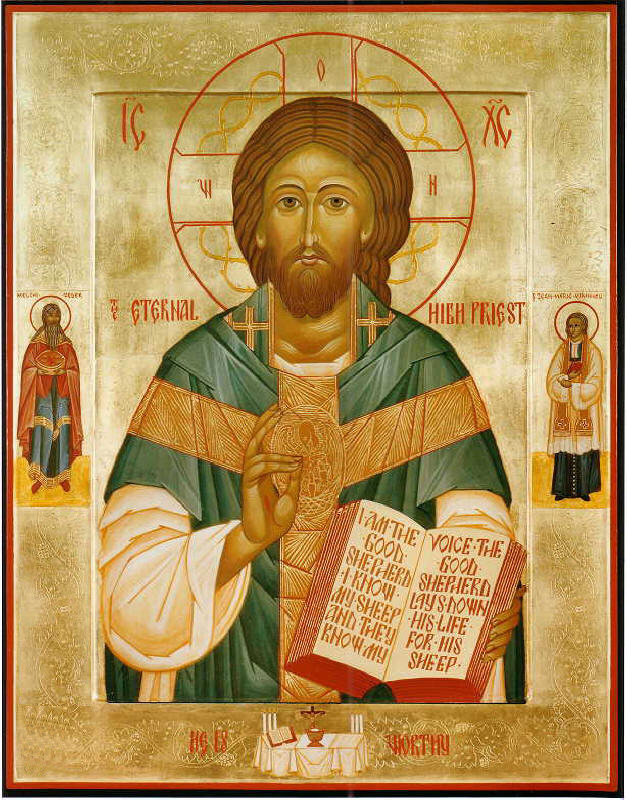
This icon shows Jesus Christ, our eternal high priest.
The gold pelican over His heart represents self-sacrifice.
The border contains an altar and grapevines, representing the Mass, and icons of Melchizedek and St. Jean-Baptiste Vianney.
Melchizedek: king of righteousness (left icon) was priest and king of Jerusalem. He blessed Abraham and has been considered an ideal priest-king.
St. Jean-Baptiste Vianney is the patron saint of parish priests.

1. Sign of the Cross: In the name of the Father, and of the Son, and of the Holy Spirit. Amen.
2. The Apostles Creed: I BELIEVE in God, the Father almighty, Creator of heaven and earth, and in Jesus Christ, His only Son, our Lord, who was conceived by the Holy Spirit, born of the Virgin Mary, suffered under Pontius Pilate, was crucified, died, and was buried. He descended into hell; on the third day he rose again from the dead; he ascended into heaven, and is seated at the right hand of God, the Father Almighty; from there He shall come to judge the living and the dead.
I believe in the Holy Spirit, the holy catholic Church, the communion of saints, the forgiveness of sins, the resurrection of the body, and the life everlasting. Amen.
3. The Lord's Prayer: OUR Father, who art in heaven, hallowed be Thy name. Thy kingdom come. Thy will be done on earth as it is in heaven. Give us this day our daily bread and forgive us our trespasses as we forgive those who trespass against us. And lead us not into temptation, but deliver us from evil. Amen.
4. (3) Hail Mary: HAIL Mary, full of grace, the Lord is with thee. Blessed art thou amongst women and blessed is the fruit of thy womb, Jesus. Holy Mary, Mother of God, pray for us sinners, now, and in the hour of our death. Amen. (Three times)
5. Glory Be: GLORY be to the Father, and to the Son, and to the Holy Spirit. As it was in the beginning, is now, and ever shall be, world without end. Amen.
6. Fatima Prayer: Oh, my Jesus, forgive us our sins, save us from the fires of hell, lead all souls to heaven, especially those in most need of your mercy.
Announce each mystery, then say 1 Our Father, 10 Hail Marys, 1 Glory Be and 1 Fatima prayer. Repeat the process with each mystery.
End with the Hail Holy Queen:
Hail, Holy Queen, Mother of Mercy, our life, our sweetness and our hope! To thee do we cry, poor banished children of Eve! To thee do we send up our sighs, mourning and weeping in this vale of tears! Turn then, most gracious advocate, thine eyes of mercy towards us; and after this, our exile, show unto us the blessed fruit of thy womb, Jesus!
O clement, O loving, O sweet Virgin Mary! Pray for us, O holy Mother of God, that we may be made worthy of the promises of Christ.
Final step -- The Sign of the Cross
The Mysteries of the Rosary By tradition, Catholics meditate on these Mysteries during prayers of the Rosary. The biblical references follow each of the Mysteries below.
The Sorrowful Mysteries
(Tuesdays and Fridays)
1. The Agony in the Garden (Matthew 26:36-46, Luke 22:39-46) [Spiritual fruit - God's will be done]
2. The Scourging at the Pillar (Matthew 27:26, Mark 15:15, John 19:1) [Spiritual fruit - Mortification of the senses]
3. The Crowning with Thorns (Matthew 27:27-30, Mark 15:16-20, John 19:2) [Spiritual fruit - Reign of Christ in our heart]
4. The Carrying of the Cross (Matthew 27:31-32, Mark 15:21, Luke 23:26-32, John 19:17) [Spiritual fruit - Patient bearing of trials]
5. The Crucifixion (Matthew 27:33-56, Mark 15:22-39, Luke 23:33-49, John 19:17-37) [Spiritual fruit - Pardoning of Injuries]
Disclaimer: Opinions posted on Free Republic are those of the individual posters and do not necessarily represent the opinion of Free Republic or its management. All materials posted herein are protected by copyright law and the exemption for fair use of copyrighted works.