Posted on 06/05/2019 10:41:58 AM PDT by Salvation
by
The first reading from Tuesday’s Mass is Paul’s farewell speech to the presbyters (priests) of the early Church. Here is a skilled bishop and pastor exhorting others who have pastoral roles within the Church. Let’s examine this text and apply its wisdom to bishops and priests as well as to parents and other leaders in the Church.
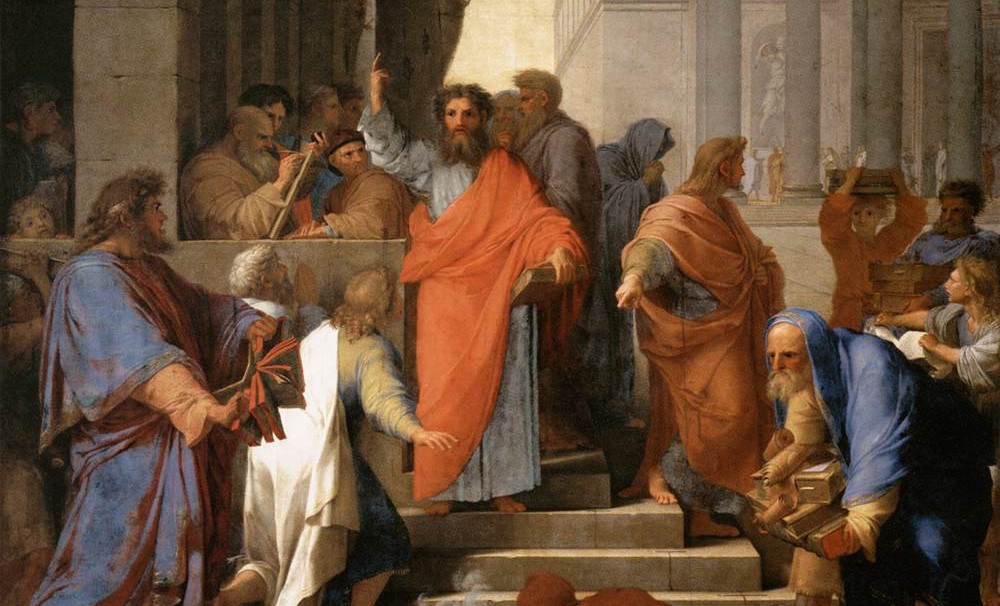
The scene is Miletus, a coastal town in Asia Minor not far from Ephesus. Paul, who is about to depart for Jerusalem, summons the presbyters of the early Church at Ephesus. He has ministered there for three years and now summons the priests for this final exhortation. In the sermon, St. Paul cites his own example of having been a zealous teacher of the faith who did not fail to preach the “whole counsel of God.” He did not merely preach what suited him or made him popular; he preached it all. To these early priests, Paul leaves this legacy and would have them follow in his footsteps. Let’s look at some excerpts from this final exhortation.
From Miletus Paul had the presbyters of the Church at Ephesus summoned. When they came to him, he addressed them, “You know how I lived among you the whole time from the day I first came to the province of Asia. I served the Lord with all humility and with the tears and trials that came to me … and I did not at all shrink from telling you what was for your benefit, or from teaching you in public or in your homes. I earnestly bore witness for both Jews and Greeks to repentance before God and to faith in our Lord Jesus … But now, compelled by the Spirit, I am going to Jerusalem … But now I know that none of you to whom I preached the kingdom during my travels will ever see my face again. And so I solemnly declare to you this day that I am not responsible for the blood of any of you, for I did not shrink from proclaiming to you the entire plan of God … (Acts 20:1-38, selected).
Here, then, is the prescription for every Catholic, whether bishop, priest, deacon, catechist, or parent: we should preach the whole counsel, the entire plan of God. It is too easy for us to emphasize only that which pleases us, or makes sense to us, or fits in with our world view. There are some who treasure the Lord’s sermons on love but cannot abide His teachings on death, judgment, Heaven, and Hell. Some love to discuss liturgy and ceremony but the care of the poor is far from them. Others point God’s compassion but neglect His call to repentance. Some love the way He dispatches the Pharisees and other leaders of the day but suddenly become deaf when the Lord warns against fornication or insists that we love our spouse, neighbor, and enemy. Some focus inward on Church politics but neglect the outward focus of true evangelization the Lord commands (cf Mat 28:19).
In the Church today, we too easily divide out rather predictably along certain lines and emphases: life issues here and social justice over there, strong moral preaching here and compassionate inclusiveness over there. When one side speaks, the other side says, “There they go again!”
We must be able to say, like St. Paul, that we did not shrink from proclaiming the whole counsel of God. While this is especially incumbent on the clergy, it is also the responsibility of parents and all who attain any leadership position in the Church. It is also the call of Catholic politicians, many of whom have lamentably chosen party over faith, what is expedient over what is eternal. All of us must remember that we will appear before the judgment seat of Christ one day and will have to render an account for what we have done and what we have failed to do.
All the issues above are important, and each must have its proper place in the preaching and witness of every Catholic, whether clergy or lay. While we may have particular gifts to work in certain areas, we should learn to appreciate the whole counsel and the fact that others in the Church may be needed to balance and complete our work. While we must exclude notions that stray from revealed doctrine, within doctrine’s protective walls we must not shrink from appreciating and proclaiming the whole counsel of God.
If we do this, we will suffer. Paul speaks of tears and trials. In preaching the whole counsel of God (not just your favorite passages or politically correct, “safe” themes), expect to suffer. Expect to not quite fit in with people’s expectations. Jesus got into trouble with nearly everyone. He didn’t offend just the elite and powerful. For example, even His own disciples puzzled over His teachings on divorce, saying, “If that is the case of a man not being able to divorce his wife it is better never to marry” (Matt 19). As a result of Jesus’ teaching on the Eucharist, many left Him and would no longer walk in His company (John 6). When Jesus spoke of His divine origins, many took up stones with which to stone Him, but He passed through their midst unharmed (Jn 8). In addition, Jesus spoke of taking up crosses, forgiving one’s enemies, and preferring nothing to Him. He forbade even lustful thoughts, let alone fornication, and insisted we learn to curb our unrighteous anger. Yes, preaching the whole counsel of God is guaranteed to bring the wrath of many upon us.
Have you proclaimed the whole counsel of God? If you are a clergyman, before you move on to another assignment; if you are a parent, before your child leaves for college; if you are a youth catechist, before the children are ready to be confirmed; if you teach in RCIA, before the time comes for Easter sacraments—can you say you preached it all? God warned Ezekiel that if he failed to warn the sinner, that sinner would surely die for his sins but that Ezekiel himself would be responsible for his death (Ez 3:17 ff). Paul can truthfully say that he is not responsible for the death (the blood) of any of them because he did not shrink from proclaiming the whole counsel of God. What about us?
Monsignor Pope Ping!
>> "He has ministered there for three years and now summons the priests for this final exhortation." <<
Stopped reading right there.
The early local assemblies had no priests. Period. End of any possible debate.
None of the Apostles or their trainees were priests having the role of offering sacrifices to The God to atone for their congregants' sins, nor was any such occupation required or desired in the function of the local regular gatherings.
All this practice was finished at the Cross and abolished going forward from the moment on the Cross that Jesus declared that His earthly ministry as Servant of The Father was fully completed, with nothing remaining to be done in propitiation; but, standing finished for all time and for all humans, His resurrection and ascension was to the resumption of His former Glorious State, in which He was to be re-clothed with all the attributes, authority, and residence that He had willingly laid aside while He submitted to The Father's Will, suffering in His service to mankind as The Lamb of God.
The standing opus of His completed work has since shown eternal never-ceasing irrevocable consequences, ruling out any further sacerdotal function save that as His as Eternal High Priesthood based on His Once Finished Sacrifice of Himself, never to be re-offered as under the Mosaic Covenant, but only to be kept fresh in mind by successive generations of His Own by often observing the Remembrance Supper, the breaking of bread, with His Superiority also continually being acknowledged, till His Act of suddenly extricating them all from this temporal dimension into His Paradise come to pass.
It was this Gospel of which Paul was reaffirming to his company and the Ephesian church elders at the unique conference that he had summoned them to for a last word of counsel at Miletus while passing by, warning them of the coming attempts to destroy their fellowship, but relinquishing to them the duty to faithfully feed their flock the Word of God, and to expose those not following the Paulician doctrine of God's gracious gift of salvation by faith, but leading undiscipled constituents away after their own perversions of Christianity.
Again, there is no indication here whatsoever of the elders of Ephesus having the occupation of a clergy of the Aaronic-Nicolaitan sort.
+1
The word “presbyter” in the Bible means priests. Yes, there were priests.
Or are you trying to tell Catholics what to believe?
Here, then, is the prescription for every Catholic, whether bishop, priest, deacon, catechist, or parent: we should preach the whole counsel, the entire plan of God. — Also from the article.
“The word “presbyter” in the Bible means priests. Yes, there were priests
Nah. You were told a falsehood friend.
The word “presbyter” in the Bible means priests. Yes, there were priests.
Please post evidence from Scripture to prove what you claim.
Thank you
It's not the Greek word for *priest*.
The Greek words used for elder and deacon in 1 Timothy are *episkopé: a visiting, an overseeing* and *diakonos: a servant, minister* respectively.
Deacon and elder or overseer at the only two NT church offices Paul refers to in his letters.
In Titus the word elder is found which in the Greek is *presbuteros: elder*.
The Greek word for *priest* is *hiereus: a priest*. The offices of elder and deacon and overseer are NOT the same as a priest.
Jesus is our great high priest and other than that, there are no earthly offices of priest for the NT church.
Nah, we're just telling you what the Bible you all claim your church wrote actually says.
Now you’ve done it.
I was hoping salvation would take time to study scripture and learn because of the effort.
Your post was of course, correct.
And here's what Paul says are the qualifications of elder in Titus.
Titus 1:5-9 This is why I left you in Crete, so that you might put what remained into order, and appoint elders in every town as I directed you— if anyone is above reproach, the husband of one wife, and his children are believers and not open to the charge of debauchery or insubordination. For an overseer, as God's steward, must be above reproach. He must not be arrogant or quick-tempered or a drunkard or violent or greedy for gain, but hospitable, a lover of good, self-controlled, upright, holy, and disciplined. He must hold firm to the trustworthy word as taught, so that he may be able to give instruction in sound doctrine and also to rebuke those who contradict it.
Your priests are not married, the husband of one wife, they do not manage their own households well, their children are not believers or open to the charge of debauchery or insubordination, and far too many are not hospitable, a lover of good, self-controlled, upright, holy, and/or disciplined.
IOW, they do not meet the criteria the Holy Spirit gave through Paul for holding office in the NT church.
Well, one can hope.......
HELPS Word-studies
4245 presbýteros – properly, a mature man having seasoned judgment (experience); an elder.
https://biblehub.com/str/greek/4245.htm
The word, or variations of it, are used 66 times in the New Testament.
https://biblehub.com/greek/strongs_4245.htm
********
In none of those times is the word rendered priest.
The priesthood, as exemplified in Roman Catholicism, is not witnessed in the New Testament.
Error #1. "Priests," while this English word ia a etymological corruption of the Greek presbuteros (as even a Orthodox historian scholar admits, "the word "priesthood" is itself a corruption of the Greek "presbyter." - John Anthony McGuckin, "The Orthodox Church: An Introduction to its History, Doctrine, and Spiritual Culture) , this does not denote what Catholicism ordains as priests. Which is a separate sacerdotal class of believers, whose primary unique function is that of confecting the Cath. Eucharist and offering it as a sacrifice for sins, and dispensing it to the people as spiritual food.
However, instead of dispensing bread as part of their ordained function, and offering the Lord's supper as a sacrifice for sin, neither of which NT pastors are never described as doing in the life of the church (Acts onward, which writings show us how the NT church understood the gospels), instead the primary work of NT pastors is that of prayer and preaching. (Act 6:3,4; 2 Tim.4:2)) by which they “feed the flock” (Acts 20:28; 1Pt. 5:2) for the word is called spiritual "milk," (1Co. 3:22; 1Pt. 1:22) and "meat," (Heb. 5:12-14) which is said to "nourish" the souls of believers and build them up, (1 Timothy 4:6; Acts 20:32) and believing it is how the lost obtain life in themselves. (Acts 15:7-9; cf. Psalms 19:7) In contrast, nowhere in the record of the NT church is the Lord's supper described as spiritual food, and the means of obtaining spiritual life in oneself.
All believers are called to sacrifice (Rm. 12:1; 15:16; Phil. 2:17; 4:18; Heb. 13:15,16; cf. 9:9) and all constitute the only priesthood (hieráteuma) in the NT church, that of all believers, (1Pt. 2:5,9; Re 1:6; 5:10; 20:6).
And thus while their is a distinctive word in Greek that is only used for a separate class of believers, the Holy Spirit never uses that word for NT pastors, yet Rome fails to make this distinction.
For the words “hiereus” and “archiereus" ("priest" and "high priest" as in Heb. 4:15; 10:11) are the Greek words which the Holy Spirit distinctively uses for a separate sacerdotal (sacrificing) class in the New Testament (over 280 times total*, mainly as archiereus”) that of Old Testament "priests" (Hebrew ko^he^n) as well as those of pagans and the general priesthood of all NT believers. But which words the Holy Spirit never uses for New Testament pastors ("poime¯n"), which are called presbuteros (senior/elder) or episkopos (superintendent/overseer), and which refers to those in one pastoral office. (Titus 1:5,7; Acts 20:17,28.
Thus, the Catholic practice of using the same term for Old Testaments priests and for NT pastors, thereby making the latter into being a separate sacerdotal class of believers, distinctive from the only priesthood in the NT church (all believers) is not Scriptural or justifiable. Instead of using the same term for Old Testaments priests and for NT pastors, the latter should be called elders or overseers or equivalents which correlate to the original meaning and keeps the distinction the Holy Spirit made evident.
Error #2:
Titus 1:5-7: Bishops and elders were one: the former (episkopos=superintendent or “overseer,”[from “epi” and “skopos” (“watch”) in the sense of “episkopeō,” to oversee, — Strong's) refers to function; the latter (presbuteros=senior) to seniority (in age, implying maturity, or position). Titus was to “set in order the things that are wanting, and ordain elders [presbuteros] in every city, as I had appointed thee: “If any be blameless, the husband of one wife, having faithful children not accused of riot or unruly. For a bishop [episkopos] must be blameless...” (Titus 1:5-7) Paul also "sent to Ephesus, and called the elders of the church," (Acts 20:17) who are said to be episkopos in v. 28. Elders are also what were ordained for every church in Acts 14:23, and bishops along with deacons are the only two classes of clergy whom Paul addresses in writing to the church in Phil. 1:1. This does not exclude that there could have been “archbishops/elders” in the New Testament church who were head pastors over others, but there is no titular distinctions in Scripture denoting such, and which distinctions are part of the hierarchical class distinctions which came later, and foster love of titles and position which the Lord warned about. (Mk. 10:42-44; Mt. 23:8-10).
Even the fourth century Roman Catholic scholar Jerome (347-420), confirms, “The presbyter is the same as the bishop, and before parties had been raised up in religion by the provocations of Satan, the churches were governed by the Senate of the presbyters. But as each one sought to appropriate to himself those whom he had baptised, instead of leaving them to Christ, it was appointed that one of the presbyters, elected by his colleagues, should be set over all the others, and have chief supervision over the general well-being of the community. And this is not my private opinion, it is that of Scripture. If you doubt that bishop and presbyter are the same, that the first word is one of function, and the second one of age, read the epistle of the Apostle to the Philippians. Without doubt it is the duty of the presbyters to bear in mind that by the discipline of the Church they are subordinated to him who has been given them as their head, but it is fitting that the bishops, on their side, do not forget that if they are set over the presbyters, it is the result of tradition, and not by the fact of a particular institution of the Lord. (Commentary on Tit. 1.7, quoted. in “Religions of authority and the religion of the spirit," pp. 77,78. 1904, by AUGUSTE SABATIER. A similar translated version of this is provided by "Catholic World," Volume 32, by the Paulist Fathers, 1881, pp. 73,74).
See my above post if you will, and,
The English word "priest" is a etymological corruption of the Greek presbuteros and is said to be referred to in Old English (around 700 to 1000 AD) as "preostas" or "preost," and finally resulting in the modern English "priest." But when also used for Old Testament ko^he^n and NT pastors, it loses the distinction the Holy Spirit provided by never using the distinctive term of hiereus for NT presbuteros, or describing as them as a distinctive sacerdotal class of believers.
Neither the Hebrew word, "ko^he^n," nor the Greek word "hiereus," or the Latin word "sacerdos" (plural, "sacerdotes") for priest have any essential connection to the Greek word presbyteros, and sacerdos has no morphological or lingual relationship with the Latin word for “presbyter.” And hiereus (as archiereus=chief priests) is used in distinction to elders in such places as Lk. 22:66; Acts 22:5
Note also that etymology is the study of the history of words, their origins, and evolving changes in form and meaning. over time, but etymologies are not definitions (examples: "cute" used to mean bow-legged; "bully" originally meant darling or sweetheart; "Nice" originally meant stupid or foolish; "counterfeit" used to mean a legitimate copy; "egregious" originally connoted eminent or admirable). It is an etymological fallacy to hold that the present-day meaning of a word or phrase means it is the same as its original or historical meaning. Since presbyteros incorrectly evolved into priest (and were assigned an imposed unique sacerdotal function) therefore it is erroneously considered to be valid to distinctively use the same distinctive term used for OT priests for NT pastors, despite the Holy Spirit never doing so and the lack of the unique sacerdotal function Catholicism attributes to NT presbyteros. In response to a query on this issue, the web site of International Standard Version (not my preferred translation) states, No Greek lexicons or other scholarly sources suggest that "presbyteros" means "priest" instead of "elder". The Greek word is equivalent to the Hebrew ZAQEN, which means "elder", and not priest. You can see the ZAQENIM described in Exodus 18:21-22 using some of the same equivalent Hebrew terms as Paul uses in the GK of 1&2 Timothy and Titus. Note that the ZAQENIM are NOT priests (i.e., from the tribe of Levi) but are rather men of distinctive maturity that qualifies them for ministerial roles among the people. Therefore the NT equivalent of the ZAQENIM cannot be the Levitical priests. The Greek "presbyteros" (literally, the comparative of the Greek word for "old" and therefore translated as "one who is older") thus describes the character qualities of the "episkopos". The term "elder" would therefore appear to describe the character, while the term "overseer" (for that is the literal rendering of "episkopos") connotes the job description. To sum up, far from obfuscating the meaning of "presbyteros", our rendering of "elder" most closely associates the original Greek term with its OT counterpart, the ZAQENIM. ...we would also question the fundamental assumption that you bring up in your last observation, i.e., that "the church has always had priests among its ordained clergy". We can find no documentation of that claim. (https://www.isv.org/downloads/catacombs/elders.htm) Catholic writer Greg Dues in "Catholic Customs & Traditions, a popular guide," states, "Priesthood as we know it in the Catholic church was unheard of during the first generation of Christianity, because at that time priesthood was still associated with animal sacrifices in both the Jewish and pagan religions." "When the Eucharist came to be regarded as a sacrifice [after Rome's theology], the role of the bishop took on a priestly dimension. By the third century bishops were considered priests. Presbyters or elders sometimes substituted for the bishop at the Eucharist. By the end of the third century people all over were using the title 'priest' (hierus in Greek and sacerdos in Latin) for whoever presided at the Eucharist." (Catholic Customs & Traditions) Finally, a literary source laments, Heaven and hell alone will tell all the mischief which has been done to men's souls by the double meaning of our word 'priest.' In the Old English Bible ' presbyter ' was rendered by 'preost,' and 'sacerdos' or 'hiereus' by 'sacerd.' Now, neither has 'preost' the 'uteros' of 'presbuteros,' nor has the latter the '0' of 'preost.' 'Preost' seems to have been a form of 'prafost,' and to have been, as such, accommodated to the expression of 'presbuteros'; for this reason, that 'prafost' or 'prafast' signified exactly what a 'presbyter' was in the ancient Church, namely, a president or rector. If 'priest' represents 'preost,' it does so badly in form; for it [priest] has an 'i,' which 'preost' has not, and it has not an '0,' which 'preost' has; and it represents it utterly falsely in meaning, for it means both elder and sacrificer, both 'presbuteros' and 'hiereus ' or 'sacerdos,' whilst 'preost,' [for presbuteros] as I have said before, did not do this. Accordingly, neither in form nor in meaning does 'priest' represent either 'preost' or 'presbuteros'... (Aarbert: A Drama Without Stage Or Scenery, Wrought Out Through Song in Many ... by William Marshall, p. 38. Transcribed using OCR software. Or are you trying to tell Catholics what to believe? You are the one incessantly telling us what to believe, while once again it is manifest that you need to be taught in correction of errors of Rome.
Maybe in nicolaitan world of catholiciism, she’s right? But according to/ of The Word of God she is just ignorant.
Is this what the "Full" gospel folks proclaim??
The Bereans were more noble than those in Thessalonica...
I wonder why??
Disclaimer: Opinions posted on Free Republic are those of the individual posters and do not necessarily represent the opinion of Free Republic or its management. All materials posted herein are protected by copyright law and the exemption for fair use of copyrighted works.