Skip to comments.
Catholic Caucus: Sunday Mass Readings, 03-03-19, Eighth Sunday in Ordinary Time
USCCB.org/RNAB ^
| 03-03-19
| Revised New American Bible
Posted on 03/02/2019 9:31:06 PM PST by Salvation
March 3, 2019
Eighth Sunday in Ordinary Time
When a sieve is shaken, the husks appear;
so do one's faults when one speaks.
As the test of what the potter molds is in the furnace,
so in tribulation is the test of the just.
The fruit of a tree shows the care it has had;
so too does one's speech disclose the bent of one's mind.
Praise no one before he speaks,
for it is then that people are tested.
R. (cf. 2a) Lord, it is good to give thanks to you.
It is good to give thanks to the LORD,
to sing praise to your name, Most High,
To proclaim your kindness at dawn
and your faithfulness throughout the night.
R. Lord, it is good to give thanks to you.
The just one shall flourish like the palm tree,
like a cedar of Lebanon shall he grow.
They that are planted in the house of the LORD
shall flourish in the courts of our God.
R. Lord, it is good to give thanks to you.
They shall bear fruit even in old age;
vigorous and sturdy shall they be,
Declaring how just is the LORD,
my rock, in whom there is no wrong.
R. Lord, it is good to give thanks to you.
Brothers and sisters:
When this which is corruptible clothes itself with incorruptibility
and this which is mortal clothes itself with immortality,
then the word that is written shall come about:
Death is swallowed up in victory.
Where, O death, is your victory?
Where, O death, is your sting?The sting of death is sin,
and the power of sin is the law.
But thanks be to God who gives us the victory
through our Lord Jesus Christ.
Therefore, my beloved brothers and sisters,
be firm, steadfast, always fully devoted to the work of the Lord,
knowing that in the Lord your labor is not in vain.
R.
Alleluia, alleluia.Shine like lights in the world
as you hold on to the word of life.
R.
Alleluia, alleluia.
Jesus told his disciples a parable,
"Can a blind person guide a blind person?
Will not both fall into a pit?
No disciple is superior to the teacher;
but when fully trained,
every disciple will be like his teacher.
Why do you notice the splinter in your brother's eye,
but do not perceive the wooden beam in your own?
How can you say to your brother,
'Brother, let me remove that splinter in your eye,'
when you do not even notice the wooden beam in your own eye?
You hypocrite! Remove the wooden beam from your eye first;
then you will see clearly
to remove the splinter in your brother's eye.
"A good tree does not bear rotten fruit,
nor does a rotten tree bear good fruit.
For every tree is known by its own fruit.
For people do not pick figs from thornbushes,
nor do they gather grapes from brambles.
A good person out of the store of goodness in his heart produces good,
but an evil person out of a store of evil produces evil;
for from the fullness of the heart the mouth speaks."
TOPICS: Catholic; General Discusssion; Prayer; Worship
KEYWORDS: catholic; lk6; ordinarytime; prayer
Navigation: use the links below to view more comments.
first 1-20, 21-40, 41-43 next last
For your reading, reflection, faith-sharing, comments, questions, discussion.
1
posted on
03/02/2019 9:31:06 PM PST
by
Salvation
To: All
KEYWORDS: catholic; lk6; ordinarytime; prayer;
2
posted on
03/02/2019 9:34:24 PM PST
by
Salvation
("With God all things are possible." Matthew 19:26)
To: nickcarraway; NYer; ELS; Pyro7480; livius; ArrogantBustard; Catholicguy; RobbyS; marshmallow; ...
Alleluia PingPlease FReepmail me to get on/off the Alleluia Ping List.
3
posted on
03/02/2019 9:35:08 PM PST
by
Salvation
("With God all things are possible." Matthew 19:26)
To: All
From: Sirach 27:4-7
The importance of effective speech
[4] When a sieve is shaken, the refuse remains;
so a man’s filth remains in his thoughts.
[5] The kiln tests the potter’s vessels;
so the test of a man is in his reasoning.
[6] The fruit discloses the cultivation of a tree;
so the expression of a thought discloses the cultivation of a man’s mind.
[7] Do not praise a man before you hear him reason,
for this is the test of men.
*********************************************************************************************
Commentary:
26:28-27:30. From the point of view of themes, it is not easy to see any particular
unity to this passage, or indeed unified parts within it. As on other occasions, the
proverbs here vary often derive from popular wisdom and thus encourage the
reader to go beyond a superficial understanding of his situation to a realization
that his ideas and actions have consequences that may rebound upon him (cf.,
for example vv. 25-30). However the underlying purpose of the sacred writer is
a religious one — teaching people not to sin (cf. 26:28-27:1), to do nothing hate-
ful to the Lord (cf. 27:24), to pursue justice always (cf. 27:8).
There is also in these verses a call to know when to speak and when to listen
(27:11-21). The wise man is sensible and prudent: you can identify him by how
he speaks. He has the great skill of knowing how to speak the truth in the right
way at the right time, so that his conversation is always pleasant and sensitive,
even when others try to lower the moral tone. “Charity and respect for the truth
should dictate the response to every request for information or communication.
The good and safety of others, respect for privacy, and the common good are
sufficient reasons for being silent about what ought not be known, or for ma-
king use of a discreet language. The duty to avoid scandal often commands
strict discretion. No one is bound to reveal the truth to someone who does not
have the right to know it. (cf. Sir 27:17; Prov 25:9-10)” (Catechism of the Ca-
tholic Church, 2489).
*********************************************************************************************
Source: “The Navarre Bible: Text and Commentaries”. Biblical text from the
Revised Standard Version and New Vulgate. Commentaries by members of
the Faculty of Theology, University of Navarre, Spain.
Published by Four Courts Press, Kill Lane, Blackrock, Co. Dublin, Ireland, and
by Scepter Publishers in the United States
4
posted on
03/02/2019 9:36:29 PM PST
by
Salvation
("With God all things are possible." Matthew 19:26)
To: All
From: 1 Corinthians 15:54-58
The manner of the resurrection of the dead
[54] When the perishable puts on the imperishable, and the mortal puts on immor-
tality, then shall come to pass the saying that is written:
“Death is swallowed up in victory.”
[55] “O death, where is thy victory?
O death, where is thy sting?”
[56] The sting of death is sin, and the power of sin is the law. [57] But thanks
be to God, who gives us the victory through our Lord Jesus Christ.
[58] Therefore, my beloved brethren, be steadfast, immovable, always abounding
in the work of the Lord, knowing that in the Lord your labor is not in vain.
*********************************************************************************************
Commentary:
54-58. The chapter ends with the words of joy and thanksgiving to God for the tre-
mendous benefits bought by the death and resurrection of our Lord, benefits which
result from his victory over those enemies which had made man their slave – sin,
death and the devil. Jesus Christ, by dying on the cross – offering himself to God
the Father in atonement for all the offences of mankind – has conquered sin and
the devil, who attained power through sin. And his victory was completed by his
resurrection, which routed death. This has made it possible for his elect to be
raised in glory, and is the cause of their resurrection. “In Christ”, St. John Paul
II explains, “justice is done to sin at the price of his sacrifice, of his obedience
‘even to death’ (Phil 2:8). He who was without sin, ‘God made him to be sin for
our sake’ (2 Cor 5:21). Justice is also brought to bear upon death, which from the
beginning of man’s history has been allied to sin. Death has justice done to it at
the price of the death of the one who was without sin and who alone was able –
by means of his own death — to inflict death upon death (cf. 1 Cor 15:54f) […]. In
this way the cross, the Cross of Christ, in fact, makes us understand the deepest
roots of evil, which are fixed in sin and death; thus the Cross becomes an escha-
tological sign. Only in the eschatological fulfillment and definitive renewal of the
world will love conquer, in all the elect, the deepest sources of evil, bringing as its
fully mature fruit the kingdom of life and holiness and glorious immortality.
The foundation of this eschatological fulfillment is already contained in the Cross
of Christ and in his death. The fact that Christ ‘was raised the third day’ (1 Cor 15:
4) constitutes the final sign of the messianic mission, a sign that perfects the en-
tire revelation of merciful love in a world that is subject to evil. At the same time it
constitutes the sign that foretells ‘a new heaven and a new earth’ (Rev 21:1) when
God ‘will wipe away every tear from their eyes and death shall be no more, neither
shall there be mourning nor crying nor pain any more, for the former things have
passed away’ (Rev 21:4)” (”Dives in misericordia”, 8).
56-57 The Apostle here provides a summary of his teaching on the connections
between death, sin and the Mosaic Law, a teaching which is given in a much
more elaborate form in chaps 5-7 of his Letter to the Romans. Sin is the sting
of death in the sense that death entered the world through sin (cf. Rom 5:12) to
do harm to men. Sin, in its turn, grew as a result of and was reinforced by the
Mosaic Law: the Law did not induce people to sin but it was the occasion of in-
crease in sin in the sense that made it plainer where good lay and yet did not
provide the grace to enable man to avoid sin (cf. “Commentary on 1 Cor, ad
loc.”).
*********************************************************************************************
Source: “The Navarre Bible: Text and Commentaries”. Biblical text from the
Revised Standard Version and New Vulgate. Commentaries by members of
the Faculty of Theology, University of Navarre, Spain.
Published by Four Courts Press, Kill Lane, Blackrock, Co. Dublin, Ireland, and
by Scepter Publishers in the United States.
5
posted on
03/02/2019 9:37:07 PM PST
by
Salvation
("With God all things are possible." Matthew 19:26)
To: All
From: Luke 6:39-45
Integrity
[39] He (Jesus) told them a parable: “Can a blind man lead a blind man? Will they
not both fall into a pit? [40] A disciple is not above his teacher, but every one when
he is fully taught will be like his teacher. [41] Why do you see the speck that is in
your brother’s eye, but do not notice the log that is in your eye? [42] Or how can
you say to your brother, ‘Brother, let me take out the speck that is in your eye,’
when you yourself do not see the log that is in your eye? You hypocrite, first take
the log out of your own eye, and then you will see clearly to take out the speck
that is in your brother’s eye.”
[43] “For no good tree bears bad fruit, nor again does a bad tree bear good fruit;
[44] for each tree is known by its own fruit. For figs are not gathered from thorns,
nor are grapes picked from a bramble bush. [45] The good man out of the good
treasure of his heart produces good, and the evil man out of his evil treasure pro-
duces evil; for out of the abundance of the heart his mouth speaks.
*********************************************************************************************
Commentary:
[None for Luke 6:39-42. Below is a commentary on a similar theme from Matthew
7:1-5. Commentary for Luke 6:43-45 follows.]
1. Jesus is condemning any rash judgments we make maliciously or carelessly
about our brothers’ behavior or feelings or motives. “Think badly and you will not
be far wrong” is completely at odds with Jesus’ teaching.
In speaking of Christian charity St. Paul lists its main features: “Love is patient
and kind [...]. Love bears all things, believes all things, hopes all things, endures
all things” (1 Corinthians 13:4, 5, 7). Therefore, “Never think badly of anyone, not
even if the words or conduct of the person in question give you good grounds for
doing so” (St. J. Escriva, “The Way”, 442).
“Let us be slow to judge. Each one sees things from his own point of view, as his
mind, with all its limitations, tells him, and through eyes that are often dimmed
and clouded by passion” (”ibid”., 451).
1-2. As elsewhere, the verbs in the passive voice (”you will be judged”, “the mea-
sure you will be given”) have God as their subject, even though He is not explicit-
ly mentioned: “Do not judge others, that you be not judged by God”. Clearly the
judgment referred to here is always a condemnatory judgment; therefore, if we do
not want to be condemned by God, we should never condemn our neighbor. “God
measures out according as we measure out and forgives as we forgive, and comes
to our rescue with the same tenderness as He sees us having towards others”
(Fray Luis de Leon, “Exposicion Del Libro De Job”, chapter 29).
3-5. A person whose sight is distorted sees things as deformed, even though in
fact they are not deformed. St. Augustine gives this advice: “Try to acquire those
virtues which you think your brothers lack, and you will no longer see their defects,
because you will not have them yourselves” (”Enarrationes In Psalmos”, 30, 2, 7).
In this connection, the saying, “A thief thinks that everyone else is a thief” is in
line with this teaching of Jesus.
Besides: “To criticize, to destroy, is not difficult; any unskilled laborer knows how
to drive his pick into the noble and finely-hewn stone of a cathedral. To construct
that is what requires the skill of a master” (St. J. Escriva, “The Way”, 456).
Luke 6:43-45 —
43-44. To distinguish the good tree from the bad tree we need to look at the fruit
the tree produces (deeds) and not at its foliage (words). “For there is no lack of
people here on earth who, on being approached, turn out to be nothing but large,
shiny, glossy leaves. Foliage, just foliage and nothing more. Meanwhile, many
souls are looking at us hoping to satisfy their hunger, which is a hunger for God.
We must not forget that we have all the resources we need. We have sufficient
doctrine and the grace of God, in spite of our wretchedness” (St. J. Escriva,
“Friends of God”, 51).
45. Jesus is giving us two similes—that of the tree which, if it is not good, pro-
duces good fruit, and that of the man, who speaks of those things he has in his
heart. “The treasure of the heart is the same as the root of the tree,” St Bede
explains. “A person who has a treasure of patience and of perfect charity in his
heart yields excellent fruit; he loves his neighbor and has all the other qualities
Jesus teaches; he loves his enemies, does good to him who hates him, blesses
him who curses him, prays for him who calumniates him, does not react against
him who attacks him or robs him; he gives to those who ask, does not claim what
they have stolen from him, wishes not to judge and does not condemn, corrects
patiently and affectionately those who err. But the person who has in his heart
the treasure of evil does exactly the opposite: he hates his friends, speaks evil
of him who loves him and does all the other things condemned by the Lord” (”In
Lucae Evangelium Expositio”, II, 6).
*********************************************************************************************
Source: “The Navarre Bible: Text and Commentaries”. Biblical text from the
Revised Standard Version and New Vulgate. Commentaries by members of
the Faculty of Theology, University of Navarre, Spain.
Published by Four Courts Press, Kill Lane, Blackrock, Co. Dublin, Ireland, and
by Scepter Publishers in the United States.
6
posted on
03/02/2019 9:38:00 PM PST
by
Salvation
("With God all things are possible." Matthew 19:26)
To: All
Scripture readings from the Jerusalem Bible by Darton, Longman & Todd
Readings at Mass
Liturgical Colour: Green.
| First reading |
| Ecclesiasticus 27:5-8 © |
| The test of a man is in his conversation |
In a shaken sieve the rubbish is left behind,
so too the defects of a man appear in his talk.
The kiln tests the work of the potter,
the test of a man is in his conversation.
The orchard where a tree grows is judged on the quality of its fruit,
similarly a man’s words betray what he feels.
Do not praise a man before he has spoken,
since this is the test of men.
| Responsorial Psalm |
| Psalm 91(92):2-3,13-16 © |
It is good to give you thanks, O Lord.
It is good to give thanks to the Lord,
to make music to your name, O Most High,
to proclaim your love in the morning
and your truth in the watches of the night.
It is good to give you thanks, O Lord.
The just will flourish like the palm tree
and grow like a Lebanon cedar.
It is good to give you thanks, O Lord.
Planted in the house of the Lord
they will flourish in the courts of our God,
still bearing fruit when they are old,
still full of sap, still green,
to proclaim that the Lord is just.
In him, my rock, there is no wrong.
It is good to give you thanks, O Lord.
| Second reading |
| 1 Corinthians 15:54-58 © |
| Death is swallowed up in victory |
When this perishable nature has put on imperishability, and when this mortal nature has put on immortality, then the words of scripture will come true: Death is swallowed up in victory. Death, where is your victory? Death, where is your sting? Now the sting of death is sin, and sin gets its power from the Law. So let us thank God for giving us the victory through our Lord Jesus Christ.
Never give in then, my dear brothers, never admit defeat; keep on working at the Lord’s work always, knowing that, in the Lord, you cannot be labouring in vain.
| Gospel Acclamation |
cf.Ac16:14 |
Alleluia, alleluia!
Open our heart, O Lord,
to accept the words of your Son.
Alleluia!
Alleluia, alleluia!
You will shine in the world like bright stars
because you are offering it the word of life.
Alleluia!
| Can the blind lead the blind? |
Jesus told a parable to his disciples: ‘Can one blind man guide another? Surely both will fall into a pit? The disciple is not superior to his teacher; the fully trained disciple will always be like his teacher. Why do you observe the splinter in your brother’s eye and never notice the plank in your own? How can you say to your brother, “Brother, let me take out the splinter that is in your eye,” when you cannot see the plank in your own? Hypocrite! Take the plank out of your own eye first, and then you will see clearly enough to take out the splinter that is in your brother’s eye.
‘There is no sound tree that produces rotten fruit, nor again a rotten tree that produces sound fruit. For every tree can be told by its own fruit: people do not pick figs from thorns, nor gather grapes from brambles. A good man draws what is good from the store of goodness in his heart; a bad man draws what is bad from the store of badness. For a man’s words flow out of what fills his heart.’
7
posted on
03/02/2019 9:40:39 PM PST
by
Salvation
("With God all things are possible." Matthew 19:26)
To: Salvation
| Luke |
| |
English: Douay-Rheims |
Latin: Vulgata Clementina |
Greek NT: Byzantine/Majority Text (2000) |
| |
Luke 6
|
| 39. |
And he spoke also to them a similitude: Can the blind lead the blind? do they not both fall into the ditch? |
Dicebat autem illis et similitudinem : Numquid potest cæcus cæcum ducere ? nonne ambo in foveam cadunt ? |
ειπεν δε παραβολην αυτοις μητι δυναται τυφλος τυφλον οδηγειν ουχι αμφοτεροι εις βοθυνον πεσουνται |
| 40. |
The disciple is not above his master: but every one shall be perfect, if he be as his master. |
Non est discipulus super magistrum : perfectus autem omnis erit, si sit sicut magister ejus. |
ουκ εστιν μαθητης υπερ τον διδασκαλον αυτου κατηρτισμενος δε πας εσται ως ο διδασκαλος αυτου |
| 41. |
And why seest thou the mote in thy brother's eye: but the beam that is in thy own eye thou considerest not? |
Quid autem vides festucam in oculo fratris tui, trabem autem, quæ in oculo tuo est, non consideras ? |
τι δε βλεπεις το καρφος το εν τω οφθαλμω του αδελφου σου την δε δοκον την εν τω ιδιω οφθαλμω ου κατανοεις |
| 42. |
Or how canst thou say to thy brother: Brother, let me pull the mote out of thy eye, when thou thyself seest not the beam in thy own eye? Hypocrite, cast first the beam out of thy own eye; and then shalt thou see clearly to take out the mote from thy brother's eye. |
aut quomodo potes dicere fratri tuo : Frater, sine ejiciam festucam de oculo tuo : ipse in oculo tuo trabem non videns ? Hypocrita, ejice primum trabem de oculo tuo : et tunc perspicies ut educas festucam de oculo fratris tui. |
η πως δυνασαι λεγειν τω αδελφω σου αδελφε αφες εκβαλω το καρφος το εν τω οφθαλμω σου αυτος την εν τω οφθαλμω σου δοκον ου βλεπων υποκριτα εκβαλε πρωτον την δοκον εκ του οφθαλμου σου και τοτε διαβλεψεις εκβαλειν το καρφος το εν τω οφθαλμω του αδελφου σου |
| 43. |
For there is no good tree that bringeth forth evil fruit; nor an evil tree that bringeth forth good fruit. |
Non est enim arbor bona, quæ facit fructus malos : neque arbor mala, faciens fructum bonum. |
ου γαρ εστιν δενδρον καλον ποιουν καρπον σαπρον ουδε δενδρον σαπρον ποιουν καρπον καλον |
| 44. |
For every tree is known by its fruit. For men do not gather figs from thorns; nor from a bramble bush do they gather the grape. |
Unaquæque enim arbor de fructu suo cognoscitur. Neque enim de spinis colligunt ficus : neque de rubo vindemiant uvam. |
εκαστον γαρ δενδρον εκ του ιδιου καρπου γινωσκεται ου γαρ εξ ακανθων συλλεγουσιν συκα ουδε εκ βατου τρυγωσιν σταφυλην |
| 45. |
A good man out of the good treasure of his heart bringeth forth that which is good: and an evil man out of the evil treasure bringeth forth that which is evil. For out of the abundance of the heart the mouth speaketh. |
Bonus homo de bono thesauro cordis sui profert bonum : et malus homo de malo thesauro profert malum. Ex abundantia enim cordis os loquitur. |
ο αγαθος ανθρωπος εκ του αγαθου θησαυρου της καρδιας αυτου προφερει το αγαθον και ο πονηρος ανθρωπος εκ του πονηρου θησαυρου της καρδιας αυτου προφερει το πονηρον εκ γαρ του περισσευματος της καρδιας λαλει το στομα αυτου |
8
posted on
03/03/2019 4:59:56 AM PST
by
annalex
(fear them not)
To: annalex
39. And he spoke a parable to them, Can the blind lead the blind? shall they not both fall into the ditch?
40. The disciple is not above his master: but every one that is perfect shall be as his master.
41. And why behold you the mote that is in your brother's eye, but perceives not the beam that is in your own eye?
42. Either how can you say to your brother, Brother, let me pull out the mote that is in your eye, when you yourself behold not the beam that is in your own eye? You hypocrite, cast out first the beam out of your own eye, and then shall you see clearly to pull out the mote that is in your brother's eye.
CYRIL; The Lord added to what had gone before a very necessary parable, as it is said, And he spoke a parable to them, for His disciples were the future teachers of the world, and it therefore became them to know the way of a virtuous life, having their minds illuminated as it were by a divine brightness, that they should not be blind leaders of the blind. And then he adds, Can the blind lead the blind? But if any should chance to attain to an equal degree of virtue with their teachers, let them stand in the measure of their teachers, and follow their footsteps.
Hence it follows, The disciple is not above his master. Hence also Paul says, Be you also followers of me, as I am of Christ. Since Christ therefore judged not, why judge you? for He came not to judge the world, but to show mercy.
THEOPHYL. Or else, If you judge another, and in the very same way sin yourself, are not you like to the blind leading the blind? For how can you lead him to good when you also yourself commit sin? For the disciple is not above his master. If therefore you sin, who think yourself a master and guide, where will he be who is taught and led by you? For he will be the perfect disciple who is as his master.
THEOPHYL; Or the sense of this sentence depends upon the former, in which we are enjoined to give alms, and forgive injuries. If, says He, anger has blinded you against the violent, and avarice against the grasping, how can you with your corrupt heart cure his corruption? If even your Master Christ, who as God might revenge His injuries, chose rather by patience to render His persecutors more merciful, it is surely binding on His disciples, who are but men, to follow the same rule of perfection.
AUG. Or, He has added the words, Can the blind, lead the blind, in order that they , might not expect to receive from the Levites that measure of which He says, They shall give into your bosom, because they gave tithes to them. And these He calls blind, because they received not the Gospel, that the people might the rather now begin to hope for that reward through the disciples of the Lord, whom wishing to point out as His imitators, He added, The disciple is not above his master.
THEOPHYL. But the Lord introduces another parable taken from the same figure, as follows, but why see you the mote (that is, the slight fault) which is in your brother's eye, but the beam which is in your own eye (that is, your great sin) you regard not?
THEOPHYL; Now this has reference to the previous parable, in which He forewarned them that the blind cannot be led by the blind, that is, the sinner corrected by the sinner. Hence it is said, Or, how can you say to your brother, Brother let me cast out the mote that is in your eye, if you see not the beam that is in your own eye?
CYRIL; As if He said, How can he who is guilty of grievous sins, (which He calls the beam,) condemn him who has sinned only slightly, or even in some cases not at all? For this the mote signifies.
THEOPHYL. But these words are applicable to all, and especially to teachers, who while they punish the least sins of those who are put under them, leave their own unpunished. Wherefore the Lord calls them hypocrites, because to this end judge they the sins of others, that they themselves might seem just. Hence it follows, You hypocrite, first cast the beam out of your own eye, &c.
CYRIL; That is to say, first show yourself clean from great sins, and then afterwards shall you give counsel to your neighbor, who is guilty only of slight sins.
BASIL; In truth, self knowledge seems the most important of all. For not only the eye, looking at outward things, fails to exercise its sight upon itself, but our understanding also, though very quick in apprehending the sin of another, is slow to perceive its own defects.
43. For a good tree brings not forth corrupt fruit; neither does a corrupt tree bring forth good fruit.
44. For every tree is known by his own fruit. For of thorns men do not gather figs, nor of a bramble bush gather they grapes.
45. A good man out of the good treasure of his heart brings forth that which is good; and an evil man out of the evil treasure of his heart brings forth that which is evil: for of the abundance of the heart his mouth speaks.
THEOPHYL; Our Lord continues the words which He had begun against the hypocrites, saying, For a good tree brings not forth corrupt fruit; i.e. as if He says, If you would have a true and unfeigned righteousness, what you set forth in words make up also in works, for the hypocrite though he pretends to be good is not good, who does evil works; and the innocent though he be blamed, is not therefore evil, who does good works.
TITUS BOS. But take not these words to thyself as an encouragement to idleness, for the tree is moved conformably to its nature but you have the exercise of free will; and every barren tree has been ordained for some good, but you were created to the good work of virtue.
ISIDORE PELEUS; He does not then exclude repentance, but a continuance in evil, which as long as it is evil cannot bring forth good fruit, but being converted to virtue, will yield abundance. But what nature is to the tree, our affections are to us. If then a corrupt tree cannot bring forth good fruit, how shall a corrupt heart?
CHRYS. But although the fruit is caused by the tree, yet, it brings to us the knowledge of the tree, because the distinctive nature of the tree is made evident by the fruit, as it follows, For every tree is know by its fruit.
CYRIL; Each man's life also will be a criterion of his character. For not by extrinsic ornaments and pretended humility is the beauty of true happiness discovered, but by those things which a man does; of which he gives an illustration, adding, For of thorns men do not gather figs.
AMBROSE; On the thorns of this world the fig cannot be found, which as being better in its second fruit, is well fitted to be a similitude of the resurrection. Either because, as you read, The fig trees have put forth their green figs, that is, the unripe and worthless fruit came first in the Synagogue. Or because our life is imperfect in the flesh, perfect in the resurrection, and therefore we ought to cast far from us worldly cares, which eat into the mind and scorch up the soul, that by diligent culture we may obtain the perfect fruits. This therefore has reference to the world and the resurrection, the next to the soul and the body, as it follows, Nor of a bramble bush gather they grapes. Either because no one living in sin obtains fruit to his soul, which like the grape nearest the ground is rotten, on the higher branches becomes ripe. Or because no one can escape the condemnations of the flesh, but he whom Christ has redeemed, Who as a grape hung on the tree.
THEOPHYL; Or, I think the thorns and bramble are the cares of the world and the prickings of sin, but the figs and the grapes are the sweetness of a new life and the warmth of love, but the fig is not gathered from the thorns nor the grape from the bramble, because the mind still debased by the habits of the old man may pretend to, but cannot bring forth the fruits of the new man. But we must know, that as the fruitful palm tree is enclosed and supported by a hedge, and the thorn bearing fruit not its own, preserves it for the use of man, so the words and acts of the wicked wherein they serve the good are not done by the wicked themselves, but by the wisdom of God working upon them.
CYRIL; But having shown that the good and the bad man may be discerned by their works as a tree by its fruits, he now sets forth the same thing by another figure, saying, A good man out of the good treasure of his heart brings forth that which is good, and the evil man out of the evil treasure brings forth that which is evil.
THEOPHYL; The treasure of the heart is the same as the root of the tree. He therefore who has in his heart the treasure of patience and perfect love, brings forth the best fruits, loving his enemy, and doing the other things which have been taught above. But he who keeps a bad treasure in his heart does the contrary to this.
BASIL; The quality of the words shows the heart from which they proceed, plainly manifesting the inclination of our thoughts. Hence it follows, For out of the abundance of the heart the mouth speaks.
CHRYS. For it is a natural consequence when wickedness abounds within, that wicked words are breathed as far as the mouth; and therefore when you hear of a man uttering abominable things, do not suppose that there lies only so much wickedness in him as is expressed in his words, but believe the fountain to be more copious than the stream.
THEOPHYL; By the speaking of the mouth the Lord signifies all things, which by word, or deed, or thought, we bring forth from the heart. For it is the manner of the Scripture to put words for deeds.
Catena Aurea Luke 6
9
posted on
03/03/2019 5:00:37 AM PST
by
annalex
(fear them not)
To: annalex
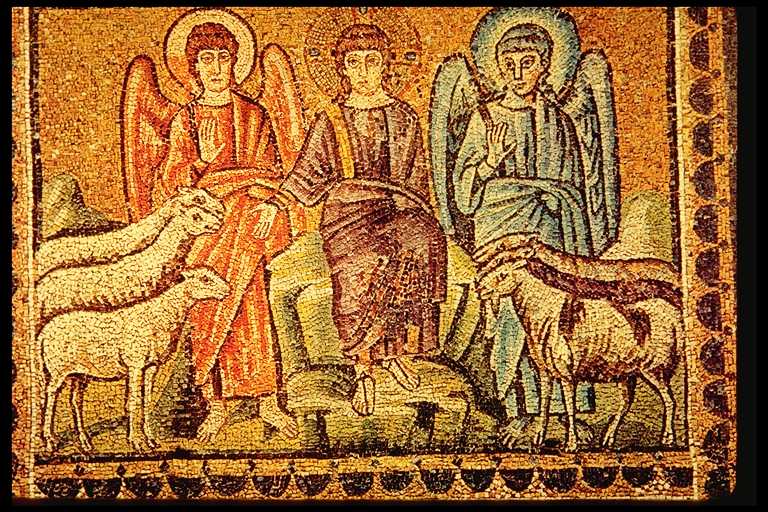
Christ separates the sheep from the goats
early 6th-century
the Church of Appolinare Nuovo
Ravenna
10
posted on
03/03/2019 5:01:16 AM PST
by
annalex
(fear them not)
To: Salvation
Thanks for posting today’s readings.
11
posted on
03/03/2019 5:09:35 AM PST
by
af_vet_1981
(The bus came by and I got on, That's when it all began)
To: Salvation
Thanks for posting every day.
5.56mm
12
posted on
03/03/2019 5:27:35 AM PST
by
M Kehoe
(DRAIN THE SWAMP! BUILD THE WALL!)
To: af_vet_1981; M Kehoe
13
posted on
03/03/2019 2:24:08 PM PST
by
Salvation
("With God all things are possible." Matthew 19:26)
To: All
14
posted on
03/03/2019 2:58:27 PM PST
by
Salvation
("With God all things are possible." Matthew 19:26)
To: All
15
posted on
03/03/2019 2:59:02 PM PST
by
Salvation
("With God all things are possible." Matthew 19:26)
To: Salvation
16
posted on
03/03/2019 3:19:18 PM PST
by
Salvation
("With God all things are possible." Matthew 19:26)
To: All
17
posted on
03/03/2019 4:19:57 PM PST
by
Salvation
("With God all things are possible." Matthew 19:26)
To: All
18
posted on
03/03/2019 4:20:41 PM PST
by
Salvation
("With God all things are possible." Matthew 19:26)
To: All
19
posted on
03/03/2019 4:21:08 PM PST
by
Salvation
("With God all things are possible." Matthew 19:26)
To: All
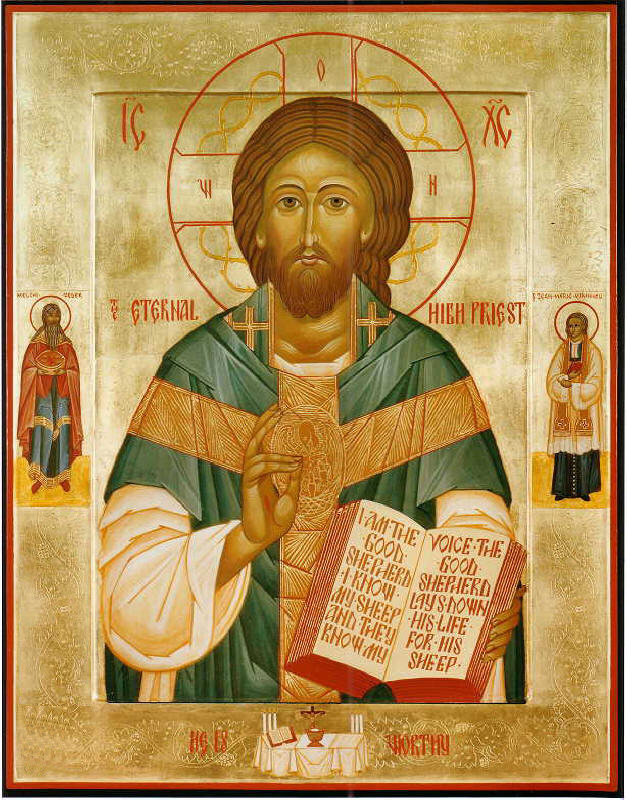
Jesus, High Priest
We thank you, God our Father, for those who have responded to your call to priestly ministry.
Accept this prayer we offer on their behalf: Fill your priests with the sure knowledge of your love.
Open their hearts to the power and consolation of the Holy Spirit.
Lead them to new depths of union with your Son.
Increase in them profound faith in the Sacraments they celebrate as they nourish, strengthen and heal us.
Lord Jesus Christ, grant that these, your priests, may inspire us to strive for holiness by the power of their example, as men of prayer who ponder your word and follow your will.
O Mary, Mother of Christ and our mother, guard with your maternal care these chosen ones, so dear to the Heart of your Son.
Intercede for our priests, that offering the Sacrifice of your Son, they may be conformed more each day to the image of your Son, our Lord and Savior, Jesus Christ. Amen.
Saint John Vianney, universal patron of priests, pray for us and our priests
This icon shows Jesus Christ, our eternal high priest.
The gold pelican over His heart represents self-sacrifice.
The border contains an altar and grapevines, representing the Mass, and icons of Melchizedek and St. Jean-Baptiste Vianney.
Melchizedek: king of righteousness (left icon) was priest and king of Jerusalem. He blessed Abraham and has been considered an ideal priest-king.
St. Jean-Baptiste Vianney is the patron saint of parish priests.
20
posted on
03/03/2019 4:21:57 PM PST
by
Salvation
("With God all things are possible." Matthew 19:26)
Navigation: use the links below to view more comments.
first 1-20, 21-40, 41-43 next last
Disclaimer:
Opinions posted on Free Republic are those of the individual
posters and do not necessarily represent the opinion of Free Republic or its
management. All materials posted herein are protected by copyright law and the
exemption for fair use of copyrighted works.
FreeRepublic.com is powered by software copyright 2000-2008 John Robinson