Posted on 05/08/2017 7:48:49 AM PDT by Salvation
Today, it is generally believed that the “Harlot City” referred to in the Book of Revelation is Rome. The opulence and the prominence of the city along with the mention of the seven hills on which it rests, its persecution of Christians, and the use of euphemisms such as “Babylon” are generally presented as evidence that Rome is the wicked city.
I propose that the city is actually Jerusalem, not Rome. A more direct indication than the oblique references above occurs in Revelation 11:8, which says that it is where also their Lord was crucified, a clear reference to Jerusalem.
Let’s look at Revelation chapter 11 in context.
Then I was given a measuring rod like a staff, and I was told: “Rise and measure the temple of God and the altar and those who worship there, but do not measure the court outside the temple; leave that out, for it is given over to the nations, and they will trample over the holy city for forty-two months.”
Revelation 11 opens with John being told to measure the “temple,” clearly referring to the Temple in Jerusalem (the “holy city”). The Jewish Temple had a court of the nations (Gentiles) and was the only temple rightly called the “temple of God.” The “forty-two months” is likely a reference to the duration of the Jewish War with the Romans, three and a half years.
The fact that John is instructed to measure the temple obviously presumes that there is still a temple to measure! Many scholars assume that the temple is only a symbol, not that it is really possible for John to measure the actual, physical temple. This may be so, but to me the context seems more straightforward and that the real temple is meant. If that is true, then this is evidence that Revelation was written before 70 A.D., as a growing number of scholars think tenable.
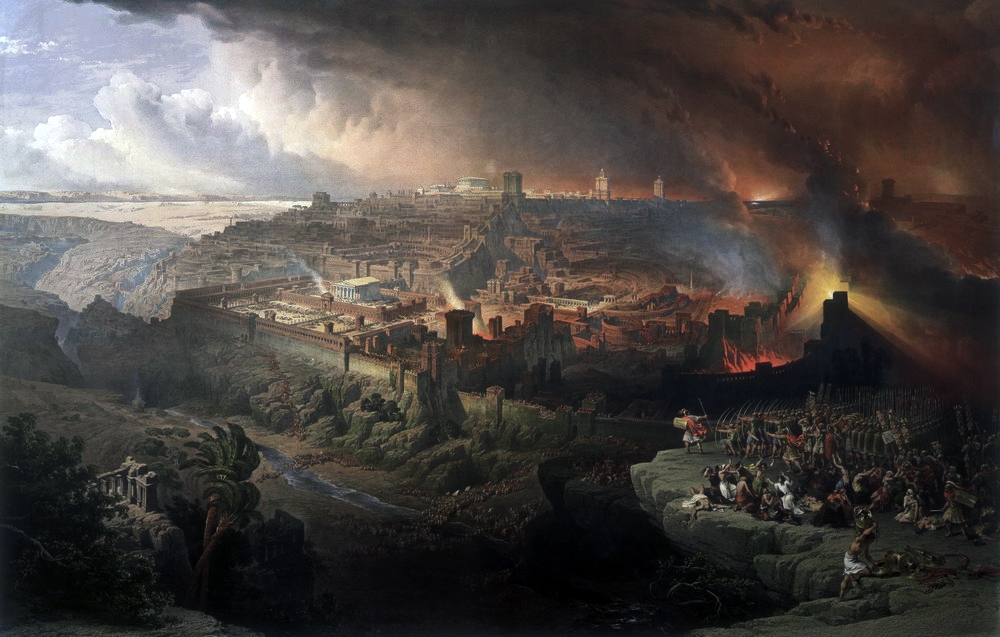
As for the court of the nations not being measured, and the Gentiles role in trampling the city, this refers to a prophesy by Jesus of Jerusalem, not Rome. Jesus prophesied that Jerusalem would fall by the edge of the sword, and be led captive among all nations; and Jerusalem will be trodden down by the Gentiles, until the times of the Gentiles are fulfilled (Lk 21:24). Rome did in fact lay siege to Jerusalem under the command of Titus. On August 29th in 70 A.D., the final wall was breached and Roman soldiers poured into the temple area where they fought hand to hand with Jewish soldiers there. In his work The Jewish War (VI 4,5), Josephus points out that the Temple was destroyed by fire on the exact anniversary (9th of Ab) of its destruction by the Babylonians.
But, back to Revelation 11, where prior to this destruction we are told of two witnesses that will warn the city and call the people to faith. The witnesses can be no other than Moses and Elijah, who are themselves symbolic of the Law and the Prophets.
And I will grant my two witnesses power to prophesy for one thousand two hundred and sixty days, clothed in sackcloth. These are the two olive trees and the two lampstands which stand before the Lord of the earth. And if anyone would harm them, fire pours out from their mouth and consumes their foes; if anyone would harm them, thus he is doomed to be killed. They have power to shut the sky, that no rain may fall during the days of their prophesying, and they have power over the waters to turn them into blood, and to smite the earth with every plague, as often as they desire.
That these are Moses and Elijah figures is evident in their powers. One has the power to smite the land with every plague and turn the waters to blood (Moses in the Exodus). The other has the power to call down fire from Heaven and to shut the sky to prevent the rain (Elijah).
Allegorically, these two witnesses represent the Law and the Prophets and illustrate how the very Scriptures venerated by the Jewish unbelievers testify against them. The Law and the Prophets point to Jesus Christ. Of what use would such a testimony be to a pagan city such as Rome? But Jerusalem would experience shame and stand accused. As the context builds, we are surely in Jerusalem, not Rome.
Then come the key verses:
And when they have finished their testimony, the beast that ascends from the bottomless pit will make war upon them and conquer them and kill them, and their dead bodies will lie in the street of the great city which is allegorically called Sodom and Egypt, where their Lord was crucified.
The Lord was not crucified in Rome but in Jerusalem. Thus the “great city” is unambiguously identified as Jerusalem.
Why does the text speak of Jerusalem as “Sodom and Egypt”? In fact, such terminology was common among the prophets. Here are some examples:
Finally, a Satanically inspired attack sees the two witnesses killed, and in what is a special ignominy in a Jewish context, the bodies are not buried:
For three days and a half, men from the peoples and tribes and tongues and nations gaze at their dead bodies and refuse to let them be placed in a tomb, and those who dwell on the earth will rejoice over them and make merry and exchange presents, because these two prophets had been a torment to those who dwell on the earth. But after the three and a half days a breath of life from God entered them, and they stood up on their feet, and great fear fell on those who saw them.
For the Jewish people, the burial of the dead was a fundamental work of mercy. It was unthinkable to allow even one’s enemy to remain unburied. In the book of Tobit, for example, Tobit actually risks his own life to ensure that a stranger is buried.
For all of these reasons, I argue that the “great city” of the Book of Revelation, a city doomed to destruction, is Jerusalem.
Some will argue that the seven hills the harlot is describe as riding (Rev 17:9) clearly refers to Rome. However, I contend that the use of “seven” may be as a symbol of fullness rather than as a definitive number. Mount Zion (Jerusalem) is the great mountain of the Lord, the true pole of the earth: God’s holy mountain rises in beauty, the joy of all the earth. Mount Zion, true pole of the earth, the Great King’s city! (Psalm 48:2-3)
Others may point out that the harlot is called “Babylon” later in Revelation: Fallen, fallen is Babylon the great! (see Rev 18:2) Babylon was a code word for Rome among early Christians (see 1 Peter 5:13). However, this may well be said in irony. Ancient Babylon was once cursed with these words: Babylon must fall because of Israel’s slain, just as the slain in all the earth have fallen because of Babylon (Jer 51:49). So now, ironically, Jerusalem must fall because of the slain Christians.
The name of the “great city” is hidden behind many references in Revelation. In the end, though, I believe that it is clearly and unambiguously identified as Jerusalem in Revelation 11:8. It is the great city, where also their Lord was crucified. No ancient pagan city (with the possible exception of Tyre) was ever referred to as “harlot.” This term was reserved as an ironic epitaph for Jerusalem or Israel, which bore this term with special ignominy because she was espoused to God (Ezekiel 16; Jer 2:20; Is 57:8).
Of all this, some may say, “Why does this matter? Who cares about the identity of the city?”
Indeed, to some this may seem to be “inside baseball” or a debate about non-essentials, but I contend that it is an important consideration for us who live in troubled times.
Jerusalem represents the family of faith and Rome, the “outside, pagan world.” One of the saddest truths for us to ponder is that our struggle is not only or even primarily with the unbelievers around us. Tragically, our struggle often takes place within the house faith. Our opposition is too often from among our very number, people who, having heard the truth of God, accept it only selectively.
Half-hearted faith is often a worse enemy than wholehearted rejection. Jerusalem saw some conversion to Christ, to be sure, but collectively she turned on and crucified the very Messiah whom God had sent to her. Why? Because she heard and accepted only what pleased her.
Selective faith may be worse than no faith at all. Indeed, the fierce Roman opposition could be tamed, but selective faith is more subtle, more internally self-justified. It wears the garments of faith, but betrays that the deeper conversion that is required has not yet occurred.
Jerusalem or Rome? What do you think? If you disagree with my conclusion, I would be grateful if you would explain why your view should override the textual reference to the city where Jesus was crucified, for indeed that is the heart of the argument I have set forth here.
This song says, not merely of ancient Jerusalem but also of us,
| Ne irascaris Domine satis, et ne ultra memineris iniquitatis nostrae. Ecce respice populus tuus omnes nos. |
Be not angry, O Lord, and remember our iniquity no more. Behold, we are all your people. |
| Civitas sancti tui facta est deserta. Sion deserta facta est, Jerusalem desolata est. |
Your holy city has become a wilderness. Zion has become a wilderness, Jerusalem has been made desolate. |
Monsignor Pope Ping!
Washington, D.C. I say that tongue-in-cheek. Maybe.
Of course, we also have Sodom-on-Hudson, Sodom-on-Michigan, and Sodom-by-the-Bay ...
For any city steeped in wickedness, the euphemism has become “Babylon” and the end result is well known.
What a shocker that the Monsignor would not agree with the interpretation that Rome is the Harlot. I would think it would be a matter of faith to Catholics to point anywhere but Rome since the Pope’s seat is there..
I’m not a Catholic, but after considering this issue for many years, I’ve come to the conclusion that all the evidence points to Jerusalem as well. Jerusalem is the focus of almost all of the “action” in all of the end times prophecies in the Old and New Testaments. It is where the “abomination of desolation” will be setting up shop, it is where the faithful are warned to flee from before the final destruction arrives, it is where the armies of the world gather before the final battle, and it is where the Lord himself will first set foot when he returns.
I believe this all points to Jerusalem becoming the capital of the antichrist’s government just before the end. Just as Jerusalem, while the denizens were faithful to God, was portrayed as a virgin bride, when the denizens are unfaithful, it is portrayed as the ultimate adulterous harlot.
You’re not really addressing his arguments though, just making an ad hominem. I’m a Protestant, but I agree with his reasoning, because it is biblically sound.
Nashville, for example. As Dwight Yoakum put it, "Another lesson about a naïve fool who came to Babylon, and found out that the pie don't taste so sweet."
Istanbul ("new Rome") is also on the list.
The Jewish Queen Julia Berenice was notoriously promiscuous and a Roman collaborator when Jerusalem was destroyed by Rome in AD 70. She carried on an affair with the Roman commander Titus, who later became emperor of Rome.
She may have been the “Whore of Babylon”.
https://en.wikipedia.org/wiki/Berenice_(daughter_of_Herod_Agrippa)
The point about the city "where their Lord was crucified" admits of no other identification other than Jerusalem, unless one were to say, metaphorically, that Jesus was crucified when his followers, some in Rome, were crucified. However, I think that's a pretty big reach.
Or perhaps the Church at Rome’s vile behavior and persecution of Christians and Jews has blinded others to the indication that the Harlot could be Jerusalem and the Rome could end up being irrelevant. In either case, pray that you view the scene from where John saw it and not from the ground.
Sad that Ithaca (The City of Evil) is not on that list.
The traditional Protestant polemic identifying the Papacy with the Harlot would basically require the Holy Spirit to be ignorant of the future and also ignorant of geography. Not likely!
IMO, the "beast" which first carries the Harlot and then "turns on" her and "burns her with fire" is Rome, the Imperial Rome of Caesar Nero. "Beast" is a common epithet in Scripture for a pagan Gentile power.
Read the entire article, please.
Hillary lives sixty miles from Babylin, New York.
BABYLON NEW YORK
Disclaimer: Opinions posted on Free Republic are those of the individual posters and do not necessarily represent the opinion of Free Republic or its management. All materials posted herein are protected by copyright law and the exemption for fair use of copyrighted works.