Skip to comments.
Catholic Caucus: Sunday Mass Readings, 04-02-17, Fifth Sunday of Lent
USCCB.org/RNAB ^
| 04-02-17
| Revised New American Bible
Posted on 04/01/2017 8:18:03 PM PDT by Salvation
April 2, 2017
Fifth Sunday of Lent
Thus says the Lord GOD:
O my people, I will open your graves
and have you rise from them,
and bring you back to the land of Israel.
Then you shall know that I am the LORD,
when I open your graves and have you rise from them,
O my people!
I will put my spirit in you that you may live,
and I will settle you upon your land;
thus you shall know that I am the LORD.
I have promised, and I will do it, says the LORD.
R. (7)
With the Lord there is mercy and fullness of redemption.Out of the depths I cry to you, O LORD;
LORD, hear my voice!
Let your ears be attentive
to my voice in supplication.
R.
With the Lord there is mercy and fullness of redemption.If you, O LORD, mark iniquities,
LORD, who can stand?
But with you is forgiveness,
that you may be revered.
R.
With the Lord there is mercy and fullness of redemption.I trust in the LORD;
my soul trusts in his word.
More than sentinels wait for the dawn,
let Israel wait for the LORD.
R.
With the Lord there is mercy and fullness of redemption.For with the LORD is kindness
and with him is plenteous redemption;
And he will redeem Israel
from all their iniquities.
R.
With the Lord there is mercy and fullness of redemption.
Brothers and sisters:
Those who are in the flesh cannot please God.
But you are not in the flesh;
on the contrary, you are in the spirit,
if only the Spirit of God dwells in you.
Whoever does not have the Spirit of Christ does not belong to him.
But if Christ is in you,
although the body is dead because of sin,
the spirit is alive because of righteousness.
If the Spirit of the one who raised Jesus from the dead dwells in you,
the one who raised Christ from the dead
will give life to your mortal bodies also,
through his Spirit dwelling in you.
I am the resurrection and the life, says the Lord;
whoever believes in me, even if he dies, will never die.
Now a man was ill, Lazarus from Bethany,
the village of Mary and her sister Martha.
Mary was the one who had anointed the Lord with perfumed oil
and dried his feet with her hair;
it was her brother Lazarus who was ill.
So the sisters sent word to him saying,
"Master, the one you love is ill."
when Jesus heard this he said,
"This illness is not to end in death,
but is for the glory of God,
that the Son of God may be glorified through it."
Now Jesus loved Martha and her sister and Lazarus.
So when he heard that he was ill,
he remained for two days in the place where he was.
Then after this he said to his disciples,
"Let us go back to Judea."
The disciples said to him,
"Rabbi, the Jews were just trying to stone you,
and you want to go back there?"
Jesus answered,
"Are there not twelve hours in a day?
If one walks during the day, he does not stumble,
because he sees the light of this world.
But if one walks at night, he stumbles,
because the light is not in him."
He said this, and then told them,
"Our friend Lazarus is asleep,
but I am going to awaken him."
So the disciples said to him,
"Master, if he is asleep, he will be saved."
But Jesus was talking about his death,
while they thought that he meant ordinary sleep.
So then Jesus said to them clearly,
"Lazarus has died.
And I am glad for you that I was not there,
that you may believe.
Let us go to him."
So Thomas, called Didymus, said to his fellow disciples,
"Let us also go to die with him."
When Jesus arrived, he found that Lazarus
had already been in the tomb for four days.
Now Bethany was near Jerusalem, only about two miles away.
And many of the Jews had come to Martha and Mary
to comfort them about their brother.
When Martha heard that Jesus was coming,
she went to meet him;
but Mary sat at home.
Martha said to Jesus,
"Lord, if you had been here,
my brother would not have died.
But even now I know that whatever you ask of God,
God will give you."
Jesus said to her,
"Your brother will rise."
Martha said to him,
"I know he will rise,
in the resurrection on the last day."
Jesus told her,
"I am the resurrection and the life;
whoever believes in me, even if he dies, will live,
and everyone who lives and believes in me will never die.
Do you believe this?"
She said to him, "Yes, Lord.
I have come to believe that you are the Christ, the Son of God,
the one who is coming into the world."
When she had said this,
she went and called her sister Mary secretly, saying,
"The teacher is here and is asking for you."
As soon as she heard this,
she rose quickly and went to him.
For Jesus had not yet come into the village,
but was still where Martha had met him.
So when the Jews who were with her in the house comforting her
saw Mary get up quickly and go out,
they followed her,
presuming that she was going to the tomb to weep there.
When Mary came to where Jesus was and saw him,
she fell at his feet and said to him,
"Lord, if you had been here,
my brother would not have died."
When Jesus saw her weeping and the Jews who had come with her weeping,
he became perturbed and deeply troubled, and said,
"Where have you laid him?"
They said to him, "Sir, come and see."
And Jesus wept.
So the Jews said, "See how he loved him."
But some of them said,
"Could not the one who opened the eyes of the blind man
have done something so that this man would not have died?"
So Jesus, perturbed again, came to the tomb.
It was a cave, and a stone lay across it.
Jesus said, "Take away the stone."
Martha, the dead man's sister, said to him,
"Lord, by now there will be a stench;
he has been dead for four days."
Jesus said to her,
"Did I not tell you that if you believe
you will see the glory of God?"
So they took away the stone.
And Jesus raised his eyes and said,
"Father, I thank you for hearing me.
I know that you always hear me;
but because of the crowd here I have said this,
that they may believe that you sent me."
And when he had said this,
He cried out in a loud voice,
"Lazarus, come out!"
The dead man came out,
tied hand and foot with burial bands,
and his face was wrapped in a cloth.
So Jesus said to them,
"Untie him and let him go."
Now many of the Jews who had come to Mary
and seen what he had done began to believe in him.
The sisters of Lazarus sent word to Jesus, saying,
"Master, the one you love is ill."
When Jesus heard this he said,
"This illness is not to end in death,
but is for the glory of God,
that the Son of God may be glorified through it."
Now Jesus loved Martha and her sister and Lazarus.
So when he heard that he was ill,
he remained for two days in the place where he was.
Then after this he said to his disciples,
"Let us go back to Judea."
When Jesus arrived, he found that Lazarus
had already been in the tomb for four days.
When Martha heard that Jesus was coming,
she went to meet him;
but Mary sat at home.
Martha said to Jesus,
"Lord, if you had been here,
my brother would not have died.
But even now I know that whatever you ask of God,
God will give you."
Jesus said to her,
"Your brother will rise."
Martha said,
"I know he will rise,
in the resurrection on the last day."
Jesus told her,
"I am the resurrection and the life;
whoever believes in me, even if he dies, will live,
and everyone who lives and believes in me will never die.
Do you believe this?"
She said to him, "Yes, Lord.
I have come to believe that you are the Christ, the Son of God,
the one who is coming into the world."
He became perturbed and deeply troubled, and said,
"Where have you laid him?"
They said to him, "Sir, come and see."
And Jesus wept.
So the Jews said, "See how he loved him."
But some of them said,
"Could not the one who opened the eyes of the blind man
have done something so that this man would not have died?"
So Jesus, perturbed again, came to the tomb.
It was a cave, and a stone lay across it.
Jesus said, "Take away the stone."
Martha, the dead man's sister, said to him,
"Lord, by now there will be a stench;
he has been dead for four days."
Jesus said to her,
"Did I not tell you that if you believe
you will see the glory of God?"
So they took away the stone.
And Jesus raised his eyes and said,
"Father, I thank you for hearing me.
I know that you always hear me;
but because of the crowd here I have said this,
that they may believe that you sent me."
And when he had said this,
He cried out in a loud voice,
"Lazarus, come out!"
The dead man came out,
tied hand and foot with burial bands,
and his face was wrapped in a cloth.
So Jesus said to them,
"Untie him and let him go."
Now many of the Jews who had come to Mary
and seen what he had done began to believe in him.
TOPICS: Catholic; General Discusssion; Prayer; Worship
KEYWORDS: catholic; jn11; lent; prayer
Navigation: use the links below to view more comments.
first 1-20, 21-40, 41-48 next last
For your reading, reflection, faith-sharing, comments, questions, discussion.
1
posted on
04/01/2017 8:18:03 PM PDT
by
Salvation
To: All
KEYWORDS: catholic; jn11; lent; prayer;
2
posted on
04/01/2017 8:20:38 PM PDT
by
Salvation
("With God all things are possible." Matthew 19:26)
To: nickcarraway; NYer; ELS; Pyro7480; livius; ArrogantBustard; Catholicguy; RobbyS; marshmallow; ...
Praise to you, Lord Jesus Christ PingPlease FReepmail me to get on/off the Lenten Ping List.
3
posted on
04/01/2017 8:22:02 PM PDT
by
Salvation
("With God all things are possible." Matthew 19:26)
To: Salvation
In the old rite was known as Passion Sunday all the statues were covered with purple cloth.
4
posted on
04/01/2017 8:38:57 PM PDT
by
mosesdapoet
(My best insights get lost in FR's because of meaningless venting no one reads.)
To: All
From: Ezekiel 37:12-14
The dry bones
[12] [”]Therefore prophesy, and say to them, Thus says the Lord God: Behold,
I will open their graves, and raise you from your graves, O my people; and I will
bring you home into the land of Israel. [13] And you shall know that I am the Lord,
when I open your graves, and raise you from your graves, O my people. [14] And
I will put my Spirit within you, and you shall live, and I will place you in your own
land; then you shall know that I, the Lord, have spoken, and I have done it, says
the Lord.”
*********************************************************************************************
Commentary:
This remarkable vision of the bones being brought back to life sets the scene for
the climax of the resurgence of Israel, the unification of the two kingdoms (cf. 37:
15-28). The dramatic contrast drawn here between death and life, bones and spi-
rit, shows that the revitalization that God will bring about goes much further than
material reconstruction or simply a return to the promised land; it implies, rather,
a new beginning, both personal and social.
The vision itself (vv. 2-10) takes place on an immense plain (cf. 3:22-23) and it
addresses the exiles’ profound concern about their future: “Our bones are dried
up, and our hope is lost” (v. 11). It is one of Ezekiel’s most famous and most
commented-on visions because it is very vivid and easy to understand. The pro-
phet himself explains it as having to do with the destruction-restoration of Israel
(vv. 11-14), though the Fathers of the Church see in it veiled references to the re-
surrection of the dead: “The Creator will revive our mortal bodies here on earth;
he promises resurrection, the opening of sepulchers and tombs, and the gift of
immortality […]. And in all this, we see that he alone is God, who can do all
things, the good Father who from his endless bounty will give life to the lifeless”
(St Irenaeus, “Adversus haereses”, 5, 15, 1). St Jerome writes in similar terms:
“The image of the resurrection would not have been used to describe the resto-
ration of the people of Israel if the future resurrection of the dead had not been
foreseen, because no one can be led to draw a conclusion from an idea that
has no basis is reality” (”Commentarii in Ezechielem”, 27, 1ff).
“I will put my Spirit within you” (v. 14). The spirit of the Lord is, at least, the po-
wer of God (cf. Gen 2:7) performing an act of creation. It is also the principle of
life causing man to “become a living being” (Gen 2:7); and, certainly, it is the
principle of supernatural life. The same God that created all things can revitalize
his demoralized people in Babylon and can allow humankind to partake of his
own life. This promise, like others found in the prophets (cf. 11:19; Jer 31:31-34;
Joel 3:1-5) will find its complete fulfillment at Pentecost, when the Spirit de-
scends on the apostles: “According to these promises, at the ‘end time’ the
Lord’s Spirit will renew the hearts of men, engraving a new law in them. He will
gather and reconcile the scattered and divided peoples; he will transform the
first creation, and God will dwell there with men in peace” (”Catechism of the
Catholic Church”, 715).
*********************************************************************************************
Source: “The Navarre Bible: Text and Commentaries”. Biblical text from the
Revised Standard Version and New Vulgate. Commentaries by members of
the Faculty of Theology, University of Navarre, Spain.
Published by Four Courts Press, Kill Lane, Blackrock, Co. Dublin, Ireland, and
by Scepter Publishers in the United States.
5
posted on
04/01/2017 8:45:47 PM PDT
by
Salvation
("With God all things are possible." Matthew 19:26)
To: All
From: Romans 8:8-11
Life in the Spirit
[8] And those who are in the flesh cannot please God.
[9] But you are not in the flesh, you are in the Spirit, if the Spirit of God really
dwells in you. Any one who does not have the Spirit of Christ does not belong
to him. [10] But if Christ is in you, although your bodies are dead because of
sin, your spirits are alive because of righteousness. [11] “If the Spirit of him who
raised Jesus from the dead dwells in you, he who raised Christ Jesus from the
dead will give life to your mortal bodies also through his Spirit who dwells in you.”
[12] So then, brethren, we are debtors, not to the flesh, to live according to the
flesh—[13] for if you live according to the flesh you will die, but if by the Spirit you
put to death the deeds of the body you will live.
Christians Are Children of God
[14] For all who are led by the Spirit of God are sons of God. [15] For you did not
receive the spirit of slavery to fall back into fear, but you have received the spirit
of sonship. When we cry, “Abba! Father!” [16] it is the Spirit himself bearing wit-
ness with our spirit that we are children of God, [17] and if children, then heirs,
heirs of God and fellow heirs with Christ, provided we suffer with him in order that
we may also be glorified with him.
*********************************************************************************************
Commentary:
1-13. After original sin man is pulled in two different directions: either he seeks
God above all things and contends, with God’s grace, against the inclinations
of his own concupiscence; or else he lets himself be overwhelmed by the disor-
dered passions of the flesh. The former lifestyle is “life in the Spirit”, the latter,
life “according to the flesh”. “There are only two possible ways of living on this
earth: either we live a supernatural life, or we live an animal life” (St. J. Escriva,
“Friends of God”, 200).
Sanctifying grace is the source of life “according to the Spirit”. It is not a matter
of simply being in the state of grace or of performing a number of regular pious
practices. Life according to the Spirit—spiritual or supernatural life—means a
living-according-to-God which influences everything a Christian does: he is cons-
tantly trying to bring his thoughts, yearnings, desires and actions into line with
what God is asking of him; in everything he does he tries to follow the inspira-
tions of the Holy Spirit.
Life according to the flesh, on the other hand, has its source in the triple concu-
piscence which is a consequence of original sin—”all that is in the world, the lust
of the flesh, and the lust of the eyes and the pride of life” (1 Jn 2:16). In this pre-
sent life it is not possible to kill concupiscence at its root: it is forever producing
new growths. The Christian is freed from original sin through Baptism (chap. 6);
the coming of Christ has set aside the ritualistic precepts of the Mosaic Law
(chap. 7); but his life in Jesus Christ is threatened by concupiscence even after
Baptism, which places him under the Law of the Spirit. “We need to submit to
the spirit, to wholeheartedly commit ourselves and strive to keep the flesh in its
place. By so doing our flesh will become spiritual again. Otherwise, if we give in
to the easy life, this will lower our soul to the level of the flesh and make it car-
nal again” (St John Chrysostom, “Hom. on Rom”, 13).
10-11. Once he is justified the Christian lives in the grace of God and confidently
hopes in his future resurrection; Christ Himself lives in him (cf. Galatians 2:20;
1 Corinthians 15:20-23). However, he is not spared the experience of death, a
consequence of Original Sin (cf. Romans 5:12; 6:23). Along with suffering, con-
cupiscence and other limitations, death is still a factor after Baptism; it is some-
thing which motivates us to struggle and makes us to be like Christ. Almost all
commentators interpret the expression “your bodies are dead because of sin” as
referring to the fact that, due to sin, the human body is destined to die. So sure
is this prospect of death that the Apostle sees the body as “already dead”.
St. John Chrysostom makes an acute observation: if Christ is living in the Chris-
tian, then the divine Spirit, the Third Person of the Trinity, is also present in him.
If this divine Spirit is absent, then indeed death reigns supreme, and with it the
wrath of God, rejection of His laws, separation from Christ, and expulsion of our
Guest. And he adds: “But when one has the Spirit within, what can be lacking?
With the Spirit one belongs to Christ, one possesses Him, one vies for honor
with the angels. With the Spirit, the flesh is crucified, one tastes the delight of
an immortal life, one has a pledge of future resurrection and advances rapidly on
the path of virtue. This is what Paul calls putting the flesh to death” (”Hom. on
Rom.”, 13).
*********************************************************************************************
Source: “The Navarre Bible: Text and Commentaries”. Biblical text from the
Revised Standard Version and New Vulgate. Commentaries by members of
the Faculty of Theology, University of Navarre, Spain.
Published by Four Courts Press, Kill Lane, Blackrock, Co. Dublin, Ireland, and
by Scepter Publishers in the United States.
6
posted on
04/01/2017 8:46:59 PM PDT
by
Salvation
("With God all things are possible." Matthew 19:26)
To: All
From: John 11:1-45
The Raising of Lazarus
[1] Now a certain man was ill, Lazarus of Bethany, the village of Mary and her
sister Martha. [2] It was Mary who anointed the Lord with ointment and wiped
his feet with her hair, whose brother Lazarus was ill. [3] So the sisters sent to
him, saying, “Lord, he whom you love is ill.” [4] But when Jesus heard it he
said, “This illness is not unto death; it is for the glory of God, so that the Son
of God may be glorified means of it.”
[5] Now Jesus loved Martha and her sister and Lazarus. [6] So when he heard
that he was ill, he stayed two days longer in the place where he was. [7] Then
after this he said to the disciples, “Let us go into Judea again.” [8] The disciples
said to him, “Rabbi, the Jews were but now seeking to stone you, and are you
going there again?” [9] Jesus answered, “Are there not twelve hours in the day?
If any one walks in the day, he does not stumble, because he sees the light of
this world. [10] But if any one walks in the night, he stumbles, because the light
is not in him.” “Thus he spoke, and the he said to them, “Our friend Lazarus has
fallen asleep, but I go to awake him out of sleep.” [12] The disciples said to him
“Lord, if he has fallen asleep, he will recover.” [13] Now Jesus had spoken of his
death, but they thought that he meant taking rest in sleep. [14] Then Jesus told
them plainly, “Lazarus is dead; [15] and for your sake I am glad that I was not
there, so that you may believe. But let us go to him.” [16] Thomas, called the
Twin, said to his fellow disciples, “Let us also go, that we may die with him.
[17] Now when Jesus came, he found that Lazarus had already been in the tomb
four days. [18] Bethany was near Jerusalem, about two miles off, [19] and many
of the Jews had come to Martha and Mary to console them concerning their bro-
ther. [20] When Martha heard that Jesus was coming, she went and met him,
while Mary sat in the house. [21] Martha said to Jesus, “Lord, if you had been
here, my brother would not have died. [22] And even now I know that whatever
you ask from God, God will give you.” [23] Jesus said to her, “Your brother will
rise again.” [24] Martha said to him, “I know that he will rise again in the resur-
rection at the last day.” [25] Jesus said to her, “I am the resurrection and the
life, he who believes in me, though he die, yet shall he live, [26] and whoever
lives and believes in me shall never die. Do you believe this?” [27] She said to
him, “Yes, Lord; I believe that you are the Christ, the son of God, he who is co-
ming into the world.”
[28] When she had said this, she went and called her sister Mary, saying quietly,
“The Teacher is here and is calling for you.” [29] And when she heard it, she rose
quickly and went to him. [30] Now Jesus had not yet come to the village, but was
still in the place where Martha had met him. [31] When the Jews who were with
her in the house, consoling her, saw Mary rise quickly and go out, they followed
her, supposing that she was going to the tomb to weep there. [32] Then Mary,
when she came where Jesus was and saw him, fell at his feet, saying to him,
“Lord, if you had been here, my brother would not have died.” [33] When Jesus
saw her weeping, and the Jews who came with her also weeping, he was deeply
moved in spirit and troubled; [34] and he said, “Where have you laid him?” They
said to him, “Lord, come and see.” [35] Jesus wept. [36] So the Jews said, “See
how he loved him!” [37] But some of them said, “Could not he who opened the
eyes of the blind man have kept this man from dying?”
[38] Then Jesus, deeply moved again, came to the tomb; it was a cave, and a
stone lay upon it. [39] Jesus said, “Take away the stone.” Martha, the sister of
the dead man, said to him, “Lord, by this time there will be an odor, for he has
been dead four days.” [40] Jesus said to her, “Did I not tell you that if you would
believe you would see the glory of God?” [41] So they took away the stone. And
Jesus lifted his eyes and said, “Father, I thank thee that thou hast heard me.
[42] I knew thou hearest me always, but I have said this on account of the people
standing by, that they may believe that thou didst send me.” [43] When he had
said this, he cried with a loud voice, “Lazarus, come out.” [44] The dead man
came out, his hands and feet bound with bandages, and his face wrapped with
a cloth. Jesus said to them, “Unbind him, and let him go.”
The Sanhedrin Decides on the Death of Jesus
[45] Many of Jews therefore, who had come with Mary and had seen what he did,
believed in him.
*********************************************************************************************
Commentary:
1-45. This chapter deals with one of Jesus’ most outstanding miracles. The
Fourth Gospel, by including it, demonstrates Jesus’ power over death, which the
Synoptic Gospels showed by reporting the raising of the daughter of Jairus (Mt
9:25 and par.) and of the son of the widow of Nain (Lk 7:12).
The evangelist first sets the scene (vv. 1-16); then he gives Jesus conversation
with Lazarus’ sisters (vv. 17-37); finally, he reports the raising of Lazarus four
days after his death (vv. 38-45). Bethany was only about three kilometers (two
miles) from Jerusalem (v. 18). On the days prior to his passion, Jesus often visi-
ted this family, to which he was very attached. St John records Jesus’ affection
(vv. 3,5,36) by describing his emotion and sorrow at the death of his friend.
By raising Lazarus our Lord shows his divine power over death and thereby gives
proof of his divinity, in order to confirm his disciples’ faith and reveal himself as
the Resurrection and the Life. Most Jews, but not the Sadducees, believed in the
resurrection of the body. Martha believed in it (cf. v. 24).
Apart from being a real, historical event, Lazarus’ return to life is a sign of our fu-
ture resurrection: we too will return to life. Christ, by his glorious resurrection
through which he is the “first-born from the dead” (1 Cor 15:2; Col 1:18; Rev 1:5),
is also the cause and model of our resurrection. In this his resurrection is diffe-
rent from that of Lazarus, for “Christ being raised from the dead will never die
again” (Rom 6:9), whereas Lazarus returned to earthly life, later to die again.
2. There are a number of women in the Gospels who are called Mary. The Mary
here is Mary of Bethany, the sister of Lazarus (v.2), the woman who later anoin-
ted our Lord, again in Bethany, at the house of Simon the leper (cf. Jn 12:1-8; Mk
14:3): the indefinite or aorist “(she) anointed” expresses an action which occurred
prior to the time of writing, but the anointing took place after the resurrection of
Lazarus.
Were Mary of Bethany, Mary Magdalene and the “sinful” woman who anointed
Jesus’ feet in Galilee (cf. Lk 7:37) one, two or three women? Although some-
times it is argued they are one and the same, it seems more likely that they
were all different people. Firstly, we must distinguish the Galilee anointing (Lk
7:38) by the “sinner” from the Bethany anointing done by Lazarus’ sister (Jn
12:1): because of the time they took place and particular details reported, they
are clearly distinct (cf. note on Jn 12:1). Besides, the Gospels give us no posi-
tive indication that Mary of Bethany was the same person as the “sinner” of
Galilee. Nor are there strong grounds for identifying Mary Magdalene and the
“sinner”, whose name is not given; Mary Magdalene appears among the women
who follow Jesus in Galilee as the woman out of whom seven demons were cast
(cf. Lk 8:2), and Luke presents her in his account as someone new: no informa-
tion is given which could link her with either of the two other women.
Nor can Mary of Bethany and Mary Magdalene be identified, for John differentiates
between the two: he never calls Lazarus’ sister Mary Magdalene, nor does he in
any way link the latter (who stays beside the Cross—Jn 19:25—and who goes to
the tomb and sees the risen Lord) with Mary of Bethany.
The reason why Mary of Bethany has sometimes been confused with Mary Mag-
dalene is due (1) to identification of the latter with the “sinner” of Galilee through
connecting Magdalene’s possession by the devil with the sinfulness of the woman
who did the anointing in Galilee; and (2) to confusing the two anointings, which
would make Lazarus’ sister the “sinner” who does the first anointing. This was
how the three women were made out to be one, but there are no grounds for that
interpretation. The best-grounded and most common interpretation offered by
exegetes is that they are three distinct women.
4. The glory which Christ speaks of here, St Augustine says, “was no gain to
Jesus; it was only for our good. Therefore, Jesus says that this illness is not un-
to death, because the particular death was not for death but rather for a miracle,
which being wrought men should believe in Christ and thereby avoid the true
death” (”In Ioann. Evang.”, 49, 6).
8-10. Stoning was the form of capital punishment applying to blasphemy (cf. Lev
24:16). We have seen that people tried to stone Jesus at least twice: first, when
he proclaimed that he was the Son of God and that he existed from eternity (by
saying that he “was” before Abraham lived)—Jn 8:58-59; second, when he
revealed that he and the Father were one (cf. Jn 10:30-31).
These attempts by the Jewish authorities failed because Jesus’ ‘hour’ had not
yet arrived—that is, the time laid down by his Father for his death and resurrection.
When the Crucifixion comes, it will be the hour of his enemies and of “the power
of darkness” (Lk 22:53). But until that moment it is daytime, and our Lord can
walk without his life being in danger.
16. Thomas’ words remind us of the Apostles saying at the last Supper that they
would be ready to die for their Master (cf. Mt 26:31-35). We have seen how the
Apostles stayed loyal when many disciples left our Lord after his discourse on
the Bread of Life (Jn 6:67-71), and how they remained faithful to him despite their
personal weaknesses. But when, after Judas Iscariot’ s betrayal, Jesus lets him-
self be arrested without offering resistance—in fact, forbidding the use of weapons
(cf. Jn 18:11)—they become disconcerted and run away. Only St John will stay
faithful in Jesus’ hour of greatest need.
18. Fifteen stadia, in Greek measurement: three kilometers (two miles).
21-22. According to St Augustine, Martha’s request is a good example of confi-
dent prayer, a prayer of abandonment into the hands of God, who knows better
than we what we need. Therefore, “she did not say, But now I ask you to raise
my brother to life again. [...] All she said was, I know that you can do it; if you
will, do it; it is for you to judge whether to do it, not for me to presume” (”In Ioann.
Evang.”, 49, 13). The same can be said of Mary’s words, which St John repeats
at v. 32.
24-26. Here we have one of those concise definitions Christ gives himself, and
which St John faithfully passes on to us (cf. Jn 10:9; 14:6; 15:1): Jesus is the
Resurrection and the Life. He is the Resurrection because by his victory over
death he is the cause of the resurrection of all men. The miracle he works in
raising Lazarus is a sign of Christ’s power to give life to people. And so, by faith
in Jesus Christ, who arose first from among the dead, the Christian is sure that
he too will rise one day, like Christ (cf. 1 Cor 15:23; Col 1:18). Therefore, for the
believer death is not the end; it is simply the step to eternal life, a change of
dwelling-place, as one of the Roman Missal’s Prefaces of Christian Death puts
it: “Lord, for your faithful people life is changed, not ended. When the body of our
earthly dwelling lies in death, we gain an everlasting dwelling place in heaven”.
By saying that he is Life, Jesus is referring not only to that life which begins
beyond the gave, but also to the supernatural life which grace brings to the soul
of man when he is still a wayfarer on this earth.
“This life, which the Father has promised and offered to each man in Jesus Christ,
his eternal and only Son, who ‘when the time had fully come’ (Gal 4:4), became
incarnate and was born of the Virgin Mary, is the final fulfillment of man’s vocation.
It is in a way the fulfillment of the ‘destiny’ that God has prepared for him from
eternity. This ‘divine destiny’ is advancing, in spite all the enigmas, the unsolved
riddles, the twists and turns of ‘human destiny’ in the world of time. Indeed, while
all this, in spite of all the riches of life in time, necessarily and inevitably leads to
the frontiers of death and the goal of the destruction of the human body, beyond
that goal we see Christ. ‘I am the resurrection and the life, he who believes in me
...shall never die.’ In Jesus Christ, who was crucified and laid in the tomb and
then rose again, ‘our hope of resurrection dawned...the bright promise of immor-
tality’ (”Roman Missal”, Preface of Christian Death, I), on the way to which man,
through the death of the body, shares with the whole of visible creation the neces-
sity to which matter is subject” (John Paul II, “Redemptor Hominis”, 18).
33-36. This passage gives us an opportunity to reflect on the depth and tender-
ness of Jesus’ feelings. If the physical death of his friend can move him to tears,
what will he not feel over the spiritual death of a sinner who has brought about his
eternal condemnation? “Christ wept: let man also weep for himself. For why did
Christ weep, but to teach men to weep” (St Augustine, “In Ioann. Evang.”, 49,
19). We also should weep—but for our sins, to help us return to the life of grace
through conversion and repentance. We should appreciate our Lord’s tears: he is
praying for us, who are sinners: “Jesus is your friend. The Friend. With a human
heart, like yours. With loving eyes that wept for Lazarus.
“And he loves you as much as he loved Lazarus” (St. J. Escriva, “The Way”,
422).
41-42. Through his sacred humanity Jesus is expressing himself as the natural
Son of God, that is, he is the metaphysical Son of God, not adopted like the
rest of men. This is the source of Jesus’ feelings, which helps us understand
that when he says “Father” he is speaking with a unique and indescribable in-
tensity. When the Gospels let us see Jesus praying, they always show him
beginning with the invocation “Father” (cf. the note on Lk 11:1-2), which reflects
his singular trust and love (cf. Mt 11:25 and par.). These sentiments should also
in some way find a place in our prayer, for through Baptism we are joined to
Christ and in him we became children of God (cf. Jn 1:12; Rom 6:1-11, 8:14-17),
and so we should always pray in a spirit of sonship and gratitude for the many
good things our Father God has given us.
The miracle of the raising of Lazarus, which really is an extraordinary miracle, is
a proof that Jesus is the Son of God, sent into the world by his Father. And so it
is, that when Lazarus is brought back to life, people’s faith in Jesus is increased
—the disciples’ (v. 15), Martha’s and Mary’s (vv. 26, 40) and that of the people at
large (36, 45).
43. Jesus calls Lazarus by name. Although he is really dead, he has not thereby
lost his personal identity: dead people continue to exist, but they have a different
mode of existence, because they have changed from mortal life to eternal life.
This is why Jesus states that God “is not God of the dead, but of the living”, for
to him all are alive (cf. Mt 22:32; Lk 20:38).
This passage can be applied to the spiritual resurrection of the soul who has
sinned and recovers grace. God wants us to be saved (cf. 1 Tim 2:4); therefore
we should never lose heart; we should always desire and hope to reach this goal:
“Never despair. Lazarus was dead and decaying: ‘Iam foetet, quatriduanus enim
est. By now he will smell; this is the fourth day,’ says Martha to Jesus. “If you
hear God’s inspiration and follow it—’Lazare, veni foras!: Lazarus come out!’ —
you will return to Life” (St. J. Escriva, “The Way”, 719).
44. The Jews prepared the body for burial by washing it and anointing it with
aromatic ointments to delay decomposition and counteract offensive odors; they
then wrapped the body in linen cloths and bandages, covering the head with a
napkin—a method very like the Egyptians’, but not entirely extending to full em-
balming, which involved removing certain internal organs.
Lazarus’ tomb would have consisted of a subterranean chamber linked to the
surface by steps, with the entrance blocked by a slab. Lazarus was moved out
to the entrance by a supernatural force. As happened in the case of the raising
of Jairus’ daughter (Mk 5:42-43), due to their astonishment no one moved until
our Lord’s words broke the atmosphere of silence and terror which had been
created.
St Augustine sees in the raising of Lazarus a symbol of the sacrament of
Penance: in the same way as Lazarus comes out of the tomb, “when you con-
fess, you come forth. For what does ‘come forth’ mean if not emerging from what
is hidden, to be made manifest. But for you to confess is God’s doing; he calls
you with an urgent voice, by an extraordinary grace. And just as the dead man
came out still bound, so you go to confession still guilty. In order that his sins
be loosed, the Lord said this to his ministers: ‘Unbind him and let him go’. What
you will loose on earth will be loosed also in heaven” (St Augustine, “In Ioann.
Evang.”, 49, 24). Christian art has used this comparison from very early on; in
the catacombs we find some one hundred and fifty representations of the raising
of Lazarus, symbolizing thereby the gift of the life of grace which comes through
the priest, who in effect repeats these words to the sinner: “Lazarus, come out.”
45-48. Once again, as Simeon had predicted, Jesus is a sign of contradiction
(cf. Lk 2:34; Jn’ 7:12, 31, 40; 9:16; etc.): presented with the miracle of the raising
of Lazarus some people believe in Jesus (v. 45), and some denounce him to his
enemies (cf. vv. 46-47)—confirming what is said in the parable of the rich man:
“neither will they be convinced if someone should rise from the dead” (Lk 16:31).
*********************************************************************************************
Source: “The Navarre Bible: Text and Commentaries”. Biblical text from the
Revised Standard Version and New Vulgate. Commentaries by members of
the Faculty of Theology, University of Navarre, Spain.
Published by Four Courts Press, Kill Lane, Blackrock, Co. Dublin, Ireland, and
by Scepter Publishers in the United States.
7
posted on
04/01/2017 8:48:39 PM PDT
by
Salvation
("With God all things are possible." Matthew 19:26)
To: All
Scripture readings from the Jerusalem Bible by Darton, Longman & Todd
Readings at Mass
Liturgical Colour: Violet.
| First reading |
| Ezekiel 37:12-14 © |
The Lord says this: I am now going to open your graves; I mean to raise you from your graves, my people, and lead you back to the soil of Israel. And you will know that I am the Lord, when I open your graves and raise you from your graves, my people. And I shall put my spirit in you, and you will live, and I shall resettle you on your own soil; and you will know that I, the Lord, have said and done this – it is the Lord who speaks.
| Responsorial Psalm |
Psalm 129(130) © |
With the Lord there is mercy and fullness of redemption.
Out of the depths I cry to you, O Lord,
Lord, hear my voice!
O let your ears be attentive
to the voice of my pleading.
With the Lord there is mercy and fullness of redemption.
If you, O Lord, should mark our guilt,
Lord, who would survive?
But with you is found forgiveness:
for this we revere you.
With the Lord there is mercy and fullness of redemption.
My soul is waiting for the Lord.
I count on his word.
My soul is longing for the Lord
more than watchman for daybreak.
(Let the watchman count on daybreak
and Israel on the Lord.)
With the Lord there is mercy and fullness of redemption.
Because with the Lord there is mercy
and fullness of redemption,
Israel indeed he will redeem
from all its iniquity.
With the Lord there is mercy and fullness of redemption.
| Second reading |
Romans 8:8-11 © |
People who are interested only in unspiritual things can never be pleasing to God. Your interests, however, are not in the unspiritual, but in the spiritual, since the Spirit of God has made his home in you. In fact, unless you possessed the Spirit of Christ you would not belong to him. Though your body may be dead it is because of sin, but if Christ is in you then your spirit is life itself because you have been justified; and if the Spirit of him who raised Jesus from the dead is living in you, then he who raised Jesus from the dead will give life to your own mortal bodies through his Spirit living in you.
| Gospel Acclamation |
Jn11:25, 26 |
Glory and praise to you, O Christ!
I am the resurrection and the life, says the Lord;
whoever believes in me will never die.
Glory and praise to you, O Christ!
EITHER:
| I am the resurrection and the life |
There was a man named Lazarus who lived in the village of Bethany with the two sisters, Mary and Martha, and he was ill. It was the same Mary, the sister of the sick man Lazarus, who anointed the Lord with ointment and wiped his feet with her hair. The sisters sent this message to Jesus, ‘Lord, the man you love is ill.’ On receiving the message, Jesus said, ‘This sickness will end not in death but in God’s glory, and through it the Son of God will be glorified.’
Jesus loved Martha and her sister and Lazarus, yet when he heard that Lazarus was ill he stayed where he was for two more days before saying to the disciples, ‘Let us go to Judaea.’ The disciples said, ‘Rabbi, it is not long since the Jews wanted to stone you; are you going back again?’ Jesus replied:
‘Are there not twelve hours in the day?
A man can walk in the daytime without stumbling
because he has the light of this world to see by;
but if he walks at night he stumbles,
because there is no light to guide him.’
He said that and then added, ‘Our friend Lazarus is resting, I am going to wake him.’ The disciples said to him, ‘Lord, if he is able to rest he is sure to get better.’ The phrase Jesus used referred to the death of Lazarus, but they thought that by ‘rest’ he meant ‘sleep’, so Jesus put it plainly, ‘Lazarus is dead; and for your sake I am glad I was not there because now you will believe. But let us go to him.’ Then Thomas – known as the Twin – said to the other disciples, ‘Let us go too, and die with him.’
On arriving, Jesus found that Lazarus had been in the tomb for four days already. Bethany is only about two miles from Jerusalem, and many Jews had come to Martha and Mary to sympathise with them over their brother. When Martha heard that Jesus had come she went to meet him. Mary remained sitting in the house. Martha said to Jesus, ‘If you had been here, my brother would not have died, but I know that, even now, whatever you ask of God, he will grant you.’ ‘Your brother’ said Jesus to her ‘will rise again.’ Martha said, ‘I know he will rise again at the resurrection on the last day.’ Jesus said:
‘I am the resurrection and the life.
If anyone believes in me, even though he dies he will live,
and whoever lives and believes in me will never die.
Do you believe this?’
‘Yes, Lord,’ she said ‘I believe that you are the Christ, the Son of God, the one who was to come into this world.’
When she had said this, she went and called her sister Mary, saying in a low voice, ‘The Master is here and wants to see you.’ Hearing this, Mary got up quickly and went to him. Jesus had not yet come into the village; he was still at the place where Martha had met him. When the Jews who were in the house sympathising with Mary saw her get up so quickly and go out, they followed her, thinking that she was going to the tomb to weep there.
Mary went to Jesus, and as soon as she saw him she threw herself at his feet, saying, ‘Lord, if you had been here, my brother would not have died.’ At the sight of her tears, and those of the Jews who followed her, Jesus said in great distress, with a sigh that came straight from the heart, ‘Where have you put him?’ They said, ‘Lord, come and see.’ Jesus wept; and the Jews said, ‘See how much he loved him!’ But there were some who remarked, ‘He opened the eyes of the blind man, could he not have prevented this man’s death?’ Still sighing, Jesus reached the tomb: it was a cave with a stone to close the opening. Jesus said, ‘Take the stone away.’ Martha said to him, ‘Lord, by now he will smell; this is the fourth day.’ Jesus replied, ‘Have I not told you that if you believe you will see the glory of God?’ So they took away the stone. Then Jesus lifted up his eyes and said:
‘Father, I thank you for hearing my prayer.
I knew indeed that you always hear me,
but I speak for the sake of all these who stand round me,
so that they may believe it was you who sent me.’
When he had said this, he cried in a loud voice, ‘Lazarus, here! Come out!’ The dead man came out, his feet and hands bound with bands of stuff and a cloth round his face. Jesus said to them, ‘Unbind him, let him go free.’
Many of the Jews who had come to visit Mary and had seen what he did believed in him.
OR:
| Alternative Gospel |
| John 11:3-7,17,20-27,33-45 © |
| I am the resurrection and the life |
Mary and Martha sent this message to Jesus, ‘Lord, the man you love is ill.’ On receiving the message, Jesus said, ‘This sickness will end not in death but in God’s glory, and through it the Son of God will be glorified.’
Jesus loved Martha and her sister and Lazarus, yet when he heard that Lazarus was ill he stayed where he was for two more days before saying to the disciples, ‘Let us go to Judaea.’
On arriving, Jesus found that Lazarus had been in the tomb for four days already. When Martha heard that Jesus had come she went to meet him. Mary remained sitting in the house. Martha said to Jesus, ‘If you had been here, my brother would not have died, but I know that, even now, whatever you ask of God, he will grant you.’ ‘Your brother’ said Jesus to her ‘will rise again.’ Martha said, ‘I know he will rise again at the resurrection on the last day.’ Jesus said:
‘I am the resurrection and the life.
If anyone believes in me, even though he dies he will live,
and whoever lives and believes in me will never die.
Do you believe this?’
‘Yes, Lord,’ she said ‘I believe that you are the Christ, the Son of God, the one who was to come into this world.’
Jesus said in great distress, with a sigh that came straight from the heart, ‘Where have you put him?’ They said, ‘Lord, come and see.’ Jesus wept; and the Jews said, ‘See how much he loved him!’ But there were some who remarked, ‘He opened the eyes of the blind man, could he not have prevented this man’s death?’ Still sighing, Jesus reached the tomb: it was a cave with a stone to close the opening. Jesus said, ‘Take the stone away.’ Martha said to him, ‘Lord, by now he will smell; this is the fourth day.’ Jesus replied, ‘Have I not told you that if you believe you will see the glory of God?’ So they took away the stone. Then Jesus lifted up his eyes and said:
‘Father, I thank you for hearing my prayer.
I knew indeed that you always hear me,
but I speak for the sake of all these who stand round me,
so that they may believe it was you who sent me.’
When he had said this, he cried in a loud voice, ‘Lazarus, here! Come out!’ The dead man came out, his feet and hands bound with bands of stuff and a cloth round his face. Jesus said to them, ‘Unbind him, let him go free.’
Many of the Jews who had come to visit Mary and had seen what he did believed in him.
8
posted on
04/01/2017 9:02:00 PM PDT
by
Salvation
("With God all things are possible." Matthew 19:26)
To: All
9
posted on
04/01/2017 9:03:08 PM PDT
by
Salvation
("With God all things are possible." Matthew 19:26)
To: All
10
posted on
04/01/2017 9:16:24 PM PDT
by
Salvation
("With God all things are possible." Matthew 19:26)
To: All
11
posted on
04/01/2017 9:17:13 PM PDT
by
Salvation
("With God all things are possible." Matthew 19:26)
To: All
12
posted on
04/01/2017 9:17:44 PM PDT
by
Salvation
("With God all things are possible." Matthew 19:26)
To: All
13
posted on
04/01/2017 9:18:32 PM PDT
by
Salvation
("With God all things are possible." Matthew 19:26)
To: All
14
posted on
04/01/2017 9:19:00 PM PDT
by
Salvation
("With God all things are possible." Matthew 19:26)
To: All
Pray a Rosary each day for our nation.
1. Sign of the Cross: In the name of the Father, and of the Son, and of the Holy Spirit. Amen.
2. The Apostles Creed: I BELIEVE in God, the Father almighty, Creator of heaven and earth, and in Jesus Christ, His only Son, our Lord, who was conceived by the Holy Spirit, born of the Virgin Mary, suffered under Pontius Pilate, was crucified, died, and was buried. He descended into hell; on the third day he rose again from the dead; he ascended into heaven, and is seated at the right hand of God, the Father Almighty; from there He shall come to judge the living and the dead.
I believe in the Holy Spirit, the holy catholic Church, the communion of saints, the forgiveness of sins, the resurrection of the body, and the life everlasting. Amen.
3. The Lord's Prayer: OUR Father, who art in heaven, hallowed be Thy name. Thy kingdom come. Thy will be done on earth as it is in heaven. Give us this day our daily bread and forgive us our trespasses as we forgive those who trespass against us. And lead us not into temptation, but deliver us from evil. Amen.
4. (3) Hail Mary: HAIL Mary, full of grace, the Lord is with thee. Blessed art thou amongst women and blessed is the fruit of thy womb, Jesus. Holy Mary, Mother of God, pray for us sinners, now, and in the hour of our death. Amen. (Three times)
5. Glory Be: GLORY be to the Father, and to the Son, and to the Holy Spirit. As it was in the beginning, is now, and ever shall be, world without end. Amen.
6. Fatima Prayer: Oh, my Jesus, forgive us our sins, save us from the fires of hell, lead all souls to heaven, especially those in most need of your mercy.
Announce each mystery, then say 1 Our Father, 10 Hail Marys, 1 Glory Be and 1 Fatima prayer. Repeat the process with each mystery.
End with the Hail Holy Queen:
Hail, Holy Queen, Mother of Mercy, our life, our sweetness and our hope! To thee do we cry, poor banished children of Eve! To thee do we send up our sighs, mourning and weeping in this vale of tears! Turn then, most gracious advocate, thine eyes of mercy towards us; and after this, our exile, show unto us the blessed fruit of thy womb, Jesus!
O clement, O loving, O sweet Virgin Mary! Pray for us, O holy Mother of God, that we may be made worthy of the promises of Christ.
Final step -- The Sign of the Cross
The Mysteries of the Rosary By tradition, Catholics meditate on these Mysteries during prayers of the Rosary. The biblical references follow each of the Mysteries below.
The Glorious Mysteries
(Wednesdays and Sundays)
1.The Resurrection (Matthew 28:1-8, Mark 16:1-18, Luke 24:1-12, John 20:1-29) [Spiritual fruit - Faith]
2. The Ascension (Mark 16:19-20, Luke 24:50-53, Acts 1:6-11) [Spiritual fruit - Christian Hope]
3. The Descent of the Holy Spirit (Acts 2:1-13) [Spiritual fruit - Gifts of the Holy Spirit]
4. The Assumption [Spiritual fruit - To Jesus through Mary]
5. The Coronation [Spiritual fruit - Grace of Final Perseverance]
15
posted on
04/01/2017 9:26:51 PM PDT
by
Salvation
("With God all things are possible." Matthew 19:26)
To: All
OR:
Pray a Rosary each day for our nation.
1. Sign of the Cross: In the name of the Father, and of the Son, and of the Holy Spirit. Amen.
2. The Apostles Creed: I BELIEVE in God, the Father almighty, Creator of heaven and earth, and in Jesus Christ, His only Son, our Lord, who was conceived by the Holy Spirit, born of the Virgin Mary, suffered under Pontius Pilate, was crucified, died, and was buried. He descended into hell; on the third day he rose again from the dead; he ascended into heaven, and is seated at the right hand of God, the Father Almighty; from there He shall come to judge the living and the dead.
I believe in the Holy Spirit, the holy catholic Church, the communion of saints, the forgiveness of sins, the resurrection of the body, and the life everlasting. Amen.
3. The Lord's Prayer: OUR Father, who art in heaven, hallowed be Thy name. Thy kingdom come. Thy will be done on earth as it is in heaven. Give us this day our daily bread and forgive us our trespasses as we forgive those who trespass against us. And lead us not into temptation, but deliver us from evil. Amen.
4. (3) Hail Mary: HAIL Mary, full of grace, the Lord is with thee. Blessed art thou amongst women and blessed is the fruit of thy womb, Jesus. Holy Mary, Mother of God, pray for us sinners, now, and in the hour of our death. Amen. (Three times)
5. Glory Be: GLORY be to the Father, and to the Son, and to the Holy Spirit. As it was in the beginning, is now, and ever shall be, world without end. Amen.
6. Fatima Prayer: Oh, my Jesus, forgive us our sins, save us from the fires of hell, lead all souls to heaven, especially those in most need of your mercy.
Announce each mystery, then say 1 Our Father, 10 Hail Marys, 1 Glory Be and 1 Fatima prayer. Repeat the process with each mystery.
End with the Hail Holy Queen:
Hail, Holy Queen, Mother of Mercy, our life, our sweetness and our hope! To thee do we cry, poor banished children of Eve! To thee do we send up our sighs, mourning and weeping in this vale of tears! Turn then, most gracious advocate, thine eyes of mercy towards us; and after this, our exile, show unto us the blessed fruit of thy womb, Jesus!
O clement, O loving, O sweet Virgin Mary! Pray for us, O holy Mother of God, that we may be made worthy of the promises of Christ.
Final step -- The Sign of the Cross
The Mysteries of the Rosary By tradition, Catholics meditate on these Mysteries during prayers of the Rosary. The biblical references follow each of the Mysteries below.
The Sorrowful Mysteries
(Tuesdays and Fridays)
1. The Agony in the Garden (Matthew 26:36-46, Luke 22:39-46) [Spiritual fruit - God's will be done]
2. The Scourging at the Pillar (Matthew 27:26, Mark 15:15, John 19:1) [Spiritual fruit - Mortification of the senses]
3. The Crowning with Thorns (Matthew 27:27-30, Mark 15:16-20, John 19:2) [Spiritual fruit - Reign of Christ in our heart]
4. The Carrying of the Cross (Matthew 27:31-32, Mark 15:21, Luke 23:26-32, John 19:17) [Spiritual fruit - Patient bearing of trials]
5. The Crucifixion (Matthew 27:33-56, Mark 15:22-39, Luke 23:33-49, John 19:17-37) [Spiritual fruit - Pardoning of Injuries]
16
posted on
04/01/2017 9:27:30 PM PDT
by
Salvation
("With God all things are possible." Matthew 19:26)
To: All
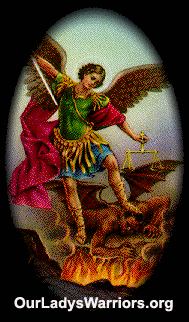
St. Michael the Archangel
~ PRAYER ~
St. Michael, the Archangel, defend us in battle
Be our protection against the wickedness
and snares of the devil;
May God rebuke him, we humbly pray,
and do thou, O Prince of the heavenly host,
by the power of God,
Cast into hell Satan and all the evil spirits
who prowl through the world seeking the ruin of souls.
Amen
+
17
posted on
04/01/2017 9:29:45 PM PDT
by
Salvation
("With God all things are possible." Matthew 19:26)
To: All
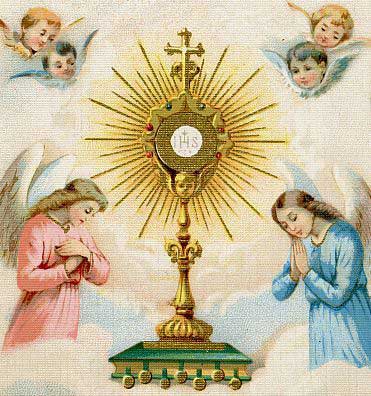
April Devotion: The Blessed Sacrament
Since the 16th century Catholic piety has assigned entire months to special devotions. The Church traditionally encouraged the month of April for increased devotion to Jesus in the Holy Eucharist. "The Church in the course of the centuries has introduced various forms of this Eucharistic worship which are ever increasing in beauty and helpfulness; as, for example, visits of devotion to the tabernacles, even every day; Benediction of the Blessed Sacrament; solemn processions, especially at the time of Eucharistic Congresses, which pass through cities and villages; and adoration of the Blessed Sacrament publicly exposed . . . These exercises of piety have brought a wonderful increase in faith and supernatural life to the Church militant upon earth and they are re-echoed to a certain extent by the Church triumphant in heaven, which sings continually a hymn of praise to God and to the Lamb 'Who was slain.'" --Pope Pius XII ACT OF ADORATION
I adore Thee, 0 Jesus, true God and true Man, here present in the Holy Eucharist, humbly kneeling before Thee and united in spirit with all the faithful on earth and all the blessed in heaven. In deepest gratitude for so great a blessing, I love Thee, my Jesus, with my whole heart, for Thou art all perfect and all worthy of love.
Give me grace nevermore in any way to offend Thee, and grant that I, being refreshed by Thy Eucharistic presence here on earth, may be found worthy to come to the enjoyment with Mary of Thine eternal and everblessed presence in heaven. Amen.
FAITH IN THE EUCHARIST
O my God, I firmly believe that Thou art really and corporally present in the Blessed Sacrament of the altar. I adore Thee here present from the very depths of my heart, and I worship Thy sacred presence with all possible humility. O my soul, what joy to have Jesus Christ always with us, and to be able to speak to Him, heart to heart, with all confidence. Grant, O Lord, that I, having adored Thy divine Majesty here on earth in this wonderful Sacrament, may be able to adore it eternally in Heaven. Amen.
FOR THE PEACE OF CHRIST
O most sacred, most loving heart of Jesus, Thou art concealed in the Holy Eucharist, and Thou beatest for us still. Now as then Thou sayest, "With desire I have desired." I worship Thee, then, with all my best love and awe, with my fervent affection, with my most subdued, most resolved will. O make my heart beat with Thy heart. Purify it of all that is earthly, all that is proud and sensual, all that is hard and cruel, of all perversity, of all disorder, of all deadness. So fill it with Thee, that neither the events of the day nor the circumstances of the time may have power to ruffle it; but that in Thy love and Thy fear it may have peace. --Cardinal Newman
ACT OF LOVE
I believe Thou art present in the Blessed Sacrament, O Jesus. I love Thee and desire Thee. Come into my heart. I embrace Thee, O never leave me. I beseech Thee, O Lord Jesus, may the burning and most sweet power of Thy love absorb my mind, that I may die through love of Thy love, who wast graciously pleased to die through love of my love. --St. Francis of Assisi
ACT OF REPARATION
Saint Margaret Mary Alacoque, well known in connection with devotion to the Sacred Herat of Jesus, led the way in making reparation to Jesus in the Blessed Sacrament for the coldness and ingratitude of men. This prayer of hers can become our own as we attempt to make amends for our own and others' neglect of the great Sacrament of His love, the Eucharist.
O kind and merciful savior, from my heart I earnestly desire to return Thee love for love. My greatest sorrow is that Thou art not loved by men, and, in particular, that my own heart is so cold, so selfish, so ungrateful. Keenly aware of my own weakness and poverty, I trust that Thy own grace will enable me to offer Thee an act of pure love. And I wish to offer Thee this act of love in reparation for the coldness and neglect that are shown to Thee in the sacrament of Thy love by Thy creatures. O Jesus, my supreme good, I love Thee, not for the sake of the reward which Thou hast promised to those who love Thee, but purely for Thyself. I love Thee above all things that can be loved, above all pleasures, and above myself and all that is not Thee, promising in the presence of heaven and earth that I will live and die purely and simply in Thy holy love, and that if to love Thee thus I must endure persecution and suffering I am completely satisfied, and I will ever say with Saint Paul: Nothing "will be able to separate us from the love of God." 0 Jesus, supreme master of all hearts, I love Thee, I adore Thee, I praise Thee, I thank Thee, because I am now all Thine own. Rule over me, and transform my soul into the likeness of Thyself, so that it may bless and glorify Thee forever in the abode of the saints.
--Saint Margaret Mary Alacoque
OFFERING
My Lord, I offer Thee myself in turn as a sacrifice of thanksgiving. Thou hast died for me, and I in turn make myself over to Thee. I am not my own. Thou hast bought me; I will by my own act and deed complete the purchase. My wish is to be separated from everything of this world; to cleanse myself simply from sin; to put away from me even what is innocent, if used for its own sake, and not for Thine. I put away reputation and honor, and influence, and power, for my praise and strength shall be in Thee. Enable me to carry out what I profess. Amen. --Cardinal Newman
Prayer Source: Prayer Book, The by Reverend John P. O'Connell, M.A., S.T.D. and Jex Martin, M.A., The Catholic Press, Inc., Chicago, Illinois, 1954

Litany of the Most Blessed Sacrament
Lord, have mercy, Lord, have mercy.
Christ, have mercy, Christ, have mercy.
Lord, have mercy, Lord, have mercy.
Christ, hear us, Christ, hear us.
Christ, graciously hear us, Christ, graciously hear us.
God the Father of Heaven, have mercy on us.
God the Son, Redeemer of the world, have mercy on us.
God, the Holy Spirit, have mercy on us.
Holy Trinity, One God, have mercy on us.
O Living Bread, Who from Heaven descended, have mercy on us.
Hidden God and Savior, have mercy on us.
Grain of the elect, have mercy on us.
Vine sprouting forth virgins, have mercy on us.
Wholesome Bread and delicacy of kings, have mercy on us.
Perpetual sacrifice, have mercy on us.
Clean oblation, have mercy on us.
Lamb without spot, have mercy on us.
Most pure feast, have mercy on us.
Food of Angels, have mercy on us.
Hidden manna, have mercy on us.
Memorial of God's wonders, have mercy on us.
Supersubstantial Bread, have mercy on us.
Word made flesh, dwelling in us, have mercy on us.
Holy Victim, have mercy on us.
O Cup of blessing, have mercy on us.
O Mystery of faith, have mercy on us.
O Most high and venerable Sacrament, have mercy on us.
O Most holy of all sacrifices, have mercy on us.
O True propitiatory Sacrifice for the living and the dead, have mercy on us.
O Heavenly antidote, by which we are preserved from sin, have mercy on us.
O stupendous miracle above all others, have mercy on us.
O most holy Commemoration of the Passison of Christ, have mercy on us.
O Gift transcending all abundance, have mercy on us.
O extraordinary memorial of Divine love, have mercy on us.
O affluence of Divine largess, have mercy on us.
O most holy and august mystery, have mercy on us.
Medicine of immortality, have mercy on us.
Awesome and life-giving Sacrament, have mercy on us.
Unbloody Sacrifice, have mercy on us.
Food and guest, have mercy on us.
Sweetest banquet at which the Angels serve, have mercy on us.
Bond of love, have mercy on us.
Offering and oblation, have mercy on us.
Spiritual sweetness tasted in its own foutain, have mercy on us.
Refreshment of holy souls, have mercy on us.
Viaticum of those dying in the Lord, have mercy on us.
Pledge of future glory, have mercy on us.
Be merciful, spare us, O Lord.
Be merciful, graciously hear us, O Lord.
From the unworthy reception of Thy Body and Blood, deliver us, O Lord.
From passions of the flesh, deliver us, O Lord.
From the concupiscence of the eyes, deliver us, O Lord.
From pride, deliver us, O Lord.
From every occasion of sin, deliver us, O Lord.
Through that desire, with which Thou desiredst to eat the Passover with Thy disciples, deliver us, O Lord.
Through that profound humility with which Thou didst wash Thy disciples' feet, deliver us, O Lord.
Through that most ardent love, with which Thou instituted this Divine Sacrament,
deliver us, O Lord.
Through the most precious Blood, which Thou hast left for us upon the altar, deliver us, O Lord.
Through those Five Wounds of Thy most holy Body, which was given up for us, deliver us, O Lord.
Sinners we are, we beseech Thee, hear us.
That Thou wouldst graciously preserve and augment the faith, reverence, and devotion in us towards this admirable Sacrament, we beseech Thee, hear us.
That Thou wouldst graciously lead us through the true confession of we beseech Thee, hear us.
our sins to a frequent reception of the Eucharist, we beseech Thee, hear us.
That Thou wouldst graciously free us from every heresy, falsehood, and blindness of the heart, we beseech Thee, hear us.
That Thou wouldst graciously impart to us the Heavenly and precious fruits of this most Holy Sacrament, we beseech Thee, hear us.
That Thou wouldst graciously protect and strengthen us in our hour of death with this Heavenly Viaticum, we beseech Thee, hear us.
O Son of God, we beseech Thee, hear us.
Lamb of God, Who taketh away the sins of the world, spare us, O Lord.
Lamb of God, Who taketh away the sins of the world, graciously hear us, O Lord.
Lamb of God, Who taketh away the sins of the world, have mercy on us, O Lord.
Christ, hear us, Christ, hear us.
Christ, graciously hear us, Christ, graciously hear us.
Lord, have mercy, Lord, have mercy.
Christ, have mercy, Christ, have mercy.
Lord, have mercy, Lord, have mercy.
Our Father . . .
Hail Mary . . .
V. Thou didst furnish them with Bread from Heaven, Alleluia.
R. Having in it every delight.
Let us pray.
O God, Who under a marvelous Sacrament has left us a memorial of Thy Passion; grant us; we beseech Thee; so to venerate the sacred mysteries of Thy Body and Blood, that we may ever perceive within us the fruit of Thy Redemption. Thou, Who livest and reignest forever and ever. Amen.
From the Manuale Sacerdotum, P. Josephus Schneider, S. J., 1867
[Catholic Caucus] Lenten Series 2015: The Blessed Eucharist
The Eucharist: Is the Real Presence Biblical?
Our Lady of the Holy Eucharist
Demons Believe and Tremble: A Reflection on the Theft of the Eucharist by Satanists
Finding My Way Home: The Eucharist drew me back [Johnnie Bernhard]
Bishop Paprocki: I Direct the Eucharist be Placed in the Center of the Sanctuary
Victory at Harvard: Satan defeated, the Eucharist enthroned (satanist reactions)
The Real Presence: The Eucharist and Chastity [Catholic/Orthodox Caucus]
The Real Presence: Faith in the Life of a Priest [Catholic/Orthodox Caucus]
The Real Presence: Eucharistic Devotion and the Real Presence [Catholic/Orthodox Caucus]
The Real Presence: The Holy Eucharist is the Whole Christ [Catholic/Orthodox Caucus]
The Real Presence: Eucharist as Presence-Sacrament [Catholic/Orthodox Caucus]
The Real Presence: Understanding the Eucharist, The Greatest Need in Church Today [Catholic/Orthodox Caucus'
The Real Presence: Living in the Presence of God [Catholic/Orthodox Caucus]
The Real Presence: The Sacred Heart Is The Holy Eucharist [Catholic/Orthodox Caucus]
The Real Presence: The Eucharist as the Living Christ [Catholic/Orthodox Caucus]
The Real Presence: Christ in the Eucharist, Introduction to the Eucharist,[Catholic/Orthodox Caucus]
The Real Presence: Christ in the Eucharist, The Last Supper, [Catholic/Orthodox Caucus]
The Eucharist: Foundation of the Christian Family(Catholic/Orthodox Caucus)
A Beautiful Summary of Eucharistic theology in an antiphon by Aquinas
Christ in the Eucharist (Ecumenical)
Canon Law and Consecrating the Eucharist (Catholic Caucus)
COMMUNION THROUGH A FEEDING TUBE (And More on Confirmations)
The Eucharist -- John 6
Catholicism and Fundamentalism - The Eucharist
On the Giving and Receiving of Holy Communion: Some norms to recall [Catholic Caucus]
Catholic Word of the Day: HOLY COMMUNION, 05-19-12
Following the Truth: Recognizing Jesus In The Eucharist [Catholic Caucus]
The Fourth Cup
The Last Supper and the Forgiveness of Sins
Bread from Heaven: The Eucharist Sustains Us and Lifts Us Up [Catholic Caucus]
Essays for Lent: The Eucharist
Essays for Lent: The Mass
Excerpt from: The Didache (The Teaching of the Twelve Apostles) [Catholic/Orthodox Caucus]
Divorced Catholics and the Eucharist
Following The Truth: So, You Just Received Jesus...Now What? (Catholic or Open)
The Coptic Orthodox doctrine of the Eucharistic sacrifice
Auxiliary Bishop Says Communion In the Hand is a Calvinist Novelty [Ecumenical]
How Something We Consider Solidly Traditional was Once Thought Progressive (Catholic)
Transubsta ntiation: Change We Can Believe In
Diocese limits Communion under both kinds, laments excessive extraordinary ministers
Phoenix Diocese to adopt new norms for Holy Communion [Catholic Caucus]
What Does GIRM 160 for the USA Really Say?
Lift the City - a Catholic Eucharistic flash mob (Catholic Caucus)
Justin Martyr: 1st apology: Sacraments, Eucharist {Catholic/Orthodox caucus}
The Institution of the Eucharist in Scripture [Catholic Caucus]
How the Mass is a sacrifice, and why so many deny this doctrine (Catholic/Orthodox Caucus)
[Ecumenical] Lent through Eastertide - Divine Mercy Diary Exerpts: Holy Communion and the Eucharist
Vatican consultant responds to Cardinal Mahoney 'Christ gave Judas communion' argument
New book connects the Eucharist with its Jewish roots
THE SACRAMENT OF THE EUCHARIST (sections 3 only) {Ecumenical Thread}
THE SACRAMENT OF THE EUCHARIST (sections 1&2 only) {Ecumenical Thread}
The Perfect Sacrifice: When Heaven Comes to Earth [Catholic Caucus]
The Real Presence [Church Fathers on the Holy Eucharist, cont'd ]
Is the Mass a Sacrifice? (Once and for all, Heb 9-10) {Catholic/Orthodox Caucus}
Radio Replies Second Volume - Holy Communion
The Real presence of Christ in the Eucharist {Catholic/Orthodox Caucus}
Radio Replies Second Volume - The Sacrifice of the Mass
Radio Replies Second Volume - Holy Eucharist
How Do We Prepare Well for the Coming of the Lord
Thanksgiving, the Prophets and the Eucharist
[CATHOLIC CAUCUS] The Pope of a Eucharistic Springtime
Lex Orandi, Lex Credendi, Lex Vivendi. As we Worship, So we Believe, So we Live
[CATHOLIC/ ORTHODOX CAUCUS] 5th Luminous Mystery: Institution of the Eucharist (Patristic Rosary)
Wounded in the house of them that loved Me
[CATHOLIC / ORTHODOX CAUCUS] Eucharist is Jesus' greatest gift to us, teaches Pope Benedict XVI
[CATHOLIC CAUCUS] What makes Jesus present in the Eucharist: broadening one's view.
The Catholic Mass in 155 A.D.
Pope's Q--A at End of Priestly Year Pt 4 "We Celebrate,..Meditate..on Eucharist" [Catholic Caucus]
Sacrifice, Transubstantiation, and Real Presence (Pope Benedict XVI) [Catholic Caucus]
Catholic Caucus: Eucharist is the Heart of God
[CATHOLIC CAUCUS]'Body, Blood, Soul and Divinity': The Miracle and Gift of the Most Holy Eucharist
A Secular Eucharist
Paul and the Eucharist
Centered in the Eucharist
Centered in the Eucharist
Who Can Receive Communion? (Catholic Caucus)
Respect For Christ In The Eucharist - One Priest's Perspective
From The Gospel To Life: The Disciples and the Eucharist
Catholic Biblical Apologetics: Opportunities of Grace: The Eucharist: The Lord's Supper
THE PRIEST IN THE COMMUNION RITES - Liturgy Prepares for Reception of the Eucharist
Novena with Saint Peter Julian Eymard for Prayer in the Presence of the Blessed Sacrament [Prayer]
Boston Cardinal: Church Needs 'Clear' Injunction Denying Pro-Abortion Pols Communion
Benedict XVI calls priests to protect communion between God and man
Eucharist: Holy Sacrifice
Fr. Men: The Eucharist [Cath-Orth caucus]
Catholics in Costa Rica outraged by disrespect toward Eucharist [Catholic Caucus]
The Institution of the Eucharist in Scripture
St Anthony and the Real Presence
The Essentials of the Catholic Faith, Part Two: Channels of Grace: The Eucharist
EWTN - October 29 - 8PM - Fr. Antoine and the Eucharist
All Should Offer Their Bodies and Blood at Mass (Father Cantalamessa) [Catholic Caucus]
The Role of the Bishop of Rome in the Communion of the Church in the First Millennium
Radio Replies First Volume - Holy Eucharist
The Institution of the Eucharist in Scripture
Catholic Caucus: The Spiritual Combat Ch 54. MANNER IN WHICH WE OUGHT TO RECEIVE...BLESSED SACRAMENT
Catholic Caucus: The Spiritual Combat: Ch 53. CONCERNING THE MOST HOLY SACRAMENT OF THE EUCHARIST
A Few Texts From Saint Cyril of Jerusalem on the Eucharist
Catholic Devotional: On Visiting Jesus Christ In the Blessed Sacrament
The Early Christians Believed in the Real Presence of Christ in the Eucharist
Focus on the Real Presence
A Chinese Girl-True Story That Inspired Bishop Fulton Sheen- Eucharist Adoration (Catholic Caucus)
Doubting Thomases(Eucharist); the Pitfalls of Folly(Catholic Caucus)
Rainbow sash-wearers prohibited from receiving [the Eucharist at Cathedral of St. Paul]
The significance of Holy Thursday (institution of the Eucharist and priesthood)
Our Lady of the Most Blessed Sacrament [Catholic Caucus]
The Catechism of St. Thomas Aquinas THE HOLY EUCHARIST
Holy Communion and Non-Catholics (with a Quiz!)
Beginning Catholic: The Eucharist: In the Presence of the Lord Himself [Ecumenical]
Beginning Catholic: Receiving the Lord in Holy Communion [Ecumenical]
Faithful Invited to Follow Pope, Adore Eucharist [Catholic Caucus]
Christmas and the Eucharist(Catholic/Orthodox Caucus)
Eucharist kneeling request sparks controversy [Catholic Caucus]
Eucharist vs. the Word (which is more important in the Catholic Church)
Christ the Miracle Worker in the Eucharist(Catholic Caucus)
Imitating Christ in the Eucharist(Catholic Caucus)
The Eucharist - the Lord's Sacrifice, Banquet and Presence (OPEN)
Pope Calls Eucharist History's Greatest Revolution [OPEN]
A Brief Catechism for Adults - Lesson 22: The Sacrament of the Holy Eucharist (Holy Communion)
A series of reflections from St. Peter Julian Eymard Blessed Sacrament(Catholic Caucus)
Eucharist, Holy Meal
Imitating Christ in the Eucharist
Christmas and the Eucharist
Prayer Before the Blessed Sacrament
This is My Body, This is My Blood
THE HOLY EUCHARIST IS THE WHOLE CHRIST
Gift Of Life, Gift Eternal: The Most Holy Eucharist and the Holy Sacrifice of the Mass
Area worshipers march to celebrate Holy Eucharist
Grace of the Eucharist is secret to holy priests, says Pope
The Disposition of Priests [Valid Mass, Valid Holy Eucharist?]
The Body of Christ?
Holy Sacrifice, Living Sacrament
Knights of the Eucharist
The Banquet of Corpus Christi - "Why did Jesus give us His Body and Blood?"
The Eucharist: Eternity and Time Together
Restored Order of the Sacraments of Initiation? Confirmation and First Eucharist together? (Vanity)
Reflection s of Cardinal Ratzinger on the Eucharist
THE HOLY EUCHARIST: NOURISHMENT TO FINISH OUR COURSE
The Eucharist in Scripture - Part 1 - Old Testament
LITANY OF REPARATION TO OUR LORD IN THE BLESSED SACRAMENT
Benedictio n of the Blessed Sacrament
POPE GRANTS PLENARY INDULGENCE FOR YEAR OF THE EUCHARIST
New Plenary Indulgence to Mark Year of the Eucharist
Kneeling and Faith in the Eucharist
The Immaculate Conception and the Eucharist, a course in Christian culture in Tashkent
The Year of the Eucharist by Bishop Donald Wuerl
"While We're At It": What can we do to show that the Eucharist is a communal activity?
CATHOLICS AND ....... WITNESSED UNUSUAL IMAGES IN BLESSED SACRAMENT
The Discipline of the Eucharist Holy See Releases Redemptionis Sacramentum...
Vatican: Matters to be observed or to be avoided regarding the Most Holy Eucharist (April 23, 2004)
Devotion to the Holy Eucharist Advances Devotion to Jesus' Person
New rules on the Holy Eucharist on Holy Thursday
The Reverence due to the Holy Eucharist
The Holy Face of Jesus Christ as appeared on the Holy Eucharist
The Fourth Cup: The Sacrament of the Eucharist [Holy Thursday] [Passover]
Holy Father stresses Need of Devotion to Holy Eucharist outside of Mass: Pope Paul VI
18
posted on
04/01/2017 9:30:41 PM PDT
by
Salvation
("With God all things are possible." Matthew 19:26)
To: All
April, 2017
Pope's Intention
Young People, That young people may respond generously to their vocations and seriously consider offering themselves to God in the priesthood or consecrated life.
19
posted on
04/01/2017 9:31:13 PM PDT
by
Salvation
("With God all things are possible." Matthew 19:26)
To: All
Daily Gospel Commentary
Fifth Sunday of Lent
Commentary of the day Saint John Damascene (c.675-749), monk, theologian, Doctor of the Church
Triodion of matins for the Saturday of Lazarus, Odes 6-9“ And Jesus wept. So the Jews said : See how he loved him ”
O Lord, since you are true God you knew about Lazarus's sleep and had made it known to your disciples... Since you are true man, who nevertheless are without limit, you came to Bethany. True man, you wept upon Lazarus; true God, you raised, by your will, this man who had been dead for four days. O Lord, have mercy on me too; my sins are numerous. I beg you, come, pull me out of the abyss of evil. It is to you that I cry; listen to my prayer, God of my salvation.
After weeping for your friend, in your compassion you put an end to Martha's tears, and through your voluntary Passion you wipe away the tears from all faces (Is 25:8). “Blessed be the Lord, the God of our Fathers” (Ezr 7:27). You, the guardian of life, cried out to the dead man as if he were sleeping. With a word you tore open the belly of hell and raised him who then began to sing: “Blessed be the Lord, the God of my Fathers”. Raise me up too, I who am strangled by the ties of my sins, and I will then sing to you: “Blessed be the Lord, the God of our Fathers”...
In her gratitude, Mary brings you, O Lord, a pound of costly perfumed oil as a due for her brother (Jn 12:3) and she sings to you forever and ever. As mortal you pray the Father, as God you awaken Lazarus. This is why we sing to you, O Christ, forever and ever... You awaken Lazarus, a man dead for four days, you raise him from his tomb, making of him a true witness of your resurrection on the third day. You walk, you weep, you talk, O my Savior, showing us your human nature; but by raising Lazarus you reveal to us your divine nature. In such an unparallelled way as this, O Lord my Saviour, by your two natures and with sovereign power you accomplished my salvation.
20
posted on
04/01/2017 9:33:49 PM PDT
by
Salvation
("With God all things are possible." Matthew 19:26)
Navigation: use the links below to view more comments.
first 1-20, 21-40, 41-48 next last
Disclaimer:
Opinions posted on Free Republic are those of the individual
posters and do not necessarily represent the opinion of Free Republic or its
management. All materials posted herein are protected by copyright law and the
exemption for fair use of copyrighted works.
FreeRepublic.com is powered by software copyright 2000-2008 John Robinson