Posted on 11/02/2016 8:48:11 AM PDT by Salvation
Some years ago it was popular to say of television, “It’s not the medium, it’s the message.” This was in answer to critics who claimed that watching it “rotted the brain.” The retort was that there was nothing wrong with the medium (television) per se, but with the message (vapid sitcoms, etc.). Television could be used to great ends if the message was right.
While television can be used to broadcast good material, there is significant evidence that watching it is in fact deleterious, especially for more than an hour a day. The flickering screen, with the picture angle that changes every eight seconds or so (according to an industry guideline), is devastating to the attention span of the viewer. The fact that it is a purely passive medium, used more often to entertain than to teach, does not help either. At least with radio, the imagination is engaged. No so with television, which supplies just about everything to the passive viewer. None of this helps us or prepares us for true human interaction, in which changing the channel is not an option, entertainment is not always the goal, and the viewing angle isn’t constantly changing. Most teachers will tell you that the average attention span of today’s youth seems to be dismally short.
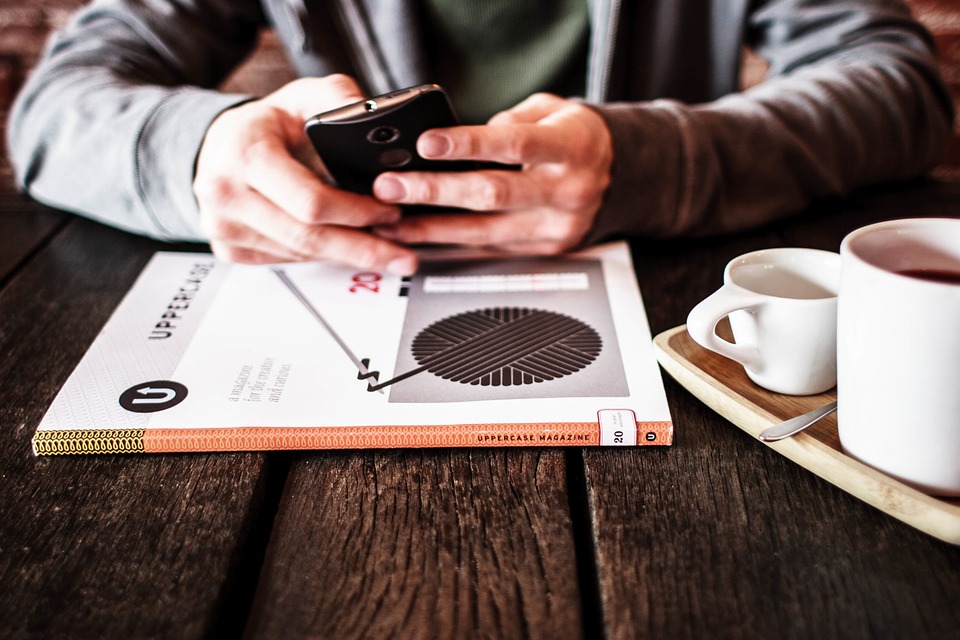
And now we have added to the mix our cell phone screens and earbuds. The tune-out from real relationships has deepened, attention spans are even shorter, and a kind of particularism has set in wherein I reject you or tune you out because you aren’t exactly what I want right now. Forget reality, bring on the virtual reality!
We see it everywhere:
In a thoughtful article published in First Things, Patricia Snow writes about the effects on high school and college students of extended immersion in cell phones (and other devices). I want to take up her call: “Look at me!” She begins by describing the problem and its symptoms:
Inevitably, in some of our young people especially, we are reaping deficits in emotional intelligence and empathy; loneliness, but also fears of unrehearsed conversations and intimacy; difficulties forming attachments but also difficulties tolerating solitude and boredom. … The teachers tell … that their students don’t make eye contact or read body language, have trouble listening, and don’t seem interested in each other, all markers of autism spectrum disorder. … Students are so caught up in their phones, one teacher says, “they don’t know how to pay attention to class or to themselves or to another person or to look in each other’s eyes and see what is going on.” Another says uneasily, “It is as though they all have some signs of being on an Asperger’s spectrum …. [Yet] we are talking about a school wide problem.”
That’s right, the effects of becoming lost in our devices lead to semi-permanent problems and symptoms we usually attribute to autism spectrum disorders. This affects not only human conversation, but even more so the conversation with God that we call prayer. Snow writes,
For all the current concern about technology’s effects on human relationships, little or nothing is being said about its effects on man’s relationship with God. If human conversations are endangered, what of prayer, a conversation like no other? All of the qualities that human conversation requires—patience and commitment, an ability to listen and a tolerance for aridity—prayer requires in greater measure. Yes, here is the one conversation Satan most wants to end.
So here is the problem: there is an increasing loss in our ability to relate to other people and to God. The virtual is prized over the real, fantasy over reality. What God actually offers us is dismissed as of lesser value and we become more deeply locked in our own little world. It is a perfect recipe for Hell since it also describes it: turned in on oneself and away from God and others.
What is the way out of this descent into a self-enclosed virtual world?
Simply put, the solution is in the eyes. Ms. Snow details one therapeutic approach in the treatment of autism as follows:
In the protocols developed by Ivar Lovaas for treating autism spectrum disorder, every discrete trial in the therapy, every drill, every interaction with the child, however seemingly innocuous, is prefaced by this clear command: “Look at me!” If absence of relationship is a defining feature of autism, connecting with the child is both the means and the whole goal of the therapy. … Eye contact—which we know is essential for brain development, emotional stability, and social fluency—is the indispensable prerequisite of the therapy, the sine qua non of everything that happens …. There are no shortcuts to this method; no medications or apps to speed things up; no machines that can do the work for us. This is work that only human beings can do, with their human eyes and human voices …. In this work of restoration, the child’s gaze comes back first. In intermediate, breakthrough moments, she greets her father when he comes home from work, and calls her mother for the first time ever in the night.
There is a need for all of us to have extended “unplugged” time, time spent with no phones or screens. Power the devices down or put them away. Leave the virtual world and re-enter the real world. Look one another in the eye and have conversations. Eat dinner with your family; sit in the living room together and just talk.
Most cell phones have a feature (sometimes called sleep or do-not-disturb mode) that silences the phone unless a call comes in from someone on a defined list. This permits calls from close family members to get through, but nothing else. I set my phone in this mode from 10:00 PM until 9:00 AM. During this time, I take no calls or texts; I’m unplugged.
Eye contact is so important! Really looking at the people in your life is essential for wholeness and holiness. To us who are collectively straying into these autistic manifestations, the cry must go up, “Look at me!” This is a summons to the person inside, too often lost in his device or listening through his earbuds, to look up and out. The summons is tied to the concept of human respect. The word “respect” means literally “to look again” (re + spectare).
Consider well what you must do, lest you get lost inward. Our life cannot merely revolve around the device screen. It isn’t just the message that can harm us; it’s the medium as well. We were made by God for relationships—true personal relationships, not just virtual ones. Our relationships with one another are meant to enrich and complete us. And how much worse it is if our relationship with God fails. The very purpose of our life is to be related to God to an ever-greater degree, and one day to be perfectly united to Him. It is, of course, Satan’s dream to sabotage our relationships on every level.
Consider these questions:
I suspect that the answers to questions like these will vary quite a bit with age. But to some extent, the concerns expressed here affect us all.
Give some serious thought to what our devices have done to us personally and collectively. Relationships and their quality matter a great deal. The most important things in life aren’t things at all. Yes, “Look at me” is a powerful and necessary corrective. Our eyes are too easily fixed on what mesmerizes us, rather than on what heals us, challenges us, and helps us to become more whole, more complete, more holy, and more human.
Look at me!
Monsignor Pope Ping!
My ex used that damn thing non-stop and it was a great enabler of her serial cheating.
I almost never touch my cell.
I don’t watch conventional TV, just a few shows on the Internet... “Game of Thrones” and “The Walking Dead”. I do the video game thing, though, because that is interactive and requires thought (mostly games requiring strategy).
I find it preferable to hanging out with people, because face it, it seems like most people today are toxic. I may not be perfect either, but at least I’m not busy trying to impose my imperfections on other people.
I was at the doctor’s office last week. While in the lobby I noticed over three quarters of the people there were playing with their smart phones.
I was the only one reading a real BOOK. I love to read. I would rather read a good OLD book than watch TV.
I have a desktop and a simple dumb flip phone; can’t get “lost” in either.
Great post! Thanks. I say I used to get up and pray and meditate. Now I get up make my coffee and get on the internet. Been working hard later to reach for prayer and meditation first as well as reading spiritual food as well. In a book. Not on the Internet. ;D
Yes. Although I download A LOT of Kindle books. I have been forcing myself to purchase certain books in paper. Reading a book is a joyous, very fulfilling activity. ;D
Anticipating your next text on a cell phone activates the same part of the brain as heroin or food or sex, studies have shown.
You get hits of dopamine and serotonin.
I think the worst part is missing out on life due to a machine and the LIVE interaction with humans that you miss out on.
Not to mention You NEVER have to wait for anything anymore. A call. A TV show. A movie.
The virtue of patience takes a hit with all these toys.
After the Weiner fiasco, “device” should be struck from the dictionary.
I can’t remember the last time I called someone on my cell. At least a year ago. I use it so little the company gave me a year of free service. Of course, they’ve made a nice profit off me on the years before and after.
Article too long. Boring.
“Eye contact—which we know is essential for brain development, emotional stability, and social fluency—”
It is?
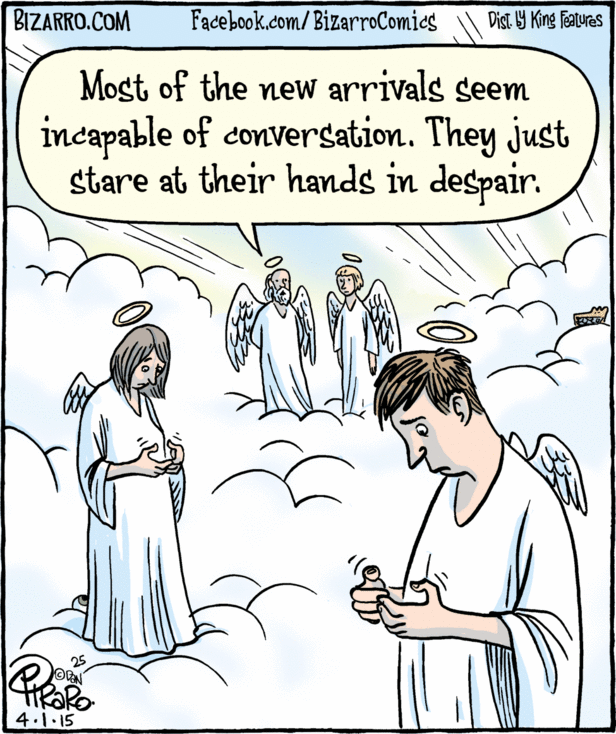
If kids are on their phones in class, at family gatherings, etc, then it’s the fault of the adults who are failing to set and enforce the rules. It’s also a failure of their parents to teach the children to behave without that crutch.
Guarantee if a teacher says “I will confiscate the first phone I see being used and return it to you at the end of the school year” and actually enforces that rule once, they won’t have to do it again.
One of the saddest things I have seen while shopping were a mom, dad and teen age son, all walking down the street looking at their cell phones.
Where was the parent-child relationship there?
Gone..............................
It’s not the object, it’s how it’s used. It can be used for good or for bad.
Wholeheartedly agree.
That is sad.
It’s affected everyone.
Sometimes I say something to my wife while we are watching TV (already 1 strike!) and she is so immersed in reading the tablet that she doesn’t hear me. Boy dod I get mad :)
The kids in the family can’t let go of them for a minute.
It’s an addiction, I believe. And it’s not making us smarter or closer. Just the opposite.
Well, we are social creatures, and eye contact is a key component of social interaction. Autistic people, and to a lesser extent, introverts, tend to avoid eye contact, and both of those groups have trouble either judging other people’s emotions or connecting with other people socially. I don’t think that is a coincidence.
Ray Bradbury's The Murderer from 1953. The video is from a 1980s TV adaptation.
Disclaimer: Opinions posted on Free Republic are those of the individual posters and do not necessarily represent the opinion of Free Republic or its management. All materials posted herein are protected by copyright law and the exemption for fair use of copyrighted works.