Posted on 08/09/2016 7:40:51 AM PDT by Salvation
There been much tension regarding the Mass as both a meal and a sacrifice. A necessary corrective was introduced in the past twenty years to rectify the overly strong emphasis, heavily advanced during the 1970s and 1980s, on the Mass as a meal. The purpose of the corrective was to bring back needed balance with the root of the Mass: the cross and the overall paschal mystery.
While we cannot dismiss the idea of the Mass as a meal, we must understand what sort of meal it is. When most people today hear the word “meal,” they do not think of a holy banquet or wedding feast, but more of an informal meal. And informality in American culture has become very informal indeed! We rarely dress up anymore; formal banquets, black-tie dinners, and the like are rare.
Thus our understanding of the Mass as a meal is colored by our culture’s informal definition, which is not intended in the Church’s understanding of the Mass. Permit, then, some of the following correctives:
I. The Mass is a meal, but it is no ordinary meal. The Mass is a sacred meal or banquet (Sacrum Convivium) and also the great Wedding Feast of the Lamb, for which one should be properly clothed (see Rev 19:6-9; Matt 22:12-13). This meal is not an informal one; it is a great banquet that should be esteemed and for which one should be prepared.
There are many people today who emphasize the “table fellowship” that Jesus had with sinners. They argue the Eucharist should be open to all, Catholic or not, saint or (even the worst) sinner. It is true that Jesus was often found at the table with sinners, where He ate with them.
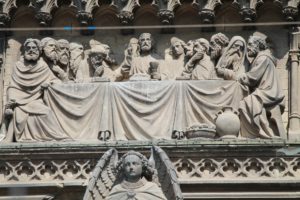
But the Last Supper, at which the Eucharist was first given, was not just any meal; it was a Passover meal. The Passover meal was not an open one; it was a family meal and one rooted in the Jewish faith. People were instructed to celebrate this meal with their own families. And while several smaller or poorer families could come together for the meal, that was the exception rather than the norm.
Hence, the Last Supper is not to be compared to the open “table fellowship” Jesus had with sinners. Only the Apostles were formally gathered for the Last Supper.
So, to the extent that we can speak of the Mass as a meal, it is not an ordinary one with a “come-one, come-all” and/or “come as you are” mentality. It is not informal. It is a sacred meal that should be received worthily, celebrated with reverence, and which is integrally linked to the sacrifice of Jesus Christ on the cross.
Joseph Cardinal Ratzinger wrote substantially on this topic back in the late 1990s, and I presented and reflected on his writings here: Worthy Reception.
II. The Mass is not a reenactment of the Last Supper. It surely includes aspects of the Last Supper (most crucially the words of Institution of the Blessed Sacrament of the Eucharist).
But these aspects of the Last Supper are summarized and referenced, not reenacted. If it were truly a reenactment, then when the priest says that Jesus gave thanks, blessed and broke the bread, and gave it to them saying, “This is my body …”, he should send the host around immediately. And then when he takes the chalice and utters the words of consecration, he should tell all the people to drink from it immediately.
A literal reenactment might also require that we all recline on the floor on our left elbows at low, U-shaped tables. The Last Supper was not served at a modern, American-looking table, or even at one as Da Vinci imagined it. And perhaps the priest should recite the lengthy, priestly prayer of Jesus at the Last Supper, as recorded in John’s Gospel. Maybe a foot-washing should take place at every Mass. But even if we don’t absolutize the notion of reenactment, the point remains that the Mass is not a re-staging of the Last Supper.
Even at the Last Supper, in giving us the words of consecration Jesus points beyond the Last Supper itself. He says of the Bread, “This is my Body, which will be given up for you.” Thus He points beyond the meal to the cross. He says of the wine in the chalice, “This is the cup of my Blood, the Blood of the new and eternal Covenant, which will be shed for you and for many …” Here, too, He points beyond the meal itself to the cross.
Hence, while the connection of the Mass to the Last Supper is clear, it is not the only or even most important connection. The meal itself points to the sacrifice of Christ on the cross. And since at Communion we receive a living Lord (not a piece of dead flesh), the Mass also points to the resurrection.
III. When the priest speaks the words of Consecration at Mass, he is not addressing the congregation. This is another common point of confusion today. Not only is the Mass not a mere reenactment of the Last Supper, even when the priest speaks the words of Consecration at Mass, he is not addressing the congregation. These words, like all the words of the Eucharistic prayer, are directed to the Heavenly Father. They serve as a kind of basis and context for our sacrifice. When saying these words, the priest is speaking in the person of Christ and indicating that this act of our worship, as members of the Body of Christ, is united to the once-for-all, perfect sacrifice of Jesus on the Cross.
The essential point is that the words are directed to the Father. For a priest to gaze intently at the congregation and/or show the bread dramatically as he says the words of Consecration is to send the wrong signal, because it is not the people who are being addressed.
In the rubrics, the priest is directed to bow a little (parum se inclinat) as he says the words. He is not to be like an actor on a stage reenacting the Last Supper with all sorts of gestures and engagement of the faithful as if they were the Apostles. He is to bow as he speaks to the heavenly Father of what Jesus did and said in the institution of the Eucharist.
To reiterate, the entire Eucharistic Prayer is addressed to the Heavenly Father. Thus we are not “pretending” or reenacting the meal that was the Last Supper.
IV. What most makes the Mass a meal is the food that we receive. The food we receive is Jesus the Lord, who feeds us with His Body and Blood, Soul and Divinity. O sacrum convivium in quo Christus sumitur! (O Sacred Banquet in which Christ is received!) It is not necessary or even essential to engage in theatrics or to insist that the altar look like a simple, modern meal table (though noble simplicity has its place).
Thus the Mass is truly a meal as well as a sacrifice. But we must understand that the meaning of the word “meal” in the context of the Mass is distinct from some of our modern notions. It is a formal, sacred, exclusive meal for those of the household of faith who are in a state of grace. Proper attire and formality should be balanced with noble simplicity. And although the Last Supper is surely integral to the Mass, it is not merely reenacted; it is taken up in its essence (not merely in its external aspects), which points to the cross.
From that link: The practice of indiscriminately presenting oneself to receive Holy Communion, merely as a consequence of being present at Mass, is an abuse that must be corrected (Joseph Cardinal Ratzinger, 2004).
Monsignor Pope Ping!
Soul food. duh.
The Lord's supper is nowhere described as a sacrifice for sin in the life of the NT church in Scripture. While Catholics claim to take the words at the last supper literally, "Take, eat; this is my body. And he took the cup, and gave thanks, and gave it to them, saying, Drink ye all of it; For this is my blood of the new testament, which is shed for many for the remission of sins," (Matthew 26:26-28) the incarnated body of the Lord Jesus which He sacrificed was not some body which did not look like, and would taste and scientifically test as real flesh, as Catholicism's "real," but it was one which manifestly, really actually was flesh (which I am sure even His resurrected body would test as), and thus which was a proper Biblical sacrifice.
That substance changes while appearance remains unchanged is contrary to the incarnation and the miracles the Lord did such in healing and changing water into wine, and instead it is a product of foreign (Greek) philosophy.
A necessary corrective was introduced in the past twenty years to rectify the overly strong emphasis, heavily advanced during the 1970s and 1980s, on the Mass as a meal. Which is just what Scripture describes it as. Nowhere is this feeding in the "feast of charity" (These are spots in your feasts of charity, when they feast with you, feeding themselves without fear: (Jude 1:12) described as a wafer of bread and sip of wine, which would hardly befit the censure of Paul that some were drunken and others were hungry, and which thus was to "shame them which have not." (1Co. 11:22) The believers were not to come hungry if they had houses to eat in, but it was a meal nonetheless.
Faced with the utter absence of any manifest description of the Lord's supper in the life of the church (besides Jude 1:12) except in one epistle (above, and in which the "body" which was not discerned was contextually the church), which absence is contrary to the Eucharistic-centricism of Catholicism, Catholics are compelled to describe the mention of breaking of bread in Acts as being the Lord's supper, yet this also hardly describes the Catholic wafer/sip ritual, and also lacks any description of any functional sacerdotal priesthood in so doing.
Permit, then, some of the following correctives:
Correctives? One what basis It cannot be Scripture, which must be abused in order to support such "correctives."
The Mass is a meal, but it is no ordinary meal. The Mass is a sacred meal or banquet (Sacrum Convivium) and also the great Wedding Feast of the Lamb, for which one should be properly clothed (see Rev 19:6-9; Matt 22:12-13).
Which is simply wresting Scripture to support what Catholics read into it. The Wedding Feast of the Lamb is not the Lords supper, which is to be practiced until the Lord comes, and the proper clothing refers to spiritual "attire," not physical.
There are many people today who emphasize the “table fellowship” that Jesus had with sinners. They argue the Eucharist should be open to all,
Which error does not support the opposite error, that of focusing on the elements consumed at the Lord's supper, not remembering/showing the Lord's death for the church by sharing food with those whom He died for, treating them as such, which neglect of this body was the error of the Corinthians which Paul corrected.
This does not translate into the Lord's supper being an ordinary meal, but neither does it translate into being a solemn ritual officiated by sacerdotal priests turning bead and wine into a sacrifice for sins, to be consumed in order to obtain essential spiritual life. Which is nowhere seen in the Lord of the NT church, which is interpretive of the gospels.
But the Last Supper, at which the Eucharist was first given, was not just any meal; it was a Passover meal.
Although Ratzinger argues that "John goes to great lengths to indicate that the Last Supper was not a Passover meal...at the time of the trial the Passover meal had not yet taken place..." (Pope Benedict XVI; http://catholiclane.com/dating-the-last-supper-excerpt-from-jesus-of-nazareth-part-2-by-joseph-ratzinger/)
The Mass is not a reenactment of the Last Supper
Indeed, it is a product foreign to Scripture.
He says of the Bread, “This is my Body, which will be given up for you.” ...at Communion we receive a living Lord
Which again, to be taken literally which Catholics boast they take it as, would mean that it is the same manifest corporeal flesh of the incarceration, not some sort of phantom which appears and would scientifically test as being mere bread and wine.
When the priest speaks the words of Consecration at Mass, he is not addressing the congregation...the words of Consecration at Mass, he is not addressing the congregation. These words, like all the words of the Eucharistic prayer, are directed to the Heavenly Father. They serve as a kind of basis and context for our sacrifice. When saying these words, the priest is speaking in the person of Christ
In addition to the FACT that there simply is no separate class of believers distinctively called "priests," the Lord was indeed addressing the congregation in saying "take, eat..." He certainly was not telling His Father this.
we are not “pretending” or reenacting the meal that was the Last Supper.
Instead, Catholicism is pretending to take the Lord's words, "This is my Body, which will be given up for you" as literal, but in reality this crucified body they presume they consume was one that does not look like, and would taste and scientifically test as real flesh, but is as "real" as Gnostic Christ. Meanwhile only the metaphorical understanding easily conflates with the totality of Scripture, as shown here by the grace of God.
Golly; I wonder WHY??
Disclaimer: Opinions posted on Free Republic are those of the individual posters and do not necessarily represent the opinion of Free Republic or its management. All materials posted herein are protected by copyright law and the exemption for fair use of copyrighted works.